.jpg)
Data should make decisions easier. For many enterprises, it does the opposite. When one dashboard shows growth while another shows decline, leadership meetings become debates over whose numbers are correct instead of discussions about what to do next.
An enterprise data warehouse (EDW) helps solve this problem by bringing structured, validated, and historical data into a single, trusted repository for analytics, reporting, and decision-making.
According to the Business Research Company’s Data Warehousing Market Report 2026, the global data warehousing market is projected to grow from USD 37.42 billion in 2025 to USD 68.15 billion by 2029, highlighting continued enterprise investment in trusted analytics platforms.
This guide explains what an enterprise data warehouse is, how it differs from a traditional data warehouse, data lakes, and data lakehouses, how its architecture and governance support enterprise analytics, and what to consider when planning an EDW strategy for modern data environments.
What is an enterprise data warehouse (EDW)?
An enterprise data warehouse centralizes data from across an organization into a single, trusted source for analytics and reporting. It stores structured, historical data optimized for business intelligence, performance, and governance.
This architecture integrates multiple systems, enforces security and compliance, and supports scalable querying for large enterprises. Modern enterprise data warehouses increasingly use cloud platforms to improve flexibility, cost control, and performance while enabling reliable, analytics-ready insights across the business.
Organizations evaluating deployment options can also compare leading cloud data warehouse solutions to understand how today's platforms differ in architecture, scalability, and pricing.
EDW vs data warehouse: What makes it "enterprise"?
Although the terms are often used interchangeably, an enterprise data warehouse (EDW) is a specific type of data warehouse designed to support the entire organization. The distinction lies in scope, governance, and integration rather than the underlying technology.
A traditional data warehouse may consolidate data for a single department or business function. An EDW integrates data across multiple business domains, applies common business definitions, and provides governed access to trusted information for enterprise-wide reporting and analytics.
|
Dimension |
Data warehouse |
Enterprise data warehouse (EDW) |
|
Scope |
Individual department or business unit |
Entire organization |
|
Source systems |
Limited set of related systems |
Multiple enterprise systems including ERP, CRM, SaaS, operational databases, and external sources |
|
Business definitions |
Department-specific |
Standardized and governed across business domains |
|
Data model |
Supports local reporting needs |
Uses enterprise-wide models with conformed dimensions |
|
Governance |
Basic access controls |
Enterprise governance, lineage, metadata, auditing, and stewardship |
|
Ownership |
Individual business or IT team |
Central data platform with domain ownership |
|
Primary use |
Team-level reporting |
Enterprise analytics, executive reporting, compliance, and AI |
We'll also encounter the abbreviations DW, DWH, and EDW. DW and DWH generally refer to a data warehouse and may describe either departmental or enterprise implementations. EDW specifically refers to an enterprise-wide warehouse that integrates governed data from across the organization.
It's also important to distinguish an EDW from a data mart. A data mart supports a specific business function, such as finance or marketing, and is typically derived from the enterprise data warehouse so departments can work from consistent, trusted business definitions.
EDW vs data lake: Structured vs raw data handling
An enterprise data warehouse is built for trust and consistency. It stores structured, curated data that has been cleaned, validated, and modeled before it is made available for analytics. Using a schema-on-write approach, an EDW delivers reliable reporting, predictable query performance, and governed business insights.
A data lake, by contrast, prioritizes flexibility. It stores raw, semi-structured, and unstructured data with minimal transformation, applying schemas only when the data is queried. This makes it well suited for data exploration, machine learning, and large-scale data science workloads.
This difference shapes how each system is used in practice. EDWs emphasize governance, accuracy, and high-performance SQL and OLAP analytics, while data lakes prioritize scalability and experimentation.
The broader data warehouse vs data lake comparison also extends to architecture, governance, performance, and analytics use cases, making each platform better suited for different enterprise requirements.
Why organizations use an enterprise data warehouse
Organizations invest in an enterprise data warehouse to create a trusted foundation for analytics as data volumes, users, and systems continue to grow. By integrating data across the business, an EDW helps eliminate inconsistent reporting and supports faster, more confident decision-making.
Key benefits include:
-
A single source of truth for consistent business metrics across departments.
-
Historical, analytics-ready data for trend analysis, forecasting, and executive reporting.
-
High-performance analytics optimized for complex SQL and OLAP workloads.
-
Enterprise-scale governance through metadata, lineage, access controls, and auditing.
-
Regulatory compliance for industries with strict security and reporting requirements.
Did you know? According to Gartner's 2024 press release, 90% of organizations are expected to adopt hybrid cloud architectures through 2027, reflecting how enterprise data warehouses increasingly operate across cloud and hybrid environments rather than purely on-premises infrastructure.
Core architecture and components of an EDW
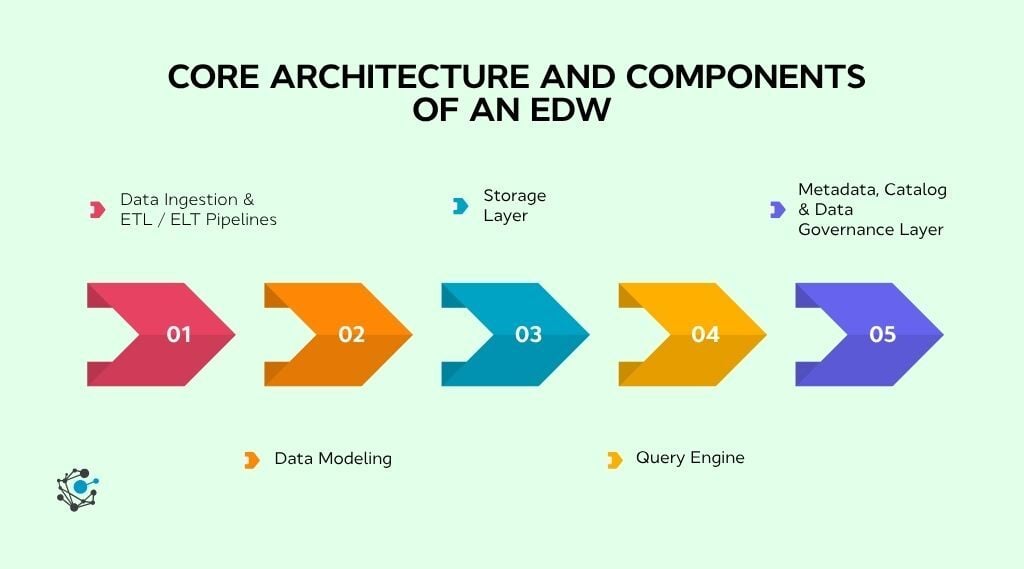
A well-designed enterprise data warehouse is not a single system but a set of tightly connected layers that work together to deliver trusted, high-performance analytics.
Each layer plays a distinct role, and weaknesses in any one of them tend to show up quickly, usually as slow dashboards, unreliable metrics, or frustrated users.
EDW architecture tiers
Before looking at individual components, it helps to understand how an enterprise data warehouse is typically organized. Most EDWs follow a layered architecture that separates data storage, processing, and presentation to improve scalability and performance.
|
Architecture |
Structure |
Typical use |
|
One-tier |
Minimal separation between data storage and reporting |
Small reporting environments |
|
Two-tier |
Data layer with a presentation layer for BI tools |
Departmental or smaller enterprise deployments |
|
Three-tier |
Database layer, OLAP/semantic layer, and reporting layer |
Standard architecture for enterprise data warehouses |
Most modern EDWs also include a staging layer, where data is temporarily stored before entering the warehouse. During staging, data is profiled, validated, cleansed, and transformed, helping prevent poor-quality data from affecting downstream analytics.
Many enterprise architectures also incorporate an Operational Data Store (ODS) to support near-real-time operational reporting before data is integrated into the enterprise data warehouse.
1. Data ingestion & ETL/ELT pipelines
Everything starts with ingestion. EDWs pull data from a wide range of sources, including ERP systems, CRMs, SaaS applications, operational databases, and event logs. The goal is simple: bring data into the warehouse in a reliable, repeatable way.
Traditionally, this process followed ETL, transforming data before loading it into the warehouse. Cloud-based EDWs increasingly favor ELT, where raw data is loaded first and transformed inside the warehouse. This shift improves flexibility and scalability, but it also raises the bar for governance and data quality.
Pipeline work also eats up more time than most teams expect. In a 2024 TDWI survey, 50% of organizations said project teams spend over 61% of their time on data integration, pipeline development, and preparation, which explains why EDW programs often slow down without strong automation and standards.
2. Data modeling
Once data is ingested, data modeling organizes it into a consistent, analytics-ready structure. Effective modeling improves query performance, simplifies reporting, and ensures business metrics remain consistent across the organization.
Common EDW modeling approaches
Enterprise data warehouses typically follow one of three modeling methodologies:
-
Inmon (top-down): Builds a centralized, normalized enterprise warehouse before creating departmental data marts. Best suited for organizations prioritizing governance and enterprise-wide consistency.
-
Kimball (bottom-up): Starts with dimensional data marts connected through conformed dimensions. Commonly used for business intelligence because it delivers reporting capabilities quickly.
-
Data Vault: Uses Hubs, Links, and Satellites to support rapidly changing data sources while preserving historical records and auditability. This makes Data Vault architecture well suited for organizations managing complex, evolving enterprise data environments.
Common schema designs
The physical schema depends on reporting and analytics requirements.
|
Schema |
Best suited for |
|
Star schema |
Fast BI reporting and OLAP queries |
|
Snowflake schema |
Complex hierarchies and normalized dimensions |
|
Galaxy (Fact Constellation) |
Multiple business processes sharing common dimensions |
|
Data Vault |
Historical tracking, scalability, and regulatory compliance |
Choosing the right methodology depends on governance requirements, reporting priorities, and data complexity. Regardless of the approach, well-defined business rules, metadata, and standardized definitions are essential for maintaining trusted enterprise analytics.
3. Storage layer
EDWs store data differently from operational systems. Most use columnar storage, which allows analytical queries to scan only the columns they need. This dramatically improves performance while keeping storage costs under control.
Compression, partitioning, and clustering further optimize access to large datasets. Tiered storage strategies separate frequently queried “hot” data from older historical data, making it possible to retain years of history without sacrificing speed or budget.
This design makes EDWs ideal for long-term trend analysis and historical reporting.
4. Query engine
The query engine is where the warehouse earns its reputation. Modern EDWs rely on distributed, massively parallel processing engines built specifically for OLAP workloads. These engines handle complex joins, aggregations, and high user concurrency without grinding to a halt.
Cloud platforms separate compute from storage, allowing organizations to scale performance independently from data volume. This flexibility is especially important for enterprises with unpredictable analytics demand.
5. Metadata, catalog & data governance layer
Metadata and governance transform an enterprise data warehouse into a trusted analytics platform. Metadata captures business definitions, ownership, lineage, and usage context, while governance enforces security, compliance, and controlled data access across the organization.
Because governance extends beyond architecture, the next section explores its key components and implementation in more detail.
Important note: OvalEdge strengthens this layer by connecting metadata, business glossaries, lineage, data quality, and governance into a unified platform, helping organizations improve data discovery, trust, and compliance across their enterprise data warehouse.
Data warehouse governance: Why it matters
An enterprise data warehouse is only as valuable as the trust users place in its data. Data warehouse governance establishes the policies, processes, and controls that ensure enterprise data remains accurate, secure, consistent, and compliant throughout its lifecycle.
It enables organizations to deliver reliable analytics while meeting regulatory and business requirements.
Core governance components
Effective data warehouse governance typically includes:
-
Data quality management: Validates, profiles, and monitors data to improve accuracy and consistency.
-
Access control and security: Uses role-based access, encryption, and monitoring to protect sensitive information.
-
Metadata management: Documents business definitions, ownership, classifications, and technical metadata to improve data discovery.
-
Data lineage: Tracks how data moves from source systems through transformations to reports and dashboards.
-
Business glossary and stewardship: Standardizes business terminology and assigns ownership to maintain consistent metrics.
-
Compliance controls: Supports regulations such as GDPR, CCPA, HIPAA, and SOX through auditing, retention, and policy enforcement.
-
Lifecycle management: Defines retention, archival, and deletion policies to balance compliance, performance, and storage costs.
Governance models
Organizations generally adopt one of three governance models.
|
Model |
Best suited for |
|
Centralized |
Highly regulated organizations requiring strict control |
|
Federated |
Large enterprises balancing central standards with domain ownership |
|
Decentralized |
Smaller organizations with independent business units |
Most enterprise data warehouse initiatives adopt a federated data governance model, combining centralized governance standards with domain-level accountability to improve scalability and consistency.
Without integrated governance, organizations often struggle with inconsistent business definitions, incomplete metadata, limited lineage, and fragmented access controls. Embedding governance directly into the enterprise data warehouse helps maintain trusted analytics while supporting regulatory compliance and enterprise-wide decision-making.
Key considerations before implementing an EDW
Before committing to an enterprise data warehouse strategy, it’s important to step back and evaluate a few foundational factors. EDWs are long-term investments, and early decisions around scope, architecture, and governance often determine whether the platform accelerates analytics or becomes a bottleneck.
Several considerations consistently shape successful EDW implementations:
-
Data volume, growth, and storage costs: Historical data grows faster than expected. Understanding current volumes and future growth helps guide storage architecture, retention policies, and cost optimization strategies.
-
Schema design and modeling strategy: Data models directly impact performance and usability. Well-designed schemas improve BI adoption and query speed, while overly complex models increase maintenance and confusion.
-
ETL and ELT integration complexity: More pipelines mean more engineering effort. Latency expectations, transformation logic, and monitoring requirements should align with real business needs, not assumed ones.
-
Governance, security, and access control requirements: Industries with regulatory obligations must plan for lineage, auditing, role-based access, and data privacy from the start. Strong governance builds trust and prevents rework later.
-
Deployment model: cloud, on-premises, or hybrid: Each option comes with trade-offs in flexibility, cost, scalability, and operational control. The right choice depends on data sensitivity, infrastructure maturity, and modernization goals.
Taken together, these factors help organizations avoid common pitfalls such as overengineering, uncontrolled costs, and low analytics adoption. A thoughtful evaluation upfront sets the foundation for an EDW that delivers reliable insights and scales with the business.
How to implement an enterprise data warehouse
Implementing an enterprise data warehouse is an iterative process. Rather than onboarding every data source at once, successful organizations establish a governed foundation and expand the warehouse in phases.
1. Assess data sources and business goals
Identify the systems that will feed the warehouse, evaluate data quality, and define the business decisions the EDW should support. Clear objectives help prioritize implementation and avoid unnecessary complexity.
2. Establish governance and ownership
Define business glossaries, data owners, security policies, and access controls before building data pipelines. Governance established early improves consistency and reduces rework as the warehouse grows.
3. Design the data model
Establish an enterprise data model that supports reporting, governance, and future scalability. Apply consistent business definitions and conformed dimensions across domains so analytics remain accurate as additional data sources are onboarded.
4. Build ingestion and transformation pipelines
Develop ETL or ELT pipelines to ingest, validate, transform, and load data into the warehouse. A staging layer helps improve data quality before information reaches analytical models.
5. Validate and deploy
Compare warehouse outputs with source systems to verify data accuracy, performance, and business logic before releasing dashboards and reports to users.
6. Expand and optimize
Extend the warehouse incrementally by onboarding additional business domains, monitoring performance, refining governance processes, and optimizing storage and query workloads as adoption increases.
Best practices
-
Start with high-value business domains instead of migrating everything at once.
-
Implement governance alongside data integration rather than after deployment.
-
Reuse common business definitions and conformed dimensions across projects.
-
Continuously monitor data quality, performance, and user adoption.
How to choose the right EDW strategy for your organization
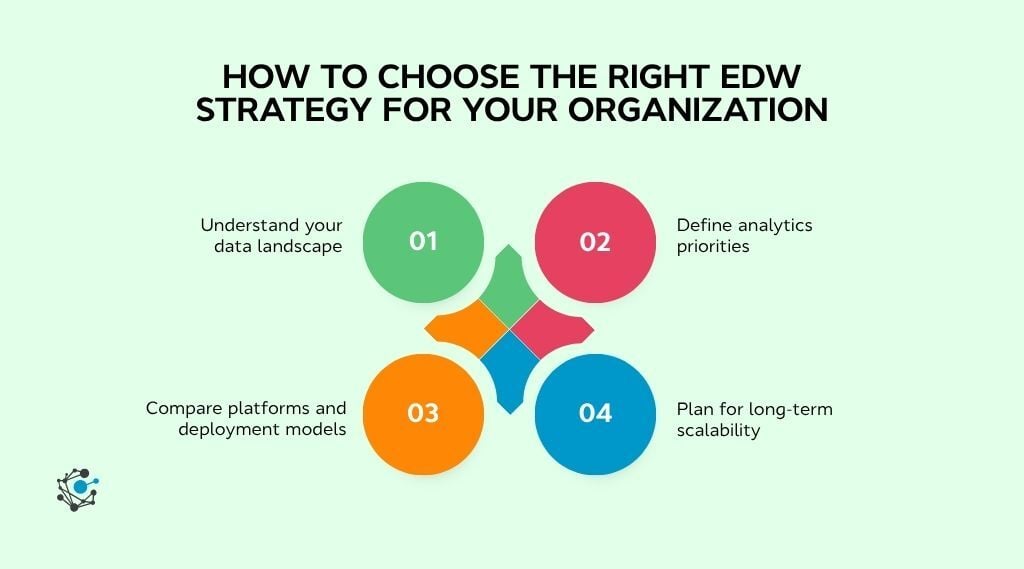
Selecting an enterprise data warehouse strategy is about choosing an architecture and platform that align with long-term business goals rather than short-term technical requirements.
1. Understand your data landscape
Evaluate data sources, growth patterns, integration complexity, and latency requirements to determine the scale and capabilities your EDW will need.
2. Define analytics priorities
Identify the reporting, compliance, AI, and business intelligence workloads the warehouse must support. Align platform capabilities with measurable business outcomes.
3. Compare platforms and deployment models
Assess cloud, hybrid, and on-premises platforms based on scalability, workload performance, governance capabilities, ecosystem integration, and total cost of ownership.
4. Plan for long-term scalability
Choose an architecture that can accommodate new business domains, increasing data volumes, evolving governance requirements, and future AI initiatives without major redesign.
A well-planned EDW strategy creates a governed foundation that can evolve with changing business and technology requirements.
Related reading: Understand how to plan a successful data warehouse migration while minimizing disruption and maintaining data quality.
Conclusion
Enterprise analytics doesn't fail because organizations lack data. It fails when insights take too long, governance becomes a blocker, or teams are forced to choose between speed and trust. An enterprise data warehouse solves the trust problem, but on its own, it can struggle to support rapid, ad hoc analysis.
That's where OvalEdge's askEdgi complements the EDW. By acting as a pop-up data warehouse, askEdgi enables governed, AI-assisted analysis on existing enterprise data without creating new pipelines, permanent models, or architectural sprawl.
Organizations can answer business questions faster while preserving the integrity of their enterprise data warehouse and governance framework.
Book a demo today and explore how OvalEdge helps enterprises turn governed data into faster, more confident decisions without rebuilding their data stack.
.png?width=1081&height=173&name=Forrester%201%20(1).png)
.png?width=1081&height=241&name=KC%20-%20Logo%201%20(1).png)