-2.png)
For both enterprises and mid-sized companies, choosing the right data governance approach is a high-stakes decision, especially when you're at a pivotal point of deciding how to scale data practices across cloud, legacy, on-prem, and hybrid systems.
Should you build data governance capabilities in-house, or should you engage a data governance as a service (DGaaS) provider to manage and operationalize it for you?
If you're navigating any of the following scenarios, DGaaS may be the more strategic path:
-
You’re starting data governance from scratch and need a proven framework fast
-
Your team lacks the bandwidth or expertise to maintain governance tooling and compliance
-
You’ve struggled to scale governance consistently across business units or geographies
-
You need governance to support rapid growth, audits, or regulatory milestones
-
You want real-time visibility and automation without owning infrastructure
For many, DGaaS is not just an outsourcing decision. It’s the first serious attempt to implement governance at scale.
Without a clear operational model or the right partner, DGaaS can lead to shallow adoption, compliance gaps, and wasted spend.
In this blog, we break down what data governance as a service really means, when and why organizations choose it, how it compares to in-house models, and what to look for when evaluating providers.
What is data governance as a service (DGaaS)?
Data governance as a service is a managed operating model where specialized providers implement and operationalize data governance across cloud and enterprise platforms. The service governs data through automated policies, role-based access controls, metadata catalogs, and lineage tracking.
Organizations use data governance as a service to enforce compliance, standardize ownership, and monitor data usage without building large internal teams.
The model scales with growing data ecosystems and keeps governance active through continuous enforcement, auditing, and operational oversight rather than static frameworks.
Why organizations choose managed data governance
As data estates grow more complex, governance stops being a design problem and becomes an execution problem. Without operational enforcement, organizations struggle to scale data intelligence initiatives that rely on consistent definitions, lineage, and quality controls. Many organizations discover that defining policies and roles is easier than keeping them enforced across cloud platforms, teams, and regions.
This gap between intent and operation is where managed data governance starts to gain attention. It offers a way to keep governance moving without slowing down analytics, product delivery, or day-to-day data access.
1. Challenge with building in-house data governance programs
Many organizations begin their data governance journey with a clear vision like
-
Defining roles
-
Documenting policies, and
-
Establishing oversight.
But within months, momentum fades. Governance leads often lack decision-making power. Policies exist in documents but are disconnected from operations. Cross-functional collaboration is limited because business and IT units work in silos.
Without dedicated teams, governance initiatives devolve into compliance checklists rather than living practices.
This isn’t due to lack of intent, but because executing governance requires more than static frameworks. It demands tooling, process integration, and full-time operational ownership, capabilities that many organizations underestimate.
As a result, frameworks sit unused, policies aren’t enforced, and confidence in data remains low.
2. Cost, skill, and scalability limitations of internal teams
The internal path to governance maturity is often constrained by both budget and bandwidth. Hiring professionals with expertise in metadata management, regulatory frameworks, data quality, and cross-system lineage is expensive. These are niche roles in high demand.
Even when internal resources are available, scaling across dozens of data sources, platforms, and business units introduces major coordination overhead.
Internal-only governance models are significantly slower to operationalize, requiring twice the effort to enforce policies compared to those that rely on external or hybrid approaches.
According to a 2022 Gartner Survey on Data Governance, through 2025, 80% of organizations seeking to scale digital business will fail because they do not adopt a modern approach to data governance.
That failure often stems from rigid, fragmented, and manual governance efforts that cannot keep pace with growing data complexity.
Most teams also struggle with tooling complexity, juggling multiple platforms without shared integration or governance automation. The result is a patchwork of partial controls that fail to deliver consistent, auditable outcomes.
3. Why choose managed governance
Adopting a managed governance operating model is a strategic enabler when organizations hit capacity or need to accelerate results. This model is particularly effective in three scenarios:
-
During cloud migrations or modernization efforts, new architectures require rapid policy implementation and visibility across distributed environments.
-
In regulated industries such as finance or healthcare, where audit readiness and risk mitigation can’t be delayed.
-
When internal data teams are already spread thin managing analytics, infrastructure, and business requests.
Instead of building a governance department from scratch, DGaaS provides structured execution, embedded expertise, and faster time-to-value.
For leadership, it offers the assurance that governance is not just initiated but actively operationalized through automated workflows, lineage tracking, and compliance enforcement.
Organizations often turn to DGaaS when:
-
They’re migrating to the cloud or expanding to new platforms
-
They face regulatory audits and need fast compliance readiness
-
Internal bandwidth is stretched across analytics and operations
For companies needing governance continuity without hiring a full department, DGaaS offers a practical path forward.
Choosing managed data governance is less about outsourcing responsibility and more about ensuring continuity. When governance operates as an ongoing service, organizations reduce friction, improve accountability, and keep controls aligned with change.
This shift allows teams to focus on using data with confidence, knowing governance adapts as platforms, regulations, and business priorities evolve.
Common use cases for data governance as a service
Organizations typically adopt data governance as a service to solve specific operational and strategic challenges rather than governance in isolation.
Common use cases include:
a. Regulatory compliance and audit readiness, where continuous monitoring and audit trails are required
b. AI and analytics initiatives that depend on high-quality, trusted, and well-classified data
c. Data integration across cloud, SaaS, and legacy platforms where ownership and standards must be unified
d. Rapid growth, mergers, or modernization programs that strain internal governance capacity
In these scenarios, DGaaS allows organizations to enforce consistency and accountability while maintaining speed and flexibility.
What does data governance as a service include?
Understanding what data governance as a service includes is key to evaluating its value. While traditional governance models rely on frameworks and scattered tools, DGaaS delivers continuous, hands-on execution.
It brings together policy automation, metadata management, access controls, and compliance workflows under a unified, cloud-delivered model. This convergence is what makes it operational, scalable, and impactful across business units.
1. Governance framework design and rollout
DGaaS providers begin by aligning governance strategy with business priorities, including:
-
Defining which data domains will be governed
-
What types of decisions need to be formalized, and
-
Who holds accountability across functions?
Rather than starting from a blank slate, providers bring reusable assets such as role matrices, policy libraries, and workflow templates.
A phased implementation strategy is critical. Instead of trying to govern every dataset at once, providers typically prioritize high-risk or high-value areas.
|
For instance, a financial institution might start with customer data subject to anti-money laundering (AML) laws, then expand into internal finance or third-party data. |
This approach ensures early wins, encourages adoption, and avoids change fatigue.
According to a 2024 Gartner Research on Modern Data Governance, by 2027, 60% of organizations will fail to realize the value of their AI use cases due to incohesive or ineffective data governance frameworks.
This highlights why a well-structured, phased rollout supported by reusable assets and clear accountability is essential not just for compliance, but for achieving long-term strategic outcomes like AI readiness.
2. Data stewardship and ownership models
One of the foundational gaps in most organizations is unclear data ownership. DGaaS providers address this by establishing stewardship structures that clarify roles such as data owners, custodians, producers, and consumers.
These roles are embedded into workflow systems to ensure accountability is not just defined but operationalized.
Workflows are built around real tasks like
-
Validating business definitions
-
Approving data quality exceptions, or
-
Resolving access issues.
This moves governance from being a documentation exercise to a living operational process.
OvalEdge helps organizations operationalize stewardship with built-in workflows that embed ownership directly into daily data activities. Its modular platform supports role-based access, collaborative approvals, and automated governance tasks, ensuring data accountability is maintained across every business unit without overwhelming individual teams.
3. Policy creation and enforcement
Defining policies is only half the equation. Enforcement is where many internal efforts break down. DGaaS providers not only help craft policies aligned to regulatory and business needs but also ensure they are enforced through system-level controls.
This might involve applying field-level encryption rules in Snowflake, embedding data retention logic in ETL pipelines, or enforcing segregation of duties through role-based access control in Redshift or BigQuery.
These policies are regularly monitored, and violations are tracked through dashboards and alerts, creating a feedback loop for governance improvement.
4. Metadata management and data lineage
Metadata acts as the backbone of any data governance strategy. It provides context, traceability, and control across the entire data lifecycle.
In traditional setups, metadata management often involves disconnected spreadsheets, incomplete glossaries, or manual inputs that quickly fall out of sync. This fragmentation creates blind spots in data access, ownership, and usage, leading to governance gaps and trust issues.
Data governance as a service (DGaaS) platforms solve this by continuously ingesting metadata using modern metadata management tools across cloud platforms, databases, SaaS applications, and BI tools.
These services standardize naming conventions, formats, classifications, and business definitions into a unified metadata catalog. This reduces manual work, eliminates inconsistencies, and provides a single source of truth for all downstream users, from analysts to compliance teams.
But metadata alone is not enough. Organizations also need to understand how data moves, transforms, and impacts downstream decisions.
DGaaS includes automated data lineage tracking, offering end-to-end visibility into the flow of data from ingestion through pipelines to dashboards and APIs. This lineage view is vital for root cause analysis, impact assessments, and identifying data drift across evolving systems.
|
For example, in regulated industries like insurance or banking, understanding how a customer’s personal data moves across platforms is critical to ensure GDPR or HIPAA compliance. |
Instead of relying on tribal knowledge or backtracking through legacy SQL code, DGaaS surfaces lineage automatically and continuously, removing guesswork and improving operational trust.
5. Compliance and regulatory support
Compliance is not a one-time effort. It requires continuous enforcement of policies, proof of adherence, and audit-ready transparency. Organizations that manage compliance manually often struggle to scale their governance efforts across cloud platforms and data silos.
Inconsistencies in access controls, data classifications, or audit logs can create risks that surface only during regulatory reviews.
DGaaS providers help close this gap by embedding regulatory compliance enforcement into the operational fabric of governance.
These services are designed to align with frameworks such as GDPR, HIPAA, SOX, and CCPA, offering out-of-the-box capabilities to track, manage, and report on compliance obligations.
Key features typically include:
-
Automated audit trails capture data access, role changes, policy enforcement, and lineage updates.
-
Subject access request (SAR) workflows that route privacy requests through standardized, trackable steps.
-
Data classification alignment with regulatory categories like PII, PHI, or financial records, enabling easier policy enforcement.
-
Pre-built compliance reports that map controls to regulatory requirements, useful for both internal reviews and third-party audits.
DGaaS allows enterprises to operate in a state of continuous audit readiness. This is especially valuable for sectors like healthcare, financial services, and government, where audit cycles are frequent, and penalties for non-compliance are significant.
Rather than retrofitting compliance after the fact, organizations using governance-as-a-service embed it into how data is stored, accessed, and used, making compliance scalable, proactive, and resilient.
DGaaS is a managed framework that embeds governance into the day-to-day flow of data. By unifying oversight, automation, and integration, it helps enterprises move from static documentation to active control, without slowing down innovation.
Data governance as a service vs in-house governance
Choosing between data governance as a service and in-house governance is a question of scalability, control, and operational maturity.
As data environments grow more complex, many organizations are reevaluating whether internal teams can keep pace with evolving compliance demands, integration needs, and automation expectations.
Understanding the trade-offs between managed and self-managed models helps leaders align governance strategy with business goals.
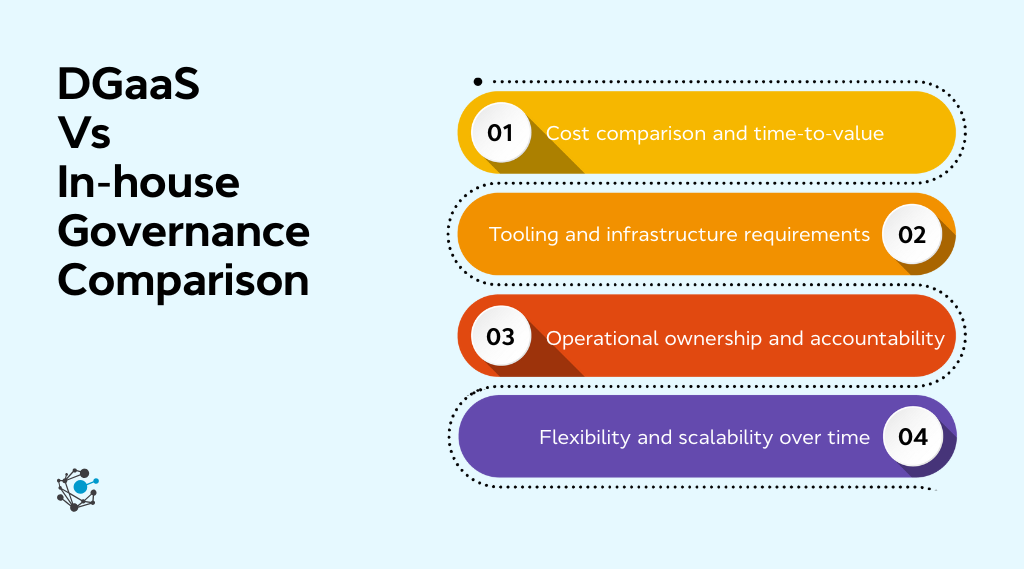
1. Cost comparison and time-to-value
Standing up a governance function internally often demands a significant upfront investment, both in time and capital.
It typically takes over a year to reach baseline operational maturity, including the formation of stewardship roles, policy documentation, cataloging systems, and compliance workflows. Even then, many organizations struggle to justify the ROI due to slow adoption, inconsistent enforcement, and fragmented tooling.
In contrast, data governance as a service accelerates this timeline substantially. Providers bring proven frameworks, automation, and delivery specialists, enabling organizations to reach functional governance within a few months.
This compressed implementation period is especially valuable for firms facing compliance deadlines or undergoing cloud modernization.
From a financial standpoint, DGaaS uses an opex model, subscription-based or usage-tied fees, making costs predictable and easier to scale.
Internal models, on the other hand, involve ongoing expenses for hiring domain experts, procuring and integrating tools, managing infrastructure, and maintaining training programs.
For organizations without governance scale or maturity, DGaaS delivers a lower total cost of ownership.
2. Tooling and infrastructure requirements
In-house data governance typically relies on assembling a patchwork of platforms such as one for metadata cataloging, another for data quality management, a third for workflow orchestration, and often custom scripts or connectors for lineage and policy enforcement.
Integrating these disparate systems requires significant IT effort and creates long-term maintenance debt.
DGaaS providers streamline this complexity. Many offer integrated platforms or tool-agnostic services that connect to your existing data stack through APIs or prebuilt connectors.
|
For example, if you already use Microsoft Purview or Snowflake, a capable DGaaS provider can extend governance workflows without replacing your tools. |
By abstracting the technical burden, DGaaS enables internal teams to focus on outcomes like increasing data quality coverage or enforcing access control instead of troubleshooting broken pipelines or managing vendor contracts.
3. Operational ownership and accountability
One of the persistent challenges in traditional governance programs is fragmented accountability.
Data owners, IT, security, and compliance teams often operate in silos, leading to delays in policy enforcement, unresolved access requests, and inconsistent definitions. No one team is ultimately responsible for governance outcomes.
DGaaS corrects this gap. Providers are responsible for operational execution and enforcement of governance policies, while strategic ownership, accountability, and decision rights stay within the organization.
This includes service-level agreements (SLAs) for policy adherence, access provisioning, stewardship task completion, and audit reporting.
With clear accountability defined in contracts and workflows, executive sponsors can track real performance indicators instead of relying on anecdotal progress.
This model fosters a higher degree of trust. Business units gain confidence that governance is not just aspirational, but operationalized and that there’s a single accountable party keeping controls aligned across platforms and teams.
4. Flexibility and scalability over time
Governance needs are not static. As businesses expand into new regions, adopt new SaaS platforms, or respond to new regulations, governance programs must adapt. Internal teams often lack the agility to reassign roles, redeploy tooling, or reconfigure workflows quickly.
DGaaS providers are built for scale. Their delivery models include federated stewardship, role-based access control, and modular policies that can be extended to new domains without re-architecting the entire framework.
Whether onboarding a new data warehouse, responding to new privacy laws, or spinning up a governance initiative in a new business unit, DGaaS makes expansion seamless.
This scalability is what positions DGaaS not just as a stopgap solution, but as a long-term operating model for enterprise-grade governance. It grows with your architecture, workforce, and regulatory landscape, while minimizing disruption to existing workflows.
While in-house models offer customization and control, they often demand higher resource commitment and slower time to value. DGaaS, by contrast, emphasizes agility, automation, and compliance by design.
The right choice depends on your governance maturity, internal bandwidth, and the need for operational scalability across data platforms.
Key criteria for selecting a data governance as a service provider
Not all data governance as a service providers operate the same way. Some focus on tools, others on advisory frameworks, and a few on sustained execution.
Choosing the right partner requires looking beyond feature lists and understanding how governance will run day to day. The criteria that matter most often relate to delivery depth, integration capability, and long-term alignment with how your data ecosystem evolves.
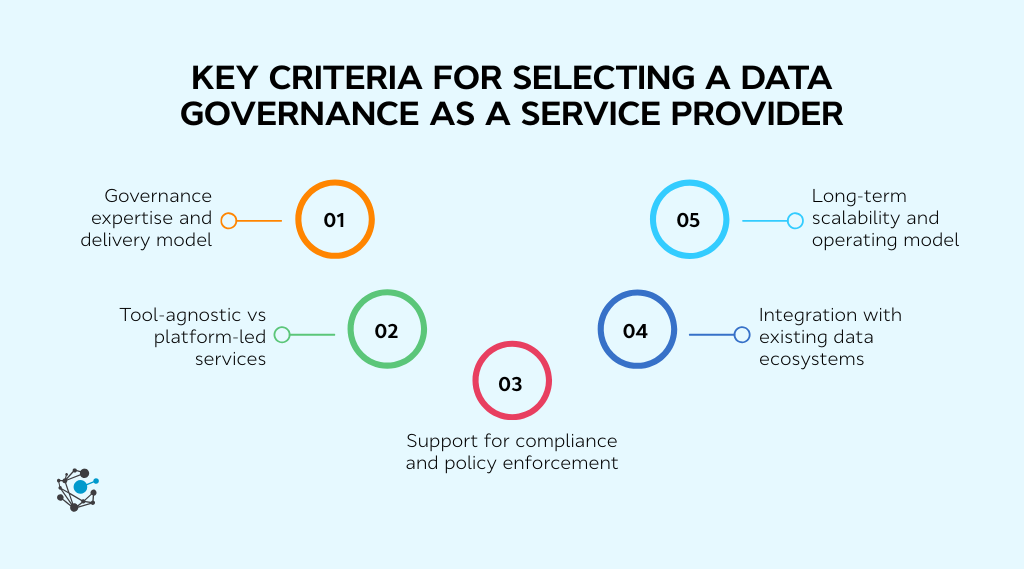
1. Governance expertise and delivery model
Choose a provider with operational experience, not just advisory credentials. Look for a track record of managing governance programs in regulated industries or complex multi-cloud environments.
Ask whether their team includes former data stewards, compliance officers, or architects who’ve executed governance programs, not just written policies.
Evaluate the delivery model in detail. A fully managed service typically provides end-to-end execution with limited internal lift. Hybrid models allow for shared responsibilities, often embedding stewards within your team.
This is ideal if you want tighter collaboration or knowledge transfer. Understand where responsibilities begin and end, and how accountability is formalized, especially for escalations, issue tracking, and audit response.
2. Tool-agnostic vs platform-led services
Some DGaaS providers require adopting their platform. This can simplify deployment but increases the risk of vendor lock-in.
If your organization already uses platforms like Snowflake, BigQuery, or AWS, seek providers that can integrate with your existing stack. Tool-agnostic providers typically offer connectors, APIs, and workflow engines that adapt to heterogeneous environments.
|
Flexibility here is key. For example, if you’re migrating from an on-prem catalog to a cloud-native data lake, a platform-led vendor may struggle to support both. |
A tool-agnostic provider can bridge systems without requiring reimplementation. This adaptability also supports future changes such as new pipelines, new tools, or expanded governance domains.
3. Support for compliance and policy enforcement
Compliance support in data governance as a service goes far beyond checkbox certifications. Leading DGaaS providers operationalize compliance by embedding enforceable controls directly into data workflows.
This allows organizations to demonstrate real-time conformance with evolving regulatory requirements rather than retrofitting compliance during audits.
The most capable platforms offer automated provisioning and de-provisioning tied to role hierarchies.
|
For instance, when an employee changes departments, their data access adjusts automatically based on updated identity attributes from systems like Azure AD or Okta. |
This minimizes the risk of orphaned permissions and ensures least-privilege access across the data lifecycle.
Audit trails are generated automatically at every stage, whether it’s a data classification update, a policy change, or a data asset being accessed. This continuous logging reduces manual recordkeeping while giving compliance teams the evidence they need during audits or investigations.
Some platforms also enforce dynamic policies for masking, encryption, and retention based on data sensitivity or residency.
|
For example, access to customer PII may be masked for analytics users in marketing while remaining fully visible to authorized customer service roles. This kind of context-aware enforcement supports frameworks like GDPR, HIPAA, and CCPA. |
Rather than offering vague promises of “compliance support,” mature providers often back their claims with industry-recognized attestations like SOC 2 Type II, ISO 27001, or HITRUST, along with published case studies showing how their controls function in live enterprise environments.
4. Integration with existing data ecosystems
One of the most significant advantages of modern DGaaS platforms is their ability to integrate seamlessly into heterogeneous data ecosystems.
Organizations today rely on an intricate mix of cloud data warehouses, ETL pipelines, BI tools, SaaS platforms, and legacy systems, all of which must operate without interruption.
A strong provider will offer prebuilt connectors to all these leading platforms. These connectors allow for real-time metadata harvesting and policy enforcement without the need for disruptive rearchitecture or parallel ingestion.
This non-invasive integration model ensures data stays where it is while governance wraps around it. Metadata is collected from orchestration tools, log streams, and transformation layers without the need to replicate or move the underlying data.
For DevOps or data engineering teams, APIs and webhook integrations make it easy to embed governance actions into CI/CD pipelines, approval workflows, and observability stacks. This allows governance to become part of the operational fabric rather than a separate, isolated process.
|
For example, instead of manually onboarding new datasets into a catalog, a webhook can trigger auto-classification and tagging the moment a new dataset lands in a cloud bucket. |
This real-time enforcement reduces delays, minimizes risk, and lowers the overhead of maintaining governance manually.
5. Long-term scalability and operating model
Short-term compliance wins mean little if governance efforts can’t scale as the business grows. The best DGaaS providers are not only technically scalable but operationally flexible, supporting a wide range of use cases as data volumes, regulations, and organizational structures evolve.
Look for platforms that allow modular expansion. It means new geographies, domains, and business units should be able to onboard without a full reimplementation.
A provider should support federated governance models, where stewardship can be delegated to local teams while maintaining centralized policy oversight.
Scalability also depends on the provider’s resourcing model. As your data footprint grows, your ability to manage policy exceptions, data quality rules, and stewardship tasks should grow with it.
Some vendors offer elastic governance-as-a-service operations, where expert support can scale up or down based on demand spikes, such as before major audits or M&A activity.
A mature DGaaS provider will also be equipped to handle emerging governance challenges like tracking model inputs for AI/ML compliance, managing unstructured files, or aligning ESG reporting with data governance controls.
Perhaps most critically, the provider’s commercial model should allow for this scalability without punitive cost increases or contractual renegotiation.
Look for solutions that support incremental capability activation, whether it’s adding new compliance modules, connecting new data sources, or enabling self-service access for more users.
Ultimately, choosing a DGaaS partner who can evolve with your needs is the difference between a short-lived implementation and a governance capability that supports long-term data strategy.
Selecting a DGaaS provider is ultimately about confidence in execution. When governance expertise, tooling flexibility, compliance support, and scalability come together, governance shifts from a risk management task to a durable operating capability.
The right partner makes governance easier to sustain as data, regulation, and business priorities continue to change.
Potential risks and limitations of data governance as a service
While DGaaS offers clear advantages, organizations should be aware of potential risks if the model is poorly implemented.
Common considerations include:
a. Vendor lock-in if governance logic cannot be exported or integrated with other tools
b. Perceived loss of control if ownership and accountability are not clearly defined
c. Security concerns when providers lack strong certifications or transparent controls
d. Inconsistent service quality if governance execution is not backed by SLAs
These risks can be mitigated by selecting providers that support open standards, clear exit strategies, strong compliance certifications, and shared governance ownership models.
Conclusion
Many organizations hesitate to outsource data governance. The assumption is that external providers might be too generic, lack domain context, or become complacent over time. That fear is valid, but it's not the full picture.
The success or failure of data governance as a service doesn’t hinge on the concept itself. It hinges on how well you align the model with your business priorities, how carefully you evaluate the provider’s operating model, and how clearly you define ownership, accountability, and outcomes from the start.
If you're expecting a plug-and-play solution that runs itself, you will likely be disappointed. But if you treat DGaaS as an extension of your own data strategy with clear success metrics, flexible operating parameters, and mutual accountability, it can become a long-term enabler of trust, compliance, and scalability.
Choosing a DGaaS provider isn’t just about technical features or pricing tiers. It’s about selecting a partner who understands your governance maturity, adapts to your evolving regulatory needs, and builds systems that actually embed governance into the daily rhythms of your data ecosystem.
Whether you build it in-house or implement it through a service model, what matters is that it works. With the right partner, DGaaS can deliver governance that scales with your data, not against it.
See how OvalEdge turns governance from policy to practice.

Book a demo to explore automated metadata, built‑in stewardship workflows, and faster adoption across teams.
FAQs
1. Is data governance as a service suitable for highly regulated industries?
Yes. Most DGaaS providers are built with regulatory compliance at the core. They offer features like audit logging, role-based access control, and policy automation aligned with standards such as HIPAA, GDPR, or SOX. The key is choosing a vendor that understands your specific regulatory landscape and can enforce controls without disrupting operations.
2. Who owns data decisions when governance is delivered as a service?
The client organization retains ownership of all strategic data decisions. DGaaS providers operationalize policies, enforce controls, and support workflows, but they do not define business rules or make decisions about data use. A successful model ensures shared accountability; execution lies with the provider, while data ownership and directional decisions remain with internal stakeholders.
3. What does data governance as a service cost compared to hiring an internal team?
DGaaS typically follows a subscription-based pricing model tied to usage, domains, or users. While upfront costs are lower, long-term savings stem from reduced hiring, tool integration, and infrastructure costs. In contrast, building in-house involves hiring specialists, buying software, and managing integrations, often resulting in higher fixed costs and longer time-to-value.
4. How does DGaaS handle cultural adoption within an organization?
DGaaS providers often include change management and onboarding support as part of their offering. They work with stakeholders to align workflows with existing practices and help teams adopt governance roles through training, stewardship toolkits, and automated workflows. However, long-term cultural adoption still requires executive sponsorship and internal champions.
5. What happens if a DGaaS provider shuts down or changes their model?
A reputable DGaaS provider will have exit and data portability clauses built into their contracts. These typically include mechanisms to export metadata, policy configurations, and lineage documentation. Before committing, organizations should verify SLAs around data retrieval and continuity. Vendor lock-in can be avoided by choosing providers that support open standards and APIs.
6. Does DGaaS replace the need for internal data stewards or governance teams?
No. DGaaS enhances governance execution but doesn’t eliminate the need for internal stewardship. Human oversight is still required to define policies, resolve conflicts, and guide ethical data use. The most effective models combine internal subject-matter experts with the automation and infrastructure of a DGaaS provider to scale governance sustainably
.png?width=1081&height=173&name=Forrester%201%20(1).png)
.png?width=1081&height=241&name=KC%20-%20Logo%201%20(1).png)