.png)
Everyone wants to be data-driven. Only a few know what that really takes. Despite being under constant pressure to make smarter decisions, business leaders aren’t fully equipped to use the data they have.
According to a 2023 Study on the State of Data & Analytics by Salesforce, 63% of business leaders are expected to find, analyze, and interpret data on their own, and yet, 54% admit they’re not fully confident in doing so.
Even fewer say they can translate that data into real action, generate timely insights, or use it effectively in daily decisions.
It’s not that the data isn’t there. In most organizations, there's more data than anyone knows what to do with.
The real challenge lies in how that data is governed, accessed, and understood.
According to an HBR Study on Data Strategy, more than 70% of employees have access to data they shouldn't, and analysts spend 80% of their time just discovering and preparing data, not analyzing it.
It results in lower decisions, higher risks, and missed opportunities.
This is exactly where data catalogs come in as the governance backbone for data-driven organizations, helping teams find the right data faster, understand its context, enforce access policies, and trust what they’re working with.
What is data catalog evaluation?
A data catalog evaluation is the structured process of assessing how well a data catalog platform supports metadata management, data discovery, governance, integration, and long-term scalability.
The evaluation compares tools based on metadata quality, lineage accuracy, search usability, security controls, and ecosystem compatibility.
Strong evaluation reduces data silos, improves trust in data, and enables compliant access across teams.
Poor evaluation leads to low adoption, manual overhead, and governance gaps.
A rigorous data catalog evaluation aligns the platform with real business use cases, operational workflows, and future data growth needs.
Why data catalog evaluation matters?
Data catalog evaluation matters because the catalog sits at the center of how an organization understands, governs, and uses its data.
Choosing the wrong platform does not just slow down discovery. It creates long-term friction across analytics, engineering, governance, and compliance workflows.
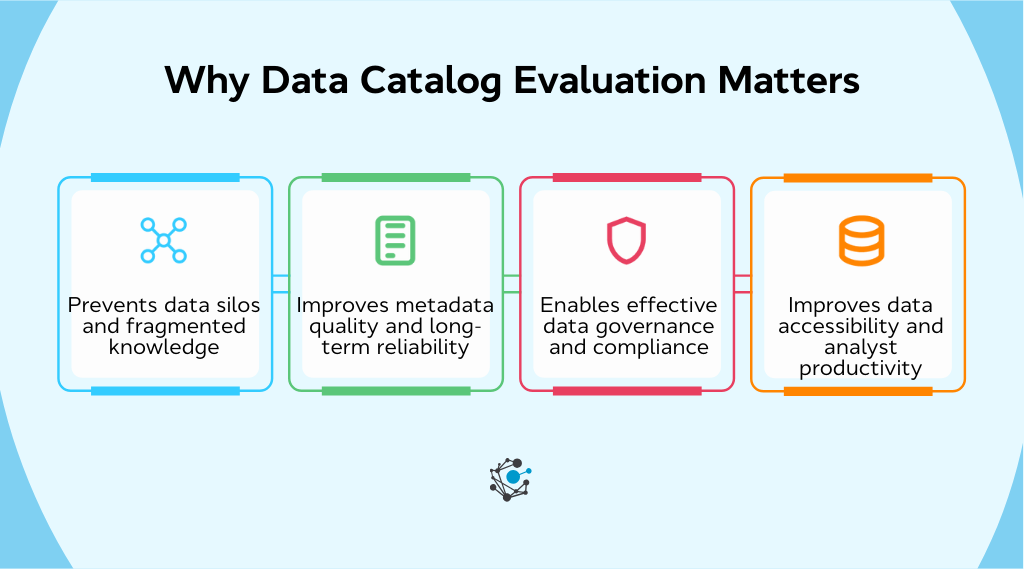
1. Prevents data silos and fragmented knowledge
Without a well-evaluated data catalog, metadata often lives in disconnected tools, spreadsheets, and individual team knowledge.
This fragmentation leads to duplicated datasets, inconsistent definitions, and repeated validation work.
Teams waste time verifying whether data exists, where it came from, and whether it can be trusted.
A thorough data catalog evaluation ensures the platform can centralize metadata across warehouses, lakes, BI tools, and pipelines.
Centralization makes data easier to find, reduces duplication, and creates a shared understanding of critical business metrics.
2. Improves metadata quality and long-term reliability
Metadata quality directly determines whether a data catalog is useful or ignored.
Poorly evaluated catalogs often rely on manual metadata entry or limited automation, which quickly leads to outdated descriptions, missing ownership, and broken lineage.
Evaluating how metadata is ingested, enriched, and maintained helps ensure the catalog stays accurate as schemas change and data volumes grow.
According to a 2025 Gartner Survey on Data & Analytics Trends, metadata provides the context, lineage, and governance needed to track, verify, and manage synthetic data responsibly, which is an increasingly critical function for ensuring AI accuracy and compliance.
This reinforces the importance of metadata quality not just for day-to-day analytics, but also for maintaining trust in advanced use cases like AI and regulatory reporting.
High-quality metadata strengthens confidence in downstream reporting and reduces the risk of analysts relying on stale or misunderstood data.
3. Enables effective data governance and compliance
Data governance fails when policies exist but cannot be enforced consistently.
A weak data catalog may expose sensitive metadata without proper controls or lack visibility into where regulated data is used.
Data catalog evaluation helps organizations assess whether governance capabilities align with regulatory and internal standards.
This includes role-based access, sensitivity classification, audit trails, and policy workflows.
When these features work in practice, governance becomes embedded in daily data access rather than enforced through manual reviews.
4. Improves data accessibility and analyst productivity
Many organizations invest in data catalogs to support self-service analytics, yet adoption often remains low.
The most common reason is poor usability. If search results are irrelevant, documentation is hard to interpret, or trust signals are missing, users revert to tribal knowledge.
Evaluating searchability, navigation, and usability ensures the catalog actually improves access to data.
A well-evaluated catalog allows analysts to quickly locate datasets, understand context, and assess fitness for use without constant back-and-forth with data teams.
How to evaluate a data catalog: Step-by-step framework?
A structured data catalog evaluation helps teams avoid tools that look strong in demos but fail in real-world usage, adoption, or scale.
The framework below reflects how mature data teams approach data catalog evaluation, from defining business problems to validating technical fit under real conditions.
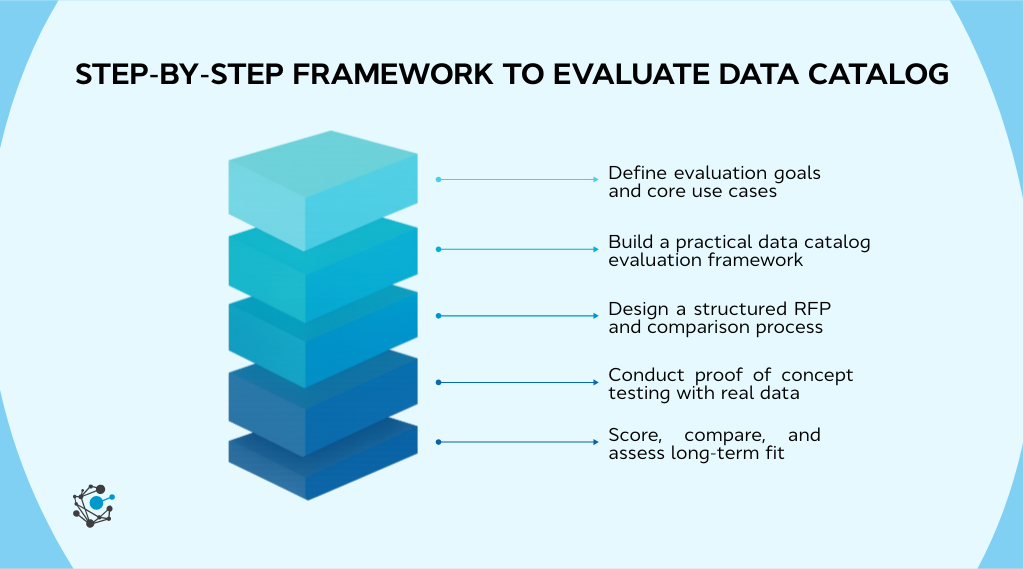
Step 1: Define evaluation goals and core use cases
Every effective data catalog evaluation starts with clarity on why the catalog exists and which problems it must solve. Organizations often struggle here because they treat a data catalog as a generic data management tool rather than a solution to specific operational gaps.
Common pain points that trigger a data catalog evaluation include:
a. Identify the primary business problem the data catalog must solve, such as poor data discoverability or weak governance controls.
b. Map catalog use cases to roles like data engineers, analysts, and compliance teams to avoid misaligned feature priorities.
c. Clarify whether success depends more on metadata automation, lineage accuracy, governance enforcement, or analyst adoption.
d. Document current pain points caused by missing context, unclear ownership, or unreliable data quality signals.
Each of these problems requires different capabilities, so defining goals early prevents feature-driven decisions later.
This is where an outcome-led approach matters. Platforms like OvalEdge explicitly structure catalog adoption around prioritized outcomes such as improving data trust, strengthening governance, or accelerating analyst productivity before expanding scope.
That framing helps teams evaluate catalog capabilities based on real operational needs, not abstract feature lists.
Additionally, evaluation goals should map directly to how different roles use data. Data engineers often need automated metadata ingestion across warehouses, lakes, and pipelines.
They also rely on accurate lineage to troubleshoot broken dashboards or downstream data quality issues.
If lineage extraction requires manual configuration or only works for limited systems, the catalog will not support day-to-day engineering workflows.
Business analysts typically care about searchability, clear descriptions, data freshness indicators, and trust signals such as certifications or quality warnings.
If analysts cannot quickly determine whether a dataset is reliable, adoption stalls regardless of technical depth.
Data governance and compliance teams focus on access controls, policy enforcement, classification of sensitive data, and auditability.
A catalog that lacks fine-grained permissions or policy workflows creates compliance risk rather than reducing it.
Defining evaluation goals upfront ensures that data catalog evaluation focuses on outcomes, not feature checklists.
Step 2: Build a practical data catalog evaluation framework
Once goals are clear, the next step is to create a data catalog evaluation framework that translates requirements into measurable criteria. This framework acts as a shared decision model across data, IT, governance, and security stakeholders.
High-quality data catalog evaluations typically group criteria into three categories.
a. Technical capabilities: Assess how the catalog integrates with your existing data stack. This includes native connectors to data warehouses, BI tools, transformation frameworks, and cloud platforms.
Weak integration often leads to incomplete metadata, outdated lineage, and manual maintenance overhead.
b. Metadata management capabilities: Determine how well the catalog captures, enriches, and maintains context.
Automated metadata extraction, support for business metadata, tagging, ownership, and documentation workflows all influence long-term catalog accuracy.
Metadata quality directly affects trust, search relevance, and usability.
c. Governance and security capabilities: Evaluate how the catalog supports compliance, access management, and policy enforcement.
This includes role-based access controls, sensitivity classification, approval workflows, and audit logs.
A catalog that exposes sensitive metadata without controls can create new risk surfaces.
Usability and adoption criteria often receive less attention but strongly influence success.
Poor search relevance, cluttered interfaces, or complex navigation reduce adoption even when technical features are strong.
During data catalog evaluation, teams should assess whether non-technical users can succeed without training.
A strong evaluation framework balances these dimensions rather than over-optimizing for one.
Step 3: Design a structured RFP and comparison process
A structured Request for Proposal helps standardize how vendors respond during data catalog evaluation. Without a consistent format, comparisons become subjective and biased toward presentation quality rather than substance.
a. Standardize vendor questions to ensure consistent, side-by-side comparison across all evaluation criteria.
Questions should require vendors to explain how features work, not just confirm that they exist.
Require detailed explanations of how features work in practice, not just confirmation that they exist.
|
For example, instead of asking whether lineage is supported, ask which systems generate lineage automatically and which require manual configuration. |
b. Align RFP questions directly to your defined use cases and regulatory requirements. RFP questions should also reflect your defined use cases.
If governance is a priority, include questions about how policies are enforced, how exceptions are handled, and how access decisions are audited.
If scalability matters, ask how the platform performs as metadata volume grows across teams and domains.
c. Involve data, governance, security, and analytics stakeholders in reviewing responses to surface hidden risks.
Including stakeholders from data engineering, analytics, security, and governance during RFP review prevents blind spots.
Each group identifies risks that others may overlook, which strengthens the overall data catalog evaluation.
4. Step 4: Conduct proof of concept testing with real data
Proof of concept testing is one of the most critical phases of data catalog evaluation. Vendor demos rarely reveal operational friction, performance limitations, or integration gaps.
a. During a proof of concept, teams should ingest real datasets from production-like environments.
This allows you to evaluate metadata completeness, lineage accuracy, and ingestion reliability under realistic conditions.
Synthetic or curated demo data often hides issues that surface immediately with live pipelines.
b. Key areas to validate include how quickly metadata updates after schema changes, whether lineage remains accurate across transformations, and how easily users can find and understand datasets without assistance.
Testing search behavior with real business terms often exposes gaps between technical metadata and analyst expectations.
Proof of concept testing also reveals adoption risks. If users struggle to document assets, apply tags, or interpret lineage graphs, those challenges will scale after rollout.
Data catalog evaluation should treat usability issues as serious risks, not cosmetic concerns.
5. Step 5: Score, compare, and assess long-term fit
After proof of concept testing, use your evaluation framework to score each platform consistently.
Scores should reflect both functional performance and operational impact.
Pay particular attention to gaps that require workarounds.
Manual metadata entry, brittle integrations, or limited governance workflows often create long-term maintenance costs that outweigh initial benefits.
Cost assessment should include more than licensing.
Data catalog evaluation should consider implementation effort, integration complexity, ongoing administration, and support requirements.
A lower-cost platform that demands heavy manual effort can become more expensive over time.
Long-term fit also matters.
Evaluate whether the catalog supports growing data domains, evolving governance standards, and changes in architecture.
A platform that works today but cannot scale across teams or data volumes limits future adoption.
Shortlisting vendors based on both current needs and future readiness helps ensure that the data catalog becomes a durable foundation rather than a short-term tool.
Key Data Catalog Evaluation Criteria
A strong data catalog evaluation goes beyond surface-level features and focuses on how well the platform supports real-world data management, governance, and discovery at scale. The criteria below reflect what experienced data teams assess when comparing data catalog tools.
1. Technical and functional criteria
Technical and functional criteria determine whether the data catalog can operate effectively within your existing data environment and support daily workflows.
a. Metadata discovery and smart automation: Many organizations start with good documentation but quickly fall behind as schemas change, new pipelines are added, and datasets multiply.
When evaluating metadata discovery, assess how the catalog automatically extracts technical metadata from data warehouses, lakes, transformation tools, and BI platforms.
This includes table schemas, column details, usage statistics, and dependencies. Automated classification and tagging reduce reliance on human input and improve consistency across domains.
AI-driven enrichment can help surface relationships between datasets, suggest business terms, and identify sensitive data.
However, the evaluation should focus on accuracy and transparency. Automated suggestions must be reviewable and auditable to maintain trust and governance standards.
b. Data lineage and data quality integration: End-to-end data lineage provides visibility into how data moves from source systems through transformations to downstream consumption.
During data catalog evaluation, lineage depth matters more than diagrams. The catalog should reflect actual pipeline logic rather than static or manually maintained flows.
Accurate lineage helps data engineers troubleshoot issues faster and allows analysts to understand how metrics are derived.
It also plays a key role in regulatory compliance by showing where sensitive data originates and how it is used.
Integration with data quality tools or native quality indicators strengthens the catalog’s value.
When users can see freshness, validation results, or quality warnings alongside metadata, they make better decisions about whether a dataset is fit for use.
c. Search experience and user adoption: Search experience directly influences whether a data catalog becomes a trusted resource or an ignored system.
Many catalogs fail not because of missing features but because users cannot find what they need quickly.
Evaluation should focus on how search handles real business language, synonyms, and partial queries.
Filters, tags, ownership fields, and popularity signals help users narrow results without deep technical knowledge.
User adoption also depends on collaboration features such as comments, documentation workflows, and certification flags.
A catalog that encourages shared context reduces dependency on informal communication channels and improves consistency across teams.
2. Governance, compliance, and security criteria
Governance capabilities determine whether the data catalog supports controlled access, regulatory compliance, and accountability.
During data catalog evaluation, assess how role-based access control is implemented across metadata and data assets.
Permissions should align with organizational roles and integrate with existing identity systems. Overly coarse controls limit usability, while weak controls increase risk.
According to a 2024 Survey on Business Agility by Deloitte, 51% of organizations still lack a governance model that balances centralized oversight with decentralized decision-making, which is a critical gap as businesses adapt to regulatory pressure and customer expectations.
This makes it even more important for data catalogs to embed structured, enforceable governance policies that scale across teams, roles, and domains without slowing down operations.
Compliance support includes sensitivity classification, policy enforcement, and audit trails.
The catalog should help organizations demonstrate how data is governed rather than simply storing metadata.
This is especially important for regulated industries where documentation and traceability are mandatory.
Built-in stewardship workflows also matter.
Assigning ownership, managing approvals, and tracking policy exceptions ensures governance becomes part of daily operations rather than a manual oversight process.
3. Integration and ecosystem compatibility
A data catalog only delivers value if it integrates smoothly with the broader data ecosystem.
Evaluation should prioritize native integrations over custom connectors whenever possible.
Key integrations typically include cloud data warehouses, data lakes, ETL and ELT tools, orchestration platforms, BI tools, and APIs. Limited integration coverage leads to incomplete metadata and fragmented visibility.
Ecosystem compatibility also affects maintenance effort.
Catalogs that require frequent manual updates or custom development introduce long-term operational overhead that is often underestimated during evaluation.
4. Scalability, performance, and architecture
Scalability is a critical but frequently overlooked data catalog evaluation criterion.
As data volumes, teams, and use cases grow, the catalog must handle increased metadata ingestion and search activity without degradation.
Performance impacts adoption.
Slow search responses or delayed metadata updates reduce trust and push users back to informal methods of finding data.
Evaluation should include performance testing with realistic metadata volumes and ingestion frequencies.
Architecture also matters.
Cloud-based, modular platforms generally adapt more easily to evolving data architectures than tightly coupled or monolithic designs.
Flexibility supports future integration and governance requirements.
5. Vendor support, cost, and licensing models
Vendor considerations influence the total cost and sustainability of the data catalog over time.
Licensing models vary widely, with differences in pricing based on users, metadata volume, or integrations.
Data catalog evaluation should account for implementation effort, onboarding support, training resources, and documentation quality.
Limited vendor support often shifts the burden to internal teams, increasing operational costs.
Clear service-level agreements and transparent pricing structures reduce risk.
A catalog that fits both budget constraints and long-term growth plans is more likely to remain viable as data strategy evolves.
By evaluating these criteria together, organizations can move beyond feature comparisons and select a data catalog that supports reliable metadata management, effective governance, and scalable data access.
If you're looking for a more tailored comparison experience, OvalEdge offers an interactive data catalog selection tool that adapts to your data landscape in real time.
Answer 10 strategic questions about your environment, like lineage complexity, metadata maturity, and governance team size, and instantly compare seven leading data catalogs side by side.
This tool helps you:
a. Get personalized platform recommendations based on your actual needs.
b. See how each vendor scores across core evaluation dimensions.
c. Adjust weights and scoring logic based on what matters to your team.
d. Download the underlying evaluation model to share, customize, or expand internally.
Try the Interactive Comparison Tool and take the guesswork out of vendor selection.
Common data catalog evaluation mistakes
Most catalog projects fail at evaluation, not implementation. Teams pick the wrong tool because they evaluated the wrong things.
a. Scoring features instead of outcomes
A long feature list tells you very little about whether the catalog will get used.
Start with the outcome you need: faster data discovery, fewer governance exceptions, less time preparing data, and evaluate backward from there.
If a vendor can't show how their tool delivers that outcome with your actual data, the feature list is noise.
b. Running the evaluation without end users
Engineers and architects are essential, but if your analysts, data stewards, and compliance teams aren't in the room during demos and POC testing, you'll end up with a technically solid tool that half the organization ignores.
Different roles catch different failure points. Don't leave any group out.
c. Taking demo performance at face value
Vendor demos use clean, curated data and rehearsed workflows. Your environment has messy schemas, legacy pipelines, and strict security policies.
Always test with a real subset of your own data. If a vendor resists a genuine POC, that tells you something.
d. Evaluating only for where you are today
New cloud platforms, additional data domains, AI pipelines, and shifting compliance requirements, your data environment in two years will look different.
Ask vendors directly about roadmap, scalability, and how the platform handles new regulatory frameworks before you shortlist, not after.
e. Overlooking the total cost of ownership
License cost is rarely the final number.
Implementation, professional services, connector maintenance, and scaling user licenses can add up to two or three times the base price. Get written clarity on all of it upfront.
OvalEdge’s data catalog comparison guide
Choosing the right data catalog is high-stakes, but the market is crowded, vendor demos are biased, and internal priorities vary.
That’s why we created a hands-on, Data Catalog Comparison Guide, designed to help teams objectively compare platforms based on what truly matters to them, not just feature lists.
This downloadable Excel guide evaluates top data catalog vendors across 15+ core capabilities, from metadata ingestion to governance workflows, lineage accuracy, usability, and integration depth.
It’s based on OvalEdge’s proprietary framework, developed through hundreds of real-world implementations, and tailored to help CDOs, architects, and data stewards make faster, evidence-based decisions.
Download the Data Catalog Comparison Guide and start your evaluation with a structured, customizable scorecard that reflects your business priorities.
Here’s how you can use this guide:
1. Customize based on your priorities
Every organization values different capabilities. Some prioritize lineage and access control, while others care more about metadata automation and user adoption.
The guide includes weighted scoring models so you can assign higher importance to the criteria that map to your use cases.
Whether you’re modernizing governance, scaling analytics, or preparing for AI-readiness, you can adjust weights in the sheet to reflect your strategic focus.
2. Compare vendors across the full lifecycle
The guide also helps you benchmark each tool’s performance across the Crawl, Curate, and Consume phases of the data lifecycle:
a. Crawl: How well does the platform connect to your data sources and extract metadata automatically?
b. Curate: Can it enrich metadata with business context, lineage, and stewardship workflows?
c. Consume: Does it empower users to find, understand, and trust the right data independently?
This lifecycle-based approach helps teams go beyond surface-level comparisons and assess how platforms will support day-to-day workflows, not just compliance checkboxes.
3. Run your own RFP or internal scorecard
You can also use the guide as a vendor evaluation workbook during your RFP process.
By standardizing how vendors respond to key questions, you avoid subjective demos and allow apples-to-apples comparisons across all shortlisted tools.
The Excel format lets you centralize inputs from data, security, governance, and analytics stakeholders, ensuring your final decision reflects all critical perspectives.
Conclusion
Without a data catalog, the cracks in your data strategy widen quickly. Your analysts spend most of their week trying to find the right dataset.
Not cleaning it, not modeling it, but just locating it.
Meanwhile, your teams pull numbers from dashboards they don’t fully understand. Worse, the same datasets are copied and reused across functions without lineage, ownership, or approval.
This is what a data-driven business looks like without a catalog.
a. Who’s verifying if the data behind a decision was even supposed to be used?
b. How do you enforce policy when you can’t see where the data lives or who touched it?
c. What’s the cost of letting data decisions happen without structure, clarity, or control?
A data catalog solves this by operationalizing it. It connects policies to assets, visibility to action, and people to trusted data.
It demands its own evaluation, not buried under broader governance tools, but assessed for the confidence it enables at the moment of decision.
If your teams are still spending more time finding data than using it, it’s time for a change.

OvalEdge brings structure to scattered data so you know what data you have, who owns it, and whether it can be trusted.

Book a demo and see how OvalEdge's data catalog gives every user clarity, confidence, and control.
FAQs
1. How is a data catalog different from a data inventory?
A data inventory lists datasets and basic attributes, often for compliance or audit purposes. A data catalog goes further by adding searchable metadata, lineage, ownership, usage context, and governance signals. During data catalog evaluation, this distinction matters because inventories support visibility, while catalogs support discovery, trust, and day-to-day analytics workflows across teams.
2. Should data catalog evaluation happen before or after data governance initiatives?
Data catalog evaluation should happen early, alongside governance planning. Governance policies rely on accurate metadata, ownership, and lineage, which the catalog enforces operationally. Evaluating catalogs after governance decisions often exposes tooling gaps that limit enforcement. A well-evaluated catalog supports governance execution rather than forcing teams to adapt policies around tool limitations.
3. What signals indicate a data catalog is failing after evaluation?
Low search usage, outdated metadata, and frequent off-platform questions signal failure. Analysts asking for dataset validation in chat tools often indicate poor trust signals. Manual updates and broken lineage also point to weak automation. Post-evaluation success depends on adoption, freshness, and reliability. A catalog that requires constant manual correction rarely delivers sustained value.
4. How often should organizations revisit data catalog evaluation?
Organizations should revisit data catalog evaluation when data volume, architecture, or governance scope changes. Major cloud migrations, new regulatory requirements, or growth in analytics users often expose limitations. Periodic reassessment helps ensure integrations remain current, performance scales, and governance controls still align with business needs. Evaluation should evolve with the data ecosystem, not remain static.
5. What role does data ownership play in data catalog evaluation?
Ownership defines accountability for accuracy, access, and documentation. During data catalog evaluation, teams should assess how ownership is assigned, displayed, and enforced. Weak ownership models lead to stale metadata and unresolved issues. Strong ownership workflows ensure faster issue resolution, clearer escalation paths, and more reliable data usage across teams and business units.
6. Can data catalog evaluation support M&A or data platform migrations?
Yes. During mergers or platform migrations, data environments expand rapidly and become fragmented. Data catalog evaluation helps assess whether a catalog can ingest metadata from multiple systems, reconcile definitions, and maintain lineage across platforms. A capable catalog reduces confusion, accelerates integration, and provides a single view of data assets during periods of structural change.
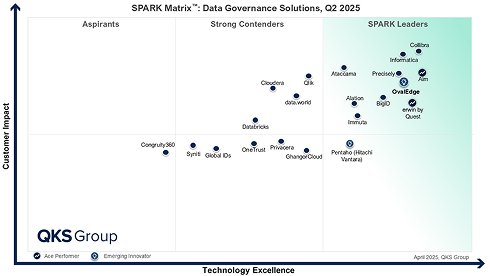
.png?width=1081&height=173&name=Forrester%201%20(1).png)
.png?width=1081&height=241&name=KC%20-%20Logo%201%20(1).png)