-3.png)
BCBS 239 data lineage is no longer optional in 2026. Regulators expect banks to trace every risk metric from source to report with full transparency. This guide explains how attribute-level lineage, governance, and change control enable audit readiness, stronger risk management, and sustained regulatory compliance.
Imagine a surprise regulatory inspection hits a bank. It scrambles to provide not just risk reports, but the full story behind them. Regulators want to trace each risk figure back to its source, field by field, system by system.
They expect end-to-end transparency, including where the data came from, how it moved, and what transformed it. But all the bank can offer is a patchwork of documentation scattered across teams, legacy systems, and spreadsheets.
There was no plan for this. The fallout is immediate with a critical audit report, millions earmarked for remediation, and accountability that lands squarely at the board level.
This level of scrutiny isn’t hypothetical.
In May 2024, the European Central Bank (ECB) released its guide on effective Risk Data Aggregation and Risk Reporting (RDARR), identifying seven key areas of concern.
One of the most urgent was attribute-level data lineage. Unlike general system-level lineage, this dives deep into how individual data attributes are sourced, transformed, and consumed.
Achieving this is challenging because:
a. Most organizations lack consistent metadata standards across systems.
b. Business logic often lives in untracked scripts and manual processes.
c. Data ownership is fragmented, making traceability unreliable.
In this blog, we explore the role of data lineage in BCBS 239 compliance, zooming in on both attribute-level and system-level lineage.
You’ll learn how to build a lineage that not only meets regulatory expectations but also strengthens internal risk management, data governance, and operational control.
What is BCBS 239 data lineage?
BCBS 239 data lineage is the structured ability to trace risk data from its source through every transformation to final regulatory and management reports.
It ensures accuracy, completeness, and transparency in risk data aggregation and reporting.
Regulators expect end-to-end visibility across systems, processes, and controls to validate how risk figures are produced.
Strong data lineage supports governance, auditability, and timely decision-making, especially during periods of stress.
For banks, BCBS 239 data lineage is a core compliance capability that proves control over risk data across the enterprise.
If you’re evaluating data lineage tools, explore our curated guide on the Top 25 Data Lineage Tools for Reliable Analytics Governance, comparing data lineage platforms designed to support accuracy, auditability, and enterprise‑wide governance.
BCBS 239 principles and data lineage requirements
BCBS 239 (Principles for effective risk data aggregation and risk reporting) remains a cornerstone regulatory framework for global systemically important banks (G-SIBs) and domestic systemically important banks (D-SIBs).
Among its 14 principles, data lineage is a critical enabler of compliance.
Yet implementing meaningful lineage remains a challenge across legacy systems, siloed architectures, and diverse risk environments.
Principle 1: Accuracy and integrity
Risk data must be accurate and reliable. Institutions must be able to validate the data used in risk management and reporting.
Data lineage provides the transparency needed to validate that risk data has not been altered, truncated, or corrupted through processing.
This includes tracking every transformation from extraction to enrichment to final presentation in dashboards or regulatory reports.
Without a traceable path, financial institutions cannot prove the integrity of risk indicators such as liquidity coverage ratios (LCRs) or credit exposures, especially during audits or stress tests.
Principle 2: Completeness
Banks must capture and aggregate all material risk data across entities, geographies, and systems.
Data lineage surfaces hidden or missing inputs across fragmented systems, ensuring that no critical data source or transformation step is omitted from the reporting chain.
|
For example, lineage tools can expose where a business unit’s data is being excluded from enterprise-level risk calculations, often due to an undocumented manual data transfer or misaligned metadata. |
Manual, spreadsheet-based lineage cannot keep up with the dynamic integration of new products, acquisitions, or platforms, leading to incomplete reporting and potential supervisory breaches.
Principle 3: Timeliness
Banks must ensure risk data is available quickly and reliably, especially during times of market stress. Timely access to risk indicators enables better crisis management and decision-making.
Without clear visibility into how data moves through the organization, timeliness breaks down. Lineage maps enable banks to proactively identify and address bottlenecks in data pipelines, such as:
a. Latent ETL processes
b. Queued jobs in data orchestration tools
c. Manual hand-offs or spreadsheet-based reconciliation
d. Delays introduced by legacy platforms
In times of market volatility, regulators increasingly expect same-day or even intra-day delivery of comprehensive risk reports.
Data lineage allows institutions to pinpoint specific choke points that slow down reporting.
|
For example, if a liquidity ratio report is delayed, lineage can trace the delay back to a sluggish reconciliation process in a treasury system, enabling immediate remediation. |
Principle 4: Adaptability
Risk data systems must adapt to evolving internal and external conditions, including regulatory changes, business restructures, or sudden shifts in risk appetite.
When regulations change, or new reporting dimensions are added (e.g., ESG stress testing or climate risk metrics), data lineage diagrams enable rapid impact analysis by:
a. Identifying all upstream systems feeding affected metrics
b. Highlighting dependent dashboards, models, or reports
c. Flagging outdated logic, filters, or transformation scripts
This minimizes the risk of inconsistent updates across systems and supports coordinated change management.
|
For example, if a central bank mandates a new risk exposure ratio, a lineage map helps IT, risk, and compliance teams visualize which databases, ETL jobs, and reporting layers need modification, reducing both time and error risk. |
In scenarios such as mergers, acquisitions, or system migrations (e.g., replacing a core banking system), lineage ensures continuity by mapping legacy schemas to new structures.
This avoids orphaned metrics or misaligned reporting during transitional periods, a common source of risk data errors in regulatory exams.
The Basel Committee’s Principles 7 through 11 focus on the operational maturity of a bank’s risk data environment.
These principles go beyond the collection of accurate data and require institutions to prove the governance, transparency, and traceability of that data throughout its lifecycle.
This is where data lineage becomes an indispensable tool.
Principle 5: Data architecture and IT infrastructure
To comply with BCBS 239, institutions must maintain an enterprise-wide data architecture that supports seamless integration, traceability, and resilience across systems.
However, many banks operate hybrid landscapes that span cloud platforms, legacy systems, data lakes, and vendor solutions, each with its own data flow and metadata silos.
Data lineage maps the end-to-end flow of data across this fragmented architecture.
It captures how risk metrics are calculated, transformed, and transferred from ingestion in source systems to final aggregation in dashboards.
Including lineage in architectural documentation enables IT and compliance teams to pinpoint integration failures, monitor changes, and validate system behavior in audits.
This traceability also supports future-proofing the architecture against regulatory changes or system migrations.
Principle 6: Accuracy and integrity of risk data
Accuracy in risk reporting isn’t only about having correct numbers. It’s about demonstrating how those numbers were derived.
Regulators are increasingly scrutinizing the "how" behind reported figures, demanding transparency in calculations, assumptions, and data transformations.
Data lineage provides an audit-ready, step-by-step visualization of data transformations.
It enables institutions to trace every metric back to its origin, exposing aggregation logic, transformation rules, and validation checks.
This ensures that the reported output aligns with defined risk models and that any deviation, intentional or accidental, is clearly documented and explainable.
Without lineage, errors in transformation logic (e.g., misapplied risk weightings or duplicated records) can go undetected until post-reporting.
Lineage helps surface these issues early, supporting remediation and avoiding reputational or regulatory fallout.
Principle 7: Clarity and understandability of risk reports
Regulators expect reports that are not only correct but also clear, understandable, and actionable.
Risk metrics must be explainable not just to data scientists, but to board-level decision-makers and supervisory authorities.
Lineage enhances report clarity by documenting the full data journey, from origin to outcome.
It bridges the gap between technical metadata and business context.
|
For instance, lineage diagrams can show how a report field labeled "Credit Risk Exposure" was calculated using multiple systems, external sources, and internal assumptions. |
This clarity is especially critical in environments where risk teams, auditors, and compliance officers must validate reporting processes across different regions or business lines.
Lineage serves as a common language between these stakeholders.
Principle 8: Frequency of risk reporting
BCBS 239 emphasizes the need for timely and frequent reporting, especially in periods of market volatility.
Institutions must be able to produce accurate risk reports daily, or even intraday, without compromising on quality or compliance.
Automated data lineage ensures that rapid reporting cycles do not sacrifice traceability.
Real-time or near-real-time lineage tracking allows teams to continuously monitor the integrity of the data pipeline.
It helps identify process lags, outdated datasets, or failed batch jobs that could delay or compromise reporting.
By embedding lineage into workflow automation, institutions can flag data quality issues early and reroute or correct workflows without waiting for post-mortem analysis.
This aligns reporting capabilities with the agility required by crisis scenarios or stress testing exercises.
Principle 9: Distribution of risk reports
Accurate data is useless if it doesn’t reach the right stakeholders in time.
Distribution must be consistent, secure, and aligned with regulatory and internal escalation protocols.
Lineage provides visibility into report consumption.
It allows teams to validate whether different departments, such as the board, risk, treasury, and compliance, are receiving the correct versions of risk metrics.
It also supports version control by highlighting any branching or modification of data as it moves toward different outputs.
This is especially critical in situations where conflicting versions of a risk report lead to inconsistent decision-making.
With lineage, discrepancies in report distribution can be traced and resolved before they escalate into governance failures.
By embedding data lineage into the heart of BCBS 239 compliance programs, institutions can move from reactive reporting to proactive risk management.
The result is not only better compliance but also better operational resilience, stakeholder trust, and business agility.
As regulatory scrutiny increases, institutions must be able to trace, validate, and explain every step of their risk data lifecycle.
Whether for timeliness, completeness, or auditability, lineage enables the transparency and trust that regulators now demand by default.
By aligning data architecture, governance, and technology with lineage-first thinking, firms not only ensure compliance but also strengthen the integrity of their enterprise risk decisions.
Understanding how data lineage supports compliance requires a broader view of the BCBS 239 framework itself.
Each of the 14 principles places specific expectations on accuracy, completeness, governance, and auditability, many of which cannot be met without clear lineage.
| For a deeper breakdown of how each principle translates into practical data and governance requirements, see our detailed guide on BCBS 239 Principles: Complete Guide for 2026. |
Why is data lineage critical for BCBS 239 compliance?
Financial institutions striving for compliance with BCBS 239 (Principles for Effective Risk Data Aggregation and Risk Reporting) face a multilayered challenge with regulatory intensity, fragmented data architectures, and an urgent need for trustworthy, auditable reporting.
At the heart of these challenges lies data lineage, the systematic tracing of data’s journey from source to report, which has become indispensable in demonstrating data integrity and governance.
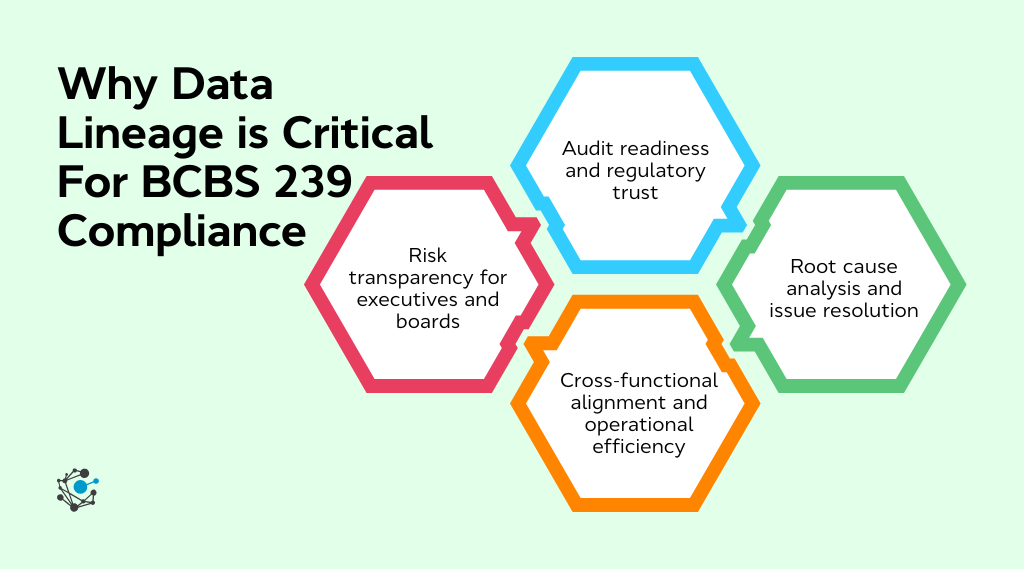
1. Audit readiness and regulatory trust
Under BCBS 239, regulators may request proof of data aggregation processes at any time.
Effective data lineage provides this proof by offering a transparent view into how risk data flows, transforms, and appears in reports.
These regulators might not just require a system-level overview, but granular traceability of Critical Data Elements (CDEs) used in Key Risk Indicators (KRIs).
They expect data to be traceable to the origin, with each transformation step documented and justified.
|
For example, if a capital adequacy ratio in a risk dashboard is flagged, regulators must see exactly which data fields from which systems were aggregated and how those values were calculated. |
2. Root cause analysis and issue resolution
When a data quality issue or reporting anomaly surfaces, institutions must move quickly to identify the source.
Without lineage, this becomes a manual, error-prone process involving guesswork and siloed knowledge.
Lineage enables pinpoint accuracy in tracing errors back to specific systems, transformations, or business rules.
|
For example, if VaR (Value at Risk) metrics are misreported due to an incorrect feed from a market data system, lineage helps isolate that misfeed, determine which downstream reports were affected, and document the corrective action taken. |
This ability to respond quickly and precisely aligns with BCBS 239’s principle on accuracy and integrity, ensuring decisions are based on reliable data.
3. Cross-functional alignment and operational efficiency
BCBS 239 isn’t just an IT or compliance problem. It’s an enterprise-wide mandate that touches risk, finance, reporting, data governance, and business operations.
Data lineage serves as the unifying layer that enables stakeholders to work from a shared understanding of how data flows.
Without lineage, finance may reconcile differently than risk, or compliance may question a data element’s validity, triggering friction and rework.
With lineage, all functions reference the same lineage map, improving alignment, reducing duplication, and enabling consistent interpretation of risk figures across the enterprise.
This alignment is essential for fulfilling BCBS 239’s emphasis on data governance, architecture, and control.
4. Risk transparency for executives and boards
Senior management and boards are accountable for signing off on regulatory submissions.
BCBS 239 mandates that risk data must be understandable and transparent, even at the highest level of oversight.
Without lineage, executives rely on black-box reports, unaware of potential data manipulation or aggregation errors.
With lineage, decision-makers can trace risk figures to their data sources, understand transformation logic, and gain confidence that the outputs are both defensible and actionable.
While many banks still view attribute-level data lineage as a cost burden, the reality is shifting.
Institutions that invest in automated, traceable, and auditable lineage systems are not just complying with BCBS 239. They are future-proofing their risk data infrastructure.
Core components of data lineage for BCBS 239
BCBS 239 compliance is not achieved through simple metadata documentation or isolated systems.
It demands structured, end-to-end data lineage that proves how risk data is sourced, transformed, validated, and reported across complex ecosystems.
Institutions must demonstrate transparency, control, and accuracy in how risk data is handled, making lineage a regulatory obligation, rather than just a technical asset.
1. Business lineage: Framing context and ownership
Business lineage contextualizes the “what” and “why” of data. It connects risk metrics, financial terms, and regulatory definitions with the underlying data that powers them.
|
For example, institutions must be able to trace the meaning and ownership of a metric like “risk-weighted assets” across jurisdictions, departments, and reporting layers. |
Common challenges of business lineage include:
a. Disconnected definitions across business units
b. No clear data ownership or accountability structure.
c. Inconsistent interpretation of terms across global reports
A shared data glossary and ownership matrix ensure consistency in regulatory submissions and reduce the risk of misreported figures in supervisory reviews.
2. Technical lineage: Mapping the data journey
Technical lineage traces how data physically moves and transforms from source systems through ETL pipelines to final reports. This includes:
a. Table-to-table movement
b. Transformation logic (e.g., risk factor aggregation)
c. Filters, joins, scripts, and data enrichment processes
Regulators such as the European Central Bank now explicitly require attribute-level lineage, capturing data at the column level from ingestion to output
This level of detail is vital for identifying critical data elements (CDEs) tied to Key Risk Indicators (KRIs) and resolving data quality issues at their source.
According to a 2025 Gartner guide on Data Integration, data integration maturity spans six key dimensions, including strategy, governance, metadata use, and architecture, demonstrating that mapping a data journey goes beyond tracing pipelines.
True lineage requires a structured, end-to-end approach that aligns with both regulatory expectations and enterprise data strategy.
3. Operational lineage: Tracking execution and control
Operational lineage details the execution processes that handle risk data, such as batch jobs, validation rules, reconciliation checkpoints, and exception handling routines. It helps with:
a. Supporting BCBS 239 Principle 6 (Timeliness) and Principle 11 (Control and Validation)
b. Providing transparency into whether automated processes are working as designed
c. Ensuring traceable audit trails during regulatory inspections or internal reviews
Operational lineage also captures dependencies between data processes and business calendars (e.g., end-of-day or T+1 cutoffs), which is vital for explaining report delays or timing mismatches in submissions.
4. Integrated data glossaries and taxonomies
One of the most frequent points of regulatory criticism in BCBS 239 audits is inconsistency in the way risk data is defined and interpreted across departments.
A lack of standardized business terms for critical metrics, such as "liquidity coverage ratio" or "credit exposure," leads to conflicting versions of the truth in regulatory submissions and internal dashboards.
A well-governed data lineage solution must be aligned with an enterprise-wide data glossary and taxonomy model.
This ensures that every data element tracked in lineage maps back to a defined and agreed-upon business term, including its metadata attributes, units of measure, and permissible values.
When glossary terms are not integrated into the lineage model, the same data point may be calculated differently in risk versus finance, violating the principle of consistency and traceability.
Leading organizations link their glossaries directly to the data pipeline.
This enables impact analysis when glossary definitions are updated and ensures automated propagation of semantic changes through reports and models.
5. Ownership maps and stewardship structures
BCBS 239 emphasizes defined roles and responsibilities for every step in the data lifecycle.
Ambiguity in ownership is a common root cause of poor data quality, delayed remediation, and failed audits.
Regulators want to see not just policies, but operating models that demonstrate real-world accountability for data quality, lineage validation, and control design.
Effective data lineage is not just about tracing data flows. It must also surface who is responsible for each stage in the journey. This includes:
a. Data stewards, who oversee the quality, completeness, and timeliness of data at rest
b. System owners, accountable for infrastructure integrity, access control, and interface reliability
c. Process owners, responsible for the end-to-end orchestration of data ingestion, transformation, and reporting
By embedding these roles directly into the lineage map, institutions gain the ability to accelerate root cause analysis, issue escalation, and regulatory response during reviews or incident investigations.
|
For example, if a key field in a risk report is flagged during internal validation, lineage tied to ownership roles allows teams to quickly determine whether the issue stemmed from a missing upstream control, a transformation error, or a recent schema change and who is responsible for fixing it. |
6. Change control and validation integration
A major failure point in many BCBS 239 programs is treating data lineage as a one-time documentation project.
Static lineage diagrams quickly become outdated, especially in agile environments where data pipelines, source systems, and risk models are under constant revision.
This undermines the very purpose of lineage, which is proactive compliance and risk oversight.
Lineage systems must be integrated with the institution’s change management framework, including data modeling tools, data catalog platforms, and workflow engines.
Any structural change, such as modifying a field in a source table or updating aggregation logic, should automatically trigger:
a. An update to the lineage model
b. An impact analysis of all downstream dependencies
c. A review and approval workflow involving relevant data stewards and control owners
Financial institutions cannot fulfill the principles of BCBS 239, especially those tied to risk data aggregation and reporting, without comprehensive, accurate, and governed data lineage.
Institutions that embed lineage into their enterprise governance architecture will:
a. Reduce regulatory risk and audit exposure
b. Respond faster to supervisory inquiries
c. Improve the quality and trustworthiness of internal risk decisions
Implementing data lineage for BCBS 239 compliance
Many BCBS 239 programs fail not because of a lack of intent, but because data lineage is approached as a documentation exercise rather than a compliance capability.
Implementing data lineage for BCBS 239 requires clear scoping, strong governance alignment, and continuous validation to ensure risk data remains traceable, accurate, and audit-ready as systems and regulations evolve.
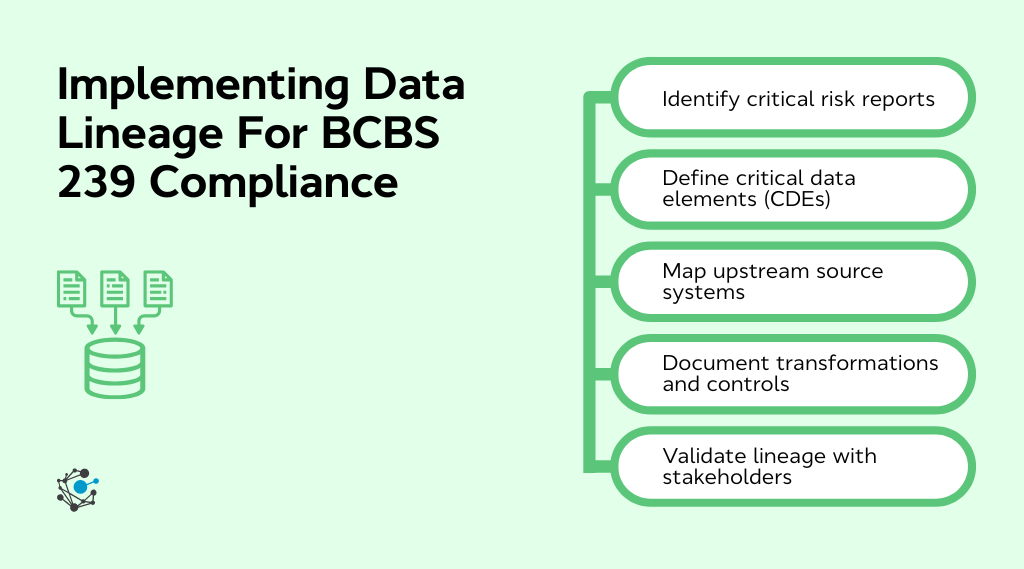
1. Identify critical risk reports
Effective BCBS 239 compliance begins with scoping the most high-impact deliverables, such as risk reports used by regulators, senior management, and boards of directors.
These reports represent the pinnacle of exposure under BCBS 239’s 14 principles, especially those tied to risk aggregation (Principle 3) and reporting accuracy (Principle 5). That is why institutions must prioritize:
a. Internal Capital Adequacy Assessment Process (ICAAP) reports
b. Liquidity Coverage Ratio (LCR) and Net Stable Funding Ratio (NSFR) submissions
c. Counterparty credit exposure summaries
d. Daily trading and market risk dashboards
Since these reports are directly tied to capital and liquidity adequacy, their traceability and data sourcing must be auditable at the data element level.
Without a clear lineage, banks risk regulatory sanctions for breaches of timeliness, accuracy, or completeness.
Firms often cast too wide a net or too narrow a scope. Over-prioritizing low-materiality reports dilutes effort.
Conversely, underestimating the regulatory relevance of internal dashboards used by CROs or CFOs can expose institutions to audit failures.
2. Define critical data elements (CDEs)
Identifying and governing Critical Data Elements (CDEs) is foundational to meeting the data architecture and IT infrastructure expectations outlined in BCBS 239 (Principles 2, 3, and 6).
CDEs are risk-sensitive metrics that influence capital planning, risk appetite, and real-time financial decisions. These include:
a. Counterparty exposure at default
b. Liquidity coverage metrics
c. Market risk sensitivities
d. Operational loss indicators
e. Stress test assumptions
Each CDE must be formally defined, owned, and catalogued, with clear business definitions and data quality thresholds.
Regulatory scrutiny often focuses on whether institutions can demonstrate consistent CDE usage across entities and jurisdictions, especially for global systemically important banks (G-SIBs).
Many banks struggle with misaligned definitions across geographies (e.g., "exposure at default" differing between regional risk teams), which leads to aggregation inconsistencies and undermines Principle 1: Governance.
3. Map upstream source systems
BCBS 239 expects end-to-end data traceability, from report output back to its originating systems, in line with Principle 2: Data Architecture and IT Infrastructure.
Mapping source systems involves cataloging:
a. Trading and treasury platforms (e.g., Murex, Calypso)
b. Risk engines and internal models
c. Core banking systems
d. Finance data marts
e. Third-party and external feeds
This phase must connect each CDE to its source table, field, and transformation logic, enabling regulators and internal stakeholders to reconstruct the full data pipeline.
Ideally, this mapping also includes data ownership at each point, aligning with accountability frameworks.
Some institutions stop at system-level mapping, which fails under regulatory review, whereas regulators expect attribute-level mapping.
OvalEdge automatically maps data at the attribute level, letting you trace each critical data element (CDE) back to its original field, along with every transformation, filter, or join applied along the way, so you can:
a. Connect business terms to source columns and spark data-driven conversations across teams for better definitions, ownership, and quality alignment.
b. Know exactly which reports, dashboards, or KPIs will break if a schema changes or a source field is deprecated.
This level of precision not only streamlines audits and reduces remediation costs but also builds trust across business, IT, and compliance teams.
4. Document transformations and controls
Transformation logic is where most data integrity risk accumulates and where regulators increasingly demand visibility. For BCBS 239 compliance, institutions must systematically document how data changes from source to report, including:
a. Joins, filters, and aggregations
b. Derived fields, formulas, and model outputs
c. Data quality rules, reconciliation checks, and break thresholds
d. ETL pipelines, staging layers, and control points
Modern regulatory expectations go beyond knowing what changed. They focus on why and how.
Regulators may request to see how a single liquidity ratio was derived, including intermediate logic, data exclusions, and control overrides.
5. Validate lineage with stakeholders
A critical but often neglected step in lineage implementation is cross-functional validation.
Regulators expect that data lineage is not just technically accurate but business-relevant and clearly understood.
Institutions should:
a. Run joint workshops with IT, risk, compliance, and finance teams
b. Review lineage maps using plain-language overlays for non-technical users
c. Test against known issues (e.g., mismatched totals, stale data flags)
d. Build lineage-based data issue resolution workflows
Validation ensures alignment with Principle 11, which requires that senior executives can explain the origin and processing of risk data.
Without this shared understanding, even the most technically accurate lineage model may fail regulatory scrutiny.
Validated lineage enhances data stewardship programs, enables faster root cause analysis when quality issues arise, and supports continuous improvement, rather than static documentation exercises.
If you're responsible for regulatory data reporting, governance, or architecture, mastering BCBS 239 data lineage is non-negotiable.
Traceability isn't just about ticking a box. It’s about proving control, enabling trust, and maintaining compliance in a high-stakes environment.
Conclusion
What happens when BCBS 239 data lineage is incomplete, unclear, or not maintained?
a. Can customers trust capital adequacy reports if data sources are unverifiable?
b. What happens when credit risk metrics shift overnight, and no one can trace why?
c. How do inaccurate liquidity reports impact decisions during market stress or client withdrawals?
While regulatory fines and remediation plans are immediate consequences, the broader impact is long-term and structural.
Inconsistent data lineage erodes customer confidence, especially in moments that demand transparency.
Clients, whether institutional or retail, expect financial institutions to operate with precision.
A single data error, if left unexplained or untraceable, can damage reputations far beyond the regulatory sphere.
This is why data lineage, in the context of BCBS 239, must be treated not as a reactive compliance obligation but as core data infrastructure.
When lineage is standardized, actively maintained, and governed across the enterprise, it unlocks far more than regulatory readiness.
It ensures every metric used in risk reporting, capital planning, and customer analysis is accurate, explainable, and defensible, internally and externally.
Struggling to trace risk data down to the column level?

See how OvalEdge automates end‑to‑end data lineage to support BCBS 239 requirements, reduce audit risk, and improve confidence in your reports.

Book a demo to see lineage built directly from your source systems.
FAQs
1. Are data catalog and data lineage exclusive?
No. While data catalogs list and describe data assets, data lineage shows how data moves and transforms. They complement each other. Catalogs provide the “what,” while lineage shows the “how” across systems and processes.
2. What is the role of data lineage in governance?
Data lineage underpins data governance by providing traceability, transparency, and accountability. It enables organizations to enforce data policies, validate reporting accuracy, and support regulatory audits with documented data flow.
3. How important is data lineage for a data catalog?
Data lineage adds context to data catalog entries by mapping data origins and flows. This enables better impact analysis, enhances trust in the data, and supports more effective stewardship and compliance.
4. Is metadata required for data lineage?
Yes. Metadata is essential for effective lineage. It defines how data is structured, moved, and transformed across systems, enabling accurate tracking, classification, and governance.
5. Why is version control important in data lineage?
Versioning ensures lineage reflects the current state of data pipelines. It also tracks historical changes, which is critical for audits, impact assessments, and regulatory reviews.
6. What is horizontal vs vertical data lineage?
Horizontal lineage tracks data movement across systems. Vertical lineage shows how data transforms within a system. Both are necessary to meet BCBS 239 traceability requirements.
.png?width=1081&height=173&name=Forrester%201%20(1).png)
.png?width=1081&height=241&name=KC%20-%20Logo%201%20(1).png)