


Business intelligence has long helped organizations understand performance, but it struggles to keep up with today’s decision speed and complexity. Agentic analytics represents a structural shift, moving analytics beyond reporting into continuous decision support and execution. This blog explains what has fundamentally changed, where agentic analytics improves outcomes, and why most enterprises layer it alongside BI rather than replacing it. It also outlines adoption criteria, risks of moving too fast, and how strong governance enables autonomy at scale.
Business intelligence has helped organizations understand performance for years, but it increasingly struggles to keep pace with how decisions are made today. We see teams surrounded by dashboards and reports, yet critical decisions are still delayed.
Reporting cycles rely heavily on historical data, manual refreshes, and human interpretation, which slows response times and limits agility.
As data volumes grow and operating environments become more dynamic, these challenges intensify. Insights remain reactive rather than proactive. Automation is fragmented. Analysts and business users spend more time interpreting information than acting on it. This growing gap between data availability and decision execution is no longer sustainable.
In this blog, we will explore why traditional BI is reaching its limits, where agentic analytics changes outcomes, and how organizations can adopt it responsibly to support faster, more consistent decision-making.
What is agentic analytics
Agentic analytics is best understood as a new operating model for analytics, not a nicer dashboard and not a light upgrade to reporting. It is built around autonomy, decision orchestration, and continuous interpretation of data signals in context.
Operating model
Agentic analytics is analytics driven by autonomous AI agents that can interpret signals, anticipate outcomes, and act within defined boundaries. The most important shift is responsibility. The system does not just deliver insights to humans, it helps enable decisions and, in some cases, initiates approved actions through governed workflows.
Gartner’s framing of decision intelligence is relevant here because it emphasizes engineering how decisions are made and improved through feedback loops. Agentic analytics takes that idea further by putting autonomous agents into the loop so decisions can scale without constant human handoffs.
How agentic analytics functions in practice
In practice, agentic analytics behaves less like a reporting tool and more like an always-on analyst-plus-operator. It continuously monitors key business signals, interprets changes using business context, and prompts or triggers actions when thresholds and policies are met.
You can think of it as three continuous motions working together:
-
Continuous interpretation: The system watches metrics and operational signals in near real time, not just in scheduled reports.
-
Contextual awareness: It links what it sees to definitions, ownership, lineage, and “what changed” narratives so the output is usable, not just accurate.
-
Decision execution: It routes recommended actions into the places work happens, such as ticketing, messaging, CRM workflows, or approvals, so insight does not die on a slide.
The point is not the novelty of AI. The point is that analytics becomes a living decision system instead of a library of dashboards.
What is business intelligence
Business intelligence is not broken. It has been a historically effective way to standardize reporting and give organizations shared visibility. It is simply becoming constrained by the speed and complexity of modern operations.
Traditional BI explained
Traditional BI is designed for historical analysis, structured data, and human-led interpretation. It excels at governance-heavy reporting, shared KPI definitions, and producing reliable snapshots of performance that teams can trust and align around.
If you run compliance reporting, quarterly business reviews, finance close analysis, or board packs, BI remains foundational because repeatability and auditability matter.
Where BI begins to fall short today
BI starts to strain when the business environment demands fast, consistent decisions across many teams at once. Common modern gaps include:
-
Decision latency: The time between a signal appearing and a decision being made grows because insights require manual analysis and coordination.
-
Manual dependency: Analyst bandwidth becomes a bottleneck when every new question requires a new dashboard or data model.
-
Limited scaling of insight consumption: A small group can interpret dashboards well, but insight rarely scales across the organization.
-
Real-time operational demands: Static reporting cycles do not match always-on digital operations, customer expectations, and rapid market shifts.
That is the opening where agentic analytics is emerging.
Agentic analytics vs business intelligence: what has fundamentally changed
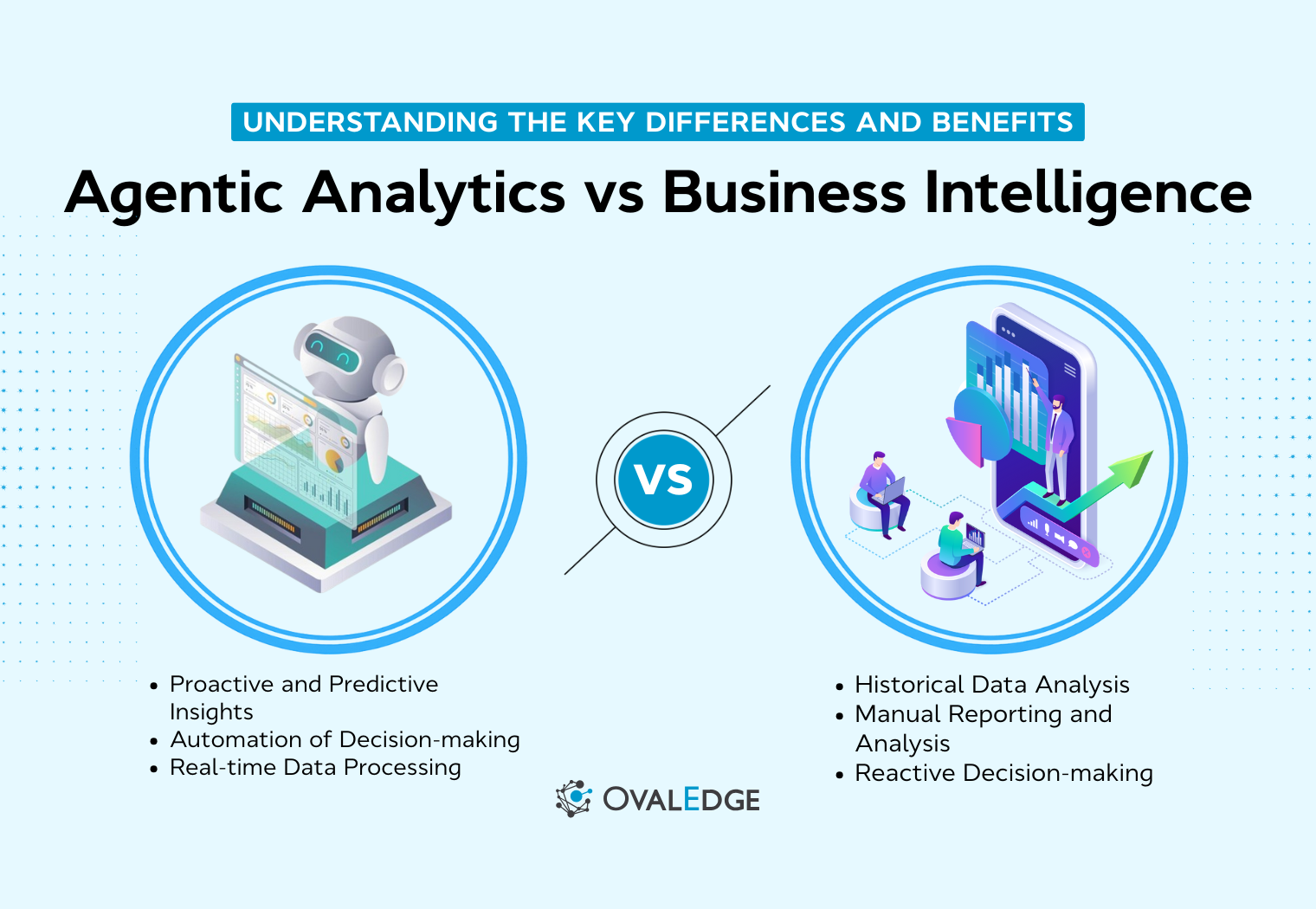
Agentic analytics and business intelligence are separated by more than technology upgrades. The difference lies in how decisions are made, who carries responsibility, and whether analytics stops at insight or continues into action and execution.
From insight consumption to decision execution
BI typically stops at insight delivery. It tells you what happened and sometimes why, then hands the rest to humans. Agentic analytics extends into decision-making and action by integrating recommendations, automation, and governed execution pathways.
From human-dependent workflows to scalable autonomy
BI scales slowly because it scales through people. As demand for insights grows, organizations add more analysts, expand reporting backlogs, and spend more time aligning stakeholders on definitions and interpretations. This model works up to a point, but it struggles when decision volume increases faster than human capacity.
Agentic analytics is designed to scale decision-making without a proportional increase in human effort. By allowing autonomous agents to handle repeatable interpretation, monitoring, and routing of insights, organizations can support more decisions with less manual coordination.
A structural shift, not an AI enhancement
BI with AI improves existing workflows. Faster charts, natural language queries, and automated insights still assume people review the output and decide what to do next. The role of analytics remains largely supportive.
Agentic analytics changes that role. Instead of waiting for questions, it continuously monitors signals, interprets change, and helps move decisions forward within defined boundaries. Analytics shifts from responding to requests to actively supporting action.
Because analytics is now closer to execution, the requirements are higher. Autonomous systems must be explainable, governed, and aligned with business policies. Without clear guardrails and measurable outcomes, agentic analytics becomes little more than traditional BI with smarter interfaces, not a fundamentally different decision model.
Agentic analytics requires more than smarter dashboards. It demands new architectural patterns, governance models, and decision boundaries. The OvalEdge Agentic Analytics whitepaper explains how enterprises design systems that move from insight to action without sacrificing control, explainability, or trust.
Why agentic analytics matters now
Agentic analytics matters now because the environment around data has changed faster than organizations’ ability to act. The challenge is no longer access to insight, but turning insight into timely, consistent decisions at scale.
The growing gap between data availability and decision speed
Organizations have more data than ever, but that abundance can widen the gap between seeing and acting. When data volumes grow faster than decision capacity, latency becomes a business risk. The cost shows up as missed revenue, slow incident response, and inconsistent customer experiences.
McKinsey’s AI research continues to show rapid gen AI adoption and a push toward value creation, but also highlights that scaling impact requires operating model changes, not just experimentation. Agentic analytics fits that theme because it targets the operating model of decisions.
The shift toward autonomous decision systems
The market is clearly moving toward autonomous decision systems. Organizations are facing environments where conditions change faster than humans can continuously monitor, interpret, and respond. In that context, autonomy becomes a necessity rather than an experiment.
Where agentic analytics changes outcomes
The real impact of agentic analytics shows up in outcomes, not interfaces. Its value lies in faster responses, fewer manual handoffs, and more consistent decisions across the organization.
Reducing decision latency across the organization
When agentic analytics is designed well, it reduces time lost to manual handoffs and interpretation bottlenecks. Instead of a chain like detect, request, build report, interpret, decide, act, you get a tighter loop where detection and interpretation happen continuously, and actions are routed directly into workflows.
You can see the broader enterprise trend in how consulting firms and platforms are building agent-based systems that automate cross-functional work. Business reporting on PwC’s “agent OS” describes it as a switchboard for coordinating multiple AI agents across enterprise tools. That is the direction of travel: fewer handoffs, more coordinated execution.
Improving consistency and decision quality at scale
Humans are inconsistent, especially under time pressure. Different teams interpret the same KPI differently, or apply different thresholds for action. Agentic analytics can reduce variance by embedding definitions, policies, and approved decision rules into the execution loop.
This is also where decision intelligence thinking matters. If you care about repeatability, explainability, and learning loops, you need systems that log rationale, outcomes, and feedback, not just screenshots of charts.
Agentic analytics tools and capabilities
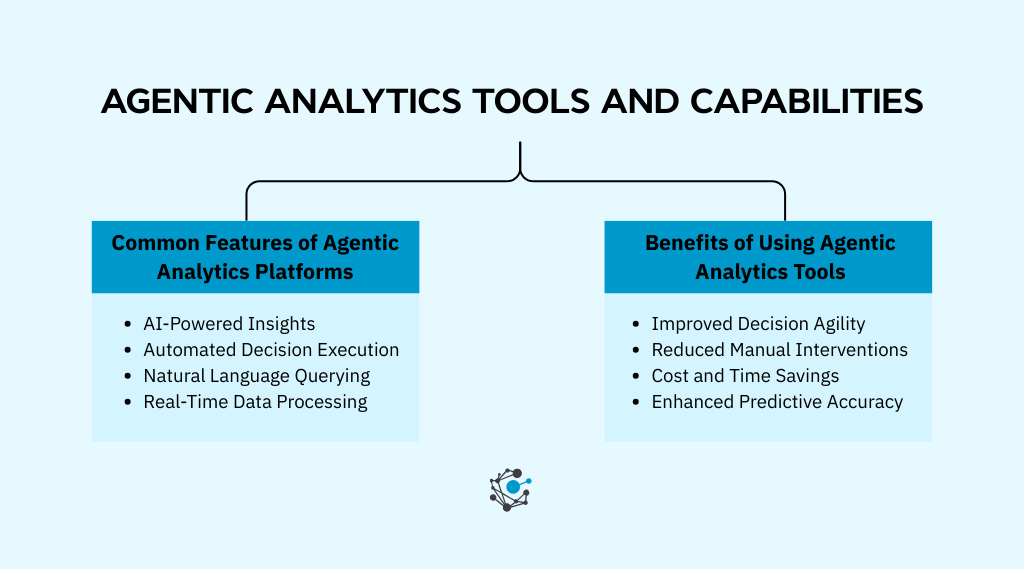
Agentic analytics tools matter not because of what they display, but because of what they enable. Their value lies in how they support continuous decision-making, automation, and scale across complex organizations.
Capabilities that enable autonomy
The capabilities behind agentic analytics are designed to reduce human dependency in routine decision flows while maintaining control and accountability. They focus on keeping decisions moving, not just insights visible.
-
Continuous monitoring of key business signals without manual queries or scheduled reporting
-
Context-aware interpretation that ties data changes to business definitions, ownership, and impact
-
Automated recommendation and governed action routing into operational workflows
-
Policy-driven guardrails that define when systems act, escalate, or defer to humans
-
Feedback loops that capture outcomes and improve future decisions over time
|
Also read: AI Agents for Analytics: Enterprise Guide for 2026 — a practical overview of how AI analytics agents operate, how they connect with existing BI and governance foundations, and what teams need to adopt them responsibly at scale. |
Organizational benefits of agentic analytics
When these capabilities are applied consistently, the benefits extend beyond analytics teams and into day-to-day operations. Agentic analytics changes how organizations respond to change, coordinate work, and sustain performance at scale.
-
Faster decision cycles by removing manual analysis and approval bottlenecks
-
Greater consistency in how teams interpret signals and take action
-
Improved operational efficiency by reducing repetitive reporting and coordination work
-
Better resilience during periods of volatility or rapid change
-
Stronger alignment between data, decisions, and business outcomes
Do organizations replace BI or layer agentic analytics?
Most organizations do not treat agentic analytics as a direct replacement for business intelligence. Instead, they evaluate where autonomy adds measurable value and layer it alongside BI to support faster, more consistent decision-making.
When BI remains the right tool
Business intelligence continues to be effective when the primary objective is standardized reporting and historical analysis. Use cases such as compliance reporting, financial close, executive dashboards, and quarterly performance reviews rely on BI’s ability to deliver stable, repeatable views of the business.
In these scenarios, the cost of variability is high and the pace of decision-making is predictable. BI provides the governance, auditability, and shared definitions required to maintain trust and alignment across the organization.
How agentic analytics layers on top of BI
Agentic analytics typically builds on BI rather than replacing it. It relies on trusted metrics, shared definitions, and historical context from existing BI systems, then continuously monitors how those signals change in operational environments to support faster decisions.
This layered approach is reflected in OvalEdge’s Fast, Cheap, On-Demand Analytics whitepaper, which explains how metadata-driven analytics reduces dependence on static report building. By emphasizing reusable context and on-demand insight, organizations can preserve BI as the system of record while enabling analytics that supports real-time interpretation and action.
How enterprise teams evaluate adoption
Adopting agentic analytics is not a binary decision. Enterprise teams assess where autonomy delivers meaningful value, how it fits within existing operations, and what level of control is required before systems are allowed to act.
Evaluation criteria for modern analytics stacks
Enterprise teams focus on whether an analytics platform can support faster, more reliable decisions without increasing operational burden.
-
Decision speed and the impact of latency on business outcomes
-
Frequency and repeatability of decisions that could be partially automated
-
Ability to scale insight consumption beyond analyst teams
-
Integration with existing data platforms and operational workflows
-
Support for real-time or near-real-time decision contexts
Governance and implementation considerations
Introducing autonomy requires clear guardrails to maintain trust, accountability, and compliance.
-
Defined decision boundaries that determine when systems act, escalate, or defer to humans
-
Explainability and auditability of recommendations and actions
-
Data access controls and security alignment with enterprise policies
-
Integration complexity with legacy systems and processes
-
Organizational readiness, including skills, ownership, and change management
Risks and challenges of accelerating into agentic analytics
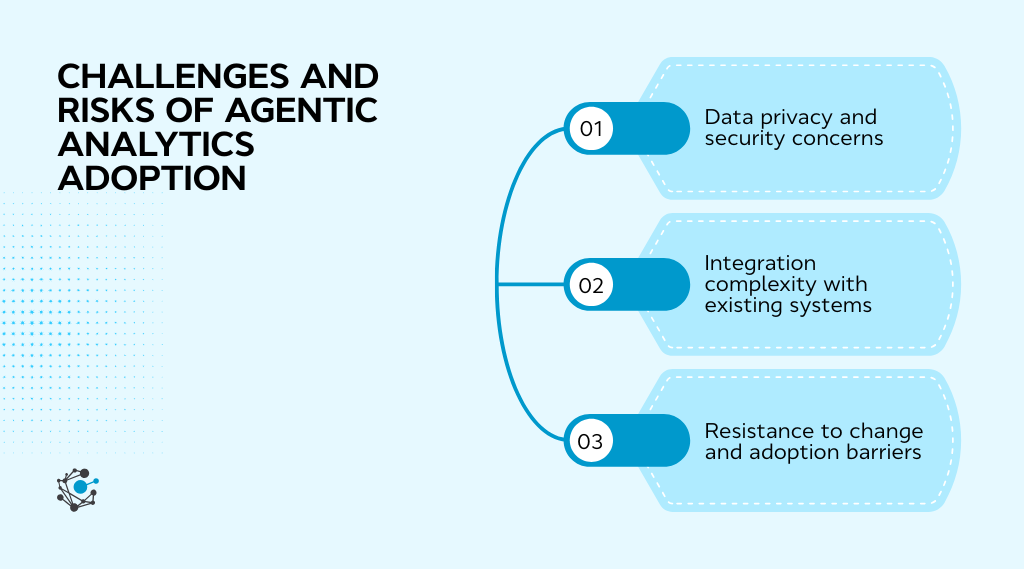
Agentic analytics can deliver meaningful gains, but moving too quickly introduces new risks. Without the right foundations, autonomy can amplify errors, erode trust, and create operational instability.
Data privacy and security risks
Autonomous analytics systems often require broad access to sensitive data and operational systems. Without strong access controls, monitoring, and policy enforcement, this expanded reach increases the risk of data exposure and unintended actions.
Privacy regulations and internal compliance requirements also raise the bar. Organizations must ensure that autonomous decisions respect consent, data residency, and usage constraints at all times.
Integration and operational complexity
Most enterprises operate across fragmented data platforms and legacy systems. Introducing agentic analytics adds another layer that must integrate cleanly with existing tools, workflows, and ownership models.
Without careful design, teams can end up with overlapping automation, unclear accountability, and fragile dependencies that are difficult to debug or scale.
Organizational readiness and adoption barriers
Technology readiness does not guarantee organizational readiness. Teams may resist automated decisions if trust, transparency, and accountability are not clearly established.
Skill gaps, unclear ownership, and misaligned incentives can also slow adoption. Successful implementations require leadership alignment, clear communication, and a phased approach that builds confidence over time.
|
Example: A commercial real estate company, Bedrock, struggled with inconsistent definitions and fragmented reporting that slowed decision cycles. By implementing OvalEdge’s integrated governance platform, the team standardized data, improved accuracy, and reduced manual effort. This foundation made analytics more trustworthy and actionable, mitigating risks that often arise when autonomy is introduced without governance. |
Conclusion
The conversation around agentic analytics vs business intelligence is not about choosing sides. Business intelligence remains essential for governed reporting and historical understanding, but it is no longer sufficient where speed, consistency, and execution determine outcomes. Agentic analytics fills that gap by turning analytics into an active decision layer rather than a passive reporting function.
For enterprise teams, the real question is where autonomy can safely and measurably improve results. Starting with repeatable decisions, clear guardrails, and strong governance is what separates durable impact from short-lived experimentation.
If your organization is exploring this shift, AskEdgi by OvalEdge offers a strong foundation. By combining AI-driven insights with governed data context and enterprise controls, AskEdgi helps teams operationalize analytics responsibly while maintaining trust and compliance.

Ready to move from insight to action. Book a demo with OvalEdge and see how agentic analytics can work within your existing data ecosystem.
FAQs
1. What are the main differences between agentic analytics and business intelligence?
Agentic analytics focuses on predictive insights, automation, and proactive decision-making, while business intelligence primarily offers descriptive analytics, relying on historical data and manual reporting for insights.
2. How does agentic analytics improve decision-making over traditional BI?
Agentic analytics automates decision-making processes, providing real-time insights and AI-driven recommendations, enabling businesses to make faster, more accurate decisions without manual interventions that BI tools typically require.
3. Can traditional BI tools still be useful alongside agentic analytics?
Yes, traditional BI tools can still be useful for long-term reporting and static data analysis. However, businesses seeking real-time insights and automated actions should consider integrating agentic analytics for greater agility.
4. What are the main challenges when adopting agentic analytics?
Challenges include data privacy concerns, integration with legacy systems, and resistance to change within organizations. Overcoming these hurdles requires proper governance, training, and a well-defined implementation plan.
5. How does AI play a role in agentic analytics platforms?
AI enhances agentic analytics by enabling autonomous data analysis, predictive modeling, and natural language queries, helping businesses make proactive decisions and automate processes based on real-time data.
6. Is OvalEdge suitable for organizations transitioning to agentic analytics?
Yes, OvalEdge integrates AI-driven insights, data governance, and automated decision-making into its platform, making it ideal for businesses looking to adopt agentic analytics and enhance their data-driven workflows.
Deep-dive whitepapers on modern data governance and agentic analytics
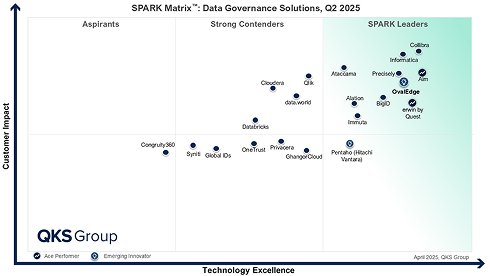
OvalEdge Recognized as a Leader in Data Governance Solutions
.png?width=1081&height=173&name=Forrester%201%20(1).png)
“Reference customers have repeatedly mentioned the great customer service they receive along with the support for their custom requirements, facilitating time to value. OvalEdge fits well with organizations prioritizing business user empowerment within their data governance strategy.”
.png?width=1081&height=241&name=KC%20-%20Logo%201%20(1).png)
“Reference customers have repeatedly mentioned the great customer service they receive along with the support for their custom requirements, facilitating time to value. OvalEdge fits well with organizations prioritizing business user empowerment within their data governance strategy.”
Gartner, Magic Quadrant for Data and Analytics Governance Platforms, January 2025
Gartner does not endorse any vendor, product or service depicted in its research publications, and does not advise technology users to select only those vendors with the highest ratings or other designation. Gartner research publications consist of the opinions of Gartner’s research organization and should not be construed as statements of fact. Gartner disclaims all warranties, expressed or implied, with respect to this research, including any warranties of merchantability or fitness for a particular purpose.
GARTNER and MAGIC QUADRANT are registered trademarks of Gartner, Inc. and/or its affiliates in the U.S. and internationally and are used herein with permission. All rights reserved.