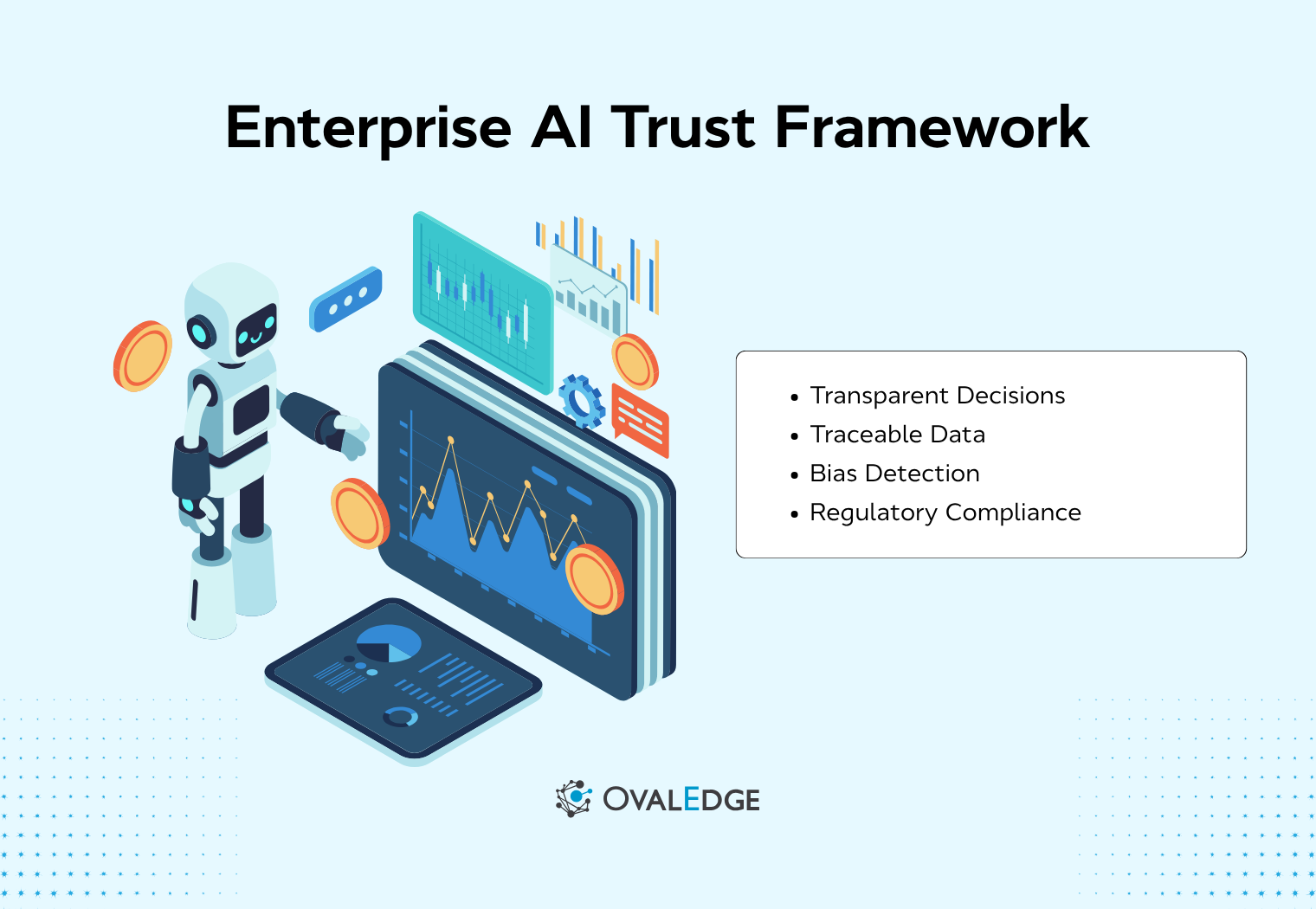
AI decisions are already shaping outcomes that matter, from who gets approved for credit to how global supply chains respond to disruption. But when those decisions are questioned, many organizations still struggle to explain them.
IBM Global AI Adoption Index Report 2023 shows that over 80% of enterprises say trust and explainability in AI are critical to their business, yet the reality inside most systems tells a different story.
Teams often cannot trace where data originated, how it was transformed, or why a model produced a specific outcome.
This is not a problem of capability. It is a problem of visibility. As AI scales across the enterprise, decisions become harder to track, validate, and defend, especially under growing regulatory scrutiny from frameworks like the EU AI Act.
What organizations are missing is not more advanced models, but a way to connect data, models, and decisions into a single, verifiable system.
This is where an enterprise AI trust framework comes in. It turns trust into something structured and measurable, embedding transparency, accountability, and compliance across the AI lifecycle. As companies move beyond experimentation, platforms that unify metadata, lineage, and governance are becoming essential to building this connected trust layer.
What is an enterprise AI trust framework?
An enterprise AI trust framework is a structured approach that ensures AI systems are transparent, accountable, compliant, and reliable by connecting data governance, model oversight, and risk management across the AI lifecycle. It replaces fragmented governance practices, isolated model monitoring tools, and disconnected compliance processes with a unified system of trust.
This definition is important because most organizations already have elements of governance in place. What they lack is a connected system that produces verifiable trust signals across data, models, and decisions.
What does it include?
In practice, a trust framework brings together multiple capabilities into a single, connected system:
-
Data lineage tracking to understand how data flows into AI models and decisions
-
Metadata and business context to define what data means, who owns it, and how it should be used
-
Model explainability to translate outputs into interpretable insights for stakeholders
-
Bias and performance monitoring to detect issues over time
-
Ownership and accountability mapping across data, models, and decisions
-
Policy enforcement mechanisms to ensure compliance with internal and external regulations
These are not isolated capabilities. They must work together.
|
Did You Know? According to the KPMG 2025 report, "Trust, Attitudes and Use of Artificial Intelligence: A Global Study," four in five people say they would be more willing to trust AI systems when assurance mechanisms such as monitoring, human oversight, and accountability are in place. |
Why it matters now
The need for structured trust frameworks is growing as AI moves into regulated and high-impact use cases. A 2025 Gartner report predicts that organizations that skip proper testing and governance for AI deployments will face twice as many cybersecurity incidents as those that take a proactive approach.
This shift is less about adopting AI and more about operating it responsibly at scale. As AI systems become embedded in decision-making across finance, operations, and customer interactions, the cost of failure increases. Errors are no longer contained in internal dashboards. They directly affect customers, compliance posture, and business outcomes.
What is changing is the nature of risk. Enterprises are no longer just managing model accuracy. They are managing:
-
Decision accountability across automated workflows
-
Real-time model behavior in dynamic environments
-
Regulatory exposure tied to explainability and auditability
This creates a new requirement. AI systems must be continuously governed, not periodically reviewed.
That is why trust frameworks are becoming an operational necessity. They enable organizations to move from reactive validation to proactive control, where risks are identified early, decisions are traceable, and governance is embedded directly into how AI systems run in production.
Core pillars of an enterprise AI trust framework
An enterprise AI trust framework is only as strong as the foundations it is built on. In practice, trust is not created through a single control or checkpoint. It emerges from a combination of tightly connected pillars that ensure visibility, accountability, and consistency across the AI lifecycle.
Leading organizations structure their frameworks around six core pillars.
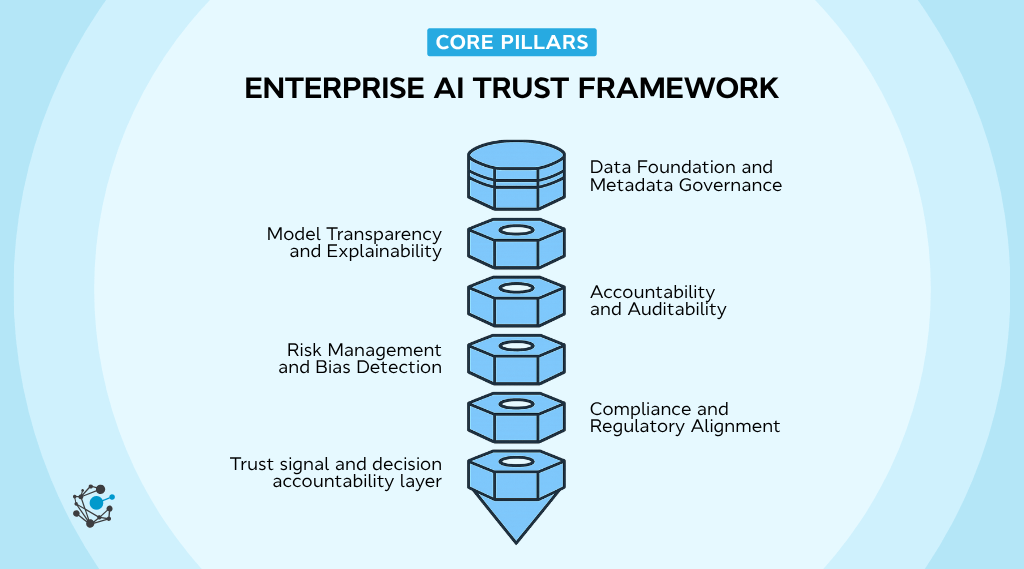
1. Data foundation and metadata governance
Trusted AI implementation always starts with trusted data. AI models are only as reliable as the data they are trained on. If the underlying data is inconsistent, poorly defined, or lacks context, even the most advanced models will produce unreliable or biased outputs.
This is where metadata governance plays a critical role. Metadata provides the context behind data, what it means, where it comes from, how it has changed, and how it is being used.
Data lineage further strengthens this foundation by enabling teams to trace the journey of data from source systems to AI outputs. This traceability is essential for debugging issues, validating results, and supporting audits.
Without this foundation, trust breaks down before models even come into play.
Where this shows up in practice:
-
Understanding which datasets feed into a model
-
Identifying transformations applied to data
-
Ensuring consistent definitions across teams
Platforms like OvalEdge help unify metadata, lineage, and governance, making it easier to establish a strong, trusted data foundation.
2. Model transparency and explainability
Once data is governed, the next challenge is understanding how models make decisions. AI systems, especially complex ones like deep learning models, often operate as black boxes. This creates a gap between technical outputs and business understanding. For AI to be trusted, stakeholders must be able to interpret why a decision was made.
Model explainability bridges this gap by translating model logic into human-understandable insights. This is critical not only for business adoption but also for regulatory compliance.
|
Pro tip: If a business user cannot explain an AI-driven decision in simple terms, the model is unlikely to be trusted, regardless of its accuracy. |
Explainability also supports:
-
Model validation and debugging
-
Regulatory audits and documentation
-
Building confidence among non-technical stakeholders
Frameworks increasingly incorporate tools that provide feature importance, decision paths, and scenario-based explanations to make AI outputs more transparent.
3. Accountability and auditability
Trust requires clear ownership. In many enterprises, AI systems operate across multiple teams, including data engineers, data scientists, business users, and compliance officers. Without clearly defined ownership, it becomes difficult to determine who is responsible for outcomes.
An effective AI accountability framework ensures that:
-
Data owners are responsible for data quality
-
Model owners are accountable for performance and behavior
-
Business stakeholders are responsible for decision usage
Auditability complements this by maintaining detailed records of how AI systems operate over time. Audit trails typically include:
-
Model versions and updates
-
Data inputs used for predictions
-
Decision logs and outputs
These capabilities are essential for both internal governance and external regulatory reviews.
|
Key takeaway: If you cannot trace who made a decision, what data was used, and how the model behaved at that moment, you cannot fully trust the system. |
4. Risk management and bias detection
AI introduces new categories of risk that traditional systems were not designed to handle. These include:
-
Bias in training data leading to unfair outcomes
-
Model drift as real-world conditions change
-
Over-reliance on automated decisions
A robust trust framework continuously monitors these risks rather than treating them as one-time checks.
|
Did you know? More than half (55%) of AI-related failures stem from third-party AI tools, highlighting how difficult it is for organizations to effectively monitor and manage emerging risks as per Boston Consulting Group, 2023. |
Key capabilities in this pillar include:
-
Bias detection across demographic or behavioral segments
-
Performance monitoring over time
-
Alert systems for anomalies or degradation
Risk management ensures that AI systems remain reliable not just at launch, but throughout their lifecycle.
5. Compliance and regulatory alignment
As AI adoption grows, so does regulatory scrutiny. Governments and regulatory bodies are introducing frameworks to ensure AI systems are safe, fair, and accountable. Organizations must align their AI practices with these evolving requirements.
This pillar focuses on:
-
Mapping AI systems to applicable regulations
-
Ensuring policies are enforced consistently
-
Maintaining documentation for audits and reporting
For teams managing sensitive data, pairing this with the right data privacy tools ensures that governance and regulatory requirements stay connected.
|
Pro tip: Compliance should not be treated as a final checkpoint. Embedding regulatory requirements into workflows from the start reduces risk and rework. |
6. Trust signal and decision accountability layer (differentiator)
This is the layer that connects all other pillars and makes trust measurable. Without it, governance efforts remain fragmented. With it, trust becomes something that can be consistently evaluated and validated across systems.
This layer links data inputs, model behavior, and final decisions into a single traceable chain. It ensures that every decision can be evaluated in context. It surfaces trust signals such as:
-
Data quality and completeness
-
Lineage coverage and traceability
-
Model confidence and performance
-
Policy compliance status
These signals allow stakeholders to assess whether a decision can be trusted, not just what the decision is. It also connects decisions back to ownership and governance policies, ensuring accountability is enforced.
This is what enables trust to scale. Instead of relying on manual validation, organizations can use consistent signals to evaluate AI systems across use cases and environments.
|
Key Takeaway: Trust becomes scalable only when it is measurable. The trust signal layer transforms governance from a static framework into a dynamic, verifiable system. |
How enterprise AI trust frameworks work in practice
An enterprise AI trust framework is not a static model. It operates as a continuous system where trust is built, validated, and reinforced at every stage of the AI lifecycle.
At a practical level, this can be understood as an end-to-end flow:
Data → Model → Decision → Audit → Review
Each stage is connected. Context, ownership, and controls move with the system, ensuring that trust is maintained continuously rather than verified after the fact.
Trust layer across data, models, and decisions
Enterprise AI trust frameworks operate across three tightly connected layers: the data layer, the model layer, and the decision layer.
-
The data layer ensures that all inputs into AI systems are governed, high-quality, and enriched with metadata such as definitions, ownership, and sensitivity. Without this layer, downstream systems inherit inconsistencies that directly impact model outputs.
-
The model layer focuses on how AI systems process data. It includes monitoring model performance, detecting drift, and applying explainability techniques so that outputs can be interpreted and validated. This layer ensures that models do not operate as black boxes.
-
The decision layer is where AI outputs are consumed and acted upon. Here, accountability becomes critical. Every decision must be linked to ownership, supported by audit trails, and evaluated against governance policies.
What makes this effective is not the individual layers, but how they are connected.
When a decision is made, stakeholders should be able to:
-
Trace it back to the underlying data
-
Understand how the model processed that data
-
Verify whether policies and controls were applied
This end-to-end visibility is what transforms AI systems from opaque processes into trusted enterprise systems.
Integration with enterprise data ecosystems
Enterprise AI does not operate in isolation. It is deeply embedded within a broader data ecosystem that includes multiple platforms, pipelines, and tools.
|
Did you know? 88% of organizations are already deploying or operating in hybrid cloud environments, making seamless integration across data platforms essential for effectively scaling AI, according to the IDC Cloud Pulse Survey, 2024. |
A trust framework works by integrating directly with these systems, such as:
- Cloud data warehouses like Snowflake and Google BigQuery
- Data lake platforms like Databricks
- Business intelligence tools and dashboards are used by business teams
This integration ensures that trust is not confined to AI models alone but is embedded across the entire data pipeline.
This is where unified platforms like OvalEdge play a key role, connecting data assets, pipelines, lineage, and governance workflows into a single layer that supports trusted AI at scale.
Role of AI compliance teams and governance workflows
Technology alone does not create trust. It requires coordinated effort across teams. Enterprise AI trust frameworks rely on cross-functional collaboration between:
-
Data engineering and data governance teams
-
AI/ML teams responsible for model development
-
Risk, compliance, and legal teams
-
Business stakeholders who use AI-driven insights
To make this collaboration effective, organizations establish structured governance workflows. These workflows typically include:
-
Policy definition and enforcement
-
Approval processes for model deployment
-
Continuous monitoring of models and data
-
Escalation mechanisms for risks or anomalies
|
Pro tip: The most effective AI governance workflows are automated as much as possible, reducing manual oversight while ensuring consistent enforcement of policies. |
Over time, many enterprises formalize these processes through dedicated AI governance committees or centers of excellence, ensuring that trust is not dependent on individual teams but embedded into organizational operations.
End-to-end trust lifecycle in action
To understand how all of this comes together, consider how trust is maintained across the lifecycle:
-
Data stage: Data enters the system with metadata, lineage, and policy context attached. Quality checks ensure reliability from the start.
-
Model stage: Models process this data with continuous monitoring, explainability, and risk controls in place.
-
Decision stage: Outputs are generated with clear context, ownership, and confidence indicators, making them interpretable and actionable.
-
Audit stage: Every decision is logged with traceability across data, models, and policies, enabling full auditability.
-
Review stage: Feedback loops validate outcomes, improve models, and update governance policies over time.
At each stage, trust is not assumed. It is validated through visibility, controls, and accountability.
Popular enterprise AI trust frameworks and standards
As enterprise AI adoption grows, organizations are not building trust frameworks from scratch. Instead, they are aligning with globally recognized standards and industry-led frameworks that provide structured guidance on responsible and trustworthy AI.
These frameworks help enterprises benchmark their practices, reduce risk, and ensure consistency across regions and use cases.
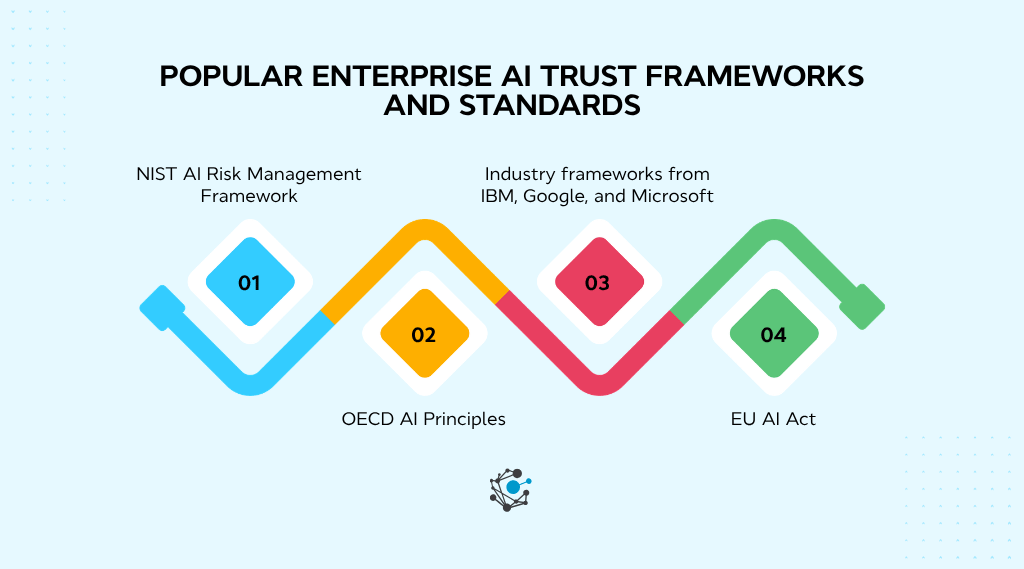
1. NIST AI Risk Management Framework
The National Institute of Standards and Technology AI Risk Management Framework (AI RMF) is one of the most widely adopted standards for managing AI risk in enterprises.
It provides a structured approach built around four key functions:
-
Govern: Establish policies, roles, and accountability
-
Map: Understand AI systems, data, and context
-
Measure: Assess risks such as bias, accuracy, and security
-
Manage: Mitigate and monitor risks continuously
What makes NIST particularly valuable is its flexibility. It does not prescribe specific technologies but instead offers a risk-based approach that organizations can adapt to their needs.
|
Did you know? The NIST AI RMF is designed to be voluntary but is increasingly being used as a baseline for regulatory and enterprise AI governance programs globally. |
2. OECD AI Principles
The Organisation for Economic Co-operation and Development (OECD) AI Principles were among the first internationally agreed guidelines for trustworthy AI.
They focus on five core values:
-
Inclusive growth and sustainable development
-
Human-centered values and fairness
-
Transparency and explainability
-
Robustness, security, and safety
-
Accountability
These principles are widely adopted by governments and enterprises as a high-level ethical foundation for AI systems.
|
Key takeaway: While OECD principles are not operational frameworks, they set the direction for how AI should behave, influencing both policy and enterprise governance strategies. |
3. EU AI Act
The EU AI Act represents one of the most comprehensive regulatory efforts for AI to date. It introduces a risk-based classification system for AI:
-
Minimal risk (limited regulation)
-
Limited risk (transparency requirements)
-
High risk (strict compliance obligations)
-
Unacceptable risk (banned use cases)
For high-risk AI systems, organizations must meet requirements such as:
-
Detailed documentation and auditability
-
Robust data governance and quality controls
-
Human oversight mechanisms
-
Continuous monitoring and risk management
|
Pro tip: Even organizations outside the EU are aligning with the EU AI Act because it is rapidly becoming a global benchmark for AI regulation. |
4. Industry frameworks from IBM, Google, and Microsoft
In addition to regulatory and policy frameworks, major technology companies have developed their own industry-specific trust frameworks. IBM, Google, and Microsoft have all published responsible AI guidelines and governance models that focus on operationalizing trust within enterprise environments.
For example:
-
IBM emphasizes explainability, fairness, and lifecycle governance in its trusted AI approach
-
Google focuses on responsible AI principles combined with technical tools for fairness and interpretability
-
Microsoft provides a comprehensive responsible AI framework supported by tooling for monitoring, transparency, and compliance
These frameworks are valuable because they bridge the gap between theory and implementation. They provide practical tools, reference architectures, and best practices that enterprises can adopt.
However, they are not one-size-fits-all solutions. Organizations typically adapt elements from these frameworks based on their industry, risk profile, and regulatory requirements.
|
How enterprises actually use these frameworks
In practice, organizations rarely follow one framework in isolation. Instead, they:
This layered approach allows enterprises to balance compliance, ethics, and operational efficiency. |
Strategic benefits of enterprise AI trust frameworks
Enterprise AI trust frameworks help organizations move from experimental AI adoption to scalable, reliable, and compliant systems by embedding trust into every stage of the lifecycle.
When trust is operationalized, AI stops being a high-risk initiative and becomes a dependable driver of business outcomes.
1. Improved confidence in AI-driven decisions
One of the most immediate benefits of a strong trust framework is increased confidence across stakeholders. When business users can understand how decisions are made, trace them back to underlying data, and verify their accuracy, they are far more likely to rely on AI outputs in critical workflows.
58% of executives say responsible AI initiatives improve ROI and efficiency, reinforcing how trust directly drives better outcomes and confidence in AI decisions as per PwC, Responsible AI Survey, 2025.
This reflects a simple reality. Trust is not just a compliance requirement. It is a usability factor. If users cannot interpret or validate AI-driven decisions, they hesitate to act on them. Over time, this limits adoption, regardless of how advanced or accurate the model may be.
On the other hand, when transparency, traceability, and validation are built into the system, AI becomes a reliable decision-support layer rather than a black box.
2. Better regulatory compliance and reduced risk exposure
Regulatory pressure around AI is increasing across industries. Organizations must be able to demonstrate how their systems operate, how risks are managed, and how decisions are made.
A trust framework embeds compliance into the system itself. Instead of preparing for audits manually, organizations can rely on:
-
Built-in audit trails
-
Policy enforcement across data and models
-
Documentation generated as part of workflows
This reduces compliance effort while improving audit readiness.
3. Increased transparency across data and models
In many enterprises, data and models operate in silos. Data teams manage pipelines, AI teams manage models, and business teams consume outputs without full visibility into how they are generated.
A trust framework connects these layers.
It ensures that metadata, lineage, and explainability are accessible across systems, so stakeholders can understand both the inputs and outputs of AI systems.
This reduces ambiguity and improves collaboration across teams.
4. Faster adoption of AI across business teams
When trust barriers are removed, AI adoption accelerates. Business teams are more willing to integrate AI into their workflows when they:
-
Understand how models work
-
Trust the data behind them
-
Have confidence in governance and oversight
This leads to faster scaling of AI initiatives across departments such as finance, marketing, operations, and customer experience.
|
Pro Tip: If your AI initiatives are stuck in pilot mode, the issue is often not capability. It is a lack of trust and governance at scale. |
5. Reduced operational issues from poor data quality
Many AI failures can be traced back to data issues rather than model limitations. A trust framework addresses this by continuously monitoring data quality, tracking lineage, and enforcing governance policies.
This reduces:
-
Inconsistent outputs caused by unreliable data
-
Model performance issues due to data drift
-
Rework caused by undetected data errors
Bringing it all together
When these benefits compound, organizations move from fragmented AI efforts to a cohesive, scalable AI strategy.
Instead of constantly validating outputs or addressing risks reactively, teams operate with confidence, knowing that trust is built into the system.
This shift is what separates organizations experimenting with AI from those truly operationalizing it at scale.
How enterprises implement an AI trust framework
Enterprise AI trust frameworks are not deployed as a single system. They are implemented in stages by connecting governance, data, and AI workflows into a unified operating model.
Step 1: Define trust policies and governance standards
The first step is to establish what “trust” means within the organization.
This involves defining policies for data usage, model behavior, and decision accountability. Organizations must also identify regulatory requirements and risk thresholds based on their industry and use cases.
Ownership is assigned across data, models, and decision workflows to ensure accountability is clearly defined from the start.
This step creates the baseline for how AI systems should operate.
Step 2: Map data, metadata, and lineage
Trust depends on understanding what data flows into AI systems. This often starts with data discovery tools that help teams surface and inventory what data they actually have across distributed environments.
They also establish lineage from source systems to model inputs and outputs, ensuring that every AI decision can be traced back to its origin.
This step is often where gaps become visible, especially in complex, distributed data environments.
|
Did You Know? Many enterprises discover during this stage that they lack complete visibility into their data pipelines, which becomes a major barrier to building trusted AI systems. |
Step 3: Monitor models and enforce controls
Once models are in production, continuous monitoring becomes essential.
Organizations track model performance, detect drift, and monitor bias over time. Explainability techniques are applied to interpret outputs, making them understandable for stakeholders.
Policies are enforced through automated checks, alerts, and thresholds, ensuring that models operate within defined governance boundaries.
This step ensures that trust is maintained, not just established at deployment.
Step 4: Enable audit, review, and continuous improvement
Trust frameworks must support validation and iteration.
Organizations maintain audit trails across data, models, and decisions, enabling full traceability. Periodic reviews are conducted with governance and compliance teams to assess performance and identify risks.
Feedback loops are used to refine models, improve data quality, and update governance policies as systems evolve. This ensures that trust is not static but continuously improving.
Conclusion
AI adoption is no longer the challenge. Trust is.
Enterprises today have the tools, data, and models to build powerful AI systems, but without a structured way to validate decisions, trace outcomes, and enforce accountability, those systems struggle to scale beyond controlled environments.
An enterprise AI trust framework changes that by connecting data, models, and decisions into a single, governed system. It enables organizations to explain outcomes, ensure compliance, and act with confidence rather than assumptions.
Trust is not something you add later. It is what determines whether AI delivers real business value. Capabilities like metadata, lineage, governance workflows, and continuous monitoring make AI systems reliable, auditable, and usable across the enterprise.
As AI becomes central to decision-making, organizations that invest in trust will move faster and reduce risk. Platforms like OvalEdge help operationalize this at scale.
If you are building enterprise AI, start by embedding trust from the ground up. Book a demo to see how OvalEdge can help.
FAQs
1. How do enterprises measure trust in AI systems?
Enterprises measure AI trust using indicators such as model accuracy, stability, bias detection rates, explainability scores, audit readiness, and compliance adherence. Many organizations also track user confidence and decision adoption to assess whether AI outputs are consistently trusted across business teams.
2. What roles are responsible for managing AI trust in enterprises?
AI trust is managed through cross-functional collaboration. Data governance leaders handle metadata, lineage, and data quality. AI and ML teams manage model performance, explainability, and monitoring. Risk and compliance teams oversee regulatory alignment. Many enterprises also establish AI governance committees to ensure accountability and coordination.
3. How does data lineage contribute to AI trust frameworks?
Data lineage provides visibility into how data moves from source systems into AI models and final decisions. This traceability supports root-cause analysis, improves auditability, and ensures stakeholders understand how inputs influence outputs, which strengthens trust in AI systems.
4. What industries require enterprise AI trust frameworks the most?
Industries with high regulatory pressure and risk exposure benefit the most. This includes financial services, healthcare, insurance, and public sector organizations, where explainability, auditability, and compliance are critical for decision-making.
5. How long does it take to implement an enterprise AI trust framework?
Implementation timelines vary based on data maturity and existing governance practices. Most organizations can establish foundational capabilities within a few months, but fully operationalizing trust across data, models, and workflows typically takes 12 to 24 months.
6. Can enterprise AI trust frameworks support generative AI systems?
Yes. Enterprise AI trust frameworks are increasingly being extended to support generative AI by adding controls for prompt tracking, output validation, content risk monitoring, and usage governance. These controls ensure that generated outputs remain accurate, compliant, and aligned with organizational policies.
.png?width=1081&height=173&name=Forrester%201%20(1).png)
.png?width=1081&height=241&name=KC%20-%20Logo%201%20(1).png)