AI adoption inside enterprises has moved from experimentation to scale. Teams are deploying machine learning models across customer analytics, risk scoring, operations, and generative AI use cases. But scaling AI successfully remains a challenge for most organizations.
According to Boston Consulting Group’s 2024 global AI study, 74% of companies struggle to achieve and scale value from AI, with only 26% successfully moving beyond pilot stages.
Most organizations are not struggling to build models. They are struggling to govern them.
As the number of models grows, complexity increases. Models drift, decisions become harder to explain, and regulatory expectations continue to tighten. Regulations such as the EU AI Act and evolving global AI standards are pushing organizations to demonstrate transparency, accountability, and risk control across the entire AI lifecycle.
This is where enterprise AI model governance software becomes essential. These platforms help organizations monitor models, enforce policies, track lifecycle changes, and ensure compliance across AI systems.
For teams evaluating AI model governance tools today, the goal is clear: reduce model risk gaps while building AI systems that remain reliable, auditable, and scalable.
What is enterprise AI model governance software?
Enterprise AI model governance software helps organizations monitor, control, and document how AI and machine learning models are built, deployed, and used across the enterprise. It provides a structured way to manage the entire model lifecycle while ensuring transparency, compliance, and accountability.
These platforms act as a central control layer for AI systems. Instead of models being scattered across teams, tools, and environments, governance software creates visibility into where models exist, how they behave, and whether they meet regulatory and business standards.
At an enterprise level, this becomes critical. Without governance, organizations face issues such as:
-
Undocumented models in production
-
Inconsistent validation processes
-
Lack of explainability in decision-making
-
Difficulty responding to audits or regulatory inquiries
Modern enterprise AI model governance software addresses these gaps by combining lifecycle management, monitoring, and compliance workflows into a single system.
|
Did you know? Many enterprises cannot produce a complete inventory of their production models during audits. A centralized model registry is often the first step toward building a mature AI governance program. |
Key functions of AI model governance platforms
At a functional level, most AI model governance tools provide a consistent set of capabilities that help organizations operationalize governance at scale:
-
Model inventory and documentation
-
Model lifecycle tracking
-
Bias detection and fairness monitoring
-
Regulatory compliance monitoring
-
Audit trails and explainability
-
Model performance monitoring
-
Version control and change tracking
These capabilities vary significantly in depth depending on whether the platform focuses on data governance, model monitoring, or MLOps. However, when implemented together, they form a continuous governance loop rather than a one-time validation process.
How AI model governance differs from traditional model risk management
Traditional model risk management (MRM) frameworks were originally designed for financial models, where the number of models was relatively limited, and validation cycles were periodic. AI systems operate very differently, which is why governance approaches have evolved.
Here’s how they differ in practice:
|
Aspect |
Traditional model risk management |
AI model governance |
|
Scope |
Financial and statistical models |
ML, GenAI, predictive, and decision systems |
|
Validation approach |
Periodic reviews |
Continuous monitoring and validation |
|
Transparency |
Limited explainability |
Built-in explainability and traceability |
|
Governance model |
Manual processes |
Automated lifecycle governance |
|
Risk coverage |
Model accuracy and stability |
Bias, fairness, compliance, drift, and usage risks |
In modern enterprises, relying only on traditional MRM is no longer sufficient. AI model governance tools are designed to handle the scale, complexity, and regulatory expectations of today’s AI-driven systems.
Types of AI model governance tools used by enterprises
Enterprise AI governance is not handled by a single type of tool. Most organizations use a combination of platforms depending on how their data, models, and workflows are structured.
Broadly, AI model governance tools fall into three categories. Each plays a different role in managing model risk, compliance, and lifecycle visibility.
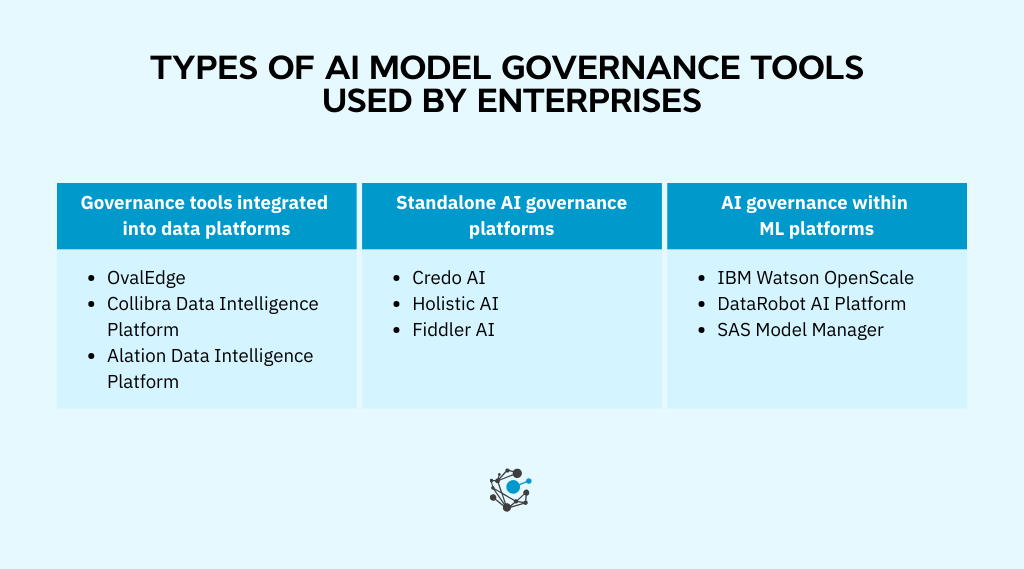
Governance tools integrated into data platforms
These platforms extend data governance, metadata management, and lineage into AI governance. Instead of focusing only on models, they govern the data pipelines feeding those models, which is critical for auditability and compliance.
This approach works well for organizations where AI governance is tightly linked to data governance maturity.
1. OvalEdge
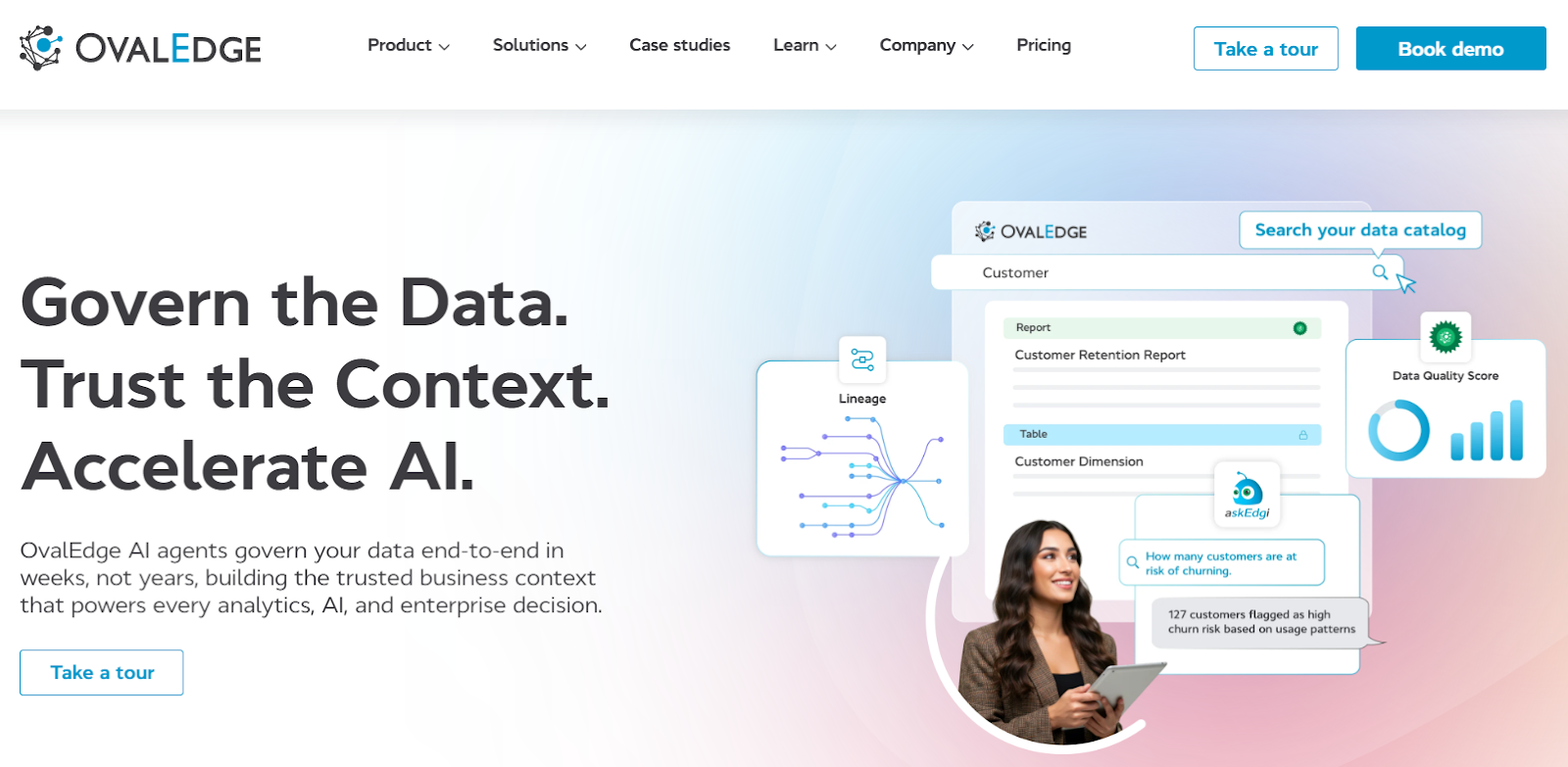
OvalEdge is a data governance and data catalog platform that extends into AI model governance by providing visibility into the data pipelines, data lineage, and metadata that power machine learning models. Instead of governing models in isolation, it helps organizations trace how data flows into AI systems, which is essential for auditability, compliance, and model risk management. This makes it particularly useful for enterprises where data governance maturity is a prerequisite for AI governance.
Key features
-
Data lineage and traceability: OvalEdge provides end-to-end data lineage, allowing teams to trace how data flows from source systems into AI models. This visibility is essential for audits, root cause analysis, and understanding how data changes impact model outcomes.
-
Metadata management and data catalog: It centralizes metadata across datasets, pipelines, and systems, making it easier to discover, understand, and govern data assets. This helps data science and governance teams work with consistent, well-documented inputs for AI models.
-
Policy management and compliance controls: OvalEdge enables organizations to define and enforce data governance policies across their data ecosystem. This ensures that only compliant, approved datasets are used in model training and inference.
-
Data quality monitoring: The platform helps track data quality problems such as missing values, inconsistencies, or anomalies. This reduces the risk of poor model performance caused by unreliable or corrupted data inputs.
Pros
-
Strong data lineage and visibility across complex data ecosystems
-
Centralized metadata improves data discovery and governance
-
Helps ensure AI models are built on compliant and high-quality data
-
Integrates well with broader enterprise data governance initiatives
Best for: Enterprises that want to extend data governance into AI governance, especially where controlling data lineage, quality, and compliance across pipelines is critical for managing AI model risk.
Want to see how OvalEdge helps govern data pipelines, lineage, and compliance for AI models?

Book a quick walkthrough to explore how it fits into your AI governance stack.
2. Collibra Data Intelligence Platform
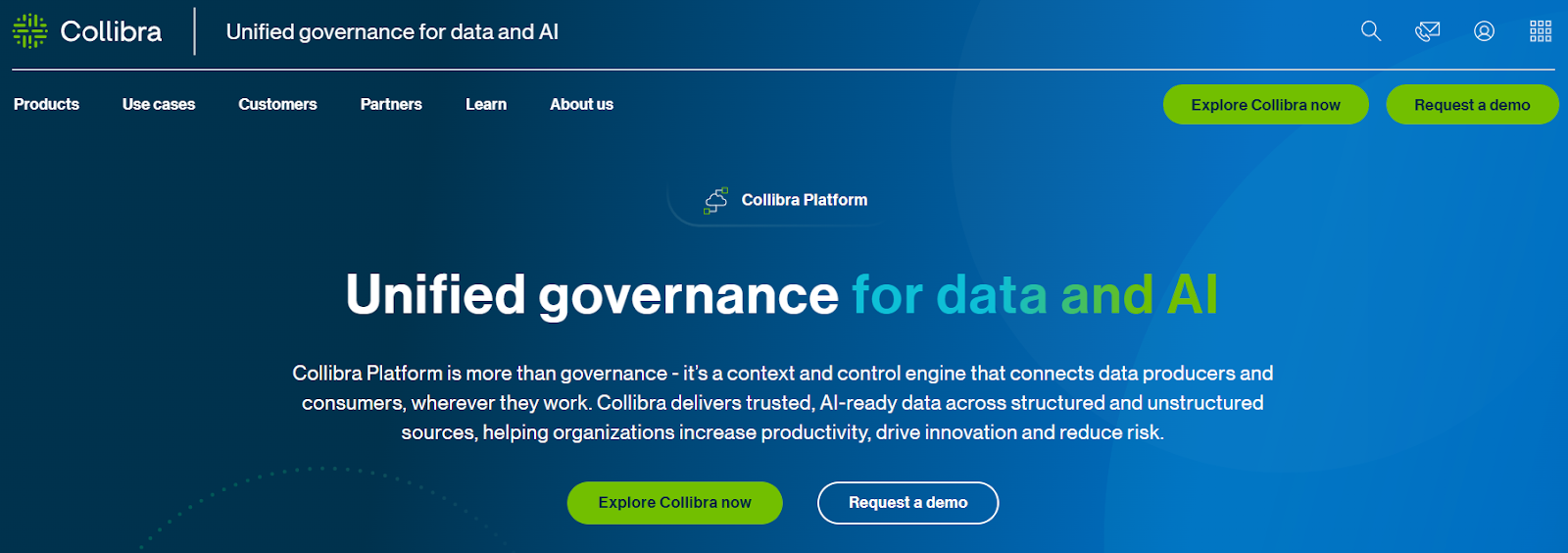
Collibra Data Intelligence Platform is an enterprise data governance solution that supports AI model governance by providing policy management, data lineage, and stewardship workflows. It helps organizations govern the data layer behind AI systems, ensuring that models are built on trusted, compliant, and well-documented data.
Key features
-
Data catalog and metadata management: Collibra provides a centralized data catalog that allows teams to discover, understand, and trust data assets.
-
End-to-end data lineage: It enables detailed lineage tracking from source systems to downstream consumption, including AI pipelines.
-
Policy management and governance workflows: Allows organizations to define governance policies and enforce them through workflows.
-
Data stewardship and ownership: The platform supports role-based ownership, helping assign accountability for datasets.
|
Pros |
Cons |
|
|
Best for: Large enterprises with established governance programs that need to enforce policies, manage data ownership, and ensure compliance across AI data pipelines.
3. Alation Data Intelligence Platform
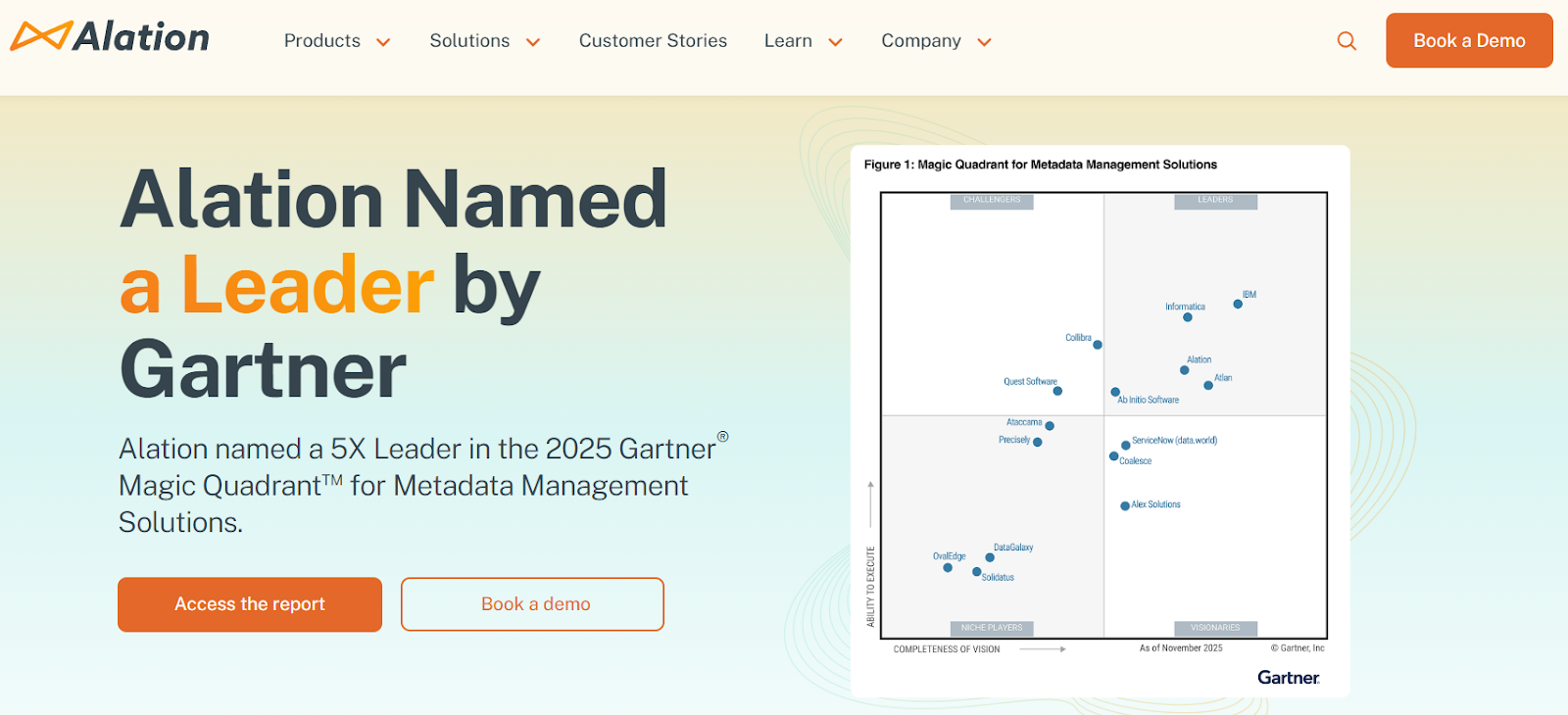
Alation Data Intelligence Platform is a data catalog and governance solution that supports AI model governance by improving data discovery, usage visibility, and governance policy adoption. It focuses on helping teams understand how data is used across analytics and AI workflows, which is critical for ensuring that models are built on trusted and well-governed data.
Key features
-
Data catalog and discovery: Alation provides a searchable catalog that helps teams quickly find relevant datasets. Built-in collaboration and usage insights make it easier to identify trusted data for AI use cases.
-
Data lineage and impact analysis: It offers lineage capabilities that show how data flows across systems and transformations.
-
Governance policies and data quality signals: Alation enables policy definition and enforcement along with data quality indicators.
-
Collaboration and data stewardship: The platform encourages collaboration through annotations, certifications, and shared knowledge.
|
Pros |
Cons |
|
|
Best for: Organizations looking to improve data discovery, collaboration, and trust in datasets used for AI, especially where adoption and usability are key priorities alongside governance.
|
Why data governance matters for AI?
Many AI failures are not model failures; they are data failures. BCG’s research further shows that 70% of AI implementation challenges are related to people and process issues, not algorithms. This reinforces why governance, accountability, and structured workflows are critical for scaling AI reliably. Without clear lineage and metadata, it becomes difficult to explain model decisions or prove compliance during audits. |
Standalone AI governance platforms
These tools are purpose-built for AI governance, model monitoring, explainability, and compliance. They operate independently of data governance systems and focus directly on model behavior and risk.
They are commonly adopted in highly regulated industries where model transparency and audit readiness are critical.
1. Credo AI
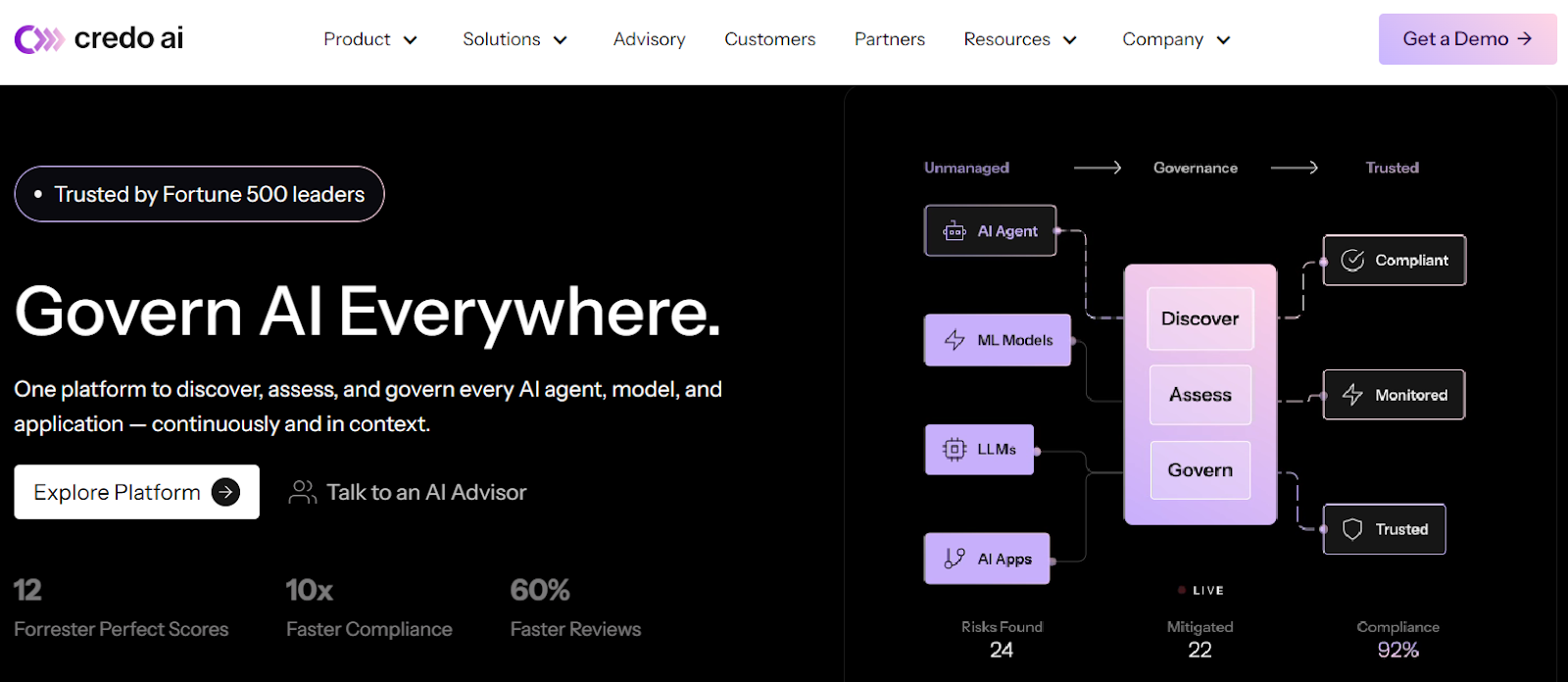
Credo AI is a purpose-built AI governance platform designed to help enterprises operationalize responsible AI, risk management, and regulatory compliance. Unlike data governance tools, Credo AI focuses directly on governing AI systems by aligning models with internal policies, external regulations, and ethical standards.
Key features
-
AI governance workflows and policy enforcement: Allows organizations to define responsible AI policies and map them to workflows.
-
AI risk assessment and scoring: Evaluates AI systems based on risk factors such as use case sensitivity, data exposure, and regulatory impact.
-
Compliance tracking and audit readiness: Maintains structured documentation and audit trails aligned with frameworks like NIST AI RMF and emerging regulations.
-
Centralized AI system inventory: It provides visibility into all AI systems across the organization, including ownership, risk classification, and governance status.
|
Pros |
Cons |
|
|
Best for: Enterprises building formal, responsible AI programs that need structured governance workflows, risk scoring, and regulatory compliance tracking across multiple AI use cases.
2. Holistic AI
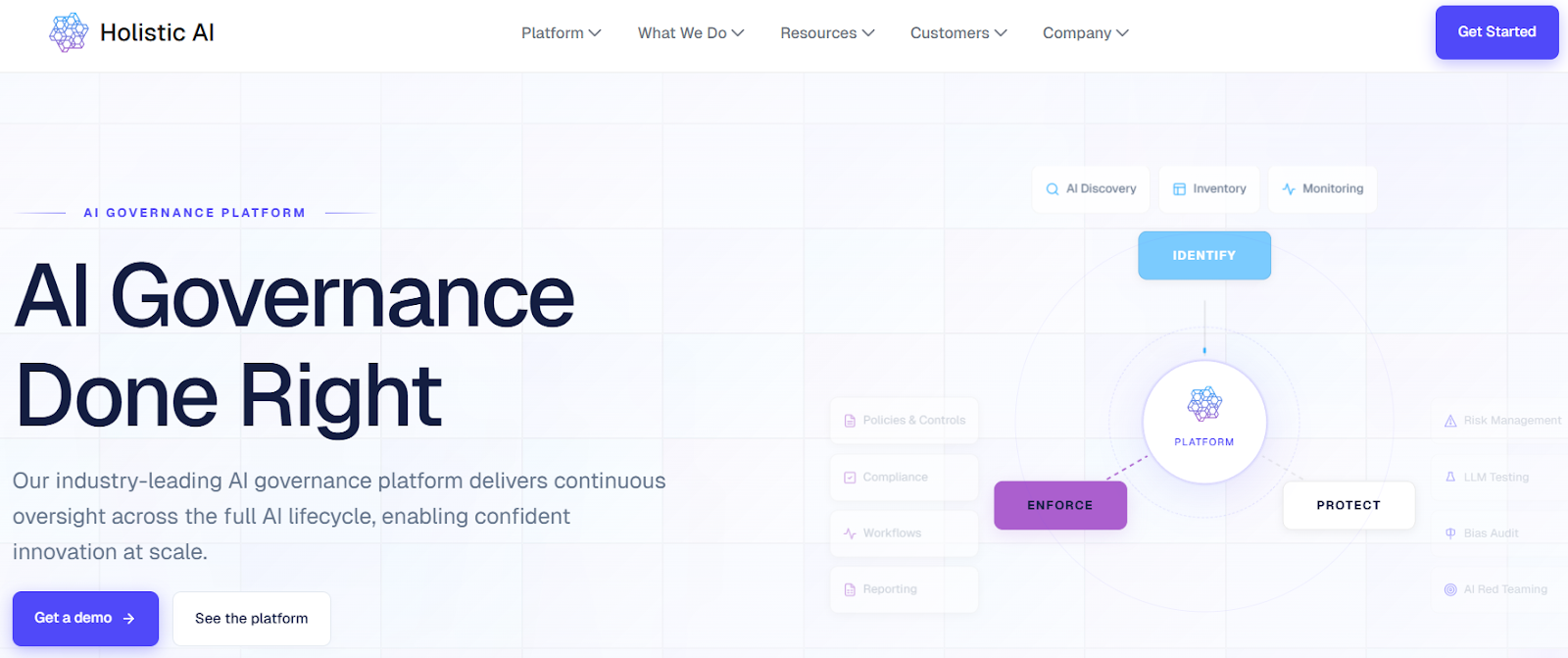
Holistic AI is a specialized AI governance platform that focuses on risk management, bias detection, and regulatory compliance across enterprise AI systems. It helps organizations assess AI models against global standards and identify risks related to fairness, transparency, and accountability.
Key features
-
Bias detection and fairness analysis: Holistic AI provides tools to assess models for bias across protected attributes and fairness metrics.
-
AI risk assessment framework: The platform evaluates AI systems across multiple risk dimensions, including ethical, legal, and operational factors.
-
Regulatory compliance support: Holistic AI aligns governance workflows with emerging global regulations and standards.
-
Monitoring and reporting dashboards: It offers dashboards that track risk indicators, fairness metrics, and governance status over time.
|
Pros |
Cons |
|
|
Best for: Organizations that need to prioritize AI risk management, fairness, and compliance, particularly in sectors where ethical and regulatory considerations are critical.
3. Fiddler AI

Fiddler AI is an AI observability and model monitoring platform that focuses on explainability, performance tracking, and fairness analysis for machine learning models in production. It helps data science and ML teams understand how models behave over time, detect issues early, and maintain transparency in decision-making.
Key features
-
Model explainability and insights: Fiddler provides local and global explainability for model predictions, helping teams understand why a model made a specific decision.
-
Real-time monitoring and drift detection: The platform continuously monitors models for data drift, concept drift, and performance degradation. Alerts help teams respond quickly to emerging issues.
-
Bias and fairness analysis: Fiddler enables teams to track fairness metrics across different segments and detect bias in model predictions.
-
Model performance analytics: It offers dashboards to track key performance metrics over time, including accuracy, latency, and prediction distribution changes.
|
Pros |
Cons |
|
|
Best for: Enterprises that need deep visibility into model behavior in production, especially for monitoring, explainability, and detecting drift or bias in real time.
AI governance within ML platforms
Many enterprise ML platforms now include built-in governance capabilities as part of broader MLOps workflows. These tools integrate governance directly into model development, deployment, and monitoring environments.
This approach is useful for teams that want governance tightly embedded within their existing ML stack.
1. IBM Watson OpenScale
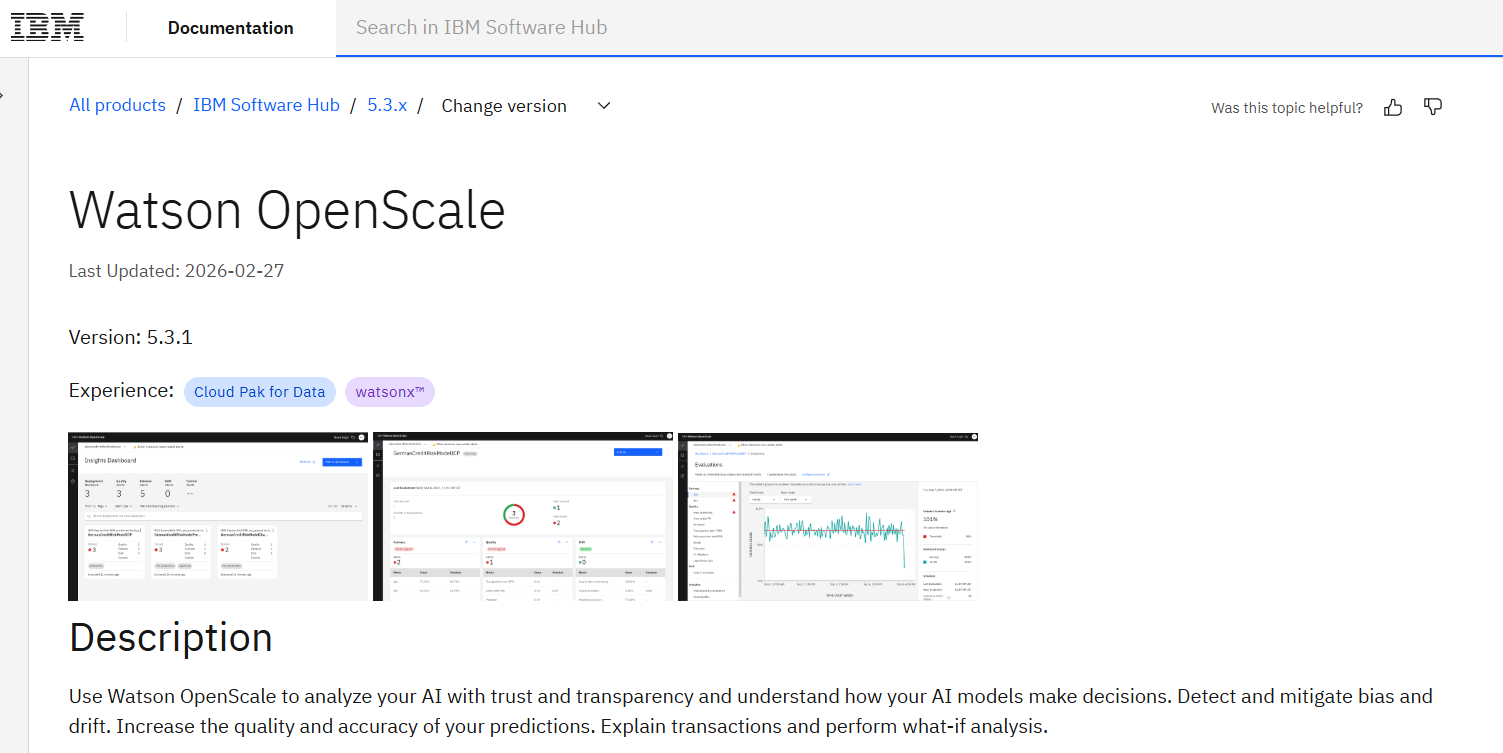
IBM Watson OpenScale is an AI governance and monitoring solution within the IBM ecosystem that focuses on model explainability, fairness, and lifecycle monitoring. It helps organizations track how models perform in production, understand their decisions, and ensure they meet governance and compliance standards.
Key features
-
Explainability and decision transparency: OpenScale provides detailed explanations for model predictions, helping teams understand and justify AI-driven decisions.
-
Fairness monitoring and bias detection: The platform continuously evaluates models for bias across different attributes.
-
Drift detection and model monitoring: It monitors models for data drift, concept drift, and performance degradation. Alerts and dashboards help maintain model reliability over time.
-
Governance dashboards and lifecycle visibility: OpenScale offers centralized dashboards that provide visibility into model performance, risk indicators, and governance status across the lifecycle.
|
Pros |
Cons |
|
|
Best for: Enterprises already invested in the IBM ecosystem that want integrated AI governance, monitoring, and explainability within their ML workflows.
2. DataRobot AI Platform
DataRobot AI Platform is an end-to-end enterprise AI platform that includes built-in capabilities for model lifecycle management, governance, and compliance tracking. It enables organizations to manage models from development to deployment while maintaining visibility into performance, documentation, and risk.
Key features
-
End-to-end model lifecycle management: DataRobot supports the full lifecycle, from data preparation and model training to deployment and monitoring. Governance checkpoints can be embedded at each stage.
-
Model documentation and compliance tracking: The platform automatically generates documentation for models, including inputs, performance metrics, and validation details.
-
Model monitoring and drift detection: It continuously tracks model performance, data drift, and prediction changes in production.
-
Governance controls and approvals: DataRobot includes workflow-based approvals and role-based access, ensuring that models meet governance standards before deployment.
|
Pros |
Cons |
|
|
Best for: Enterprises looking for an all-in-one AI platform with built-in governance, especially those aiming to streamline model development, deployment, and monitoring within a single system.
3. SAS Model Manager
SAS Model Manager is an enterprise-grade solution for model lifecycle governance, validation, and risk management, widely used in regulated industries such as banking, insurance, and healthcare. It builds on traditional model risk management practices and extends them to support modern AI and machine learning models.
Key features
-
Model inventory and centralized registry: SAS Model Manager provides a centralized repository to track all models, including metadata, ownership, and version history.
-
Model validation and approval workflows: The platform supports structured validation processes, including testing, approval checkpoints, and documentation.
-
Performance monitoring and model tracking: It tracks model performance over time, helping detect degradation or changes in behavior.
-
Model risk management capabilities: SAS Model Manager includes features tailored for model risk management, such as validation reports, governance controls, and audit trails.
|
Pros |
Cons |
|
|
Best for: Enterprises with established model risk management frameworks that want to extend governance to AI while maintaining structured validation, documentation, and compliance processes.
Core capabilities to look for in enterprise AI model governance software
Choosing the right enterprise AI model governance software is less about checking feature boxes and more about understanding how governance actually works at scale. Mature platforms don’t just track models; they connect data, models, workflows, and compliance into a continuous system of oversight.
Below are the capabilities that matter most when evaluating AI model governance tools.
Model inventory and centralized governance
At enterprise scale, models quickly become fragmented across teams and platforms. Without a centralized inventory, organizations lose visibility into what models exist, who owns them, and how they are used.
A governance platform should provide a central model registry that includes:
-
Model metadata and documentation
-
Ownership and accountability
-
Approval status and governance workflows
It should also connect models to upstream data and downstream applications through lineage.
|
Example: A large financial institution managing hundreds of models can use a centralized registry to track ownership, validation status, and risk classification in one place, instead of relying on fragmented spreadsheets and documentation. |
Model lifecycle management
Governance must extend across every stage of the model lifecycle, not just deployment. This includes:
-
Model development
-
Validation and testing
-
Deployment
-
Monitoring
-
Retirement
Without lifecycle visibility, organizations struggle to enforce consistent governance policies or track changes over time.
|
Common mistake: Many teams focus governance only on production models. In reality, risks often originate earlier, during data selection, feature engineering, or validation. |
Model risk management and validation workflows
Model risk management remains a core requirement, especially in regulated industries. However, modern AI systems require more automated and scalable approaches.
Look for capabilities such as:
-
Structured validation pipelines
-
Automated risk scoring
-
Approval workflows and governance checkpoints
These features help ensure that models meet internal and regulatory standards before deployment.
Bias detection and fairness monitoring
Bias in AI models is not just an ethical issue. It is also a regulatory and reputational risk. Governance platforms should provide:
-
Bias detection across demographic and data segments
-
Fairness metrics and thresholds
-
Alerts when models deviate from acceptable standards
|
Did you know? Research from the National Institute of Standards and Technology (NIST) highlights bias and lack of transparency as two of the most significant risks in AI systems, driving the need for continuous monitoring and governance. |
Explainability and auditability
Enterprises must be able to explain how models make decisions, especially in regulated use cases such as credit scoring or healthcare.
Key capabilities include:
-
Model explainability reports
-
Decision traceability
-
Audit-ready documentation
These features help organizations respond to regulatory audits, internal reviews, and stakeholder questions with confidence.
Continuous monitoring and performance tracking
AI models degrade over time due to data drift, changing conditions, or evolving user behavior. Without continuous monitoring, performance issues can go unnoticed.
Governance platforms should monitor:
-
Model accuracy and performance trends
-
Data drift and concept drift
-
Anomalies in predictions
|
What this means for teams: Continuous monitoring reduces the time between issue detection and resolution, helping prevent business impact from faulty model outputs. |
AI compliance and regulatory reporting
Regulatory pressure around AI is increasing globally. Frameworks such as the EU AI Act and NIST AI Risk Management Framework require organizations to demonstrate control, transparency, and accountability.
Governance platforms should support:
-
Compliance dashboards
-
Audit logs and documentation
-
Reporting aligned with regulatory requirements
|
Pro tip: Choose tools that allow you to map governance controls directly to regulatory frameworks. This reduces manual effort during audits and ensures consistent compliance reporting. |
What this means for buyers
Enterprise AI model governance software should not be evaluated as a standalone tool. It should be assessed based on how well it connects:
-
data governance
-
model lifecycle management
-
monitoring and observability
-
compliance and reporting
The most effective platforms are those that bring these elements together into a unified governance framework rather than treating them as separate processes.
How to evaluate enterprise AI model governance software
By the time organizations evaluate enterprise AI model governance software, they are usually managing multiple models, cross-functional teams, and increasing regulatory pressure. The goal is not to re-check features, but to understand how well a platform supports governance in real operating conditions.
A useful way to approach evaluation is to assess platforms across four dimensions: lifecycle coverage, compliance readiness, integration, and scalability.
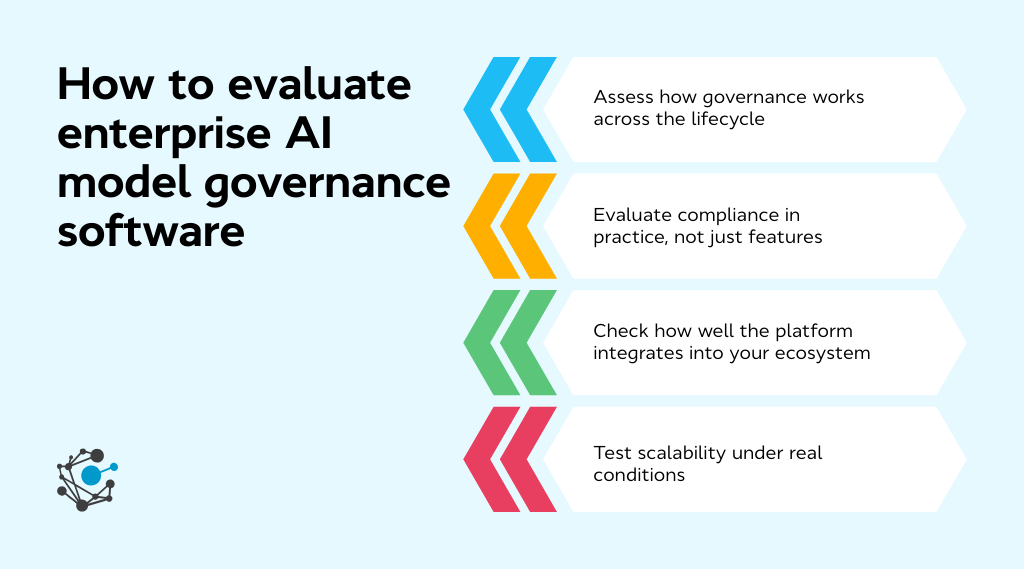
Assess how governance works across the lifecycle
Instead of asking whether lifecycle features exist, evaluate how consistently governance is applied from development through monitoring and retirement.
Look for:
-
Whether approvals, validation, and monitoring are connected in a single workflow
-
How easily teams can track model changes and decisions over time
-
Whether governance remains consistent across different environments and teams
Strong platforms connect these stages into a continuous system rather than treating them as separate steps.
|
Pro tip: Ask vendors to demonstrate how governance works from model creation to retirement, not just in isolated features. |
Evaluate compliance in practice, not just features
Most platforms claim compliance support. The real question is how easily teams can demonstrate it.
Look for:
-
How quickly can audit-ready documentation be generated
-
Whether decisions and model behavior can be traced during reviews
-
How clearly governance controls align with regulatory frameworks
The focus should be on reducing audit effort and improving transparency, not just listing compliance features.
|
What to look for: Platforms that align with frameworks such as the EU AI Act or NIST AI RMF can reduce compliance risk and audit effort. |
Check how well the platform integrates into your ecosystem
Governance is only effective if it connects across your existing tools and workflows.
Look for:
-
Whether model, data, and monitoring signals are unified or remain fragmented
-
How seamlessly the platform integrates with ML tools, data platforms, and pipelines
-
Whether governance workflows can operate across hybrid or multi-cloud environments
Weak integration often leads to manual processes and incomplete visibility.
Test scalability under real conditions
Governance becomes significantly more complex as the number of models and teams grows.
Look for:
-
How the platform handles increasing model volume and activity
-
Whether governance workflows remain consistent across teams and domains
-
How easily ownership, approvals, and monitoring scale across the organization
Scalability should support both technical growth and operational consistency.
|
Checklist: what to look for in enterprise AI model governance software
|
How enterprises implement AI model governance successfully
Buying the right tool is only part of the solution. Many AI governance initiatives fail not because of technology limitations, but because organizations implement tools without a clear governance structure, ownership model, or operational process.
Enterprises that succeed treat AI governance as a cross-functional operating model, not just a software capability.
1. Establish a governance framework before deploying tools
Before selecting or implementing any platform, organizations need a clear governance foundation. This includes:
-
Defining AI governance policies and risk thresholds
-
Identifying high-risk use cases and prioritizing governance efforts
-
Establishing lifecycle controls for model development, validation, and monitoring
Without this structure, tools become passive systems that store information rather than enforce governance.
|
Did you know? 63% of organizations now report CEO involvement in AI governance, rising to 81% in organizations with mature governance practices as per the IBM Institute for Business Value. |
What this means in practice: Start with governance principles and processes, then implement tools to operationalize them.
2. Create cross-functional governance teams
AI governance cannot be owned by a single team. It requires coordination across multiple functions.
Typical stakeholders include:
-
Data science teams building models
-
Risk and compliance teams defining governance policies
-
IT and data engineering teams are managing infrastructure
-
Legal teams overseeing regulatory alignment
This structure ensures that governance decisions are balanced across technical, regulatory, and business perspectives.
|
Common mistake: Assigning governance only to data science teams often leads to gaps in compliance and risk oversight. |
3. Standardize model documentation and validation
One of the biggest challenges in AI governance is inconsistency in how models are documented and validated.
Best practice is to standardize:
-
Model documentation (model cards, assumptions, data sources)
-
Validation reports and testing criteria
-
Compliance documentation for audits
This ensures that every model follows the same governance process, regardless of team or use case.
4. Automate monitoring and governance workflows
Manual governance processes do not scale. As the number of models increases, organizations need automation to maintain control without slowing down innovation.
Automation should cover:
-
Model performance monitoring and drift detection
-
Alerts for bias, anomalies, or compliance violations
-
Approval workflows for model deployment and updates
|
What successful implementation looks like Enterprises that implement AI model governance effectively typically:
|
AI governance is not a one-time setup. It is an ongoing process that evolves with new models, regulations, and business requirements. Organizations that treat governance as a continuous capability are better positioned to scale AI responsibly while managing model risk and compliance.
Conclusion
Enterprise AI adoption is accelerating, but governance is struggling to keep pace. As organizations deploy more machine learning and generative AI models across critical business functions, the risks tied to bias, lack of transparency, and regulatory non-compliance continue to grow.
Enterprise AI model governance software helps address this challenge by providing visibility, control, and accountability across the AI lifecycle. From model inventory and lifecycle management to bias detection, explainability, and compliance reporting, these platforms enable organizations to move from fragmented oversight to structured governance.
However, choosing the right solution requires more than comparing features. Organizations need to evaluate how well a platform integrates with their existing data and AI ecosystem, supports regulatory requirements, and scales across teams and use cases.
As AI becomes embedded in decision-making, governance is no longer optional. It is a foundational capability for building reliable, compliant, and scalable AI systems.
FAQs
1. What is enterprise AI model governance software?
Enterprise AI model governance software helps organizations manage, monitor, and document AI and machine learning models across their lifecycle. It ensures models remain transparent, compliant, and reliable through capabilities such as lifecycle tracking, explainability, and compliance reporting.
2. Why is AI model governance important for enterprises?
AI model governance reduces risks such as biased decisions, model drift, and regulatory non-compliance. It helps organizations maintain transparency, ensure accountability, and build trust in AI systems used for critical business decisions.
3. How does AI model governance differ from model risk management?
Traditional model risk management focuses on financial and statistical models with periodic validation. AI governance expands this scope to include machine learning and generative AI, with continuous monitoring, explainability, and broader risk coverage such as bias and compliance.
4. What features should enterprises look for in AI model governance tools?
Key features include model lifecycle management, centralized model inventory, bias detection, explainability, performance monitoring, and compliance reporting. These capabilities help organizations manage AI systems at scale while meeting regulatory requirements.
5. How do AI governance platforms support regulatory compliance?
AI governance platforms provide audit trails, documentation, and compliance dashboards that align with regulatory frameworks. They help organizations track model decisions, enforce policies, and generate reports required for audits and regulatory reviews.
6. Can data governance platforms support AI model governance?
Yes, data governance platforms support AI governance by providing metadata, lineage, and data quality visibility. They help organizations understand the data feeding AI models, which is essential for auditability, compliance, and model reliability.
.png?width=1081&height=173&name=Forrester%201%20(1).png)
.png?width=1081&height=241&name=KC%20-%20Logo%201%20(1).png)