A model goes live after weeks of testing, and everything appears to be working. Then, a business stakeholder asks why the system made a specific recommendation, the compliance team requests documentation for the decision trail, and the data team realizes the underlying training-data assumptions were never captured in a way others can review.
We see this happen often in enterprise AI programs. Teams can move quickly from experimentation to deployment, but trusted AI practices often lag behind.
That gap matters more now because enterprise AI adoption is accelerating.
IBM reported in early 2024 that 42 percent of enterprise-scale organizations said they were already using AI actively.
At the same time, regulators are asking for clearer accountability, stronger oversight, and better evidence of how AI systems behave.
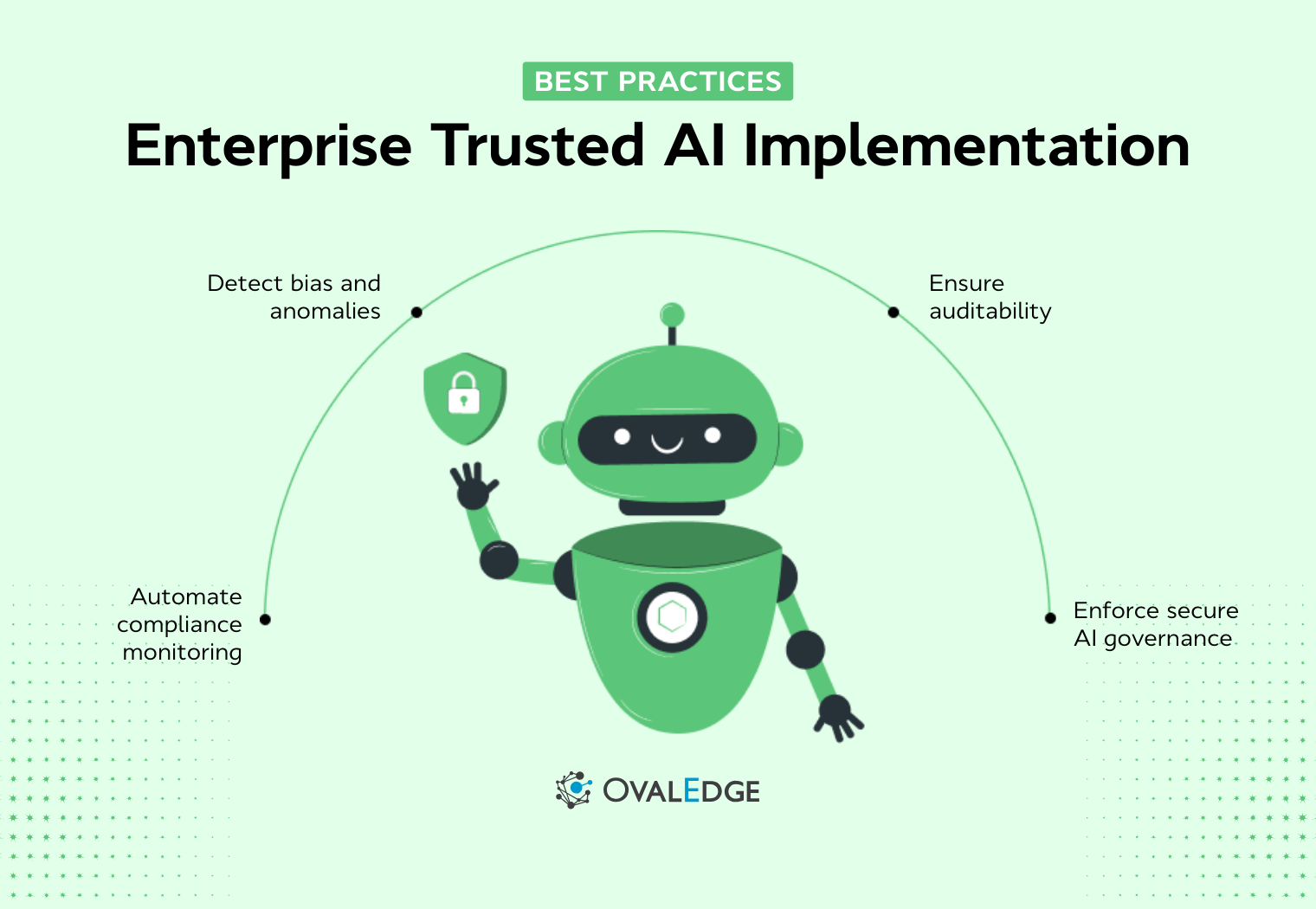
This guide explains enterprise trusted AI implementation in practical terms. We cover what trusted AI means in an enterprise setting, why it has become a priority, the principles and technical architecture behind trustworthy AI systems, and the operating steps that make responsible AI implementation real.
What is trusted AI in enterprises
Trusted AI in enterprises refers to the governance practices, technical controls, and operational processes that ensure AI systems operate reliably, transparently, and responsibly in production environments. The objective is to make AI-driven decisions explainable, accountable, and aligned with organizational policies and regulatory expectations.
Trusted AI functions as an operational framework rather than a single technology. It integrates governance policies, model documentation, monitoring systems, human oversight, and audit mechanisms so enterprises can manage AI systems responsibly across complex environments.
In practice, trusted AI applies across the full AI lifecycle, including:
-
Data preparation and validation
-
Model development and testing
-
Deployment and access control
-
Production monitoring and retraining
-
Model retirement or replacement when performance declines
Trusted AI implementation also involves collaboration across multiple enterprise teams. Data scientists develop models, governance teams define policies, compliance and legal teams oversee regulatory alignment, and business leaders ensure AI use cases support organizational goals.
As enterprises increasingly deploy AI in analytics, decision systems, fraud detection, and generative AI applications, trusted AI becomes an operational requirement rather than a theoretical concept.
Why trusted AI has become a priority for enterprises
Trusted AI has moved from an ethics discussion to an execution issue. The reason is simple. AI now affects more decisions, more workflows, and more regulated processes than before.
As AI adoption expands across enterprises, the risks associated with poorly governed systems also increase. Organizations now recognize that implementing trusted AI is essential for maintaining reliability, compliance, and stakeholder confidence.
Growing regulatory and compliance requirements for AI
Governments and regulators across the world are increasingly introducing rules that require organizations to demonstrate accountability and transparency in AI-driven systems. Regulations are evolving to ensure that automated decisions can be explained, audited, and monitored throughout the lifecycle of AI models.
This shift is changing how enterprises deploy AI. Organizations can no longer rely on informal or experimental approaches when deploying AI in business-critical environments. Instead, they must establish structured governance frameworks that ensure traceability, explainability, and auditability of AI decisions.
As regulatory scrutiny grows, enterprises are under pressure to maintain clear documentation, monitor AI behavior continuously, and demonstrate that their AI systems comply with ethical and legal standards.
Business risks of deploying AI systems without trust controls
The risks of poorly governed AI systems extend beyond technical performance. When organizations deploy AI without proper governance controls, operational, regulatory, and reputational risks increase significantly.
Common risks enterprises face include:
-
Biased outcomes from incomplete or skewed training data: Models trained on unbalanced datasets can reinforce existing biases, leading to unfair outcomes in areas such as hiring, credit scoring, or insurance risk evaluation.
-
Incorrect predictions due to model drift: When underlying data patterns change over time, models may lose accuracy and produce unreliable predictions.
-
Limited explainability in automated decisions: Complex AI models can make it difficult for organizations to understand or justify how decisions are generated.
-
Legal and reputational consequences: Automated decisions that affect customers or employees can trigger regulatory scrutiny, legal challenges, and public criticism if outcomes are perceived as unfair.
These risks highlight why enterprise trusted AI implementation is critical for maintaining accountability, reliability, and trust in AI-driven systems.
The importance of transparency and accountability in AI-driven decisions
Transparency plays a critical role in building trust in AI systems. Business leaders, regulators, and operational teams must understand how AI models generate outcomes and what factors influence their decisions. Without transparency, organizations struggle to validate model behavior or identify potential bias and errors.
Accountability is equally important. Enterprises must clearly define who is responsible for monitoring model performance, addressing unexpected behavior, and ensuring compliance with governance policies.
Research from McKinsey’s 2024 State of AI report found that 40 percent of respondents identified explainability as a key risk in adopting generative AI, yet only 17 percent reported actively working to mitigate that risk.
This gap highlights why organizations are prioritizing trusted AI implementation as they scale AI-driven decision systems.
Principles of enterprise trusted AI implementation
Trusted AI implementation starts with principles. These principles define what enterprises expect from AI systems before they choose tools, vendors, or control processes.
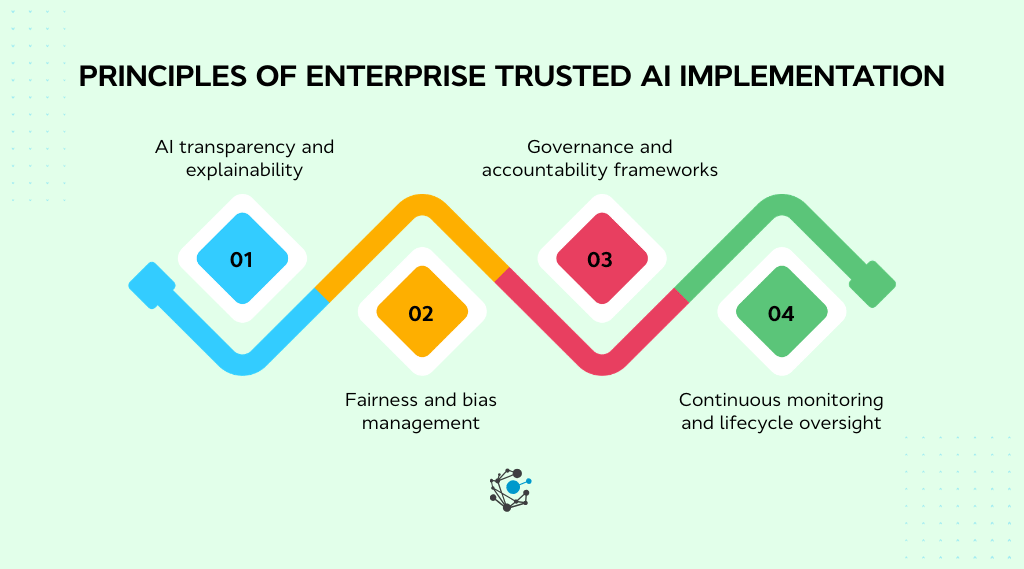
AI transparency and explainability
Transparency means people can understand how an AI system was built, what data it depends on, and where its limits sit. Explainability focuses on helping stakeholders interpret why a model produced a specific output or recommendation.
Strong enterprise practices usually include:
-
Model documentation that describes inputs, assumptions, and limitations
-
Explanation methods suited to the model and use case
-
Human review for high-impact decisions
-
Plain-language guidance for non-technical stakeholders
When implemented effectively, these practices improve review quality, accelerate governance approvals, and reduce confusion when AI-driven outcomes are questioned.
|
Organizations looking to strengthen these capabilities can refer to OvalEdge’s whitepaper on implementing data governance, which explains how metadata, lineage, and policy frameworks support transparency, traceability, and explainable AI systems at scale. |
Fairness and bias management
Trusted AI requires systems that produce fair and unbiased outcomes across different groups and use cases. Enterprises must recognize that bias can originate from data, model design, or historical patterns, and that unmanaged bias can lead to unfair or discriminatory decisions.
To address this, organizations need to evaluate how data represents different populations, assess model behavior across groups, and continuously monitor outcomes after deployment. Fairness is not a one-time validation step but an ongoing requirement that must evolve with changing data and business contexts.
Governance and accountability frameworks
Trusted AI requires clear governance structures that define ownership, responsibility, and decision-making authority across AI systems. Enterprises must establish who is accountable for model performance, risk management, and compliance throughout the lifecycle.
This includes defining approval processes for AI use cases, creating oversight mechanisms, and ensuring that escalation paths exist when issues arise. Without clear accountability, AI systems can operate without proper control, increasing both operational and regulatory risks.
Continuous monitoring and lifecycle oversight
Trusted AI requires continuous monitoring to ensure that systems remain reliable and aligned with business expectations over time. AI models operate in dynamic environments, and their performance can change as data patterns evolve.
Enterprises must track model performance, detect drift, identify unexpected behaviors, and decide when retraining or retirement is necessary. This ongoing oversight ensures that AI systems remain stable, trustworthy, and effective throughout their lifecycle.
Technical architecture for building trustworthy AI systems
Once principles are defined, enterprises need technical systems to enforce them in production environments.
This layer translates governance intent into enforceable controls, repeatable workflows, and measurable outcomes. The focus here is not on defining what trusted AI should be, but on how enterprises implement and run it at scale.
AI governance and policy management layer
This layer operationalizes governance by turning policies into enforceable controls across data and AI systems.
Key capabilities include:
-
Policy engines that enforce rules for fairness, access, and risk
-
Approval workflows integrated into model deployment processes
-
Role-based access control across data, models, and users
-
Compliance tracking with audit-ready evidence
How this layer helps:
-
Ensures governance policies are consistently applied across workflows and systems
-
Embeds approvals, access checks, and compliance validation into daily operations
Where gaps appear without it:
-
Models may be deployed without proper approvals or oversight
-
Access control and compliance enforcement become inconsistent across teams
Data and model lifecycle management infrastructure
This layer standardizes how data and models move from development to production and beyond.
Typical components include:
-
Data pipelines that validate and prepare training datasets
-
Version-controlled environments for model development and testing
-
Model registries that track deployed versions and changes
-
Workflow systems for deployment, rollback, and retraining
How this layer helps:
-
Maintains consistency in how models and data are developed, tested, and deployed
-
Enables controlled updates with clear versioning and traceability
Where gaps appear without it:
-
Model versions become inconsistent or poorly tracked
-
Changes can disrupt downstream systems or introduce unmanaged risks
|
Related reading: Enterprises that want to strengthen lifecycle control can also refer to OvalEdge’s data lifecycle management guide, which explains how organizations manage data from creation to retirement with governance, lineage, and continuous monitoring built into the process. |
AI monitoring and observability systems
This layer continuously monitors how AI systems behave in production.
Key monitoring capabilities include:
-
Performance tracking for model accuracy and stability
-
Detection of data drift and model drift
-
Monitoring for unexpected or high-risk outputs
-
Alerting systems that trigger reviews or interventions
How this layer helps:
-
Provides continuous visibility into model performance and behavior
-
Enables early detection of drift, anomalies, and risk signals
Where gaps appear without it:
-
Performance issues or bias may go unnoticed until they impact outcomes
-
Teams are forced into reactive issue handling instead of proactive monitoring
Documentation, traceability, and auditability controls
This layer creates a complete record of how AI systems are built, used, and changed over time.
Core practices include:
-
Structured documentation of datasets, models, and assumptions
-
End-to-end traceability from data sources to model outputs
-
Logs of model decisions, changes, and access events
-
Audit trails that support compliance and internal reviews
How this layer helps:
-
Provides visibility into data, models, and decisions across the lifecycle
-
Supports audits, reviews, and internal accountability
Where gaps appear without it:
-
Decisions cannot be explained or traced back to their source
-
Organizations struggle to demonstrate compliance or investigate issues
How enterprises implement trusted AI: A practical roadmap
A strong roadmap keeps trusted AI from becoming a side project. The most effective programs translate governance, transparency, and monitoring into repeatable actions that teams can execute consistently across AI systems.
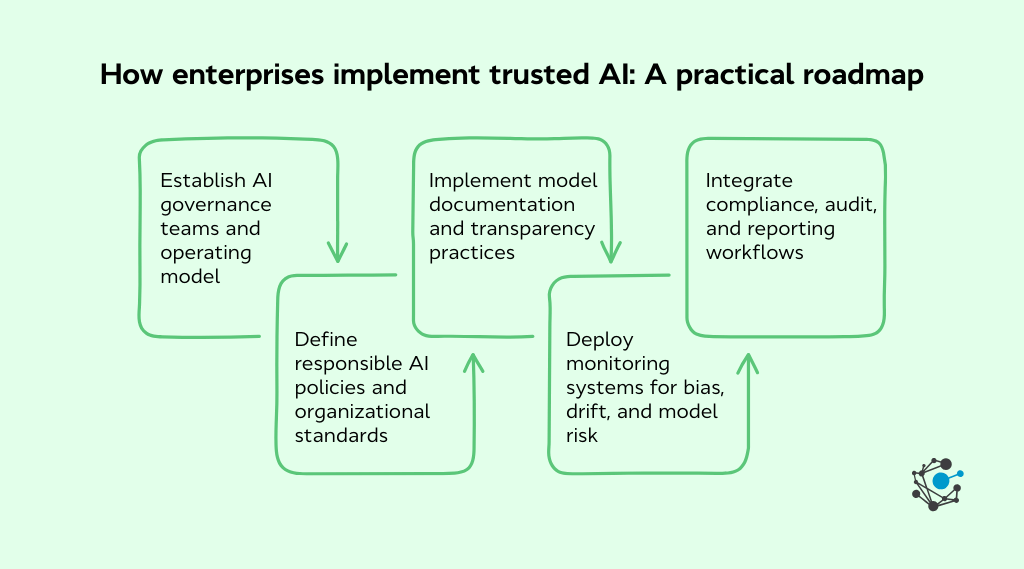
Step 1: Establish AI governance teams and operating model
Enterprises must first define ownership and decision-making structures for AI systems. Without clear roles, governance efforts remain fragmented and reactive.
Actionable steps:
-
Define core roles such as AI governance leads, model owners, data stewards, and risk managers with clear responsibilities
-
Establish cross-functional governance teams involving data, legal, compliance, and business stakeholders
-
Create decision frameworks that define who approves, reviews, and escalates AI-related risks
Step 2: Define responsible AI policies and organizational standards
Policies provide the foundation for consistent and scalable trusted AI implementation. They ensure that all AI systems follow the same expectations for fairness, transparency, and accountability.
Actionable steps:
-
Develop enterprise-wide AI policies covering transparency, fairness, acceptable use, and risk thresholds
-
Align internal standards with regulatory requirements and industry frameworks
-
Standardize guidelines for documentation, validation, monitoring, and escalation across teams
Policies should cover transparency, fairness, acceptable use, documentation, validation, monitoring, and escalation. Align them with regulatory expectations and internal governance standards to ensure consistency across AI systems.
|
Pro tip: Organizations defining these policies can refer to OvalEdge’s guide on data governance principles, which explains how ownership, data quality, and compliance frameworks form the foundation for reliable and scalable AI systems. |
Step 3: Implement model documentation and transparency practices
Documentation is essential for making AI systems understandable and reviewable across the organization. Without it, governance teams cannot validate or audit AI decisions effectively.
Actionable steps:
-
Document training data sources, model assumptions, intended use, and known limitations
-
Ensure documentation is accessible to governance, compliance, and business teams
-
Establish review checkpoints where documentation is validated before deployment
Step 4: Deploy monitoring systems for bias, drift, and model risk
Monitoring enables enterprises to detect issues early and maintain reliable AI performance in production environments. It shifts governance from static validation to continuous oversight.
Actionable steps:
-
Implement monitoring systems that track model performance, drift, and fairness metrics
-
Define thresholds and alerts for anomalies, performance degradation, and risk signals
-
Set up workflows for investigating and resolving issues when monitoring detects anomalies
Step 5: Integrate compliance, audit, and reporting workflows
Trusted AI must connect with broader enterprise risk and compliance processes. This ensures that governance efforts are measurable, auditable, and aligned with regulatory expectations.
Actionable steps:
-
Maintain logs of model decisions, updates, approvals, and policy exceptions
-
Integrate AI governance into enterprise audit and compliance reporting workflows
-
Ensure teams can generate audit-ready evidence to demonstrate governance and accountability
This roadmap helps enterprises move from conceptual trusted AI principles to operational, scalable, and auditable AI systems.
Common challenges in enterprise trusted AI implementation
Even mature teams run into obstacles. The issue is rarely a lack of intent. It is more often fragmented ownership, inconsistent documentation, or limited visibility across data and model ecosystems.
Limited visibility into model decisions and training data
Black-box behavior continues to create practical governance challenges. When enterprises cannot trace predictions back to training data, features, and assumptions, it becomes difficult to validate outcomes or respond effectively to issues.
Improving visibility requires strong metadata management, lineage tracking, and documentation practices.
|
Insight: Platforms like OvalEdge highlight how data lineage and metadata frameworks help organizations trace data flow across systems, making it easier to understand how inputs influence AI-driven decisions. |
Governance maturity gaps across teams
Many AI initiatives start within individual teams, which leads to inconsistent governance practices across the organization. Policies, thresholds, and documentation standards often vary, making it difficult to enforce a unified approach to trusted AI.
To address this, enterprises need centralized governance frameworks that standardize policies, ownership, and accountability across teams. This ensures that AI systems operate under consistent rules regardless of where they are developed or deployed.
Monitoring complexity for large AI portfolios
Monitoring a single model is manageable, but enterprise environments often include hundreds of models across different business units and platforms. As scale increases, tracking performance, fairness, and risk become significantly more complex.
This is where centralized monitoring and observability become critical.
|
OvalEdge’s focus on data quality monitoring and automated lineage supports this need by helping teams identify anomalies, track changes, and maintain visibility across large data ecosystems, which directly impacts AI reliability. |
Balancing innovation with regulatory compliance
Enterprises often struggle to balance the speed of AI innovation with the need for governance and compliance. Overly strict controls can slow experimentation, while weak controls can increase risk and reduce trust in AI systems.
Successful organizations design governance frameworks that support controlled experimentation. They define clear policies for high-risk use cases while allowing flexibility in lower-risk scenarios, enabling innovation without compromising accountability.
This balance is essential for scaling enterprise trusted AI implementation effectively.
What good looks like
In practice, organizations that navigate these challenges successfully create an environment where governance is embedded into everyday workflows rather than applied as a separate layer. Teams have clear visibility into how data and models evolve, monitoring systems provide continuous insight into performance and risk, and documentation enables decisions to be understood and reviewed when needed.
This combination of visibility, control, and accountability allows enterprises to move forward with confidence, scaling AI systems while maintaining consistency, oversight, and operational clarity.
Conclusion
Trusted AI works best when enterprises treat it as an operating system for AI rather than a checklist. The next step is to assess where your current program needs attention, whether in governance, ownership, documentation, monitoring, or auditability, and then strengthen those areas in a structured way.
Start by clarifying roles, standardizing documentation, and introducing continuous monitoring for drift, fairness, and performance. Over time, connect these controls to compliance and audit workflows, so AI systems remain transparent and accountable.
This foundation enables scalable, trustworthy AI systems.
Platforms like OvalEdge extend this further with capabilities such as askEdgi, which helps teams explore data, lineage, and metadata through natural language, improving transparency across AI workflows.

To see how this works in practice, book a demo with OvalEdge and explore how to operationalize trusted AI across your organization.
FAQs
1. What is enterprise trusted AI implementation?
Enterprise trusted AI implementation is the process of integrating AI systems, including generative AI and autonomous agents, into enterprise operations while ensuring they remain secure, explainable, compliant, and reliable throughout the AI lifecycle. It combines technical deployment with governance frameworks that address risks such as bias, hallucinations, and data privacy.
2. How do enterprises ensure AI systems remain trustworthy?
Enterprises maintain trustworthy AI systems by implementing governance frameworks, monitoring model performance, enforcing security and privacy controls, and maintaining transparency in decision-making. Continuous oversight through explainability tools, bias detection, and human-in-the-loop review helps ensure AI outputs remain reliable and accountable.
3. What governance controls are needed for responsible AI?
Responsible AI governance requires policies for model risk management, auditing, compliance monitoring, and documentation of training data and model decisions. Many organizations align these controls with frameworks such as the NIST AI Risk Management Framework and emerging regulations like the EU AI Act.
4. What technologies support enterprise trusted AI implementation?
Trusted AI implementation relies on technologies such as AI observability platforms, governance and policy management tools, and secure architectures like Retrieval-Augmented Generation (RAG). Many organizations also implement an AI control plane and centralized monitoring systems to track performance, bias, and compliance.
5. What role do governance teams play in enterprise AI implementation?
Governance teams coordinate policies, risk management, and compliance across AI initiatives. They typically include legal, compliance, data science, and business leaders who oversee model approvals, ensure responsible data usage, monitor risks, and guide organizations in scaling AI safely across the enterprise.
.png?width=1081&height=173&name=Forrester%201%20(1).png)
.png?width=1081&height=241&name=KC%20-%20Logo%201%20(1).png)