-2.png)
Data governance and data security are often discussed as if they serve the same purpose. In reality, treating them as interchangeable creates gaps that only become visible as data access expands, regulations tighten, and analytics teams move faster than controls can keep up. Policies get documented but never enforced, while security teams lock systems down without understanding how data is meant to be used.
This disconnect is widespread.
According to a 2023 Gartner Press Release, only 44 percent of data and analytics leaders say their organizations are effective at delivering trusted data at scale.
The remaining majority struggle with inconsistent access controls, manual approvals, and governance rules that fail to translate into day-to-day operations. As cloud platforms, self-service analytics, and AI-driven use cases accelerate data movement, these weaknesses become harder to ignore.
The problem is not a lack of tools or effort. It is a lack of alignment. Data governance defines ownership, usage rules, and accountability. Data security enforces protection through technical controls. When these functions operate in isolation, governance remains theoretical, and security lacks a business context.
This guide clarifies the distinction between data governance and data security, explains their interconnection, and demonstrates how organizations can integrate security into governance to bridge enforcement gaps and foster lasting trust in data.
Why data governance fails without embedded security
Data governance breaks down when it exists only as policy and documentation. Without technical enforcement, governance decisions stay disconnected from the systems that store and process data.
Where governance typically falls short
-
Policies without enforcement: Ownership, usage, and retention rules are defined but never translated into access controls or monitoring.
-
Manual exceptions become permanent: Access is granted broadly to avoid delays, weakening least privilege and purpose-based usage.
-
Classification that goes unused: Sensitivity labels exist in documents but are not linked to encryption, masking, or access restrictions.
-
Audit evidence is fragile: Compliance depends on screenshots and attestations instead of verifiable system logs.
The impact on governance outcomes
-
Accountability becomes unclear because rules are not enforced consistently.
-
Risk increases as sensitive data remains exposed despite documented controls.
-
Trust in governance erodes when teams see policies ignored in daily operations.
Why embedded security matters
Security turns governance intent into action. When access controls, monitoring, and protection mechanisms enforce governance decisions directly, policies move from guidance to operational reality. This alignment is what allows governance programs to scale without losing control or credibility.
|
Did you know? Industry evidence shows how dangerous unenforced access policies can be. According to the Verizon 2025 Data Breach Investigations Report, 88 percent of basic web application breaches involved stolen credentials, highlighting how excessive or poorly governed access dramatically increases exposure. |
Moving from siloed security to governance-led control
Many organizations treat data security as a standalone technical function. Security teams configure access controls, encryption, and monitoring based on infrastructure boundaries rather than business context. While this approach protects systems, it rarely reflects how data is meant to be used.
What siloed security looks like in practice
-
Access decisions are based on roles or systems, not the data purpose.
-
Controls are applied uniformly, ignoring sensitivity or business criticality.
-
Security teams act as gatekeepers without visibility into data ownership or usage intent.
This creates friction. Business teams experience delays and over-restriction, while security teams compensate by granting broad access to keep work moving.
Governance-led control changes the model
Governance-led control starts with decision-making rather than tooling.
-
Data owners and stewards define who can access data and why.
-
Policies describe acceptable use, retention, and sharing rules.
-
Classification provides context about sensitivity and risk.
Security then enforces these decisions consistently across platforms.
The shift organizations must make
-
Move from system-centric controls to data-centric controls.
-
Replace static permissions with policy-driven access.
-
Connect governance decisions directly to technical enforcement.
When security operates within a governance framework, control becomes both stronger and more flexible. Protection improves without slowing analytics, and access reflects intent rather than convenience.
|
As AI-driven use cases expand, governance gaps widen even faster. The IBM Cost of a Data Breach Report 2025 found that 63 percent of organizations lack formal AI governance policies, leaving sensitive data exposed as models and data pipelines proliferate without oversight. |
What is data governance?
Data governance is the framework that defines how data is owned, controlled, and used across an organization. It focuses on decision-making rather than tooling, answering questions about responsibility, rules, and accountability at every stage of the data lifecycle.
Defining data governance as ownership, control, and accountability
At its core, data governance establishes who is responsible for data and how decisions about that data are made.
-
Ownership defines who is accountable for a dataset and its correct use.
-
Control defines the rules for access, usage, sharing, and retention.
-
Accountability ensures decisions are traceable and enforceable.
Governance provides clarity on what is allowed, what is restricted, and who has the authority to decide, reducing ambiguity as data scales across teams and platforms.
Core components of a modern data governance program
An effective governance program brings multiple elements together into a single operating model.
-
Documented policies for access, usage, retention, and compliance.
-
Clearly assigned data owners and stewards.
-
Metadata that explains meaning, context, and business definitions.
-
Lineage that shows where data comes from and how it is transformed.
-
Data quality standards and monitoring.
-
Oversight mechanisms for regulatory and internal compliance.
These components work together to ensure data is understandable, managed, and used responsibly.
Governance goals across quality, compliance, and trust
Data governance exists to support outcomes, not bureaucracy.
-
Improve data quality so analytics and reporting are reliable.
-
Meet regulatory and internal compliance requirements consistently.
-
Build trust by making data usage transparent and accountable.
When governance is working well, teams spend less time validating data and more time acting on it with confidence.
|
Also Read: Data Governance Best Practices for 2026: Key Strategies |
What is data security?
Data security is the set of technical and operational controls used to protect data from unauthorized access, exposure, alteration, or loss. Its role is to reduce risk by ensuring data remains confidential, accurate, and available, regardless of where it resides or how it moves across systems.
Defining data security and its core objectives
Data security is guided by three foundational objectives that shape every control and process.
-
Confidentiality limits access to approved users, applications, and services, preventing accidental exposure or deliberate misuse.
-
Integrity ensures data cannot be altered without authorization, protecting reports, models, and operational systems from corruption.
-
Availability ensures data remains accessible to authorized users, even during failures, attacks, or high demand.
Together, these objectives focus security on protection and resilience rather than decision making or business intent.
Key data security controls organizations rely on
Organizations implement data security through controls that operate at the platform, system, and infrastructure layers.
-
Identity and access management governs authentication, authorization, and role-based access across users and services.
-
Encryption protects sensitive data at rest and in transit, reducing the impact of unauthorized access.
-
Monitoring and logging track access patterns, data movement, and anomalous behavior for detection and investigation.
-
Data loss prevention and masking limit the exposure of sensitive fields during access and sharing.
-
Incident response processes define how breaches, misuse, and control failures are identified, contained, and remediated.
These controls are designed to be consistent and scalable, often applied uniformly across environments.
Why security alone does not equal governance
Data security answers how data is protected, not how it should be governed.
-
Security controls enforce permissions but do not determine appropriate access based on business purpose or ownership.
-
They lack context around data meaning, sensitivity from a business perspective, and acceptable usage scenarios.
-
Without governance input, controls are configured conservatively, leading to broad restrictions or excessive access exceptions.
As a result, security alone cannot ensure responsible data usage. It reduces technical risk but leaves gaps in accountability, policy intent, and alignment with business outcomes. Effective data programs require governance to define direction and security to enforce it consistently.
Data security within the framework of data governance
Data security becomes most effective when it operates inside a governance framework. Governance defines intent, while security provides the mechanisms to enforce that intent consistently across systems, teams, and data flows.
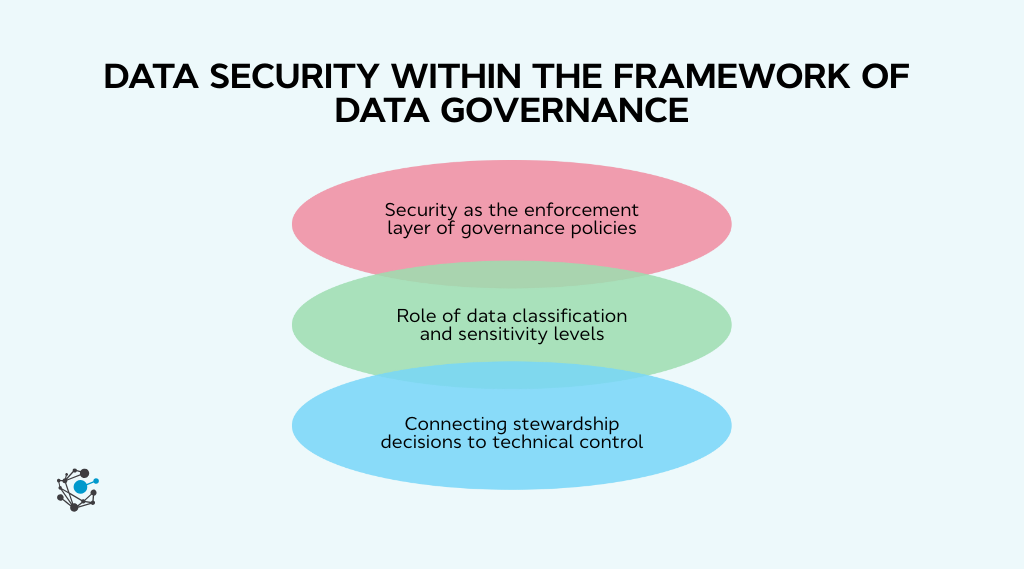
Security as the enforcement layer of governance policies
Data governance establishes rules around who can access data, for what purpose, and under which conditions. Security ensures those rules are applied in practice.
-
Governance policies define access, usage, retention, and sharing requirements.
-
Security controls translate those requirements into permissions, restrictions, and monitoring.
-
Enforcement happens automatically across platforms rather than through manual approvals.
When security is tied directly to governance policies, enforcement remains consistent even as data scales and environments change.
|
The cost of unenforced governance becomes especially clear in AI environments. According to IBM, 97 percent of organizations reporting AI-related security incidents lacked proper access controls, highlighting how governance intent fails without technical enforcement. |
Role of data classification and sensitivity levels
Data classification acts as the bridge between governance decisions and security execution.
-
Governance defines classification levels based on sensitivity, criticality, and regulatory impact.
-
Each level maps to specific security controls such as encryption, masking, or restricted access.
-
Classification ensures protection adapts to risk rather than applying uniform controls everywhere.
This alignment allows organizations to protect sensitive data more aggressively while enabling appropriate access to low-risk datasets.
Connecting stewardship decisions to technical controls
Data owners and stewards are responsible for defining how their data should be used.
-
Stewards determine acceptable access, usage conditions, and retention periods.
-
Governance records these decisions as policies and metadata.
-
Security systems enforce them through access controls, monitoring, and lifecycle protections.
This connection ensures stewardship is not symbolic. Decisions made by data owners directly influence how data is protected and accessed, closing the gap between governance intent and operational reality.
|
As data increasingly flows between partners and platforms, governance must extend beyond internal boundaries. The 2025 Verizon DBIR shows a sharp increase in breaches involving third parties, underscoring the need for governance-defined sharing rules that are enforced consistently through security controls. |
How data security enables effective data governance
Data governance sets rules and accountability, but it relies on data security to make those rules real. Without security, governance remains descriptive. With security, governance becomes enforceable and measurable.
1. Enforcing access and usage policies defined by governance
Governance defines who can access data and for what purpose. Security ensures those decisions are applied consistently.
-
Access controls enforce least privilege based on roles, attributes, and approved use cases.
-
Purpose-based access limits how data can be used, not just who can see it.
-
Continuous monitoring detects policy violations and unauthorized usage.
This enforcement reduces manual reviews and prevents policy drift as access needs change.
2. Protecting governed data across its lifecycle
Data moves constantly from ingestion to transformation, analysis, sharing, and archival. Security protects governed data at every stage.
-
Controls apply as data is created, copied, and transformed.
-
Protection follows data across platforms and environments.
-
Retention and deletion rules are enforced automatically.
Lifecycle protection ensures governance standards remain intact as data evolves and spreads.
3. Supporting audits, risk management, and regulatory oversight
Security provides the evidence governance needs.
-
Access logs show who used data and when.
-
Monitoring records demonstrate compliance with policies.
-
Incident records support risk assessments and remediation.
This evidence replaces manual attestations with verifiable proof, strengthening audits, reducing regulatory risk, and improving confidence in governance outcomes.
Key benefits of embedding data security into data governance
When data security is embedded into governance, policies are no longer aspirational. They are enforced consistently, measured continuously, and trusted across the organization.
1. Stronger policy enforcement and reduced governance gaps
-
Governance rules are enforced automatically rather than through manual approvals.
-
Policy drift is minimized as controls stay aligned with defined standards.
-
Exceptions are visible, traceable, and easier to manage.
This reduces the gap between documented governance and day-to-day data access.
2. Clear accountability with technically enforced controls
-
Data ownership maps directly to enforced access and usage rules.
-
Stewardship decisions are reflected in system-level controls.
-
Accountability becomes auditable rather than assumed.
Clear enforcement removes ambiguity between governance intent and operational reality.
3. Higher trust in analytics and data sharing
-
Protected data increases confidence in reports, dashboards, and models.
-
Teams can share data internally and externally with reduced risk.
-
Consistent controls support collaboration without sacrificing protection.
Embedding security into governance enables faster, safer data-driven decisions without weakening control.
|
When governance and security are misaligned, the impact is no longer theoretical. IBM reports that the global average cost of a data breach is now USD 4.4 million, reinforcing why enforceable governance is a business priority, not just a compliance exercise. |
Tools that support governance-driven data security
Governance-driven data security depends on tooling that can translate policy intent into consistent technical enforcement across the data ecosystem. In practice, these capabilities rarely live in a single platform or fit neatly into isolated categories.
Most organizations rely on a connected set of tools, each playing a primary role in the governance security stack while often overlapping across discovery, classification, access control, protection, and monitoring. The goal is not strict tool separation, but coordinated enforcement where governance defines intent and security systems apply it at scale.
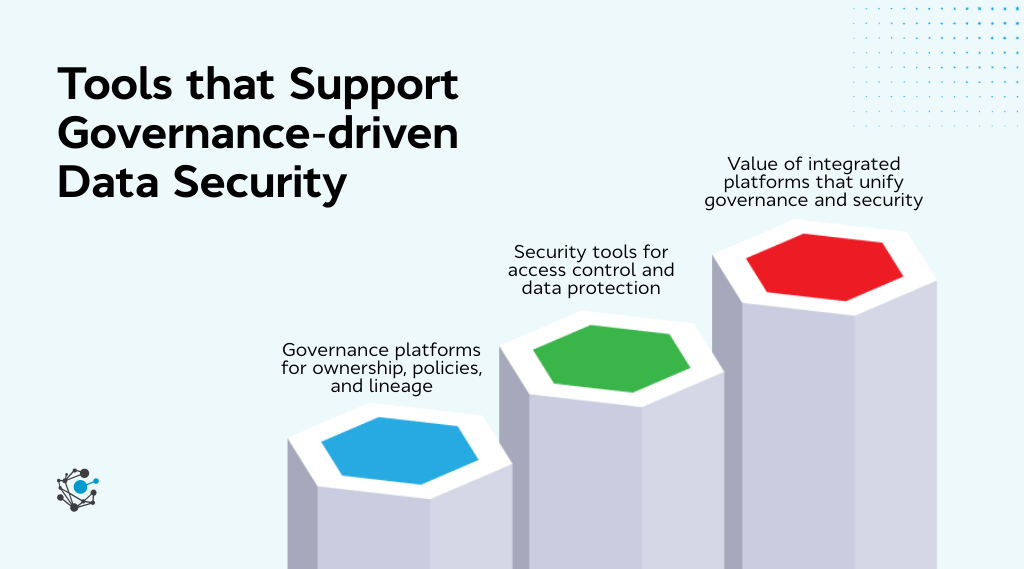
Data governance and metadata management platforms
These tools define ownership, policies, business context, and accountability. They help organizations document how data should be used and who is responsible for it across the enterprise.
Key capabilities
-
Data ownership and stewardship management
-
Policy definition and governance workflows
-
Business metadata, glossary, and data lineage
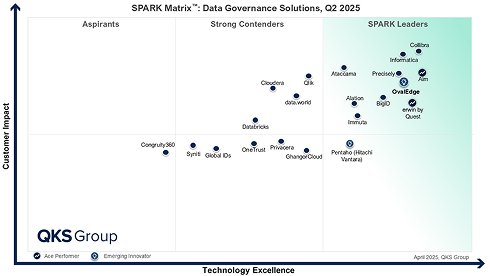
Example: OvalEdge, Collibra, and Alation.
Data discovery and classification tools
Discovery and classification tools identify where data lives and determine its sensitivity. They provide the foundation needed to apply governance-driven controls consistently.
Key capabilities
-
Automated data discovery across platforms
-
Sensitivity detection and labeling
-
Support for regulatory classifications
Example: BigID, Microsoft Purview, Amazon Macie, and Informatica Data Privacy Management.
Identity and access management platforms
IAM tools enforce who can access data based on governance-defined rules. They control authentication, authorization, and access lifecycle management across users and services.
Key capabilities
-
Role and attribute-based access control
-
User provisioning and deprovisioning
-
Integration with data platforms and applications
Example: Okta, Azure Active Directory, AWS IAM, and Ping Identity.
Data protection and privacy controls
These tools apply protection mechanisms to sensitive data based on its classification and usage context. They reduce exposure while enabling controlled access.
Key capabilities
-
Encryption at rest and in transit
-
Data masking and tokenization
-
Data loss prevention controls
Example: Protegrity, Thales CipherTrust, Varonis, and IBM Guardium.
Monitoring, audit, and incident response tools
Monitoring and response tools provide visibility into how governed data is accessed and used. They generate the evidence required for audits, risk management, and compliance.
Key capabilities
-
Access and activity logging
-
Anomaly detection and alerting
-
Incident investigation and remediation
Example: Splunk, Datadog, Sumo Logic, and Rapid7.
Together, these governance security tools form an integrated ecosystem where governance defines intent and security enforces it at scale.
How to integrate data security into data governance programs
Integrating data security into data governance works best when approached as a structured program rather than an ad hoc initiative. The following five steps help organizations move from disconnected policies and controls to governance-led security that scales.
Step 1: Define governance policies with enforcement in mind
Governance policies must be specific enough to be enforced technically. Vague statements about access or protection force security teams to interpret intent, which leads to inconsistent controls across systems.
Actionable tips
-
Write access and usage policies in terms of who, what, and why rather than general principles.
-
Link each policy to a clear enforcement mechanism such as access control, masking, or monitoring.
-
Review existing policies and flag any that cannot be enforced using current security tooling.
Step 2: Establish consistent data classification and sensitivity levels
Data classification provides the common language that connects governance intent to security execution. Without it, controls are applied uniformly instead of based on risk and business context.
Actionable tips
-
Define a small, manageable set of sensitivity levels that align with regulatory and business risk.
-
Assign default classifications to new datasets to avoid gaps during ingestion.
-
Map each classification level to required security controls such as encryption or restricted access.
Step 3: Connect ownership and stewardship to access decisions
Data owners and stewards should influence who can access data and under what conditions. When ownership is unclear or symbolic, access decisions default to convenience rather than accountability.
Actionable tips
-
Assign accountable owners for critical datasets and document their responsibilities clearly.
-
Route access approvals and exception requests through data stewards instead of only IT.
-
Periodically review access rights with owners to remove outdated or unnecessary permissions.
Step 4: Translate governance rules into automated security controls
Manual enforcement does not scale in modern data environments. Automation ensures governance rules are applied consistently as data moves and changes.
Actionable tips
-
Use attribute-based or policy-driven access models rather than static role assignments.
-
Integrate governance metadata with IAM and data protection tools where possible.
-
Automate enforcement of retention and deletion policies to reduce human error.
Step 5: Monitor, audit, and continuously refine alignment
Governance security alignment is not a one-time effort. Continuous monitoring and review are required to keep policies and controls in sync with evolving data usage.
Actionable tips
-
Use access logs and usage monitoring to identify policy violations or unusual behavior.
-
Incorporate security evidence into governance reviews and audits.
-
Regularly update policies and controls based on incidents, regulatory changes, and business needs.
These steps help organizations move from policy-driven intent to technically enforced governance, reducing risk while enabling responsible data access at scale.
|
Pro Tip: While understanding the principles of governance-led security is essential, execution is where most organizations struggle. Translating policies, classifications, and ownership into day-to-day controls requires a structured approach. OvalEdge’s Implementing Data Governance: Framework and Best Practices outlines a phased, execution-ready model that helps organizations move from intent to enforcement without overengineering governance from day one. |
Conclusion
Data governance and data security address different but equally critical layers of data management. Governance defines ownership, rules, and accountability, while security enforces protection through technical controls. Treating one as a substitute for the other creates gaps that surface as data access expands, regulations tighten, and analytics become more decentralized.
Strong data programs align both. Governance provides direction by defining how data should be used, who is responsible, and what constraints apply. Data security turns those decisions into enforceable, auditable controls that operate consistently across platforms and throughout the data lifecycle.
Organizations that succeed treat governance as an operational capability, not a documentation exercise. Practical frameworks that focus on scoping, automation, and measurable outcomes help teams scale governance without slowing the business.
Approaches like the phased governance model outlined by OvalEdge show how security enforcement can be embedded into governance programs incrementally, aligned to real business priorities.
When governance clarity guides security enforcement, data becomes both usable and protected at scale.
FAQs
1. Is data governance part of data security or a separate function?
Data governance and data security are separate but closely connected functions. Governance defines data ownership, usage rules, and accountability, while security focuses on protecting data through technical controls. Effective data programs rely on governance for direction and security for enforcement.
2. Can data security tools replace a data governance framework?
No. Security tools enforce protection but do not define business rules, ownership, or acceptable data usage. Without governance, security lacks context, which often leads to over-restriction, under-protection, or inconsistent access decisions.
3. Which teams should own data governance and data security initiatives?
Data governance is typically led by business, data, and compliance stakeholders, while data security is owned by IT and security teams. Successful organizations align these groups through shared accountability and coordinated workflows.
4. How does data classification improve both governance and security?
Data classification creates a shared foundation by defining sensitivity and criticality. Governance uses it to set policies, and security uses it to apply appropriate access controls, encryption, and monitoring based on risk.
5. What happens if data governance exists without strong data security?
Governance without security results in policies that cannot be enforced. Sensitive data may remain exposed despite documented rules, increasing the risk of breaches, regulatory violations, and loss of trust across analytics and business teams.
6. Do cloud native environments require different governance and security approaches?
Yes. Cloud environments increase data access and distribution, making manual controls ineffective. Organizations need automated governance policies and scalable security controls that adapt to dynamic data movement and self-service usage.
.png?width=1081&height=173&name=Forrester%201%20(1).png)
.png?width=1081&height=241&name=KC%20-%20Logo%201%20(1).png)