OpenMetadata alternatives for teams scaling data governance
Evaluate commercial and open-source platforms based on governance workflows, implementation effort, AI support, business adoption, and metadata control.
In this article
What are the best OpenMetadata alternatives?
The best OpenMetadata alternatives include OvalEdge, Collibra, Alation, Apache Atlas, DataHub, and Amundsen. Each platform serves a different need across enterprise governance, metadata management, and open-source flexibility.
-
OvalEdge focuses on unified data governance with cataloging, lineage, data quality, access control, and AI-assisted workflows.
-
Collibra supports enterprise governance programs with strong policy, stewardship, and compliance workflows.
-
Alation is built for data cataloging, search, and analytics team collaboration.
-
Apache Atlas provides open-source metadata governance for Hadoop and enterprise data ecosystems.
-
DataHub fits engineering-led teams that need event-driven metadata management and extensibility.
-
Amundsen supports lightweight data discovery for teams that want an open-source catalog.
When comparing these alternatives, the right choice depends on governance maturity, technical ownership, AI needs, and implementation effort. Let’s compare these OpenMetadata competitors side by side.
OpenMetadata alternatives compared
Here’s a quick comparison of the leading OpenMetadata alternatives. Use this comparison to shortlist platforms based on ownership model, governance depth, and implementation fit.
|
Tool |
Deployment model |
Best for |
Core strength |
AI capability |
Limitation |
|
OvalEdge |
Commercial SaaS, cloud, or on-prem |
Enterprise governance execution |
Catalog + governance workflows |
Agentic governance automation |
Broader than lightweight cataloging |
|
Collibra |
Commercial SaaS |
Regulated enterprise governance |
Policy and stewardship control |
Data and AI governance support |
Higher rollout effort |
|
Alation |
Commercial SaaS |
Analytics-led data discovery |
Search and collaboration |
AI-assisted catalog curation |
Less open-source flexibility |
|
Apache Atlas |
Open source |
Hadoop-centric governance |
Metadata and classification |
Limited native AI capability |
Older ecosystem fit |
|
DataHub |
Open source + managed cloud |
Engineering-led metadata teams |
Extensible metadata graph |
AI data catalog capabilities |
Needs technical ownership |
|
Amundsen |
Open source |
Lightweight data discovery |
Usage-based search |
Limited native AI capability |
Narrower governance depth |
This table gives a quick view of fit. The next section looks at OpenMetadata itself, so buyers can understand where alternatives may make sense.
What users say about OpenMetadata
OpenMetadata is widely discussed as a modern open-source metadata platform for teams that want more control over discovery, lineage, observability, and governance. Its own positioning centers on unified data discovery, data observability, and governance across a shared metadata graph.
Teams commonly use this platform to centralize metadata, document assets, improve search, track lineage, monitor quality, and support collaboration across data teams. It is especially a great fit for engineering-led organizations that can manage setup, customization, and ongoing platform ownership.
Strengths users mention
-
Strong open-source flexibility for teams with internal engineering capacity.
-
Useful metadata discovery, lineage, and observability capabilities.
-
Good fit for technical teams that want control over deployment and customization.
Limitations users mention
-
Implementation can depend heavily on internal platform or data engineering support.
-
Governance workflows may need extra process design outside the platform.
-
Business-user adoption can require additional enablement and operating structure.
-
Stewardship, approvals, and remediation may need more configuration as governance matures.
-
Long-term maintenance can add overhead for teams without dedicated ownership.
OpenMetadata is a strong fit when teams want an open-source metadata layer with technical flexibility. Buyers usually compare alternatives when they need stronger governance execution, broader stewardship workflows, or a lower-maintenance operating model. The right option depends on whether the priority is open-source control, enterprise governance depth, or faster cross-functional adoption.
Best OpenMetadata alternatives by platform type
OpenMetadata alternatives are easier to evaluate when grouped by platform type. Some teams want a commercial governance platform with built-in workflows and support, while others want open-source control with more internal ownership.
The sections below group each tool by the type of organization it fits best, so you can compare options based on how your team wants to build, scale, and operate governance.
Commercial OpenMetadata alternatives
Commercial OpenMetadata alternatives fit teams that want governance to move beyond metadata visibility. These platforms are better suited for organizations that need structured ownership, policy workflows, stewardship participation, and faster adoption across business and technical teams.
1. OvalEdge
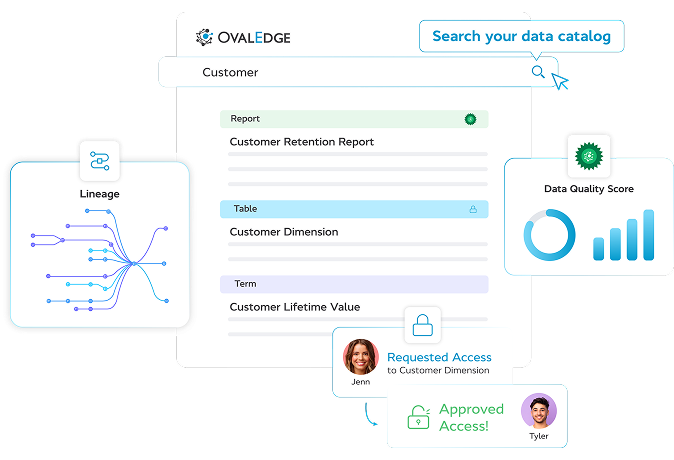
OvalEdge is an enterprise data governance and catalog platform built for teams that want metadata visibility and governance execution in one place. It brings data cataloging, business glossary, lineage, data quality, access governance, privacy controls, and AI-assisted workflows into a single platform for trusted data use.
What is it used for?
OvalEdge is used to discover data, assign ownership, manage governance policies, track lineage, monitor data quality, and support governed self-service analytics. It helps data teams, stewards, compliance users, and business teams work from shared definitions, trusted assets, and clear accountability.
When buyers choose it over OpenMetadata
OpenMetadata is a strong choice for engineering-led teams that want an open-source metadata platform. Buyers usually evaluate OvalEdge when their governance program needs more structure around ownership, workflow execution, and business adoption.
1. Metadata visibility needs to become governance execution
OpenMetadata helps teams centralize metadata, lineage, observability, and governance context. That gives technical users a strong foundation for understanding data assets and relationships.
OvalEdge becomes a stronger fit when the organization needs governance actions to happen inside the platform. Data owners need assigned responsibilities. Stewards need tasks and approvals. Compliance teams need policy controls. Business users need trusted answers without depending on technical teams for every question.
This is where OvalEdge’s positioning becomes sharper. It is not only a catalog. It helps teams operate governance as a repeatable process.
2. Open-source flexibility creates internal ownership pressure
OpenMetadata gives teams flexibility and control. That can work well when the organization has dedicated platform engineers who can manage deployment, configuration, upgrades, connectors, and long-term support.
OvalEdge fits buyers who want to reduce that internal load. Instead of building governance processes around an open-source layer, teams get a commercial platform designed to support cataloging, lineage, quality, privacy, access control, and governance workflows together.
3. AI governance needs more than metadata context
OpenMetadata supports modern metadata intelligence and AI-oriented context. OvalEdge extends this into AI-assisted governance execution.
Its agentic governance approach helps discover assets, enrich metadata, infer lineage, detect quality issues, classify sensitive data, and route approvals to the right people. Humans stay in control, but the manual work reduces significantly.
4. Business users need a governed way to work with data
OpenMetadata can support collaboration across data teams. OvalEdge goes further by making governance easier for non-technical users to participate in.
Business users can search trusted assets, understand definitions, request access, ask questions through askEdgi, and work with governed data products. That matters when governance needs adoption beyond engineering and analytics teams.
What changes after adoption
After adopting OvalEdge, governance becomes easier to run because ownership, quality, lineage, and access workflows sit in one place. Teams can move from scattered documentation to a governed system where users know what data means, where it comes from, who owns it, and whether it can be trusted.
Key changes include:
-
Clearer ownership: Data owners and stewards get defined responsibilities.
-
Faster data understanding: Lineage and glossary context help users interpret assets with less back-and-forth.
-
Stronger quality control: Data quality rules help teams identify issues before they affect reporting.
-
Better access governance: Users can request and manage access through a more controlled process.
Bayview’s experience shows why this matters in practice. During its move from on-prem systems to Snowflake, Bayview used OvalEdge to strengthen governance around data cataloging, business glossary, and data quality. The team added automated quality rules, ticket routing, and scheduled monitoring, which helped identify and resolve errors in minutes instead of waiting for client inquiries.
An open-source metadata tool could help Bayview document assets and improve metadata visibility. But Bayview needed more than visibility during a cloud migration. OvalEdge helped operationalize quality checks, route issues to the right teams, support regulatory needs, and make governance easier for business users to adopt. That is the practical gap buyers should look for when comparing OpenMetadata alternatives.
AI governance and automation capabilities
OvalEdge’s AI capabilities are designed to reduce manual governance work while keeping humans in control. The platform supports agentic data governance, where AI helps discover assets, enrich metadata, identify quality issues, classify sensitive data, and guide governance actions.
Core AI capabilities include:
-
AI-curated cataloging: Assets are discovered, organized, and kept current with less manual effort.
-
Auto lineage: Data flows are inferred so teams can understand impact faster.
-
AI-assisted quality: The platform can surface quality debt and suggest governance rules.
-
askEdgi: Business users can ask questions and receive answers grounded in governed data.
-
Privacy and access automation: Sensitive data can be classified and governed through access policies.
This makes OvalEdge useful for teams preparing data for analytics, compliance, and AI programs.
Things to consider
OvalEdge is best suited for teams that want a broader governance platform, not a simple open-source metadata layer. It works well when governance needs to include business users, data stewards, compliance teams, and technical teams.
Consider OvalEdge if you need:
-
Governance execution: Policies, workflows, ownership, and approvals.
-
Integrated capabilities: Catalog, glossary, lineage, quality, access, and privacy in one platform.
-
Business adoption: A governed experience for non-technical users.
-
AI readiness: Trusted data foundations for analytics and AI use cases.
Teams that only need lightweight metadata discovery may not need the full platform depth.
Ratings, reviews, and analyst validation
OvalEdge has strong validation across user-review and analyst channels. Gartner describes it as an AI-enhanced data catalog and end-to-end data governance platform with catalog, lineage, glossary, quality rules, anomaly detection, remediation, privacy compliance, classification, and access governance capabilities.
User feedback highlights practical governance value:
-
G2: Users mention reduced time spent searching for data and better end-to-end data management. G2 also shows a visible verified review rating of 5 out of 5.
-
Gartner: Users highlight support quality, business glossary integration, and AI-enabled term association, while rating it 4.7 out of 5.
-
TrustRadius: OvalEdge shows a 10.0 out of 10 score in TrustRadius comparison data, with reviews mentioning auto lineage, impact analysis, API support, and customer support.
The platform is also recognized in the 2025 Gartner Magic Quadrant and SPARK Matrix for data governance capabilities.
Proof point: Forrester TEI impactA Forrester Total Economic Impact study reported 337% ROI and payback in under 6 months for organizations adopting OvalEdge. The study ties the value to reduced effort in cataloging metadata, fulfilling data requests, compiling lineage, improving analyst productivity, and finding sensitive data faster. For buyers comparing OvalEdge with OpenMetadata, this matters because the decision is not only about catalog features. It is also about how quickly governance work becomes measurable, repeatable, and easier for teams to sustain. |
See how OvalEdge compares in your environment
If you are evaluating OpenMetadata alternatives, OvalEdge is worth a closer look. Explore how OvalEdge fits your architecture, governance needs, and rollout plan.
2. Collibra
Collibra is a commercial data governance platform focused on data intelligence, data cataloging, policy management, lineage, data quality, and AI governance. It is commonly evaluated by large organizations with formal governance and compliance programs.
What is it used for?
Collibra is used to create a governed data foundation across business and technical teams. It helps organizations document data assets, define ownership, manage policies, support compliance work, improve data discovery, and connect governance activity to data and AI programs.
When buyers choose it over OpenMetadata
Buyers usually choose Collibra over OpenMetadata when they want a commercial governance platform instead of an open-source metadata layer. It fits teams that need structured governance ownership and more vendor-backed support.
Key reasons include:
-
Policy-led governance: Collibra is built around governance operating models, policy control, and stewardship workflows.
-
Enterprise compliance needs: It fits teams that need formal governance processes across regulated data environments.
-
Less internal platform ownership: Teams do not need to manage the same level of open-source deployment and maintenance.
What changes after adoption
After adoption, Collibra can give governance teams a central place to manage data ownership, policies, definitions, and approvals. It can also make governance more visible to business users when the rollout is planned carefully.
Common changes include:
-
More formal ownership: Data domains, stewards, and responsibilities become easier to define.
-
Clearer policy workflows: Teams can connect policies with data assets and governance tasks.
-
Improved compliance support: Governance teams get a more structured system for documentation and audit readiness.
AI and automation capabilities
Collibra positions its platform around unified governance for data and AI. Its product pages mention AI governance, AI Command Center, AI-assisted curation, classification, governance tasks, and workflow automation.
Relevant capabilities include:
-
AI governance support: Teams can manage controls and context for AI initiatives.
-
Automated stewardship: Collibra supports curation, classification, and governance tasks through AI-driven automation.
-
Catalog and lineage assistance: AI capabilities can help users find trusted data and understand context faster.
Things to consider
Collibra may require careful planning before teams see broad adoption. It is often suited to organizations that already have governance roles, ownership models, and executive support in place.
Consider these tradeoffs:
-
Learning curve: Reviewers often mention that setup and usage can feel complex for new teams.
-
Adoption effort: Business users may need training to understand terms, workflows, and governance processes.
-
Cost fit: Smaller teams may find the investment harder to justify if they only need metadata discovery.
-
Process dependency: The platform works best when governance responsibilities are already clearly defined.
Ratings and reviews
Across G2 and TrustRadius, users mention Collibra’s governance depth, centralized data assets, collaboration features, workflow support, and compliance value as positives. Reviewers also point to setup complexity, a steep learning curve, ease-of-use challenges, and gaps around areas like reference data management or data quality integration depending on the implementation.
On Reddit, users mention that Collibra can help with cataloging and governance structure, but adoption may suffer when governance is treated as a separate activity. Some users also describe the terminology as hard to understand for engineering teams.
Also read → Comparing Collibra alternatives in 2026? Compare tools before you buy
3. Alation
Alation is a commercial data catalog and governance platform focused on data discovery, search, collaboration, lineage, and trusted data use. It is commonly evaluated by analytics-led teams that want a searchable knowledge layer.
What is it used for?
Alation is used to help users find, understand, and use trusted data. Teams use it for data cataloging, metadata curation, governance policies, stewardship workflows, lineage visibility, and collaboration between business and technical users.
When buyers choose it over OpenMetadata
Buyers usually choose Alation over OpenMetadata when they want a managed catalog experience with less internal engineering ownership. It fits teams that prioritize discovery, usability, and collaboration across analytics users.
Key reasons include:
-
Search-led discovery: Alation is built around helping users find relevant data through a governed catalog experience.
-
Analytics adoption: It can support analysts and business users who need more context before using data.
-
Managed platform model: Teams do not need to maintain an open-source metadata platform themselves.
What changes after adoption
After adoption, Alation can help teams create a shared place for data discovery and context. Users can search for datasets, understand ownership, view lineage, and see governance signals before using data.
Common changes include:
-
Better data understanding: Users get more business and technical context before using an asset.
-
More guided usage: Trust signals and policies can help users handle data correctly.
-
Improved collaboration: Data owners and consumers can work around shared catalog context.
AI and automation capabilities
Alation positions its platform around agentic data intelligence and AI-ready governance. Its product pages mention agentic workflows, suggested descriptions, policy guidance, lineage, Trust Flags, and dynamic masking.
Relevant capabilities include:
-
AI-assisted curation: Suggested descriptions can help teams document assets faster.
-
Governed AI context: Metadata and policies can give AI and analytics users clearer data context.
-
Policy automation: Trust Flags and linked policies can guide users toward compliant data use.
Things to consider
Alation may not be the best fit for every governance operating model. It works well for cataloging and discovery, but buyers should check how deeply it supports their policy, quality, and stewardship needs.
Consider these tradeoffs:
-
Governance depth: Teams with complex policy execution needs should validate workflow fit early.
-
Data quality expectations: Some reviewers have asked for more integrated data quality capability.
-
Lineage experience: Some practitioner discussions mention that lineage may need careful evaluation.
-
Cost fit: Smaller teams may find a commercial catalog more than they need.
Ratings and reviews
Across G2 and Gartner Peer Insights, users mention Alation’s search experience, catalog usability, collaboration, data visibility, and ability to bring business and technical users into one shared system as positives. Reviewers also point to areas to validate before purchase, including onboarding effort, data quality depth, lineage experience, and setup needs for broader governance use cases.
Users on Reddit describe Alation as easier to understand than Collibra and useful for catalog adoption. The more critical comments mention lighter governance depth, a traditional steward-led approach, weaker automation, and lineage experience that may vary.
Also read → Looking for Alation alternatives? Compare top tools in 2026 | Compare OvalEdge vs Alation vs Collibra vs Informatica side-by-side
Evaluate Apache Atlas alternatives with agentic analytics and governance frameworks
Understand how agentic analytics accelerates data governance through AI-driven workflows, real-time insights, and governed self-service. This whitepaper shows how teams operationalize governance for analytics and AI readiness.
Open-source OpenMetadata alternatives
Open-source OpenMetadata alternatives fit teams that want more control over metadata architecture, deployment, and customization. These tools usually work best when data engineering or platform teams can own setup, integrations, upgrades, and long-term maintenance.
4. Apache Atlas
Apache Atlas is an open-source metadata management and governance framework. It helps organizations build a catalog of data assets, classify data, manage metadata, and support governance across data ecosystems.
What is it used for?
Apache Atlas is used for metadata management, classification, lineage, glossary management, and data governance. It is often considered by teams working with Hadoop-based systems, big data platforms, and environments where metadata must support access and compliance controls.
When buyers choose it over OpenMetadata
Buyers may choose Apache Atlas over OpenMetadata when they want an open-source governance framework that fits closely with Apache and Hadoop-oriented data environments. It can also appeal to teams that want control over metadata types and governance models.
Common reasons include:
-
Apache ecosystem fit: Atlas can work well when Hadoop, Hive, HBase, Kafka, or Ranger already sit at the center of the data stack.
-
Metadata type control: Teams can define custom types to model assets and relationships.
-
Governance foundation: It supports classification, lineage, and policy-related metadata.
What changes after adoption
After adoption, Apache Atlas can give technical teams a central metadata repository for governed data assets. It can also help connect classification and lineage to security decisions when paired with tools such as Apache Ranger.
Common changes include:
-
Centralized metadata: Technical teams get one place to manage asset context.
-
Classification support: Sensitive or regulated data can be tagged for governance use.
-
Lineage visibility: Teams can trace how data moves across connected systems.
-
Policy context: Metadata can support access decisions in Apache-based environments.
AI and automation capabilities
Apache Atlas does not position itself as an AI governance or AI automation platform. Its value is more focused on metadata foundations that can support governance architecture.
Relevant capabilities include:
-
Metadata modeling: Teams can define data types and relationships for governed assets.
-
Classification automation: Metadata tags can support governance and access policies.
-
Lineage capture: Atlas can help collect and display data flow context.
-
API extensibility: Teams can build custom processes around Atlas when they have engineering support.
Teams looking for native AI assistance, natural language search, or AI-driven stewardship should validate fit carefully.
Things to consider
Apache Atlas can be useful for technical teams, but it may require significant internal ownership. Buyers should evaluate the work needed to deploy, configure, customize, and maintain it.
Consider these tradeoffs:
-
Implementation effort: Setup can be resource-intensive, especially outside Apache-heavy environments.
-
User experience: Business teams may need additional tools or enablement to use metadata effectively.
-
Modern stack fit: Teams using cloud warehouses, SaaS tools, and BI platforms should verify connector coverage.
-
AI readiness: Native AI governance support is limited compared with newer commercial platforms.
Ratings and reviews
Across G2 and TrustRadius, users mention Apache Atlas positively for metadata management, governance support, classification, lineage, and handling enterprise data assets. Reviewers also point to setup effort, resource needs, and usability limits as areas to evaluate before adoption. G2 review summaries mention that initial setup can be resource-intensive for users.
Also read → Best commercial and open-source Apache Atlas alternatives in 2026
5. DataHub
DataHub is an open-source metadata platform and AI data catalog. It focuses on discovery, governance, observability, metadata graph management, and data asset context for engineering-led data teams.
What is it used for?
DataHub is used to collect metadata, document data assets, track lineage, support discovery, and manage governance context across data systems. Teams also use DataHub Cloud when they want a managed version of the open-source platform.
When buyers choose it over OpenMetadata
Buyers may choose DataHub over OpenMetadata when they want an event-oriented metadata architecture with a flexible metadata graph. It can fit teams that want to build metadata workflows around engineering systems.
Common reasons include:
-
Metadata graph depth: DataHub can model relationships across datasets, dashboards, pipelines, and users.
-
Engineering extensibility: Teams can build custom metadata ingestion and governance workflows around APIs.
-
Managed option: DataHub Cloud can reduce some hosting work while keeping the DataHub ecosystem.
What changes after adoption
After adoption, DataHub gives technical teams a shared metadata layer for data discovery and governance context. It can help users understand where data lives, how it changes, and how assets relate to each other.
Common changes include:
-
Better asset discovery: Users can search for data assets across connected systems.
-
Clearer lineage context: Teams can trace data movement across pipelines and downstream use.
-
More metadata ownership: Data producers can document ownership, tags, and descriptions in one place.
AI and automation capabilities
DataHub positions itself as an open-source AI data catalog. Its platform messaging highlights unified discovery, governance, and observability for AI-readiness. It also describes AI data catalogs as supporting natural language search, automated documentation, sensitive data classification, relationship discovery, and anomaly detection.
Relevant capabilities include:
-
AI-ready metadata context: DataHub helps create data context for people and AI systems.
-
Automated metadata management: Teams can reduce manual documentation through metadata ingestion and enrichment.
-
Observability signals: Metadata changes and data quality context can support governance decisions.
Things to consider
DataHub can be a fit for technical teams, but buyers should evaluate the engineering ownership required. Open-source flexibility usually comes with responsibility for setup, customization, monitoring, and upgrades.
Consider these tradeoffs:
-
Technical dependency: Teams need platform or data engineering support to get full value.
-
Governance execution: Workflow-heavy stewardship and policy operations may require added process design.
-
Business adoption: Non-technical users may need enablement to use metadata consistently.
-
Cost model: DataHub Cloud changes the open-source cost equation, so compare licensing and support needs carefully.
Ratings and reviews
Across G2 and Gartner Peer Insights, users mention DataHub’s ease of use, dataset organization, tool connectivity, metadata discovery, and managed cloud deployment as positives. Reviewers and buyers should also evaluate implementation needs, governance workflow depth, and the engineering effort required for custom metadata operations.
On Reddit, users mention DataHub as a solid open source catalog option for engineering teams, while also noting that catalog success depends on how teams document and maintain metadata. The concern is less the tool itself and more long-term ownership.
Also read → Looking for DataHub alternatives in 2026? Start here | Compare OpenMetadata vs DataHub side-by-side in 2026
6. Amundsen
Amundsen is an open-source data discovery and metadata engine originally built at Lyft. It helps analysts, data scientists, and engineers find trusted data through search, metadata context, and usage signals.
What is it used for?
Amundsen is used to index data resources such as tables, dashboards, and streams. Teams use it to search data assets, view descriptions, identify owners, check usage patterns, and reduce repeated questions about where trusted data lives.
When buyers choose it over OpenMetadata
Buyers may choose Amundsen over OpenMetadata when they want a simpler open-source discovery layer instead of a broader metadata and governance platform. It can fit teams that mainly need search and asset context.
Common reasons include:
-
Discovery-first use case: Amundsen focuses on helping users find data through search and usage-based ranking.
-
Simpler catalog scope: Teams that do not need deeper governance workflows may prefer its lighter approach.
-
Open-source control: Engineering teams can customize the metadata model and services around internal needs.
What changes after adoption
After adoption, Amundsen can make internal data discovery easier for analysts and engineers. Users get a searchable catalog where popular assets, owners, descriptions, and usage context are easier to find.
Common changes include:
-
Faster asset search: Users can find tables or dashboards through a familiar search experience.
-
Less repeated clarification: Owners, descriptions, and column context reduce basic data questions.
-
Usage-informed discovery: Frequently queried or viewed assets can appear more prominently.
-
Better onboarding: New users can locate known data sources with less dependence on informal knowledge.
AI and automation capabilities
Amundsen does not position itself as an AI governance or AI automation platform. Its automation focus is mainly around metadata ingestion and search relevance.
Relevant capabilities include:
-
Automated metadata extraction: Databuilder can pull metadata from connected systems into the catalog.
-
Usage-based ranking: Its PageRank-inspired search uses activity signals to improve result relevance.
-
Metadata enrichment: Users can add descriptions and context to improve discovery.
-
Extensible services: Teams can build additional workflows if they have engineering support.
Teams needing native AI assistance or governed self-service analytics should evaluate other options.
Things to consider
Amundsen is narrower than many newer catalog and governance platforms. It can work for discovery, but teams should validate whether it supports their broader governance needs.
Consider these tradeoffs:
-
Governance depth: It is more discovery-focused than workflow-focused.
-
Maintenance ownership: Teams still need to manage services such as frontend, search, metadata storage, and ingestion.
-
Modern feature fit: Native AI governance, advanced stewardship, and policy workflows are limited.
-
Scale planning: Larger deployments may need more engineering work around performance and integrations.
Ratings and reviews
Public review coverage for Amundsen is limited compared with commercial data catalog tools. This makes it harder for buyers to benchmark user satisfaction through sites like G2 or Gartner. Users generally tend to discuss it as a lightweight discovery option rather than a full governance platform.
Users on Reddit describe Amundsen as simpler and easier to set up than DataHub. The positives center on smaller-team discovery use cases. The negatives focus on narrower capability depth and limited fit when teams need broader governance operations.
Not sure which OpenMetadata alternative fits your use case?
Get a tailored walkthrough based on your data stack and governance needs.
OvalEdge vs OpenMetadata: Side-by-side comparison
OpenMetadata and OvalEdge can both support metadata-driven governance, but they fit different operating models. Here’s a practical comparison of the two tools side-by-side:
|
Evaluation factor |
OvalEdge |
OpenMetadata |
|
Positioning |
Enterprise governance operating platform |
Open-source metadata platform |
|
Deployment model |
SaaS, cloud, or on-prem |
Self-hosted open source |
|
Governance execution |
Built-in workflows, policies, approvals |
Governance metadata and configuration |
|
Metadata management |
Catalog, glossary, ownership, context |
Metadata graph, schemas, glossary |
|
Lineage depth |
Auto-lineage with impact analysis |
Lineage visibility and relationships |
|
Data quality support |
Rules, monitoring, remediation workflows |
Tests, profiling, observability |
|
AI capability |
Agentic governance and askEdgi |
AI-ready metadata context |
|
Stewardship workflows |
Assigned tasks, reviews, approvals |
Requires process design |
|
Setup effort |
Guided platform rollout |
Engineering-owned setup |
|
Time-to-value |
Built for faster governance rollout |
Depends on internal capacity |
|
User adoption |
Supports business and technical users |
Often technical-team led |
|
Ecosystem fit |
Enterprise, hybrid, and regulated teams |
Modern data stack teams |
|
Flexibility |
Configurable with platform support |
Highly customizable open source |
|
Pricing fit |
Fits enterprise governance investment |
Lower license cost, higher ownership |
|
Best fit |
Teams scaling governance execution |
Teams building metadata infrastructure |
When OpenMetadata fits better:
OpenMetadata fits teams that want open-source control, strong metadata visibility, flexible customization, and enough engineering capacity to own deployment, integrations, upgrades, and long-term support.
When OvalEdge fits better:
OvalEdge fits teams that want governance to move beyond metadata visibility. It is better suited when organizations need stewardship workflows, quality remediation, access governance, policy execution, AI-assisted automation, and business-user adoption in one platform.
Evaluate OvalEdge for your automated governance needs
Get a focused walkthrough of how OvalEdge handles governance workflows, lineage, data quality, and business-user adoption based on your data setup.
How to choose the right OpenMetadata alternative
The right OpenMetadata alternative depends on what your team needs after metadata is centralized. Look beyond the catalog interface and evaluate how each platform will support ownership, governance work, user adoption, and long-term maintenance.
1. Look at how much governance execution you need
If your team only needs metadata discovery, an open-source catalog may be enough. If you need approvals, ownership workflows, policy tracking, access governance, and quality remediation, look for a platform that supports governance as an ongoing operating process.
2. Check who will own implementation and maintenance
Open-source tools give teams flexibility, but they also need internal ownership. Before choosing one, ask whether your data engineering team can manage deployment, connectors, upgrades, custom workflows, and platform reliability without slowing other priorities.
3. Evaluate adoption beyond technical users
A catalog only works when people use it consistently. Look for features that help business users understand terms, request access, find trusted assets, ask questions, and participate in governance without depending on technical teams for every step.
4. Compare lineage and data quality in real workflows
Lineage and quality features should support decisions, not just visibility. Check whether the platform helps teams trace impact, monitor quality rules, assign issues, route remediation, and show how data problems affect reports, products, or compliance work.
5. Assess AI readiness with governance controls
If AI is part of your roadmap, metadata context alone may not be enough. Look for governed AI capabilities that can classify sensitive data, support trusted answers, enforce access rules, and connect AI outputs to approved business definitions.
The best alternative should fit the way your team actually wants to run governance. If you need full control and have the engineering resources, open-source tools may work well. If you need faster adoption, clearer accountability, and governance workflows built into the platform, a commercial alternative will usually be easier to scale.
|
Did You Know? Gartner’s 2025 survey found that 70% of CDAOs now own AI strategy and operating models, while PwC’s 2025 Responsible AI Survey found that half of executives struggle to turn Responsible AI principles into repeatable processes. For teams evaluating OpenMetadata alternatives, this shifts the decision beyond metadata visibility. The right platform should help govern trusted data, support lineage, enforce policies, and give business users reliable context for AI and analytics. |
Where OvalEdge stands out among OpenMetadata competitors
OvalEdge stands out when teams want governance to produce measurable outcomes, not just better metadata visibility.
1. Proven financial impact from governance adoption
Forrester’s Total Economic Impact study reported 337% ROI, $2.5 million NPV, and payback in under 6 months for organizations using OvalEdge. The study also reported $3.2 million in benefits over three years, showing how governance can reduce manual work and create measurable business value.
2. Less manual effort for stewards and data teams
Forrester found that OvalEdge reduced effort for metadata cataloging, data requests, and lineage work by up to 40%. This matters when teams are comparing OvalEdge with OpenMetadata because open-source tools often need more internal ownership to turn metadata into repeatable governance work.
3. Better productivity for analysts and business users
The same Forrester study reported up to 30% improvement in analyst productivity and up to 20% improvement in business-user productivity. G2 users also mention that OvalEdge reduces the time spent searching for data, with one review citing a drop from 70% of time spent searching to 5%.
4. Stronger support for sensitive data and compliance work
Forrester reported a 75% reduction in effort required to find, tag, and secure sensitive data. This gives OvalEdge a practical edge for teams that need governance to support privacy, access control, and compliance readiness, not only metadata documentation.
5. Independent analyst recognition adds buyer confidence
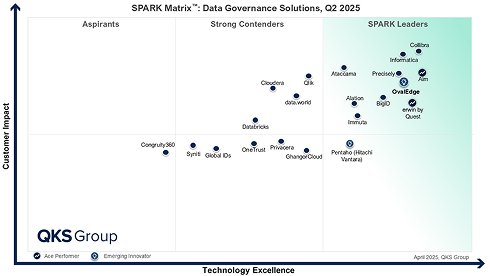
QKS Group positioned OvalEdge as a Leader and Emerging Innovator in the 2025 SPARK Matrix for Data Governance Solutions, citing technology excellence and customer impact. OvalEdge is also recognized in the 2025 Gartner Magic Quadrant for Data and Analytics Governance Platforms.
6. Reviewers validate practical day-to-day value
Gartner Peer Insights lists OvalEdge at 4.7 out of 5, with users highlighting support quality, glossary integration, and AI-enabled term association. Users on TrustRadius mention auto-lineage, impact analysis, API support, and responsive support as practical strengths.
If you want governance that turns metadata into ownership, trusted access, quality control, and measurable productivity gains, OvalEdge is worth evaluating closely.
Book a demo to see how OvalEdge fits your governance goals and long-term data maturity initiatives.
Go beyond open-source metadata management
OvalEdge helps you move from metadata visibility to governed workflows with AI-assisted cataloging, automated lineage, data quality, and policy controls in one platform.
Frequently asked questions
1. What is the best OpenMetadata alternative?
OvalEdge is a strong OpenMetadata alternative for teams that need enterprise data governance, not just open-source metadata management. It brings cataloging, lineage, data quality, access governance, stewardship workflows, and AI-assisted governance into one platform.
2. Why do companies look for OpenMetadata alternatives?
Companies look for OpenMetadata alternatives when they need more governance execution, business-user adoption, and lower internal ownership. OpenMetadata fits technical teams, but larger governance programs often need more workflow support.
3. Is OvalEdge better than OpenMetadata?
OvalEdge is better suited for organizations that want a commercial governance platform with built-in workflows, support, and measurable business outcomes. OpenMetadata can be a better fit for teams that want open-source control and have engineering resources to manage setup, customization, and ongoing maintenance.
4. What is the difference between OpenMetadata and DataHub?
OpenMetadata focuses on unified metadata management with discovery, governance, quality, and collaboration in one open-source platform. DataHub is often evaluated by engineering-led teams that want an extensible metadata graph and event-driven metadata architecture.
5. Which OpenMetadata alternative is best for enterprise governance?
OvalEdge, Collibra, and Alation are common commercial options for enterprise governance use cases. OvalEdge is especially relevant when teams want governance workflows, automated lineage, data quality, access governance, and AI-assisted stewardship in one platform.
6. Which OpenMetadata alternative is best for open-source metadata management?
DataHub, Apache Atlas, and Amundsen are relevant open-source alternatives depending on the use case. DataHub fits engineering-led metadata programs, Apache Atlas fits Apache and Hadoop-centric environments, and Amundsen fits lightweight discovery needs.
Evaluating OpenMetadata alternatives? Start here
- Need governance workflows, not just metadata visibility?
- Want catalog, lineage, quality, and access together?
- Can your team manage open-source ownership long term?
- Do business users need a simpler way to trust data?
- Is AI readiness now part of your governance plan?
Implement data governance faster with a proven framework
Access a practical 5-step framework used across real deployments to scope, prioritize, and implement governance without over-engineering.
Learn how to identify high-impact use cases and apply AI and automation to reduce manual effort.
Proven by customer successes across industries
.png?width=151&height=151&name=Mask%20group%20(18).png)
How Delta Community Credit Union enhanced its data governance with OvalEdge
"We have seen dramatic results across the board by implementing these programs, centralizing our metadata with the OvalEdge data catalog, and enabling self-service data education."
Dr. Su Rayburn
Vice President, Information Management & Analytics

.png?width=151&height=151&name=Mask%20group%20(19).png)
Bedrock leverages OvalEdge to standardize definitions, improve data accuracy
"OvalEdge stands out for its holistic approach, providing everything from business glossary to data lineage, all seamlessly integrated. The auto-lineage feature saves us months of work, enabling us to quickly understand data flows and address issues at the source.”
Sergei Vandalov
Senior Manager, Data Governance & Analytics

.png?width=151&height=151&name=Mask%20group%20(20).png)
Gousto’s continued data governance journey to deliver exceptional customer experience
“Incorrect pricing, nutritional or allergen information can disrupt the customer experience. With quality data at every stage, Gousto aligns its customer promise with operational excellence.”
Cathy Pendleton
Senior Manager - Data Governance
OvalEdge Recognized as a Leader in Data Governance Solutions
.png?width=1081&height=173&name=Forrester%201%20(1).png)
“Reference customers have repeatedly mentioned the great customer service they receive along with the support for their custom requirements, facilitating time to value. OvalEdge fits well with organizations prioritizing business user empowerment within their data governance strategy.”
.png?width=1081&height=241&name=KC%20-%20Logo%201%20(1).png)
“Reference customers have repeatedly mentioned the great customer service they receive along with the support for their custom requirements, facilitating time to value. OvalEdge fits well with organizations prioritizing business user empowerment within their data governance strategy.”
Gartner, Magic Quadrant for Data and Analytics Governance Platforms, January 2025
Gartner does not endorse any vendor, product or service depicted in its research publications, and does not advise technology users to select only those vendors with the highest ratings or other designation. Gartner research publications consist of the opinions of Gartner’s research organization and should not be construed as statements of fact. Gartner disclaims all warranties, expressed or implied, with respect to this research, including any warranties of merchantability or fitness for a particular purpose.
GARTNER and MAGIC QUADRANT are registered trademarks of Gartner, Inc. and/or its affiliates in the U.S. and internationally and are used herein with permission. All rights reserved.