Ataccama Alternatives: Compare Top Platforms for Data Quality & Governance
Evaluate platforms that help you connect data quality with automated governance, lineage, ownership, stewardship, and trusted data use across the business.
In this article
What are the best Ataccama alternatives?
The best Ataccama alternatives include OvalEdge, Collibra, Informatica, Talend, Semarchy, and Profisee. Each platform fits a different priority, from governance execution and enterprise data management to data quality, integration, and MDM.
-
OvalEdge: Best for unified governance with catalog, lineage, data quality, access, and AI-driven workflows.
-
Collibra: Best for enterprise-wide governance programs with mature policy and stewardship needs.
-
Informatica: Best for large-scale data management across integration, quality, governance, and MDM.
-
Talend: Best for teams prioritizing data integration, pipeline quality, and transformation workflows.
-
Semarchy: Best for flexible multi-domain MDM and governed master data management.
-
Profisee: Best for practical MDM programs focused on stewardship, matching, and business adoption.
The right choice depends on whether you need governance depth, data quality automation, MDM strength, faster adoption, or broader enterprise integration. Let’s compare these Ataccama competitors side by side.
Ataccama alternatives compared
Use this table to quickly compare where each Ataccama alternative fits before evaluating them in detail.
|
Tool |
Best for |
Core strength |
AI capability |
Limitation |
|
OvalEdge |
Unified governance |
Catalog, lineage, quality, access |
Agentic governance automation |
Needs governance ownership |
|
Collibra |
Enterprise governance |
Data and AI policy control |
AI governance workflows |
Heavier implementation |
|
Informatica |
Enterprise data management |
Integration, quality, MDM |
CLAIRE AI automation |
Higher platform complexity |
|
Talend |
Data integration and quality |
Pipelines, quality, transformation |
AI-assisted data engineering |
Less governance-led |
|
Semarchy |
Multi-domain MDM |
Golden records and DataOps |
AI-driven MDM support |
MDM-first focus |
|
Profisee |
Practical MDM rollout |
Trusted master data |
AI-accelerated MDM |
Narrower governance scope |
The best fit depends on the problem you need to solve first. Choose the platform that matches your operating model.
What users say about Ataccama
Ataccama is commonly used for data quality, MDM, metadata management, profiling, monitoring, and remediation. Reviews on Gartner Peer Insights and G2 show that users value it most when data quality is the center of the program. Gartner also lists Ataccama across data quality, metadata management, and MDM review categories, which reflects its broader data management positioning.
Based on user reviews, Ataccama is often valued for:
-
Data quality management: Users highlight its ability to surface DQ issues, support remediation, and improve trust in decision-making data.
-
MDM and metadata support: Reviews point to master data management, metadata management, and lineage as useful parts of the platform.
-
Automation and reporting: G2 reviews mention automated data quality features, reporting, and support for data management workflows.
However, buyers may look for alternatives due to these limitations:
-
Steep learning curve: G2 review summaries point to complexity and difficulty learning the platform, especially for users who need time and training to use it effectively.
-
Business-user adoption can take effort: When a platform needs heavy training, adoption can slow down for stewards, analysts, and non-technical users.
-
Governance execution may need closer evaluation: Ataccama is strong in DQ-led programs, but buyers looking for day-to-day stewardship, ownership workflows, and governance adoption should compare how each platform supports execution beyond quality checks.
-
Scalability should be validated for large workloads: Teams running quality checks across high-volume Snowflake, Databricks, healthcare, or financial datasets should test performance, sampling, and connector reliability before rollout.
-
Implementation can become configuration-heavy: For complex environments, buyers should assess setup effort, service dependencies, and internal technical ownership early.
-
AI use cases may feel DQ-centered: Ataccama’s AI value is often tied to quality rules and monitoring, while some buyers may need AI support across governance, cataloging, lineage, glossary, and business-user workflows.
These patterns explain why teams compare Ataccama alternatives based on their main use case. Some need stronger governance execution, while others prioritize integration, data quality scale, or MDM maturity.
Best Ataccama alternatives for your use case
Choosing an Ataccama alternative becomes easier when you start with the job the platform needs to do. Some teams need stronger governance execution. Others need deeper data quality, integration, or MDM control.
The sections below group each alternative by the use case it fits best, so buyers can compare platforms based on the outcome they need first.
Tools for unified data governance and cataloging
This group is best for buyers who want data governance, cataloging, lineage, stewardship, and business adoption to work from one platform.
1. OvalEdge
OvalEdge is an AI-powered, unified data governance platform built for teams that want to connect cataloging, lineage, data quality, access control, and stewardship in one place. It is a strong Ataccama alternative for buyers who want to connect data quality findings with ownership, workflows, and business impact.
What is it used for?
OvalEdge is used to help teams find trusted data, understand its meaning, check its quality, and act on governance tasks from one place. It connects cataloging, glossary, lineage, access, and stewardship so business and data teams can work with the same context.
For Ataccama buyers, the main value is practical. OvalEdge brings data quality signals into the same place where teams manage ownership, workflows, approvals, and downstream impact.
When buyers choose OvalEdge over Ataccama
Buyers choose OvalEdge over Ataccama when they want data quality to become part of governance execution. This is especially relevant for teams that already know quality issues exist, but struggle to assign ownership, understand downstream impact, and get business teams involved.
1. When governance needs to move beyond documentation
Many teams begin governance by documenting assets and definitions. That helps, but it does not answer the bigger operational questions: Who owns the data? Can this report be trusted? What failed? Who needs to approve the fix?
OvalEdge helps teams answer these questions through catalog context, lineage, quality scores, and workflows. This makes governance easier to manage as daily work and move from static documentation to active governance.
2. When business users need a simpler way to participate
Governance slows down when only technical teams can use the platform confidently. Ataccama can feel more technical for non-technical users because of its data quality and stewardship orientation.
OvalEdge is built for both business and technical users, so adoption does not depend entirely on engineering. Stewards can review glossary terms. Analysts can understand data context. Business owners can approve requests and resolve tasks. This makes governance easier to scale across teams that need trusted data but may not work inside technical systems every day.
3. When data quality issues need downstream context
A failed data quality rule is only useful when teams know what it affects. OvalEdge connects quality issues with lineage, so users can see which reports, data products, or business processes may be impacted.
This helps teams focus on the issues that matter most. Instead of treating every quality failure the same way, they can prioritize the ones tied to critical reporting and business use.
This is one of the clearest differences for Ataccama buyers. Ataccama is often evaluated for data quality strength. OvalEdge is stronger when teams need to connect quality with lineage, ownership, and remediation workflows.
4. When recurring quality issues keep coming back
Some data quality problems are not one-time failures. They come from unclear ownership, outdated rules, missing definitions, or unresolved source issues.
OvalEdge helps teams identify data quality debt and trace repeat issues to their root causes. From there, teams can assign ownership and resolve issues through workflows instead of monitoring the same failures again and again.
5. When teams want a catalog, glossary, lineage, and quality in one place
Ataccama is strong when data quality is the main driver. OvalEdge fits better when the buyer needs a broader governance foundation. That usually includes catalog, glossary, lineage, quality scores, access workflows, stewardship, sensitive data classification, and compliance support to work together.
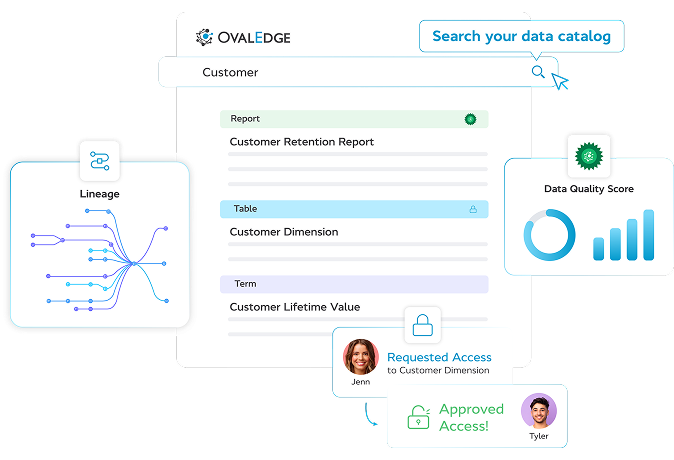
A business user can find a data asset, check its definition, review its quality score, see lineage, request access, and identify the owner from the same platform. That connected experience is the real value.
6. When faster governance value matters
Long implementation cycles can make governance lose momentum. OvalEdge supports faster time-to-value through agentic governance automation across cataloging, lineage, quality, and access control.
Humans still review and approve important decisions. The difference is that teams do not need to build every process from scratch. A glossary can take shape sooner. Metadata can become usable faster. Lineage can support impact analysis earlier.
7. When AI needs trusted data underneath it
AI projects depend on clear, trusted, and governed data. OvalEdge positions governance as the foundation for AI-ready data. Its AI capabilities support cataloging, lineage, rule suggestions, anomaly detection, and governed self-service. askEdgi helps users ask questions and receive answers grounded in an approved data context.
This is a strong fit for teams that want AI support across governance work, rather than only assistance with data quality rules.
What changes after adoption
After adopting OvalEdge, governance becomes easier to act on. Teams can see ownership, lineage, quality, and access context in one place instead of treating each as a separate task.
1. Data quality becomes business-visible
OvalEdge brings quality scores into the catalog experience. When users search for a dataset, they can see its trust level and decide whether it is ready to use. This is useful for Ataccama buyers who want quality insights to reach business users, not only technical teams.
2. Failed rules connect to downstream impact
When a data quality rule fails upstream, OvalEdge connects the issue with lineage. Teams can see which reports, users, or processes may be affected. This helps teams move from “a rule failed” to “this is what it affects, and this is who needs to act.”
3. Ownership becomes clearer
OvalEdge helps assign owners to assets, glossary terms, approvals, and remediation tasks. Stewards and business owners know what they need to review, approve, or fix. This makes governance easier to scale beyond a central data team.
4. Recurring quality issues become easier to reduce
OvalEdge helps identify data quality debt, which refers to repeated issues caused by unresolved root problems. Instead of reviewing the same failures again and again, teams can trace the cause, assign ownership, and resolve it through workflow.
5. Glossary work moves faster
OvalEdge helps teams build a governed business glossary with definitions, owners, synonyms, and usage context. Automation supports faster review and validation, so teams can move from scattered definitions to trusted business terms sooner.
Delta Community Credit Union is a good example of this change. Before OvalEdge, users relied on spreadsheet-based processes and emailed data dictionaries. With OvalEdge, they centralized metadata, built a shared business glossary, improved stewardship, and enabled self-service data education. Their team also used lineage to understand where data came from and how metrics were calculated.
As Dr. Su Rayburn from Delta Community Credit Union said, OvalEdge became a “water cooler” where people could collaborate and have meaningful data conversations.
AI governance and automation capabilities
OvalEdge uses AI to reduce manual governance work and help teams prepare trusted data for analytics and AI use cases.
- Agentic governance automation: Uses agentic governance automation to support cataloging, lineage, quality, and access workflows. Agentic AI helps with the heavy lifting, while humans review and approve key decisions.
- AI-curated catalog: Helps discover, organize, and enrich data assets. Stewards do not need to start every catalog entry manually. They can focus on validating business context and improving trust.
- AI-assisted lineage: Supports auto lineage to help teams trace how data moves across systems. This helps users understand the impact, investigate quality issues, and review changes before they affect reports.
- Rule support and anomaly detection: Supports AI-assisted rule writing and anomaly detection. This helps teams identify patterns and act on quality issues faster. The stronger value is not standalone observability. It is the connection between data quality, governance workflows, and ownership.
- askEdgi for governed self-service: askEdgi helps users ask questions and get answers grounded in approved metadata, definitions, and governance context. This gives business teams faster answers without separating AI from trusted enterprise data.
- Human review stays in place: Keeps humans in the loop. AI speeds up governance work, but people still approve definitions, review exceptions, and validate business context.
|
Did you know? AI adoption is now closely tied to governance readiness. Deloitte 2025 GenAI enterprise survey found that 38% of organizations cite regulatory compliance concerns as a top barrier to GenAI deployment, while 32% struggle with managing AI risks. It also notes that fewer than 25% of organizations with AI governance frameworks have fully operationalized them. For buyers, this makes governance automation important. AI-ready data needs trusted metadata, lineage, ownership, audit trails, and workflows, not just data quality rules. |
Things to consider
OvalEdge is strongest when buyers want governance to become part of everyday data use.
-
It works best when teams have clear governance goals before rollout.
-
Business users may need onboarding to use self-service features fully.
-
It is not a lightweight catalog for teams that only need basic data discovery.
-
It should not be positioned as a full log-monitoring or deep observability platform.
-
Very large data quality workloads should be tested based on where the data lives and how rules will run.
The fit is strongest when your team wants cataloging, lineage, quality, access, and stewardship to support one practical governance process.
Ratings, reviews, and analyst validation
Public review platforms show strong feedback for OvalEdge across governance, lineage, support, and usability.
- G2: OvalEdge is rated 5/5 and listed as a data catalog for end-to-end governance, privacy compliance, and trusted analytics. It also highlights capabilities such as data asset discovery, data lineage, business glossary, and impact analysis.
- Gartner Peer Insights: OvalEdge has a 4.7/5 rating and is described as an AI-enhanced data catalog and end-to-end data governance platform with catalog, auto lineage, glossary, quality rules, anomaly detection, remediation, privacy compliance, classification, and access governance.
- TrustRadius: Reviews mention auto lineage, impact analysis, metadata propagation, API support, and 24x7 support as positives. Reviewers also point to data lineage and impact analysis as ROI drivers.
|
Proof point: Forrester found measurable business value A governance platform should reduce the manual work that teams repeat every week. A Forrester Total Economic Impact study found that organizations adopting OvalEdge achieved 337% ROI and payback in under six months, driven by faster cataloging, easier lineage work, quicker data requests, and better control over sensitive data. For Ataccama buyers, this makes OvalEdge worth evaluating when time-to-value matters as much as platform depth. |
If you are evaluating Ataccama alternatives, OvalEdge is worth a closer look when governance adoption matters as much as data quality. Book a demo and see how OvalEdge compares in your environment.
2. Collibra
Collibra is a data and AI governance platform for enterprises that need formal controls around data ownership, policies, stewardship, lineage, and compliance. It is usually evaluated by teams with established governance programs and clear internal ownership.
What is it used for?
Collibra is used to organize governance work across business and data teams. It helps organizations define ownership and document business meaning. It also gives teams a structured way to manage policies and stewardship activity.
Teams use Collibra to support cataloging and glossary management. They can also use it to trace lineage, connect quality issues with owners, and manage AI governance controls.
When buyers choose it over Ataccama
Buyers may choose Collibra over Ataccama when governance structure is the main decision factor. Ataccama is often evaluated for data quality and MDM. Collibra is usually considered when teams need policy control, stewardship workflows, data ownership, and governance reporting.
Collibra may fit better when:
-
The organization has a central data governance office.
-
Data ownership needs to be defined across many business units.
-
Governance policies need to be documented and enforced consistently.
-
AI governance is becoming part of the data strategy.
-
Compliance teams need evidence of ownership, approvals, and controls.
For buyers comparing both platforms, the key question is simple: do you need a data quality-led platform, or do you need a governance operating system with quality as one part of the program?
What changes after adoption
After adopting Collibra, governance work becomes more structured. Teams can move policy documents, glossary terms, ownership details, stewardship tasks, and data catalog context into a shared platform.
This can help large organizations reduce scattered governance processes. A business user can look up a term. A steward can review ownership. A governance lead can track policy progress. A compliance team can review evidence when needed.
The main change is accountability. Data assets can be tied to owners. Policies can be tied to workflows. Glossary terms can be tied to definitions and approval paths. This creates a clearer record of who owns what and what needs to happen next.
For teams with mature governance processes, this structure can be useful. For teams still defining their operating model, it may require more planning before rollout.
AI and automation capabilities
Collibra’s AI and automation capabilities are tied to data governance, AI governance, policy management, and workflow support. Its platform positioning focuses on helping teams govern trusted data and manage AI risk through defined controls.
Key capabilities to evaluate include:
-
AI governance workflows: Helps teams document AI use cases, policies, ownership, and risk controls.
-
Workflow automation: Supports approvals, reviews, stewardship tasks, and policy processes.
-
Data quality automation: Helps teams connect quality rules and issue management with governance.
-
Catalog intelligence: Helps users find data assets and understand related business context.
-
Policy support: Gives governance teams a way to manage data and AI policy expectations.
For Ataccama buyers, this makes Collibra more relevant when the need goes beyond data quality rules. It fits teams that want governance and AI accountability to sit at the center of the platform.
Things to consider
Collibra can require planning before teams see full value. Buyers should define ownership, workflows, stewardship roles, and success metrics early.
Things to evaluate carefully:
-
Setup effort: Implementation can take time if governance processes are still unclear.
-
Learning curve: G2 user reviews mention complexity and initial setup challenges.
-
Business adoption: Non-specialist users may need training before using the platform confidently.
-
Cost: Buyers should review pricing carefully as modules, users, and governance needs expand.
-
Fit for smaller teams: Teams looking for a lighter rollout may find the platform more than they need.
Collibra can fit organizations with formal governance teams. It may feel heavy for teams that need faster adoption or simpler day-to-day governance participation.
Ratings and reviews
Collibra has a 4.2/5 rating on G2, where users highlight governance workflows, collaboration, data cataloging, and policy management as key positives. Reviewers also mention setup complexity and a learning curve for teams new to enterprise governance platforms.
On Capterra, Collibra has a 4.6/5 rating. Users value its cataloging, stewardship, glossary, automation, and cloud integration capabilities, while some note that the platform can feel less intuitive for new users.
Also read → Comparing Collibra alternatives in 2026? Compare tools before you buy
Evaluate Ataccama alternatives with agentic analytics and governance frameworks
Understand how agentic analytics accelerates data governance through AI-driven workflows, real-time insights, and governed self-service. This whitepaper shows how teams operationalize governance for analytics and AI readiness.
Tools for enterprise data quality and integration
This group is for buyers who mainly need data quality, profiling, cleansing, enrichment, ETL, and integration capabilities.
3. Informatica
Informatica is an enterprise data management platform used for data integration, data quality, MDM, governance, privacy, and cloud data operations. It is often evaluated by teams with large data environments and complex integration needs.
What is it used for?
Informatica is used to move, clean, manage, and govern data across enterprise systems. It fits organizations that need data integration and data quality to work across cloud, on-premises, and hybrid environments.
Teams use Informatica to build data pipelines, profile records, standardize data, support MDM, and manage privacy controls. It is most relevant when data quality is tied to a broader enterprise data management program.
When buyers choose it over Ataccama
Buyers may choose Informatica over Ataccama when integration depth is a major requirement. Ataccama is often evaluated for data quality and MDM. Informatica is more commonly considered when the buyer needs a larger data management ecosystem.
Informatica may fit when:
- Data quality must work with large-scale integration pipelines.
- The team already uses Informatica products.
- Data needs to move across many cloud and on-premises systems.
- MDM, governance, integration, and privacy need to be managed within one vendor ecosystem.
- The organization has technical teams that can support a broad enterprise platform.
This makes Informatica a logical option for teams that want to consolidate data management work under a broad platform. It is less about a narrow Ataccama replacement and more about expanding the scope of data operations.
What changes after adoption
After adopting Informatica, teams can manage more of their data movement and data quality work under one vendor ecosystem. This can help enterprises reduce the number of disconnected tools used for integration, cleansing, matching, and governance.
For data engineering teams, the main change is operational control. They can build pipelines, apply quality checks, and manage transformations across larger environments. For governance or data management teams, Informatica can help connect quality and metadata to broader enterprise data programs.
A practical change is that data quality can become part of pipeline design. Instead of checking data only after it reaches reports, teams can profile, cleanse, standardize, and monitor data earlier in the process.
This is useful for organizations where integration and quality are closely linked. It can also support modernization projects where legacy data needs to be cleaned before migration.
AI and automation capabilities
Informatica’s AI capabilities are centered around CLAIRE, its metadata-driven AI engine. CLAIRE supports automation across areas such as data discovery, classification, integration, quality, governance, and MDM.
Key AI and automation capabilities to evaluate include:
- Metadata intelligence: Uses metadata to support discovery, classification, and recommendations.
- Data quality automation: Helps automate profiling, rule suggestions, standardization, and quality monitoring.
- Integration automation: Supports faster pipeline development and data movement tasks.
- MDM automation: Helps with matching, mastering, and relationship discovery.
- Governance support: Connects data context with cataloging, policy, and stewardship processes.
For Ataccama buyers, Informatica’s AI and automation story is most useful when quality needs to work with integration and enterprise data operations. It may be more than required for teams that only need governance adoption or a simpler catalog-led rollout.
Things to consider
Informatica can be a large platform decision. Buyers should assess whether they need the full data management suite or only a specific data quality capability.
Things to evaluate carefully:
- Implementation effort: Larger enterprise deployments may need planning, skilled teams, and phased rollout.
- Cost: Buyers should review licensing, services, and module-level costs before expanding use cases.
- Technical ownership: The platform often suits teams with data engineering and platform administration capacity.
- Business-user experience: Non-technical teams may need enablement before they can use governance or quality workflows confidently.
- Scope control: Broad capabilities can create complexity if the buyer has not prioritized use cases.
Ratings and reviews
Informatica has a 4.3/5 overall rating on G2, with users recognizing its data quality, ETL, governance, MDM, privacy, and integration coverage. Positive reviews point to its fit for enterprise data management, while critical feedback often mentions complexity and the need for skilled technical teams.
On Capterra India, Informatica Data Quality has a 4.3/5 rating. Users value its data quality capabilities and deployment flexibility, but buyers should assess implementation effort, cost, and usability before committing.
Also read → The best Informatica alternatives compared in 2026
4. Talend
Talend, now part of Qlik, is used for data integration, data quality, transformation, and pipeline automation. It is often evaluated by teams that need to move data across systems and improve quality before analytics or reporting.
What is it used for?
Talend is mainly used by data engineering and integration teams. It helps organizations connect systems, transform data, and prepare cleaner datasets before they reach analytics or reporting workflows.
Teams use Talend to build ETL and ELT pipelines, run data quality checks, prepare datasets, and move data across cloud or hybrid environments. It fits teams that need stronger control over data movement and pipeline-level quality.
When buyers choose it over Ataccama
Buyers may choose Talend over Ataccama when integration and data movement are the primary needs. Ataccama is often evaluated for data quality, MDM, and data trust programs. Talend is more commonly considered when teams need ETL, ELT, transformation, and quality controls in the same workflow.
Talend may fit better when:
- Data needs to move across many systems.
- Data quality checks need to happen inside integration workflows.
- Teams are modernizing legacy ETL processes.
- Cloud migration or warehouse migration is part of the project.
- Data engineers need visual workflow design for recurring pipelines.
- The team already uses Qlik products and wants integration closer to that ecosystem.
For Ataccama buyers, Talend makes sense when the quality problem is linked to how data is moved, transformed, and delivered. It is less suited when the main goal is business-facing governance, stewardship, or policy execution.
What changes after adoption
After adopting Talend, teams can build data pipelines with more structure. Data engineers can define how data should move, how it should transform, and where quality checks should run.
This can help reduce one-off scripts and manual data transfers. Teams get a more repeatable way to prepare data for analytics, migration, and operational reporting.
A practical change is that data quality can happen closer to the pipeline. Instead of checking data only after it lands in a report or warehouse, teams can profile and clean it earlier in the process.
For organizations with many integration projects, this can improve consistency. The value depends on how well teams design jobs, manage documentation, and maintain workflows over time.
AI and automation capabilities
Talend’s automation value is mainly tied to data integration and data quality workflows. As part of Qlik, Talend is positioned within Qlik Talend Cloud, which brings together integration, quality, transformation, and governance-adjacent capabilities.
Key areas to evaluate include:
- Pipeline automation: Helps teams run recurring integration and transformation workflows.
- Data quality automation: Supports profiling, cleansing, standardization, and validation.
- Metadata support: Helps teams understand where data comes from and how it is used.
- Cloud integration: Supports repeatable data movement across cloud environments.
- Qlik ecosystem fit: Can be useful for teams already using Qlik for analytics or data operations.
For buyers comparing Talend with Ataccama, the AI and automation story is more engineering-led. It is useful when the team wants better data movement and preparation. It may be less relevant when the main priority is governance participation across business teams.
Things to consider
Talend is useful for integration-led teams, but buyers should evaluate how much governance depth they need before choosing it as an Ataccama alternative.
Things to assess carefully:
- Governance scope: Talend is not usually the first choice for broad stewardship and governance execution.
- Maintenance effort: Data jobs need ongoing monitoring, updates, and documentation.
- Technical ownership: The platform may depend heavily on data engineering resources.
- Real-time needs: Some users mention gaps around real-time data work and advanced use cases.
- Documentation: Some G2 reviewers mention a need for more examples and clearer support material.
- Cost: Buyers should review pricing if many jobs, users, or environments are involved.
Talend is best suited when the core problem is integration and pipeline-level data quality. Teams looking for a governance-first platform may need to compare it with catalog and stewardship-led alternatives.
Ratings and reviews
On G2, Talend Cloud Data Integration reviews highlight visual workflow creation, data mapping, connector coverage, ETL support, and cloud integration as key positives. Critical feedback mentions cost, documentation gaps, CPU usage, and limits around some real-time use cases.
On Gartner Peer Insights, Qlik Talend Cloud has a 4.3/5 rating. Users mention real-time ingestion, automated lineage, drag-and-drop job design, and broad connector support, while limitations include pricing complexity, learning curve, migration effort, and cost tradeoffs.
Tools for master data management
This group is for buyers whose main priority is managing customer, product, supplier, location, or reference data across systems.
5. Semarchy
Semarchy is an MDM-focused platform used to create governed, trusted master data across domains such as customer, product, supplier, location, and reference data. It fits buyers who want MDM to be the center of their data program.
What is it used for?
Semarchy is used to build and manage master data applications. It helps teams consolidate records, define relationships, improve consistency, and create a reliable view of core business entities.
Teams use Semarchy for customer, product, supplier, and reference data management. It also supports matching, merging, stewardship workflows, and golden record creation.
When buyers choose it over Ataccama
Buyers may choose Semarchy over Ataccama when MDM is the main business need. Ataccama is often evaluated for data quality, MDM, and monitoring. Semarchy is more directly focused on helping teams design and manage master data domains.
Semarchy may fit better when:
- The organization needs multi-domain MDM.
- Customer, product, or supplier data is duplicated across systems.
- Teams need golden records for analytics or operations.
- Reference data needs stricter control.
- Data stewardship needs to sit around master data workflows.
- The buyer wants configurable data applications for specific business domains.
This makes Semarchy useful for teams that need to improve entity-level data consistency. It is less relevant when the buyer’s main concern is enterprise-wide governance adoption or catalog-led data discovery.
What changes after adoption
After adopting Semarchy, teams can manage master data through more defined workflows. Duplicate records can be matched and merged. Business rules can help standardize how records are created, updated, and approved.
A practical change is that teams can reduce conflicting versions of the same entity. For example, customer data can become easier to reconcile across sales, finance, and support systems. Product records can follow a more consistent structure. Supplier data can be reviewed through clearer stewardship processes.
Semarchy can also help teams create MDM applications for different domains. This is useful when business teams need a more controlled way to manage entity data without relying only on spreadsheets or disconnected operational systems.
The main value is consistency. Teams get a more reliable source of master data that can support reporting, operations, and downstream systems.
AI and automation capabilities
Semarchy’s automation capabilities are tied closely to MDM workflows. The platform supports rule-based processes for matching, merging, validation, enrichment, survivorship, and stewardship.
Key areas to evaluate include:
- Matching and merging: Helps identify duplicate records and consolidate them.
- Survivorship rules: Defines which values should be retained when records conflict.
- Workflow automation: Routes master data changes for review and approval.
- Data enrichment: Supports improved context around master records.
- Data application design: Helps teams create domain-specific MDM applications.
For Ataccama buyers, Semarchy’s automation value is practical when master data is the main problem. It is less centered on broad data governance, cataloging, or business-wide data discovery.
Things to consider
Semarchy is best evaluated as an MDM-first platform. Buyers should be clear about whether their main need is master data control or broader governance execution.
Things to assess carefully:
- Governance scope: Semarchy may not cover enterprise governance needs as broadly as catalog-led platforms.
- Learning curve: Review sources mention that the feature set can take time to understand.
- Implementation planning: MDM programs need clear domain ownership before rollout.
- Technical configuration: Matching, survivorship, and workflows require careful setup.
- Use-case fit: Teams that need cataloging, lineage, access, and stewardship in one governance layer may need a broader platform.
- Scale of need: Semarchy may be more than required for teams with simple deduplication or data cleanup needs.
Semarchy can fit teams with serious MDM requirements. It may feel narrow for buyers who want data governance, quality, lineage, and access workflows to work together.
Ratings and reviews
On G2, Semarchy has a 4.8 out of 5 rating from verified reviews. It lists Semarchy in the Master Data Management category, with reviewer themes around data management, ease of use, customer support, and the learning curve.
On Capterra, Semarchy xDM has a 4.8 out of 5 rating from 8 reviews. Positive review themes mention flexibility, customization, UI simplicity, and the ability to build different types of data applications. Critical feedback points to a broad feature set that may require time to learn.
6. Profisee
Profisee is a master data management platform focused on helping organizations clean, match, merge, and govern core business records. It is most relevant for buyers whose main need is trusted master data.
What is it used for?
Profisee is used to manage master data across customer, product, supplier, location, and reference domains. It helps teams clean records, reduce duplicates, and create a more consistent view of core business entities.
Teams use Profisee for matching, merging, golden record creation, and stewardship workflows. It fits organizations that need trusted master data with clear review and maintenance processes.
When buyers choose it over Ataccama
Buyers may choose Profisee over Ataccama when they want an MDM-focused platform with practical stewardship workflows. Ataccama is commonly evaluated for data quality, MDM, and data trust. Profisee is more focused on master data control.
Profisee may fit better when:
- The organization needs trusted customer or product records.
- Duplicate records are affecting reporting or operations.
- MDM needs to work across business and technical teams.
- Microsoft ecosystem fit is important.
- Data stewardship needs to happen in familiar business tools.
- The buyer wants MDM without adopting a much broader data management suite.
This makes Profisee a fit for teams that want to improve entity-level trust. It is less relevant when the buyer needs deeper governance coverage across cataloging, lineage, policy workflows, and access governance.
What changes after adoption
After adopting Profisee, teams can manage master data through a more defined process. Records can be matched, merged, reviewed, and maintained with clearer rules.
This helps reduce conflicting versions of the same customer, product, or supplier record. Business users get a clearer path to review data. Data teams get a system for managing quality and survivorship rules.
A practical change is that stewardship can become easier to assign and track. Instead of resolving master data issues through spreadsheets or manual requests, teams can use workflows tied to the records that need attention.
Profisee can also fit organizations that want MDM to sit close to Microsoft tools. G2 lists integrations such as Azure SQL Database, Microsoft 365, Microsoft Fabric, Microsoft Purview Data Governance, and Synapse.
AI and automation capabilities
Profisee’s AI and automation capabilities are tied to MDM workflows. The platform supports automation for matching, merging, stewardship, and data quality management around master records.
Key areas to evaluate include:
- AI copilot support: Offers a helpful AI copilot for cleaning and unifying enterprise data.
- Azure OpenAI integration: Integrates with Azure OpenAI to reduce manual stewardship effort.
- Matching and merging: Helps identify duplicate records and consolidate them.
- Workflow automation: Routes master data changes to the right reviewers.
- Stewardship support: Helps business users review data quality issues and update records.
- Data quality measurement: Supports dashboards for measuring master data quality impact.
For Ataccama buyers, Profisee’s automation is most useful when the goal is to improve master records. It is less focused on broad governance, catalog discovery, or end-to-end data lineage.
Things to consider
Profisee should be evaluated as an MDM-first platform. Buyers should confirm whether their primary challenge is master data or a wider governance program.
Things to assess carefully:
- Governance scope: Profisee is narrower than platforms built for catalog-led enterprise governance.
- Workflow complexity: Gartner reviewers mention that some workflows may require more coding knowledge than expected.
- Connect feature support: One Gartner reviewer raised concerns about limited documentation and disruption around newer Connect features.
- Scale testing: G2 review summaries mention that some users note performance challenges at larger scales.
- Implementation planning: MDM programs still need clear rules, domain ownership, and stewardship responsibilities.
- Fit beyond MDM: Teams needing catalog, lineage, access governance, and policy management may need a broader platform.
Profisee can work well when MDM is the main use case. Buyers with broader governance goals should compare how far the platform can support those needs beyond master data.
Ratings and reviews
Profisee has a 4.4/5 rating on G2, where users highlight ease of use, data management capabilities, customer support, data accuracy, and connector support. Critical feedback points to performance at larger scales, integration issues, customization limits, and setup complexity.
On Gartner Peer Insights, Profisee has a 4.4/5 rating. Users value its customer support, customization, usability, and customer record matching, while buyers should still validate workflow complexity and fit beyond core MDM needs.
Also read → Compare OvalEdge vs Alation vs Collibra vs Informatica side-by-side
OvalEdge vs Ataccama: side-by-side comparison
Here’s a quick comparison for you to evaluate both platforms based on how they support governance, data quality, lineage, adoption, and long-term operating needs.
|
Evaluation factor |
OvalEdge |
Ataccama |
|
Positioning |
Governance-first data intelligence platform |
Data quality-first data management platform |
|
Best fit |
Teams operationalizing governance across users |
Teams prioritizing DQ and MDM |
|
Data catalog |
Unified catalog with glossary and lineage |
Catalog available, but DQ-led focus |
|
Lineage |
Built for impact analysis and downstream alerts |
Advanced, but setup can be complex |
|
Data quality |
Quality scores tied to governance workflows |
Deep DQ, profiling, and monitoring |
|
MDM |
Supports governed data management workflows |
Strong MDM capability |
|
Workflow execution |
Ownership, approvals, remediation, stewardship |
More technical and DQ-oriented |
|
AI capability |
Agentic governance, askEdgi, rule support |
AI is mainly tied to DQ workflows |
|
Business-user adoption |
Designed for stewards and business users |
May need more technical training |
|
Implementation fit |
Faster governance rollout and support-led adoption |
Can require custom configuration |
|
Cost model |
Transparent, flexible licensing |
Can involve modules and an added setup cost |
|
Best for |
Turning data quality into governed action |
Managing data quality at depth |
When Ataccama fits better:
Ataccama fits better when data quality, profiling, cleansing, monitoring, and MDM are the primary buying drivers. It is a credible fit for teams that want a DQ-led platform and have the technical resources to support configuration and rollout.
When OvalEdge fits better:
OvalEdge fits better when teams need data quality to connect with cataloging, lineage, ownership, access, and stewardship. Its strongest differentiators are governance execution, business-user adoption, data quality debt reduction, and lineage-connected issue resolution.
Evaluate OvalEdge for your governance needs
Get a focused walkthrough of how OvalEdge handles governance workflows, lineage, data quality, and business-user adoption based on your data setup.
How to choose the right Ataccama alternative
Your best-fit platform depends on the problem you need to solve first. Use the criteria below to separate a good feature match from a platform your teams will actually use.
1. Start with your primary use case: Check whether your priority is governance execution, data quality, integration, or MDM. This will narrow the list faster than comparing every feature side by side.
2. Look at how quality issues turn into action: A useful alternative should show who owns an issue, what it affects, and how it gets resolved. Data quality scores alone are not enough.
3. Test business-user adoption early: Ask how stewards, analysts, and domain owners will use the platform in daily work. If adoption depends too heavily on technical teams, rollout can slow down.
4. Validate lineage and downstream impact: Look for lineage that helps users understand where data comes from and what breaks when something changes. This is critical for reports, compliance, and AI readiness.
5. Review implementation effort and cost clarity: Compare setup effort, service dependencies, licensing structure, and module requirements. A platform that looks complete on paper may still need heavy configuration.
The right Ataccama alternative should help your team move from data quality checks to trusted data action. Prioritize the platform that fits your operating model, not the one with the longest feature list.
|
Insight: AI is no longer only an innovation team priority. Gartner’s 2025 CDAO survey found that 70% of CDAOs are responsible for AI strategy and operating models, while the 2025 University of Melbourne and KPMG global AI study reports that 58% of employees use AI regularly at work. That makes governed data a practical requirement. If AI tools are already being used across teams, buyers should evaluate Ataccama alternatives based on metadata trust, lineage, ownership, quality controls, and AI readiness. |
Where OvalEdge stands out among Ataccama competitors
OvalEdge stands out because it connects governance work to measurable business value, user adoption, and independent validation.
1. Governance that reaches business users
OvalEdge is rated 4.7/5 on Gartner Peer Insights, where reviewers highlight support quality, intuitive metadata management, and the ability to connect business glossary terms with catalog assets. Reviewers also note that AI-enabled term association can reduce the time needed for data classification.
2. Faster value from governance work
A Forrester TEI study found 337% ROI, $2.5M NPV, and payback in under six months for organizations adopting OvalEdge. The study also reported up to 40% reduction in manual effort for cataloging, lineage, and data requests, along with 30% improvement in analyst productivity.
3. Quality issues tied to ownership
OvalEdge makes data quality more actionable by connecting quality scores with lineage, ownership, and workflows. When a rule fails, teams can see the downstream impact and route the issue to the right owner instead of treating it as an isolated technical alert.
4. Recognition from independent analyst sources
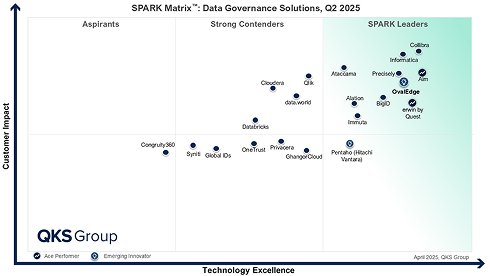
QKS Group positioned OvalEdge as a Leader and Emerging Innovator in the 2025 SPARK Matrix™: Data Governance Solutions. OvalEdge is also recognized as a Niche Player in the 2025 Gartner Magic Quadrant for Data and Analytics Governance Platforms, which evaluates vendors across governance, AI, trust, and platform capabilities.
5. Better fit for adoption-led governance
OvalEdge brings catalog, governance, quality, and compliance into one platform built for both technical and business users. This helps teams move governance into daily work, from finding trusted data to reviewing ownership and resolving quality issues.
For buyers comparing Ataccama alternatives, OvalEdge is strongest when the goal is to move from quality checks to governed action. Book a demo to see how it fits your use cases, data environment, and rollout priorities.
Move from data quality checks to governed action
OvalEdge helps you turn scattered metadata, unclear ownership, and recurring quality issues into a connected governance workflow that supports analytics, compliance, and AI-ready data.
Frequently asked questions
1. What is the best Ataccama alternative?
The best Ataccama alternative depends on the primary use case. OvalEdge fits teams that need governance, cataloging, lineage, quality context, and stewardship in one platform, while tools like Informatica, Semarchy, and Profisee may fit more specialized data quality or MDM needs.
2. Is OvalEdge a good alternative to Ataccama?
Yes, OvalEdge is a good alternative for teams that want a governance-first platform. It is most relevant when data quality needs to connect with ownership, lineage, glossary, and day-to-day governance workflows.
3. Which Ataccama alternative is best for data governance?
OvalEdge is best suited for teams that want governance to move beyond documentation. It helps users find trusted data, understand business definitions, trace lineage, review quality scores, and act on stewardship tasks from one platform.
4. Which Ataccama alternative is best for data quality?
Ataccama is already known for data quality, so the right alternative depends on how quality will be used. OvalEdge works well when quality scores need to connect with governance action, while Informatica and Talend may fit teams focused on technical data quality and integration workflows.
5. Which Ataccama alternative is best for MDM?
Semarchy and Profisee are MDM-focused alternatives for customer, product, supplier, and reference data. OvalEdge is worth considering when MDM needs to sit alongside cataloging, lineage, quality, and governance workflows.
6. How should enterprises compare Ataccama alternatives?
Start with the problem you need to solve first. Compare each platform on governance depth, data quality needs, MDM fit, business-user adoption, implementation effort, and long-term cost.
Choosing an Ataccama alternative? Start here
- Need governance action, or only data quality checks?
- Want catalog, lineage, quality, and access in one place?
- Do business users need to participate daily?
- Are recurring quality issues slowing trust in reports?
- Do you need a faster rollout with clear ownership?
Implement data governance faster with a proven framework
Access a practical 5-step framework used across real deployments to scope, prioritize, and implement governance without over-engineering.
Learn how to identify high-impact use cases and apply AI and automation to reduce manual effort.
Proven by customer successes across industries
.png?width=151&height=151&name=Mask%20group%20(18).png)
How Delta Community Credit Union enhanced its data governance with OvalEdge
"We have seen dramatic results across the board by implementing these programs, centralizing our metadata with the OvalEdge data catalog, and enabling self-service data education."
Dr. Su Rayburn
Vice President, Information Management & Analytics

.png?width=151&height=151&name=Mask%20group%20(19).png)
Bedrock leverages OvalEdge to standardize definitions, improve data accuracy
"OvalEdge stands out for its holistic approach, providing everything from business glossary to data lineage, all seamlessly integrated. The auto-lineage feature saves us months of work, enabling us to quickly understand data flows and address issues at the source.”
Sergei Vandalov
Senior Manager, Data Governance & Analytics

.png?width=151&height=151&name=Mask%20group%20(20).png)
Gousto’s continued data governance journey to deliver exceptional customer experience
“Incorrect pricing, nutritional or allergen information can disrupt the customer experience. With quality data at every stage, Gousto aligns its customer promise with operational excellence.”
Cathy Pendleton
Senior Manager - Data Governance
OvalEdge Recognized as a Leader in Data Governance Solutions
.png?width=1081&height=173&name=Forrester%201%20(1).png)
“Reference customers have repeatedly mentioned the great customer service they receive along with the support for their custom requirements, facilitating time to value. OvalEdge fits well with organizations prioritizing business user empowerment within their data governance strategy.”
.png?width=1081&height=241&name=KC%20-%20Logo%201%20(1).png)
“Reference customers have repeatedly mentioned the great customer service they receive along with the support for their custom requirements, facilitating time to value. OvalEdge fits well with organizations prioritizing business user empowerment within their data governance strategy.”
Gartner, Magic Quadrant for Data and Analytics Governance Platforms, January 2025
Gartner does not endorse any vendor, product or service depicted in its research publications, and does not advise technology users to select only those vendors with the highest ratings or other designation. Gartner research publications consist of the opinions of Gartner’s research organization and should not be construed as statements of fact. Gartner disclaims all warranties, expressed or implied, with respect to this research, including any warranties of merchantability or fitness for a particular purpose.
GARTNER and MAGIC QUADRANT are registered trademarks of Gartner, Inc. and/or its affiliates in the U.S. and internationally and are used herein with permission. All rights reserved.