Alation Alternatives: Evaluate Top Platforms Based on Real Use Cases
Compare leading platforms on governance workflows, AI-driven automation, lineage, and data quality across real enterprise use cases. See which tool fits your architecture and rollout priorities.
In this article
What are the best Alation alternatives?
The best Alation alternatives include OvalEdge, Collibra, Atlan, Microsoft Purview, and data. World, Secoda, DataHub, and OpenMetadata. Each serves a different need:
-
OvalEdge focuses on unified governance with built-in lineage, data quality, privacy & access management, and AI-driven workflows.
-
Collibra is strong in compliance-heavy environments.
-
Atlan emphasizes modern data discovery and collaboration.
-
Microsoft Purview fits Azure-centric ecosystems.
-
data.world supports fast, business-friendly adoption.
-
Secoda is designed for quick setup and AI-powered search.
-
DataHub offers flexibility for engineering-led teams; and
-
OpenMetadata provides an open-source approach to metadata and governance.
The right choice depends on whether you prioritize governance depth, AI capabilities, implementation speed, or long-term cost.
Let’s compare these Alation competitors side by side.
Alation alternatives compared
Before we dive deeper, here’s a quick snapshot of the top Alation alternatives across different use cases.
|
Tool |
Best for |
Core strength |
AI capability |
Limitation |
|
OvalEdge |
Governance-first enterprises |
Unified governance with automated workflows |
Agentic AI, AskEdgi for governed automation |
Needs structured rollout for full adoption |
|
Collibra |
Compliance-heavy enterprises |
Policy workflows and governance control |
Limited AI, workflow-driven |
High setup time and overhead |
|
Atlan |
Modern data teams |
Data discovery and collaboration |
AI-powered search and metadata enrichment |
Limited governance execution depth |
|
Microsoft Purview |
Azure ecosystems |
Native Microsoft integration |
Automated classification and compliance AI |
Limited outside the Microsoft stack |
|
data.world |
Business-friendly adoption |
Knowledge graph and collaboration |
AI-assisted discovery and context linking |
Limited for complex governance |
|
Secoda |
Fast-moving teams |
Simple UI and quick setup |
AI-powered documentation and search |
Not built for enterprise-scale governance |
|
DataHub |
Engineering-led teams |
Flexible, extensible metadata platform |
Real-time metadata and lineage AI |
Requires engineering effort to scale |
|
OpenMetadata |
Custom data stacks |
Open-source flexibility and control |
AI-assisted metadata and lineage |
Needs technical resources to implement |
Next, we’ll break down these Alation alternatives by use case to help you find the right fit.
Best Alation alternatives for different use cases
Teams look for Alation alternatives when the platform starts creating friction in implementation, scaling, or day-to-day governance workflows. These challenges show up early in deployment and become more visible as data environments grow.
The shift usually happens because of recurring challenges:
-
Connecting to source systems and collecting metadata takes longer than expected, which delays time-to-value
-
Lineage becomes difficult to build and maintain for complex or custom data models
-
Support cycles slow down for advanced use cases, especially when governance needs to scale
-
Costs increase over time as usage expands, making long-term planning harder
-
Adoption falls short when governance workflows are not fully operationalized
These gaps push teams to evaluate platforms based on how well they fit specific use cases, from enterprise governance to modern data workflows. The sections below break down the most relevant alternatives across these scenarios.
Best alternatives for governance-heavy and enterprise use cases
Organizations operating in regulated environments or managing large, distributed data systems need governance that works across lineage, quality, access, and policy enforcement. This is where platforms like OvalEdge and Collibra are typically evaluated.
1. OvalEdge
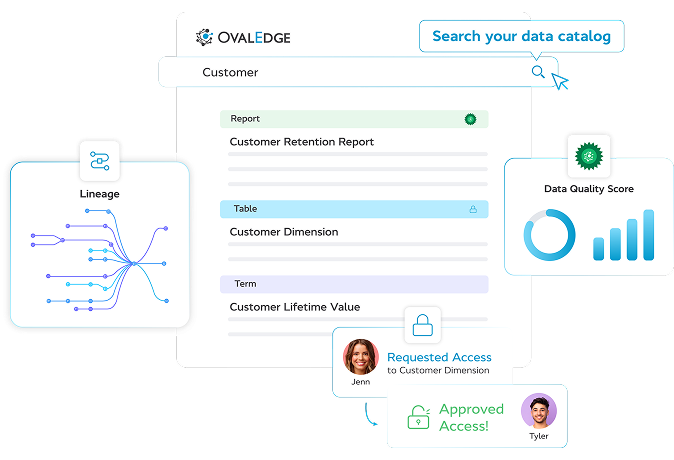
OvalEdge is a unified, AI-driven data governance platform. It is designed for teams that want governance to run continuously in the background, instead of being maintained manually. It combines cataloging, lineage, data quality, and access control into a single system, so teams can understand and act on data without switching between tools.
What is it used for
Teams use OvalEdge when governance needs to directly support analytics, compliance, and day-to-day decision-making.
-
End-to-end lineage visibility: It maps data flows across systems automatically, including column-level detail. This helps teams understand dependencies and assess downstream impact before making changes.
-
Continuous data quality monitoring: It tracks data as it moves through pipelines and flags anomalies early with automated data cleaning. This reduces the chances of incorrect data reaching dashboards or AI models.
-
AI agents for governance automation: It enables AI-powered governance to automate metadata discovery, lineage creation, data classification, and policy enforcement. These AI agents operate in the background to keep governance aligned with system changes, reducing manual effort.
-
Governed self-service through AskEdgi: It provides a natural language interface for users to explore data. AskEdgi acts as the access layer, while governed metadata, lineage, and policies ensure responses remain accurate and context-aware.
-
Automated privacy and access control: It identifies sensitive data and applies policies across systems. This helps teams manage compliance requirements without manual coordination.
-
Connected governance workflows: It links lineage, quality, and policy enforcement into one system. This ensures governance actions are applied consistently across the data stack.
-
Business context integration: links business definitions and ownership with metadata so data carries consistent meaning across systems and workflows, making it easier for teams to interpret data correctly and align decisions with business goals.
-
AI governance: It tracks and governs AI-driven models and processes, ensuring that data used for AI remains compliant and traceable. This includes maintaining accountability for AI models, ensuring transparency, and applying relevant policies to mitigate risks.
These capabilities work together. Lineage provides context, quality ensures reliability, and governance controls access. This connection is what makes the platform useful in real workflows.
When buyers choose it over Alation
The shift usually happens when teams realize that discovery alone is not solving operational challenges.
-
Metadata becomes outdated, which makes the catalog unreliable
-
Teams cannot trace data deeply enough to assess the downstream impact
-
Data quality issues are identified after reports are already impacted
-
Governance policies exist, but execution depends on manual coordination
-
Costs increase as usage grows, without improving control or visibility
OvalEdge addresses this by turning governance into an active system. Instead of managing separate layers, teams work within a platform where lineage, quality, and policies are continuously updated and enforced together.
What changes after adoption
The difference shows up in how quickly teams can act and how much manual effort is removed from governance.
-
Metadata stays current without manual updates: The platform continuously discovers and enriches metadata, so the catalog reflects actual system changes instead of becoming outdated over time.
-
Data issues are resolved earlier in the pipeline: With real-time monitoring of both upstream and downstream data flows, teams detect anomalies during data movement, not after dashboards are already affected.
-
Business users rely less on data teams: AskEdgi allows users to access governed data directly, which reduces repeated queries and speeds up analysis.
-
Governance becomes part of everyday workflows: Policies are enforced automatically as data changes, instead of being checked manually during audits or incidents.
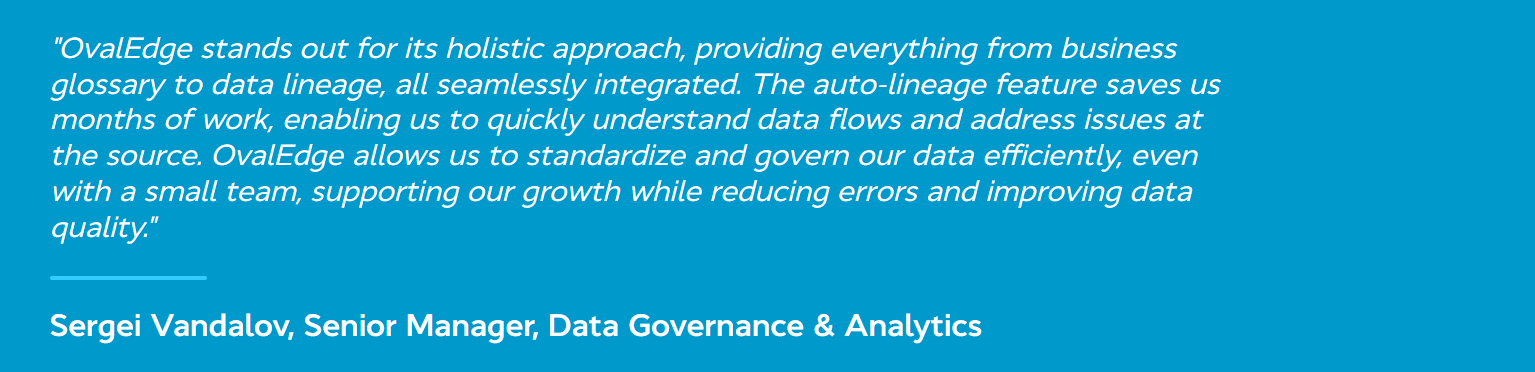
This adoption helped Bedrock, a commercial real estate company, move from fragmented data and inconsistent definitions to a unified governance setup. OvalEdge connected their data sources, automated lineage, and standardized governance workflows. This reduced manual effort, improved data consistency, and helped the team identify and resolve issues at the source instead of reacting later
Things to consider
OvalEdge is built for structured governance, so it performs best when teams are clear about their goals and rollout plan.
-
Teams need to define governance use cases early to drive adoption
-
Business users may require onboarding to fully use self-service capabilities
-
It may not be the right fit for teams looking only for lightweight discovery
At the same time, implementation is designed to reduce overhead. With pre-built connectors and automated metadata discovery, teams can start seeing value within weeks as the system begins to populate and organize data.
Ratings, reviews, and analyst validation
Ratings give a clearer picture of how the platform performs after implementation.
- TrustRadius rates OvalEdge a 10 out of 10, while Alation is rated 9.3 out of 10. OvalEdge scores higher in overall satisfaction, especially around governance execution and completeness.
- On Gartner Peer Insights, OvalEdge is rated around 4.7 out of 5, with consistent feedback around implementation experience and governance capabilities.
- On G2, the platform maintains a rating of 5 out of 5, where users frequently mention lineage visibility, support quality, and usability.
|
Did you know? OvalEdge’s capabilities are also supported by independent analysis. A Forrester Total Economic Impact study found that organizations using OvalEdge achieved up to 337% ROI, driven by reduced manual effort, improved data access, and stronger compliance processes. This aligns with how the platform is used in practice, where automation replaces manual governance tasks and improves productivity across teams. |
| If you want to see how OvalEdge would handle lineage, data quality, governance workflows, and governed self-service across your data stack, book a demo to get a tailored walkthrough. |
2. Collibra
Collibra is a data governance platform designed for enterprises that need structured control over data. It helps organizations define ownership, enforce policies, and manage governance processes across teams.
What is it used for
Collibra is used to formalize governance across teams and systems.
-
Standardizes business definitions so teams across departments work with consistent metrics and terminology
-
Enables workflow-driven governance where approvals, certifications, and issue resolution follow defined processes instead of manual coordination
-
Centralizes policies and compliance controls, making it easier to enforce governance rules and maintain audit readiness
-
Assigns ownership to data assets, improving accountability and reducing confusion across teams
This setup helps organizations move from fragmented governance efforts to a more controlled system.
When buyers choose it over Alation
Collibra is evaluated when governance needs more structure and control.
-
Governance requires defined roles, ownership, and accountability across teams
-
Compliance demands audit trails and consistent policy enforcement
-
Organizations want centralized governance across business units
-
Data definitions need to be standardized across systems
It is typically selected when governance maturity is a priority.
What changes after adoption
The impact is seen in how governance is organized and executed.
-
Governance becomes structured, with clear ownership and defined responsibilities
-
Policies are applied through workflows instead of manual enforcement
-
Data definitions remain consistent across teams, reducing reporting conflicts
-
Compliance tracking becomes easier because governance activity is documented
This improves control and reduces inconsistencies across the organization.
Things to consider
Collibra delivers a strong governance structure, but that comes with trade-offs.
-
Implementation takes time because workflows and governance models must be defined upfront
-
Ongoing management requires dedicated resources to maintain governance processes
-
The platform can feel complex for teams that need a faster rollout
-
Less flexibility when teams want lightweight or evolving governance setups
It works best in organizations that are ready to invest in governance as a structured, long-term function.
Best alternatives for modern, cloud-first data teams
Teams working in modern data stacks often prioritize speed, collaboration, and ease of use. They need a platform that fits into fast-moving workflows, supports cloud-native tools, and helps teams discover and use data without heavy setup.
3. Atlan
Atlan is a modern data workspace built for cloud-first teams. It focuses on making data easy to discover, document, and collaborate on across engineering and analytics teams.
What is it used for
Atlan is used to improve data discovery and collaboration in modern data environments.
-
Surfaces data assets through search, usage signals, and metadata context, so teams can quickly find relevant datasets
-
Integrates with tools like Snowflake, dbt, and BI platforms, which helps teams work within their existing workflows
-
Enables collaboration through comments, documentation, and shared context, so knowledge is captured where data is used
-
Automates metadata collection and enrichment, reducing manual documentation effort
This makes it useful for teams that want faster access to data and better collaboration without heavy governance overhead.
When buyers choose it over Alation
Atlan is considered when usability and speed are key priorities.
-
Teams want a more modern interface that is easier for analysts and engineers to adopt
-
Data workflows rely on cloud tools and require strong integrations
-
Collaboration and knowledge sharing are more important than a formal governance structure
-
Organizations prefer faster rollout with less setup complexity
It is often chosen by teams that prioritize adoption and ease of use over deep governance execution.
What changes after adoption
The impact is visible in how quickly teams can find and use data.
-
Data discovery becomes faster through search and recommendations
-
Documentation improves as teams add context directly within workflows
-
Collaboration increases through shared knowledge and discussions
-
Analysts spend less time asking for context and more time working with data
This helps improve data usage across teams, especially in fast-paced environments.
Things to consider
Atlan is optimized for modern data teams, which creates some limitations.
-
Governance workflows and policy enforcement are not as deep as enterprise-focused tools
-
Compliance-heavy environments may require additional systems or customization
-
Scaling governance across large enterprises can require more effort
-
Advanced governance use cases may not be fully covered out of the box
It works best for teams that prioritize speed, collaboration, and cloud-native workflows over structured governance programs.
Also read → Top Atlan Alternatives in 2026: Compare Platforms for Modern Data Governance
4. Microsoft Purview
Microsoft Purview is a unified data governance, security, and compliance platform from Microsoft. It is designed to help organizations manage and protect data across Azure, Microsoft 365, on-premises, and multicloud environments.
What is it used for
Microsoft Purview is used to manage data governance alongside security and compliance within the Microsoft ecosystem.
-
Centralizes metadata into a unified data catalog, which helps teams discover and access data across sources
-
Tracks lineage across systems, giving visibility into how data moves and how it is used in downstream processes
-
Identifies sensitive data through classification and labeling, which helps teams apply protection policies consistently
-
Supports a federated governance model, where central teams define policies and domain teams manage execution within those guidelines
This setup is useful for organizations that want governance, compliance, and security to work together within a single platform.
When buyers choose it over Alation
Microsoft Purview is typically considered in Microsoft-centric environments.
-
Organizations already use Azure, Microsoft 365, or Fabric
-
Governance needs to integrate with existing Microsoft security and compliance tools
-
Teams want a single platform for governance, risk, and compliance
-
Licensing and ecosystem alignment are important decision factors
It is often chosen when Microsoft integration matters more than tool flexibility.
What changes after adoption
The impact shows up in how governance and compliance are managed together.
-
Data assets become easier to discover through a centralized catalog
-
Governance follows a federated model, allowing teams to manage their own data within defined policies
-
Sensitive data becomes easier to identify through automated classification
-
Compliance processes become more structured through integrated tools
This helps organizations gain visibility and control across distributed data environments.
Things to consider
Microsoft Purview works well within its ecosystem, but has limitations outside it.
-
Best suited for Microsoft environments, with less flexibility in non-Microsoft stacks
-
Governance depth may not match specialized governance platforms
-
Customization can be limited compared to standalone tools
-
Some features require additional configuration across multiple services
It works best for organizations that are already invested in the Microsoft ecosystem and want governance integrated with security and compliance.
Best alternatives for faster adoption and ease of use
Some teams do not want a heavy setup. They want a tool that is easy to roll out, simple to use, and quick to deliver value. This is where platforms focused on usability and speed come into play.
5. data.world
data.world is a cloud-native data catalog built around a knowledge graph. It focuses on helping teams understand how data connects to business context, not just where it exists.
What is it used for
data.world is used to make data easier to discover and interpret across teams.
-
Connects technical metadata with business context so users understand what data represents, not just where it lives
-
Organizes data into domains and collections, which helps teams navigate large data environments more easily
-
Supports business glossary creation, which improves consistency in how teams define and use data
-
Enables collaboration through shared documentation and discussions, which helps teams align faster
This setup works well for organizations that want to improve data understanding without adding heavy governance layers.
When buyers choose it over Alation
Teams consider data.world when they want a more business-friendly approach.
-
Data needs to be understandable for non-technical users
-
Collaboration across teams is a priority
-
Knowledge sharing matters more than strict governance
-
Teams are adopting data products or domain-based ownership
It is often chosen when usability and shared understanding matter more than governance enforcement.
What changes after adoption
The shift is visible in how teams interact with data.
-
Data becomes easier to interpret because context is attached to datasets
-
Business users rely less on data teams for explanations
-
Collaboration improves as knowledge is captured in one place
-
Data usage increases because access barriers are reduced
This helps organizations build stronger data literacy across teams.
Things to consider
data.world focuses on usability, which limits its depth in some areas.
-
Governance workflows are not as strong as enterprise-focused platforms
-
Lineage and impact analysis may not cover complex pipelines
-
Large environments may require additional structure
-
Compliance-heavy use cases may need complementary tools
It works best for teams that want simplicity and collaboration, not deep governance control.
6. Secoda
Secoda is a modern data catalog designed for speed. It focuses on reducing manual work through automation and making data easy to access through AI-powered search.
What is it used for
Secoda is used to simplify data discovery and documentation.
-
Automates metadata collection so teams do not have to maintain documentation manually
-
Provides a central place to search and explore data across tools
-
Uses AI to answer questions about datasets, which helps users find information quickly
-
Supports lightweight lineage and documentation, which improves understanding across teams
This approach works well for teams that want to move fast without investing heavily in governance setup.
When buyers choose it over Alation
Secoda is considered when simplicity is the main goal.
-
Teams want a tool that is easy to implement
-
Manual documentation is slowing down workflows
-
AI-driven search is a priority
-
Organizations want quick adoption across teams
It is often chosen by smaller teams or fast-growing companies that need immediate value.
What changes after adoption
The impact shows up in speed and ease of use.
-
Documentation improves because metadata is captured automatically
-
Data becomes easier to find through search and AI responses
-
Teams spend less time maintaining catalogs
-
Collaboration improves as information is centralized
This helps teams focus more on analysis and less on documentation.
Things to consider
Secoda prioritizes speed, which creates limitations.
-
Governance features are still evolving compared to enterprise platforms
-
Compliance use cases may require additional tools
-
Scaling across large environments can be challenging
-
Advanced lineage and control features are limited
It works best for teams that want fast adoption and minimal overhead.
Best alternatives for engineering-led and flexible setups
Some teams want full control over how metadata, lineage, and governance are implemented. These setups are usually owned by engineering teams that prefer open architectures and are comfortable managing tooling over time.
7. DataHub
DataHub is an open-source metadata platform originally built at LinkedIn. It is designed for teams that want flexibility in how data discovery, lineage, and governance are implemented.
What is it used for
DataHub is used to create a centralized metadata layer across modern data stacks.
-
Ingests metadata from multiple systems into one platform, which improves visibility across datasets
-
Updates metadata in near real time, so changes in pipelines are reflected quickly
-
Tracks lineage across pipelines, helping teams understand dependencies and downstream impact
-
Provides APIs and extensibility, allowing teams to customize workflows and integrations
This makes it suitable for teams that want to build governance around their existing architecture instead of adopting predefined workflows.
When buyers choose it over Alation
DataHub is considered when control and flexibility are key requirements.
-
Engineering teams want an open-source platform they can customize
-
Organizations need control over how metadata models are structured
-
Teams prefer building governance workflows internally
-
Cost considerations favor open-source over licensed tools
It is often selected by companies with strong engineering capabilities and evolving data systems.
What changes after adoption
The impact is seen in how metadata and lineage are managed.
-
Metadata becomes centralized, improving visibility across tools
-
Lineage tracking helps teams understand how data flows across pipelines
-
Teams gain flexibility to extend the platform as requirements evolve
-
Data discovery improves as metadata becomes more structured
This allows teams to shape governance based on their needs.
Things to consider
DataHub provides flexibility, but requires ongoing effort.
-
Implementation depends on engineering resources
-
Governance workflows need to be designed and maintained internally
-
Setup and scaling can take longer compared to managed tools
-
Business user adoption may require additional layers or interfaces
It works best for teams that want control and are prepared to manage the platform long term.
8. OpenMetadata
OpenMetadata is an open-source data catalog and metadata platform. It is designed to provide a unified place to manage metadata, lineage, and governance with a focus on extensibility.
What is it used for
OpenMetadata is used to centralize metadata and build governance capabilities on top of it.
-
Connects to databases, pipelines, and BI tools to bring metadata into one system
-
Tracks lineage across data pipelines, helping teams understand dependencies
-
Supports data quality checks and tests, which help teams monitor reliability
-
Provides APIs and integrations, allowing teams to extend functionality based on their needs
This makes it useful for teams that want an open and customizable foundation for data governance.
When buyers choose it over Alation
OpenMetadata is evaluated when teams want an open-source alternative with flexibility.
-
Organizations prefer open-source tools over commercial platforms
-
Engineering teams want control over customization and deployment
-
Teams need a platform that can adapt to evolving requirements
-
Cost considerations favor self-managed solutions
It is often chosen by teams that want to build governance incrementally.
What changes after adoption
The impact is seen in how metadata and governance are structured.
-
Metadata becomes centralized, improving visibility across systems
-
Lineage tracking provides a better understanding of data flow
-
Data quality checks become part of the workflow
-
Teams gain flexibility to extend the platform over time
This helps organizations build a governance layer tailored to their environment.
Things to consider
OpenMetadata offers flexibility, but comes with trade-offs.
-
Requires engineering effort for setup and maintenance
-
Governance workflows need to be configured manually
-
Scaling across large environments can be complex
-
User experience may require additional customization for business users
It works best for teams that prioritize flexibility and are comfortable managing open-source tools.
Also read → Compare OvalEdge vs Alation vs Collibra vs Informatica side-by-side
See how OvalEdge fits your governance needs
Get a tailored walkthrough of how OvalEdge handles lineage, data quality, governance workflows, and governed self-service across your data stack.
OvalEdge vs Alation: side-by-side comparison
Choosing between OvalEdge and Alation usually comes down to one question. Do you need better data discovery, or do you need governance to actively run across systems?
Here’s a practical comparison based on how teams evaluate both platforms.
|
Evaluation factor |
OvalEdge |
Alation |
|
Positioning |
End-to-end governance platform |
Data catalog and data intelligence platform |
|
AI capability |
Agentic AI, AskEdgi for governed workflows and automation |
AI for search, recommendations, and usage insights |
|
Governance execution |
Built-in workflows, policies, and automation |
Requires additional setup and tooling |
|
Lineage depth |
Column-level lineage with impact analysis |
Strong lineage, but less depth in complex scenarios |
|
Data quality support |
Built-in monitoring and rules |
Limited native capability, often external tools |
|
Setup effort |
Moderate, structured rollout |
Moderate to high, depending on integrations |
|
Time-to-value |
Weeks to a few months |
Can extend depending on scale and setup |
|
User adoption |
Strong with governed self-service |
Strong for analysts and data discovery |
|
Ecosystem fit |
Works across multi-system environments |
Strong integrations across the modern data stack |
|
Flexibility |
Configurable with built-in modules |
Flexible through integrations and extensions |
|
Cost model |
Lower TCO with bundled capabilities |
Costs increase as usage scales |
|
Best fit |
Governance-first enterprises |
Discovery-first, analyst-driven teams |
|
Insight: G2’s 2025 Buyer Behavior Report shows that more than two out of three buyers actively consider AI capabilities when selecting software, and 4 out of 5 report positive returns from AI-powered tools. This matters because governance platforms are now expected to include automation, intelligent search, and AI-driven workflows as part of core evaluation criteria. |
Summary
Alation fits better when the priority is improving data discovery and driving adoption among analysts. It works well in environments where governance is evolving but not deeply operational yet.
OvalEdge fits better when governance needs to be executed across lineage, quality, and compliance in a single system. It works well for teams that want agentic AI automations to reduce manual effort and build a scalable governance program.
Not sure which Alation alternative fits your use case?
Get a tailored walkthrough based on your data stack and governance needs.
How to choose the right Alation alternative
Choosing the right alternative depends on how your data environment operates today and what you need it to support next. These factors help narrow down the decision.
-
Match the tool to your governance needs: Choose discovery-focused tools if visibility is the goal. Choose governance platforms if you need policy enforcement, lineage, and quality to work together.
-
Evaluate implementation effort and internal ownership: Some tools require dedicated data stewards or engineering support, while others are easier to roll out with smaller teams.
-
Consider adoption across business and technical users: Platforms with strong search and collaboration improve analyst adoption, while governance-heavy tools need structured onboarding.
-
Compare initial pricing and long-term cost: Licensing, scaling, and additional tooling can increase cost over time, especially if governance features are not built in.
-
Align the platform with your data ecosystem: Tools like OvalEdge integrate across multiple systems and support both discovery and governance through a unified metadata layer, so ecosystem fit directly impacts long-term usability and scalability.
-
Evaluate AI and automation capabilities: Platforms that automate metadata discovery reduce manual effort. Automation in lineage and policy enforcement helps governance stay aligned as data changes.
Making the right choice comes down to aligning the platform with how your data teams actually work.
|
Insight: Gartner 2025 CDAO leadership data shows that 65% of organizations are increasing investment in AI, while 44% prioritize data governance and 41% focus on data quality. This matters because governance platforms are now expected to support AI use cases alongside traditional catalog and compliance needs. |
Evaluate Alation alternatives with agentic analytics and governance frameworks
Get a practical breakdown of how modern teams operationalize governance using agentic analytics. This whitepaper helps you compare platforms based on real implementation models.
Why OvalEdge is a strong Alation alternative
When teams evaluate Alation alternatives, the decision often comes down to how effectively governance can run across systems and how quickly teams can start seeing measurable outcomes.
OvalEdge is considered when governance needs to move beyond discovery into continuous execution.
Faster time to usable governance
OvalEdge automates metadata discovery and lineage from the start, so teams can activate governance use cases early instead of spending months building the catalog layer.
Reduced manual effort across governance workflows
Metadata capture, lineage creation, and impact analysis are handled within the platform through AI agents that work hand-in-hand with humans in the loop. This reduces dependency on data stewards. The Forrester TEI study reports that organizations saw up to 40% reduction in effort for cataloging, data requests, and lineage-related tasks after implementation.
Improved access to trusted data for business users
Data is exposed with definitions, lineage, and ownership context, which makes it easier for users to find and trust data without relying on data teams. Forrester’s TEI reports up to 30% improvement in analyst productivity and 20% improvement for business users.
Aligned with enterprise data and AI expectations
Modern platforms are expected to combine governance, automation, and interoperability across systems. Gartner Magic Quadrant 2025 report highlights this shift toward integrated governance and AI-driven capabilities as a core requirement for enterprise data platforms.
Stronger control over sensitive and regulated data
Classification, lineage visibility, and policy enforcement work together to identify and manage sensitive data across systems. Organizations reduced effort in identifying and securing sensitive data by up to 75%, as per the Forrester TEI report.
OvalEdge also enables organizations to treat data as products. This approach creates reusable, governed assets that can be easily shared across teams. It ensures compliance and security by providing better control over the data lifecycle, improving data quality, and simplifying the process of meeting regulatory requirements.
Recognized for governance capability and enterprise adoption
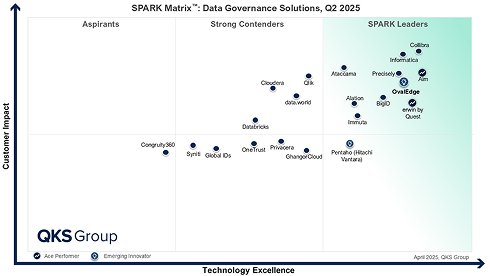
Analyst evaluations such as the SPARK Matrix position OvalEdge strongly on governance execution and enterprise readiness, reflecting its ability to handle complex environments.
Proven financial impact at scale
The Forrester TEI study reports 337% ROI, $2.5M net present value, and payback in under 6 months for organizations adopting OvalEdge.
The execution becomes visible when you look at the customer success stories. At Delta Community Credit Union, OvalEdge brought scattered data assets into a single governed layer, which improved visibility into data, reduced duplication in reporting, and made it easier for teams to work with consistent definitions across systems.
Book a demo to see how OvalEdge fits your data stack, governance model, and rollout priorities. Get a tailored walkthrough focused on your use cases and constraints.
Frequently asked questions
1. What are the best Alation alternatives?
OvalEdge is often considered when governance execution is a priority. Other commonly evaluated options include Collibra and Atlan, depending on whether the focus is on structured governance or data discovery.
2. Why do buyers look for Alation alternatives?
Buyers typically explore alternatives when governance needs extend beyond discovery into execution. Other factors include implementation complexity, scaling challenges, and the need to reduce reliance on multiple tools.
3. Which Alation competitor is best for enterprise use?
For enterprise environments, tools like OvalEdge, Collibra, and Microsoft Purview are typically evaluated due to their ability to support governance, compliance, and large-scale data operations.
4. Is OvalEdge a strong alternative to Alation?
OvalEdge is considered in scenarios where governance needs to be applied across lineage, data quality, and policy enforcement. It is relevant for teams looking to reduce manual effort and manage governance within a single platform.
5. What should I compare when evaluating Alation competitors?
Focus on governance execution, lineage depth, data quality support, implementation effort, and long-term cost. Also evaluate how well the platform fits your existing data ecosystem and team structure.
6. How do I choose the right Alation alternative for my team?
Start by identifying whether your priority is governance, discovery, or flexibility. Then evaluate how quickly the platform can be implemented and how well it supports both technical and business users.
Unify catalog, lineage, and governance in one platform
OvalEdge combines AI-driven cataloging, AskEdgi-powered self-service, automated lineage, data quality monitoring, and policy enforcement to turn governance into a continuous operating layer across your data ecosystem.
Choosing an Alation alternative? Start here
- Need governance workflows or only data visibility?
- Single system or multi-platform environment?
- Analyst-only usage or cross-team adoption?
- Immediate time-to-value required?
- Flexible governance and policy configuration needed?
Implement data governance faster with a proven framework
Access a practical 5-step framework used across real deployments to scope, prioritize, and implement governance without over-engineering.
Learn how to identify high-impact use cases and apply AI and automation to reduce manual effort.
Proven by customer successes across industries
.png?width=151&height=151&name=Mask%20group%20(18).png)
How Delta Community Credit Union enhanced its data governance with OvalEdge
"We have seen dramatic results across the board by implementing these programs, centralizing our metadata with the OvalEdge data catalog, and enabling self-service data education."
Dr. Su Rayburn
Vice President, Information Management & Analytics

.png?width=151&height=151&name=Mask%20group%20(19).png)
Bedrock leverages OvalEdge to standardize definitions, improve data accuracy
"OvalEdge stands out for its holistic approach, providing everything from business glossary to data lineage, all seamlessly integrated. The auto-lineage feature saves us months of work, enabling us to quickly understand data flows and address issues at the source.”
Sergei Vandalov
Senior Manager, Data Governance & Analytics

.png?width=151&height=151&name=Mask%20group%20(20).png)
Gousto’s continued data governance journey to deliver exceptional customer experience
“Incorrect pricing, nutritional or allergen information can disrupt the customer experience. With quality data at every stage, Gousto aligns its customer promise with operational excellence.”
Cathy Pendleton
Senior Manager - Data Governance
OvalEdge Recognized as a Leader in Data Governance Solutions
.png?width=1081&height=173&name=Forrester%201%20(1).png)
“Reference customers have repeatedly mentioned the great customer service they receive along with the support for their custom requirements, facilitating time to value. OvalEdge fits well with organizations prioritizing business user empowerment within their data governance strategy.”
.png?width=1081&height=241&name=KC%20-%20Logo%201%20(1).png)
“Reference customers have repeatedly mentioned the great customer service they receive along with the support for their custom requirements, facilitating time to value. OvalEdge fits well with organizations prioritizing business user empowerment within their data governance strategy.”
Gartner, Magic Quadrant for Data and Analytics Governance Platforms, January 2025
Gartner does not endorse any vendor, product or service depicted in its research publications, and does not advise technology users to select only those vendors with the highest ratings or other designation. Gartner research publications consist of the opinions of Gartner’s research organization and should not be construed as statements of fact. Gartner disclaims all warranties, expressed or implied, with respect to this research, including any warranties of merchantability or fitness for a particular purpose.
GARTNER and MAGIC QUADRANT are registered trademarks of Gartner, Inc. and/or its affiliates in the U.S. and internationally and are used herein with permission. All rights reserved.