Most governance teams don’t struggle because they lack tools. They struggle because the pace of data and AI has outgrown how governance actually works.
Access requests pile up, compliance checks lag behind real activity, and tracing how data moves across systems often turns into a slow, manual investigation that few teams have time to complete.
That gap is widening as AI adoption accelerates.
IBM reported in early 2024 that 42% of enterprise-scale organizations were already actively using AI, which means governance teams now have to manage far more data movement, automated decisions, and risk signals than before.
Traditional approaches built on periodic audits and manual oversight remain effective in stable, predictable environments, but often struggle to keep pace with dynamic, AI-driven systems where data moves and risks evolve in real time.
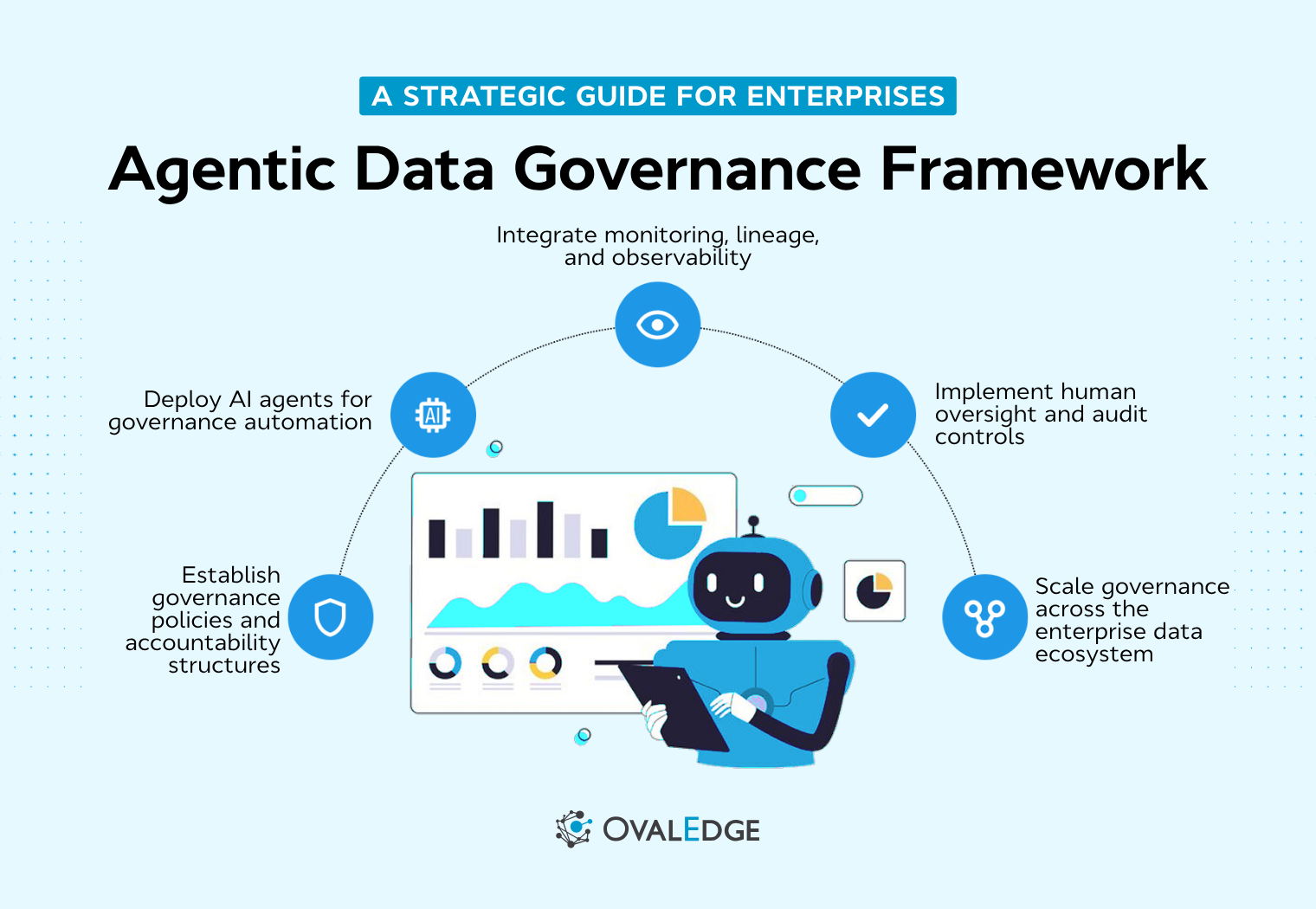
This guide explains how an agentic data governance framework helps close that gap by introducing AI agents that automate monitoring, enforce policies continuously, and enable scalable, accountable governance across modern data ecosystems without losing control.
What is an agentic data governance framework?
An agentic data governance framework uses AI agents to monitor data environments, interpret policies, and trigger governance actions continuously. Instead of relying on manual reviews and periodic audits, it enables governance systems that operate in real time as data moves across pipelines, platforms, and AI workflows.
This shift matters because traditional governance depends heavily on human intervention. Teams review access requests, classify sensitive data, and investigate issues after they occur. While these tasks remain important, they do not scale effectively across modern data ecosystems that span cloud platforms, data warehouses, and machine learning systems.
Agentic governance builds on automation but goes further by introducing context-aware decision-making. Instead of relying only on predefined rules, AI agents evaluate multiple signals such as data sensitivity, user roles, recent activity, and access patterns to determine the appropriate action.
|
For example, a rule-based system might grant access based solely on a user’s role, while an agentic system can adjust its decision by considering risk factors and context, choosing to approve, restrict, or escalate the request accordingly. |
In practice, AI agents support governance by:
-
Identifying sensitive data across datasets automatically
-
Enforcing access policies dynamically based on context and risk
-
Monitoring compliance continuously instead of periodically
-
Detecting unusual data usage patterns that may indicate misuse
Before moving further, it helps to understand how agentic governance differs from traditional and rule-based approaches:
Traditional vs automated vs agentic governance
|
Aspect |
Traditional governance |
Automated governance |
Agentic governance |
|
Execution |
Manual workflows |
Predefined rules |
Context-aware AI decisions |
|
Monitoring |
Periodic |
Scheduled or event-based |
Continuous |
|
Policy enforcement |
Inconsistent across teams |
Consistent but rigid |
Dynamic and adaptive |
|
Risk response |
Reactive |
Faster but limited |
Immediate and prioritized |
|
Scalability |
Constrained by people |
Moderate |
High |
This shift from static and rule-based governance to continuous, context-aware decision-making is what enables governance to scale with modern data environments.
Why enterprises are adopting agentic data governance frameworks
Enterprises are adopting agentic data governance frameworks due to rising access requests, stricter compliance demands, and new risks introduced by AI-driven systems. These pressures are leading to approval delays, growing backlogs, and limited visibility into data usage.
Agentic frameworks help by reducing approval turnaround times, increasing policy enforcement consistency, and enabling continuous monitoring of data activity. This allows organizations to scale governance operations, improve response to risks, and reduce manual workload without adding headcount.
Limits of traditional governance in AI-powered data environments
Traditional governance models struggle in AI-heavy environments for three reasons. Policies are often static and manually enforced. Compliance issues are detected late because reviews happen periodically. Visibility across systems remains fragmented, especially when data pipelines and AI models span multiple tools and teams.
AI amplifies these challenges. Models generate large volumes of decisions, data flows shift continuously, and governance teams cannot manually inspect every access request, dataset change, or downstream use case.
|
Do you know: McKinsey reported in its 2024 survey that 40 percent of respondents identified explainability as a key risk in generative AI, yet only 17 percent said they were actively working to mitigate it. That gap highlights how governance practices are still catching up to AI adoption. |
Rising complexity of enterprise data ecosystems
Modern enterprise environments add another layer of complexity. Data is distributed across multi-cloud platforms, data lakes, warehouses, machine learning pipelines, and operational systems. Ownership is fragmented across teams, and metadata is often inconsistent or incomplete.
This makes governance harder to enforce. Without clear lineage, standardized policies, and unified visibility, governance teams struggle to track how data moves, who uses it, and how decisions are made. As data ecosystems grow, governance overhead increases while control becomes harder to maintain.
The growing role of AI governance automation
This is where an AI-driven governance framework becomes essential. Automation allows governance to scale by enabling continuous policy enforcement, real-time anomaly detection, and faster access management.
The impact on enterprise operations is clear:
-
Reduced manual effort for governance teams
-
Faster detection of compliance and policy violations
-
Improved monitoring across distributed data environments
-
Stronger audit readiness through automated logging and traceability
As governance shifts from periodic oversight to continuous execution, agentic frameworks provide the foundation for managing data and AI systems at scale without slowing down innovation.
Architecture of an agentic data governance framework
An agentic data governance framework works effectively only when its architecture supports policy interpretation, continuous monitoring, and coordinated action across the data ecosystem. Most implementations are built around four core layers.
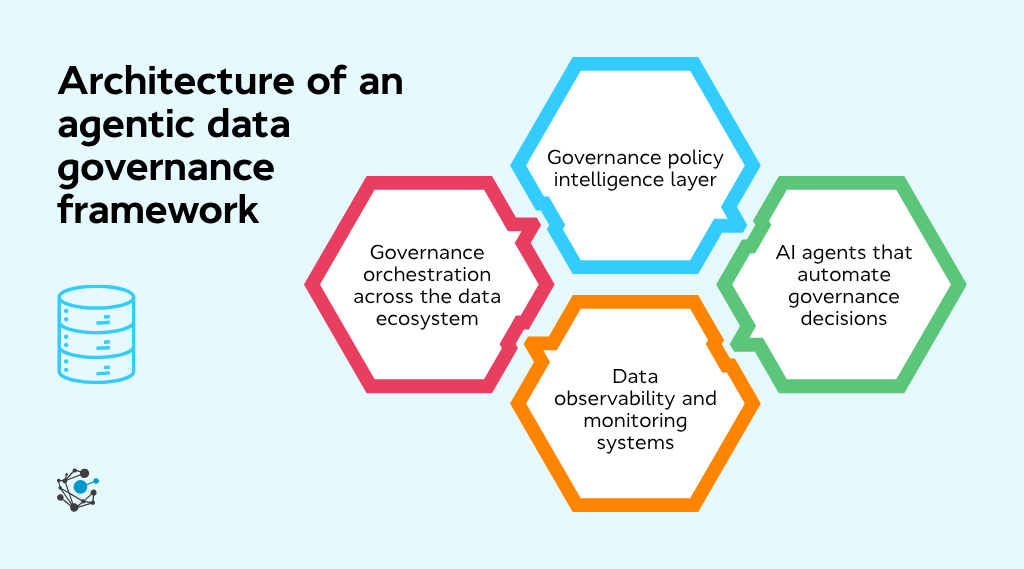
Governance policy intelligence layer
This layer defines and stores governance policies in a machine-readable, executable format, including access rules, compliance requirements, and security controls. AI agents rely on this layer to interpret policies in context and decide actions.
The key risk is ambiguity and fragmentation. If policies are inconsistent across teams or not clearly defined, agents may enforce them incorrectly or inconsistently. Enterprises should evaluate whether policies are standardized, version-controlled, and structured in a way that supports automated interpretation.
AI agents that automate governance decisions
This layer handles execution. AI agents monitor system activity, interpret policies, and trigger actions such as restricting access, flagging risks, or escalating issues in real time.
The main challenge is trust and control. Overly rigid agents can block legitimate access, while poorly tuned ones may miss risks. Organizations should assess how decisions are validated, how exceptions are handled, and whether there is clear human oversight for critical actions.
Data observability and monitoring systems
Agentic governance depends on strong observability. This layer provides signals such as access patterns, pipeline anomalies, data quality issues, and lineage.
The failure point here is incomplete visibility. If data sources, pipelines, or usage signals are not fully captured, agents operate with blind spots. Enterprises should evaluate coverage across systems, the freshness of signals, and the reliability of metadata and lineage tracking.
Governance orchestration across the data ecosystem
This layer ensures governance actions are applied consistently across platforms by connecting policy engines, monitoring tools, and workflows.
Without effective orchestration, governance becomes fragmented. Actions may be enforced in one system but not others, leading to gaps in control. Organizations should assess how well tools are integrated, whether actions propagate across systems, and how conflicts between tools are resolved.
The need for unified execution is widely recognized.
|
For example, the Ovaledge whitepaper, From Data Chaos to Data Trust, highlights the importance of unifying data quality, governance, and operational workflows to build reliable and scalable data systems. |
How agentic governance enables autonomous data governance
Agentic governance enables organizations to move toward autonomous data governance, where intelligent systems continuously monitor, enforce, and adapt governance policies without constant human intervention.
Autonomous governance replaces manual workflows with real-time, system-driven execution. Decisions are triggered automatically as events occur, and policies are applied based on context such as data sensitivity, user roles, and usage patterns. Monitoring runs continuously, ensuring issues are detected early rather than during periodic reviews.
Autonomous governance systems are built on three core capabilities:
-
Self-monitoring systems: Continuously track data access, movement, and usage patterns
-
Adaptive policy enforcement: Apply and adjust policies based on context, risk, and behavior
-
Automated governance workflows: Execute approvals, restrictions, and alerts without manual intervention
As a result, governance becomes more scalable and efficient. Compliance monitoring shifts from reactive audits to proactive detection, and data access risks are reduced through real-time enforcement.
Organizations typically progress through three levels of governance maturity:
-
Assisted governance: Systems provide recommendations, while humans make final decisions
-
Semi-automated governance: Standard scenarios are handled automatically, with exceptions escalated
-
Fully agent-driven governance: AI agents execute governance decisions autonomously, with human oversight for high-risk cases
Real-world workflow example: Access request
|
Scenario: A user requests access to a sensitive dataset In an agentic governance system:
No manual approval chain is required unless the request is high-risk. |
Before vs after: Manual vs agentic governance flow
In a manual governance model, workflows are slow and fragmented. Access requests move through approvals, policy checks are manual, and monitoring happens after the fact, often delaying issue detection.
In an agentic governance model, the same workflow runs in real time. The system evaluates requests against policies, uses context like metadata and lineage, and makes decisions instantly while continuously monitoring for risks.
The shift is not just faster execution. It transforms governance from reactive processes to continuous, system-driven control that scales with the data environment.
How enterprises implement an agentic data governance framework
Most enterprises do not implement agentic governance all at once. The most effective approach is phased adoption, where organizations introduce automation gradually while strengthening governance foundations.
Step 1: Establish governance policies and accountability structures
The foundation of agentic governance starts with clear policies and ownership. Enterprises need well-defined governance frameworks, roles, and compliance guidelines before introducing automation.
This means defining how data should be accessed, secured, and monitored, while also assigning clear ownership for governance decisions and risk management. Without this clarity, automation can amplify gaps instead of solving them.
Step 2: Deploy AI agents for governance automation
Once policies are in place, organizations can introduce AI agents into targeted, high-impact workflows. Starting small helps build confidence and demonstrate value early.
Common entry points include:
-
Access approvals and policy enforcement
-
Sensitive data identification and classification
-
Detection of policy violations and anomalies
These use cases are easier to measure and provide immediate operational benefits.
Step 3: Integrate monitoring, lineage, and observability
AI agents rely on context to make decisions, which makes integration with monitoring and metadata systems essential.
Enterprises need visibility into:
-
Data lineage to understand how data flows across systems
-
Usage patterns to detect anomalies and risks
-
Data quality signals to identify inconsistencies
This is where platforms that combine metadata, lineage, and monitoring capabilities become critical.
|
Pro tip: Solutions like OvalEdge help unify these signals, making it easier to trace data movement, understand context, and support continuous governance decisions. |
With this foundation, governance shifts from reactive checks to continuous monitoring.
Step 4: Implement human oversight and audit controls
Even with automation, human oversight remains critical. Governance systems must include mechanisms to review and validate automated decisions.
This typically involves governance dashboards, audit logs, and structured review processes for high-risk scenarios. The goal is to ensure accountability while allowing automation to handle routine decisions at scale.
Step 5: Scale governance across the enterprise data ecosystem
After initial success, organizations can expand agentic governance across more systems and workflows. The focus shifts from isolated use cases to consistent governance across the enterprise.
This includes extending governance across platforms, automating additional processes, and aligning governance with AI and analytics operations. Over time, governance evolves from a control function into a scalable system that supports both risk management and innovation.
Common failure points during implementation
During implementation, issues such as unclear governance policies, undefined ownership, and poor metadata quality can slow progress. These gaps affect how AI agents interpret data and make decisions.
Without well-defined standards and accurate context, outcomes may become inconsistent. Addressing these challenges early helps ensure smoother adoption and more reliable governance at scale.
Common challenges in autonomous data governance
Agentic governance offers clear advantages, but implementation comes with practical challenges. Most enterprises encounter a mix of technical, organizational, and maturity-related barriers as they move toward autonomous governance.
-
Limited governance visibility: Without strong metadata and lineage, governance systems lack the context needed for accurate decision-making. Incomplete visibility makes it difficult to track how data moves, who uses it, and how policies should be applied.
-
Organizational resistance to automation: Teams accustomed to manual workflows may hesitate to trust automated decision-making. This is especially true in regulated environments where accountability and control are critical.
-
Governance maturity gaps: Many organizations are still building foundational governance capabilities. Common gaps include a lack of well-defined governance policies, inconsistent metadata management, and limited alignment between governance, data, and AI teams.
-
Integration complexity: Modern data ecosystems are often fragmented across tools and platforms. Integrating governance across legacy systems, cloud environments, and data pipelines can be complex and time-consuming.
Despite these challenges, the path forward is gradual adoption. Start with areas where policies are clear, observability is strong, and manual friction is highest. Early wins help build trust and create momentum for scaling autonomous governance across the enterprise.
How OvalEdge supports agentic data governance
Platforms that combine governance automation, observability, and metadata management play a critical role in enabling agentic data governance. OvalEdge brings these capabilities together to help organizations operationalize governance across complex and distributed data ecosystems.
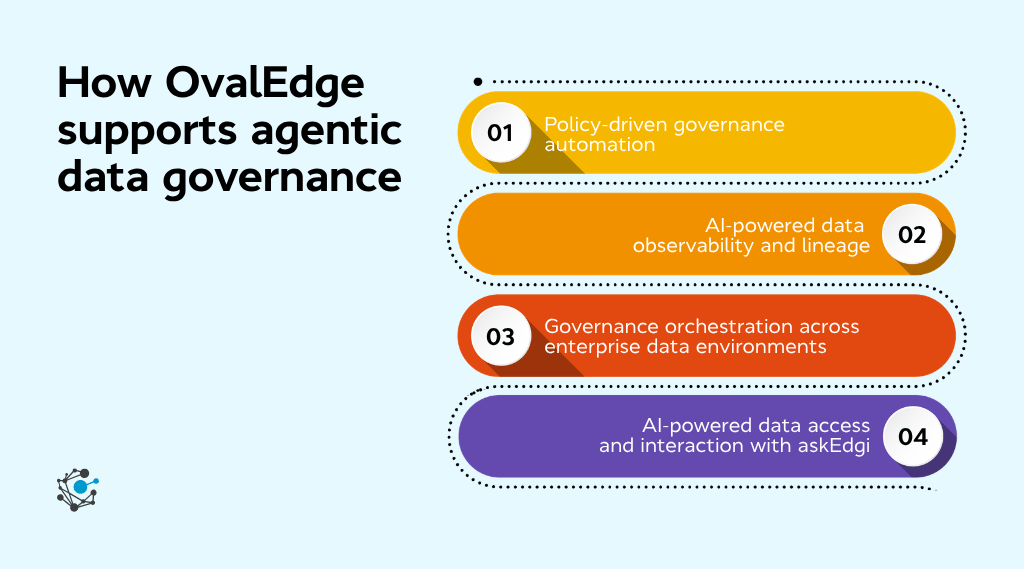
1. Policy-driven governance automation
Agentic governance depends on policies that can be executed consistently across systems. OvalEdge enables organizations to define and operationalize governance rules around data access, security, and compliance.
This includes automated access control, sensitive data classification, and workflow-driven governance processes.
|
Related reading: As highlighted in the guide, data governance best practices, strong governance requires clearly defined policies, ownership, and continuous enforcement to maintain data trust and compliance. |
By embedding these controls into workflows, governance shifts from manual enforcement to continuous execution.
2. AI-powered data observability and lineage
Autonomous governance requires visibility into how data moves and is used. OvalEdge provides capabilities such as automated lineage, data quality monitoring, and usage analytics to create this context.
These capabilities align with the idea that governance and data usability must work together.
|
As explained in the Data Asset Management vs. Data Governance guide, governance defines rules, while metadata, lineage, and asset visibility make those rules actionable in day-to-day operations. |
With this level of observability, governance systems can detect risks early and respond in real time.
3. Governance orchestration across enterprise data environments
Agentic governance is not just about individual capabilities. It requires coordination across tools, teams, and workflows to ensure governance operates consistently across the entire data ecosystem.
OvalEdge enables this by connecting policy management, monitoring, lineage, and governance workflows into a unified system. Instead of managing governance in silos, organizations can enforce policies, track data movement, and respond to risks in a coordinated way.
This reduces fragmentation and eliminates gaps where governance can break down. As a result, policy enforcement becomes consistent across platforms, workflows become more streamlined, and governance scales more effectively without increasing operational complexity.
4. AI-powered data access and interaction with askEdgi
Governance should not be limited to backend systems. It needs to extend into how users interact with data. askEdgi brings this layer into practice by enabling users to query governed data through a conversational interface.
What makes this relevant for agentic governance is how governance is enforced at the point of interaction:
-
Access controls are applied based on governance policies
-
Sensitive data is detected and restricted automatically
-
Every query and action is logged for audit and compliance
-
Data quality rules can influence what data is accessible
|
askEdgi: Bringing governance closer to end users This approach is reflected in tools like askEdgi, where governance policies, metadata, and access controls are enforced directly during user interactions. This bridges a critical gap. Governance is no longer just about control. It becomes part of how users discover, access, and trust data in everyday workflows. |
Conclusion
Traditional governance cannot keep pace with modern AI-driven data ecosystems. An agentic data governance framework enables organizations to shift from manual, reactive control to continuous, context-aware governance, improving visibility, policy enforcement, and auditability.
The next steps are clear. Assess your governance maturity, strengthen policies and accountability, and improve lineage and observability.
Then introduce AI-driven automation in high-friction areas such as access control and compliance monitoring. The goal is not fewer controls, but smarter controls that operate at the speed of data.
Platforms like OvalEdge support this transition by bringing together governance automation, metadata management, and observability into a unified system. Schedule a demo with OvalEdge to understand how this works in practice.
FAQs
1. What is the difference between agentic data governance and traditional data governance?
Traditional governance relies on manual workflows and periodic audits. Agentic data governance uses AI agents to monitor data activity, interpret policies, and enforce governance rules automatically, enabling continuous and scalable oversight across complex data ecosystems.
2. How do AI agents support data governance automation?
AI agents analyze governance policies, monitor data usage patterns, and trigger automated actions such as restricting access, flagging sensitive data, or generating compliance alerts. This allows governance teams to manage large-scale data environments more efficiently.
3. What types of enterprises benefit most from an agentic data governance framework?
Organizations with large data ecosystems, multiple data platforms, AI-driven applications, and strict regulatory requirements benefit the most. Industries such as finance, healthcare, retail, and technology often require automated governance to manage scale and compliance.
4. Can agentic data governance work with existing data platforms?
Yes. Agentic governance frameworks typically integrate with existing data platforms such as data lakes, warehouses, analytics tools, and machine learning systems. This allows enterprises to automate governance without replacing their current infrastructure.
5. How does agentic governance improve regulatory compliance?
Agentic governance continuously monitors data activity, enforces policies automatically, and records governance actions. These capabilities help organizations maintain audit trails, detect policy violations quickly, and demonstrate compliance with evolving data regulations.
6. What skills do data governance leaders need to implement agentic governance?
Data governance leaders need expertise in governance policies, metadata management, data observability, and AI-enabled automation. They must also collaborate with engineering and compliance teams to ensure governance frameworks align with organizational and regulatory requirements.
.png?width=1081&height=173&name=Forrester%201%20(1).png)
.png?width=1081&height=241&name=KC%20-%20Logo%201%20(1).png)