Microsoft Purview Alternatives: Compare Top Platforms for Data Governance
Compare leading Microsoft Purview competitors across governance workflows, lineage depth, data quality, and AI-driven automation to find the right fit for your data stack.
In this article
What are the best Microsoft Purview alternatives?
The best Microsoft Purview alternatives include OvalEdge, Collibra, Informatica, Alation, Atlan, data.world, BigID, and OneTrust. Each serves a different need:
- OvalEdge focuses on unified data governance with built-in lineage, data quality, privacy, and AI-driven workflows.
- Collibra supports structured governance and stewardship programs at scale.
- Informatica provides a broad governance suite with deeper integration across data management.
- Alation emphasizes data discovery, cataloging, and governed self-service analytics.
- Atlan offers a modern metadata workspace for collaboration and data team workflows.
- data.world enables collaborative governance with a knowledge graph-based approach.
- BigID specializes in data discovery, classification, and privacy management.
- OneTrust focuses on regulatory compliance, privacy operations, and data risk management.
These tools differ across governance depth, AI capabilities, implementation complexity, and cost, making it important to evaluate them based on your specific use case.
Let’s compare these alternatives based on your specific use case.
Microsoft Purview alternatives compared
Here is a quick comparison of the leading Microsoft Purview alternatives across key decision factors.
|
Tool |
Best for |
Core strength |
AI capability |
Limitation |
|
OvalEdge |
Unified governance across ecosystems |
End-to-end governance + lineage + quality |
Strong AI-driven automation & AskEdgi |
Requires governance maturity to fully leverage |
|
Collibra |
Structured governance programs |
Policy workflows & stewardship |
AI-assisted governance workflows |
Complex, heavy to implement |
|
Informatica |
Enterprise data management suites |
Broad integration + governance stack |
AI-driven data management |
High cost, slow deployment |
|
Alation |
Data discovery & adoption |
Search-driven catalog & collaboration |
Emerging AI data intelligence |
Limited deep governance |
|
Atlan |
Modern data teams |
Active metadata & collaboration |
AI-native workflows |
Less depth in enterprise governance |
|
data.world |
Collaborative governance |
Knowledge graph-based catalog |
AI-driven discovery & linking |
Limited enterprise workflow depth |
|
BigID |
Data privacy & discovery |
Sensitive data classification |
AI-powered discovery & risk insights |
Not a full governance platform |
|
OneTrust |
Compliance & privacy operations |
Regulatory workflows & data mapping |
AI-assisted compliance automation |
Limited catalog & lineage depth |
Each platform addresses a different set of requirements. The right choice depends on the specific problem you are trying to solve. Next, we break these down by use case so you can choose the right fit.
Best Microsoft Purview alternatives for your use case
Microsoft Purview works well as a starting point for organizations already invested in the Microsoft ecosystem, especially for basic data cataloging and compliance use cases. The challenge begins when teams try to scale governance across diverse systems, users, and workflows.
Common limitations that push teams to evaluate alternatives include:
- Ecosystem dependency: Works best within Azure and Microsoft tools, limiting visibility across non-Microsoft environments
- Multi-cloud constraints: Struggles to provide consistent governance across hybrid and multi-cloud data landscapes
- Fragmented experience: Governance, security, and compliance workflows are not unified, leading to tool sprawl
- Limited operational depth: Focuses more on data visibility than enforcing governance through workflows and policies
- Adoption challenges: Technical complexity and UI limitations slow down business user adoption
In practice, many teams run into limitations once they move beyond basic use cases. Discussions around scaling governance across diverse systems highlight that gaps in cross-platform visibility and incomplete lineage make it harder to trust the platform, especially outside the Microsoft ecosystem.
|
Did you know? Enterprise environments are no longer single-platform. In Kyndryl’s 2025 Cloud Innovation Survey, only 18% of organizations operate on a single cloud, while 84% of leaders actively choose multi-cloud environments. Another Thales 2025 Cloud Security Study found that organizations use an average of 85 SaaS applications. This helps explain why buyers often look beyond single-platform governance assumptions and evaluate tools by breadth, interoperability, and operational fit. |
In the next section, we group Microsoft Purview alternatives by use case to help you evaluate them more effectively.
Tools for unified data governance and cataloging
These platforms are designed for teams looking to move beyond basic cataloging and actually run governance across their data ecosystem.
1. OvalEdge
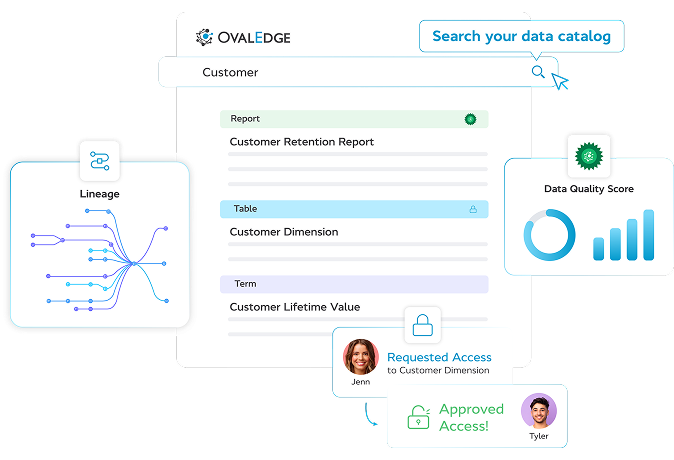
OvalEdge is a unified, AI-driven data governance platform that combines data catalog, lineage, data quality, access control, and governance workflows into a single system. It is designed for enterprises that need to operationalize governance across complex, multi-platform environments rather than managing it through disconnected tools.
What is it used for
OvalEdge is used to establish a working governance layer across the organization. It is used for:
-
Building a centralized, business-friendly data catalog across all systems
-
Automatically generating end-to-end data lineage across cloud, on-prem, and hybrid environments
-
Enforcing governance policies across access, privacy, quality, and metadata standards
-
Enabling governed self-service analytics for business users
-
Managing compliance workflows, such as data access requests and regulatory reporting
This makes it easier to move from fragmented governance efforts to a structured, organization-wide approach.
When teams evaluate it against Microsoft Purview
Teams typically consider OvalEdge when Purview starts limiting their ability to scale governance. This usually happens when:
-
They operate in multi-cloud or non-Microsoft environments and need broader connectivity
-
Lineage becomes a priority, but is difficult to implement or incomplete in Purview
-
Governance needs to move from visibility to execution through workflows and policies
-
Business user adoption becomes critical, and existing tools feel too technical or fragmented
Prospects often reach this point after realizing Purview cannot support their long-term governance requirements.
What changes after adoption
Once OvalEdge is implemented, governance shifts from a manual effort to a system that runs continuously across teams. Here’s what users get after adoption:
-
A connected view of your data ecosystem: Data from different systems is brought into a single catalog. Business context, relationships, and ownership are clearly defined, so teams understand what data exists and how it is used.
-
Lineage that supports real decisions: Teams can trace data from source to report and understand transformations. Impact analysis can be done across multiple datasets at once, which helps teams assess changes before making updates.
-
Governance built into workflows: Policies for access, privacy, and data quality are enforced through structured AI workflows. Approvals are tracked, ownership is clearly defined, and accountability is visible across the organization.
-
Clear ownership across teams: Data owners, stewards, and consumers work within defined roles. This creates consistency in how data is managed and reduces dependency on individual teams.
-
Business and technical context in one place: Metadata, lineage, and business definitions are connected. Both business users and technical teams work with the same understanding of data.
-
Self-service access for business users: Analysts and business teams can find and use data through the catalog and glossary. This reduces reliance on engineering teams for everyday data needs.
-
Faster time to value: Organizations start seeing measurable outcomes shortly after deployment, such as faster data discovery, improved data trust, and increased adoption.
This is where the biggest shift happens. Instead of investing time in setting up governance without clear outcomes, teams begin to see improvements in how data is discovered, trusted, and used across the organization.
|
Insight: The Enterprise Data Strategy Board’s 2025 report shows that 54% of governance modernization efforts are focused on embedding governance into workflows and increasing automation. This shift explains why platforms that enforce policies through workflows are becoming the standard for enterprise governance. |
AI governance and automation capabilities
OvalEdge brings AI into governance in a way that reduces manual effort rather than adding complexity.
- Agentic automation: AI agent continuously discovers and enriches metadata. It keeps the catalog updated without requiring manual effort.
- Auto-lineage generation: Lineage is generated and updated as systems change. Teams always have an accurate view of data flows.
- AI-driven quality and anomaly detection: The platform identifies issues in data. It also suggests rules to improve quality based on observed patterns automatically.
- askEdgi for self-service analytics: Business users can query data using natural language and get governed answers.
- Privacy and compliance automation: Sensitive data is identified automatically. Access policies are enforced to meet regulatory requirements.
- AI governance: AI-generated outputs are grounded in trusted metadata. This ensures that decisions are based on verified and consistent data.
A practical example of this is how Bayview, a U.S.-based financial services firm, applied these capabilities in real environments.
Bayview needed a way to manage data quality and compliance across multiple systems. With OvalEdge, they implemented automated data quality rules and real-time monitoring. Issues are now detected and routed to the right teams within minutes instead of surfacing later through client complaints.
The outcome is a governance system that runs in the background while keeping data reliable. Teams spend less time tracking issues manually and more time using data with confidence.
Things to consider
-
Requires alignment on governance processes to fully realize value
-
Best suited for organizations moving beyond basic cataloging into full governance execution
-
Initial setup still requires defining policies, ownership, and workflows
Ratings, reviews, and analyst validation
Independent review platforms consistently highlight OvalEdge’s strengths in governance depth, usability, and time to value.
- On G2, users highlight fast implementation, strong lineage capabilities, and responsive support
- On Gartner Peer Insights, reviews emphasize governance workflows, metadata management, and platform flexibility
- On TrustRadius, feedback focuses on automation, data discoverability, and improved access to trusted data
Across platforms, a clear pattern emerges. Teams value how quickly they can move from setup to real outcomes, especially in areas like lineage, governance execution, and business adoption.
A closer look at real impactOvalEdge’s value is also validated through independent research. According to the Forrester Total Economic Impact (TEI) study, organizations using OvalEdge achieved 337% ROI with payback in under 6 months. The value comes from measurable outcomes:
|
If you are evaluating alternatives because Purview cannot scale with your governance needs, it is worth seeing how OvalEdge performs in your environment.
Book a demo to explore how OvalEdge fits your architecture and rollout plan.
2. Collibra
Collibra is a data intelligence and governance platform that helps organizations manage data policies, stewardship, and metadata across the enterprise. It is widely used in regulated industries where governance processes need to be formal and auditable.
What is it used for
Collibra is used to build and manage structured governance programs with clear ownership and policy enforcement.
-
Establish governance frameworks with defined roles and responsibilities
-
Manage business glossaries and metadata across teams
-
Support compliance initiatives with audit-ready processes
-
Enable stewardship workflows to maintain data definitions and quality
The platform focuses on creating consistency in how data is defined, owned, and governed across the organization.
When teams evaluate it against Microsoft Purview
Teams typically evaluate Collibra when governance requirements become more formal and process-driven.
-
When organizations need stronger policy management and stewardship workflows
-
When compliance and audit readiness require structured governance processes
-
When teams want a dedicated governance platform beyond basic catalog capabilities
Collibra is often considered in environments where governance maturity is increasing and requires tighter control.
What changes after adoption
Collibra brings structure and standardization to governance programs.
-
Governance processes are formalized with defined workflows and approvals
-
Data ownership and definitions become consistent across teams
-
Compliance tracking becomes easier through documented policies and processes
-
Stewardship activities are organized and monitored through the platform
This helps organizations move from informal governance practices to a more controlled and repeatable approach.
Things to consider
-
Implementation can take time due to the need to define governance structures upfront
-
Business user adoption may require training because of the platform’s depth
-
Some capabilities, such as advanced lineage or data quality, may require additional integrations
3. Informatica
Informatica is an enterprise data management platform that combines data integration, governance, data quality, and master data management. It is designed for organizations looking to manage large-scale data operations within a unified ecosystem.
What is it used for
Informatica is used to manage data across its lifecycle, from ingestion and transformation to governance and compliance.
-
Build governance frameworks alongside data integration and pipelines
-
Manage master data across domains such as customer and product
-
Enforce data quality rules within data pipelines
-
Support regulatory compliance with centralized control
It is commonly used by enterprises that want governance tightly linked with their broader data infrastructure.
When teams evaluate it against Microsoft Purview
Teams evaluate Informatica when they need more than a catalog and require deeper control over data processes.
-
When governance needs to integrate with ETL, data pipelines, and MDM
-
When organizations want a single platform to manage multiple data functions
-
When enterprise-scale control and compliance are key priorities
Informatica is often considered in large organizations with complex data environments and existing investments in data infrastructure.
What changes after adoption
Informatica provides centralized control across data management functions.
-
Governance is integrated with data pipelines and transformation processes
-
Data quality rules are applied as part of data movement
-
Master data is managed consistently across systems
-
Teams gain visibility into how data flows across the organization
This enables organizations to manage governance and data operations within the same system, though it often requires dedicated resources.
Things to consider
-
Implementation effort is high and may involve multiple teams
-
Platform complexity can slow down onboarding for business users
-
Costs can increase as additional modules and capabilities are added
Tools for data cataloging and metadata management
These platforms help teams discover, understand, and use data through metadata, lineage, and collaboration rather than full governance execution.
4. Alation
Alation is a data intelligence platform that focuses on data cataloging, metadata management, and search. It helps organizations improve data discovery and trust by combining technical metadata with business context and usage insights.
What is it used for
Alation is used to make data easier to find, understand, and use across teams.
-
Centralize metadata from multiple systems into a searchable catalog
-
Provide context through business definitions, usage patterns, and ownership
-
Enable self-service analytics so users can find and work with trusted data
-
Support governance through policy tracking and lineage visibility
The platform helps reduce time spent searching for data and improves how teams evaluate data before using it.
When teams evaluate it against Microsoft Purview
Teams evaluate Alation when they want to improve how users interact with data.
-
When search and discovery need to be faster and more intuitive
-
When business users need better context to trust and use data
-
When organizations want to increase the adoption of data across teams
It is often considered when usability and data discovery are the primary focus areas.
What changes after adoption
Alation improves how data is accessed and understood across the organization.
-
Data becomes easier to locate through contextual and AI-driven search
-
Users gain visibility into how data is used and which assets are trusted
-
Collaboration increases through shared knowledge and annotations
-
Analysts spend more time using data and less time searching for it
These changes help teams work more efficiently and improve confidence in data-driven decisions.
Things to consider
-
Governance capabilities are present but may not cover full governance execution across workflows
-
Lineage and quality features depend on integrations with underlying systems
-
Implementation requires effort to curate metadata and drive user adoption
-
Organizations may need additional tools for deeper governance, policy enforcement, or compliance workflows
Also read → Compare Top Alation Alternatives in 2026
5. Atlan
Atlan is a metadata platform designed for modern data teams. It combines a data catalog with collaboration features and active metadata to keep data context updated across tools and workflows.
What is it used for
Atlan is used to manage metadata and improve collaboration across data teams.
-
Build a centralized catalog for datasets, dashboards, and pipelines
-
Maintain metadata and lineage across cloud data platforms
-
Enable collaboration between engineers, analysts, and business users
-
Integrate with modern tools such as warehouses, BI tools, and transformation layers
It focuses on keeping metadata aligned with rapidly changing data environments.
When teams evaluate it against Microsoft Purview
Teams evaluate Atlan when working with modern cloud-based data stacks.
-
When data workflows rely on tools like Snowflake, dbt, and cloud warehouses
-
When metadata needs to stay updated as data pipelines change
-
When collaboration across engineering and analytics teams is a priority
It is often considered in fast-moving data environments where flexibility is important.
What changes after adoption
Atlan improves visibility and collaboration around metadata.
-
Metadata is updated continuously as data changes
-
Teams gain better visibility into data relationships and lineage
-
Collaboration improves through shared context and integrations
-
Data teams spend less time manually maintaining metadata
This helps teams keep pace with evolving data systems while maintaining context.
Things to consider
-
Governance capabilities may need to be extended for enterprise-wide policy enforcement
-
Business user adoption depends on how well metadata is curated and documented
-
Implementation requires alignment with existing data stack tools
-
Organizations with strict compliance requirements may need additional governance layers
Also read → Evaluate Top Atlan Alternatives for Data Governance in 2026
6. data.world
data.world is a cloud-native data catalog platform that uses a knowledge graph to connect data assets. It focuses on improving data discovery, context, and collaboration across both business and technical users.
What is it used for
data.world is used to create a connected view of data across the organization.
-
Catalog datasets, dashboards, and data assets in one place
-
Link data through a knowledge graph to show relationships and context
-
Enable collaboration through shared documentation and discussions
-
Support governance through metadata and policy definitions
The platform helps teams understand how data relates across systems.
When teams evaluate it against Microsoft Purview
Teams evaluate data.world when they need stronger context and collaboration around data.
-
When understanding relationships between data assets is important
-
When teams want to improve knowledge sharing across departments
-
When business users need more context to interpret data
It is often considered in environments where data literacy and collaboration are priorities.
What changes after adoption
data.world improves how data is connected and understood.
-
Data assets are linked through relationships instead of isolated catalogs
-
Users gain context about how datasets relate to each other
-
Collaboration increases through shared knowledge and discussions
-
Data discovery becomes more intuitive for non-technical users
This helps organizations build a more connected and collaborative data environment.
Things to consider
-
Governance execution may require additional systems for enforcement
-
Lineage capabilities may not be as detailed across all integrations
-
Implementation requires consistent metadata curation to maintain accuracy
-
Organizations focused on strict governance workflows may need complementary tools
Tools for data privacy, security, and compliance
These platforms are used when the primary goal is to identify sensitive data, reduce risk, and meet regulatory requirements across complex environments.
7. BigID
BigID is a data security and privacy platform focused on discovering, classifying, and managing sensitive data across cloud, SaaS, and on-prem systems. It uses machine learning to map data to individuals and regulatory requirements at scale.
What is it used for
BigID is used to gain deep visibility into sensitive data and manage privacy risk across the enterprise.
-
Discover and classify personal and sensitive data across structured and unstructured sources
-
Map data to identities to understand how information relates to individuals
-
Automate workflows such as data subject access requests and data deletion
-
Monitor risk exposure and enforce data protection policies
The platform connects discovery, classification, and remediation, so privacy operations are tied directly to actual data rather than documentation alone.
When teams evaluate it against Microsoft Purview
Teams evaluate BigID when they need deeper visibility into sensitive data.
-
When identifying and classifying data across non-Microsoft environments becomes critical
-
When privacy regulations require accurate mapping of data to individuals
-
When organizations need to reduce risk across distributed data environments
It is often considered when Purview’s classification and discovery capabilities are not sufficient for enterprise-scale privacy programs.
What changes after adoption
BigID gives organizations a more detailed understanding of sensitive data and how it is used.
-
Sensitive data is identified across more systems, including unstructured sources
-
Data is mapped to individuals, which improves how privacy requests are handled
-
Privacy workflows become faster through the automation of requests and approvals
-
Risk exposure becomes more visible, which helps teams take action earlier
This allows organizations to move from partial visibility to a more complete understanding of their data risk posture.
Things to consider
-
Focus is centered on privacy and security, not full data governance across catalog, lineage, and quality
-
Implementation depends on the number and type of data sources that need to be scanned
-
Requires integration with other platforms for broader governance workflows
-
Teams need alignment between privacy, security, and data teams to fully utilize capabilities
-
Licensing and deployment are typically enterprise-focused and may require longer evaluation cycles
8. OneTrust
OneTrust is a governance, risk, and compliance platform that helps organizations manage privacy, consent, and regulatory requirements. It provides a broad set of modules covering privacy operations, AI governance, and third-party risk management.
What is it used for
OneTrust is used to operationalize privacy and compliance programs across the organization.
-
Maintain data inventories and map data flows across systems
-
Manage consent and user preferences across digital channels
-
Automate compliance workflows such as audits and regulatory reporting
-
Assess and manage risk across vendors and third parties
It focuses on connecting policies, workflows, and documentation to ensure compliance requirements are met consistently.
When teams evaluate it against Microsoft Purview
Teams evaluate OneTrust when compliance and regulatory management become the main priority.
-
When organizations need structured workflows for privacy and compliance
-
When audit readiness and regulatory reporting are key requirements
-
When consent management and third-party risk need dedicated systems
It is often considered by enterprises when building formal privacy and risk management programs.
What changes after adoption
OneTrust helps organizations formalize how compliance is managed.
-
Data mapping and records of processing become structured and easier to maintain
-
Compliance workflows are automated and tracked across teams
-
Consent and preference management are handled consistently across systems
-
Risk visibility improves through centralized monitoring and reporting
This allows organizations to manage regulatory requirements in a more structured and repeatable way.
Things to consider
-
Focus is on privacy, risk, and compliance rather than broader data governance capabilities
-
Data discovery and lineage may not be as deep as specialized platforms
-
Implementation often requires coordination across legal, compliance, and IT teams
-
Platform complexity can increase as multiple modules are deployed
-
Typically suited for large enterprises with mature compliance programs
Also read → Compare OvalEdge vs Alation vs Collibra vs Informatica side-by-side
Not sure which Microsoft Purview alternative fits your use case?
Get a tailored walkthrough based on your data stack and governance needs.
OvalEdge vs Microsoft Purview: side-by-side comparison
If you are evaluating both platforms, this comparison highlights how they differ across the factors that actually impact implementation, adoption, and long-term value.
|
Factor |
OvalEdge |
Microsoft Purview |
|
Positioning |
Unified governance platform focused on execution |
Microsoft-native catalog and compliance layer |
|
AI capability |
Agentic AI for lineage, quality, and governance automation |
Limited AI, mainly for metadata enrichment |
|
Governance execution |
Built-in workflows to enforce policies across teams |
Focus on visibility, limited execution workflows |
|
Lineage depth |
End-to-end, cross-platform, column-level lineage |
Limited lineage, especially outside the Microsoft stack |
|
Data quality support |
Built-in profiling, monitoring, and rule enforcement |
Basic capabilities, often requires additional tools |
|
Setup effort |
Lightweight, faster implementation with fewer dependencies |
Easy start, but constrained by ecosystem and features |
|
Time-to-value |
Measurable outcomes within weeks |
Slower value realization for advanced use cases |
|
User adoption |
Designed for both business and technical users |
UI and complexity impact adoption |
|
Ecosystem fit |
Platform-agnostic across cloud, SaaS, and on-prem |
Works best within Microsoft ecosystem |
|
Flexibility |
Configurable workflows and governance policies |
Limited customization and extensibility |
|
Cost model |
Predictable pricing with broader capabilities included |
Low entry cost but limited functionality |
|
G2 rating |
5.0/5; Strong feedback on usability and support |
4.7/5; Seamless integration with M365 & Azure |
|
Best fit |
Scaling governance across diverse environments |
Microsoft-first environments with basic needs |
Sources: G2 for OvalEdge and Microsoft Purview
Microsoft Purview fits better when your data environment is largely within Azure and your requirements are limited to cataloging and compliance.
OvalEdge fits better when you need governance to run across systems, enforce policies through workflows, and support long-term data and AI initiatives.
Find out if OvalEdge is the right Purview alternative
Get a personalized demo focused on the areas that matter most to your team, from lineage and quality to workflows and governed self-service.
How to choose the right Microsoft Purview alternative
Use these factors to evaluate which platform actually fits your needs and avoids the limitations teams commonly face with Purview:
-
Ecosystem coverage: Choose a platform that connects across cloud, SaaS, and on-prem systems so you get a complete view of your data, not a partial one tied to a single stack.
-
Lineage that works in practice: Look for tools that deliver usable, end-to-end lineage without heavy manual setup, especially across non-Microsoft systems.
-
Governance beyond visibility: Prioritize platforms that enforce policies through workflows and role-based controls instead of only documenting data.
-
Time to value and implementation effort: Evaluate how quickly you can go from setup to measurable outcomes without needing large teams or long deployment cycles.
-
Adoption across teams: Ensure the platform is usable for both business and technical users so governance efforts actually scale across the organization.
-
AI and automation capabilities: Evaluate if the platform can automate lineage, metadata discovery, and policy enforcement, so manual effort is reduced, and governance stays aligned as data changes.
|
Insight: In PwC’s 2025 Responsible AI Survey, nearly half of organizations said their biggest challenge is turning AI principles into repeatable processes, while 69% said they already have, or plan to have, evaluation and testing capabilities to govern AI agent activity. This is why automation in governance is required to scale AI safely and is no longer just an option to have. |
These factors reflect what most teams prioritize when they move beyond basic cataloging and start looking for a platform that can support long-term governance.
Why OvalEdge is a strong Microsoft Purview alternative
If you look beyond feature checklists, the real difference comes down to how well a platform helps you run governance, scale it across systems, and drive adoption. This is where OvalEdge consistently stands out, based on analyst research, customer reviews, and measured outcomes.
1. Governance that runs as a system
Most tools help you document data. OvalEdge is designed to run governance across teams through workflows, policies, and ownership.
Policies for access, privacy, naming, and quality are enforced within the platform. Teams do not need to manage governance separately in documents or external processes. This creates a consistent way to manage data across business and technical teams.
This approach is also reflected in customer feedback. On platforms like Gartner Peer Insights and G2, users highlight how governance becomes easier to manage once roles, policies, and workflows are defined within a single system.
2. Lineage that supports real impact analysis
Lineage is one of the most common reasons teams move away from Purview. The challenge is not access to lineage, but whether it works across systems and supports real analysis.
OvalEdge provides cross-platform, automatic lineage with the ability to analyze impact across multiple columns at once. This allows teams to understand how changes affect downstream reports without manual effort.
Lineage in Purview is often limited outside the Microsoft ecosystem, while OvalEdge supports lineage across cloud, SaaS, and on-prem systems.
3. AI that reduces manual governance effort
OvalEdge uses AI to handle ongoing governance tasks instead of limiting AI to metadata suggestions.
The platform continuously updates metadata, builds lineage, identifies data quality issues, and supports natural language querying through askEdgi. These capabilities reduce the need for manual cataloging and maintenance.
This is supported by the Forrester TEI study, which found:
- 40% reduction in effort for cataloging and lineage
- 30% improvement in analyst productivity
- 75% reduction in effort to find and secure sensitive data
These outcomes come from automation replacing manual work, not from incremental improvements.
4. Faster time to value with measurable ROI
A consistent theme across customer feedback and analyst studies is how quickly teams see results with OvalEdge.
According to the Forrester TEI study:
- Organizations achieved 337% ROI
- The payback period was under 6 months
The study also highlights that teams were able to move from manual data processes to automated governance within a short period. Data discovery, lineage, and self-service access improved early in the implementation.
This aligns with what users report in reviews. On TrustRadius, customers often mention quick onboarding and early value from features like lineage and cataloging.
5. Built for adoption across business and data teams
Adoption is a common gap in governance tools. Many platforms are used primarily by technical teams.
OvalEdge focuses on making data accessible to business users through a searchable catalog, business glossary, and self-service access. This allows analysts and business teams to work with data directly instead of relying on engineering teams.
The Forrester TEI study found a 20% improvement in business user productivity after adoption.
6. Platform-agnostic connectivity across your data stack
Many governance challenges come from fragmented data environments. OvalEdge addresses this by supporting a wide range of connectors across cloud, SaaS, and on-prem systems.
-
150+ connectors available across technologies
-
Ability to add new connectors based on customer needs
This is one of the key differences compared to Purview, which is often evaluated as part of a Microsoft-first ecosystem.
7. Recognized by analysts and validated by customers
OvalEdge’s positioning is supported by both analyst research and user feedback.
-
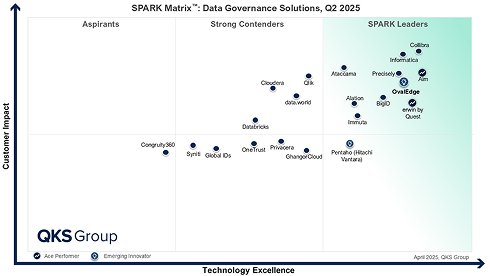
Recognized as a Leader in the SPARK Matrix 2025 by QKS Group, with strong scores in technology and customer impact
-
Backed by independent economic analysis from Forrester
-
Consistently high ratings across review platforms like G2 and Gartner.
Users commonly highlight:
-
Faster implementation
-
Strong lineage capabilities
-
Better usability compared to heavier platforms
-
Improved data accessibility across teams
What this means for your decision
When teams evaluate Microsoft Purview alternatives, the decision usually comes down to a few practical questions.
-
Can the platform run governance across systems
-
Can it reduce manual effort over time
-
Can business teams actually use it
-
Can it deliver value quickly
OvalEdge stands out in these areas.
Book a demo with OvalEdge to get a tailored walkthrough on how it fits your use cases and rollout priorities.
OvalEdge combines governance, lineage, quality, and automation into a system that teams can use daily.
Get a practical breakdown of how modern teams operationalize governance using agentic analytics. This whitepaper helps you compare platforms based on real implementation models.
Frequently asked questions
1. What are the best Microsoft Purview alternatives?
The best Microsoft Purview alternatives include OvalEdge, Collibra, Informatica, Alation, Atlan, data.world, BigID, and OneTrust. Each platform focuses on a different priority, such as governance execution, metadata management, or privacy compliance. The right choice depends on whether you need deeper governance workflows, better lineage, or broader ecosystem support.
2. Why do organizations look for Microsoft Purview alternatives?
Organizations often look beyond Purview when they need more flexibility outside the Microsoft ecosystem. Common reasons include limited cross-platform lineage, lack of governance workflows, and challenges with business user adoption. Many teams also need stronger data quality, automation, and faster time to value.
3. How does OvalEdge compare to Microsoft Purview?
OvalEdge offers deeper governance execution with built-in workflows, stronger cross-platform lineage, and integrated data quality capabilities. Purview is more suited for Azure-centric environments with basic cataloging and compliance needs. Teams evaluating both typically prioritize flexibility, usability, and operational governance depth.
4. Which Microsoft Purview alternative is best for multi-cloud environments?
Platforms like OvalEdge, Informatica, and BigID are commonly considered for multi-cloud environments. These tools support data across AWS, GCP, Azure, and on-prem systems. They provide broader connectivity and governance coverage compared to tools that are tightly coupled with a single ecosystem.
5. What should you look for in a Microsoft Purview alternative?
Key factors include ecosystem compatibility, lineage depth, governance workflows, and time to value. It is also important to evaluate how easily business users can adopt the platform. Tools that combine automation, usability, and cross-platform support tend to deliver better long-term outcomes.
6. Is Microsoft Purview enough for enterprise data governance?
Microsoft Purview can work for organizations that are fully invested in the Microsoft ecosystem and have basic governance needs. For enterprise-scale governance, teams often require deeper capabilities such as workflow-driven governance, advanced lineage, and integrated data quality. This is where alternative platforms like OvalEdge are typically evaluated.
Unify catalog, lineage, and governance in one platform
OvalEdge combines AI-driven cataloging, AskEdgi-powered self-service, automated lineage, data quality monitoring, and policy enforcement to turn governance into a continuous operating layer across your data ecosystem.
Choosing an Microsoft Purview alternative? Start here
- Need governance workflows or only data visibility?
- Single system or multi-platform environment?
- Analyst-only usage or cross-team adoption?
- Immediate time-to-value required?
- Flexible governance and policy configuration needed?
Implement data governance faster with a proven framework
Access a practical 5-step framework used across real deployments to scope, prioritize, and implement governance without over-engineering.
Learn how to identify high-impact use cases and apply AI and automation to reduce manual effort.
Proven by customer successes across industries
.png?width=151&height=151&name=Mask%20group%20(18).png)
How Delta Community Credit Union enhanced its data governance with OvalEdge
"We have seen dramatic results across the board by implementing these programs, centralizing our metadata with the OvalEdge data catalog, and enabling self-service data education."
Dr. Su Rayburn
Vice President, Information Management & Analytics

.png?width=151&height=151&name=Mask%20group%20(19).png)
Bedrock leverages OvalEdge to standardize definitions, improve data accuracy
"OvalEdge stands out for its holistic approach, providing everything from business glossary to data lineage, all seamlessly integrated. The auto-lineage feature saves us months of work, enabling us to quickly understand data flows and address issues at the source.”
Sergei Vandalov
Senior Manager, Data Governance & Analytics

.png?width=151&height=151&name=Mask%20group%20(20).png)
Gousto’s continued data governance journey to deliver exceptional customer experience
“Incorrect pricing, nutritional or allergen information can disrupt the customer experience. With quality data at every stage, Gousto aligns its customer promise with operational excellence.”
Cathy Pendleton
Senior Manager - Data Governance
OvalEdge Recognized as a Leader in Data Governance Solutions
.png?width=1081&height=173&name=Forrester%201%20(1).png)
“Reference customers have repeatedly mentioned the great customer service they receive along with the support for their custom requirements, facilitating time to value. OvalEdge fits well with organizations prioritizing business user empowerment within their data governance strategy.”
.png?width=1081&height=241&name=KC%20-%20Logo%201%20(1).png)
“Reference customers have repeatedly mentioned the great customer service they receive along with the support for their custom requirements, facilitating time to value. OvalEdge fits well with organizations prioritizing business user empowerment within their data governance strategy.”
Gartner, Magic Quadrant for Data and Analytics Governance Platforms, January 2025
Gartner does not endorse any vendor, product or service depicted in its research publications, and does not advise technology users to select only those vendors with the highest ratings or other designation. Gartner research publications consist of the opinions of Gartner’s research organization and should not be construed as statements of fact. Gartner disclaims all warranties, expressed or implied, with respect to this research, including any warranties of merchantability or fitness for a particular purpose.
GARTNER and MAGIC QUADRANT are registered trademarks of Gartner, Inc. and/or its affiliates in the U.S. and internationally and are used herein with permission. All rights reserved.