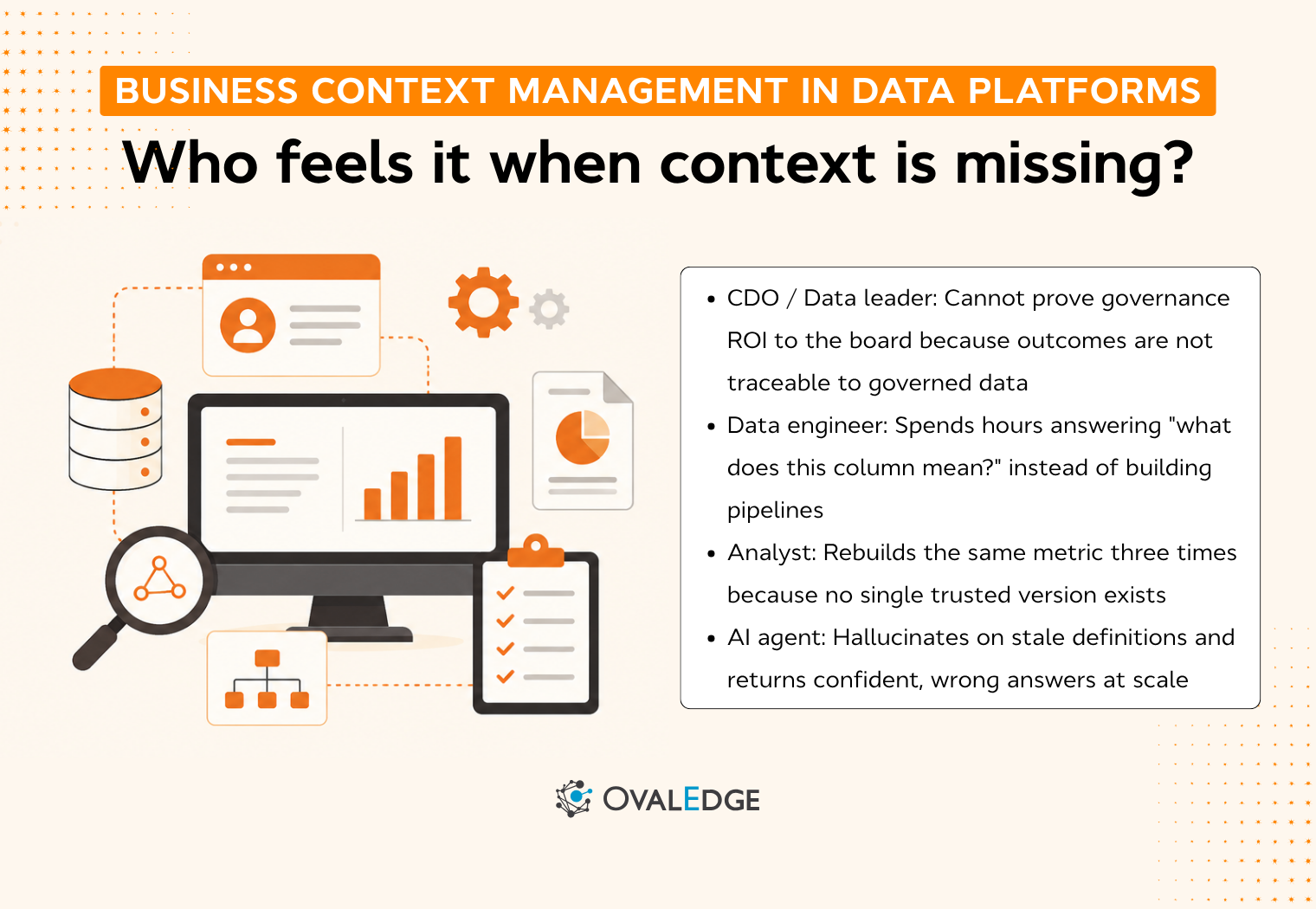
A familiar metric appears in three dashboards, and each one tells a different story. The numbers match. The definitions do not. One team measures revenue at booking, another at recognition, and a third at cash receipt. All three are technically valid, drawing from the same source tables, producing three different answers because the business context behind each number was never attached or propagated across systems.
This is the gap that business context management in data platforms exists to close. Modern platforms handle schemas, lineage, and transformations well. They struggle to carry business meaning, including definitions, ownership, metric logic, and domain relationships, consistently as data crosses system boundaries.
The consequences are predictable. Teams reconstruct meaning at every stage. Reports conflict. Governance policies exist on paper without connecting to how data is actually consumed; when AI agents enter the picture, the stakes compound, because agents that lack governed context produce answers that are confident and wrong.
According to the Forrester TEI study, organizations that embed context into governance workflows reduce the effort required to catalog metadata, fulfill data requests, and compile lineage by up to 40%. The return on getting this right is measurable.
This guide explains how business context is structured inside data platforms, why it breaks, how it is maintained across the lifecycle, and why it now matters for enterprise AI.
What is business context in data platforms?
Business context is the layer of meaning that connects raw data to its business purpose. It includes what a dataset represents, who owns it, how it should be interpreted, and why it matters within an organization's workflows and decisions. Data context is a related concept covering the broader background surrounding any dataset, including source, collection method, transformation history, and relationships to other assets.
In data governance, business context is the specific subset that makes metadata operationally useful by attaching definitions, classifications, quality assessments, and ownership records.
A practical example makes the distinction concrete. A column labeled "rev_amt" in a data warehouse carries technical metadata: its data type is numeric, it sits in the finance schema, and it updates nightly through an automated pipeline. The business context adds the meaning: this column represents recognized revenue under ASC 606 standards, it is owned by the finance team, it is certified for external reporting, and it should never be used interchangeably with bookings or billings data.
Without that layer, a downstream analyst or AI agent might treat all three revenue measures as equivalent, producing a report that looks correct and is not.
The difference between business context and technical metadata matters because platforms typically automate the technical layer while leaving the business layer incomplete.
|
Dimension |
Technical metadata |
Business context |
|
What it captures |
Schemas, data types, table structures, pipeline dependencies |
Definitions, ownership, metric logic, domain classifications, quality scores |
|
How it is generated |
Automated by platforms during ingestion, ETL, and lineage tracking |
Requires human input, enriched by AI agents, standardized through a business glossary |
|
Who uses it |
Data engineers, platform administrators |
Analysts, business users, governance teams, AI agents |
|
What happens when missing |
Pipelines break, queries fail (visible, immediate errors) |
Reports conflict, metrics diverge, AI hallucinations (silent, compounding failures) |
Pro tip: The most expensive context failures are the silent ones. A missing schema causes an error message. A missing business definition causes a wrong decision that nobody catches until the quarterly review.
Why does business context break in modern data platforms?
Business context breaks because meaning does not travel with the data. Systems capture schemas and lineage automatically. They do not propagate business definitions, metric ownership, or domain relationships across layers with the same automation.
This is a platform-level problem. Data leaders face mounting pressure to enable business and AI initiatives on data they cannot find, cannot trust, and cannot explain. The governance tools meant to solve this were often built on the same fragmented foundation, capturing metadata without connecting it to meaning.
The breakdown typically happens at four system-level points.
-
Context evaporates during transformation: Data changes shape as it moves from ingestion through processing to reporting. A metric defined in a transformation pipeline may not carry its definition forward into the dashboard. The downstream consumer sees a number without knowing its calculation logic, filter conditions, or business intent.
-
Technical metadata accumulates without business alignment: Platforms capture lineage and schema changes continuously. They rarely connect those changes to the business glossary. The result is multiple versions of the same metric in use across teams, each technically valid, each telling a different story.
-
Distributed stacks create competing interpretations: When warehouses, transformation tools, and multiple BI platforms operate together, each system becomes a partial source of truth. Teams rely on local context rather than a shared, system-level understanding. Tribal knowledge fills the gaps that platforms do not.
-
Context becomes stale when pipelines change: Schemas evolve. Transformation logic is updated. Downstream datasets and dashboards continue running on assumptions that no longer hold. Without automated propagation of changes through the metadata layer, context drift is inevitable, and it accelerates as pipelines grow more complex.
Did you know: A global consulting organization used a unified governance platform to consolidate metadata and business context across distributed systems, enabling consistent data discovery, standardized definitions, and faster analytics across teams.
Architecture of business context management in data platforms
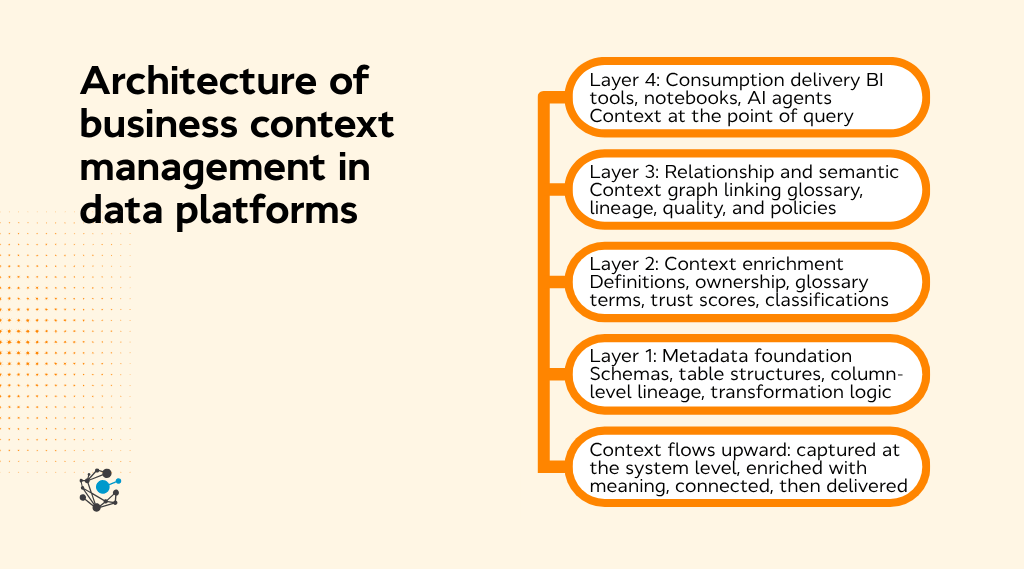
Business context in modern platforms is built through a structured architecture where context is generated at the system level, enriched with business meaning, connected through semantic relationships, and delivered into the tools where data is consumed.
Each layer serves a distinct function, and weaknesses in any single layer create gaps that propagate downstream.
This architecture operates across four layers, each building on the one below it.
Metadata foundation layer
The first layer captures technical metadata directly from pipelines and data platforms: schemas, table structures, column-level lineage, and transformation logic generated automatically from warehouses and processing systems.
Lineage is the backbone of this layer. It allows teams to trace how a KPI in a dashboard derives from multiple upstream transformations, which is critical for debugging, impact analysis, and validation. The precision of lineage depends on how it is derived. Log-based inference captures only what executes and misses dormant or conditional code paths.
Source code parsing reads SQL, ETL configurations, BI report definitions, and notebook code directly, producing exact column-level lineage that reflects true logic regardless of execution history. At scale, lineage gaps in this layer compound into context gaps everywhere downstream.
Context enrichment layer
At this stage, technical assets are mapped to business meaning. Datasets gain descriptions, ownership records, domain classifications, quality scores, and standardized definitions drawn from a governed business glossary.
This layer bridges the gap between engineering teams that build pipelines and business teams that consume outputs. A column labeled "rev_amt" becomes interpretable only when it carries a clear definition, an assigned owner, and a certification status signaling whether it is safe for external use.
Without enrichment, the catalog is just an inventory. With it, the catalog becomes a decision-ready system.
Historically, enrichment has been the bottleneck. AI-powered curation agents now analyze enterprise data to detect inconsistencies, recommend glossary terms, identify duplicates and conflicting terminology, and assign trust scores to datasets so both humans and AI agents know what is reliable. This automation addresses the scale problem directly.
The Forrester TEI study found that this approach reduces effort required to catalog metadata, fulfill data requests, and compile lineage by up to 40%.
Relationship and semantic layer
This layer connects datasets, metrics, and dependencies into a structured graph of semantic relationships. Instead of tracking individual assets in isolation, a connected enterprise context graph links glossary terms, lineage, catalog entries, quality signals, and governance policies into a continuously evolving knowledge structure. Every query, every dashboard, and every AI agent can operate from the same trusted context.
The industry is converging on this model. Several major cloud data platforms have introduced governed business metrics within their native catalogs, making certified definitions available across notebooks, dashboards, and SQL. Semantic consistency is becoming a core architectural requirement.
Platforms that cannot maintain a unified semantic graph face increasing structural disadvantages as organizations demand consistent meaning across distributed data stacks.
Consumption layer
The final layer delivers context into the tools where data is actually used: BI platforms, notebooks, and AI/ML systems. This is where context becomes actionable.
A natural-language interface enables cross-system data queries and predictive analytics, with answers tracing back to governed, certified sources. Browser extensions surface trusted definitions, certifications, and lineage directly inside Power BI and Tableau. For AI systems, open context APIs and MCP integration expose governed enterprise context to Claude, ChatGPT, and custom agents at query time, so agents do not have to infer meaning from table names alone.
How is business context maintained across the data lifecycle?
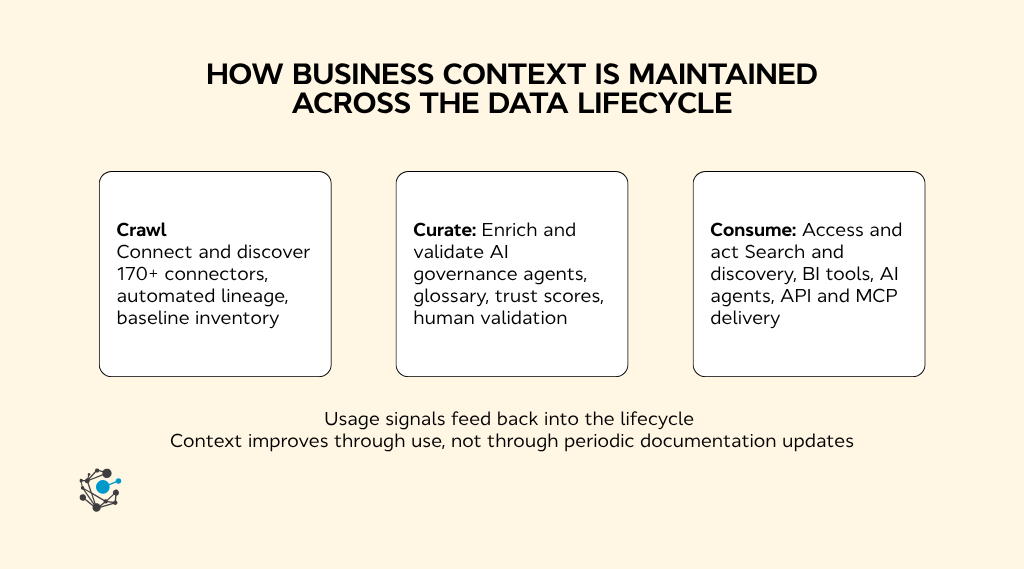
Business context is not a one-time setup. It functions as a continuous flow where context is captured, enriched, validated, and kept current as data moves across platforms. Organizations that treat context as a documentation project end up with glossaries that go stale within months.
A practical model for this lifecycle follows three stages.
Crawl: Connect and discover
The lifecycle starts with connection. Data sources, reports, code repositories, and metadata from across the stack are connected through pre-built native connectors covering modern cloud-native platforms and legacy systems. AI automatically builds lineage, discovers relationships, and creates a baseline inventory.
The discipline at this stage is breadth. Every asset that enters the ecosystem should carry baseline metadata (source, schema, freshness, and owner) from the moment of ingestion. Standardizing naming, tagging, and classification at the source prevents inconsistencies from compounding downstream.
Curate: Enrich and validate
Curation transforms raw metadata into business context. AI governance agents perform the heavy lifting: analyzing data profiles, detecting inconsistencies, recommending glossary terms, identifying duplicate entities, and building a standardized vocabulary. Human stewards validate the results, answer business questions the agents surface, and approve certifications.
This stage is where most organizations have historically bottlenecked. Manual curation cannot keep pace with the volume of modern data ecosystems. Automated agents change the economics by handling discovery, tagging, classification, and task routing, while stewards focus on the judgment calls that require domain expertise. The Forrester TEI study found that this approach reduced effort required to find, tag, and secure sensitive data by up to 75%.
Consume: Access and act
The final stage is where context reaches the people and systems that use data. Analysts find trusted datasets through search and discovery. Business users access governed definitions inside their BI tools. AI agents pull certified context through API and MCP integrations.
Usage signals from this stage feed back into the lifecycle. Query patterns, access frequency, and dashboard usage continuously refine which datasets are relevant, which are trusted, and which need attention. This creates an active metadata loop where context improves through use rather than decaying through neglect.
Did you know: A leading credit union connected metadata, lineage, and business context through a unified governance platform, improving data consistency and enabling more reliable decision-making across departments.
Why does business context matter for enterprise AI?
AI agents are now data consumers. They query datasets, generate insights, make recommendations, and trigger workflows. Unlike human analysts who carry institutional knowledge and can navigate ambiguity, AI agents take data at face value. When context is incomplete, agents do not ask clarifying questions. They produce answers that are confident, specific, and wrong.
This makes business context a prerequisite for any enterprise AI initiative moving past proof of concept. Agents need the same context humans have always needed, just delivered programmatically. A human analyst knows to verify a revenue figure with the finance team before presenting it to the board. An AI agent lacks that awareness unless it is encoded as governed context, with definitions in the glossary, ownership in the catalog, trust scores on each dataset, and access policies enforced at the API layer.
Three requirements emerge when context must serve AI consumers alongside human ones.
-
Context must be machine-readable: Definitions stored in PDFs and wikis cannot be consumed by agents at query time. The business glossary must function as an AI-ready meaning system supporting taxonomy, ontology, semantic mappings, and business meaning rules, moving beyond human-readable text into structured, queryable formats that agents can interpret programmatically.
-
Context must be continuously validated: Stale context is worse than no context, because agents use it with full confidence. Active metadata pipelines that capture schema changes, lineage updates, and usage signals keep context aligned with the current state of data rather than last quarter's documentation.
-
Context must be governed at the point of delivery: When an AI agent retrieves data, it should receive the business context alongside the result: what the metric means, where it came from, whether it is certified, and what policies apply. Model Context Protocol (MCP) integration enables this by exposing governed enterprise context to AI models and agents at runtime. This intersection of context engineering and data governance is where enterprise AI becomes reliable and auditable.
The shift is significant. Data governance was historically consumed by humans: analysts, stewards, and compliance teams. Enterprise AI changes the consumer of governance, not the need for it. Governance must now be readable, accessible, and enforceable for both people and machines operating from the same trusted foundation.
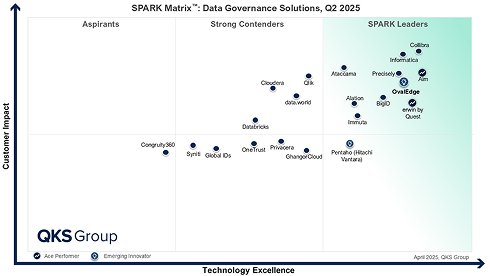
Unified governance platforms like OvalEdge address this by operationalizing context across catalog, lineage, glossary, quality, access, and policy as a single operating layer, recognized in the 2025 Gartner Magic Quadrant for Data and Analytics Governance and as a SPARK Matrix 2026 Leader for Data Governance Platforms.
Pro tip: Start with the data assets AI agents will consume first. Certify those datasets, attach definitions, assign ownership, and expose them through governed APIs before scaling to the broader catalog. Context that serves AI also serves every other consumer.
Conclusion
Business context can no longer sit in static documentation or spreadsheet-based glossaries. In modern data environments where data flows continuously across pipelines, platforms, and AI systems, context must be embedded into the platform architecture, updated through metadata signals, and delivered to every consumer.
The organizations seeing results treat context as infrastructure. They connect metadata across systems for clarity, enrich it with business meaning for context, enforce policies and access controls for control, and embed governed definitions into tools and AI workflows for adoption. This transforms governance from a compliance exercise into an operating layer that delivers measurable outcomes.
OvalEdge brings this into practice as a unified data governance platform, connecting catalog, lineage, glossary, quality, access, and policy into one operating layer for people and AI agents alike.
To see how governed business context works across pipelines, analytics, and AI workflows, book a demo and explore how to operationalize context management at scale.
.png?width=1081&height=173&name=Forrester%201%20(1).png)
.png?width=1081&height=241&name=KC%20-%20Logo%201%20(1).png)