%20(1).png)
Your AI runs on data. All of it. Every response, every decision, every insight your customers see comes from somewhere in your systems.
The problem is visibility.
IBM’s AI at the Core 2025 research shows that 74% of organizations have only limited or moderate coverage of their AI risks in governance frameworks.
They don't actually know what data their models are touching. They can't audit where answers come from. They can't promise customers that sensitive information stays locked down.
Unstructured data makes this worse. Emails, documents, and files are scattered across cloud drives and collaboration tools. Your AI pulls from this pile without knowing what's in it. Old information surfaces as current. Sensitive data leaks into responses. Quality tanks because nobody classified the content.
Organizations moving fast on AI are doing something different. They're mapping their unstructured data before it goes near a model. They know what's sensitive. They know what's outdated. They can trace every decision back to a source. When compliance asks questions, they have answers.
In this blog, we're looking at why unstructured data governance matters now, what makes it different from traditional governance, and how to actually build a framework that keeps your AI reliable and your data secure.
What is unstructured data governance?
Unstructured data governance is the practice of discovering, classifying, securing, monitoring, and managing non-tabular data such as documents, emails, PDFs, images, videos, and chat transcripts. It ensures this content is visible, controlled, and usable for compliance, access management, analytics, and AI systems.
At a practical level, it answers critical questions: What data exists? Where is it stored? Who owns it? Who can access it? And how long should it be retained?
How unstructured data governance differs from structured data governance
Structured data governance deals with systems that are inherently organized. Tables, schemas, and defined fields make it easier to inventory, classify, and control data.
Unstructured data doesn’t offer that advantage.
Files require content-aware discovery to understand what’s inside them. Classification cannot rely on column names; it depends on interpreting language, context, and intent. Metadata often needs to be created or enriched after the fact. And policies such as access control or retention must be mapped to content types, not just system locations.
This is why traditional governance approaches, built around databases and warehouses, struggle to scale when applied to unstructured environments.
Why governance matters more than storage
Storage answers a basic question: where does data live?
Governance answers everything else that actually matters.
A file can be perfectly stored in a cloud drive, but still be undiscoverable, misclassified, overexposed, or retained far longer than necessary. Without governance, storage simply becomes accumulation.
Governance ensures that unstructured data is:
-
discoverable when needed
-
trusted and context-rich
-
secured based on sensitivity
-
retained or deleted according to policy
-
usable for analytics and AI
|
Did you know? The NIST 2026 draft on data classification practices focuses heavily on how organizations can discover, identify, and label sensitive unstructured data, highlighting how central this problem has become for modern enterprises. |
Why unstructured data governance matters now
The urgency around unstructured data governance isn't theoretical. It's driven by three forces: rapid AI adoption, expanding compliance exposure, and operational inefficiency. According to a 2023 Gartner Press Release, 80% of enterprises will have used generative AI APIs or deployed GenAI-enabled applications by 2026, making this an operational reality now.
AI initiatives now depend on governed documents, emails, and knowledge assets
AI systems rely on context from unstructured sources like documents, emails, and knowledge bases. Retrieval-Augmented Generation (RAG), copilots, and AI agents all depend on pulling relevant content in real time.
When data is ungoverned, AI surfaces outdated policies, conflicting versions, or sensitive information. This creates inaccurate outputs, compliance risks, and erodes trust. Governance tools shift from control function to enablement layer—making unstructured data usable for data science teams.
Compliance obligations extend beyond structured systems
Sensitive data rarely stays confined to databases. PII, financial data, and regulated content live inside contracts, emails, and attachments, assets that are hardest to track. Traditional compliance programs weren't designed for distributed unstructured environments.
Without governance extending to data masking, data privacy controls, and cloud access governance, organizations operate with incomplete compliance coverage.
Unstructured sprawl creates both risk and waste
Files are duplicated across systems with little oversight. Organizations accumulate vast redundant, obsolete, and trivial (ROT) data with unclear ownership. This simultaneously increases risk as sensitive data sits in unknown locations, and costs rise with storage and backup expenses.
Governance is reduced by identifying what exists, who owns it, and what should be retained. Solutions like data discovery tools and data governance committees provide critical visibility.
Governance is becoming the foundation for trustworthy AI
AI output quality is directly tied to data quality and governance. Governed data improves retrieval accuracy, consistency, compliance enforcement, and trust in AI decisions. The strongest governance programs frame this not as risk-only, but as the foundation making AI reliable, usable, and safe at scale.
|
Pro tip: The strongest governance programs don’t position themselves as risk-only initiatives. They frame governance as the foundation that makes AI reliable, usable, and safe at scale. |
Key challenges in governing unstructured data
Unstructured data is difficult to govern because it works against traditional governance models. It's fragmented across systems, lacks consistent context, and hides meaning inside content rather than exposing it through structure. Unlike databases, where schemas are scannable, unstructured data requires interpretation before governance can begin.
This is where most programs break down.
1. Lack of visibility across repositories
Unstructured data spreads across SharePoint, OneDrive, Google Drive, email, file servers, S3, Azure Blob, Slack, and Teams. Each operates independently with its own access model.
This fragmentation creates blind spots. Governance teams cannot control what they cannot see. Most organizations lack a unified inventory of their unstructured data.
|
Key Challenge: "Dark data" sits unmanaged and unmonitored, creating silent risk. Data discovery tools are critical for establishing baseline visibility across repositories. |
Enterprise insight: According to IBM's Cost of a Data Breach Report 2024, 40% of breaches involved data stored across multiple environments, such as public cloud, private cloud, and on-premise, costing over $5 million on average and taking 283 days to identify and contain. Fragmentation isn't just an operational inconvenience. It directly extends how long a breach goes undetected.
2. Limited metadata and weak business context
Files come with minimal metadata: name, timestamp, and location. This doesn't reveal whether a document contains sensitive financial information, a draft, or a binding contract.
Without enriched metadata, governance cannot differentiate between low-risk and high-risk content. Manual tagging doesn't scale across millions of files; this is where efforts typically stall.
Enterprise insight: Gartner found that by the end of 2024, at least 50% of GenAI projects were abandoned after proof of concept, with poor data quality cited as one of the top reasons. Without enriched metadata that tells governance teams what they actually have, organizations are feeding unclassified, ungoverned content into AI pipelines, and then wondering why outputs can't be trusted
3. Sensitive content is hidden inside files
Structured systems make sensitive data easier to detect. Unstructured data hides PII, PHI, financial data, and intellectual property deep within documents and emails.
At the system level, these files appear no different from any other document. Sensitive data can exist where governance policies aren't applied simply because it hasn't been detected.
|
Did you know? 35% of data breaches involve unstructured data stored in unmanaged sources (IBM Cost of a Data Breach, 2025). Data masking tools and data privacy controls reduce this exposure. |
4. Permissions are inconsistent and difficult to audit
Access control is messy. Permissions are inherited, overridden, shared via public links, or granted temporarily and never revoked. Auditing across multiple systems becomes complex, especially for compliance alignment.
Enterprise insight: According to the Cloud Security Alliance's State of SaaS Security Report 2025 (420 IT and security professionals surveyed), 63% of organizations report external data oversharing, 58% struggle to enforce access privileges consistently, and 54% lack any automation for lifecycle management, meaning access granted is rarely revoked. Meanwhile, 55% of employees are adopting SaaS tools without security's involvement at all, making governance reactive by default. Permission sprawl isn't a configuration problem. It's a governance gap that compounds every time a new tool is deployed.
5. Lineage is harder to establish
Documents get created, edited, downloaded, emailed, copied, and uploaded elsewhere. Each step introduces changes but rarely leaves a complete trace. Without lineage, organizations struggle to answer: Where did this originate? How was it modified? Where is it being used?
Similarly, retention policies are defined but rarely enforced. Outdated content accumulates, increasing storage costs and breach risk.
Enterprise insight: According to Accenture, 55% of organizations cannot always trace data from source to point of consumption. Without lineage, regulated industries face a compounding risk: auditors ask where a document originated, and the honest answer is "we don't know."
|
Pro tip: Treat each of these challenges as a distinct problem to solve. Discovery, classification, permissions, and lifecycle management require different capabilities, and combining them into a single “data problem” is exactly what causes governance programs to stall. |
The 6 pillars of an unstructured data governance framework
Unstructured data governance is a system of capabilities that work together across the data lifecycle. When designed correctly, it becomes the minimum viable architecture for making unstructured data usable, secure, and AI-ready.
The key is to treat governance as an operating model, not just a set of controls.
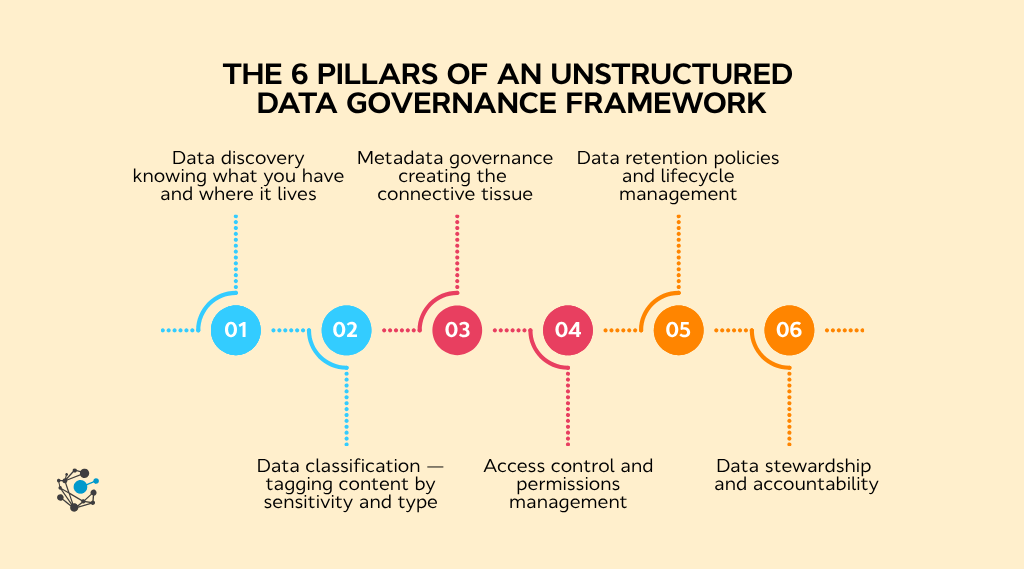
Pillar 1: Data discovery — knowing what you have and where it lives
Everything starts with visibility. Discovery focuses on files and documents spread across cloud storage, collaboration platforms, and file shares. It includes automated scanning, indexing, file-type detection, and identifying duplicate or "dark" data.
The business value is immediate. Data discovery tools create a centralized inventory and highlight high-risk clusters. In real deployments, organizations often uncover terabytes of unknown sensitive data during their first scan.
|
Pro tip: Start discovery with high-risk domains like legal, HR, and finance instead of attempting full enterprise scans upfront. |
Pillar 2: Data classification — tagging content by sensitivity and type
Once data is visible, it needs meaning. Classification assigns tags based on sensitivity (PII, PHI, confidential data), content type (contracts, invoices), or regulatory categories (GDPR, HIPAA).
This uses a combination of AI and NLP-based classification, rule-based pattern matching, and hybrid models. Classification enables risk-based governance by determining how data should be accessed, retained, and used in AI systems.
Pillar 3: Metadata governance — creating the connective tissue
Metadata turns unstructured content into something governable. For unstructured data, this includes:
Technical metadata: file type, size, location
Business metadata: ownership, domain, purpose
Operational metadata: access frequency, modification history
Metadata enrichment using NLP extracts entities like names and financial terms from within documents, creating context. That context enables search, policy enforcement, and gives AI systems the structured understanding they need for reliable outputs.
|
Key Insight: Without metadata, files remain isolated. With metadata, they become part of a governed ecosystem. |
Pillar 4: Access control and permissions management
One of the fastest ways to reduce risk is by fixing access. Many organizations deal with over-permissioned files, broken inheritance, and little visibility into actual access patterns.
Effective governance requires auditing permissions across systems, implementing role-based (RBAC) or attribute-based (ABAC) access models, and aligning policies with data sensitivity. Data access governance tools enforce least-privilege principles.
Pillar 5: Data retention policies and lifecycle management
Governance extends through the entire data lifecycle: creation, active use, archival, and deletion. Without governance, data often stays "active" indefinitely.
Lifecycle management introduces policy-driven retention rules, automated archival and deletion, and legal hold mechanisms. The impact is both operational and financial, reducing storage costs while ensuring compliance.
Pillar 6: Data stewardship and accountability
Technology alone doesn't make governance work. Ownership does. Governance requires clearly defined roles, data owners, and stewards at the domain level responsible for data quality, access approvals, and policy enforcement.
Governance workflows embed access approvals and issue resolution into daily operations. This creates alignment across IT, legal, compliance, and business teams.
|
Did you know?
NIST’s AI Risk Management Framework emphasizes trustworthiness across the AI lifecycle, built on governing, mapping, measuring, and managing risk. Unstructured data governance directly supports this by ensuring AI systems operate on controlled, reliable data. |
Together, these six pillars form the foundation of a governance model that handles scale, complexity, and risk of unstructured data while enabling its use in analytics and AI.
How unstructured data governance works across the lifecycle
Understanding the pillars is one thing. Seeing how they actually work together in practice is where governance becomes real. Without a structured flow, governance quickly becomes reactive and manual. With a lifecycle approach, it becomes automated, repeatable, and measurable.
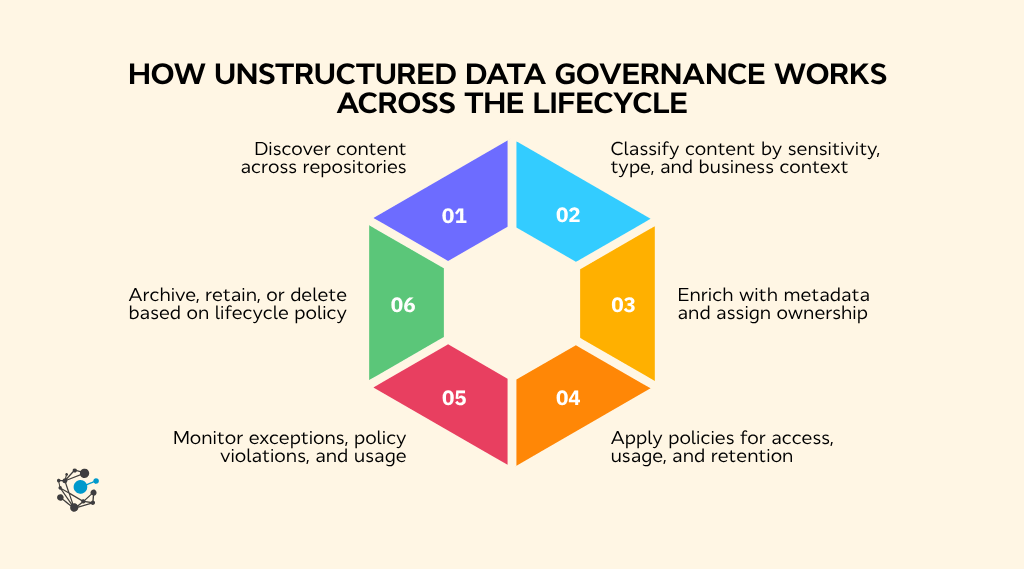
Step 1: Discover content across repositories
The process begins with connecting to all relevant data sources and building a unified inventory of unstructured content.
This includes scanning cloud storage systems, collaboration tools, email platforms, and legacy file shares. Data discovery tools use connectors and automated indexing to identify what data exists, where it lives, and basic attributes such as file type, size, and activity. Many organizations also leverage a data catalog to centralize this inventory.
At this stage, the goal is visibility. Without it, no downstream governance action is possible.
Step 2: Classify content by sensitivity, type, and business context
Once data is discovered, the next step is understanding what it contains.
Classification engines analyze file content using a combination of AI models and rule-based logic. They identify patterns, entities, and contextual signals to categorize data into types such as contracts, invoices, HR records, product documentation, or customer communications. At the same time, sensitive data like PII, financial details, or regulated information is detected and labeled appropriately.
Tools like data masking solutions and data privacy tools help identify and protect sensitive content during this stage.
This step is what transforms raw files into categorized assets that governance policies can act on.
Step 3: Enrich with metadata and assign ownership
After classification, data needs context. Metadata enrichment adds business meaning by assigning ownership, mapping content to domains, linking it to business glossary terms, and capturing operational attributes such as usage patterns or modification history.
Understanding the types of metadata ensures that classification and context are accurate. This is also where stewardship comes into play. Data governance committees and designated data owners are assigned responsibility for specific datasets or domains, ensuring accountability for governance decisions.
The result is that files are no longer isolated objects. They become part of a connected, understandable data ecosystem.
Step 4: Apply policies for access, usage, and retention
With classification and metadata in place, governance policies can now be enforced.
Data access governance tools apply access controls based on sensitivity and business role. For example, HR documents may be restricted to specific teams, while general knowledge-base content may remain broadly accessible. Cloud access governance tools extend this control across distributed environments.
Usage policies define how data can be shared or consumed, especially in AI and analytics workflows. Retention policies determine how long data should be kept and when it should be archived or deleted.
This is where governance shifts from insight to control.
Step 5: Monitor exceptions, policy violations, and usage
Governance is not a one-time setup. It requires continuous monitoring.
Systems track access patterns, detect anomalies, and flag policy violations such as unauthorized access attempts, oversharing, or unusual data movement. Data quality tools help maintain accuracy and flag inconsistencies. Alerts and dashboards help governance teams respond quickly to potential risks.
Monitoring also provides insights into how data is actually being used. This helps refine policies, improve classification accuracy, and identify areas where governance needs to be strengthened.
Step 6: Archive, retain, or delete based on lifecycle policy
The final step closes the loop.
Based on retention rules and data classification, content is either archived for long-term storage, retained for compliance purposes, or permanently deleted when it is no longer needed.
This step is critical for reducing both risk and cost. Retaining unnecessary data increases exposure in the event of a breach and adds to storage overhead. Lifecycle enforcement ensures that data does not accumulate indefinitely without purpose.
When implemented correctly, this lifecycle turns governance from a static policy exercise into an operational system. It ensures that unstructured data is not only controlled but also continuously aligned with business needs, compliance requirements, and AI use cases.
Designing an enterprise unstructured data governance framework
Most enterprises don't need a separate program for unstructured data. They need to extend their existing governance model to cover new data types, repositories, and use cases, especially AI.
The shift is architectural. Unstructured data governance connects data governance, privacy, security, and AI governance into a single operating model. This is critical as regulations like the EU AI Act emphasize that data in high-risk AI systems must be well-managed and governed for quality and bias.
1. Start with business-critical domains
Trying to govern everything at once is where initiatives stall. Start with domains where both value and risk are high: legal, HR, healthcare, financial data, customer records, and product content. These areas contain sensitive information, are frequently accessed, and directly impact compliance.
This approach demonstrates quick wins, reduces immediate risk, and builds a repeatable model.
2. Define ownership and stewardship clearly
Governance fails without accountability. Unstructured data spans multiple systems, making ownership ambiguous. A strong framework defines data owners at the domain level, stewards responsible for classification and metadata, and approval workflows for access.
80% of data and analytics governance initiatives will fail by 2027 without clear accountability and crisis momentum, as per Gartner's 2024 press release.
Data governance committees establish this ownership structure and reduce cross-domain friction.
3. Create a policy model for unstructured content
Policies for unstructured data need to go beyond general guidelines.
They should define:
-
Classification tiers (confidential, restricted, public, etc.)
-
Data handling rules (who can access, share, or modify content)
-
Retention schedules based on content type and regulation
-
Legal hold triggers for compliance scenarios
-
AI usage boundaries, including what data can or cannot be used in models
The goal is to translate governance from static documentation into actionable, enforceable rules.
4. Align with existing governance, privacy, and security programs
Unstructured data governance is strongest when integrated, not isolated. Connect it with data catalogs, privacy programs (GDPR, CCPA, DPDP), security frameworks, and records management.
Enterprise data governance platforms provide this unified approach, ensuring consistency across structured and unstructured data while avoiding duplicate efforts.
5. Build AI governance into the framework from day one
Unstructured data is a primary input for AI systems such as copilots, RAG pipelines, and autonomous agents. Without governance, these systems operate on incomplete or risky data, leading to hallucinations, compliance violations, and unreliable outputs.
This is no longer theoretical. According to McKinsey’s 2025 State of AI survey, 78% of organizations now use AI in at least one business function, making governance a foundational requirement, not an afterthought.
Embedding AI governance means controlling what data AI accesses, ensuring classification before ingestion, tracking lineage, and enforcing policies on outputs. Governance becomes the foundation that makes AI safe and reliable.
|
90-day quick-start template for data governance teams A phased rollout keeps things practical and focused. Days 0–30: Foundation Audit key systems, identify high-risk data domains, and define initial classification tiers to establish visibility and a baseline. Days 30–60: Implementation Deploy discovery and classification across priority domains, assign stewards, and enrich metadata to connect data with business context. Days 60–90: Enforcement Apply access controls, enforce retention policies, and launch monitoring dashboards to drive measurable outcomes. By 90 days, teams should have: A working data inventory, a defined classification framework, clear ownership, and initial policy enforcement in place. |
Unstructured data governance tools: what to look for and leading platforms
Unstructured data governance requires more than a single capability. It spans discovery, classification, metadata management, access control, and lifecycle enforcement across multiple systems. Most platforms specialize in a subset of these areas, which is why evaluating tools based on core capabilities, not just features, is critical.
|
5 capabilities to evaluate in any unstructured data governance tool The strongest evaluation approach starts with capabilities, not vendors. 1. Data discovery and coverage 2. Classification and sensitive data detection 3. Metadata and catalog integration 4. Access control and policy enforcement 5. Lifecycle and retention management |
1. OvalEdge: data catalog and governance for unstructured assets
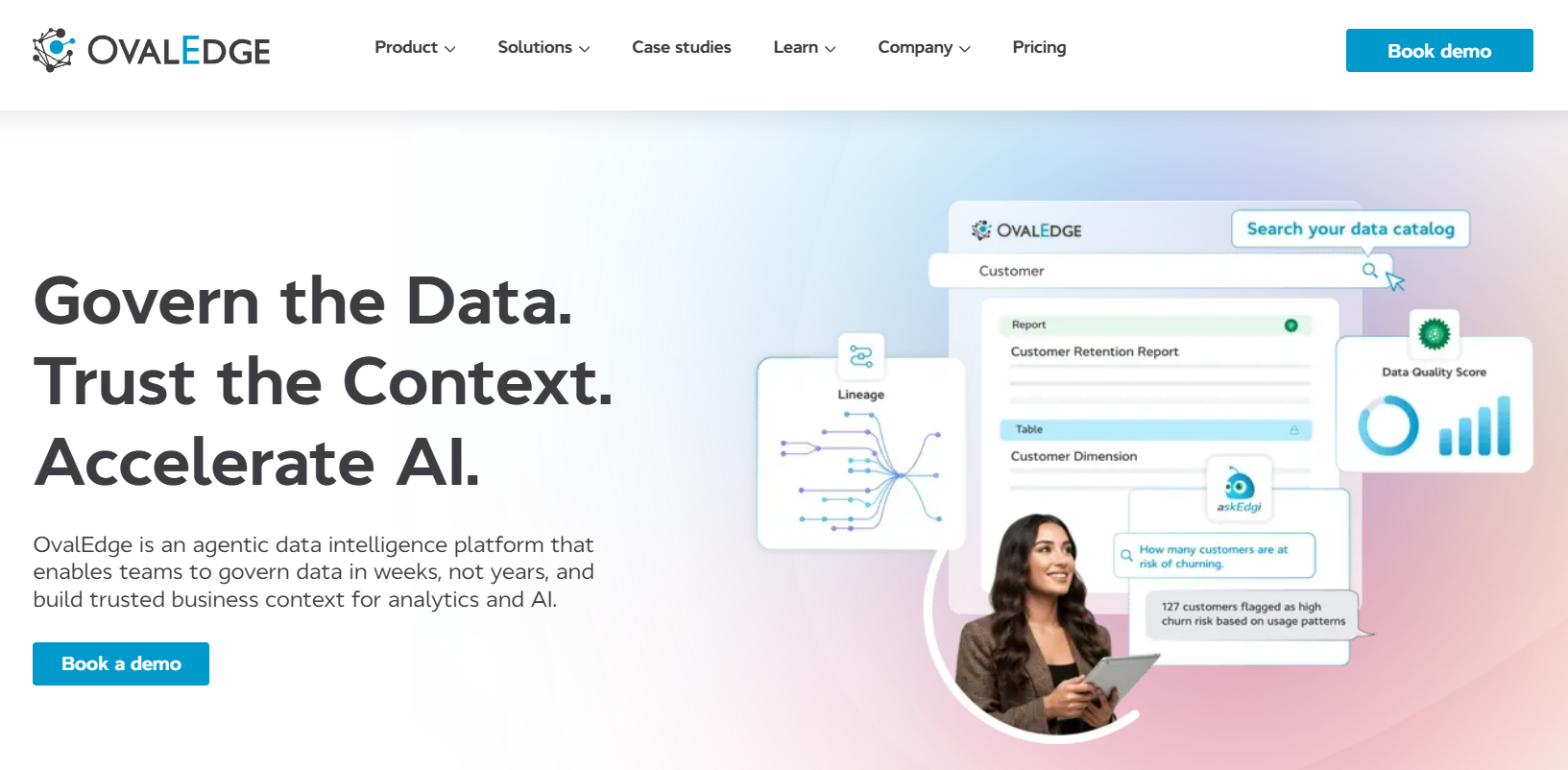
OvalEdge focuses on unified data governance and cataloging, extending governance into unstructured environments through metadata, lineage, and policy workflows.
Its approach is centered on creating a governed context layer across all data types. This becomes especially important for AI use cases, where models depend on accurate metadata, lineage, and business definitions to generate reliable outputs.
Key features include:
-
Automated metadata extraction and cataloging for unstructured assets
-
End-to-end lineage across systems for visibility and impact analysis
-
Policy-driven governance workflows that enforce access and compliance
-
Unified integration across structured and unstructured environments
-
AI-driven automation to reduce manual stewardship and scale governance
This approach aligns with how modern governance is evolving. Instead of one-time documentation, OvalEdge enables continuous, operational governance that supports both compliance and AI readiness.
Best fit: Organizations building a centralized governance layer and prioritizing metadata-driven governance, stewardship, and AI readiness.
Pricing: Pricing is typically customized based on data volume, connectors, and deployment scope. Most enterprises evaluate it through tailored demos or proofs-of-concept rather than fixed plans.
If you’re looking to operationalize unstructured data governance and make your data AI-ready, it’s worth exploring how OvalEdge fits into your stack. Book a demo to see how it works in your environment.
2. Komprise
Komprise is focused on unstructured data management, particularly around storage optimization and lifecycle control.
Its strength lies in helping organizations understand how their data is growing, where it is stored, and how it can be moved or tiered more efficiently across storage environments.
Key capabilities include:
-
Discovery across distributed storage systems
-
Policy-based data movement and tiering
-
Storage cost optimization at scale
-
Analytics on data usage and growth trends
Komprise is often used in environments dealing with large volumes of file-based data where storage efficiency and lifecycle automation are top priorities.
Best fit: Enterprises managing massive unstructured data volumes and looking to optimize storage cost and lifecycle management.
3. Microsoft Purview

Microsoft Purview provides governance, classification, and compliance capabilities, particularly strong within the Microsoft ecosystem.
It is widely used for enforcing data protection policies across Microsoft 365, Azure, and related services.
Key capabilities include:
-
Built-in sensitive data classification for PII and compliance labels
-
Deep integration with Microsoft tools such as Office 365 and Azure
-
Data loss prevention (DLP) and compliance policy enforcement
-
Unified governance across Microsoft services
Purview is especially effective for organizations that are already heavily invested in Microsoft infrastructure and need strong compliance controls within that ecosystem.
Best fit: Enterprises prioritizing compliance and operating primarily within Microsoft environments.
Conclusion
Looking ahead, governance is shifting from a compliance-driven exercise to an AI-enabled layer.
Organizations that move early are already seeing the difference. Instead of struggling with data trust, they are building systems where AI outputs are grounded in governed, reliable context. Instead of reacting to audits, they are operating in a state of continuous compliance. And instead of treating governance as overhead, they are using it to accelerate data usage across the business.
If you’re getting started, don’t try to solve everything at once. Begin with a high-impact domain like HR, legal, or finance. Assess your current maturity across the six pillars. Then build outward with a framework that supports both compliance and AI.
Because at this point, unstructured data governance is not just about control. It’s about making your data usable, trustworthy, and ready for what comes next.
This is where OvalEdge comes into play. By combining metadata, lineage, policy enforcement, and AI-driven automation, they help organizations move from fragmented governance efforts to a unified, scalable model that works across both structured and unstructured data.
Want to see how this works in practice? Book a demo and explore how you can operationalize unstructured data governance for AI.
FAQs
1. How long does it take to implement unstructured data governance?
Timelines vary based on scale, but most organizations can establish a working foundation within 60–90 days by focusing on high-priority domains first. Full enterprise-wide governance is typically iterative, expanding across systems and use cases over time rather than being deployed all at once.
2. How do you govern sensitive data in unstructured files?
Governing sensitive data starts with AI-driven classification to detect PII, financial data, or regulated content inside files. From there, organizations apply metadata tagging, enforce access controls, and implement retention and compliance policies across systems. Automation is critical, since manual identification and control do not scale across large volumes of unstructured data.
3. What is an unstructured data governance framework?
An unstructured data governance framework is a set of capabilities that includes data discovery, classification, metadata management, access control, and lifecycle policies. It ensures that unstructured data is visible, secure, compliant, and usable across the enterprise, especially for analytics and AI use cases.
4. How does unstructured data governance support AI initiatives?
AI systems depend on clean, well-labeled, and context-rich data. Governance ensures that unstructured data is properly classified, enriched with metadata, and controlled through policies. This improves retrieval quality, reduces hallucinations, and ensures compliance when AI systems access enterprise data.
5. What industries need unstructured data governance the most?
Industries with high regulatory exposure and content-heavy workflows benefit the most, including:
-
Healthcare, where patient records and clinical notes must be protected
-
Financial services, with contracts, transactions, and compliance requirements
-
Legal, where case files and documentation carry high sensitivity
-
Government and public sector, where regulated records and citizen data must be managed
These sectors rely heavily on unstructured data and face strict compliance obligations.
6. What are the biggest challenges in governing unstructured data?
The most common challenges include:
-
Lack of visibility across distributed systems
-
Limited metadata and business context
-
Sensitive data hidden inside files
-
Inconsistent permissions and access controls
-
Poorly enforced retention policies
These challenges are why unstructured data governance requires a dedicated framework rather than an extension of traditional structured data governance.
.png?width=1081&height=173&name=Forrester%201%20(1).png)
.png?width=1081&height=241&name=KC%20-%20Logo%201%20(1).png)