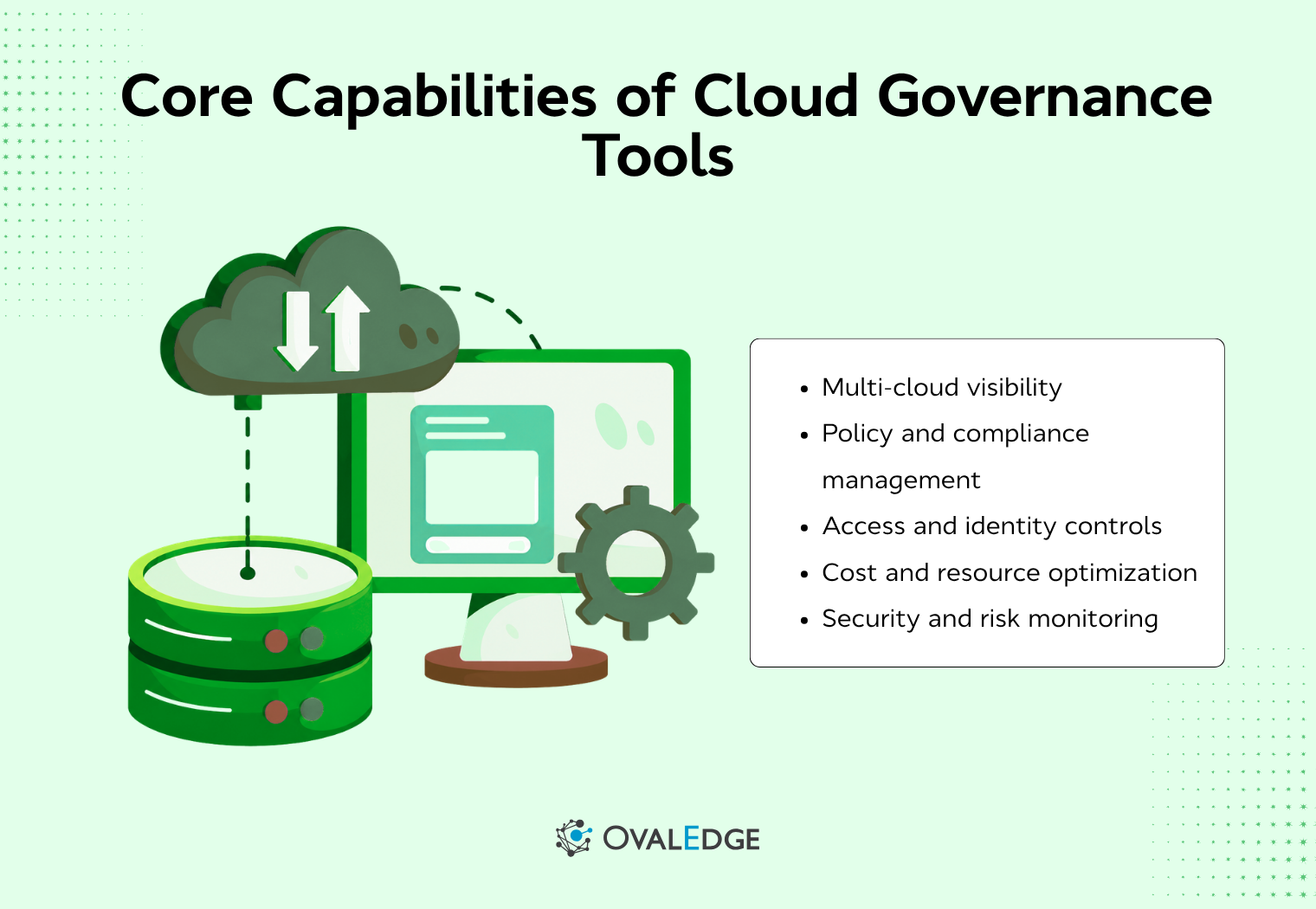
Modern cloud environments rarely stay simple for long. Accounts multiply, regions multiply, teams multiply, and control slips faster than manual oversight can catch it. Tags go missing, budgets creep, and policies drift without anyone noticing until an audit or a surprise invoice makes the gap visible.
Cloud governance tools bring that sprawl back in line by automating access, cost, and compliance rules across AWS, Azure, and GCP.
This guide compares 10 tools for 2026, from AWS Control Tower and Azure Policy to Flexera One, Turbot Guardrails, CloudBolt, and Tenable Cloud Security, grouped into three pillars: cloud-provider-native, multi-cloud FinOps, and policy-as-code.
Cloud governance tools at a glance
Ten tools, three pillars, and one honest truth about cloud governance: no single platform covers all of it. The table below is the fastest way to see where each tool actually earns its keep, from the native services that set the baseline to the policy-as-code platforms that catch drift in real time.
|
Tool |
Pillar |
Best For |
Cost Governance |
Compliance & Policy |
Multi- |
Best for Maturity Level |
|
AWS Control Tower |
Native |
AWS-first teams |
Limited |
Guardrails, SCPs |
AWS only |
Level 2-3 |
|
Azure Policy & Blueprints |
Native |
Azure-first teams |
Limited |
Policy definitions, blueprints |
Azure only |
Level 2-3 |
|
Google Cloud Asset Inventory |
Native |
GCP-first teams |
Visibility only |
Asset compliance |
GCP only |
Level 2-3 |
|
CloudHealth by VMware |
FinOps |
Cost-driven enterprises |
Deep |
CIS, SOC 2, ISO 27001 |
AWS, Azure, GCP |
Level 3-4 |
|
Flexera One |
FinOps |
Hybrid IT + procurement |
Deep |
SaaS + IaaS compliance |
AWS, Azure, GCP, on-prem |
Level 3-4 |
|
CloudCheckr (Spot by NetApp) |
FinOps |
Multi-cloud MSPs |
Deep |
CIS, ISO 27001, SOC 2 |
AWS, Azure, GCP |
Level 3-4 |
|
Turbot Guardrails |
Policy- Code |
Regulated enterprises |
Moderate |
Real-time guardrails |
AWS, Azure, GCP |
Level 4 |
|
Tenable Cloud Security |
Policy- Code |
Identity-first security |
Limited |
CIEM, CSPM, least privilege |
AWS, Azure, GCP |
Level 4 |
|
ServiceNow Cloud Governance |
Policy- Code |
ITSM-driven enterprises |
Moderate |
Workflow-based approvals |
AWS, Azure, GCP |
Level 3-4 |
|
CloudBolt |
Policy- Code |
Hybrid + DevOps enterprises |
Deep |
Governance-as-code |
AWS, Azure, GCP, on-prem |
Level 4-5 |
How OvalEdge brings governance to your cloud data stack
The OvalEdge AskEdgi (ECG) is not another cloud governance tool. It is the metadata and data governance layer that sits underneath them and carries the context every cloud policy decision depends on: what the data is, who owns it, how sensitive it is, and where its lineage runs.
Cloud governance platforms enforce policy at the resource layer. ECG makes that enforcement smarter by giving it data-layer context.
What ECG adds to a cloud governance stack:
-
Curo classifies sensitive data across warehouses, lakes, and SaaS sources, so policy enforcement acts on actual sensitivity, not resource type.
-
Sift traces lineage across the stack, so a policy change in one system is understood everywhere it applies downstream.
-
AskEdgi lets governance and audit teams query the full metadata layer in natural language, turning a week of audit prep into minutes.
-
Unified context for cloud and data governance, so cloud controls and data controls act on the same source of truth.
For organizations running AWS Control Tower, Flexera One, Turbot Guardrails, or CloudBolt, ECG plugs into the same enforcement flow. It is the layer that moves a governance program from Level 4 automated remediation to Level 5 self-healing governance.
Book a demo to see how OvalEdge ECG complements your cloud governance stack
The 10 best cloud governance tools for 2026
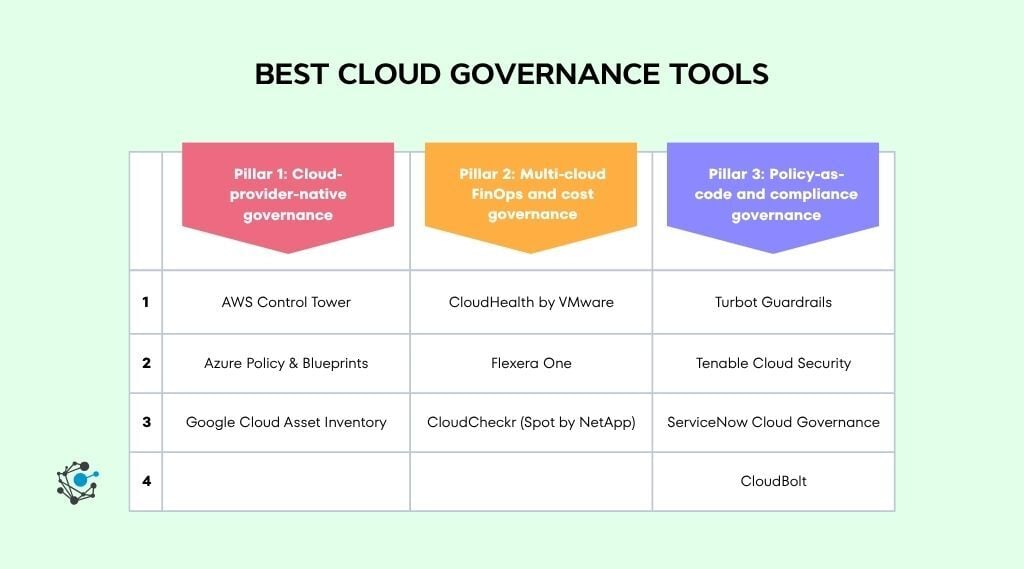
The tools below are grouped by the pillar they lead with. Every tool covers more than one pillar in practice, but the grouping reflects where each one is strongest and how the market positions them.
Pillar 1: Cloud-provider-native governance
Native services from AWS, Azure, and GCP are the default starting point for single-cloud teams. They cost nothing extra, integrate directly with identity and billing, and cover the foundational tagging, access, and policy needs. They stop short of multi-cloud visibility.
1. AWS Control Tower
AWS Control Tower is a native AWS service that sets up and governs a secure, multi-account AWS environment through a landing zone, an Account Factory, and a library of preventive and detective guardrails.
How it handles policy and access governance
Control Tower applies Service Control Policies through AWS Organizations and layers Config-based detective controls on top. New accounts inherit the guardrail set at creation, so drift is caught before an account starts running production workloads.
The centralized dashboard tracks compliance status across every account without a separate compliance stack.
Where it fits and where it does not
-
Fits AWS-first organizations that need a standardized multi-account baseline and are comfortable operating inside AWS-native tooling.
-
Not a fit for Azure or GCP workloads, and cost governance is limited compared with dedicated FinOps platforms.
Pricing signal: Free service. Underlying AWS Config, CloudTrail, and other billed services apply.
2. Azure Policy & Blueprints
Azure Policy & Blueprints is Microsoft's native governance layer for Azure. Policy defines and enforces rules for resource configuration, while Blueprints packages policies, RBAC assignments, and ARM templates into repeatable governance bundles that can be applied to any subscription.
How it handles policy and access governance
Policy definitions are JSON-based and can be applied at management group, subscription, or resource group scope. Blueprints ship a full governance baseline (policies + roles + templates) to any new subscription in minutes.
Real-time compliance tracking sits in the Azure Portal and flags non-compliant resources for remediation.
Where it fits and where it does not
-
Fits Azure-first teams that already run Entra ID and want native policy enforcement tied to existing RBAC.
-
Not a fit for teams needing a single pane across AWS and GCP.
Pricing signal: Free. Guest Configuration and some advanced features are billed separately.
3. Google Cloud Asset Inventory
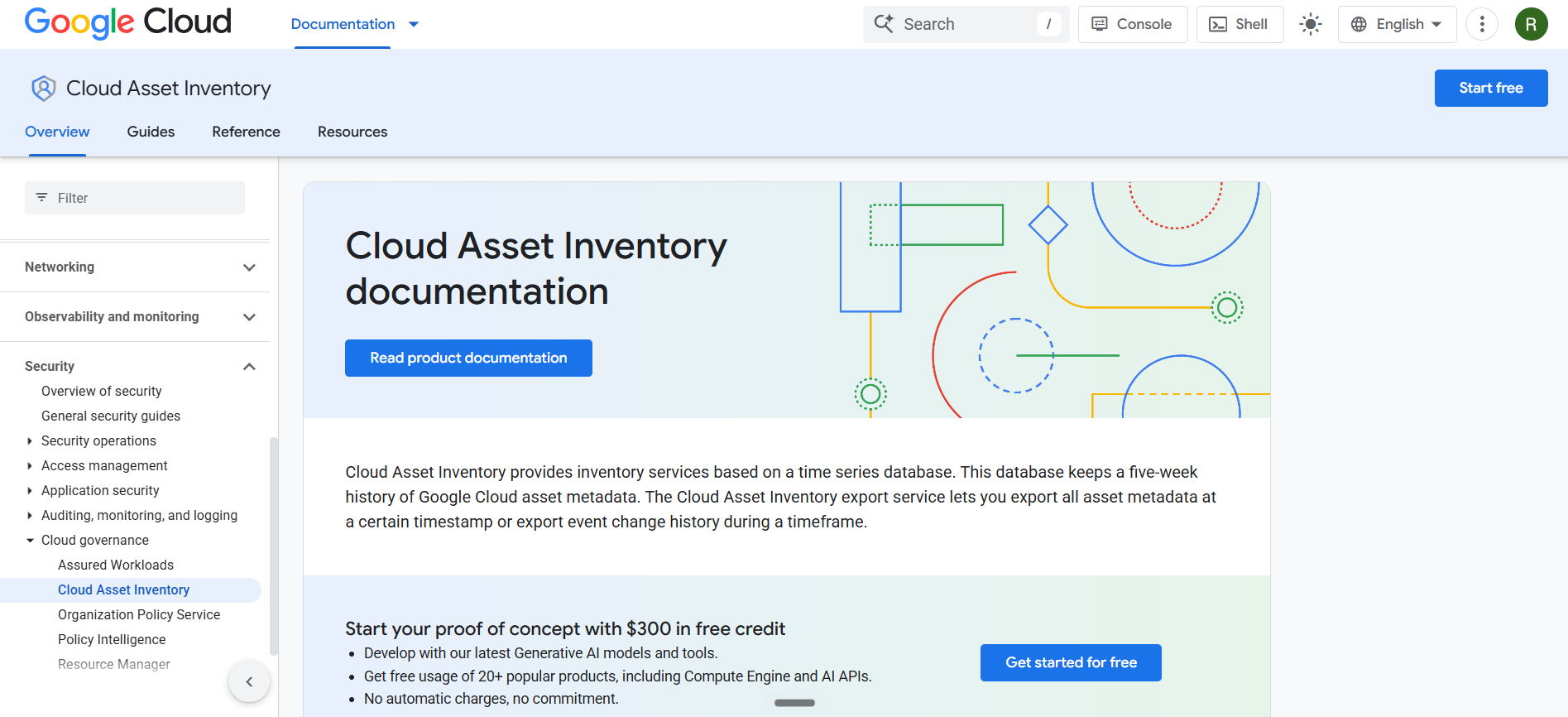
Google Cloud Asset Inventory is GCP's centralized asset metadata service. It aggregates configuration and IAM data for every Google Cloud resource across projects, folders, and organizations, giving governance teams a single source of truth for what exists and how it is configured.
How it handles policy and access governance
Asset Inventory records configuration change history for audit and troubleshooting, exposes data through APIs and BigQuery for advanced analysis, and monitors real-time policy drift.
Tagging governance is enforced by feeding the inventory into Cloud Functions or Terraform pipelines for automated remediation.
Where it fits and where it does not
-
Fits GCP-first teams that need centralized asset visibility and consistent tagging across projects.
-
Weaker on cost governance and cross-cloud coverage.
Pricing signal: Free for standard use. BigQuery export incurs standard BigQuery costs.
Pillar 2: Multi-cloud FinOps and cost governance
Multi-cloud FinOps platforms exist because native services stop at the cloud they were built for. This pillar is where cost visibility, budget accountability, and cross-cloud compliance mapping actually get solved.
4. CloudHealth by VMware
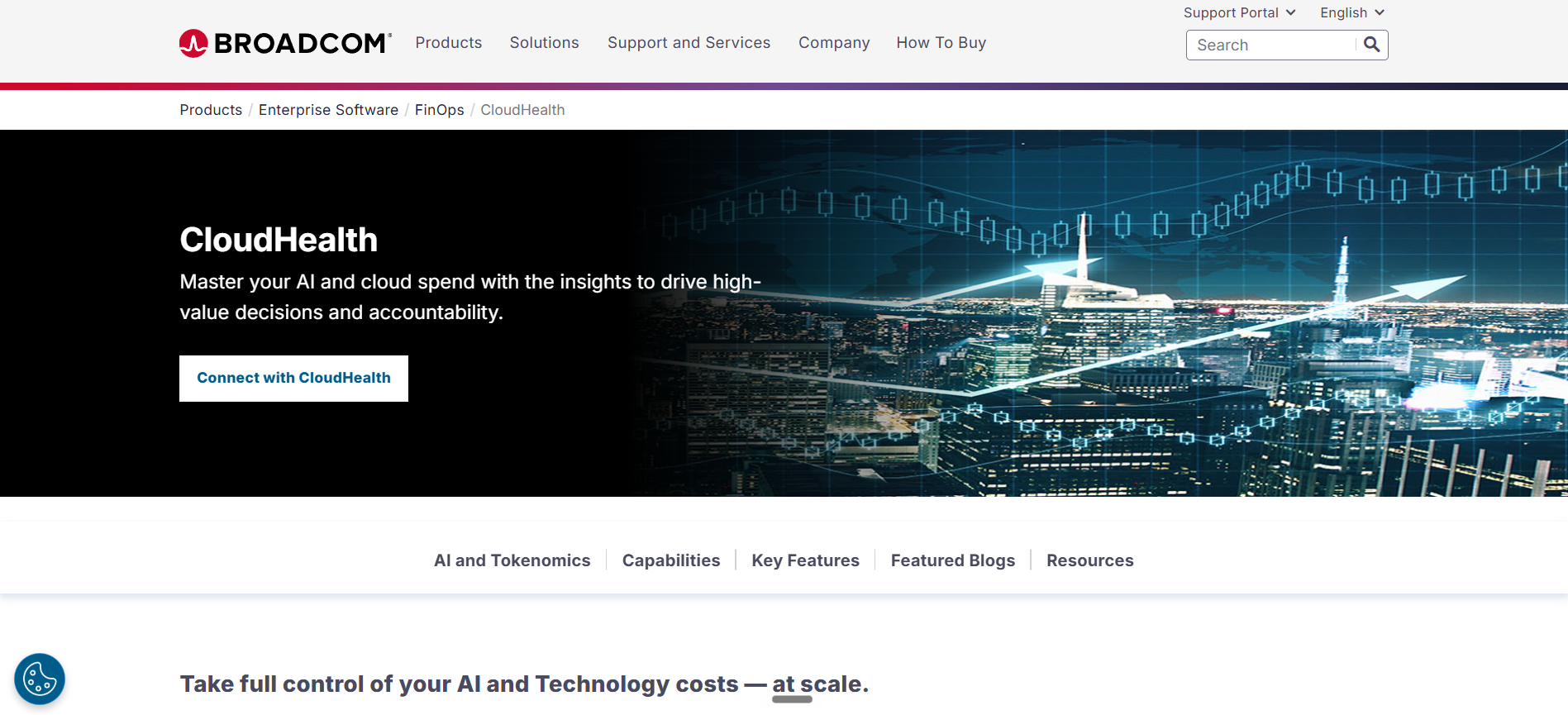
CloudHealth is a multi-cloud management and governance platform focused on cost, performance, and compliance across AWS, Azure, and GCP. It gives finance, IT, and security teams a shared view of spend, utilization, and policy adherence across every account.
How it handles cost governance
CloudHealth tracks spending patterns across accounts, identifies unused or underutilized resources, and enforces cost governance policies through automated actions.
Role-based dashboards let finance, IT, and security teams work from the same data without exporting spreadsheets. Compliance mapping aligns policies with CIS, SOC 2, and ISO 27001 out of the box.
Where it fits and where it does not
-
Fits mid-market to enterprise teams looking to consolidate cost governance and compliance under one platform.
-
Less strong as a real-time policy enforcement layer, so it often runs alongside a Turbot or a Tenable.
Pricing signal: Subscription-based, usage tiered. Contact vendor for enterprise quote.
5. Flexera One
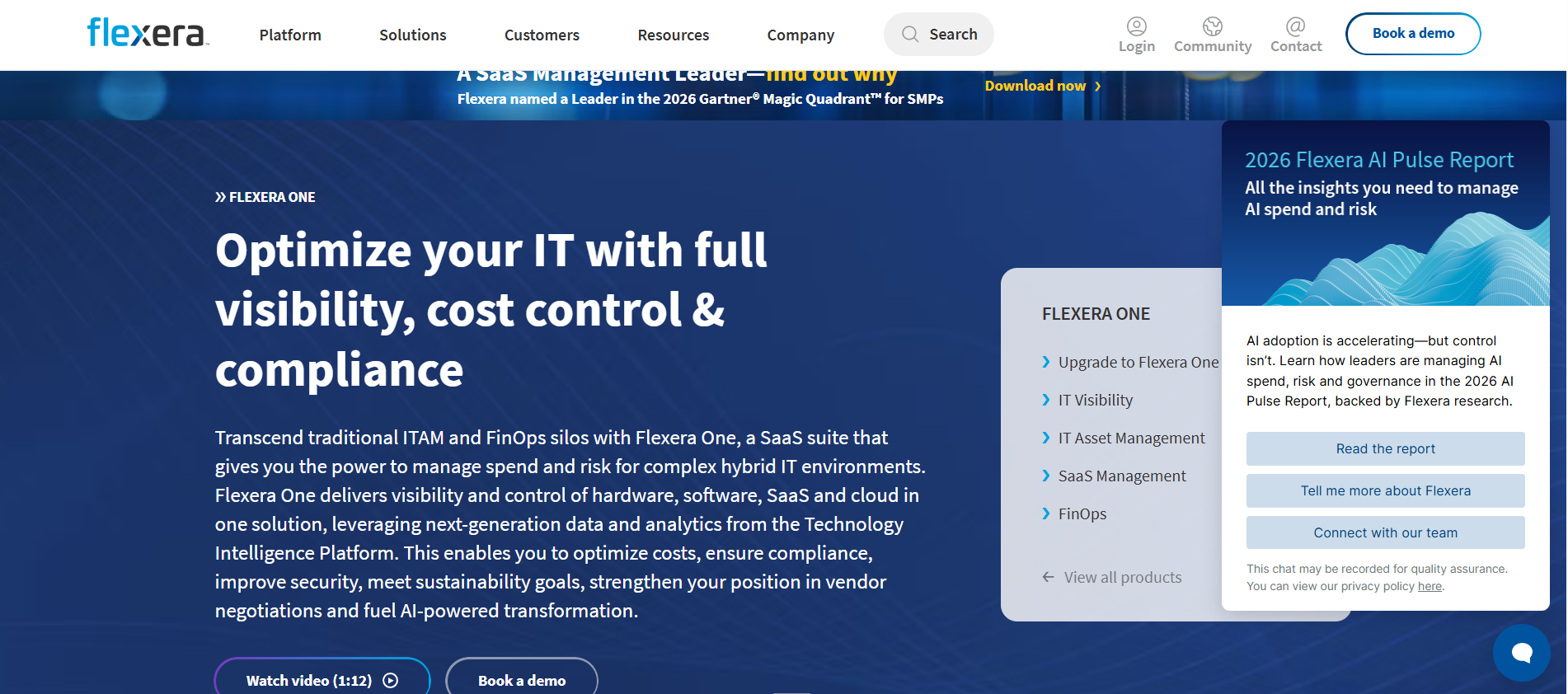
Flexera One is a hybrid IT management platform that unifies SaaS, IaaS, PaaS, and on-premises visibility. Cloud governance is one module inside a broader ITAM and FinOps suite.
How it handles cost governance
Flexera One aggregates spend and utilization across AWS, Azure, GCP, and on-premises data centers. Rightsizing recommendations, reserved instance planning, and anomaly detection sit inside the same dashboard as SaaS license optimization, which is a genuine differentiator for procurement-led governance teams.
Where it fits and where it does not
-
Fits enterprises with hybrid infrastructure, mixed procurement models, and a mature FinOps function.
-
Overkill for cloud-native startups without an on-premises footprint.
Pricing signal: Enterprise subscription. Modular pricing by capability.
6. CloudCheckr (Spot by NetApp)
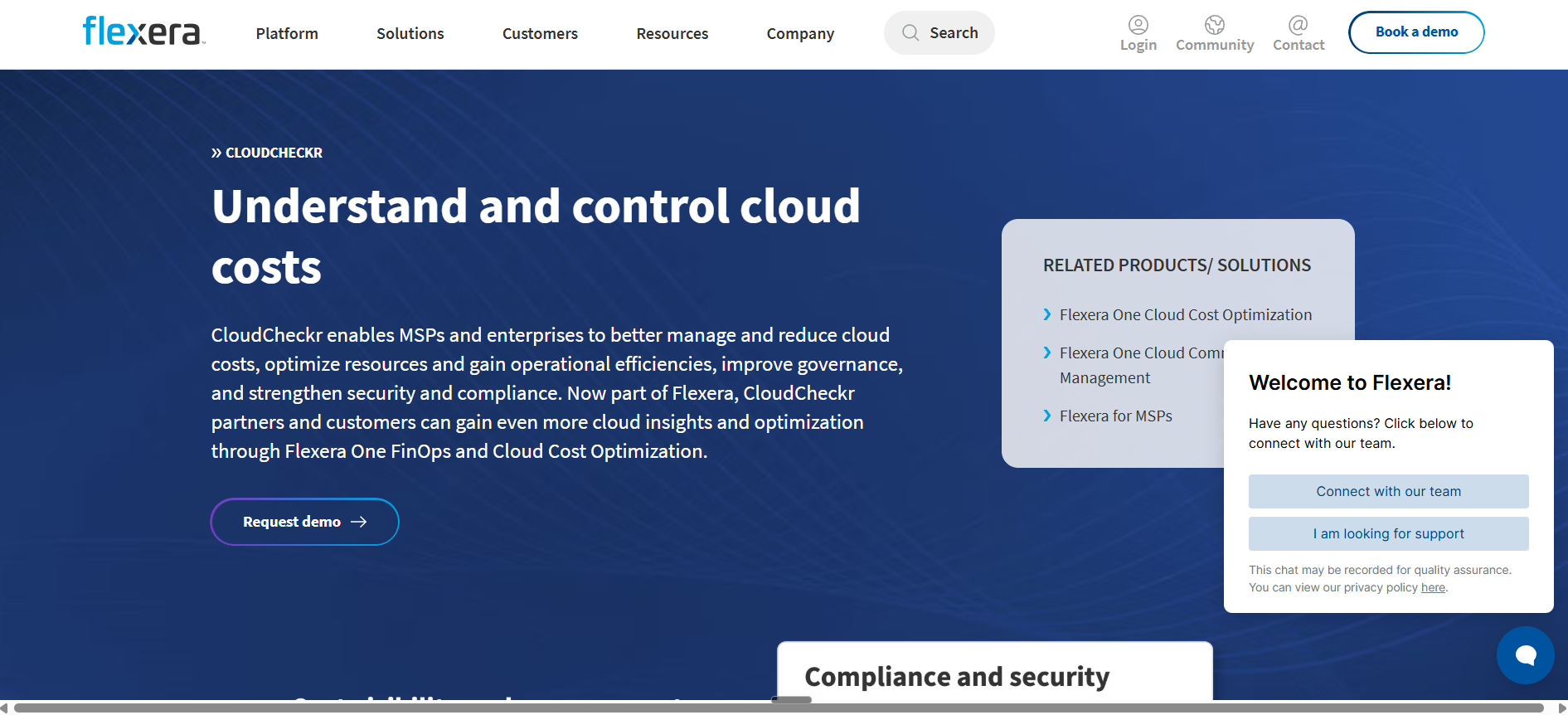
CloudCheckr is a multi-cloud governance platform now part of Spot by NetApp, covering cost, security, and compliance across AWS, Azure, and GCP.
How it handles cost governance
CloudCheckr identifies waste, unused resources, and savings opportunities across accounts. Continuous configuration checks against CIS, ISO 27001, and SOC 2 run alongside cost analytics, so the same platform surfaces both a cost anomaly and a compliance drift on the same asset.
Customizable reporting supports audit workflows for enterprises and MSPs.
Where it fits and where it does not
-
Fits MSPs managing multi-tenant cloud footprints and enterprises with heavy compliance reporting needs.
-
Less strong on identity governance.
Pricing signal: Subscription-based, usage tiered. Contact vendor.
Pillar 3: Policy-as-code and compliance governance
Policy-as-code platforms treat governance rules as version-controlled code. They enforce, detect, and remediate in real time, often through event-driven automation. This pillar is where mature organizations move once native controls hit their ceiling.
7. Turbot Guardrails
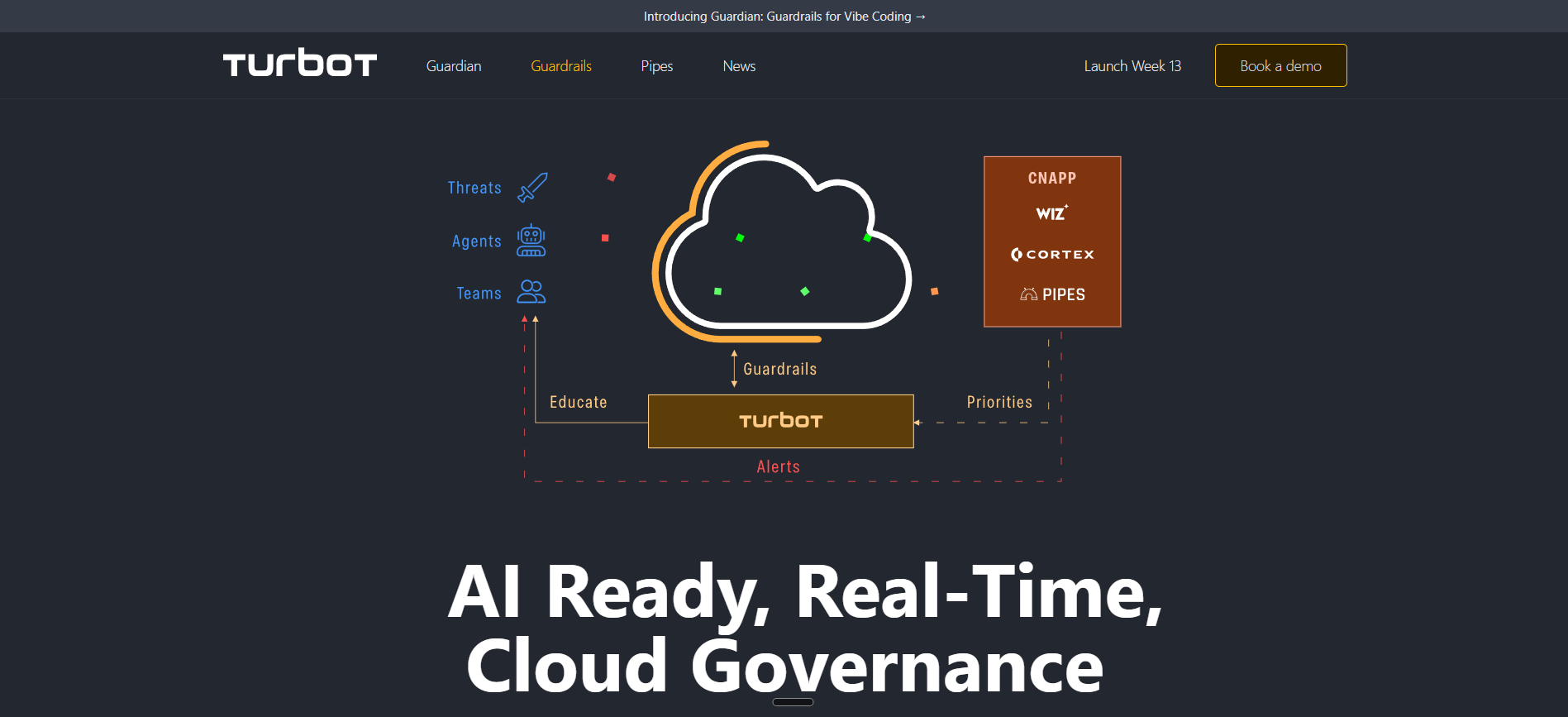
Turbot Guardrails is a policy-as-code governance platform that applies real-time controls, detection, and automated remediation across AWS, Azure, and GCP.
How it handles policy and access governance
Guardrails enforces thousands of pre-built policies at the resource level and remediates violations automatically, without waiting for a scheduled scan. Policies are versioned, auditable, and mapped to compliance frameworks like NIST, HIPAA, and PCI-DSS. The event-driven model is what separates Turbot from configuration-scan platforms.
Where it fits and where it does not
Fits regulated enterprises in financial services, healthcare, or government that need continuous compliance rather than periodic audits. Less relevant for small teams without dedicated governance headcount.
Pricing signal: Enterprise subscription. Contact vendor.
8. Tenable Cloud Security
Tenable Cloud Security is an identity-centric cloud security and governance platform, strengthened through Tenable's acquisition of Ermetic. Combines CIEM, CSPM, and workload posture.
How it handles policy and access governance
Tenable evaluates permissions across AWS, Azure, and GCP to surface excessive or orphaned entitlements. Least-privilege recommendations are enforced through automated policy actions, and risk visualization maps relationships between identities, resources, and vulnerabilities. Compliance mapping aligns with NIST, SOC 2, and ISO 27001.
Where it fits and where it does not:
-
Fits security-driven enterprises where identity is the attack surface.
-
Not the tool for FinOps or cost governance.
Pricing signal: Enterprise subscription, per-asset pricing.
9. ServiceNow Cloud Governance
ServiceNow Cloud Governance is ServiceNow's extension of its ITSM platform into cloud governance. It covers policy exception handling, approval workflows, and resource request management inside the same platform of record teams already use for incident, change, and configuration management.
How it handles policy and access governance
Workflow automation streamlines policy enforcement, approval, and exception management by tying every governance action into the ServiceNow platform of record. Standardized templates define governance rules across cloud providers, and audit-ready reporting is generated automatically.
Where it fits and where it does not
-
Fits enterprises already standardized on ServiceNow for ITSM, where governance benefits from the existing incident, change, and CMDB integration.
-
Overkill for organizations without a mature ServiceNow footprint.
Pricing signal: Enterprise subscription. Bundled with ServiceNow platform contracts.
10. CloudBolt
CloudBolt is a hybrid and multi-cloud management platform that applies governance-as-code across cloud and on-premises infrastructure.
How it handles policy and access governance
CloudBolt versions governance policies so compliance and cost controls are auditable and embedded in CI/CD pipelines. Provisioning workflows include built-in compliance checks, and the platform integrates natively with ServiceNow, Terraform, and Kubernetes. This is the closest platform on the list to a full Level 5 governance approach.
Where it fits and where it does not
-
Fits large enterprises with hybrid infrastructure and mature DevOps practices.
-
Less relevant for cloud-native teams already deep in Turbot or Tenable.
Pricing signal: Enterprise subscription. Modular by capability.
The cloud governance maturity model: where does our organization stand?
Governance has stopped being ad hoc. According to the 2026 Flexera cloud report, 71% of organizations have adopted Cloud Centers of Excellence and 63% run dedicated FinOps teams, which points to a market that has moved from scattered oversight into structured accountability.
The maturity model below helps assess where an organization currently sits on that arc and what it takes to keep moving toward intelligent, self-healing governance.
Level 1: Reactive: manual tagging and ad-hoc policies
Governance is manual. Teams rely on spreadsheets, emails, and human oversight to track resources. Tagging and access controls are inconsistent or missing. Compliance checks happen only after incidents or audits, and policy ownership is unclear.
Tools that support this level: None. Governance at Level 1 is a process problem before a tool problem.
Level 2: Defined: foundational governance frameworks established
Basic tagging standards, IAM roles, and approval workflows exist. Policies are documented but manually enforced. Cost and compliance reporting begin, though data stays siloed across teams.
Tools that support this level: AWS Control Tower, Azure Policy & Blueprints, Google Cloud Asset Inventory. Native services are the fastest way to establish a defined baseline.
Level 3: Standardized: policy-as-code and centralized visibility
Policies are codified and version-controlled. Dashboards consolidate visibility into cost, security, and compliance. IT, security, and finance operate under unified governance principles.
Tools that support this level: CloudHealth, CloudCheckr, ServiceNow Cloud Governance. These platforms centralize visibility and enforce policy consistently across cloud providers.
Level 4: Automated: AI-driven compliance and continuous monitoring
Event-driven systems respond to policy violations in real time. Machine learning detects anomalies, drift, and risk. Compliance evidence is generated automatically for CIS, ISO 27001, and NIST. This stage is no longer aspirational: most organizations report deploying or piloting AI to automate compliance, classification, or policy enforcement, according to McKinsey's State of AI report 2026.
Tools that support this level: Turbot Guardrails, Tenable Cloud Security, Flexera One. Real-time enforcement and automated remediation define this stage.
Level 5: Intelligent: self-healing governance and active metadata
Governance systems self-correct using active metadata and contextual intelligence. Policies remediate based on data sensitivity, ownership, and environment. Compliance becomes predictive, embedded directly into DevSecOps pipelines.
Tools that support this level: CloudBolt for governance-as-code across hybrid environments, alongside the OvalEdge Enterprise Context Graph (ECG) as the metadata and data governance layer.
Cloud governance challenges and best practices for 2026
Every governance framework hits recurring challenges that no single tool solves in isolation. Understanding which tool addresses which challenge turns a scattered stack into a coherent governance program.
Key challenges and the tools that address them
-
Multi-cloud complexity: Each provider uses different IAM models, APIs, and compliance frameworks. Flexera One and CloudBolt unify visibility and policy enforcement across AWS, Azure, GCP, and on-premises environments.
-
Policy drift: Configurations drift away from defined standards as infrastructure evolves. Turbot Guardrails and CloudCheckr apply continuous compliance checks and automated remediation to catch drift in real time.
-
Inconsistent tagging: Untagged resources break cost accountability and disrupt policy tracking. AWS Control Tower and Azure Policy enforce tagging-as-code at resource creation for native environments; CloudCheckr handles the multi-cloud extension.
-
Lack of ownership metadata: Assets without clear ownership slow remediation and dissolve accountability. ServiceNow Cloud Governance ties assets into the ITSM CMDB, and the OvalEdge ECG carries ownership metadata for the underlying data assets each cloud resource depends on.
-
Rigid or fragmented policies: Overly strict rules block innovation, while scattered controls create alert fatigue. CloudBolt's governance-as-code model versions policies so they can evolve without breaking downstream workflows.
-
Limited visibility: Hybrid and SaaS environments often lack centralized monitoring. CloudHealth and Google Cloud Asset Inventory consolidate spend, configuration, and compliance data across accounts.
Best practices that make cloud governance scale
-
Apply tagging-as-code and event-driven policy actions across every cloud. CloudCheckr and Turbot Guardrails operationalize this.
-
Embed policy validation and compliance checks inside CI/CD pipelines, not stapled on after deployment. CloudBolt and Turbot Guardrails handle this integration natively.
-
Adapt governance decisions to workload sensitivity, data classification, and regulatory context. The OvalEdge ECG feeds the data-layer metadata that lets cloud policies act on risk, not resource type.
-
Consolidate cost, compliance, and security dashboards across clouds. Flexera One and CloudHealth are the platforms most often chosen for this.
-
Map governance policies to the Cloud Adoption Framework, NIST, and CIS. Tenable and ServiceNow ship pre-built mappings that reduce audit-prep effort.
OvalEdge expert insight: Cloud governance and data governance are not the same program, but they fail the same way when they run separately. The active metadata layer is what keeps them aligned.
Also read: Data governance for cloud environments
Conclusion
The organizations that lead in the cloud era do not treat governance as a compliance exercise. They treat it as a design constraint. Every resource, policy, and permission is automated, auditable, and aligned with business intent.
The 10 tools compared here cover different pillars of that discipline: native services set the baseline, FinOps platforms unify cost and compliance visibility, and policy-as-code platforms bring real-time enforcement.
Moving from Level 3 standardized governance to Level 5 self-healing governance requires an active metadata foundation, which is where the OvalEdge ECG connects data-layer intelligence to cloud policy enforcement.
Schedule an OvalEdge demo to see how ECG fits into an existing cloud governance stack.
.png?width=1081&height=173&name=Forrester%201%20(1).png)
.png?width=1081&height=241&name=KC%20-%20Logo%201%20(1).png)