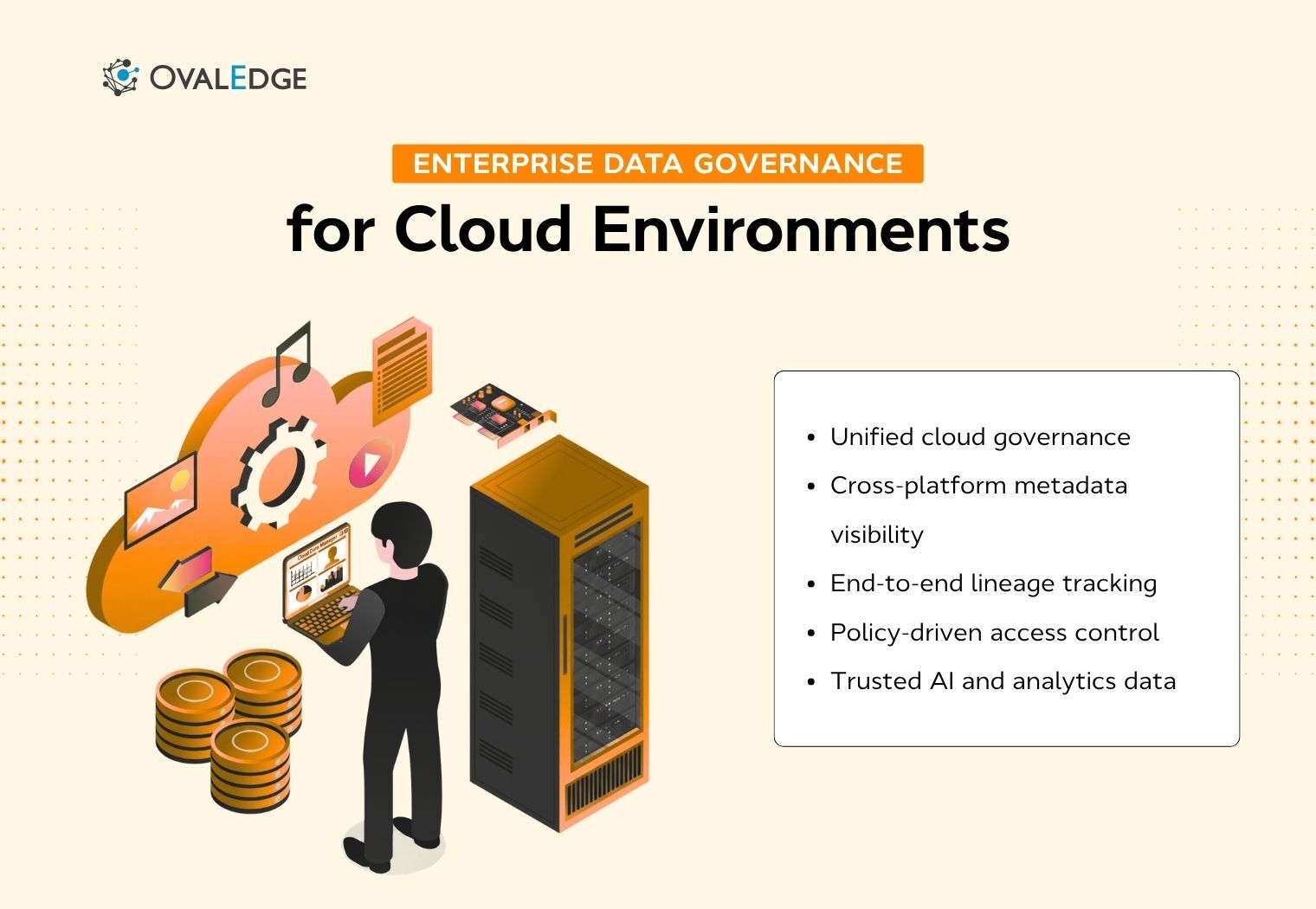
Organizations spent the last several years accelerating cloud adoption to support analytics, AI, and real-time operations across AWS, Azure, GCP, and SaaS ecosystems. But while cloud environments scaled rapidly, governance models often failed to evolve at the same pace.
Traditional governance frameworks built for centralized warehouses and static infrastructure now struggle in cloud ecosystems that are distributed, self-service, and constantly changing.
As a result, enterprises increasingly struggle with governance coordination, operational visibility, distributed ownership, and policy consistency across multi-cloud environments.
According to cloud governance statistics 2025 published by DataStackHub, more than 81% of enterprises now identify cloud governance as a strategic focus within their digital transformation initiatives.
This guide explains how organizations can build scalable, trusted, and governance-ready data environments across modern cloud architectures.
What is data governance for cloud environments?
Data governance for cloud environments is the set of policies, processes, and controls that manage data quality, access, lineage, and compliance across cloud and multi-cloud platforms, including AWS, Azure, GCP, hybrid environments, and cloud-native SaaS ecosystems.
How it differs from traditional governance
Traditional governance frameworks assumed relatively stable environments with centralized ownership, predictable ETL pipelines, and limited data movement. Cloud environments operate very differently.
Data now flows dynamically across multiple platforms, teams, regions, SaaS applications, and real-time analytics systems simultaneously, making governance significantly harder to standardize and enforce.
The easier cloud platforms make it to provision, replicate, and distribute data, the harder it becomes to maintain governance consistency, ownership clarity, lineage continuity, and policy enforcement at scale.
Governance models designed for static infrastructure often struggle to adapt to cloud-native architectures built around API integrations, elastic storage, decentralized teams, and continuously changing pipelines.
Why Multi-Cloud makes it harder
Multi-cloud environments further increase complexity because AWS, Azure, and GCP each use different metadata models, access frameworks, and lineage structures.
The differences become clearer when comparing traditional, cloud, and multi-cloud governance models directly.
|
Governance dimension |
On-premises |
Cloud |
Multi-Cloud |
|
Data Location |
Centralized |
Distributed |
Highly fragmented |
|
Access Model |
Network perimeter-based |
Identity and API-based |
Platform-specific IAM models |
|
Lineage Capture |
Limited ETL visibility |
Pipeline-aware |
Cross-platform gaps |
|
Metadata Source |
Single catalog |
Multiple services |
Federated metadata required |
|
Compliance Scope |
Internal systems |
Shared responsibility |
Multi-region and multi-platform governance |
These differences make it clear why cloud data governance cannot rely on traditional governance models alone. Modern environments require governance frameworks designed specifically for distributed, multi-platform, and continuously changing data ecosystems.
Core goals of cloud data governance
Cloud data governance is no longer just about documenting datasets or managing access permissions. In modern multi-cloud environments, governance must continuously maintain operational accountability, policy consistency, and trusted data usage across distributed cloud ecosystems. Strong governance frameworks are typically built around five core operational goals.
-
Metadata visibility: Organizations need a unified view of data assets across cloud platforms, SaaS applications, and analytics systems. Organizations need a unified view of data assets across cloud platforms, SaaS applications, and analytics systems. Modern metadata management tools help governance teams centralize visibility across fragmented cloud ecosystems. Without connected metadata, governance teams cannot reliably track ownership, classification, or usage across environments.
-
End-to-end lineage: Governance frameworks must trace data movement from ingestion to consumption across pipelines, platforms, and SaaS tools. End-to-end lineage improves auditability, impact analysis, and trust in downstream analytics and AI systems.
-
Access governance: Modern governance relies on data-level access controls instead of traditional network perimeter security. Policies must remain consistently enforced across Snowflake, Databricks, BigQuery, Redshift, and cloud-native storage platforms.
-
Data quality: Cloud-native governance requires continuous quality monitoring embedded directly into pipelines and data products. Automated validation and observability help organizations detect issues before unreliable data reaches downstream users.
-
Compliance readiness: Enterprises must maintain audit-ready evidence for GDPR, HIPAA, CCPA, and internal governance policies at all times. This includes visibility into access activity, retention enforcement, classification history, and data residency controls.
|
Do you know? OvalEdge helps enterprises unify metadata, lineage, access governance, and compliance visibility across complex multi-cloud environments. |
Looking to unify metadata, lineage, access governance, and compliance visibility across AWS, Azure, GCP, and SaaS platforms?
Book a Demo to see how OvalEdge simplifies cloud data governance at enterprise scale.
Key challenges in Multi-Cloud data governance
Many enterprises migrated data into cloud platforms faster than they matured their governance operating models, creating environments where scalability outpaced governance consistency.
As cloud ecosystems expanded across platforms, SaaS applications, and decentralized teams, governance visibility, access control, and accountability became significantly harder to manage at scale.
1. Fragmented metadata and visibility
In distributed cloud ecosystems, governance increasingly becomes a metadata coordination problem because governance coordination and stewardship consistency increasingly depend on connected metadata across platforms.
For example, a customer dataset may exist in AWS S3, get transformed in Databricks, and appear in Power BI dashboards, while ownership, classifications, and policy details remain scattered across separate systems. This fragmentation slows analytics, creates duplicate reporting, and reduces trust in governed data assets.
Without connected metadata across cloud environments, organizations struggle to maintain consistent governance visibility at scale. This is why many enterprises invest in enterprise metadata management strategies to improve governance coordination.
2. Inconsistent access controls and policy drift
Cloud platforms use different identity models and policy structures, making access governance difficult to standardize across environments.
For instance, a finance analyst who changes roles may lose access in Snowflake but still retain permissions in BigQuery or cloud storage systems because policy updates were never synchronized across platforms. Over time, these inconsistencies create governance risk, stale permissions, and over-permissioned access across cloud ecosystems.
Over time, stale permissions, duplicated roles, and inconsistent enforcement create governance risk and increase the likelihood of over-permissioned access across cloud environments.
3. Lineage gaps and saas blind spots
Lineage visibility often breaks when data moves across cloud platforms, SaaS tools, and external analytics environments.
For example, a pipeline may begin in Oracle, move through AWS Glue, feed Snowflake models, and power Tableau dashboards, while lineage tracking stops at each platform boundary. These blind spots make impact analysis, compliance validation, incident response, and AI explainability significantly harder.
These blind spots make incident response, downstream impact analysis, and AI governance significantly harder to manage.
4. Centralization vs. domain ownership
Governance programs often struggle to balance centralized standards with decentralized execution across business domains.
For example, a centralized governance team may become overwhelmed handling every access request, certification workflow, and metadata update across hundreds of domain-owned datasets. At the same time, fully decentralized teams often create inconsistent metadata standards, stewardship processes, and governance practices across environments.
The governance challenge is no longer choosing between centralized and decentralized governance. It is enabling federated governance that preserves enterprise standards while allowing domains to operate independently at cloud scale.
|
What effective Multi-Cloud governance looks like Mature cloud governance environments maintain connected metadata, consistent access controls, and end-to-end lineage visibility across distributed platforms without slowing business operations.
|
Core components of a cloud data governance framework
Modern cloud governance frameworks combine operational visibility, policy enforcement, stewardship coordination, observability, and audit readiness across distributed cloud ecosystems.
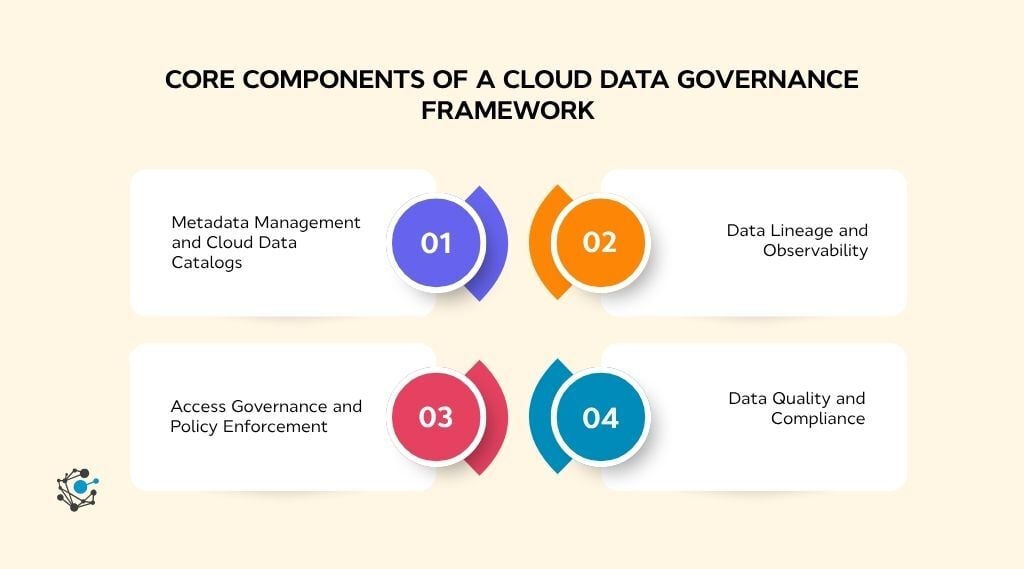
1. Metadata management and cloud data catalogs
Cloud governance depends heavily on connected metadata across AWS, Azure, GCP, Snowflake, Databricks, SaaS applications, and BI tools. Modern data catalogs use automated crawling to continuously capture business definitions, ownership, classifications, schemas, and stewardship context across environments.
The catalog becomes the operational visibility layer for governance by helping teams identify trusted assets, stale datasets, duplicate pipelines, and governance gaps.
2. Data lineage and observability
Lineage helps organizations understand how data moves across dbt, Spark, Glue, Databricks, BigQuery, Redshift, SaaS applications, and downstream analytics systems. This visibility becomes critical for compliance validation, impact analysis, root-cause investigation, and AI explainability.
Observability extends lineage further by monitoring freshness, schema drift, failed transformations, and downstream quality impacts in real time. Together, lineage and observability improve trust in analytics pipelines while reducing operational blind spots across cloud environments.
3. Access governance and policy enforcement
Modern cloud governance focuses on data-level security controls rather than traditional perimeter-based access management. This includes role-based access control, attribute-based policies, row-level filtering, column masking, encryption enforcement, and sensitive data discovery.
Policy-as-code approaches allow organizations to define governance standards centrally while enforcing them consistently across cloud platforms through APIs and integrations. This is especially important for regulated industries managing PII, PHI, and PCI data, and residency requirements across regions.
4. Data quality and compliance
Cloud-native governance requires continuous quality monitoring embedded directly into operational pipelines. Frameworks such as dbt tests and Great Expectations help detect unreliable data before it affects downstream reports, dashboards, and AI systems.
Governance platforms also help organizations maintain audit-ready evidence through access logs, retention policies, classification history, stewardship records, and compliance tracking.
Cloud data governance best practices
Successful cloud governance programs are rarely built through policies alone. Enterprises that scale governance effectively typically combine automation, federated ownership, standardized controls, and measurable operational accountability. The following best practices help organizations operationalize governance consistently across distributed cloud environments.
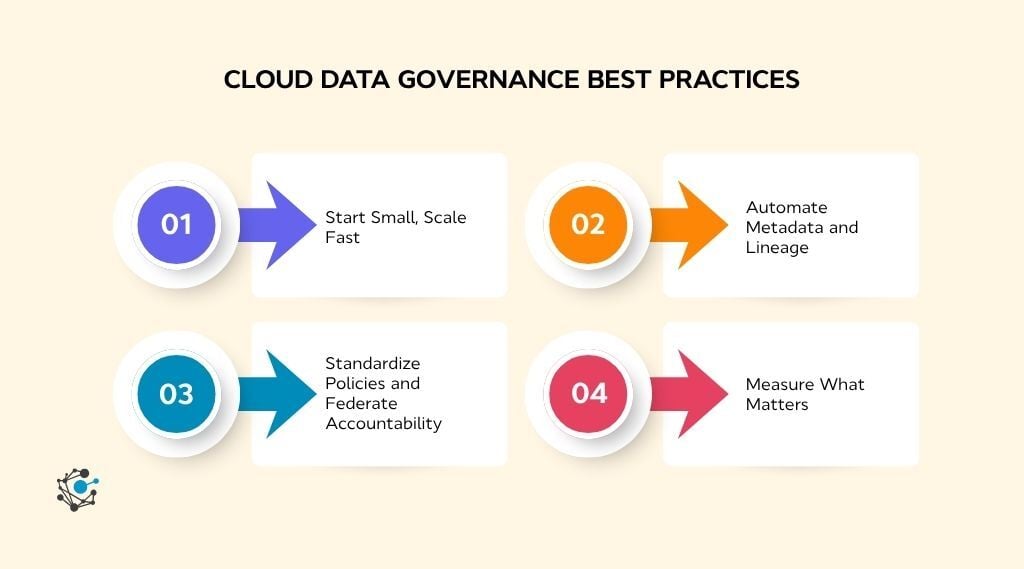
1. Start small, scale fast
Many governance programs fail because organizations attempt enterprise-wide rollout too early. The most effective initiatives usually begin with high-risk domains such as customer data, financial reporting, healthcare datasets, or regulated operational systems.
A phased rollout helps governance teams validate workflows, improve stewardship adoption, and demonstrate measurable value before scaling governance across the enterprise. Many organizations use structured data governance frameworks to operationalize governance incrementally.
Actionable steps:
-
Prioritize domains with the highest compliance or reporting impact
-
Establish governance ownership before onboarding new datasets.
-
Define measurable success criteria for the pilot phase
2. Automate metadata and lineage
Manual governance processes become difficult to sustain as cloud ecosystems expand across platforms, pipelines, and SaaS environments.
Metadata harvesting, lineage collection, classification, and monitoring should operate continuously through automation so governance visibility remains current without relying on manual updates. Modern metadata management tools and automated data lineage tools help organizations scale governance visibility across complex cloud ecosystems.
Actionable steps:
-
Enable automated metadata crawling across cloud and SaaS platforms
-
Integrate lineage collection directly into dbt, Spark, and orchestration pipelines.
-
Use event-driven monitoring to detect schema and pipeline changes early.
3. Standardize policies and federate accountability
Governance standards must remain consistent across environments without central teams becoming operational bottlenecks.
Successful organizations standardize classification, retention, and access policies centrally while allowing domains to operationalize governance locally through stewardship and ownership workflows.
Strong data stewardship programs and clearly defined data governance policies help enterprises maintain governance consistency across distributed cloud environments.
Actionable steps:
-
Create organization-wide classification and certification standards
-
Assign domain-level stewards for governance execution and approvals.
-
Use policy templates that can be enforced consistently across platforms
4. Measure what matters
Governance programs lose momentum when organizations cannot demonstrate operational progress or business impact.
Tracking governance KPIs helps leadership evaluate adoption, identify operational gaps, and improve accountability across domains and platforms.
Actionable steps:
-
Measure ownership coverage and certified asset adoption regularly
-
Track governance workflow metrics, such as access request turnaround time
-
Review governance health metrics quarterly with platform and business leaders.
How governance works across AWS, Azure, and GCP
AWS, Azure, and GCP each provide strong native governance capabilities built around their own cloud ecosystems. However, governance consistency often becomes harder to maintain once data moves across platforms, SaaS applications, and distributed analytics environments.
Modern cloud data management platforms help enterprises maintain centralized governance visibility across fragmented ecosystems.
AWS
AWS governance capabilities focus heavily on data lake governance and infrastructure-level control.
Key governance services include:
-
AWS Lake Formation for fine-grained access controls
-
Glue Data Catalog for metadata management
-
Amazon Macie for PII discovery and classification
-
CloudTrail for audit logging and activity monitoring
AWS performs strongly for organizations operating primarily within S3, Redshift, Glue, and Lake Formation ecosystems. For example, enterprises building centralized AWS data lakes can automate classification, data access governance, and audit logging directly within native services.
However, governance visibility often becomes fragmented once data moves across accounts, SaaS applications, or external analytics platforms.
Many enterprises now adopt active metadata to continuously synchronize governance context, lineage visibility, and metadata coordination across distributed cloud ecosystems.
Azure
Azure governance is centered around Microsoft Purview and deep integration across Microsoft’s enterprise ecosystem.
Key capabilities include:
-
metadata cataloging
-
automated classification
-
lineage visibility
-
compliance scanning
Purview integrates natively with:
-
Azure Data Lake
-
Synapse
-
SQL Server
-
Power BI
-
Microsoft 365
This creates strong governance visibility for Microsoft-centric enterprises where analytics, collaboration, and reporting workflows remain tightly integrated within Azure services.
|
For example, organizations using Synapse and Power BI can trace lineage and sensitivity classifications more easily across Microsoft-native environments. However, governance visibility typically weakens once pipelines extend into non-Microsoft cloud platforms or external SaaS ecosystems. |
GCP
GCP governance capabilities are designed heavily around analytics and BigQuery-centric data operations.
Key governance services include:
-
Google Dataplex for unified governance management
-
Data Catalog for metadata and tagging
-
Cloud DLP for sensitive data classification and de-identification
These services support governance across:
-
BigQuery
-
Cloud Storage
-
Pub/Sub environments
GCP performs particularly well for enterprises operating large-scale analytics workloads inside BigQuery ecosystems.
|
For example, organizations can apply classification, governance policies, and metadata management directly across analytics pipelines and streaming workloads. |
The case for a unified governance layer
Each hyperscaler governs effectively within its own ecosystem. The challenge emerges at the boundaries between platforms where metadata models, lineage structures, and policy frameworks become difficult to synchronize.
For example, governance workflows may span AWS ingestion pipelines, Databricks transformations, Snowflake analytics models, and Power BI reporting environments, while governance visibility remains fragmented across separate platforms.
As organizations scale across AWS, Azure, GCP, SaaS, and hybrid environments, many adopt cloud-agnostic governance platforms to federate metadata, stewardship, policy management, and operational visibility across the broader data ecosystem.
Selecting a cloud data governance platform
Many organizations mistakenly treat cloud migration as governance maturity. In reality, governance complexity often increases after cloud adoption due to fragmented tooling, decentralized ownership, and rapidly expanding data ecosystems.
Governance platforms increasingly determine how effectively enterprises coordinate governance workflows, standardize policies, and scale operational accountability across distributed environments.
Unified governance platforms
Unified governance platforms operate above individual cloud ecosystems to federate metadata, lineage, stewardship, governance workflows, and policy visibility across environments.
|
Platform |
Best Fit |
Core Strength |
Limitation to Consider |
|
Multi-cloud, SaaS, and hybrid governance |
Unified catalog, lineage, stewardship, and governance workflows |
Best suited when organizations need enterprise-wide governance beyond one cloud |
|
|
Modern data teams using active metadata |
Collaboration, discovery, and metadata activation |
May need integration planning for complex governance workflows |
|
|
Large enterprises with mature governance programs |
Policy governance, compliance workflows, and stewardship |
Can require a heavier implementation effort |
These platforms help enterprises maintain governance consistency across distributed cloud ecosystems without relying entirely on disconnected cloud-native governance tooling.
Cloud-native governance services
Cloud-native governance services focus primarily on governance within their own cloud ecosystems.
|
Platform |
Best Fit |
Core Strength |
Limitation to Consider |
|
AWS-centered data lakes |
Fine-grained access control for S3-based lake environments |
Limited outside AWS |
|
|
Microsoft-centric enterprises |
Cataloging, classification, lineage, and compliance across the Azure/Microsoft stack |
Cross-cloud coverage can require augmentation |
|
|
BigQuery and GCP analytics environments |
Governance across GCP data lakes and analytics workloads |
Less comprehensive outside GCP |
|
|
Databricks lakehouse environments |
Unified governance for Databricks data and AI assets |
Primarily Databricks-focused |
These services are often highly effective for organizations operating predominantly within a single cloud ecosystem.
However, enterprises managing multi-cloud environments frequently require additional governance layers for federated metadata visibility, cross-platform lineage, and centralized governance reporting.
What to evaluate
When selecting a cloud data governance platform, organizations should evaluate whether the platform can scale governance consistently across distributed cloud ecosystems.
|
Governance platform evaluation checklist
|
The strongest governance platforms reduce operational friction while helping enterprises maintain governance consistency across distributed cloud environments.
Conclusion
Cloud data governance is no longer just a compliance initiative. As enterprises expand across AWS, Azure, GCP, SaaS platforms, and AI ecosystems, governance increasingly determines how effectively organizations maintain visibility, trust, security, and operational consistency at scale.
Organizations that mature governance successfully typically automate metadata and lineage collection, standardize governance policies, and adopt federated operating models that balance central oversight with domain ownership. Without these capabilities, governance complexity grows faster than cloud adoption itself.
Platforms such as OvalEdge help enterprises standardize governance operations, automate stewardship workflows, and scale governance coordination across multi-cloud ecosystems.

Ready to simplify governance across your multi-cloud ecosystem?

Book a Demo with OvalEdge and see how modern cloud governance can scale with your business.
FAQs
1. What is cloud data governance?
Cloud data governance is the framework of policies, controls, metadata management, lineage tracking, and compliance processes used to govern data across cloud and multi-cloud environments.
2. Why is cloud data governance important?
Cloud data governance helps organizations maintain security, compliance, data quality, and operational trust across distributed cloud ecosystems. It also supports regulatory readiness for GDPR, HIPAA, CCPA, and emerging AI governance requirements.
3. What are the biggest challenges in multi-cloud governance?
The biggest challenges include fragmented metadata, inconsistent access controls, lineage gaps, SaaS visibility limitations, and balancing centralized governance standards with decentralized domain ownership.
4. How do AWS, Azure, and GCP support data governance?
AWS supports governance through Lake Formation, Glue, Macie, and CloudTrail. Azure uses Microsoft Purview for metadata cataloging, lineage, and compliance visibility, while GCP provides governance through Dataplex, Data Catalog, and Cloud DLP. Each platform governs well within its own ecosystem, but cross-platform governance often requires federated governance layers.
5. What is the difference between cloud governance and cloud data governance?
Cloud governance focuses on infrastructure management, operational controls, cloud security, and cost management. Cloud data governance specifically manages metadata, lineage, data quality, access controls, compliance, and stewardship across cloud environments.
6. What is a cloud data governance framework?
A cloud data governance framework is the operational structure used to manage metadata, lineage, access governance, data quality, and compliance across distributed cloud ecosystems. It combines governance policies, stewardship models, automation workflows, and cloud-native governance technologies into a unified operating model.
.png?width=1081&height=173&name=Forrester%201%20(1).png)
.png?width=1081&height=241&name=KC%20-%20Logo%201%20(1).png)