Take a tour
Book demo
Cloud Data Management Platform: Complete Overview & Key Capabilities

Cloud Data Management Platform: Complete Overview & Key Capabilities

A cloud data management platform enables organizations to govern, secure, integrate, and analyze data across hybrid and multi-cloud environments. As data becomes more distributed, real-time, and complex, these platforms provide essential capabilities such as metadata cataloging, data lineage, access control, backup, and compliance enforcement. Leading solutions like AWS, Azure, Google Cloud, and Databricks support scalable analytics, while tools like OvalEdge overlay governance across existing infrastructure. Choosing the right platform requires aligning business goals with technical needs around ingestion, analytics, automation, resilience, and regulatory compliance.

Traditional data management platforms were built for a time when data lived in one place, grew predictably, and served a limited set of users. That reality no longer exists. Enterprise data is spread across SaaS tools, cloud services, and on‑prem systems. 

Volumes spike without warning. Teams expect real‑time access. Compliance rules keep changing. Legacy platforms struggle to keep up, creating bottlenecks instead of enabling insight.

When organizations outgrow traditional data management platforms, the consequences surface quickly:

  • What happens when analytics slow down because systems can’t scale on demand?

  • What happens when governance breaks because data is scattered across clouds and tools?

This is where the shift to a cloud data management platform becomes necessary, not as a technology upgrade, but as a structural change. 

Knowing when to move and how to choose the right platform determines whether data becomes a competitive advantage or an operational risk.

In this blog, we break down why cloud data management platforms matter, the core capabilities that define them, how leading platforms compare, where governance tools like OvalEdge fit, and how to choose the right solution for your organization’s data, compliance, and growth needs.

Why cloud data management platforms matter 

The way organizations create, store, and interact with data has changed more in the last five years than in the previous two decades. 

As digital transformation accelerates across every industry, data has moved from being a byproduct of operations to a core driver of business value. 

But with that shift comes a growing list of challenges, such as fragmented systems, compliance burdens, infrastructure sprawl, and inconsistent data quality. This is the environment that makes cloud data management platforms essential.

1. Data volume, variety, and velocity are outpacing traditional systems

Organizations collect data from an ever-expanding range of sources like SaaS platforms, web applications, IoT devices, transactional systems, mobile apps, and external feeds. 

According to a Statista Digital Economy Compass, global data creation is projected to hit 175 zettabytes in 2025 and surge past 2,000 zettabytes by 2035. 

This unprecedented scale is far beyond what traditional infrastructure was ever designed to manage. This data explosion brings three key challenges:

  • Volume: Storage and compute demands are growing exponentially.

  • Variety: Organizations deal with structured, semi-structured, and unstructured data across silos.

  • Velocity: Real-time data flows are now critical for decision-making in areas like fraud detection, logistics, and customer engagement.

Legacy on-premise systems weren’t built to handle this scale or speed. They struggle with integrating data across cloud services, scaling compute dynamically, and delivering analytics in real time. 

This is where cloud-native data management platforms deliver immediate value.

2. Unified access to distributed data

One of the most difficult problems for large organizations is the fragmentation of data across tools, departments, and geographies. Finance might use SAP, marketing might live in HubSpot, and engineering might be analyzing telemetry in Amazon Redshift. 

Without a unified layer of visibility and control, data becomes siloed, duplicated, or misused.

According to the IBM Data Differentiator Guide 2024, 82% of enterprises report that data silos disrupt their critical workflows, while 68% of enterprise data remains unanalyzed, largely because it’s locked away in disconnected systems

Cloud data management platforms solve this by creating a centralized control plane over decentralized data. This allows teams to:

  • Discover and catalog assets across environments

  • Enforce governance policies uniformly

  • Enable access to trusted, consistent data without needing to physically consolidate it

This is especially vital in hybrid and multi-cloud environments, where data may reside in AWS S3, Azure Synapse, Google BigQuery, or even legacy on-prem databases, depending on compliance or latency needs.

3. Enabling Analytics, AI, and operational intelligence

Analytics tools are only as powerful as the data feeding them. Business intelligence, machine learning models, and operational dashboards require:

  • Clean, high-quality data

  • Up-to-date access to live datasets

  • Clear data lineage and definitions

Cloud data management platforms enable real-time data pipelines, automated data quality checks, and self-service access for business teams, without compromising security. 

They power everything from product recommendation engines to real-time logistics dashboards.

For example, logistics providers use streaming data ingestion and analytics to optimize routes in real-time. Financial institutions apply governance workflows to ensure AI models only use data approved for regulatory use cases.

4. Supporting hybrid and multi-cloud operations

Few enterprises operate in a single cloud environment. Due to data residency laws, risk diversification, and regional performance requirements, most are adopting hybrid or multi-cloud strategies. 

But managing data across these environments creates complexity. Cloud data management platforms are purpose-built to abstract this complexity by providing:

  • Interoperability between platforms like AWS, Azure, and GCP

  • Federated metadata management for global discoverability

  • Cross-cloud policy enforcement for consistent governance

These capabilities ensure that as organizations scale geographically or by business unit, they don’t lose control or visibility over their data assets.

Cloud data management platforms matter because they solve the core challenges of the modern data landscape, like fragmentation, compliance, speed, and scale. 

They are the architectural foundation that enables organizations to turn distributed, fast-moving data into secure, trusted, and actionable insights.

Core components & capabilities of cloud data management platforms

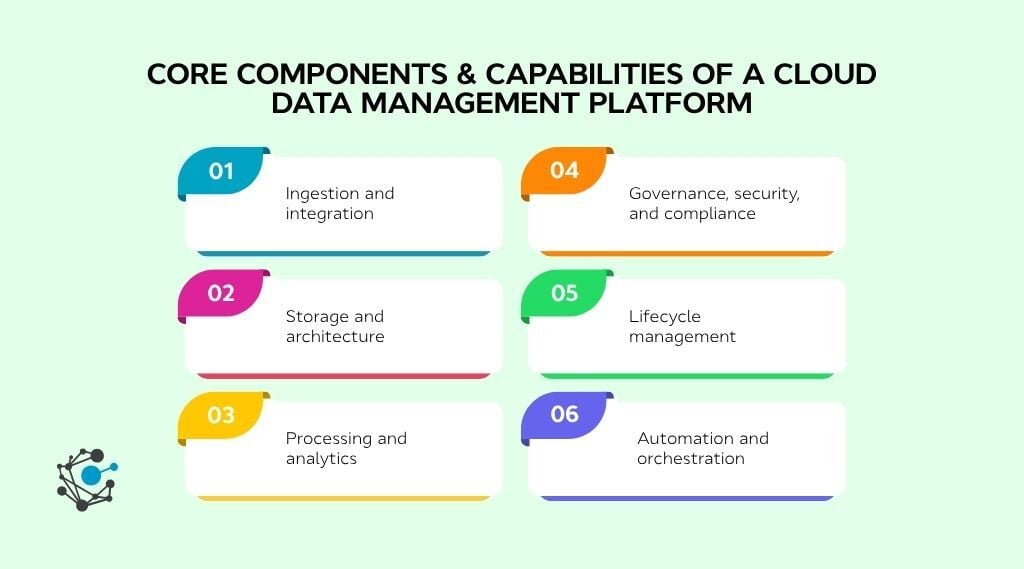
A cloud data management platform is an architectural approach made up of integrated capabilities that manage the full lifecycle of data, from ingestion to archiving, across distributed environments.

Info 2-1 

Below are the essential components that define a robust cloud data management platform.

1. Data ingestion and integration

Modern enterprises draw data from hundreds of sources, from SaaS tools and legacy databases to APIs and real-time event streams. The ability to ingest and integrate data from diverse environments is foundational.

Key capabilities include: 

  • Batch and real-time ingestion: Batch ETL (Extract, Transform, Load) remains critical for financial reporting, while real-time ingestion through ELT or streaming pipelines enables use cases like fraud detection, personalization, or IoT analytics.

  • Pre-built connectors: Platforms should offer seamless connectors to databases (PostgreSQL, Oracle, MySQL), cloud apps (Salesforce, SAP, ServiceNow), and object stores (Amazon S3, Google Cloud Storage). The more native connectors available, the less engineering effort is needed for integration.

  • Support for streaming technologies: Tools like Apache Kafka, Amazon Kinesis, or Google Pub/Sub allow platforms to process event-driven data flows. This is especially vital for applications like telemetry monitoring or logistics optimization.

2. Storage and architecture

The way data is stored determines its accessibility, cost efficiency, and analytical readiness. Modern platforms accommodate multiple storage paradigms to suit varied data types and access patterns.

Three dominant storage models include: 

  • Data warehouses: Systems like Redshift, BigQuery, and Snowflake are optimized for structured, SQL-based analytical queries. They power dashboards, KPIs, and business intelligence use cases.

  • Data lakes: Built on object storage such as Amazon S3 or Azure Data Lake Gen2, data lakes store semi-structured and unstructured data at scale. They are essential for archiving logs, images, clickstreams, and preparing training data for machine learning.

  • Lakehouses: Platforms like Databricks Lakehouse unify the warehouse and lake paradigms by supporting ACID transactions, schema enforcement, and open file formats (Parquet, Delta Lake), which simplifies data governance and improves consistency across analytical workflows.

Hybrid architecture considerations:

Many organizations adopt a hybrid model to manage data residency requirements, reduce latency for on-prem systems, or maintain control over sensitive datasets. 

For example, a financial institution may retain transactional data on-prem for compliance, while exporting anonymized datasets to the cloud for AI model training.

3. Data processing and analytics

Ingesting and storing data is only valuable if it can be transformed into insights. A cloud data management platform must support both scheduled and real-time processing to accommodate a wide range of analytical workloads.

Capabilities to look for:

  • Transformation pipelines: Tools such as dbt (data build tool) or Azure Data Factory allow data teams to model, transform, and version data for use in dashboards or ML models. They support modular, testable development of data flows.

  • Real-time analytics: Streaming platforms like Google Dataflow and Azure Stream Analytics process events as they arrive, enabling instant feedback loops in use cases like supply chain management or fraud prevention.

  • AI and ML integration: Platforms should support connections to machine learning services like Vertex AI (Google Cloud) or SageMaker (AWS) to facilitate experimentation, training, and deployment of predictive models.

4. Governance, security, and compliance

As data environments grow in complexity, so does the need to track how data moves, who accesses it, and whether it adheres to regulatory standards. Without strong governance, data becomes a liability rather than an asset.

Governance features include:

  • Data catalogs and metadata management: Cataloging tools like OvalEdge help users discover, classify, and understand datasets, improving trust and usability across departments.

  • Lineage tracking: Understanding how data flows from source to report helps organizations identify errors, comply with audit requirements, and trace the origin of sensitive attributes like personal health information.

  • Security controls: Enterprise-grade platforms must support identity and access management (IAM), encryption both in transit and at rest, granular access roles, and continuous audit logging.

  • Compliance frameworks: Look for alignment with SOC 2, GDPR, HIPAA, ISO 27001, and country-specific data residency laws.

5. Data lifecycle management 

Data doesn’t just need to be stored. It must be protected, retained appropriately, and removed when no longer needed. Lifecycle management is vital for resilience and compliance.

Essential features include:

  • Automated backups and point-in-time recovery: These are critical for disaster recovery, especially in ransomware scenarios or accidental deletions. Platforms should support frequent snapshots and easy rollback.

  • Archival and cold storage tiers: Not all data is accessed frequently. Tiered storage options such as Amazon Glacier or Azure Archive help reduce long-term storage costs while maintaining compliance with record retention policies.

  • Retention and deletion policies: Platforms should allow policy-based automation that aligns with regulations like GDPR’s “right to be forgotten” and other sector-specific data retention mandates.

6. Automation, orchestration, and scalability

With data pipelines becoming more complex and distributed, manual management is no longer sustainable. Automation ensures consistency, efficiency, and resilience across data workflows.

Core capabilities include:

  • Workflow orchestration: Tools like Apache Airflow, Prefect, or cloud-native services (e.g., Azure Data Factory) allow teams to schedule and monitor ETL/ELT pipelines across environments.

  • Auto-scaling and elasticity: Cloud platforms should dynamically allocate resources based on workload intensity. This ensures optimal performance during high-volume periods and cost savings during idle times.

  • Support for CI/CD and DataOps: Mature platforms integrate with Git-based version control and CI/CD pipelines, enabling collaborative development, testing, and deployment of data workflows with rollback and audit capabilities.

Automating repetitive tasks such as schema validation, pipeline retries, or access provisioning reduces human error and accelerates time to insight.

Comparing cloud data management platforms

Not all cloud data management platforms solve the same problems. Some excel at large-scale analytics. Others focus on governance, security, or AI integration. 

The real challenge is matching the platform’s strengths with your actual needs rather than chasing feature lists.

Before you decide, ask yourself:

  • Will this platform scale with my data and compliance demands?

  • Can it handle my hybrid or multi-cloud reality without lock-in?

Here’s how some of the leading platforms stack up across core capabilities and ideal use cases.

Platform

Category

Key Capabilities

Strengths

Limitations

Ideal Use Case

OvalEdge

Data Governance & Catalog

Metadata, lineage, access policies

Easy to adopt, central visibility

Not a full ingestion or analytics platform

Governance layer atop AWS, Azure, GCP

AWS (Redshift, Glue, Lake Formation)

Cloud Data Platform

ETL, storage, orchestration, ML

Broad ecosystem, scalable

Complexity, cost

Enterprise-scale analytics

Azure (Synapse, Purview)

Cloud Data Platform

Unified analytics + governance

Hybrid strength, strong integrations

More setup needed

On-prem + cloud orgs

Google Cloud (BigQuery, Dataflow)

Cloud Data Platform

Serverless analytics

Fast, cost-efficient

Limited hybrid features

Event-driven workloads

Databricks

Unified Lakehouse

Notebooks, ETL, ML

Ideal for data science teams

Requires strong engineering

AI-driven orgs

Informatica IDMC

Governance + Integration

Cataloging, compliance

Best-in-class governance

No built-in analytics

Compliance-heavy verticals

Each cloud data management platform brings unique trade-offs across governance, scalability, integration depth, and operational complexity. The key is finding the one that aligns with your architecture, compliance needs, and data maturity.

For a more detailed analysis of each platform, including strengths, limitations, and suitability by organization type, explore our in-depth guide on cloud data management solutions. 

It breaks down the decision-making process by use case, so you can evaluate not just what a platform offers, but whether it’s the right fit for your organization.

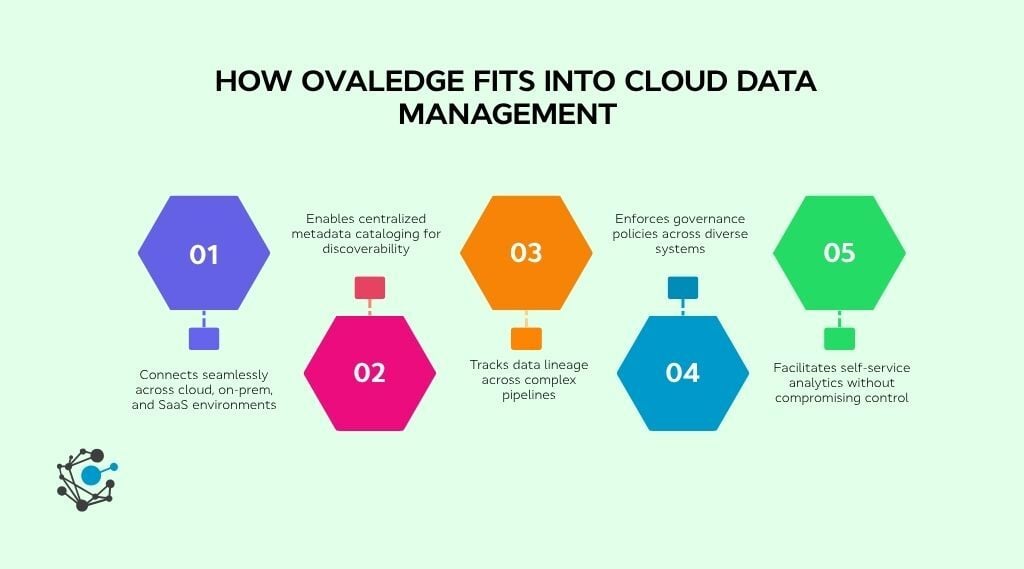
How OvalEdge fits into cloud data management

OvalEdge is not a storage or compute engine, nor does it handle raw data ingestion or transformation. Instead, it operates as the intelligence and governance layer across your data ecosystem. 

In a cloud data management platform, this role is particularly critical when enterprises are managing distributed, multi-cloud, and hybrid environments where data governance and visibility often break down.

OvalEdge addresses these gaps by enabling organizations to bring structure, compliance, and trust to their data assets, regardless of where they reside.

info 1

1. Connects seamlessly across cloud, on-prem, and SaaS environments

Enterprises typically operate across multiple public cloud providers like AWS, Azure, and Google Cloud, while retaining legacy systems on-premises and using a wide range of SaaS applications. This creates silos that make unified data governance difficult to achieve.

OvalEdge integrates with all major cloud storage and processing platforms, on-prem databases, and commonly used business applications. Its interoperability allows organizations to map their entire data landscape without centralizing the data itself. 

This capability is particularly useful in industries like healthcare or financial services, where data residency, security, and sovereignty requirements prevent full migration to the public cloud.

2. Enables centralized metadata cataloging for discoverability

As data volume grows, so does the difficulty of understanding what data exists, who owns it, and how it should be used. 

OvalEdge provides a centralized metadata catalog, which automatically crawls and indexes metadata from connected systems. This includes data structure, lineage, usage frequency, classification tags, and sensitivity levels.

By unifying this metadata in a searchable interface, organizations can eliminate duplicate efforts, reduce reliance on tribal knowledge, and accelerate data-driven decision-making.

Data engineers, analysts, and compliance officers can find the datasets they need with full context, reducing bottlenecks in analytics workflows.

3. Tracks data lineage across complex pipelines

Data lineage has become a non-negotiable feature for enterprises dealing with auditability, compliance, or AI model transparency. 

OvalEdge captures both technical lineage (which systems and pipelines data moves through) and business lineage (how data relates to business processes and definitions).This visibility helps teams understand the impact of upstream changes, pinpoint root causes of data quality issues, and respond more effectively to regulatory audits. 

For example, when preparing for GDPR audits, having documented lineage allows privacy officers to trace the origin and transformation path of personal data, aiding in right-to-access or right-to-erasure requests.

4. Enforces governance policies across diverse systems

Cloud environments often rely on decentralized teams working across dozens of tools, which can lead to inconsistent enforcement of access policies and security protocols. OvalEdge allows organizations to define and enforce centralized governance policies, including:

  • Role-based access controls (RBAC)

  • Data masking for sensitive fields

  • Approval workflows for access requests

  • Policy-based alerts for non-compliant data usage

These governance controls can be applied regardless of whether the data is stored in Snowflake, Oracle, or Amazon S3, enabling consistent enforcement across the data estate.

This not only strengthens compliance posture but also reduces the burden on security teams to manually monitor access and usage.

5. Facilitates self-service analytics without compromising control

Data democratization is a core objective for many organizations, but it often leads to chaos when users are given unrestricted access to datasets they don’t fully understand. OvalEdge bridges this gap by giving business users controlled, contextualized access to data.

Through the platform’s interface, users can search for datasets, view definitions, see lineage, and understand data quality metrics before they ever query the data. 

Access is governed by role-based permissions, ensuring sensitive information remains protected while still enabling faster insights.

This self-service model reduces the dependency on central data teams and allows analysts, marketers, and product managers to independently explore and analyze data with confidence in its accuracy and provenance.

OvalEdge complements cloud-native data platforms by acting as the governance and metadata intelligence layer. While tools like BigQuery or Databricks handle data storage and processing, OvalEdge ensures that the data within these systems is discoverable, trusted, and used in line with compliance standards.

How to choose the right cloud data management platform

The decision to adopt a cloud data management platform is about aligning tools with your operational realities, regulatory obligations, and growth ambitions. The right platform should enable not only seamless data storage and processing but also governance, analytics agility, and cross-environment integration.

Below are four essential steps to guide a high-impact evaluation and selection process.

1. Assess current data landscape and business requirements

You need to begin with a detailed audit of your existing data ecosystem. This step is not about technology for its own sake, but about framing the selection in terms of what your business needs now and what it will demand in the future.

Key areas to evaluate:

  • Data location and structure: Identify whether your data lives in SaaS platforms, on-prem databases, cloud storage buckets, or distributed edge devices. The more fragmented it is, the more critical unified governance becomes.

  • Latency and analytics expectations: Do you require real-time decisioning (e.g., fraud detection, personalization engines), or is batch processing sufficient for your reporting cycles?

  • Regulatory and risk profile: Consider industry-specific obligations such as HIPAA in healthcare, GDPR for European users, or data localization laws in finance and the public sector. These will directly influence architectural choices like region-specific hosting and encryption protocols.

  • Strategic priorities: Are you preparing for AI-driven services, enabling self-service analytics, or consolidating infrastructure to cut operational costs? These goals will determine which platforms offer real functional alignment.

Many enterprises assume they need a full platform overhaul, but later find that their real bottlenecks lie in poor data visibility, weak governance, or a lack of lineage. These issues can be solved with a governance layer like OvalEdge on top of their existing stack.

2. Build a vendor shortlist based on use cases and compliance needs

Once your internal needs are mapped, begin shortlisting vendors whose strengths directly correspond to your use cases. This is where alignment matters more than general popularity.

Evaluation criteria should include:

  • Industry alignment: Some platforms are tuned for high-compliance sectors, while others cater to AI-first use cases.

  • Hybrid and multi-cloud flexibility: If you operate across AWS, Azure, GCP, and on-prem, choose a platform that can integrate across clouds with consistent policy enforcement and data lineage.

  • Scalability and elasticity: Ensure the platform can scale with data volume and complexity without requiring constant architectural changes. Platforms like Snowflake and BigQuery offer separation of storage and compute to support elastic scaling.

  • Interoperability and vendor lock-in: Check whether the platform supports open standards, APIs, and connectors. Vendor-agnostic tools reduce migration risk and future-proof your investments.

  • Pricing model transparency: Understand whether you're billed by compute hours, storage volume, or query frequency. Predictability is critical to avoiding runaway costs.

3. Run a pilot or proof of concept

Before committing to full deployment, run a targeted pilot project. The goal is not just to validate vendor promises, but to observe how the platform behaves under real-world conditions and workloads.

Recommended test areas:

  • Ingestion success rates: Can the platform connect to your critical data sources like ERP systems, SaaS apps, and operational databases, without requiring excessive engineering overhead?

  • Query performance and workload optimization: Evaluate how quickly users can query high-volume datasets. Measure concurrency handling and performance under load.

  • Governance workflows: Test metadata cataloging, data classification, policy creation, access management, and data masking. These are often the weakest links in platforms that focus heavily on analytics but overlook control.

  • Usability across teams: Engineers, analysts, compliance teams, and business users all interact differently with data. The platform should support varying user needs without adding complexity.

This process provides tangible benchmarks and internal stakeholder buy-in while reducing the risk of misalignment between platform capabilities and operational needs.

4. Plan for future growth

The capabilities you need today are just the beginning. A modern cloud data management platform must support long-term flexibility across data scale, geographic reach, analytics maturity, and automation readiness.

Look for:

  • Support for real-time streaming: Platforms should accommodate not just scheduled ETL but also streaming ingestion from Kafka, Pub/Sub, or IoT devices. This is vital for use cases like fraud prevention, dynamic pricing, and operational intelligence.

  • ML/AI integration: Choose platforms that integrate with popular machine learning frameworks and support model versioning, governance, and real-time inference.

  • Cross-cloud and global expansion: Ensure the platform can operate across regions with built-in support for data residency laws, regional failover, and cross-cloud sync.

  • Governance compatibility: As data complexity increases, centralized oversight becomes essential. Tools like OvalEdge can plug into multi-platform environments to manage metadata, enforce policies, and visualize lineage across systems.

Choosing the right cloud data management platform is a strategic decision, but it’s often approached for the wrong reasons. Many organizations rush the choice based on surface-level signals rather than long-term impact.

You should not choose a platform based on:

  • Brand familiarity or vendor marketing alone

  • Who offers the lowest upfront cost or the most storage

  • Assumptions that a single cloud provider will meet every future need

  • Short-term performance benchmarks without governance maturity

These factors may influence convenience, but they rarely determine whether a platform will scale, stay compliant, or support growing data complexity.

Conclusion

It’s important to recognize that data management and data governance are not the same thing. Data management handles the basics like ingesting data, storing it, processing it, and making it available for analytics. 

It’s foundational and necessary, but it only answers the question, “Can we manage our data?” Data governance answers the harder questions like:

  • Who should access this data?

  • Is it compliant with regulations?

  • Can we trace where it came from and how it’s used?

  • Can multiple teams collaborate without creating risk or confusion?

As data volumes grow, teams expand, and regulatory pressure increases, governance becomes the natural and urgent next step after basic data management. 

It’s what allows organizations to scale safely, maintain trust in their data, and enable self-service analytics without losing control.

A modern cloud data strategy succeeds when management and governance work together. One provides the operational foundation, while the other ensures accountability, compliance, and long-term sustainability.

Managing data is only the beginning. 

OvalEdge helps organizations answer the harder governance questions across access, compliance, lineage, and collaboration, without slowing teams down. 

See how governance fits naturally into your cloud data strategy with a quick OvalEdge product demo

FAQs

1. How is a cloud data management platform different from traditional data management?

Traditional data management relies on on-prem systems with limited scalability. A cloud data management platform is cloud-native, scalable, supports real-time data, and manages data across hybrid and multi-cloud environments with built-in automation and governance.

2. What is the difference between data management and data governance?

Data management focuses on storing, integrating, processing, and maintaining data. Data governance defines policies, ownership, access controls, and compliance rules to ensure data is used securely, consistently, and responsibly across systems.

3. Does data management include regulatory compliance?

Yes, modern cloud data management platforms support compliance by enabling access controls, encryption, data lineage, retention policies, and audit logs, which help organizations meet regulations like GDPR, HIPAA, and SOC 2.

4. Is a cloud data management platform the same as a data warehouse?

No. A data warehouse is a storage and analytics component. A cloud data management platform is broader, covering ingestion, integration, governance, security, lifecycle management, and orchestration across multiple data systems.

5. Who typically uses a cloud data management platform within an organization?

These platforms are used by data engineers, analytics teams, governance leaders, security teams, and IT operations, each relying on different capabilities such as pipelines, catalogs, access controls, and monitoring.

6. When is the right time to adopt a cloud data management platform?

It’s time when data becomes fragmented across tools, analytics slow down, compliance risks increase, or teams struggle with visibility, access control, and trust in data across cloud and hybrid environments.

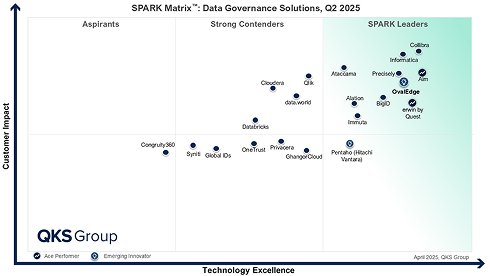
OvalEdge recognized as a leader in data governance solutions

SPARK Matrix™: Data Governance Solution, 2025
Final_2025_SPARK Matrix_Data Governance Solutions_QKS GroupOvalEdge 1
Total Economic Impact™ (TEI) Study commissioned by OvalEdge: ROI of 337%

“Reference customers have repeatedly mentioned the great customer service they receive along with the support for their custom requirements, facilitating time to value. OvalEdge fits well with organizations prioritizing business user empowerment within their data governance strategy.”

Named an Overall Leader in Data Catalogs & Metadata Management

“Reference customers have repeatedly mentioned the great customer service they receive along with the support for their custom requirements, facilitating time to value. OvalEdge fits well with organizations prioritizing business user empowerment within their data governance strategy.”

Recognized as a Niche Player in the 2025 Gartner® Magic Quadrant™ for Data and Analytics Governance Platforms

Gartner, Magic Quadrant for Data and Analytics Governance Platforms, January 2025

Gartner does not endorse any vendor, product or service depicted in its research publications, and does not advise technology users to select only those vendors with the highest ratings or other designation. Gartner research publications consist of the opinions of Gartner’s research organization and should not be construed as statements of fact. Gartner disclaims all warranties, expressed or implied, with respect to this research, including any warranties of merchantability or fitness for a particular purpose. 

GARTNER and MAGIC QUADRANT are registered trademarks of Gartner, Inc. and/or its affiliates in the U.S. and internationally and are used herein with permission. All rights reserved.

Find your edge now. See how OvalEdge works.