Most organizations begin with centralized data governance to maintain control, consistency, and compliance. This approach works well in structured environments, but as data ecosystems expand across domains and platforms, it begins to slow down. Governance workflows become rigid, access delays increase, and accountability becomes harder to enforce across distributed teams.
Federated data governance models are gaining traction as organizations look for more scalable approaches.
According to the 2025 State of Enterprise Data Governance Report, 36% of organizations use federated models, matching centralized approaches at 36%, while 29% adopt hybrid structures.
This even distribution shows that no single model dominates, with choices driven by organizational complexity and data maturity.
At the same time, fully decentralized models introduce inconsistencies and fragmented standards. This growing tension has led to the rise of federated data governance, which balances centralized oversight with domain-level ownership.
This guide explains how federated governance works, why it is gaining traction, and how organizations can implement it effectively at scale.
What is federated data governance?
Federated data governance is a hybrid model where data ownership is distributed across business domains, while standards and policies are defined centrally.
Instead of a single team controlling everything, governance becomes a shared responsibility. Domain teams manage their own data, but they operate within a common framework.
This approach solves a core problem. Centralized governance ensures consistency but limits speed. Decentralized governance enables speed but risks fragmentation. Federated governance brings structured autonomy.
Federated governance model explained in simple terms
At its core, the federated governance model is about dividing responsibility without losing alignment.
The central governance team defines policies, standards, and compliance requirements. Domain teams take ownership of their data and apply those policies locally.
This creates two clear layers:
Central governance layer
-
Defines global standards and policies
-
Ensures regulatory compliance
-
Maintains enterprise-wide consistency
Domain governance layer
-
Owns and manages data assets
-
Applies governance rules
-
Maintains data quality within the domain
What makes this powerful is accountability. Instead of governance being “someone else’s job,” it becomes embedded within business domains.
How federated governance differs from decentralized governance
Federated and decentralized governance both distribute responsibility, but they are not the same.
Decentralized governance removes central control almost entirely. Each domain operates independently, which often leads to inconsistent definitions, duplicated efforts, and challenges in maintaining enterprise-wide trust in data.
Federated governance, on the other hand, retains a structured backbone that ensures alignment while still enabling domain-level autonomy.
|
Aspect |
Federated governance |
Decentralized governance |
|
Governance structure |
Hybrid with central standards |
Fully distributed |
|
Policy enforcement |
Consistent across domains |
Varies by domain |
|
Data ownership |
Domain-owned with oversight |
Fully domain-owned |
|
Standardization |
High |
Low |
|
Scalability |
Controlled scaling |
Fragmented scaling |
|
Use case |
Large enterprises |
Highly autonomous teams |
Federated governance ultimately enables organizations to scale data ownership across domains without losing control over standards, definitions, and compliance.
Why organizations are moving to federated data governance
Organizations are rethinking governance models as data environments become more distributed and complex. The shift toward federated governance reflects a need to scale data ownership without losing consistency, control, or trust.
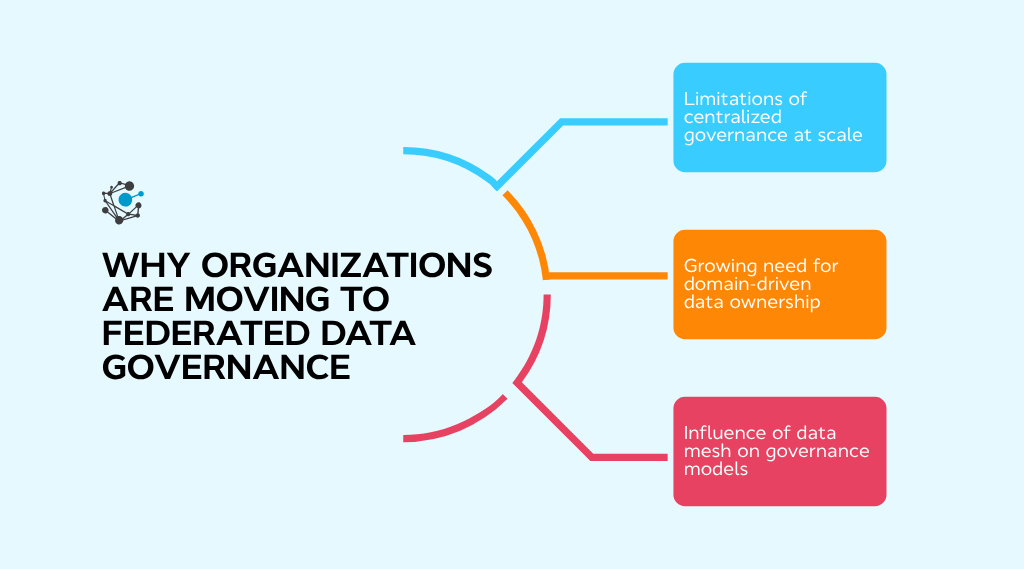
Limitations of centralized governance at scale
Centralized governance models are effective in controlled environments, but they struggle as data ecosystems expand across multiple systems, teams, and domains. What once ensured consistency begins to introduce friction when demand for data access increases.
As data volumes grow, central teams become bottlenecks for approvals, policy enforcement, and issue resolution. This leads to:
-
Delayed access to data required for analytics
-
Slower turnaround times for governance processes
-
Reduced agility in responding to business needs
Over time, these inefficiencies push teams to work around governance instead of within it, creating inconsistencies and weakening data trust.
Growing need for domain-driven data ownership
Organizations today are structured around business domains such as finance, marketing, and operations, each with unique data requirements and context. Centralized teams often lack the depth needed to manage this complexity effectively.
Giving ownership to domain teams brings governance closer to the source of data. This results in faster decision-making, improved data quality, and clearer accountability. When responsibility sits within the domain, data is more actively maintained, validated, and aligned with business needs.
This shift also helps embed governance into everyday workflows rather than treating it as a separate, centralized function.
Influence of data mesh on governance models
The rise of data mesh has reshaped how organizations think about data ownership and architecture. It promotes a decentralized approach where domains own their data and treat it as a product with defined quality and usability standards.
Key principles include:
-
Domain-oriented ownership of data
-
Treating data as a product with accountability
-
Decentralized architecture to support scalability
Federated governance builds on these ideas by introducing structured coordination. It ensures that while domains operate independently, they follow shared policies and standards.
This balance allows organizations to scale governance effectively without creating fragmentation or inconsistency across the enterprise.
Federated vs centralized data governance
Choosing between centralized and federated data governance depends on the scale and complexity of the organization. Each model serves a different purpose, and the right choice comes down to how data is structured and used.
Centralized governance is designed for control and works well in smaller, structured environments. It ensures consistency through a single authority managing policies, access, and standards. However, as data expands across domains and platforms, this model becomes harder to sustain. Central teams face increasing pressure, leading to slower processes and bottlenecks.
Federated governance addresses this by distributing data ownership to domain teams while maintaining centralized standards. This allows organizations to scale governance without losing alignment or control.
The comparison between the two models is best understood through key decision factors:
-
Control vs autonomy: Centralized models prioritize control, while federated models enable domain-level autonomy
-
Scalability vs consistency: Centralized governance ensures consistency but struggles to scale, whereas federated governance scales while maintaining consistency through shared standards
-
Speed vs governance rigor: Centralized models enforce strict processes, while federated models improve speed without completely sacrificing governance discipline
|
Aspect |
Centralized governance |
Federated governance |
|
Decision-making |
Central authority controls decisions |
Distributed across domains |
|
Data ownership |
The central team owns the data |
Domain teams own data |
|
Scalability |
Limited as complexity grows |
High scalability across domains |
|
Agility |
Slower due to bottlenecks |
Faster due to autonomy |
|
Consistency |
High consistency |
Maintained through shared standards |
|
Governance model |
Top-down |
Hub-and-spoke |
|
Best suited for |
Smaller environments |
Large, complex organizations |
When federated governance may not be the right fit
Federated governance requires a certain level of maturity and coordination. It may not be suitable for:
- Smaller organizations with limited data complexity
- Teams without clearly defined data ownership or roles
- Environments where governance processes are still evolving
In such cases, a centralized approach can provide the structure needed before transitioning to a federated model.
Centralized governance prioritizes uniformity and tight control, making it suitable for simpler data environments. Federated governance, in contrast, enables organizations to scale data ownership and operations across domains while preserving alignment through shared standards, making it better suited for modern, distributed data ecosystems.
How federated data governance works in practice
Federated governance operates through a structured division of responsibilities between central governance teams and domain-level data owners.
|
For example, a banking organization defines data access and classification policies centrally, while business units manage their own datasets. When new data is created, domain teams apply these policies directly, ensuring compliance without central approvals and enabling faster access. |
Division of responsibilities between central and domain teams
In a federated model, governance operates through a structured split of responsibilities.
The central governance team focuses on:
-
Defining governance policies and enterprise standards
-
Establishing common data definitions and frameworks
-
Ensuring regulatory and compliance alignment
Domain teams are responsible for:
-
Managing data assets within their domains
-
Applying governance standards in operational workflows
-
Maintaining data quality and usability
This structure ensures that governance decisions are guided centrally but executed locally, enabling both control and scalability.
How standards and policies are enforced across domains
Policies are defined centrally but enforced through standardized processes across domains.
Organizations operationalize this by:
-
Embedding governance rules into workflows and systems
-
Enabling shared visibility through metadata and cataloging
-
Monitoring adherence through governance frameworks
This approach reduces reliance on manual coordination and ensures consistent application of standards across distributed environments.
Role of data stewards and domain teams
Data stewards ensure that governance is actively maintained within each domain.
Their role focuses on:
-
Managing data definitions and business context
-
Monitoring and improving data quality
-
Ensuring alignment with enterprise standards
By working closely with domain teams, they embed governance into daily operations, creating shared accountability across the organization.
|
Also read: Data Stewardship Guide, a practical overview of roles, responsibilities, and best practices for managing data quality and governance. |
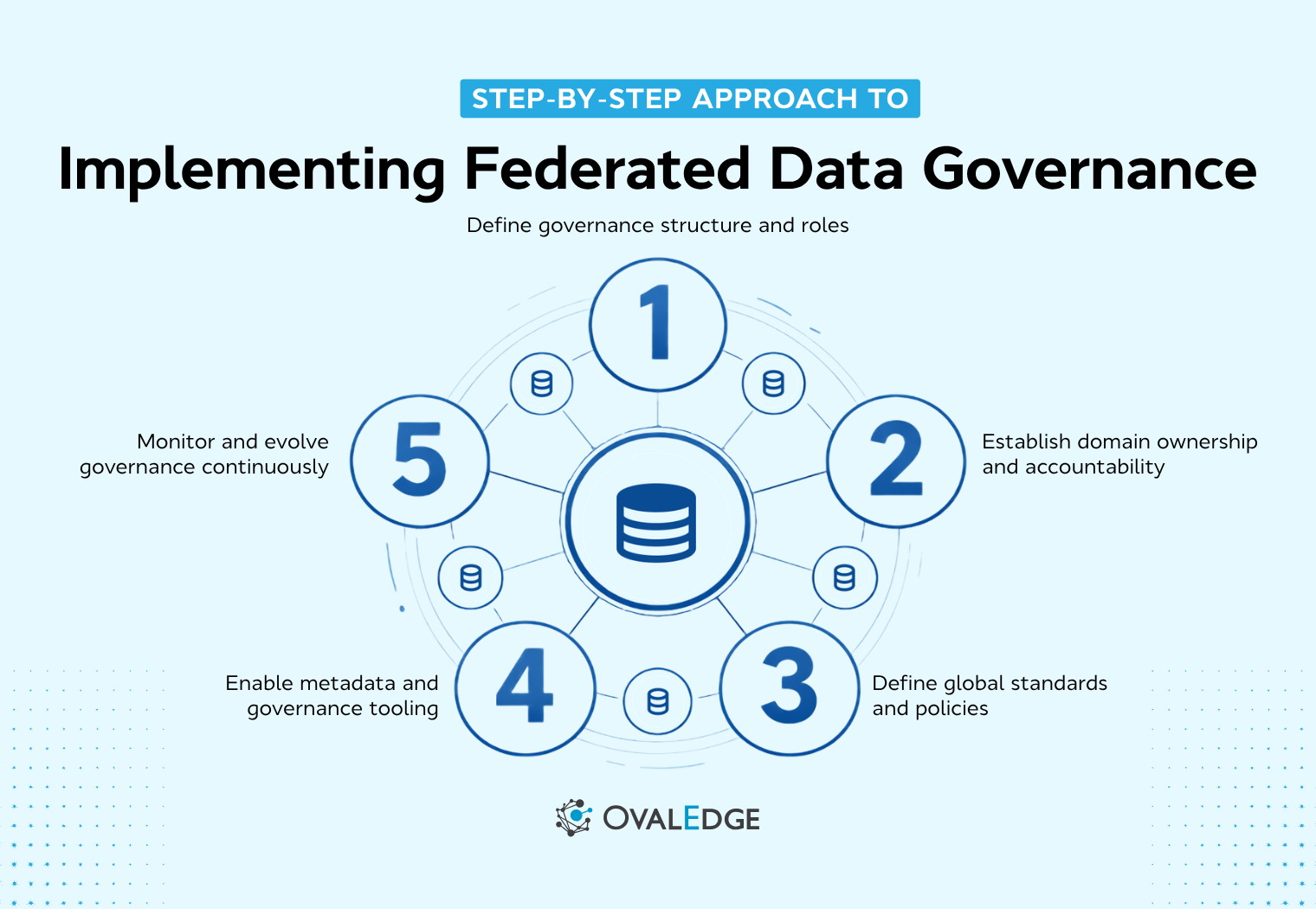
How to implement a federated data governance model
Implementing federated governance requires translating this operating model into a structured, repeatable approach across the organization.
Step 1: Define governance structure and roles
The foundation of a federated model lies in clarity of ownership. Organizations must establish a governance structure that separates strategic oversight from operational execution.
This typically includes:
-
A central governance team responsible for policies and standards
-
Domain owners are accountable for data within business units.
-
Data stewards managing definitions, quality, and consistency
Clear role definition ensures that responsibilities do not overlap and governance processes remain efficient as the organization scales.
Step 2: Establish domain ownership and accountability
Once the structure is defined, assign ownership at the domain level.
Each domain should:
-
Own its data assets and lifecycle
-
Be accountable for quality, usage, and compliance.
-
Act as the primary point of responsibility for data-related decisions
This step operationalizes ownership rather than just defining it.
|
How this works in practice: A retail organization assigns customer data ownership to its marketing domain. The domain team defines key attributes, maintains data quality rules, and resolves issues related to campaign datasets. Instead of routing requests through a central team, analysts work directly with the domain, reducing delays and improving data reliability. |
Step 3: Define global standards and policies
While ownership is distributed, consistency must be maintained through shared standards. These standards act as the common language across all domains.
Key elements include:
-
Standardized data definitions and business glossaries
-
Data quality rules and validation criteria
-
Compliance and access control policies
Establishing these centrally ensures that all domains operate within a unified governance framework, even as they manage data independently.
Step 4: Enable metadata and governance tooling
Technology enables federated governance to function at scale. Without the right tooling, enforcing standards across domains becomes difficult.
Organizations typically rely on:
-
Data catalogs to improve data discovery and visibility
-
Metadata management systems to maintain context and definitions
-
Data lineage tools to track data flow across systems
These capabilities provide the transparency needed to align domain-level execution with enterprise-wide governance standards, without introducing manual overhead.
|
Applied scenario:
A financial services company uses a data catalog to tag sensitive data fields across domains. Policies are defined centrally and applied automatically through metadata.
|
Step 5: Monitor and evolve governance continuously
Federated governance is not static. It requires continuous monitoring and refinement as data environments evolve.
Organizations should track:
-
Data quality and reliability across domains
-
Policy compliance and enforcement effectiveness
-
Adoption of governance practices within business units
Regular evaluation helps identify gaps, improve processes, and ensure that governance continues to support business needs as complexity increases.
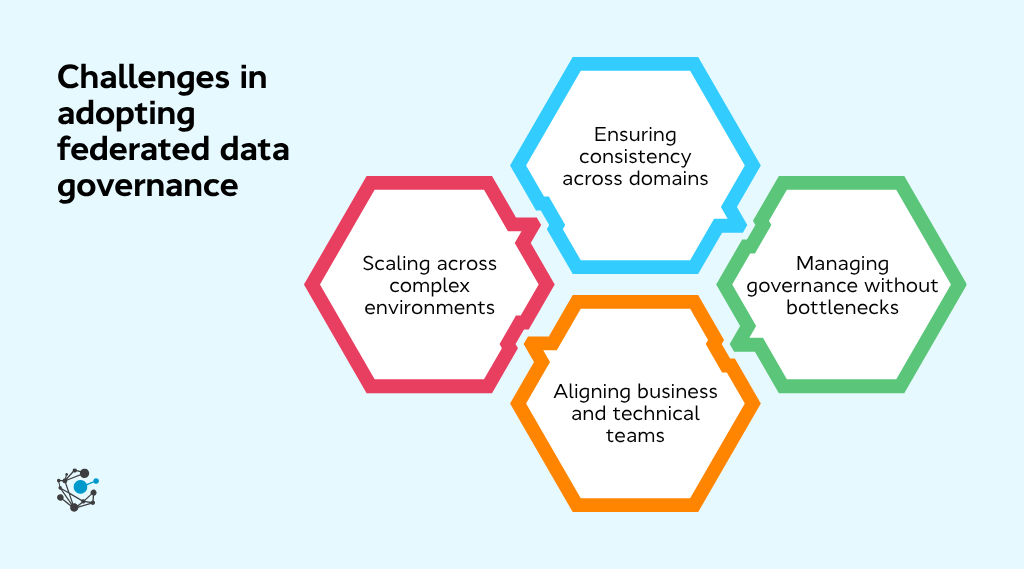
Challenges in adopting federated data governance
Federated governance improves scalability and ownership, but it also introduces new layers of complexity. Without the right structure and alignment, organizations can struggle to maintain consistency and coordination across domains.
-
Inconsistent interpretation of standards: Policies are defined centrally but executed by different domains, leading to varied interpretations. This creates inconsistencies in definitions, quality rules, and compliance practices.
-
Coordination across distributed teams: Federated models depend on collaboration across domains with different priorities. Without clear processes, governance efforts can become fragmented and slow.
-
Balancing control and autonomy: Too much central control limits domain agility, while too much autonomy reduces consistency. Striking the right balance is critical for effective governance.
-
Complexity in multi-system environments: Data is spread across multiple platforms and tools, increasing operational complexity. Maintaining consistent governance across systems becomes challenging.
-
Alignment between business and technical teams: Governance requires both business context and technical execution. Misalignment between teams leads to unclear definitions and inconsistent outcomes.
What good looks like
A well-functioning federated governance model combines clear central standards with strong domain ownership. Policies are consistently understood, and domain teams take accountability for data quality, compliance, and usage within their areas.
Governance is embedded into everyday workflows with structured communication between teams. Data quality, policy adherence, and ownership are visible and measurable, enabling organizations to scale governance without losing consistency or control.
A clear indicator of success is when every critical data asset has an identified owner, a standardized definition, and active quality monitoring in place across all domains.
How data governance platforms support federated governance
Federated governance requires a layer that connects central policies with domain-level execution. Data governance platforms enable this by creating a shared system where standards are defined once and applied consistently across domains.
These platforms provide:
-
Centralized metadata for a unified understanding of data
-
Data catalogs for discovery and accessibility
-
Business glossaries for consistent definitions
-
Policy management for standardized enforcement
-
Data lineage for visibility into data flow and impact
Together, these capabilities ensure that governance is applied consistently without relying on manual coordination, allowing domain teams to operate independently while staying aligned with enterprise standards.
|
How OvalEdge enables federated governance at scale Platforms like OvalEdge support this model by bringing metadata, governance, and data quality into a unified environment. This helps organizations maintain visibility and coordination across domains without restricting autonomy. |
Quick checklist for evaluating governance platform readiness
|
In distributed environments, this approach ensures governance remains consistent, scalable, and aligned even as data ownership expands across domains.
Conclusion
Federated data governance represents a shift toward managing data at scale while maintaining consistency and control. As data environments become more distributed, balancing centralized standards with domain ownership is essential for enabling both agility and trust.
Successful implementation depends on a structured approach. Organizations typically begin by identifying key domains, defining ownership, and establishing shared standards that guide governance across teams. A phased rollout helps build a scalable and sustainable model without disrupting existing processes.
When governance processes create bottlenecks, delay access, or lead to inconsistencies, federated governance provides a practical alternative. Platforms like OvalEdge support this model by integrating metadata, governance, and data quality into a unified system.
To understand how federated governance can be implemented effectively, explore OvalEdge’s capabilities and book a demo for a detailed walkthrough.
FAQs
1. How does federated data governance impact data security and access control?
Federated governance improves security by assigning access control to domain teams while enforcing central policies. This ensures sensitive data is managed by those closest to it, while maintaining compliance through standardized controls, reducing risks associated with over-centralized or inconsistent access management.
2. What organizational structure is required to support federated data governance?
Organizations need a hybrid structure with a central governance team and domain-level data owners. Clear role definitions for CDOs, data stewards, and domain leads are essential to ensure accountability, coordination, and consistent policy enforcement across distributed teams.
3. How long does it take to transition from centralized to federated governance?
The transition timeline depends on organizational complexity, data maturity, and existing governance practices. Most enterprises adopt a phased approach over several months, starting with a few domains, refining governance processes, and gradually scaling the model across the organization.
4. What metrics should be tracked in a federated data governance model?
Key metrics include domain-level data ownership coverage, policy compliance rates, data quality improvements, and time to resolve data issues. Organizations also track adoption metrics, such as how effectively domain teams manage governance responsibilities and adhere to shared standards.
5. How does federated governance support multi-cloud and hybrid environments?
Federated governance aligns well with multi-cloud strategies by allowing domain teams to manage data within their respective environments while following centralized policies. This flexibility ensures consistent governance across diverse platforms without restricting operational independence.
6. What skills do teams need to successfully adopt federated data governance?
Teams need a mix of business and technical expertise, including data stewardship, metadata management, policy design, and domain knowledge. Strong collaboration skills are critical, as federated governance relies on coordination between central teams and distributed domain owners.
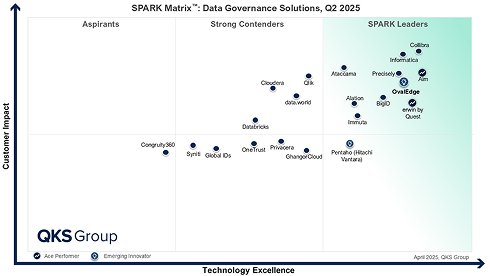
.png?width=1081&height=173&name=Forrester%201%20(1).png)
.png?width=1081&height=241&name=KC%20-%20Logo%201%20(1).png)