Access risk builds quietly: analysts inherit roles they no longer need, file shares stay open after projects end, and AI assistants can surface anything a user is technically allowed to see.
Data access governance tools discover sensitive data, map who can reach it, and enforce least privilege through policy and review workflows. The ten platforms below fall into three groups: data-platform governance, identity-led governance, and file-focused governance, with best fit and limits for each.
What is data access governance?
Data access governance (DAG) is the practice of discovering where sensitive data lives, mapping who can access it, and enforcing policies that keep access limited to what each person or system needs. It combines classification, entitlement analysis, access reviews, and audit reporting into one continuous control.
DAG overlaps with two neighboring categories:
|
Category |
Primary question |
Typical tools |
|
Identity governance and administration (IGA) |
Which applications and roles should this person have? |
SailPoint, Saviynt, One Identity |
|
Data access governance (DAG) |
Who can reach this sensitive data, and should they? |
Varonis, Netwrix, Immuta, OvalEdge |
|
Data security posture management (DSPM) |
Where is sensitive data exposed or misconfigured? |
BigID, Microsoft Purview, Sentra |
Most enterprises run more than one. IGA governs the person, DSPM finds the exposure, and DAG enforces what happens between the person and the data."
Also read: Top data governance platforms compared
Top data access governance tools and software in 2026
The tools are grouped by access model, starting with platforms that govern structured data and analytics, then identity-led platforms, then file-focused tools.
|
Tool |
Access model |
Primary data coverage |
Best for |
|
OvalEdge |
Data-platform governance |
Warehouses, lakes, BI tools |
Catalog, lineage, and access policy in one platform |
|
Immuta |
Data-platform governance |
Snowflake, Databricks, Redshift, BigQuery |
Policy-as-code across data platforms |
|
Securiti |
Data-platform governance |
Multicloud, SaaS, data platforms, AI systems |
AI-aware access and cross-border privacy |
|
BigID |
DSPM-led |
Cloud, SaaS, hybrid, on-prem, AI environments |
Access risk scored against data sensitivity |
|
SailPoint |
Identity-led |
File shares, SharePoint, OneDrive |
Extending existing SailPoint IGA to data |
|
Saviynt |
Identity-led |
Cloud, SaaS, IaaS, PaaS |
Cloud-first identity plus data access |
|
Varonis |
File-focused |
M365, NAS, Google Drive, Box |
Permission cleanup at scale |
|
Netwrix |
File-focused |
File servers, NAS, cloud storage |
Audit-ready access visibility |
|
OpenText |
File-focused |
Windows file servers, NAS, M365 |
Legacy file share governance |
|
Microsoft Purview |
DSPM-led |
Microsoft 365 and Microsoft-centric estates |
Organizations standardized on Microsoft |
Disclosure: Our platform, OvalEdge, is scored on the same criteria as every other tool.
Which DAG tool fits your situation?
-
Unified platform with catalog and access governance: OvalEdge
-
Extending existing identity governance to data: SailPoint or Saviynt
-
Permission sprawl in files and Microsoft 365: Varonis or Netwrix
-
Legacy Windows file servers and network shares: OpenText
-
Policy-as-code across Snowflake, Databricks, BigQuery: Immuta
-
AI and LLM access controls plus multicloud privacy: Securiti
-
Access risk scored against data sensitivity across hybrid and AI environments: BigID
-
Posture, DLP, and access risk in one console for Microsoft-centric estates: Microsoft Purview
Behavior-Driven Governance and Least-Privilege Auditing
Behavior-driven governance is an access review model that uses actual usage to decide whether access should stay. One Identity introduced the approach in its identity platform: application-usage events from OneLogin feed Identity Manager, which then recommends revoking applications a user has not opened within a set period, such as 90 days. Static roles drift out of date, and usage data shows which grants nobody exercises.
The approach operationalizes continuous least-privilege auditing through:
-
Continuous monitoring of access behavior with risk-based scoring
-
Mapping granted access against actual usage to identify over-provisioning
-
Automated permission remediation
-
Audit-ready compliance reporting
Tools mentioned as supporting this model include Varonis, Securiti, and SailPoint. At the data layer, the same principle applies to warehouse tables, columns, and dashboards, where query history shows which grants no analyst has used.
1. OvalEdge
OvalEdge is a data governance platform that makes access decisions with full context on the data involved. Its Enterprise Context Graph links every table, column, and dashboard to its classification, owner, lineage, and access policy, so approvals and enforcement reflect what the data is and who is accountable for it.
Key features:
-
Fine-grained RBAC: Column- and row-level data access control, enforced across platforms through the connector layer.
-
Sensitive data classification with Sift: Identifies PII, PHI, financial, and custom sensitive data, and ties each classification to an access policy.
-
Owner-routed approvals: Helm assigns business owners and stewards. Access requests route to them through Jira and ServiceNow, and every approval is logged and enforced.
-
Masking and privacy workflows: Masking for sensitive fields, plus DSAR and ROPA workflows for GDPR, CCPA, and HIPAA.
-
Governed AI access: An MCP server exposes governed context to Claude, ChatGPT, and custom agents, so agents only see what they are allowed to see.
-
Connectivity: 170+ pre-built connectors, including Snowflake, BigQuery, Tableau, ServiceNow, and Jira.
Why it stands out: Most DAG tools start from identities or file permissions. OvalEdge starts from the data itself, so a request for a customer table arrives with its sensitivity, lineage, and owner already attached, and the approval goes to the person accountable for that data.
Best for: Data and analytics teams that need governed self-service access to warehouses, lakes, and BI tools, with privacy-aware policies and owner-routed approvals.
Where it falls short: Joiner-mover-leaver provisioning and application entitlements stay with an IGA platform such as SailPoint or Saviynt. Teams whose main risk is NAS or Microsoft 365 permission sprawl should confirm source coverage during evaluation.
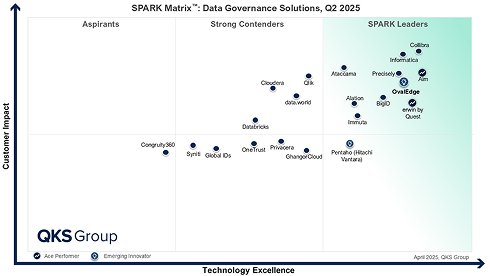
A Forrester Total Economic Impact study found 337% ROI for OvalEdge customers, with analyst productivity improving by up to 30%. OvalEdge is also recognized in the 2025 Gartner Magic Quadrant for Data and Analytics Governance Platforms. The Forrester Total Economic Impact study was commissioned by OvalEdge.
2. Immuta
Immuta is built for modern data teams enforcing fine-grained, dynamic controls across Snowflake, Databricks, Redshift, and BigQuery through policy-as-code governance without hardcoding rules.
Key features:
-
Attribute-based access control: Row-, column-, and purpose-based access.
-
Policy-as-code: Written in natural language or code, applied across platforms.
-
Data discovery and classification: Powers access policies automatically.
-
Real-time enforcement: Applied at query time without manual replication.
-
Unified auditing: Captures detailed access logs and policy application.
Best for: Data platform teams enforcing fine-grained, policy-as-code access without modifying analytics pipelines.
Where it falls short: Immuta governs structured data platforms only, so file shares, SaaS entitlements, and identity lifecycle stay outside its scope. Policy-as-code also assumes a data engineering team comfortable writing and maintaining those policies.
3. Securiti
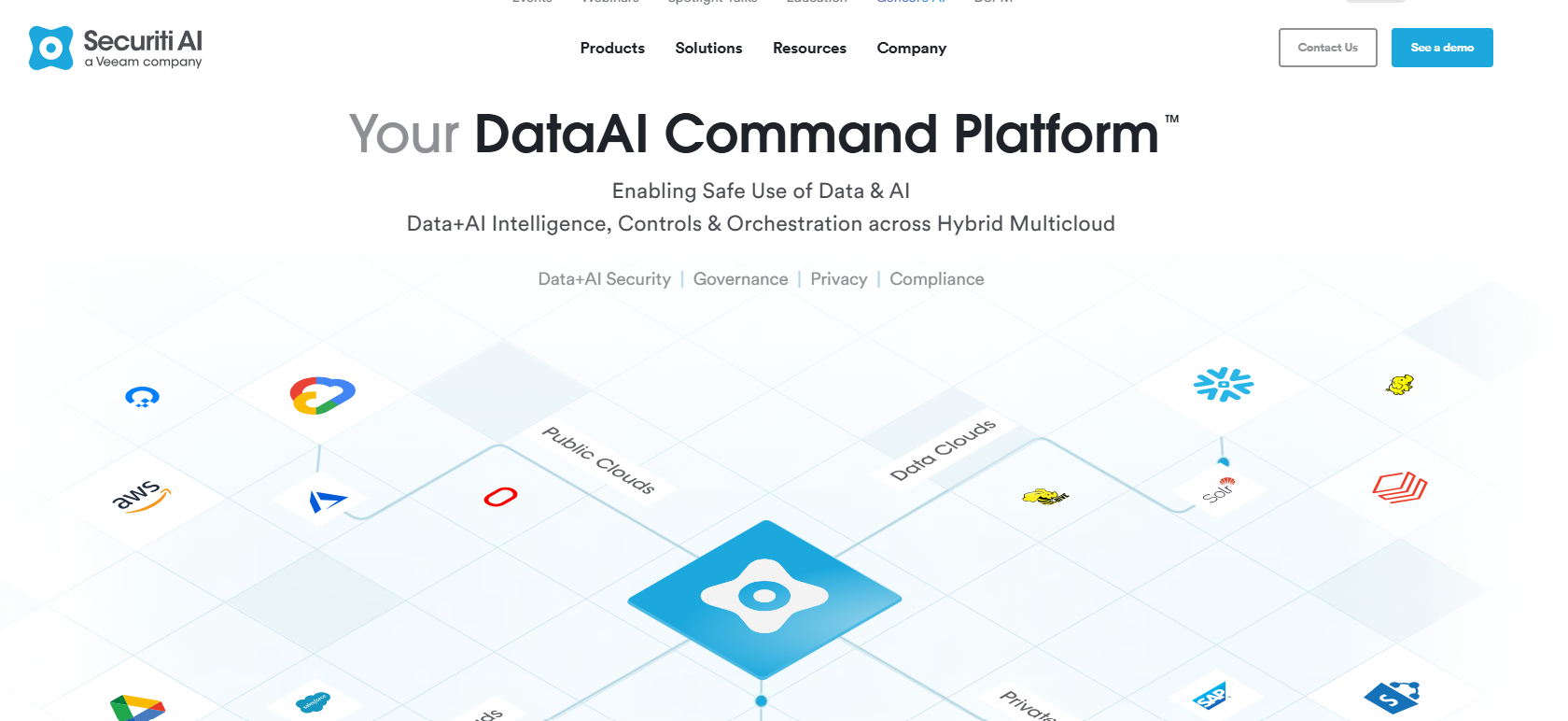
Securiti is an AI-powered, multicloud data access governance platform spanning structured and unstructured data, SaaS, and AI systems, with granular controls preventing least-privilege violations and AI data leakage.
Key features:
-
Attribute-based access controls: Uses hundreds of attributes to set policy.
-
LLM and copilot safeguards: Context-aware firewalls prevent AI data leakage.
-
Dynamic masking and row-level filters: Apply real-time obfuscation.
-
Policy orchestration: Centrally manages enforcement across clouds and platforms.
-
Cross-border privacy alignment: Covers GDPR, CPRA, and DPDP 2023.
Best for: AI-aware, multicloud access governance across Snowflake, BigQuery, and Salesforce with cross-border controls and LLM safeguards.
Where it falls short: Securiti's breadth across AI, multicloud, and privacy comes at the cost of depth in any one area. Teams that need warehouse-native, policy-as-code enforcement as their primary use case may find a specialist like Immuta a tighter fit.
4. BigID
BigID approaches data access governance from data security posture management. It connects identities, permissions, activity, ownership, and sensitive data exposure to show who has access to what and where the risk sits.
Key features:
- Excessive access detection: Identifies users, groups, service accounts, machine identities, and AI systems with more access than they need.
- Risk prioritization: Ranks access risk by data sensitivity, permission severity, identity type, activity, ownership, and exposure.
- Remediation support: Assigns ownership, delegates review workflows, and helps teams reduce excessive access.
- Broad coverage: Operates across cloud, SaaS, hybrid, on-prem, and AI environments.
Best for: Security teams that want access risk scored against data sensitivity across hybrid estates.
Where it falls short: Confirm native revocation support for each source system during evaluation, since remediation depends on integrations with the platforms where permissions live.
5. SailPoint
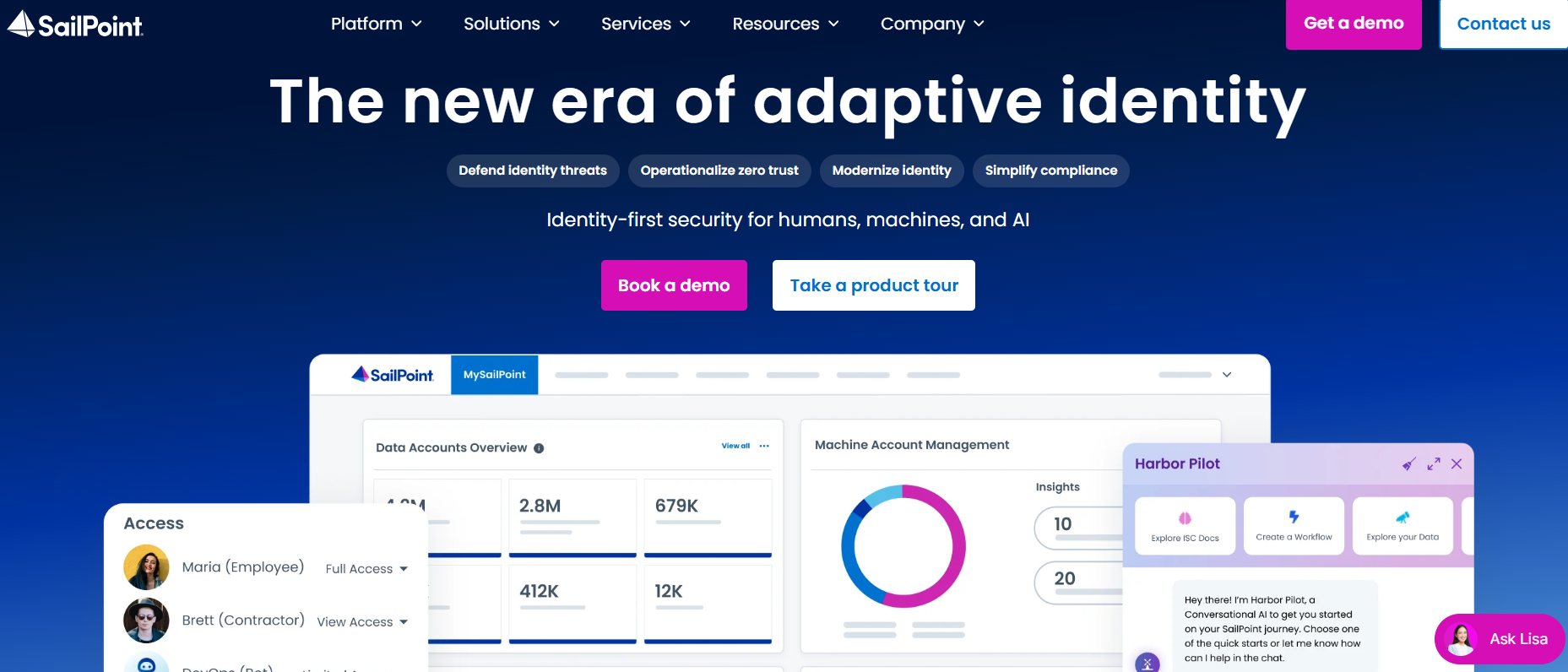
SailPoint extends identity security into unstructured data governance, discovering, classifying, and controlling access to sensitive files across shared drives, SharePoint, and OneDrive. DAG capabilities integrate with identity governance.
Key features:
-
Unstructured data discovery: Across Microsoft 365, file servers, and cloud storage.
-
Entitlement visibility: Maps permissions to identities, roles, and risk levels.
-
Least-privilege enforcement: Through scheduled reviews and automated remediation.
-
Policy-driven governance: Aligned with GDPR, HIPAA, and PCI-DSS.
-
Continuous risk detection: Monitors file access changes in real time.
Best for: SailPoint Identity Security Cloud customers extending governance to unstructured data across SharePoint, OneDrive, and network shares.
Where it falls short: SailPoint's data governance is an extension of its identity platform, so it fits best as an add-on for existing SailPoint customers rather than a standalone DAG purchase. Structured data in warehouses and lakes isn't the focus; unstructured files and SharePoint are.
6. Saviynt
Saviynt uses Cloud-native data access governance, combining IGA with controls across hybrid and multi-cloud environments. Discovers sensitive data, analyzes entitlements, enforces policies, and runs access certification campaigns.
Key features:
-
Cloud-native DAG: Spans SaaS, IaaS, and PaaS with built-in identity governance.
-
Sensitive data discovery: Identifies regulated data such as PII, PCI, and PHI.
-
Entitlement and risk analytics: Highlights toxic combinations and violations.
-
JIT and privileged access: Approval workflows with time-bound entitlements.
-
Access certification campaigns: Manager attestation with automation.
Best for: Cloud-first organizations unifying identity governance and data access with automated reviews and fine-grained controls for regulatory compliance.
Where it falls short: Saviynt's data access governance rides on top of a full identity governance platform, so it's a heavier deployment than a standalone DAG tool. Teams that want data governance without adopting IGA end to end may find the platform more than they need.
7. Varonis

Varonis is purpose-built for automated data access governance across SaaS, cloud file systems, and on-premises environments, identifying over-permissioned accounts and enforcing least privilege at scale.
Key features:
-
Access mapping: Shows who can access sensitive files across platforms.
-
Automated remediation: Detects excessive permissions and revokes or adjusts them based on policy.
-
Access review campaigns: Built-in workflows and alerts.
-
Activity monitoring: Tracks user behavior and file access patterns.
-
Least-privilege modeling: Simulates and applies least-privilege roles.
Best for: Cleaning up permission sprawl across M365, NAS, Google Drive, and Box with automated least-privilege enforcement a
nd continuous monitoring.
Where it falls short: Varonis's strength is unstructured and semi-structured data across files and SaaS. It doesn't natively govern structured warehouse data such as Snowflake or BigQuery, so warehouse-heavy environments need a data-platform tool alongside it.
8. Netwrix
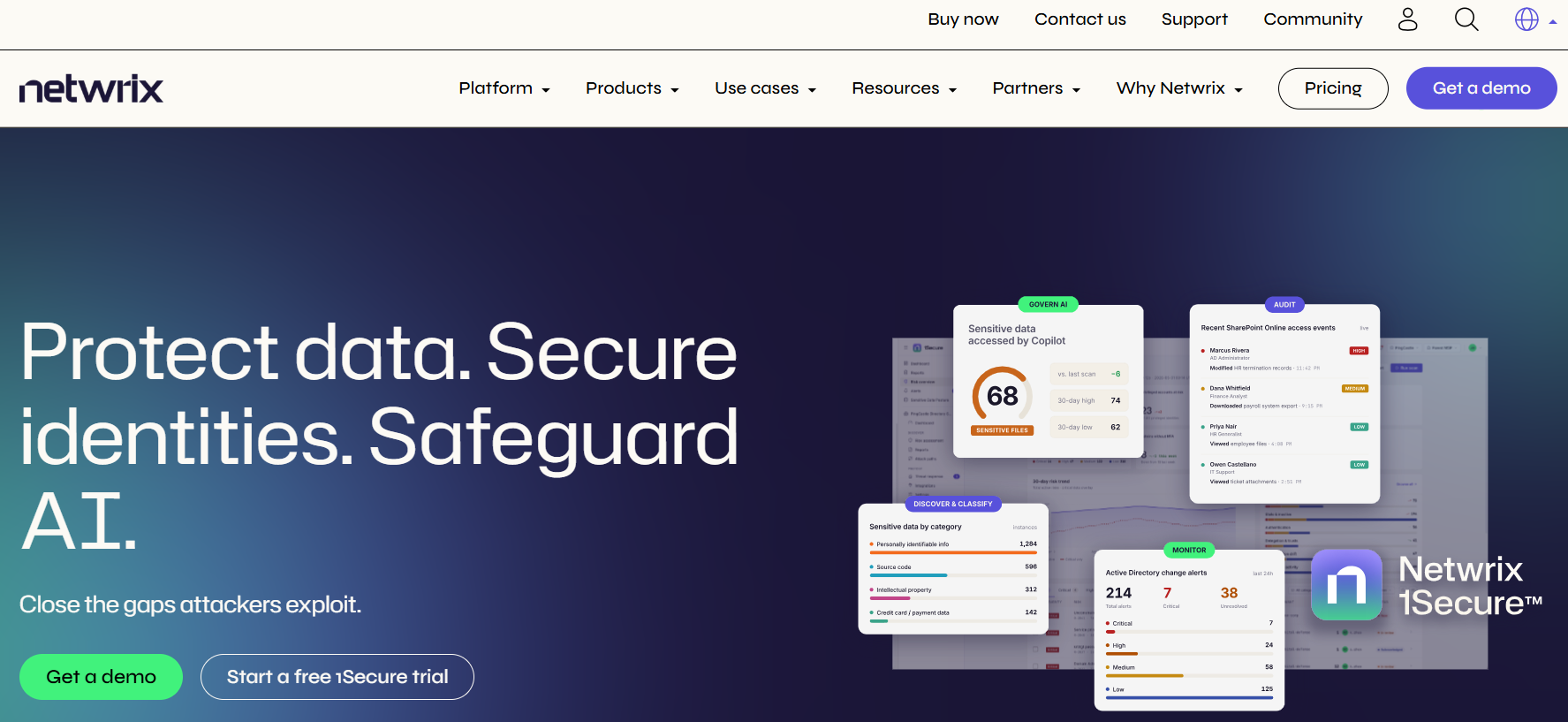
Netwrix gives Data access governance through visibility, auditing, and automation across file servers, NAS appliances, cloud storage, and select SaaS environments for practical compliance demonstration.
Key features:
-
Access inventory: Covers Windows, NAS, Synology, and Qumulo, documenting effective permissions.
-
Change auditing: Tracks permission modifications in real time.
-
Access review automation: Launches attestation campaigns and cleanups.
-
Risk identification: Surfaces over-permissioned roles, orphaned accounts, and shadow admins.
-
Compliance reporting: Templates aligned with GDPR, HIPAA, SOX, and PCI-DSS.
Best for: Audit-ready file and folder access visibility with attestation and compliance reporting requiring minimal customization.
Where it falls short: Netwrix leans toward visibility and audit reporting rather than deep automated remediation, so teams wanting active enforcement, not just detection, may need to pair it with another tool. Cloud data warehouses and broader SaaS estates sit outside its core coverage.
9. OpenText
OpenText specializes in data access governance for file systems and legacy network shares through File Reporter and File Dynamics, discovering access, flagging risks, and automating remediation.
Key features:
-
Permission discovery: Scans file servers to map structures and reveal effective permissions.
-
Access risk analysis: Identifies over-permissioned users, stale access, and orphaned accounts.
-
Automated remediation: Removes excessive permissions and applies policies at scale.
-
Policy-based workflows: Covers provisioning, cleanups, and governance.
-
Audit-ready reporting: Built for HIPAA and SOX compliance.
Best for: Bringing large legacy Windows file server and NAS estates under governance with automated discovery and remediation.
Where it falls short: OpenText is purpose-built for legacy Windows file servers and NAS, and it doesn't extend to cloud data warehouses, SaaS platforms, or AI access governance. Cloud-first organizations will need a separate tool for that coverage.
10. Microsoft Purview

Microsoft Purview combines data security posture management, data loss prevention, and insider risk controls for Microsoft-centric estates. Its DSPM shows how unprotected sensitive data is being handled and accessed, then recommends policies to close the gaps.
Key features:
-
Posture visibility: Surfaces unprotected sensitive data and how it is accessed.
-
Policy recommendations: Suggests DLP and Insider Risk Management policies, such as blocking sensitive files from being copied to other network locations.
-
AI-assisted investigation: Security Copilot prompts help investigate alerts and pinpoint top data security risks.
Best for: Organizations standardized on Microsoft 365 and Azure that want posture, DLP, and access risk in one console.
Where it falls short: Permissions in Purview's Data Map and Unified Catalog govern access to metadata, not to the underlying data, so warehouse-level access policies need another enforcement layer.
Key features to look for in a data access governance tool
.png?width=1024&height=569&name=info%201%20(3).png)
Section intro line: Five capabilities separate strong DAG tools from partial ones:
1. Discovery & classification
-
Automatic sensitive data discovery across structured, unstructured, and SaaS environments
-
Classification by type, sensitivity, and compliance requirements
-
Effective access mapping showing actual versus intended access
Also read: Compare 9 sensitive data discovery tools
2. Entitlement analytics & least-privilege enforcement
Strong tools:
-
Detect excessive entitlements, inactive accounts, toxic combinations
-
Analyze usage to recommend rightsizing
-
Automate revocation and cleanup, maintaining least-privilege
3. Fine-grained access controls
Strong tools:
- Attribute-based and role-based access control
- Row-, column-, purpose-level filters protecting contextual data
- Real-time data masking or redaction based on the user's role or data sensitivity
4. Workflow orchestration
The solution should:
-
Support request, approval, and provisioning workflows
-
Run review campaigns with ownership attestation and resolution tracking
-
Automate joiner-mover-leaver flows to reduce manual provisioning risks
5. Auditability & compliance readiness
Strong tools provide:
-
Detailed logging of access events, approvals, changes
-
Regulatory-aligned reporting for GDPR, DPDP 2023, CCPA, HIPAA, ISO 27001
-
Support for periodic certifications and policy reviews
How to choose the right data access governance tool for your business
.png?width=1024&height=569&name=Info%202%20(4).png)
1. Identify the data landscape: Start by listing where sensitive data lives: SaaS platforms, file shares, cloud warehouses, or all three. The more varied the estate, the more integration coverage matters.
2. Prioritize compliance requirements: Map the regulations that apply, such as GDPR, HIPAA, DPDP 2023, or SOX, and list the audit evidence each one requires. The right tool produces that evidence without manual assembly.
3. Assess integration capabilities: Confirm native connectors for the identity provider, data platforms, BI tools, and ticketing systems already in use. A sandbox demo on real systems exposes integration gaps faster than a slide deck.
4. Evaluate scalability and automation: Estimate the users, roles, and entitlements to govern over the next two years, then ask each vendor how usage data and automation reduce manual review work at that scale.
5. Review vendor support and roadmap: Check onboarding timelines, support SLAs, and roadmap commitments for AI access governance, since agent access is the fastest-changing requirement in this category.
Implementation & adoption best practices
1. Start with a high-risk pilot
Begin with one high-risk, visible domain (external M365 sharing or Snowflake sensitive data). Run complete cycles: discover entitlements, certify access, remediate overprovisioning, monitor drift. Phased approaches validate policies before expansion.
2. Close the human-risk gap
Automated reviews, owner-led approvals, and guided self-service access reduce mistakes without adding approval friction.
3. Operationalize policies across platforms
Convert privacy rules into technical controls using ABAC, dynamic masking, and row-level filters, working with legal and governance teams.
4. Govern AI & assistant access
AI assistants and agents query data on behalf of users, so every access policy has to hold when the requester is software. Two controls matter most:
-
Enforcement at query time: An agent inherits the permissions of the user it acts for, and every read runs under policy.
-
Governed context: The agent knows which assets are certified, sensitive, or restricted before it retrieves them.
Securiti applies LLM firewalls at the prompt and response layer. OvalEdge exposes its Enterprise Context Graph through an MCP server to Claude, ChatGPT, and custom agents, carrying classification, ownership, and access policy with each asset.
Conclusion
The right data access governance tool depends on where sensitive data lives and who needs to reach it. Identity-led platforms such as SailPoint and Saviynt extend access reviews from applications into data. File-focused tools such as Varonis, Netwrix, and OpenText clean up permission sprawl across shares and Microsoft 365. Data-platform tools such as Immuta and Securiti enforce fine-grained policies inside warehouses and multicloud estates.
OvalEdge governs access where analytics and AI run. Its Enterprise Context Graph ties every table, column, and dashboard to its classification, owner, lineage, and access policy, so approvals reach the right owner and AI agents only see what they are allowed to see.
Book a demo to see how OvalEdge enforces least-privilege access across the data estate.
.png?width=1081&height=173&name=Forrester%201%20(1).png)
.png?width=1081&height=241&name=KC%20-%20Logo%201%20(1).png)