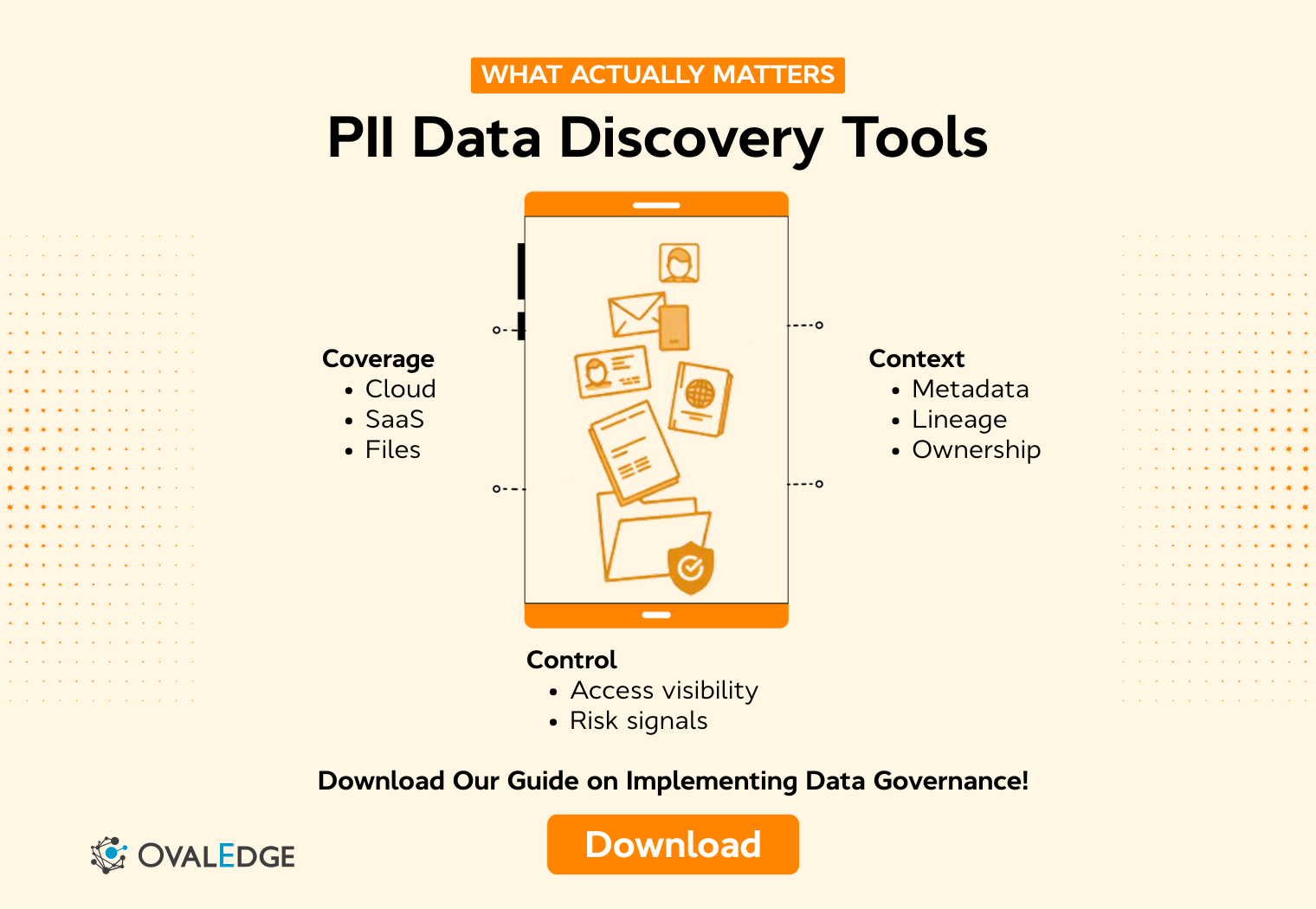
Personally identifiable information rarely stays in one place. It spreads across cloud storage, SaaS applications, shared drives, analytics platforms, and collaboration tools, often without anyone tracking where it ends up. The more distributed an environment gets, the faster PII moves beyond the reach of manual inventories and periodic audits.
Security and compliance teams feel the impact when regulators ask for evidence, when a breach requires rapid scoping, or when a data subject request demands answers about what personal data exists and who can access it. The gap is almost always the same: no reliable, current view of where PII actually lives.
Data discovery tools for PII exist to close that gap. They give teams a continuous way to find, classify, and monitor sensitive data across structured and unstructured sources, turning scattered data landscapes into searchable, defensible inventories.
In this guide, you will learn how PII discovery tools work, which platforms lead in 2026, what features matter most when evaluating, and how to measure whether your discovery program is actually reducing risk.
What are PII data discovery tools?
PII data discovery tools identify and classify personal data across cloud platforms, SaaS applications, databases, and file systems. They scan structured and unstructured sources to locate sensitive information, label it by regulation and sensitivity level, and maintain a continuously updated inventory that security and compliance teams can act on.
In practice, these tools go well beyond one-time scans. They analyze how personal data moves and changes as new systems, users, and workflows get introduced. Effective platforms help teams scan databases, data lakes, SaaS applications, and file systems without disrupting operations. They detect PII using a combination of pattern matching, machine learning, and contextual analysis. They classify sensitive data based on regulatory requirements such as GDPR, CCPA, and HIPAA. They also provide clear visibility into where PII exists and how it is accessed across the organization, supporting audits, privacy compliance, and breach prevention.
Did you know? The IBM Cost of a Data Breach Report 2024 found that the average total cost of a data breach reached USD 4.88M, which is why teams increasingly treat PII discovery as an always-on control.
What PII discovery tools do not solve on their own
Discovery alone does not eliminate privacy or security risk. Identifying where sensitive data exists is only the first step. Without the right operational layers around it, several gaps remain:
-
Ownership stays unassigned. Discovery can surface PII, but it cannot decide who owns that data or who approves access, retention, or remediation actions.
-
Over-permissioned access persists. Tools may flag risky access patterns, but reducing exposure still requires governance policies, access reviews, and enforcement workflows.
-
Business context is missing. Detection engines identify data types, not intent. Without metadata, lineage, and business context, teams struggle to distinguish high-risk datasets from low-impact ones.
-
Compliance obligations remain open. Regulations like GDPR and CCPA require evidence of ownership, controls, and ongoing oversight. Discovery supports these requirements but does not replace the governance processes needed to demonstrate accountability.
-
Future sprawl continues unchecked. Continuous discovery can detect new PII as it appears, but without standards and controls, sensitive data keeps spreading across systems.
Mature organizations treat PII discovery as a foundational capability, not a standalone solution. When discovery connects to metadata, ownership, access controls, and policy enforcement, visibility turns into action and compliance becomes sustainable.
How PII data discovery works
Understanding what PII discovery tools do is one thing. Understanding how they actually find sensitive data across messy, distributed environments is what separates tools that deliver from tools that generate noise.
Detection methods that reduce false positives
The simplest version of PII discovery uses pattern matching, detecting formats like credit card numbers, email addresses, or national ID structures. Pattern matching is useful, but it is not enough on its own. Real environments contain identifiers that look like PII but are not, and they contain PII that does not follow obvious patterns.
The platforms that perform best layer multiple detection techniques together:
-
Pattern matching for known formats such as email addresses, payment cards, and national IDs
-
Keyword and dictionary matching for business-specific labels such as "patient_id" or "tax_id"
-
Metadata and location signals such as file type, folder path, ownership, or database schema context
-
Machine learning classifiers that use surrounding text and field context to determine what the data actually represents
Layering matters because many high-risk cases are subtle. A column called "id" can be harmless in one system and highly sensitive in another. A "number" field might store phone numbers, device identifiers, or telemetry codes. The detection method needs to understand context, not just format. When teams get flooded with detections that require manual review, they stop trusting the system. Confidence scoring and context-aware validation are what keep discovery programs from stalling.
Here's a fact: A 2025 research study reported a 97.5 F1-score for PII detection, supporting the case that automation can be reliable when paired with strong coverage and governance workflows
Types of PII that tools must identify
Not all personal data looks the same, and many tools focus too narrowly on the obvious identifiers while missing the data that creates real re-identification risk.
|
Type |
Examples |
Risk profile |
|
Direct identifiers |
Name, SSN, passport number, driver's license, biometric data |
High on their own. A single field can identify an individual. |
|
Quasi-identifiers |
Date of birth, ZIP code, device ID, IP address |
Low individually, but combining two or three can re-identify people in supposedly anonymized datasets. |
|
Derived or inferred data |
Behavioral profiles, risk scores, AI-generated attributes linked to individuals |
Often missed entirely. Created downstream by analytics and ML pipelines, not stored in source systems. |
Best PII data discovery tools and platforms in 2026
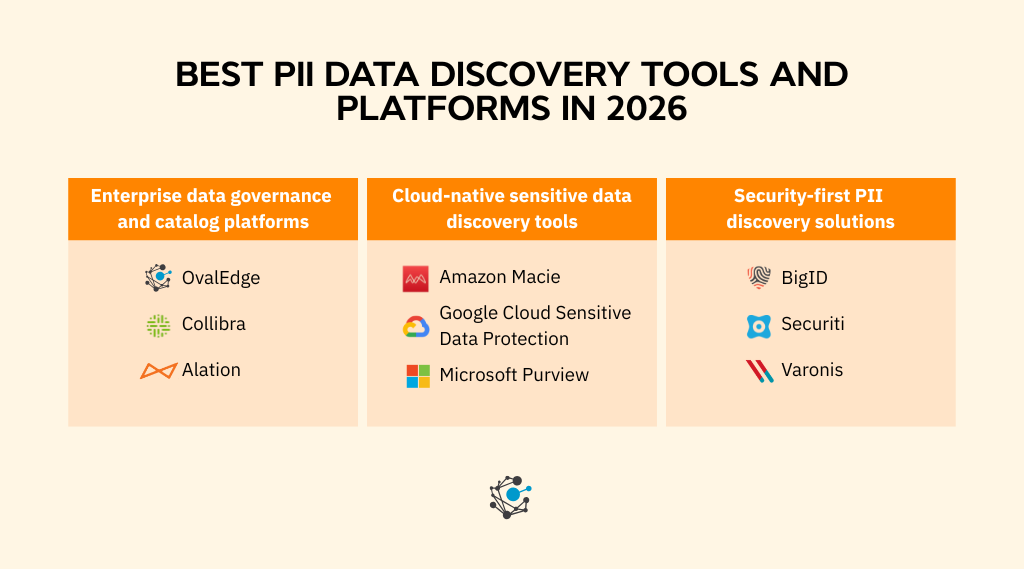
Security and compliance teams often struggle to compare PII data discovery tools because vendors solve the problem from different angles. Some platforms embed discovery into governance and metadata workflows. Others focus on cloud-native scanning within a single hyperscaler ecosystem.
A third group approaches PII discovery through the lens of security exposure and access risk. Understanding these categories upfront makes it easier to evaluate tools based on how you plan to operationalize discovery, not just how fast they scan.
Enterprise data governance and catalog platforms
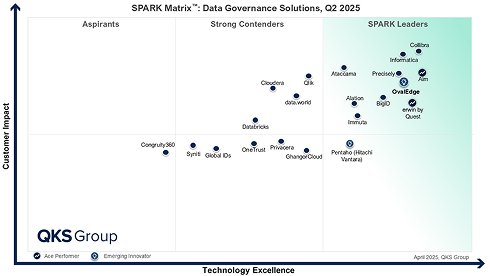
1. OvalEdge
OvalEdge treats PII discovery as a governance-first capability, not a standalone scan. It connects detection to metadata, lineage, ownership, and access controls inside a unified platform, so findings drive action instead of sitting in dashboards waiting for manual follow-up.
Key features
-
AI-based data classification recommendations. Machine learning models scan connected systems and suggest classifications for potential PII, presented through a Yes/No confirmation workflow that keeps humans in the loop.
-
Automated compliance alerts. The platform generates alerts whenever new PII is detected, supporting continuous compliance rather than periodic review cycles.
-
Ownership and stewardship enforcement. Teams assign clear owners and stewards to sensitive datasets, reducing ambiguity during audits and access reviews.
-
Column-level lineage. Lineage tracking traces how personal data moves from source systems through analytics platforms and downstream integrations, clarifying impact during incidents or regulatory inquiries.
-
Access intelligence. Detected sensitive datasets can be cross-referenced with user entitlements and role-based access controls, supporting risk-based access management.
Pros
-
Discovery, classification, and governance live in the same platform, eliminating handoffs between security and privacy teams.
-
AI-assisted classification reduces manual effort at scale while preserving accuracy through human validation.
-
Broad connector ecosystem covers cloud, SaaS, and on-premises sources without heavy operational overhead.
Cons
-
Organizations looking for a lightweight, scan-only tool may find the full governance platform more than they need for an initial deployment.
Best for: Midmarket to enterprise organizations that need PII discovery connected to ownership, policy enforcement, and audit-ready governance across complex data environments.
OvalEdge expert insight: Structured governance is what turns discovery findings into consistent compliance outcomes. For a deeper look at how formal policies around ownership, standards, and controls support sensitive data management at scale, see Data Governance Policy: What It Is and How to Create One.
2. Collibra
Collibra focuses on governed data discovery aligned with business glossaries and stewardship models. PII identification feeds directly into governance workflows, helping large organizations manage regulatory responsibilities across domains with an emphasis on consistency and accountability at scale.
Key features
- Business glossary integration. Sensitive data classification ties directly to business terms and policies, ensuring consistent labeling across teams and domains.
- Stewardship workflows. Built-in workflows route PII findings to designated stewards for review, approval, and remediation within governed processes.
- Data lineage and impact analysis. Teams can trace how sensitive data flows across systems, supporting compliance reporting and incident scoping.
- Policy management. Centralized governance controls let organizations define and enforce data handling rules across distributed teams and business units.
Pros
- Strong alignment between PII discovery and enterprise-wide business glossary standards reduces classification inconsistencies.
- Mature stewardship and workflow engine suits large organizations with formal governance operating models.
- Broad marketplace of integrations connects to a wide range of data platforms and tools.
Cons
- Implementation timelines and cost can be significant, making it a heavier lift for midmarket organizations or teams in early governance maturity stages.
Best for: Large enterprises with established governance programs that need PII discovery tightly linked to business glossaries, stewardship workflows, and cross-domain policy enforcement.
3. Alation

Alation embeds sensitive data classification into its data catalog experience. Teams view PII alongside usage patterns, metadata, and trust signals within the same interface they use for everyday data search and collaboration, keeping discovery close to how people actually work with data.
Key features
- Catalog-embedded PII tagging. Sensitive data classifications appear directly within cataloged datasets, so users see sensitivity context without switching tools.
- Usage and access analytics. Visibility into how datasets are queried, by whom, and how frequently helps teams assess real-world exposure alongside classification results.
- Trust signals and data health. Built-in indicators flag data quality, documentation completeness, and endorsement status, adding governance context around discovered PII.
- Collaboration and curation. Stewards and analysts can annotate, flag, and discuss sensitive datasets within the catalog, supporting distributed review processes.
Pros
- PII visibility lives inside the same catalog experience analysts already use daily, which drives higher adoption across data teams.
- Usage analytics provide practical context about who actually accesses sensitive data and how often.
- Strong search and discovery interface makes it easy for non-technical users to find and understand classified datasets.
Cons
- Organizations that need deep access governance, automated remediation, or privacy operations workflows may require additional tooling beyond the catalog.
Best for: Analytics-driven organizations that want PII discovery embedded into the data catalog experience their teams already use for search, collaboration, and data understanding.
4. Amazon Macie
Amazon Macie automatically discovers and classifies sensitive data stored in Amazon S3. It uses machine learning and pattern matching to evaluate objects at scale, providing findings that feed directly into the broader AWS security and compliance toolchain.
Key features
- Automated S3 scanning. Macie continuously evaluates S3 buckets to detect PII, financial data, and credentials without requiring manual configuration per bucket.
- ML-powered classification. Machine learning models identify sensitive data beyond simple pattern matching, improving detection accuracy for less obvious identifiers.
- Security Hub integration. Findings route into AWS Security Hub, enabling centralized visibility alongside other AWS security alerts and compliance signals.
- Bucket-level risk scoring. Each S3 bucket receives a sensitivity score based on the volume, type, and access configuration of detected sensitive data.
Pros
- Native AWS integration means zero infrastructure setup for organizations already running workloads on S3.
- Cost model scales with actual data evaluated, keeping expenses proportional to usage.
- Findings connect directly to AWS security workflows, reducing the gap between detection and response.
Cons
- Coverage is limited to S3, so organizations with data spread across other clouds, SaaS platforms, or on-premises systems need separate discovery tools for those environments.
Best for: AWS-centric organizations that need fast, low-friction PII discovery focused on S3 storage with tight integration into existing AWS security workflows.
5. Google Cloud Sensitive Data Protection
Google Cloud Sensitive Data Protection provides inspection, classification, and de-identification capabilities across Google Cloud services. It supports over 150 built-in detectors and allows custom rules, giving teams flexibility to tailor detection to their regulatory and business requirements within the GCP ecosystem.
Key features
- Pre-built and custom detectors. Over 150 infoType detectors cover common PII patterns out of the box, with the option to define custom detectors for industry-specific or regional identifiers.
- De-identification and redaction. Beyond detection, the service can mask, tokenize, or redact sensitive data directly within supported GCP services, reducing manual remediation steps.
- Inspection across GCP services. Scanning covers BigQuery, Cloud Storage, Datastore, and other GCP-native data stores through a unified API.
- Risk scoring and profiling. Automated data profiles assess sensitivity levels and exposure risk across scanned resources, helping teams prioritize remediation.
Pros
- Deep integration across GCP services means organizations standardized on Google Cloud can activate discovery with minimal setup.
- Built-in de-identification capabilities reduce the gap between finding PII and protecting it within the same workflow.
- Flexible detector framework lets teams adapt detection rules to jurisdiction-specific or sector-specific requirements.
Cons
- Coverage is concentrated within the GCP ecosystem, so multi-cloud or hybrid environments require additional tools to achieve full visibility.
Best for: Organizations standardized on Google Cloud that need PII detection, classification, and de-identification tightly integrated into their GCP data and security workflows.
6. Microsoft Purview

Microsoft Purview combines data mapping, classification, and sensitivity labeling across Microsoft ecosystems and connected sources. It serves as a foundational governance layer for organizations that run significant workloads on Azure, Microsoft 365, SharePoint, OneDrive, and Teams.
Key features
- Sensitivity labeling. Automated and manual sensitivity labels apply classification consistently across Microsoft 365 apps, emails, documents, and Teams content.
- Data map and estate scanning. Purview scans Azure data services, on-premises SQL sources, and multi-cloud environments to build a unified map of where sensitive data resides.
- Information protection policies. Labels connect directly to encryption, access restrictions, and data loss prevention rules, tying classification to enforcement.
- Compliance manager integration. Built-in compliance assessments map discovery findings against regulatory frameworks like GDPR, HIPAA, and PCI DSS, supporting audit preparation.
Pros
- Native integration across Microsoft 365 and Azure gives organizations immediate visibility into the productivity and collaboration tools where PII often spreads unnoticed.
- Sensitivity labels flow directly into DLP and encryption policies, connecting discovery to enforcement without additional tooling.
- Licensing is often bundled with existing Microsoft enterprise agreements, lowering the barrier to initial deployment.
Cons
- Organizations with significant non-Microsoft infrastructure may find coverage gaps in third-party SaaS apps, non-Azure cloud environments, or legacy on-premises systems.
Best for: Microsoft-centric enterprises that need PII discovery, classification, and protection tightly coupled with the Microsoft 365 and Azure ecosystem they already operate in.
At OvalEdge, we believe cloud-native tools excel at coverage within their own ecosystems, but most organizations run data across multiple clouds, SaaS apps, and on-premises systems. Discovery that stops at the platform boundary leaves governance gaps that create risk during audits and incidents.
7. BigID
BigID specializes in sensitive data discovery and intelligence across structured and unstructured sources. It uses ML-driven classification to build a detailed picture of where PII exists, how it flows, and where exposure concentrates, with a focus on helping security and privacy teams prioritize risk.
Key features
- ML-driven data discovery. Advanced machine learning classifies sensitive data beyond regex-based pattern matching, improving accuracy across large and diverse data estates.
- Correlation and identity mapping. The platform links scattered data elements back to specific individuals, supporting DSAR fulfillment and breach impact scoping.
- App and data source coverage. Connectors span cloud storage, SaaS applications, databases, data lakes, and email systems, covering a broad range of enterprise environments.
- Retention and remediation workflows. Teams can define retention policies and trigger remediation actions based on discovery findings, moving beyond detection into operational response.
Pros
- Identity-aware correlation helps teams answer "which individuals are affected" rather than just "which fields contain PII."
- Broad connector library covers a wide range of structured and unstructured data sources across cloud and on-premises environments.
- Platform extends beyond discovery into data intelligence, supporting privacy, security, and governance use cases from a single deployment.
Cons
- Platform breadth and pricing can be significant, which may make it a heavier investment for organizations that only need focused PII scanning capabilities.
Best for: Enterprise security and privacy teams that need broad, ML-driven PII discovery with identity correlation and the ability to extend into data intelligence, retention, and remediation workflows.
8. Securiti
Securiti combines PII discovery with privacy operations in a unified platform. It connects detection directly to DSAR fulfillment, consent management, and privacy impact assessments, making it a fit for organizations where privacy compliance drives the discovery mandate rather than security alone.
Key features
- Privacy-aligned discovery. PII detection feeds into privacy workflows like data mapping, RoPA generation, and privacy impact assessments, keeping discovery connected to regulatory deliverables.
- DSAR automation. The platform links discovered PII back to data subjects, enabling automated retrieval, redaction, or deletion in response to access and erasure requests.
- Consent and preference management. Discovery findings connect to consent records, helping teams verify that personal data processing aligns with the permissions individuals have granted.
- Multi-cloud and SaaS coverage. Connectors span AWS, Azure, GCP, Snowflake, and a range of SaaS applications, supporting discovery across distributed environments.
Pros
- Tight integration between discovery and privacy operations reduces the manual handoffs that slow down DSAR response and compliance reporting.
- Data subject linking gives privacy teams a person-centric view of where an individual's data resides across systems.
- Broad regulatory template library covers GDPR, CCPA, LGPD, and other frameworks out of the box.
Cons
- Organizations that approach PII discovery primarily through a security or governance lens may find the privacy-operations focus less aligned with their operating model.
Best for: Privacy and compliance teams that need PII discovery directly integrated with DSAR automation, consent management, and regulatory reporting workflows.
9. Varonis

Varonis focuses on file systems and access analytics, combining PII discovery with deep permission analysis. It maps sensitive data locations alongside who can reach them and how access has changed over time, making it particularly strong for environments with complex file-sharing and collaboration structures.
Key features
- Permission and access analytics. The platform cross-references PII locations with user entitlements, group memberships, and permission inheritance chains to surface over-permissioned or exposed datasets.
- Behavioral threat detection. Alerts trigger when user access patterns deviate from established baselines, helping teams catch unusual activity around sensitive data before it becomes an incident.
- Automated remediation. Teams can revoke stale permissions, remove global access groups, and quarantine exposed files directly from the platform without manual IT tickets.
- File system and collaboration coverage. Discovery spans on-premises file servers, NAS, SharePoint, OneDrive, Exchange, and cloud storage, covering the collaboration surfaces where PII often accumulates unnoticed.
Pros
- Combines PII discovery with access governance and behavioral analytics in a single platform, reducing the need for separate tooling across those functions.
- Automated remediation capabilities close the gap between detecting exposure and fixing it, which most discovery-only tools leave open.
- Strong coverage across file systems and collaboration tools where unstructured PII tends to spread.
Cons
- Organizations that need broad database, data lake, or SaaS application coverage may need to supplement Varonis with additional discovery tools for those environments.
Best for: Security teams where PII risk concentrates in file systems, SharePoint, and collaboration data, and where access governance and behavioral anomaly detection matter alongside classification.
Enforcement pressure keeps rising alongside tooling expectations.
The European Data Protection Board's 2024 report noted that EU authorities issued over €1.2 billion in fines that year, which is why organizations increasingly favor PII discovery tools that support defensible inventories, ownership tracking, and audit-ready reporting.
This is where integrated governance platforms like OvalEdge often complement security-focused discovery by providing the operational context needed to assign responsibility and enforce policies at scale.
PII data discovery tools comparison table
The table below compares all nine platforms across the capabilities that matter most when evaluating PII discovery tools. Use it to shortlist vendors based on how your organization plans to operationalize discovery, whether through governance workflows, cloud-native security, or exposure-first risk reduction.
|
Tool |
Category |
Structured data |
Unstructured data |
Ownership and stewardship |
Access governance |
DSAR support |
|
OvalEdge |
Governance |
Yes |
Yes |
Yes |
Yes |
Via governance workflows |
|
Collibra |
Governance |
Yes |
Yes |
Yes |
Via integrations |
Via integrations |
|
Alation |
Governance |
Yes |
Limited |
Via catalog workflows |
Limited |
Limited |
|
Amazon Macie |
Cloud-native |
Yes (S3) |
Yes (S3 objects) |
No |
Via AWS IAM |
No |
|
Google Cloud SDP |
Cloud-native |
Yes (GCP) |
Yes (GCP) |
No |
Via GCP IAM |
No |
|
Microsoft Purview |
Cloud-native |
Yes |
Yes (M365, Azure) |
Via sensitivity labels |
Via M365 policies |
Limited |
|
BigID |
Security-first |
Yes |
Yes |
Limited |
Via integrations |
Yes |
|
Securiti |
Security-first |
Yes |
Yes |
Limited |
Via integrations |
Yes |
|
Varonis |
Security-first |
Limited |
Yes |
No |
Yes |
Limited |
A few patterns stand out. Governance platforms offer the broadest coverage across discovery, ownership, and policy enforcement, making them the strongest fit when PII discovery needs to feed into long-term compliance and accountability processes.
Cloud-native tools optimize for speed and depth within their own ecosystems but leave gaps when data spans multiple clouds or on-premises systems. Security-first tools prioritize exposure detection and access risk, though most require additional layers for ownership assignment and sustained governance.
The right choice depends less on any single feature and more on how discovery fits into the way your organization already manages data, assigns responsibility, and proves compliance. For teams evaluating how governance platforms compare more broadly, that context can help narrow the field further.
Core features to evaluate in PII discovery tools
Comparing PII discovery tools feature by feature can get overwhelming. A more practical approach is to focus on the capabilities regulators and auditors actually ask about: can you prove where sensitive data exists, who can access it, how it is classified, and what controls are in place? These six features form the evaluation baseline.
1. Automated PII identification and classification
The tool should detect sensitive data using a combination of pre-built detectors and customizable rules. Pre-built coverage handles common identifiers like SSNs, email addresses, and payment card numbers. Custom rules let teams add industry-specific or region-specific identifiers that generic detectors miss, such as national health IDs or internal employee codes.
2. Coverage across structured and unstructured data
PII rarely stays in databases alone. It spreads into documents, emails, PDFs, shared drives, chat logs, and collaboration tools. A discovery tool that only scans structured sources leaves a significant portion of the data estate unmonitored. Evaluate coverage breadth against where your organization actually stores and processes personal data.
3. Context-aware detection using metadata and lineage
Classification confidence improves significantly when the tool considers surrounding context, not just the data value itself. Metadata signals like column names, table descriptions, file paths, and lineage connections help distinguish genuinely sensitive fields from false positives, which is the difference between a tool teams trust and one they learn to ignore.
4. Access visibility and risk-based prioritization
Knowing where PII exists is only useful if you also know who can reach it. Tools that cross-reference discovery findings with user entitlements, permission structures, and access patterns help teams prioritize remediation based on actual exposure rather than treating every detection equally.
5. Ownership, stewardship, and accountability
Discovered PII needs a clear owner responsible for access decisions, retention, and remediation. Without ownership assignment, findings accumulate in dashboards and no one acts on them. Evaluate whether the tool supports assigning and tracking data owners and stewards as part of the discovery workflow.
6. Built-in support for privacy regulations
Audit trails, compliance reporting, and DSAR readiness should be embedded in the platform rather than requiring manual assembly. The best tools generate evidence that sensitive data is inventoried, classified, governed, and monitored continuously, which is what regulators expect to see during audits.
At OvalEdge, we believe the tools that deliver long-term value are the ones that prove ownership, access decisions, and policy enforcement over time, not just detection speed on the initial scan. See how OvalEdge approaches this →
How to measure PII discovery effectiveness
Running PII discovery tools is not the same as running an effective PII discovery program. Many organizations deploy a tool, run initial scans, and assume the job is done. The gap shows up months later when an audit reveals blind spots, a DSAR takes weeks instead of hours, or a breach response stalls because no one can confirm the scope of exposed data. Tracking the right metrics helps teams catch those gaps early and demonstrate measurable improvement over time.
1. Percentage of data assets scanned for PII
Coverage is the foundation. If discovery only reaches databases while documents, shared drives, SaaS applications, and cloud storage go unscanned, the inventory creates a false sense of completeness. Measure the percentage of known data assets that fall within the tool's active scanning scope and track how that number changes as new systems get onboarded.
2. False-positive and false-negative rates
High false-positive rates lead to alert fatigue. Teams stop reviewing flagged results, and real PII exposure gets buried in noise. High false-negative rates are worse because they mean sensitive data exists in the environment without anyone knowing. Track both rates over time and use them to evaluate whether detection tuning and contextual classification are actually improving accuracy.
3. Time to detect newly introduced PII
New columns, new datasets, new integrations, and new SaaS applications introduce PII constantly. If discovery runs on quarterly or monthly cycles, months of exposure accumulate between scans. Measure the average time between PII entering the environment and the tool detecting it. Shorter detection windows reduce the risk of unmonitored personal data lingering across systems.
4. Reduction in DSAR and audit response time
Compliance efficiency is a practical indicator of whether discovery is working at an operational level. Automated discovery should measurably reduce the effort required to locate, retrieve, and report on personal data during data subject requests and regulatory audits. If response times are not improving, the discovery program may not be connected to the workflows that matter.
For example, a governance team might manually review a random sample of 500 records from a recently scanned dataset to compare the tool's automated classifications against human judgment, establishing a baseline accuracy rate they can track quarter over quarter.
Organizations that treat these metrics as ongoing indicators rather than one-time benchmarks build discovery programs that improve with each cycle. Platforms like OvalEdge support this by connecting discovery findings to governance workflows where ownership, classification accuracy, and compliance outcomes are tracked and reported continuously.
Conclusion
Most organizations already run some form of PII discovery. The challenge is rarely the initial scan. It is what happens after detection: who owns the findings, how access decisions get made, whether classification stays current as data environments change, and what evidence exists when regulators ask for proof.
The tools in this guide approach that challenge from different angles. Cloud-native platforms deliver speed within their ecosystems. Security-first tools prioritize exposure and access risk. Governance platforms connect discovery to the ownership, lineage, and policy enforcement workflows that make compliance sustainable over time.
OvalEdge brings these layers together in a unified platform. AI-based classification, column-level lineage, ownership enforcement, access intelligence, and continuous compliance monitoring work as a connected system, so PII discovery feeds directly into the governance processes that auditors and regulators expect to see.
Schedule a conversation with the OvalEdge team to see how your organization can move from periodic PII scans to a governed, audit-ready discovery program.
.png?width=1081&height=173&name=Forrester%201%20(1).png)
.png?width=1081&height=241&name=KC%20-%20Logo%201%20(1).png)