Data problems rarely announce themselves with failures. Dashboards load, pipelines succeed, and teams still make decisions on missing values, duplicates, and quietly drifting definitions.
As the data estate expands across SaaS systems, warehouses, and lakehouses, small inconsistencies multiply into reconciliation work, broken trust, and higher compliance risk.
The real challenge is not spotting issues once they explode. The challenge is defining what “good” means, enforcing it consistently, and keeping it true as data changes.
Many teams start with quick fixes like a few ETL checks, a shared spreadsheet of rules, or a monitoring tool that flags freshness. Those efforts help, but they rarely scale across domains or survive ownership changes.
An enterprise data quality platform exists for that shift. It turns expectations into rules, measures quality with KPIs and SLAs, monitors anomalies and drift, and routes fixes to accountable owners.
In this blog, we’ll walk through what an enterprise data quality platform is, how it differs from observability, catalogs, ETL scripts, and MDM tools, what capabilities define it, how to evaluate vendors, and what ROI metrics to expect at enterprise scale.
What is an enterprise data quality platform?
An enterprise data quality platform is a system that measures, validates, and governs data quality across an organization. It profiles datasets, enforces data quality rules, standardizes and deduplicates records, and monitors KPIs and SLAs in warehouses and lakehouses.
It detects anomalies, tracks lineage, assigns ownership, and automates remediation workflows. It supports compliance, analytics, and AI readiness by ensuring data remains accurate, consistent, complete, and trustworthy across systems.
How enterprise data quality platforms differ
Enterprise data quality is often confused with adjacent categories that solve related but fundamentally different problems.
-
Monitoring tools detect pipeline anomalies.
-
Catalogs organize metadata.
-
ETL scripts validate transformations.
-
MDM systems master core entities.
The distinctions matter. Before evaluating features or vendors, it is critical to understand where these tools overlap, where they diverge, and why enterprise-scale quality requires more than any single layer alone.
1. Enterprise data quality platforms vs data observability tools
Data observability tools are built to answer a reliability question: “Is data behaving as expected as it moves through pipelines and systems?” They focus on signals like freshness, volume shifts, schema drift, distribution changes, and failed jobs.
That is why they are often adopted by data engineering teams first. They help teams detect incidents early, reduce time spent debugging, and restore downstream dashboards faster when something breaks.
An enterprise data quality platform solves a different category of problem: whether the data is fit for business use, consistently, across domains and systems. It does not stop at detecting that something changed. It supports the definition, enforcement, and governance of data quality rules at scale.
Observability tools are excellent at detecting unexpected behavior that is hard to capture with static rules. A few examples:
-
A daily finance table arrives late, so reports are stale.
-
A source system starts sending fewer records, so conversion dashboards look unusually low.
-
A pipeline change introduces a new column and breaks downstream transformations.
These are operational failures. They often show up as broken dashboards, missing data, or unusual spikes and drops. Observability helps you identify the dataset, the timing, and sometimes the upstream job or lineage path involved, so the right person can investigate quickly.
The limitation is that observability usually does not define the full meaning of “correct” for the business. A table can be fresh and still be wrong.
Enterprise data quality platforms are designed to define and enforce expectations that reflect business rules and data standards, not only pipeline health. They typically include:
-
Data profiling to understand patterns and highlight risk areas before writing rules
-
Rule management to create, version, approve, and reuse validation logic across teams
-
Data cleansing and standardization for issues like formatting, deduplication, and reference value alignment
This matters because many enterprise data failures are “silent failures.” The pipeline succeeds, the table is fresh, and dashboards render. The issue is semantic.
Observability can detect a sudden spike in duplicates or missing values if it is configured to track those signals. But an enterprise data quality platform is where teams define the canonical rules that represent “valid customer data,” enforce them consistently, and route failures to the right owner with evidence.
2. Enterprise data quality platforms vs data catalogs
A data catalog is built for discovery and understanding. It helps people find datasets, interpret meaning, and use data responsibly. It typically includes metadata, business definitions, lineage, ownership, classifications, and access guidance.
In large organizations, catalogs reduce confusion by making “what does this field mean” and “which table is the right one” easier to answer.
An enterprise data quality platform is built for measurement and enforcement. It makes data quality explicit, testable, and operational. It answers whether the data meets requirements like completeness, validity, consistency, uniqueness, and timeliness. It also creates a workflow to fix failures, not just document them.
Catalogs solve a common enterprise problem: too many datasets, too many teams, and too much ambiguity. They help with:
-
Discoverability: Surfacing relevant datasets for analytics and reporting
-
Definitions: Aligning business terms with technical fields and tables
-
Ownership: Showing who is responsible for a dataset and how to contact them
-
Lineage: Showing where data comes from and what depends on it
-
Governance: Classifying sensitive data and guiding access policies
This is essential for trust because many “data quality” complaints are actually “data understanding” problems. People use the wrong dataset, interpret a field incorrectly, or do not realize a metric changed definition.
But a catalog usually cannot tell you if the data inside the dataset is currently correct.
An enterprise data quality platform operationalizes quality. It typically provides capabilities that catalogs do not, such as:
-
Automated profiling that identifies anomalies and rule candidates
-
Rule enforcement across pipelines and datasets, not just documentation of expected meaning
-
Continuous monitoring that tracks data quality KPIs and alerts on breaches
-
Cleansing functions, depending on the platform, such as standardization and deduplication
|
For example, a catalog can tell you which dataset is considered “official” for revenue, define the meaning of “booked revenue,” and show lineage from source systems. That prevents many mistakes. But if revenue fields suddenly include refunds due to an upstream mapping error, the catalog still shows the dataset as official. The catalog describes intent and context. It does not validate correctness. |
A data quality platform can enforce checks like:
-
Revenue should not be negative unless a refund indicator is present
-
Line items should reconcile to invoice totals
-
Currency codes must match allowed values
It can then alert the right owner and track the fix. This is the operational layer missing from most catalog-only setups.
3. Enterprise data quality platforms vs ETL validation scripts
ETL and ELT validation scripts are usually the first place teams start when they realize data quality problems are breaking dashboards or causing downstream rework.
A data engineer adds a few checks in orchestration, or a team uses tests in a transformation framework to catch nulls, duplicates, or referential integrity issues. Early on, this works because the pipeline surface area is small, and a few people understand the logic.
The challenge is that enterprises do not stay small.
As pipelines multiply across domains, script-based validation tends to break down in predictable ways.
ETL validation scripts are effective when you need tight control at a specific point in the pipeline. Typical uses include:
-
Blocking a load when a schema changes unexpectedly
-
Failing a job when required columns are null above an agreed threshold
-
Ensuring referential integrity during transformation, such as order records referencing valid customer IDs
-
Catching type and format issues before they hit reporting tables
These checks are closest to the code, so they can be fast to run and easy for engineers to maintain in the short term.
An enterprise data quality platform treats validation as a governed capability, not just code. It typically adds:
-
Central rule management so business and technical rules are defined once, versioned, and reused consistently
-
Stewardship workflows that route issues to responsible owners with context, evidence, and an audit trail
-
Enterprise dashboards for quality KPIs and SLAs across domains, not only per pipeline
-
Continuous monitoring that can catch quality degradation even when pipelines technically succeed
-
Policy and compliance alignment so rules, approvals, and exceptions are trackable
Instead of each pipeline owning its own private quality logic, the organization creates a shared quality layer that scales with the data estate.
Most mature teams do not throw away ETL validation scripts. They keep engineering-grade tests where they are most effective, such as preventing bad loads and catching structural issues. But they complement them with an enterprise data quality platform for:
-
Shared business rules and consistent enforcement
-
Ownership, governance, and remediation workflows
-
Executive-level reporting on data quality KPIs and SLA performance
4. Enterprise data quality platforms vs master data management tools
Master Data Management tools are designed to solve a specific and important problem of creating a trusted, consistent view of core business entities such as customers, products, suppliers, and locations.
They focus on mastering, which includes identity resolution, matching, merging, survivorship rules, and stewardship processes that decide which record becomes the “golden record.”
That is why MDM is often strongest when an organization needs a single source of truth for operational systems like CRM, ERP, and downstream analytics.
However, mastering entities does not automatically eliminate the operational burden of data quality.
According to a 2024 McKinsey Research on Master Data Quality, 82% of respondents spend a day or more per week resolving master-data quality issues, and 66% rely on manual reviews to manage master-data quality.
That level of manual effort signals a structural gap. Even when MDM is in place, quality controls often remain reactive, localized, or disconnected from broader governance and monitoring frameworks.
An enterprise data quality platform overlaps with MDM in areas like standardization, deduplication, and validation. But the scope and operating model are broader.
MDM tools tend to be the right choice when you need consistent entity data across many systems, especially when duplicates and conflicting attributes create operational and customer experience problems.
Enterprises rarely suffer from quality issues only in master data. Many failures happen in analytical datasets, operational event streams, and reporting layers that sit outside MDM.
Even within mastered entities, MDM focuses on record correctness and consistency, but it may not provide continuous enterprise-wide monitoring, KPI dashboards, or data quality SLA tracking across the broader data estate.
An enterprise data quality platform typically covers:
-
Any dataset that affects decisions, not only customer and product entities
-
Continuous quality monitoring and observability signals so teams can catch issues early
-
Rule enforcement for business logic across domains, including analytic and reporting layers
-
Governance alignment and audit readiness across datasets, pipelines, and quality incidents
In the best implementations, MDM and enterprise data quality platforms are complementary:
-
MDM provides mastered entity records and stewardship for identity resolution.
-
An enterprise data quality platform validates and monitors the full set of datasets that depend on those entities, including downstream transformations, analytics models, and compliance reporting.
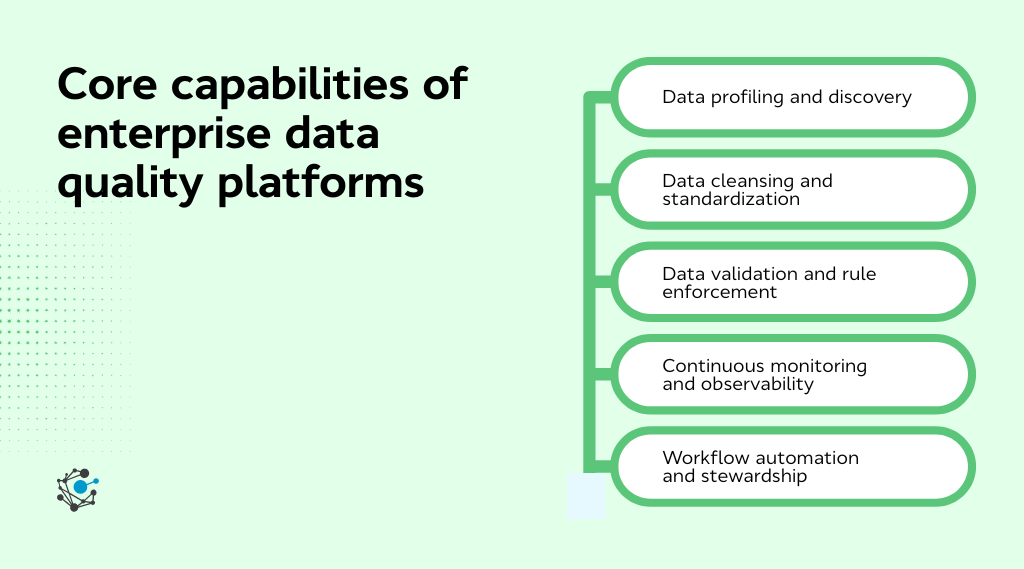
Core capabilities of enterprise data quality platforms
Enterprise data initiatives fail when data quality is treated as a one-time cleanup exercise. An enterprise data quality platform works because it treats quality as a continuous system embedded into pipelines, governance, and decision-making workflows.
The strongest platforms are built around repeatable capability layers that measure, enforce, and improve quality across the entire data estate.
1. Data profiling and discovery
Data profiling is where enterprise-grade data quality begins. Before you define rules, assign owners, or set KPIs, you need to understand how the data actually behaves. Profiling analyzes datasets to surface patterns, outliers, missing values, duplicates, structural inconsistencies, and unexpected distributions.
This matters because enterprise data problems are rarely obvious. A table may load successfully, but profiling often reveals deeper issues:
-
Required fields, such as industry codes or product categories, are sparsely populated
-
Country fields mix abbreviations, full names, and free text
-
Date columns contain invalid ranges or inconsistent formats
-
Revenue fields contain negative values without a clear refund indicator
-
Customer IDs repeat across systems due to integration inconsistencies
Profiling is also essential for data quality for AI readiness. Machine learning systems are sensitive to missing values, skewed distributions, and inconsistent labeling. A model trained on inconsistent or sparsely populated fields may behave unpredictably. An enterprise data quality platform uses profiling to surface those risks before they reach production models.
2. Data cleansing and standardization
Many people associate data cleansing software with one-time cleanup jobs during migrations. At enterprise scale, cleansing is an ongoing discipline embedded into pipelines and governance controls.
An enterprise data quality platform supports continuous cleansing across systems, not just reactive correction.
Large organizations collect data from many sources:
-
CRM platforms
-
ERP systems
-
Marketing automation tools
-
Partner feeds
-
Legacy databases
-
Cloud applications
Each source may use different standards. Over time, this creates fragmentation:
-
Customer names appear in multiple formats
-
Addresses lack a consistent structure
-
Product categories differ across regions
-
Currency and date formats vary
-
Reference data, such as country codes, are inconsistent
Without continuous standardization, analytics becomes unreliable. Duplicate records inflate counts. Inconsistent reference values break segmentation. Free-text fields complicate reporting.
For regulated industries, poor cleansing can also create compliance risk. If consent status, location data, or classification fields are inconsistent, reporting and regulatory controls may fail.
Standardization rules
These enforce consistent formats across datasets. Examples include:
-
Normalizing date formats
-
Enforcing consistent casing for names
-
Standardizing phone number formats
-
Validating email structures
-
Converting country names to approved ISO codes
Standardization reduces noise and simplifies downstream analytics.
One of the biggest misconceptions is that cleansing is a project milestone. In reality, cleansing must operate as part of data quality monitoring and validation.
New records enter systems daily. Integrations change. Business rules evolve. Without automated cleansing embedded in pipelines and monitored by quality dashboards, inconsistency returns quickly.
Continuous cleansing supports:
-
Data quality KPIs and SLAs tied to completeness and consistency
-
Reliable segmentation for marketing and sales
-
Accurate financial reconciliation
-
Stronger AI feature consistency
-
Reduced manual rework by analysts
However, cleansing alone does not guarantee trust. It must connect to:
-
Profiling, to detect new patterns of inconsistency
-
Validation, to enforce business rules
-
Monitoring, to track performance over time
-
Stewardship workflows, to assign responsibility when automated correction is not possible
When integrated within an enterprise data quality platform, cleansing becomes part of a scalable operating model. It supports data integrity, governance alignment, and long-term data trust across analytics and operations.
3. Data validation and rule enforcement
Data validation platforms translate business expectations into enforceable logic. In large organizations, rule enforcement is not optional. It is what prevents silent data corruption from spreading across reporting layers, regulatory submissions, and AI models.
According to a 2025 IBM Research on Data Quality Issues, data quality issues such as inconsistency and incompleteness directly compromise decision-making workflows.
When required fields are missing, definitions vary across systems, or values fall outside expected ranges, the impact surfaces in forecasting errors, reconciliation gaps, and unreliable reporting. Validation and reconciliation are therefore not hygiene tasks. They are decision safeguards.
Enterprise data quality rules typically fall into two major buckets.
Technical validity rules
These focus on structural integrity and pipeline reliability. They include:
-
Schema validation to detect missing or renamed columns
-
Null thresholds for required fields
-
Data type validation
-
Freshness checks for time-sensitive datasets
-
Allowed value lists for controlled attributes
-
Duplicate detection thresholds
These rules are often implemented close to pipelines and are critical for data quality monitoring and alerting. They protect the structural health of data.
Business validity rules
These reflect business logic and domain meaning. Examples include:
-
An active customer must have a valid contract start date
-
Invoice totals must reconcile with line items
-
A closed opportunity must include a reason code
-
A risk classification must align with regulatory definitions
-
A marketing lead source must match an approved channel list
Business validity rules are often where enterprise data quality programs struggle. They require cross-functional agreement, stewardship, and governance alignment.
Without centralized management, different departments implement slightly different interpretations of the same rule.
An enterprise data quality platform solves this by allowing rules to be defined once, versioned, approved, and reused across pipelines and domains. This principle of defining rules centrally and applying them broadly, including validation at the point of entry through APIs, reduces inconsistency and ensures quality is enforced before bad data spreads downstream.
4. Continuous monitoring and observability
Many organizations begin with quarterly data quality reviews or reactive investigations when a dashboard breaks. This approach fails because data ecosystems are dynamic. A minor upstream change can affect dozens of downstream reports within hours.
Continuous monitoring enables:
-
Real-time detection of anomalies
-
Early identification of schema changes
-
Tracking of data quality KPIs and SLAs
-
Proactive alerting before business users escalate issues
An effective enterprise data quality platform provides monitoring capabilities such as:
-
Automated anomaly detection based on historical patterns
-
Freshness tracking to ensure timely data availability
-
Distribution monitoring for unexpected value shifts
-
Threshold-based alerts tied to business-critical fields
-
Data lineage integration to assess downstream impact
-
Dashboard visibility for executives and governance teams
Monitoring should not only detect issues but contextualize them. If a field used in executive reporting drops below completeness thresholds, the platform should identify affected dashboards, owners, and consumers.
One of the most common pain points in data quality monitoring is alert fatigue. If teams receive too many alerts without prioritization, they start ignoring them.
Enterprise data quality platforms address this by:
-
Scoring alerts based on business impact
-
Grouping related incidents
-
Suppressing low-risk anomalies
-
Allowing SLA-driven escalation paths
-
Tying alerts to specific owners and domains
This improves accountability. Instead of generic system notifications, alerts are mapped to datasets, owners, and governance roles. Teams know who is responsible for remediation.
For organizations searching for an enterprise data quality platform, validation and continuous monitoring are the pillars that move quality from documentation to execution. Together, they enforce standards, detect degradation, and sustain trust across analytics, operations, and AI systems.
5. Workflow automation and stewardship
Many enterprise data quality initiatives stall not because teams lack rules or monitoring, but because there is no structured way to resolve issues once they are detected.
An enterprise data quality platform is not complete without workflow automation and stewardship. This is the operational backbone that turns alerts into sustained improvements.
When a validation rule fails or monitoring detects an anomaly, the real question is not whether the data is wrong. The real question is who owns the issue, how it gets fixed, and how the organization ensures it does not recur.
Stewardship answers that question.
In the context of an enterprise data quality platform, stewardship means that data quality failures are:
-
Assigned to accountable owners
-
Investigated with lineage and impact context
-
Remediated with documented actions
-
Verified and closed with audit evidence
-
Tracked over time to prevent recurrence
Without this layer, data quality monitoring becomes noise, and rule enforcement becomes a list of unresolved tickets.
In smaller teams, quality issues are often resolved informally. An analyst notices a problem, sends a message to an engineer, and the fix is applied. In enterprise environments, this approach collapses under scale.
Common pain points include:
-
No clear owner for cross-domain datasets
-
Alerts are routed to shared mailboxes with no accountability
-
Repeated failures because root causes are not documented
-
Business stakeholders are unaware of the issue status
An enterprise data quality platform introduces structured workflows to address these challenges. Instead of relying on ad hoc communication, issues become managed objects with defined states, owners, and timelines.
OvalEdge emphasizes operationalizing stewardship because quality enforcement without ownership does not produce lasting results.
Monitoring and validation detect problems. Stewardship ensures those problems are resolved systematically.
An enterprise data quality platform should support:
-
SLA tracking for remediation timelines
-
Root cause tagging to identify systemic issues
-
Recurrence tracking to measure long-term improvement
-
Integration with ticketing or IT service management systems
These capabilities help governance teams answer important questions:
-
Are certain domains experiencing recurring quality failures
-
Are remediation times improving over time
-
Which datasets pose the greatest risk to compliance or executive reporting
-
Where should additional investment in cleansing or rule refinement occur
This visibility transforms data quality from a reactive activity into a managed program with measurable outcomes.
An enterprise data quality platform measures, validates, and monitors data. But without workflow automation and stewardship, those signals do not translate into improved trust.
Stewardship ensures:
-
Ownership is explicit
-
Accountability is traceable
-
Compliance is defensible
-
Data integrity improves over time rather than resetting after each incident
For organizations searching for an enterprise data quality platform, this capability is often the difference between a technical tool and an operational framework. Quality becomes sustainable when detection, remediation, and governance are tightly integrated.
6. Data quality KPIs and scorecards
Data quality programs cannot scale without measurable performance indicators. Executives do not fund data initiatives based on tooling features. They fund programs that demonstrate measurable improvement in reliability, compliance, and decision accuracy.
An enterprise data quality platform supports formalized KPIs and scorecards that quantify data health across domains, systems, and business units.
Common enterprise data quality KPIs include:
-
Completeness: Percentage of required fields populated across critical datasets.
-
Accuracy: Degree to which values match verified or authoritative sources.
-
Consistency: Alignment of definitions and formats across systems and domains.
-
Validity: Percentage of records conforming to defined business and technical rules.
-
Timeliness: Data freshness relative to SLA thresholds.
-
Uniqueness: Duplicate record rate within master datasets.
These KPIs are typically tracked at multiple levels:
-
Dataset level
-
Domain level
-
Business unit level
-
Enterprise-wide aggregate
Scorecards consolidate these metrics into a structured view that governance teams and executives can monitor regularly. Instead of investigating issues reactively, leaders can see trend lines over time, identify deteriorating domains, and prioritize remediation efforts.
Effective scorecards also support:
-
SLA performance tracking for remediation timelines
-
Historical trend analysis to measure improvement
-
Risk scoring tied to regulatory or executive reporting impact
-
Benchmarking across domains or regions
-
Executive-ready dashboards for governance councils
Without KPIs and scorecards, data quality remains anecdotal. Teams may fix individual issues, but leadership cannot determine whether trust is improving at scale.
An enterprise data quality platform transforms quality from a technical metric into a managed performance indicator. When KPIs are standardized, monitored continuously, and reported transparently, data quality becomes part of operational governance rather than a periodic cleanup initiative.
Top enterprise data quality platforms in 2026
An enterprise data quality platform must do more than validate fields or detect anomalies. It must profile data, enforce rules, integrate with warehouses and pipelines, align with governance, and scale across domains such as customer, product, finance, and analytics.
The platforms below represent different approaches to enterprise-grade data quality. Some are governance-first. Others are observability-driven. Some combine cleansing, matching, and monitoring into one ecosystem.
Each reflects how organizations address missing values, duplicate records, schema changes, reconciliation errors, and AI reliability challenges at scale.
1. OvalEdge
OvalEdge is an agentic enterprise data quality and governance platform that combines legacy data quality remediation with real-time operational monitoring. It uses AI agents to automate data profiling, rule validation, anomaly detection, lineage-based impact analysis, and guided stewardship workflows.
By connecting data quality rules, business glossary terms, ownership, and lineage into a unified operational layer, OvalEdge helps organizations eliminate historical data quality debt while preventing real-time pipeline failures that impact dashboards, reports, and AI models.
Key Features
-
AI-powered anomaly detection: Detects unexpected shifts in distributions, null rates, record counts, and schema changes using historical baselines. Alerts include business impact context, affected dashboards, and assigned owners.
-
Real-time pipeline monitoring and rule enforcement: Embeds technical and business validation rules into pipelines to catch schema drift, null threshold violations, freshness failures, and domain rule breaches before they propagate downstream.
-
Legacy data quality debt remediation: Profiles historical datasets to uncover duplicates, cross-system inconsistencies, missing values, structural mismatches, and reference data conflicts.
-
Lineage-enabled impact analysis: Visualizes upstream and downstream dependencies to identify which dashboards, regulatory reports, or AI features are affected by data quality failures.
-
Guided data quality remediation: Provides structured workflows for issue assignment, severity classification, root cause tagging, SLA tracking, and resolution documentation.
-
Data quality KPIs and dashboards: Delivers enterprise-wide quality scorecards, trend analysis, domain-level scoring, and executive dashboards to measure completeness, consistency, validity, timeliness, and uniqueness over time.
Pros
-
Strong integration between governance, catalog, and data quality
-
Clear ownership and stewardship alignment
-
Context-rich remediation through lineage and glossary integration
Cons
-
May feel broader than needed for monitoring-focused teams
-
Requires governance maturity for full value realization
Pricing
OvalEdge offers three custom-priced tiers: Essential, Professional, and Enterprise. Plans scale by connectors, author and viewer users, and deployment options such as SaaS or on-prem.
Higher tiers add data quality, lineage, privacy, and access management features. Pricing requires contacting sales and is tailored to the enterprise scope and integrations.
Ratings
2. Informatica
Informatica delivers an AI-powered cloud data management platform that manages the full data lifecycle, from data quality and governance to integration and master data management.
Its Intelligent Data Management Cloud, powered by CLAIRE AI, supports multi-cloud and hybrid environments, automates metadata-driven workflows, and enables trusted, scalable data for analytics, AI, compliance, and enterprise transformation initiatives.
Key Features
-
Automated data profiling and discovery: Scans structured and semi-structured systems to assess completeness, consistency, and conformance across large-scale enterprise environments.
-
Data cleansing and standardization: Normalizes formats, validates reference data, and enforces standardized representations for names, addresses, and product codes across systems.
-
Entity matching and deduplication: Applies deterministic and probabilistic matching to link and merge duplicate customer or supplier records across disparate systems.
-
AI-assisted rule generation: Uses machine learning to suggest validation rules based on profiling patterns, reducing manual rule authoring effort.
Pros
-
Strong scalability for global enterprise deployments
-
Mature cleansing and entity resolution capabilities
-
Deep integration across the integration and MDM ecosystem
Cons
-
Deployment can be complex in highly customized environments
-
May require specialized expertise to manage advanced configurations
Pricing
Informatica uses flexible, consumption-based pricing through its IPU model. Customers pay based on usage volume, scale services as needed, and can swap modules over time.
Pricing is optimized with CLAIRE AI to improve performance and control costs, aiming to lower the total cost of ownership across data management services.
Ratings
3. Monte Carlo
Monte Carlo is a data and AI observability platform that helps enterprises monitor, trace, and troubleshoot data pipelines and AI agents in production. It connects data inputs to AI outputs to detect drift, anomalies, and performance issues.
With lineage, root cause analysis, and alerting, it improves trust, reliability, and visibility across modern data and AI ecosystems.
Key Features
-
Automated anomaly detection: Monitors volume, freshness, schema, and distribution shifts to detect unexpected changes across pipelines and warehouse tables.
-
Incident management workflows: Routes alerts to engineering teams with contextual metadata and lineage information for faster root cause analysis.
-
Lineage-based root cause analysis: Maps dependencies to trace anomalies back to upstream pipeline transformations or source system changes.
-
Data reliability dashboards: Provides visibility into SLAs, incident trends, and overall pipeline health across enterprise domains.
Pros
-
Strong monitoring coverage across pipelines
-
Fast detection of schema and freshness issues
-
Engineering-friendly incident workflows
Cons
-
Limited cleansing and standardization features
-
Governance alignment may require complementary platforms
Pricing
Monte Carlo offers three tiers: Start, Scale, and Enterprise. Pricing is usage-based, charging per monitor with API call limits.
Plans expand from single-team coverage to enterprise-wide observability, adding advanced integrations, security, automation, and support SLAs. Customers can pay-as-you-go or commit to discounted, predictable pricing as they scale.
Ratings
4. Bigeye
Bigeye’s Enterprise AI Trust Platform extends its lineage-enabled data observability foundation to help organizations scale AI responsibly. It improves enterprise data quality, automatically discovers sensitive data such as PII and PHI, enforces governance policies, and monitors pipelines in real time.
By combining metadata management, lineage, observability, and AI policy enforcement, Bigeye helps enterprises reduce compliance, financial, and reputational risks while building trust in production AI systems.
Key Features
-
Lineage-enabled monitoring: Associates anomalies with downstream dashboards and AI models to assess business impact before stakeholders are affected
-
Automated quality checks: Generate monitoring rules based on historical data behavior to reduce manual configuration.
-
Freshness and schema monitoring: Detects pipeline failures, structural changes, and incomplete loads that can break reporting and model performance.
-
Incident prioritization workflows: Rank alerts by business impact to reduce alert fatigue and improve remediation response.
Pros
-
Strong lineage context for anomaly detection
-
Emphasis on AI and analytics reliability
-
Cloud-native integration with modern stacks
Cons
-
Limited deep cleansing and deduplication capabilities
- Governance workflows may require integration with external tools
Ratings
5. Collibra
Collibra is a unified data and AI governance platform that helps enterprises deliver trusted, high-quality data and reliable AI at scale. It enables organizations to catalog, organize, observe, and govern data and AI use cases while aligning ownership, policies, and quality controls.
Collibra supports regulatory compliance, data products, and AI governance to help enterprises turn AI ambition into measurable business value.
Key Features
-
Enterprise data profiling and rule management: Profiles datasets and manages validation rules aligned with business glossary standards and governance policies.
-
Governed stewardship workflows: Routes data quality issues to assigned owners with structured remediation tracking and accountability controls
-
Compliance alignment and audit trails: Maintains traceable records of rule execution, ownership changes, and issue resolution for regulatory readiness.
-
Integrated lineage and metadata management: Tracks data flows across systems to link quality failures with downstream reporting and analytics impact.
Pros
-
Strong governance integration
-
Enterprise-wide stewardship alignment
-
Compliance-focused architecture
Cons
-
May require complementary tools for deep cleansing functions
-
Implementation can be resource-intensive in large environments
Ratings
How to evaluate enterprise data quality platforms
Selecting an enterprise data quality platform is about ensuring the platform can operate at the scale, complexity, and governance maturity of your organization.
Many buyers focus on dashboards and rule builders during demos. Fewer evaluate whether the platform can realistically enforce data quality across hybrid environments, multiple domains, and evolving AI workloads.
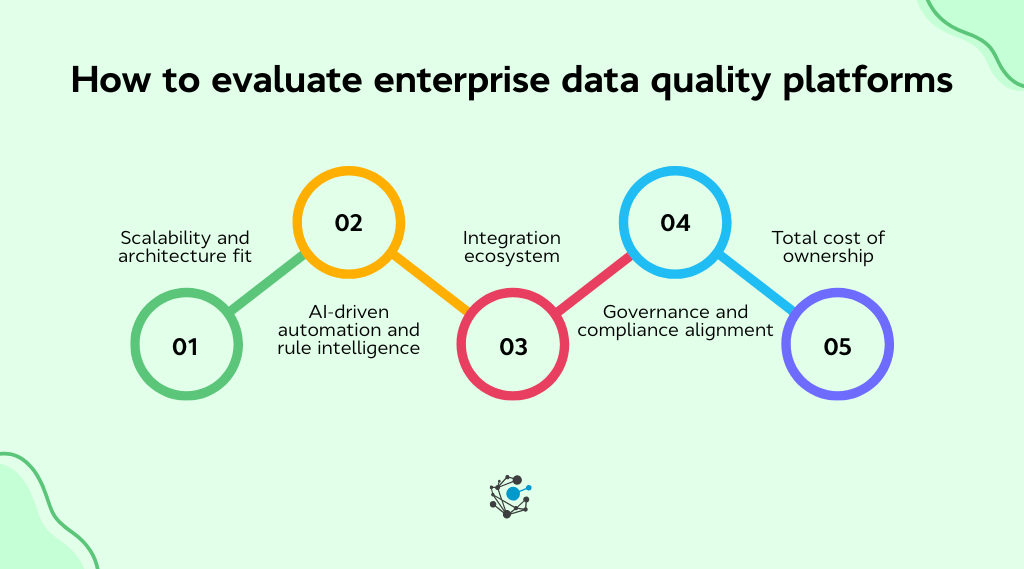
A disciplined evaluation should move from technical architecture fit to operational sustainability.
1. Scalability and architecture fit
The first evaluation question is structural. Can the enterprise data quality platform operate across your existing data estate without introducing bottlenecks or blind spots?
Large organizations rarely operate in a single environment. Data typically spans:
-
Cloud data warehouses
-
Lakehouses
-
On-premises databases
-
SaaS systems
A platform that only supports a subset of these environments will create coverage gaps. Data quality issues often emerge at integration boundaries, so integration depth matters more than surface-level connectors.
-
Hybrid and multi-cloud support: Many enterprises operate in multi-cloud or hybrid architectures for regulatory, regional, or operational reasons. An enterprise-grade data quality platform must support validation and monitoring across these environments without duplicating logic manually. Ask:
-
Can the platform run checks in different cloud regions
-
Does it support secure connectivity across on-prem and cloud systems
-
Are rule definitions reusable across environments
-
If rule logic must be rewritten for each platform, governance consistency will erode.
-
High-volume batch and near-real-time needs: Modern enterprises manage both scheduled batch processing and near-real-time data streams. Executive dashboards may update daily, while fraud detection or operational monitoring requires immediate feedback. An effective enterprise data quality platform should:
-
Support scalable validation on large datasets
-
Provide data quality monitoring and alerting for streaming inputs
-
Handle both structured and semi-structured formats
-
Avoid introducing latency that disrupts analytics pipelines
-
Warehouse, lakehouse, and pushdown capabilities: Pushdown processing is a critical technical consideration. Instead of extracting data into a separate engine for validation, the platform should ideally execute checks where the data resides. Ask directly:
-
Can the platform measure and enforce quality within our warehouse or lakehouse
-
Does it leverage native compute for profiling and validation
-
How does it minimize data movement and duplication
2. AI-driven automation and rule intelligence
Manual rule creation does not scale in large enterprises. As data estates grow, the number of potential validation rules expands rapidly. Without automation, quality programs stagnate because teams cannot keep up with rule maintenance.
Automation is no longer optional. It is central to sustainable enterprise data quality.
Rule recommendations based on profiling patterns
Profiling engines can identify patterns such as common formats, expected value ranges, and distribution baselines. Advanced platforms use this insight to suggest validation rules automatically.
For example:
-
If a field consistently contains ISO country codes, the platform can recommend an allowed values rule.
-
If a metric shows a stable distribution over time, anomaly thresholds can be generated dynamically.
These recommendations reduce the burden on data stewards and engineers.
Natural language rule creation
One persistent friction point in enterprise data governance is translation. Business stakeholders describe expectations in natural language. Engineers convert those expectations into technical logic.
Modern enterprise data quality platforms increasingly support natural language inputs that convert business requirements into enforceable rules. This reduces ambiguity and accelerates adoption.
This capability supports data quality governance and stewardship by narrowing the gap between policy and implementation.
Why automation supports long-term sustainability
Organizations often underestimate the operational overhead of rule maintenance. As new systems are added and definitions evolve, validation logic must adapt.
AI-driven automation helps:
-
Identify obsolete or conflicting rules
-
Suggest updates when data definitions change
-
Highlight redundant checks across domains
-
Maintain consistency across rule libraries
This supports long-term scalability and prevents quality programs from becoming unmanageable.
3. Integration ecosystem
An enterprise data quality platform sits inside a broader data architecture that includes ingestion tools, warehouses, BI platforms, governance systems, and sometimes streaming infrastructure.
Many enterprise implementations fail not because the platform lacks features, but because it cannot integrate deeply enough into the organization’s existing stack.
In practical terms, integration determines whether data quality becomes embedded into daily operations or remains an external layer that teams bypass.
Cloud warehouses and lakehouses
Modern enterprises rely heavily on cloud data warehouses and lakehouses for analytics and AI. A data quality platform must integrate natively with these systems to:
-
Run profiling and validation checks directly on stored data
-
Leverage native compute for scalability
-
Avoid unnecessary data extraction and duplication
-
Enforce quality at scale across large datasets
If validation requires exporting data to a separate engine, performance, cost, and governance risks increase. A strong enterprise data quality platform supports pushdown execution and works seamlessly with the warehouse’s security model.
This is especially important for organizations adopting a data quality platform for cloud data warehouse environments. Quality enforcement must align with how data is stored and queried.
BI tools and analytics visibility
Data quality metrics are only useful if decision-makers can see them. Integration with BI tools ensures:
-
Data quality KPIs and SLAs are visible alongside business metrics
-
Analysts can quickly identify whether a dashboard is impacted by a quality issue
-
Governance teams can monitor trends in data integrity across domains
|
For example, if a revenue dashboard is flagged with a completeness warning because upstream data validation failed, stakeholders can contextualize anomalies before making decisions. Without this integration, quality insights remain disconnected from business consumption. |
ETL and ELT tooling
An enterprise data quality platform must integrate with ETL and ELT frameworks so that:
-
Validation checks can run during or immediately after transformation
-
Failures can block bad data from entering production layers
-
Remediation workflows are triggered automatically when issues occur
Integration with orchestration systems allows quality checks to be part of CI workflows and deployment processes. This aligns data quality testing with modern data engineering practices.
Catalog and lineage systems
Context is essential for enterprise data quality. Integration with data catalog and lineage tools provides:
-
Visibility into dataset ownership
-
Impact analysis when quality rules fail
-
Clear traceability from source systems to downstream dashboards
-
Alignment between business definitions and validation logic
|
For example, if a key regulatory field fails validation, lineage integration shows which reports and systems depend on that field. This allows teams to prioritize remediation based on business risk. |
When vendors describe their platform as enterprise-grade, integration depth is often what distinguishes them. Broad connectivity and metadata alignment ensure that data quality governance and stewardship operate across the entire ecosystem rather than within a silo.
4. Governance and compliance alignment
An enterprise data quality platform must go beyond technical validation. It must support governance structures, compliance controls, and accountability mechanisms.
Scripts and isolated validation tools can check for null values or schema drift. They cannot demonstrate regulatory readiness or structured oversight.
Ownership mapping and stewardship accountability
Every critical dataset should have a designated owner. An enterprise data quality platform should allow organizations to:
-
Assign data owners and stewards to specific domains
-
Link rules to responsible individuals or teams
-
Escalate issues when SLAs are breached
Clear ownership is fundamental to data quality governance and stewardship. Without it, incidents linger unresolved.
Audit trails for rule changes and remediation
Compliance frameworks require traceability. When validation rules are updated, enterprises need to:
-
Track who made the change
-
Document the rationale
-
Maintain version history
-
Verify that enforcement remains consistent
Similarly, remediation actions must be auditable. If a regulatory reporting dataset fails validation, the organization must be able to demonstrate how the issue was detected, resolved, and verified.
An enterprise data quality platform that logs rule enforcement, changes, and remediation workflows supports audit readiness. This is especially important for industries governed by GDPR, HIPAA, financial regulations, or sector-specific compliance standards.
For organizations handling personal data or financial reporting, compliance alignment is a core evaluation criterion.
5. Total cost of ownership
Licensing fees are only a fraction of the investment required for an enterprise data quality platform. Long-term sustainability depends on understanding the full cost profile.
Implementation effort and time to coverage
Evaluate how quickly the platform can:
-
Connect to core systems
-
Profile critical datasets
-
Define and deploy initial rules
-
Establish monitoring dashboards
A tool that requires extensive customization or manual rule setup may delay value realization. Faster time to coverage improves business confidence and stakeholder buy-in.
Ongoing rule maintenance labor
As data evolves, rules must evolve. Consider:
-
How easily can rules be updated
-
Whether rule libraries are reusable
-
How automation reduces manual upkeep
-
Whether governance workflows support efficient approvals
If rule maintenance becomes burdensome, quality programs stagnate.
Training and adoption effort
An enterprise data quality platform must be usable by both technical and business stakeholders. Adoption considerations include:
-
Role-based interfaces for stewards and engineers
-
Clear documentation and training resources
-
Intuitive dashboards for monitoring quality KPIs
Without adoption, even advanced platforms fail to deliver impact.
When evaluating an enterprise data quality platform, integration ecosystem, governance alignment, and total cost of ownership are tightly connected.
Integration ensures quality enforcement reaches every relevant system. Governance alignment ensures accountability and compliance. Total cost awareness ensures the program remains sustainable.
Buyers searching for an enterprise data quality platform are not simply comparing features. They are assessing whether a platform can:
-
Integrate across hybrid data architectures
-
Support data quality governance and stewardship
-
Provide audit-ready documentation
-
Scale operationally without excessive manual effort
-
Deliver measurable improvements in data integrity and trust
A disciplined evaluation across these dimensions increases the likelihood that data quality becomes an enterprise capability rather than another underutilized tool.
ROI metrics to expect from an enterprise data quality platform
Return on investment from enterprise-grade data quality shows up in fewer escalations, faster analytics cycles, improved AI reliability, and lower compliance exposure. The key is tracking the right metrics from the beginning.
1. Increased operational efficiency
In many enterprises, analysts and engineers spend significant time investigating broken dashboards, reconciling mismatched reports, or cleaning data before analysis. These efforts are rarely visible in budget lines, but they accumulate across departments.
An enterprise data quality platform improves operational efficiency by:
-
Automating data profiling so teams no longer rely on manual sampling
-
Enforcing data validation rules automatically during ingestion and transformation
-
Triggering structured remediation workflows when quality issues arise
-
Reducing repetitive ad hoc investigations into the same recurring data defects
Metrics organizations commonly track include:
-
Reduction in time spent investigating data errors
-
Decrease in repeated incidents tied to the same dataset
-
Shorter remediation cycle times
-
Improved SLA adherence for critical datasets
Over time, operational efficiency becomes visible in faster reporting cycles and fewer emergency escalations.
2. Improved data-driven decision making
Cleaner data improves the quality of decisions. It sounds obvious, but in large enterprises, the gap between data availability and data trust is significant. Leaders may have access to dashboards but hesitate to act because confidence in the numbers is low.
An enterprise data quality platform supports stronger decision-making by:
-
Increasing data completeness and consistency across reporting layers
-
Aligning validation rules with business definitions
-
Monitoring KPIs to ensure data used in executive dashboards meets agreed standards
-
Reducing conflicting metrics across departments
Consider forecasting. If pipeline data includes inconsistent opportunity statuses or missing contract start dates, forecasts become unreliable. By enforcing business validity rules and monitoring changes, forecasting models operate on trusted inputs.
Improved decision-making is difficult to quantify directly, but its impact is visible in more decisive action and reduced hesitation driven by data doubt.
3. Reduced compliance risk
Regulatory exposure is one of the strongest drivers for adopting an enterprise data quality platform. In regulated sectors such as healthcare, finance, and public services, inaccurate or incomplete data can result in penalties, reporting failures, or reputational damage.
|
For example, privacy regulations require accurate consent tracking. If consent status fields are inconsistent or missing, reporting becomes unreliable and risk increases. A platform that enforces validation at data entry and monitors compliance fields reduces exposure. |
Compliance-related ROI metrics may include:
-
Fewer audit findings related to data controls
-
Reduced manual preparation time for regulatory reporting
-
Clear documentation of rule changes and remediation history
-
Lower risk of penalties tied to reporting inaccuracies
Quality plus governance is what separates an enterprise data quality platform from simple validation scripts. It provides defensible evidence of control.
4. Cost savings
Poor data quality has a measurable financial impact.
These losses come from operational inefficiencies, bad decisions, rework, and compliance failures.
An enterprise data quality platform reduces cost in several ways:
-
Lower manual data cleansing and reconciliation labor
-
Fewer production incidents caused by schema changes or missing values
-
Reduced rework in analytics and reporting
-
Lower exposure to regulatory fines
-
Improved resource allocation through accurate forecasting
To track cost savings, organizations often measure:
-
Reduction in hours spent on data correction
-
Decrease in duplicate records affecting operational systems
-
Lower volume of emergency production fixes
These savings accumulate over time and strengthen the financial case for sustained investment.
When evaluating ROI, focus not only on immediate savings but on long-term resilience. A mature data quality platform reduces recurring incidents, aligns governance with enforcement, and supports analytics and AI initiatives with consistent inputs.
For organizations asking whether an enterprise data quality platform is worth the investment, the better question is how much unreliable data is already costing the business.
Conclusion
Automation amplifies whatever foundations exist beneath it. Clean inputs accelerate insight. Inconsistent inputs accelerate failure.
Most enterprises face two distinct data quality problems. Years of accumulated legacy data debt sit quietly in historical systems. At the same time, real-time operational pipelines continuously generate new risks through schema drift, missing values, duplicate records, and inconsistent definitions.
Periodic cleanup efforts do not solve either problem. They temporarily reduce visible issues while new failures emerge upstream.
An enterprise data quality platform must address both dimensions simultaneously.
It must uncover and remediate historical inconsistencies across customer, financial, and operational datasets. It must monitor pipelines in real time, enforce validation rules at ingestion, detect anomaly patterns before they affect dashboards, and trace failures through lineage to impacted reports and AI models.
Visibility is critical. Unified data quality dashboards and scorecards provide measurable insight into completeness, validity, timeliness, and trend performance across domains. Leaders can see where quality is improving, where risk is increasing, and where remediation requires investment.
Detection alone is not enough. Issues must be routed to accountable owners with root cause context, severity classification, and SLA tracking. Guided remediation ensures that quality failures are resolved systematically rather than informally.
When legacy data debt is eliminated and operational monitoring prevents new failures from spreading, data quality shifts from reactive cleanup to continuous control.
OvalEdge combines AI-powered anomaly detection, rule-based validation, lineage-aware impact analysis, structured stewardship workflows, and enterprise-grade dashboards into a single operational framework.
If data quality is infrastructure, the right platform does more than report problems. It prevents them, contextualizes them, and resolves them before trust erodes.
Download our Data Quality Tool Comparison Guide to evaluate platforms across eight critical capability areas.

Then see how OvalEdge eliminates legacy data debt, prevents operational failures in real time, and delivers measurable data trust across analytics and AI.

Book a demo to see how governed data becomes operational confidence
FAQs
1. What is the difference between data cleansing software and an enterprise data quality platform?
Data cleansing software typically focuses on cleanup tasks like standardization and deduplication. An enterprise data quality platform goes further by continuously profiling, validating, monitoring, and governing data quality across systems, often with stewardship workflows and audit trails.
2. Can enterprise data quality tools support real-time analytics?
Many modern platforms support continuous monitoring and anomaly detection, which is critical for real-time analytics and fast-changing pipelines. Observability-driven tools emphasize this monitoring layer heavily.
3. How does a data validation platform improve compliance?
It enforces consistent rules, documents controls, and supports auditability through logs, workflows, and reporting. Governance-aligned platforms position quality as part of enterprise-wide compliance and trust programs.
4. Are enterprise data quality platforms cloud-native?
Many enterprise platforms now offer cloud-native or cloud-first deployments, and increasingly bundle data quality with observability and governance for modern stacks.
5. Who typically owns enterprise data quality initiatives?
Ownership is usually shared: data engineering implements technical controls, governance teams define standards, and data stewards own remediation and business rule definitions. Stewardship-focused guidance is increasingly emphasized by governance platforms.
6. What is data quality as code?
Data quality as code embeds validation rules directly into pipelines using version-controlled frameworks. It enables automated testing during deployment, supports CI workflows, and ensures rules evolve alongside transformations without manual rework.
.png?width=1081&height=173&name=Forrester%201%20(1).png)
.png?width=1081&height=241&name=KC%20-%20Logo%201%20(1).png)