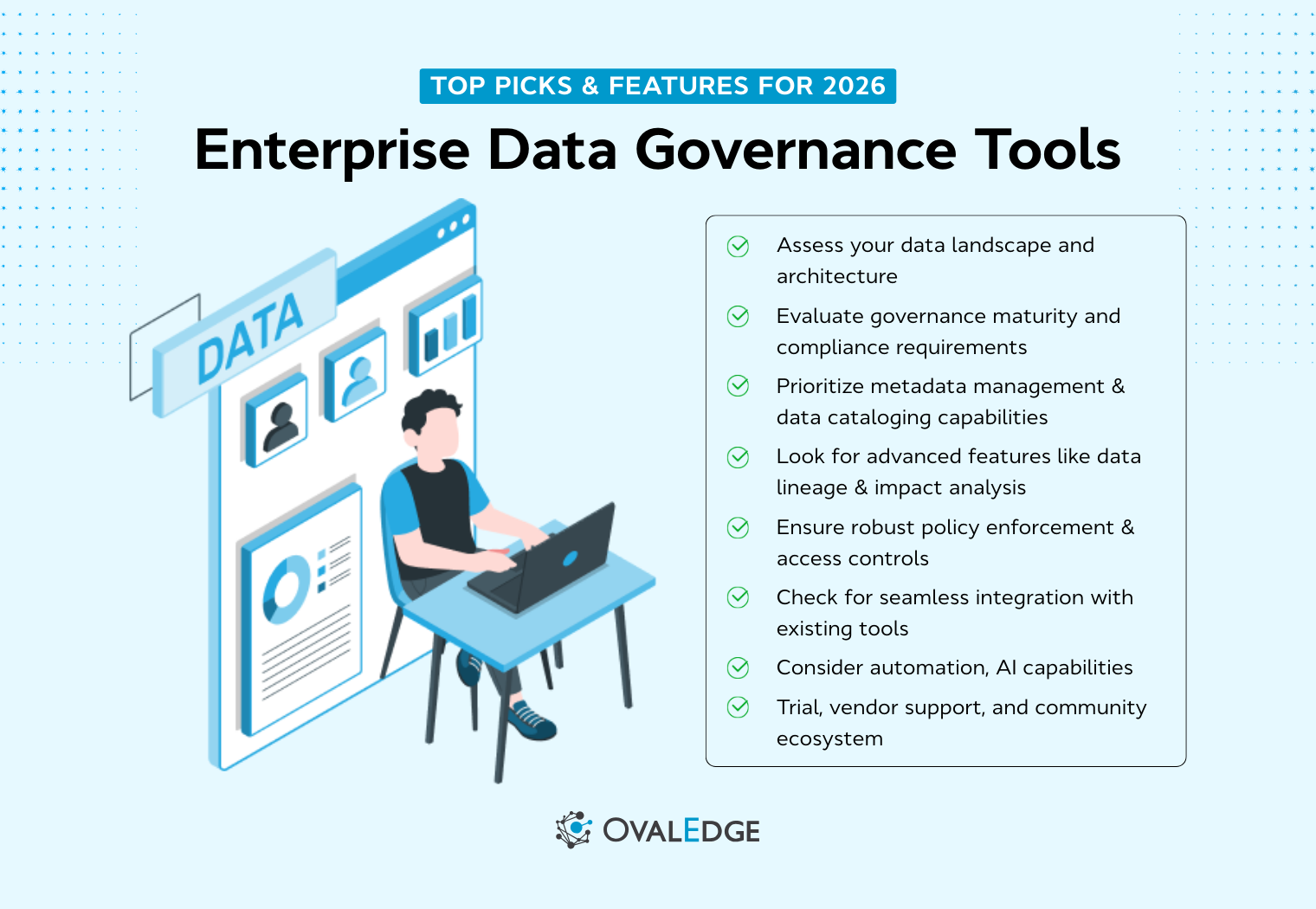
Is your organization struggling to manage data at scale?
As data grows exponentially across businesses, traditional data governance approaches can no longer meet the needs of enterprises. Managing data effectively is crucial for compliance, security, and overall data integrity, especially as data becomes more distributed, diverse, and complex.
Enterprise data governance differs from traditional data governance because it involves handling vast amounts of data across a variety of environments, such as multi-cloud or hybrid systems, while ensuring compliance and risk management at scale.
Here are three key reasons why traditional data governance fails to meet the needs of enterprises:
-
Scalability issues: Traditional methods cannot scale efficiently to manage vast amounts of data and complex data architectures found in enterprises.
-
Lack of integration across systems: Many legacy governance tools can't integrate seamlessly across cloud, on-premises, and hybrid systems, which hinders the ability to manage data comprehensively.
-
Manual oversight & high risk: Without automation and streamlined processes, traditional governance is prone to human error, delays, and compliance risks.
That’s where enterprise data governance tools come in. These tools offer comprehensive, scalable, and automated solutions to address the complexity and scale challenges faced by modern enterprises.
In this blog, we will dive into the core features of enterprise data governance tools and how they can help businesses stay compliant and secure.
What is an enterprise data governance tool?
Enterprise data governance tools are essential platforms designed to manage and secure data within organizations, ensuring compliance with regulations, enhancing data quality, and protecting privacy.
These tools centralize data management, automate governance processes, and enforce policies for data access and usage. Key features include metadata management, data lineage tracking, compliance monitoring, and real-time auditing.
They help businesses ensure data integrity, optimize workflows, and support data-driven decision-making. With automation and AI capabilities, these tools enable scalable, efficient data governance that aligns with both business objectives and regulatory standards.
Top enterprise data governance tools in 2026
As businesses continue to rely on data for decision-making, effective governance becomes crucial. In 2026, the landscape of enterprise data governance tools has evolved to meet the growing complexity of data management needs.
From ensuring regulatory compliance to enhancing data quality and security, the right tools are more important than ever.
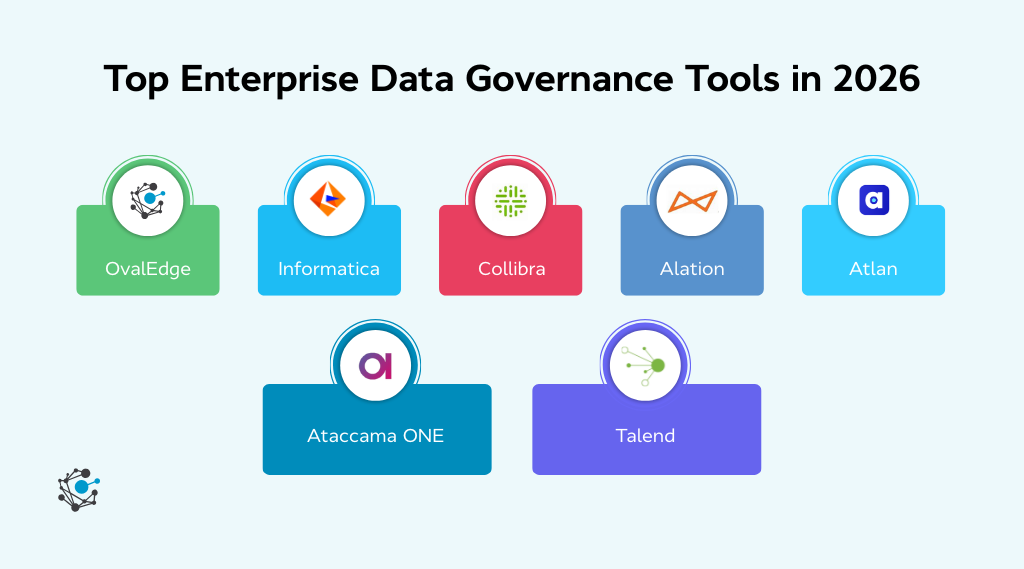
1. OvalEdge
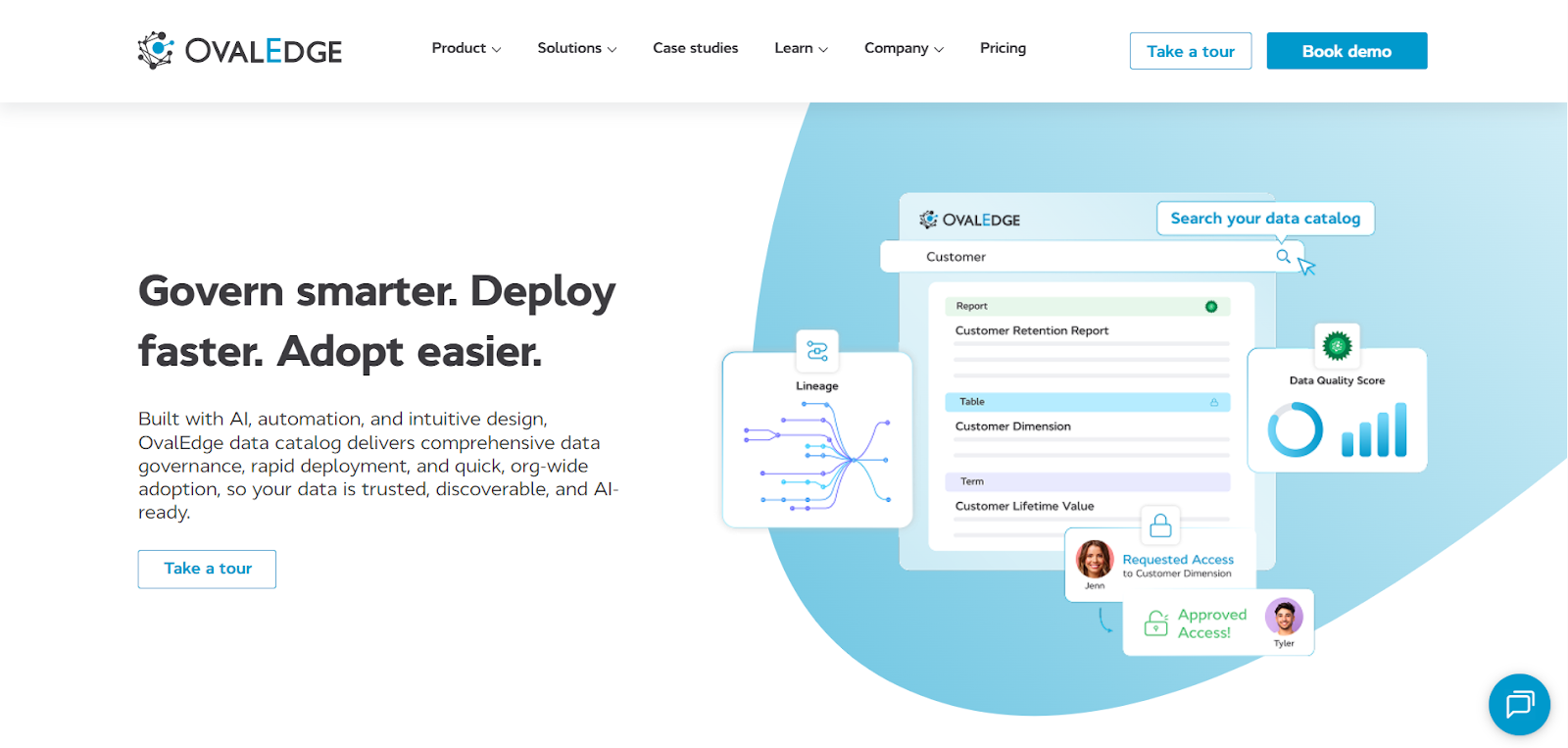
OvalEdge is a robust data governance platform known for its user-friendly interface and scalability. It offers a range of solutions for data cataloging, metadata management, and lineage tracking, ensuring that businesses can effectively manage, track, and govern their data.
OvalEdge is particularly useful for organizations dealing with constantly changing data environments, as it provides real-time visibility and automation.
Key features
-
Data cataloging: OvalEdge centralizes metadata, offering a unified view of all data assets, making it easier for organizations to locate, organize, and govern data across multiple systems.
-
Metadata management: Automatically captures metadata from diverse sources, ensuring that it remains up-to-date and easily accessible, improving decision-making and compliance.
-
Lineage tracking: The tool provides end-to-end data lineage tracking, allowing teams to trace the origins of data, monitor transformations, and ensure data quality and accuracy.
-
Automation: Automates repetitive governance tasks such as data quality checks, reporting, and compliance workflows, reducing manual intervention and errors.
-
Connectors: OvalEdge supports 150+ prebuilt connectors across databases, cloud data platforms, BI tools, ERP, ETLs, and SaaS applications. These connectors enable automated metadata harvesting, lineage discovery, and governance enforcement across the entire data landscape without manual setup
-
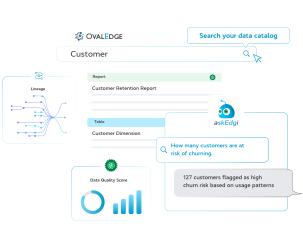
AskEdgi: AskEdgi extends OvalEdge’s catalog with AI-native, governed analytics. Business users can ask questions in plain English while AI agents handle dataset discovery, governance checks, access validation, and analysis, without requiring ETL, data warehouses, or technical expertise
See How AI Powers Enterprise Governance,
Guided by Humans

Continuously discover, classify, and map lineage

Monitor quality, detect risks, and enforce policies

Route critical decisions for human review
Pros
-
Scalable and flexible, adapting to various business sizes.
-
User-friendly interface that simplifies complex data governance tasks.
-
Real-time visibility and automation features streamline governance processes.
Pricing
OvalEdge offers scalable pricing across Essential, Professional, and Enterprise tiers, with SaaS or On-Prem options, increasing connectors, users, and advanced governance, privacy, quality, and AI capabilities as organizations grow.
Contact sales today to know the pricing.
Ratings
Rated 4.6/5 on Gartner Peer Insights
If you're evaluating platforms that combine cataloging, lineage, and automation in one place, seeing how it works with your own data setup can make the decision clearer.

Book a demo with OvalEdge to explore how it fits into your existing data stack.
2. Informatica
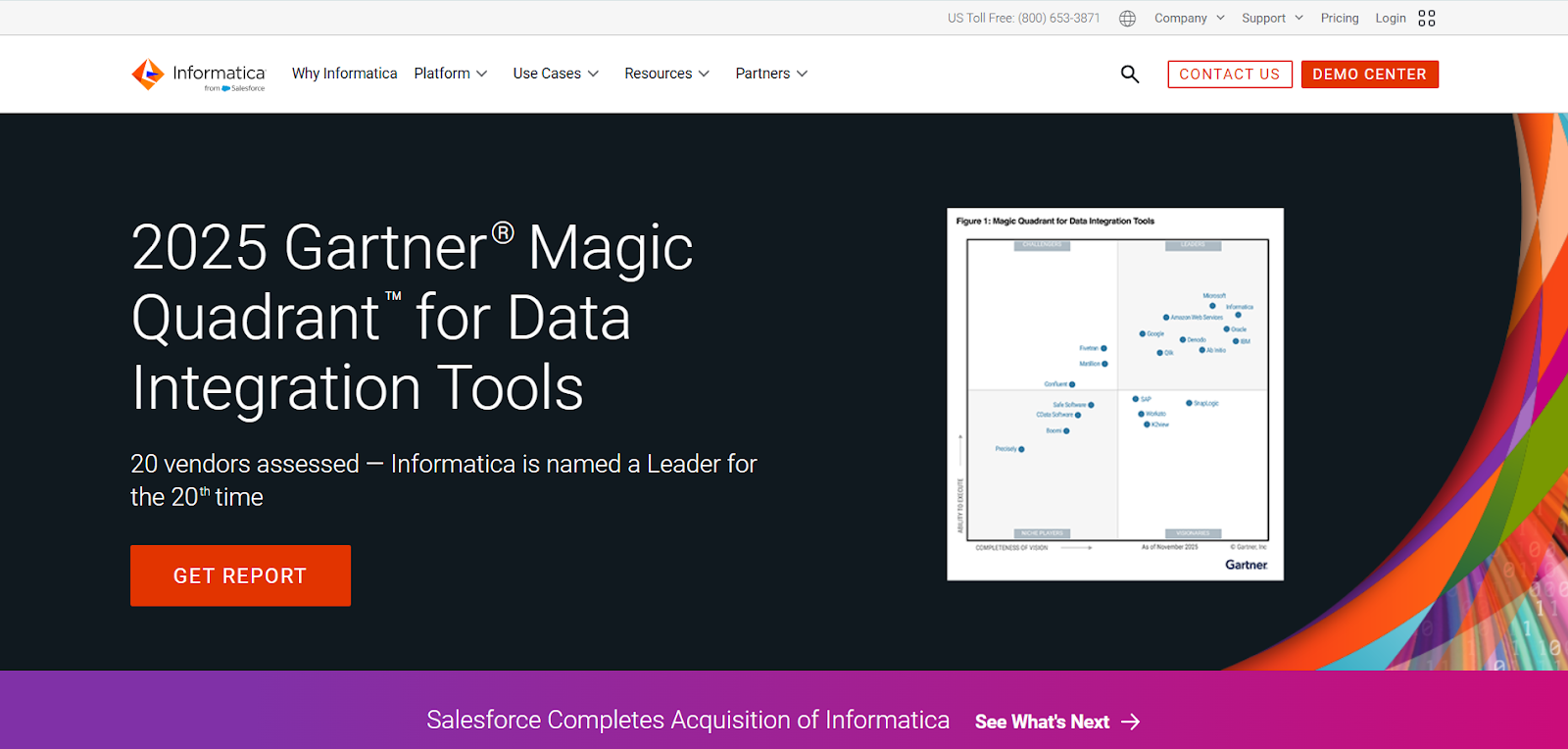
Informatica is a leading data governance tool that integrates data quality, metadata management, and automated data lineage tracking.
Known for its deep integration with various data environments, it is particularly suited for large enterprises and organizations operating in heavily regulated industries.
Informatica’s ability to handle complex data landscapes while automating key processes makes it a trusted choice for enterprise data governance.
Key features
-
Automated data lineage: Informatica automates the process of tracking data lineage, providing a clear view of how data flows across the organization, improving data accuracy and compliance.
-
Advanced metadata management: Centralizes metadata across systems and platforms, making it accessible and searchable for all data stakeholders.
-
Data quality: Ensures data quality by automatically profiling, validating, and cleansing data, allowing businesses to rely on high-quality, trustworthy information for decision-making.
-
Compliance monitoring: With built-in regulatory compliance features, Informatica helps businesses stay compliant with various data protection laws, such as GDPR and CCPA.
Pros
-
Highly integrative with various data management and analytics systems.
-
Comprehensive suite with advanced metadata management and data quality tools.
-
Strong compliance and regulatory monitoring capabilities.
Cons
-
It can be complex to implement and configure, especially for smaller teams.
-
Pricing may be prohibitive for small-to-medium-sized businesses.
Pricing
Informatica offers flexible, consumption-based pricing with volume discounts, AI-driven cost optimization, and pay-as-you-need scalability, enabling customers to access multiple data management services while reducing total ownership costs
Ratings
What it can improve
While Informatica remains a popular choice in the data engineering world, it’s not without its complaints. Users often cite complexity as a significant challenge, especially when dealing with its GUI.
Many developers point out that drag-and-drop workflows can get cumbersome, especially when scaling.
For instance, it’s common for users to end up copying and pasting workflows rather than leveraging clean, reusable code. This leads to inefficiencies and maintenance headaches down the road.
Moreover, as organizations shift towards cloud environments, many users feel Informatica's on-prem tools fall behind the curve. There’s also a learning curve associated with the platform, with many new users struggling to get comfortable due to its non-intuitive interface.
Finally, the pricing model doesn’t sit well with everyone, especially small businesses that feel the high costs don't justify the features compared to newer, more flexible cloud-based tools.
Ultimately, while Informatica offers robust features, users need to weigh its complexities and costs against the growing preference for more agile, code-centric solutions.
3. Collibra
Collibra is an enterprise-grade data governance platform designed to streamline compliance, auditability, and policy enforcement.
It features an advanced data catalog, lineage tracking, and robust compliance reporting tools, making it ideal for industries with strict regulatory requirements.
Collibra supports a wide range of data governance functions, ensuring businesses can manage their data assets and maintain high levels of transparency and control.
Key features
-
Policy automation: Collibra automates the creation and enforcement of data governance policies, reducing manual efforts and ensuring consistency across the organization.
-
Data lineage tracking: Provides a complete view of data movement and transformation, allowing users to trace data origins and impacts across systems.
-
Compliance reporting: Built-in compliance tools help businesses meet industry-specific regulations such as GDPR, HIPAA, and CCPA with ease.
-
Workflow management: It includes workflow management features that allow for collaboration between teams to ensure data stewardship and compliance tasks are completed efficiently.
Pros
-
Strong policy automation and compliance tracking.
-
Easy-to-use interface with advanced workflow management features.
-
Excellent support for auditability and transparency.
Cons
-
Can be resource-intensive, requiring substantial investment in time and manpower to fully leverage.
-
Some customization options might be limited for specific industries.
Ratings
What it can improve
While Collibra promises to streamline data governance, its implementation has been less than smooth for many users. A common frustration centers aroundpoor customer support and complex setup processes.
Some users report significant challenges in integrating Collibra with their existing systems, especially with metadata ingestion and its buggy performance. Even more troubling is the lack of business adoption.
Without strong organizational commitment, Collibra's effectiveness can quickly dwindle. As one user pointed out, despite business buy-in, the tool still felt like an abandoned town, struggling with fragmented data governance.
Additionally, many feel that Collibra's complexity only adds to their existing data governance woes, making it harder to keep things consistent and updated. So, while Collibra can be powerful, the right implementation and organization-wide support are crucial for it to live up to its promise.
4. Alation
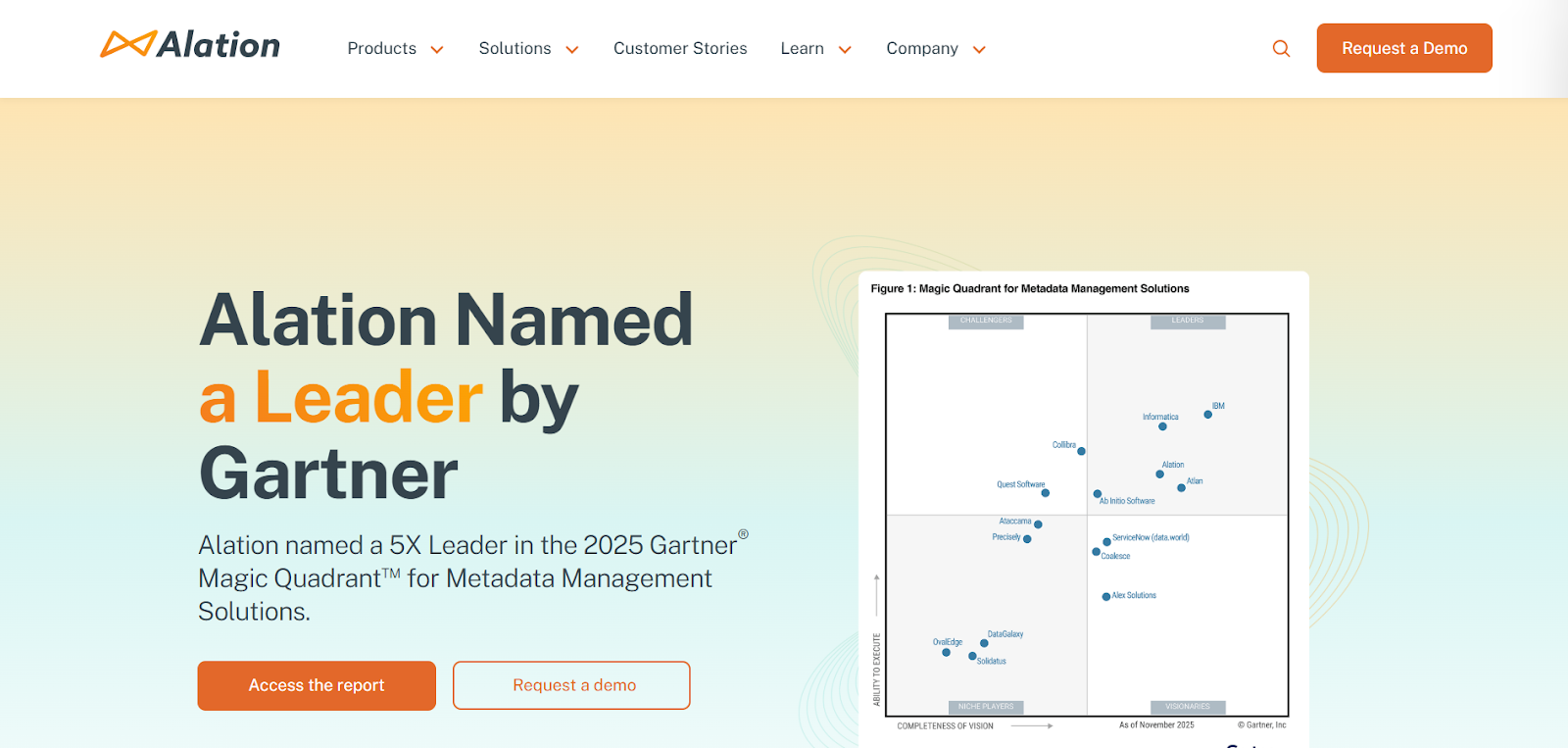
Alation is a data governance and cataloging tool that integrates governance workflows with strong collaboration features.
With a focus on search-driven navigation and business glossary features, Alation helps organizations foster data literacy and collaboration across teams. This makes it an ideal choice for businesses looking to empower their data stewards and analysts with more accessible and trustworthy data.
Key features
-
Business glossary: Alation offers a centralized business glossary that improves data literacy and ensures consistent definitions of business terms across departments.
-
Search-driven navigation: Alation’s intuitive search functionality enables data stewards and analysts to find and access data easily, boosting efficiency and reducing the time spent on data discovery.
-
Data stewardship collaboration: Alation supports collaborative workflows, allowing data stewards to document, validate, and manage data assets across the organization.
-
Compliance support: The platform includes built-in tools for tracking and reporting on regulatory compliance, ensuring that data governance is aligned with industry regulations.
Pros
-
Strong collaboration tools that enhance teamwork between technical and business teams.
-
Intuitive search interface for easy data discovery.
-
Great for fostering data literacy and stewardship within organizations.
Cons
-
Limited support for complex data lineage tracking compared to other tools.
-
The tool’s reporting capabilities could be more robust.
Pricing
Alation offers custom, request-based pricing tailored to your data intelligence needs, helping organizations access trusted data, streamline governance, and scale AI-powered data discovery and collaboration.
Ratings
What it can improve
While Alation is gaining traction as a popular data cataloging tool, some users have voiced frustrations with its limitations. A key concern revolves around its lineage capabilities. While it offers some basic functionality, users find it lacking in detail and essential features like tracking metrics and pipelines.
This makes it difficult to get a complete picture of how data flows across systems. Additionally, while Alation’s UI is praised for ease of use, its integration with newer data platforms, especially in dynamic environments, leaves some users longing for more robust automation and customization.
For many, these shortcomings hinder its potential, especially as businesses scale and evolve. Despite these challenges, Alation still remains a solid choice for teams with straightforward data governance needs.
However, those seeking more advanced functionality may need to look for alternatives.
5. Atlan
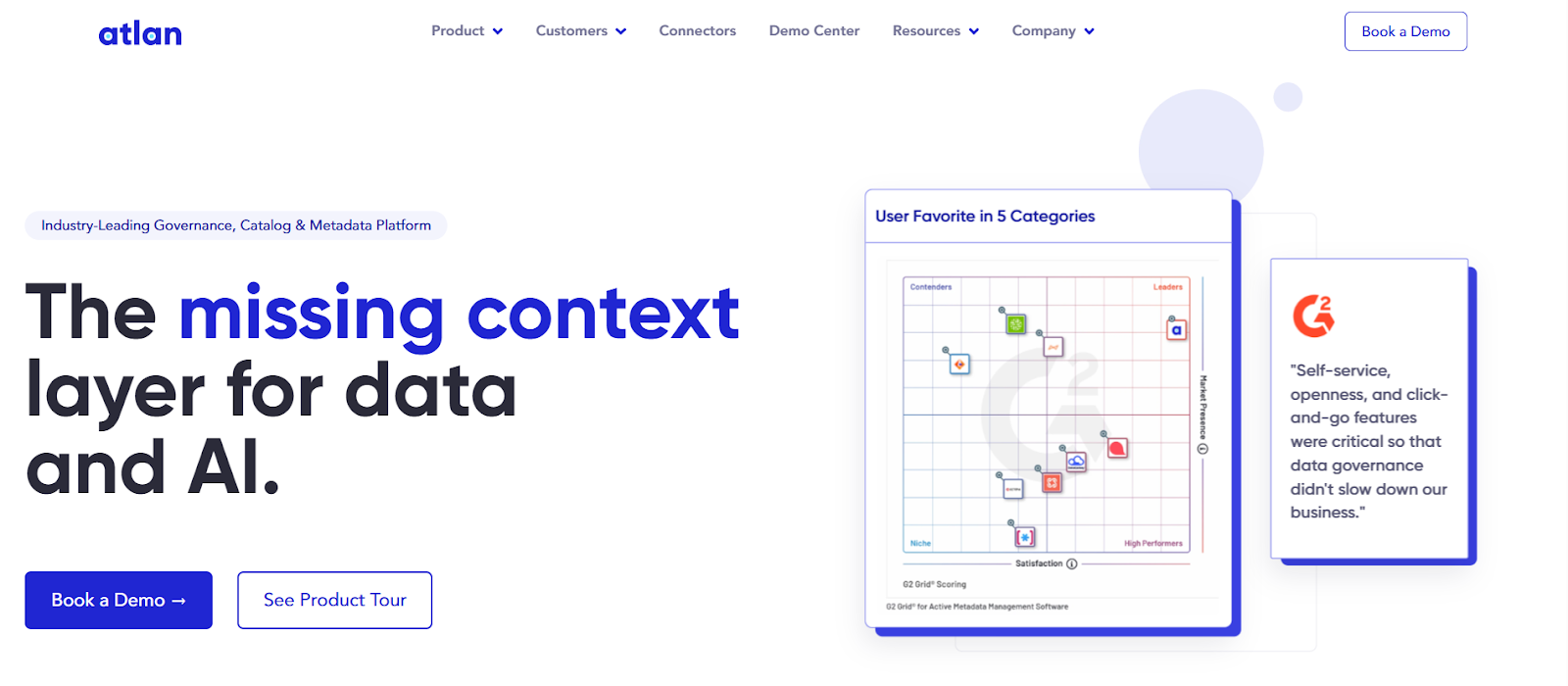
Atlan is a modern data workspace designed to bring together data cataloging, governance workflows, and metadata automation.
It is particularly popular with agile teams and decentralized organizations that need flexibility and collaboration in their data operations. Atlan helps teams work together efficiently while ensuring governance and compliance are maintained across data assets.
Key features:
-
Collaboration-focused: Atlan promotes collaboration across teams, offering features like real-time editing, versioning, and easy communication between data engineers, analysts, and business teams.
-
Metadata automation: Automates metadata capture and management, helping organizations maintain a comprehensive and up-to-date catalog without the need for manual intervention.
-
Flexible integration: Atlan integrates with a variety of data tools and systems, including BI platforms, data lakes, and cloud storage solutions, enabling seamless governance across your data landscape.
-
Governance workflows: Atlan streamlines governance workflows, allowing teams to enforce policies and ensure compliance with minimal manual effort.
Pros
-
Excellent collaboration tools that enhance communication across teams.
-
Real-time metadata automation saves time and reduces errors.
-
Seamless integration with various data platforms and tools.
Cons
-
Lacks some advanced data quality monitoring features compared to other tools.
-
Some users report that the interface can be challenging to navigate initially.
Ratings
What it can improve
While Atlan has gained popularity as a modern data workspace, it’s not without its criticisms. Some users have expressed frustration with the platform’s complexity and its limitations in handling certain workflows.
A recurring complaint is its slow support response times and inconsistent performance during metadata ingestion. Engineers have also pointed out that the user experience, especially for large organizations with vast datasets, can feel cumbersome.
Despite its automation features and focus on DataOps, many feel the platform falls short when it comes to integration with other tools and advanced customization.
For smaller teams, the platform’s full capabilities may feel overwhelming, making it less suited for simple data governance needs.
6. Ataccama ONE
Ataccama ONE is an all-in-one platform that combines data governance, data quality, and master data management (MDM).
It provides powerful tools for data profiling, classification, and continuous monitoring, making it suitable for enterprises that require an integrated solution for data governance and quality management.
Key features
-
Data quality monitoring: Ataccama ONE continuously monitors data quality, ensuring that data remains accurate, complete, and consistent.
-
Automated data profiling: The tool automatically profiles incoming data, classifying it based on predefined quality rules and business criteria.
-
Master data management (MDM): Combines governance with MDM features to create a single, trusted version of the truth across all data sources.
-
Data classification: Ataccama ONE offers automated classification for sensitive data, ensuring compliance with privacy regulations like GDPR.
Pros
-
Provides an all-in-one solution for data governance and quality management.
-
Strong MDM capabilities ensure data consistency and integrity across systems.
-
Excellent for automating data profiling and classification.
Cons
-
May require significant time and effort for implementation, especially in larger organizations.
-
Some advanced features may be challenging for non-technical users.
Ratings
What it can improve
Ataccama ONE has its fair share of enthusiasts, but users have also encountered significant challenges. While it offers a suite of powerful tools for data governance, users have faced performance issues when scaling up, especially when handling large volumes of data.
One user shared their frustration with Ataccama’s speed, citing long processing times when dealing with millions of records. Another common pain point is the platform's complexity. While it’s great for data quality, the steep learning curve and the lack of intuitive documentation have made it tough for teams to fully leverage its capabilities.
Plus, some users have expressed concern over its transition to a full platform, as it has led to additional costs and functionality overlaps with other tools.
Despite these challenges, many still appreciate its data quality features and customization options, especially when implementing it with a well-supported team.
7. Talend
Talend is a data integration platform that also offers strong data governance capabilities. It excels at integrating data across systems, ensuring that governance processes remain consistent and high-quality throughout.
Talend provides a unified environment for managing data cataloging, metadata, and governance, making it ideal for businesses with complex data pipelines.
Key features
-
Data integration and governance: Talend seamlessly integrates data from various systems, providing centralized governance across all data assets.
-
Real-time monitoring: The platform offers real-time monitoring and alerting, ensuring that data quality issues are identified and addressed quickly.
-
Data cataloging: Talend’s data catalog centralizes metadata, making it easy to track data assets and improve data transparency across departments.
-
Automated data quality checks: The tool automatically runs data quality checks, flagging anomalies and ensuring data consistency.
Pros
-
Strong integration capabilities with various data tools and systems.
-
Real-time monitoring allows for immediate action on data quality issues.
-
Provides a comprehensive data catalog for improved transparency.
Cons
-
May require extensive configuration for advanced features.
-
Not as specialized in compliance reporting compared to other tools.
Pricing
Qlik Talend offers tiered Starter, Standard, Premium, and Enterprise plans priced by data volume and usage, providing scalable data integration, transformation, governance, and AI capabilities for organizations at varying maturity levels
Ratings
What it can improve
While Talend has its merits, many users have voiced concerns about the platform's user interface and support issues. One common complaint is the clunkiness of the tool, especially when working with complex data integration workflows.
Users have experienced strange behavior, such as columns returning NULL values despite being mapped correctly, with fixes that feel like random "hacks." On top of this, the price hikes following Talend's acquisition by Qlik have left many feeling dissatisfied.
Some even switched to alternatives like Mulesoft or SSIS due to higher costs and poor performance. While it does serve its purpose for basic ETL tasks, users argue that it lacks flexibility, especially in highly dynamic environments.
It's clear that for those managing more intricate setups, the experience can be frustrating, especially with a steep learning curve and limited support.
Choosing the right enterprise data governance tool can significantly enhance an organization's data management strategy.
The tools highlighted above provide robust solutions for managing metadata, ensuring compliance, and maintaining data integrity. As the data landscape continues to evolve, staying informed about the best tools will help businesses stay ahead.
Core capabilities of enterprise data governance tools
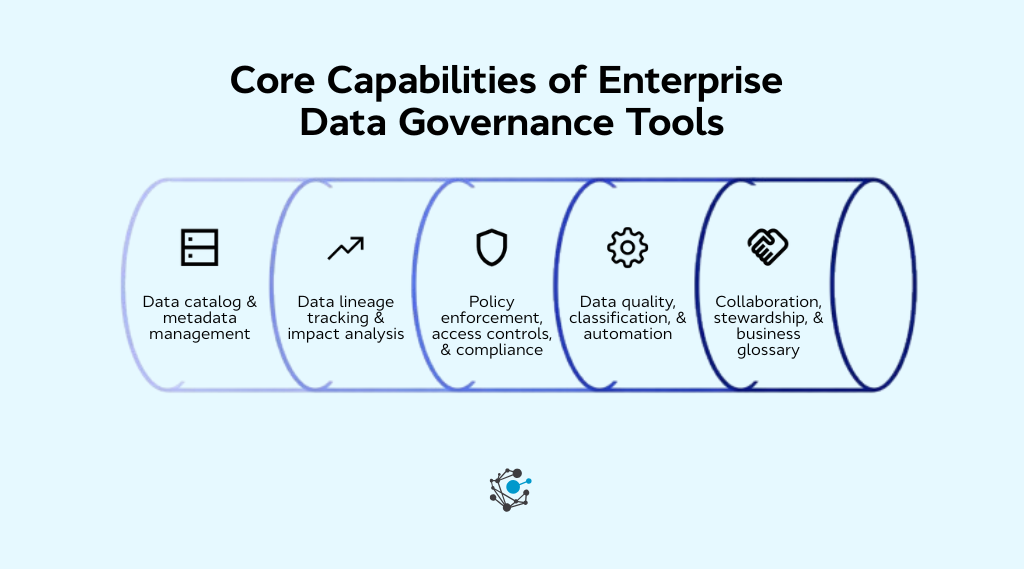
Enterprise data governance tools provide the framework to ensure that data is accurate, accessible, secure, and compliant with regulations. The capabilities these tools offer are essential for managing large, complex data ecosystems.
Below, we expand on the key features of these tools and provide insights into how they support effective data governance across enterprises.
1. Data catalog & metadata management
The ability to catalog and manage metadata is one of the cornerstones of data governance. Data catalogs centralize all metadata from various sources, making it easier for organizations to discover, track, and manage their data assets across multiple systems.
This capability allows businesses to establish a clear and comprehensive view of their data, enabling data stewardship, better decision-making, and consistency across the organization.
-
Centralized metadata repository: Data governance tools aggregate metadata from different systems, creating a single, comprehensive view of all data assets. This eliminates the need to manually search through different systems to locate data.
-
Semantic layer and business glossary: Built-in business glossaries and semantic layers define the meaning of data terms consistently across departments, helping avoid confusion and ensuring alignment across teams.
-
Data lineage mapping: By tracking the movement and transformation of data, metadata management allows businesses to understand data flows and dependencies, ensuring transparency and trust in data sources.
Metadata management ensures consistency, especially in larger organizations with multiple departments. It helps eliminate confusion around definitions, data sources, and workflows.
|
For example, if two departments refer to the same data differently (e.g., "customer" vs. "client"), metadata management ensures that both teams have a unified understanding of the term. This is vital for seamless collaboration and maintaining data integrity. |
2. Data lineage tracking & impact analysis
Data lineage refers to tracking the journey of data from its origin to its final destination, including any transformations, aggregations, or modifications it undergoes.
This is crucial for ensuring data accuracy, accountability, and understanding how changes in source systems affect downstream processes.
-
End-to-end data visibility: Data lineage provides a clear path of where data comes from and how it moves through systems, offering transparency into the process.
-
Impact analysis: When changes are made to data sources or transformations, impact analysis assesses how these changes will affect other data assets and business processes.
It enables organizations to predict and mitigate any negative consequences of changes to their data environment.
-
Auditability: Lineage tracking supports audit trails by detailing who modified data and when, supporting compliance audits and regulatory requirements.
|
For example, in regulated industries like finance or healthcare, data lineage allows organizations to demonstrate compliance with laws that require data traceability. It also helps data engineers and analysts quickly identify the source of errors in reports or data inconsistencies, saving valuable time in troubleshooting. |
3. Policy enforcement, access controls & compliance
Data governance tools ensure that organizational data is properly classified, protected, and compliant with internal policies and external regulations such as GDPR, CCPA, or HIPAA. They automate the enforcement of security policies and access controls to ensure that only authorized users can access sensitive data.
-
Role-based access control (RBAC): This feature allows organizations to define specific user roles and grant access based on the principle of least privilege. Users only have access to the data they need to perform their job.
-
Data masking and encryption: Sensitive data is protected through masking or encryption, preventing unauthorized access and ensuring compliance with privacy regulations.
-
Automated compliance reporting: Data governance tools generate reports to ensure compliance with data protection laws, making audits smoother and more efficient.
For organizations handling sensitive data (e.g., healthcare providers managing patient data or banks dealing with financial records), policy enforcement and access controls are essential for protecting against data breaches and ensuring legal compliance.
These tools automate compliance workflows, reducing the risk of human error and the potential for non-compliance penalties.
4. Data quality, classification & automation
Ensuring data quality is essential for any organization aiming to make informed, data-driven decisions.
Enterprise data governance tools include features for automatically profiling, cleansing, and classifying data to maintain its accuracy and completeness. These tools also automate workflows to reduce manual oversight, which enhances operational efficiency.
-
Data profiling and validation: Automated data profiling identifies inconsistencies, inaccuracies, or missing values, helping organizations proactively address data quality issues before they impact downstream processes.
-
Classification of sensitive data: Tools automatically classify data, including sensitive or personally identifiable information (PII), helping organizations comply with privacy regulations and avoid data leaks.
-
Automation of data quality monitoring: Data governance tools automate the continuous monitoring of data quality, ensuring that any anomalies or deviations are detected and addressed in real-time.
|
For instance, a retail company managing thousands of customer records would use these tools to ensure that customer contact information is up-to-date, accurate, and consistently formatted. Automating data quality checks reduces errors and ensures that reports and analyses based on this data are reliable. |
5. Collaboration, stewardship & business glossary
Collaboration and stewardship features are designed to support teamwork across data governance stakeholders, such as data stewards, engineers, analysts, and business users.
These tools encourage shared ownership of data quality, consistency, and compliance across the enterprise.
-
Data stewardship workflows: Data governance tools provide features for assigning stewardship roles, tracking progress, and ensuring that data is properly maintained across its lifecycle. Workflow capabilities also support approvals and version control for data changes.
-
Commenting and documentation: Collaboration features like commenting and documentation allow teams to share insights, track changes, and discuss data-related issues, ensuring that all stakeholders are on the same page.
-
Business glossary integration: A centralized business glossary ensures that data definitions are consistent across departments. This facilitates better data literacy and improves communication between technical teams and business users.
|
Consider a large multinational company that needs to manage data across multiple departments, including finance, HR, sales, and marketing. Collaboration features enable teams to maintain a shared understanding of key data definitions (e.g., "customer lifetime value") and ensure that data is handled consistently across the board. By using data stewardship workflows, organizations can hold individuals accountable for maintaining data quality and compliance. |
With capabilities like data cataloging, metadata management, lineage tracking, policy enforcement, and collaboration, these tools provide a comprehensive framework for maintaining control over an organization’s data.
They enable businesses to make better data-driven decisions while safeguarding sensitive information and meeting regulatory requirements.
By leveraging these capabilities, organizations can ensure that their data governance strategies are scalable, efficient, and aligned with both business objectives and compliance standards.
How are enterprise data governance tools evolving?
Enterprise data governance tools are moving beyond static catalogs and manual controls toward more active, intelligent, and embedded governance.
Modern platforms are increasingly built around automation and AI, enabling continuous metadata updates, real-time policy enforcement, and proactive data quality monitoring without heavy manual effort.
Governance is no longer a back-office function. It’s becoming part of everyday data usage, especially as interfaces shift toward natural language and AI copilots that let users interact with data more freely.
However, this evolution also exposes a readiness gap.
According to a 2024 Deloitte Survey on the State of Generative AI in the Enterprise, three-quarters of organizations expect GenAI to transform their business within the next three years, yet only a quarter feel highly or very highly prepared to govern AI-related risks.
This makes embedded governance critical, not optional.
Another major shift is governance embedded directly into analytics and workflows. Instead of forcing users to leave their tools, governance now travels with the data, whether it’s being queried, shared, or analyzed, ensuring compliance by design.
Finally, enterprises are prioritizing scalability and flexibility. As data ecosystems expand across cloud, on-prem, and SaaS platforms, governance tools are evolving to support decentralized ownership while maintaining centralized oversight.
The way forward is clear: data governance must be adaptive, automated, and aligned with how modern enterprises actually work with data.
How to choose the right data governance tool: key decision criteria
With the rising volume and complexity of data, choosing the right tool can seem daunting, but a methodical approach based on your organization's needs can streamline the decision-making process.
Below is a comprehensive guide on the critical decision criteria you should consider when selecting a data governance tool.
1. Assess your data landscape and architecture
Before diving into selecting a data governance tool, it’s crucial to understand your organization’s data landscape. This includes evaluating your data sources, platforms, storage systems, and any existing integration requirements.
The goal is to ensure that the chosen tool supports your current infrastructure while providing scalability for future growth.
-
Current and future data architecture: Your organization’s data might span on-premises systems, cloud-based storage, or hybrid solutions. Choose a governance tool that can integrate with these diverse environments seamlessly.
-
Volume and complexity of data: Large enterprises with vast amounts of structured and unstructured data need tools that can scale and manage complex datasets efficiently.
-
Integration needs: Consider the tool’s ability to integrate with existing platforms like databases, BI tools, and data lakes. Smooth integration is critical to prevent disruptions and ensure data flows seamlessly across systems.
|
For example, a global organization operating in multiple regions may have different data privacy requirements depending on local regulations (e.g., GDPR in Europe). The governance tool must handle diverse compliance needs across jurisdictions while integrating with cloud and on-premises systems to ensure full visibility into data flows. |
2. Evaluate governance maturity and compliance requirements
Organizations vary in terms of their data governance maturity. Some may need only basic features, such as metadata management and data cataloging, while others may require advanced functionalities like audit trails, automated compliance monitoring, and risk management.
Understanding your organization's governance maturity will help tailor the tool to meet your needs.
-
Maturity of governance processes: Organizations that are just starting with data governance may prioritize user-friendly tools for metadata management, while those with more mature processes may look for robust auditing, risk assessment, and compliance automation features.
-
Compliance demands: Regulatory compliance requirements differ greatly across industries. Your tool should be capable of ensuring compliance with relevant laws such as GDPR, CCPA, HIPAA, or industry-specific regulations.
|
A healthcare organization with strict HIPAA requirements would need a tool that supports automated compliance reporting, audit trails, and access control. For such a highly regulated sector, compliance automation ensures that the organization can maintain data privacy and security standards without manual intervention. |
According to a 2025 Gartner Research study on Data Architecture, data governance frameworks, which include architectural governance policies, ensure proper data creation, consumption, and control, helping enterprises meet privacy and regulatory requirements such as GDPR and CCPA.
This underscores the importance of selecting a governance solution that not only supports your data management needs but also guarantees compliance with evolving legal standards.
3. Prioritize metadata management & data cataloging capabilities
A robust metadata management system is the backbone of any data governance strategy. Data cataloging allows organizations to track, manage, and easily locate data assets across multiple systems.
Effective metadata management provides clarity and ensures consistency in data definitions across departments.
-
Automatic metadata harvesting: Choose tools that can automatically extract metadata from multiple data sources. This reduces the manual effort involved in metadata entry and ensures real-time updates.
-
Searchability and user interface: The tool should have a user-friendly interface, with advanced search capabilities that allow users to quickly find and access data.
-
Semantic tagging: Ensure the tool offers semantic tagging and business glossaries to define data terms and ensure consistency across departments.
In an organization with data spread across multiple systems (ERP, CRM, etc.), a data catalog simplifies data discovery.
|
For instance, business analysts can search for "customer data" and quickly locate the exact datasets, avoiding confusion over data definitions, such as distinguishing between "customers" and "clients." |
According to a 2024 Gartner Survey of Data & Analytics Leaders, 29% of organizations plan to revamp their data asset management and governance policies and practices, highlighting the growing recognition of the importance of effective metadata management.
By investing in comprehensive data cataloging and metadata management systems, businesses are not only improving data discovery but also enhancing data governance across the board.
4. Look for advanced features like data lineage & impact analysis
Data lineage and impact analysis capabilities are essential for understanding how data moves and transforms across systems.
These features enable transparency into the data flow and help identify the source of errors or inconsistencies. They are vital for ensuring that data transformations comply with business rules and maintain accuracy.
-
End-to-end lineage mapping: The tool should provide a clear path of data, from source to transformation to final destination, highlighting any dependencies or changes made to the data.
-
Impact analysis: This feature helps assess the effect of changes made to data sources or transformations on downstream systems, mitigating the risk of errors and disruptions.
In a large financial institution, the ability to track the lineage of transaction data is crucial. If a mistake occurs in a financial report, data lineage helps trace the error back to its source and understand how it propagated through various systems, enabling quick corrections.
5. Ensure robust policy enforcement & access controls
Effective policy enforcement and access control are crucial for securing data and ensuring compliance with internal and external regulations. A data governance tool should have built-in capabilities to enforce security policies and restrict access to sensitive data.
-
Role-based access control (RBAC): The tool should support detailed user roles, limiting data access based on job responsibilities. This minimizes the risk of unauthorized access to sensitive information.
-
Data masking and encryption: Sensitive data, such as PII or financial records, should be protected with masking or encryption techniques to comply with privacy regulations.
-
Automated policy enforcement: The tool should automatically apply and enforce governance policies, ensuring consistency and compliance across the organization.
|
Consider a bank that must ensure only authorized personnel can access customer financial data. A governance tool with strong RBAC and encryption features ensures that only account managers can view detailed financial records, while customer service representatives can only access basic account information. |
6. Check for seamless integration with existing tools
Data governance must work in conjunction with various data management, analytics, and business intelligence tools. The ability to integrate seamlessly with existing systems is a critical factor when selecting a data governance tool.
-
Native connectors and APIs: Ensure that the tool can integrate with your existing data infrastructure, including data warehouses, ETL pipelines, business intelligence platforms, and cloud storage solutions.
-
Compatibility with popular platforms: The tool should be compatible with widely-used platforms like AWS, Azure, Snowflake, and Google Cloud, as well as data visualization tools like Tableau or Power BI.
|
For example, for an e-commerce company using Amazon Web Services (AWS) for its data storage and Tableau for reporting, selecting a data governance tool that easily integrates with both AWS and Tableau will ensure seamless governance across data storage, reporting, and analytics systems. |
7. Consider automation, AI capabilities
Automation and AI are transforming the way data governance is executed. AI-driven features like automated tagging, anomaly detection, and active metadata management can enhance operational efficiency and reduce manual intervention.
-
Automated metadata tagging: AI can automatically classify and tag data based on pre-set rules, reducing the need for manual tagging and improving metadata accuracy.
-
Anomaly detection: AI-powered anomaly detection helps identify data quality issues or potential security breaches, alerting users in real time to take corrective actions.
-
Active metadata management: AI-driven tools can maintain and update metadata automatically, ensuring it remains current and reflective of ongoing changes to the data environment.
8. Trial, vendor support, and community ecosystem
Before committing to a data governance tool, it’s vital to test its fit for your organization through a trial or demo. Additionally, consider the level of vendor support and the strength of the community surrounding the tool.
-
Trial or demo availability: Ensure the vendor offers a trial or demo period, allowing your team to explore the tool’s features and determine if it meets your needs.
-
Vendor support and documentation: Strong support services and comprehensive documentation are essential for smooth implementation and ongoing use. Look for tools with extensive knowledge bases, forums, and responsive customer service.
-
Active user community: An engaged user community can be a valuable resource for troubleshooting, sharing best practices, and providing insights into how others use the tool in real-world scenarios.
By thoroughly evaluating your data landscape, governance maturity, and integration needs, you can select a tool that aligns with your organizational goals.
Prioritize key features like metadata management, data lineage, policy enforcement, and automation to ensure that the tool you choose can scale with your organization’s growing data needs while maintaining high levels of data quality and compliance.
Conclusion
Imagine that your company is handling millions of customer records across multiple platforms, with strict data privacy regulations to adhere to. Despite your best efforts, data breaches, non-compliance fines, and confusion over data ownership seem inevitable.
In such a scenario, relying on traditional data governance methods simply won’t cut it. As your enterprise grows, so does the complexity of managing data at scale. You need a solution that can integrate with various systems, automate key processes, and scale as your data requirements evolve.
-
How do you ensure compliance with global regulations like GDPR or CCPA across all your data environments?
-
How can you manage and secure data when it’s spread across on-prem, cloud, and hybrid systems?
-
How do you maintain data quality and avoid costly errors across massive datasets?
-
What happens when data ownership and responsibility aren’t clearly defined, and the risks pile up?
These are the critical pain points that enterprise data governance tools solve. With the right tools, you gain a centralized, automated approach that reduces risks, enhances security, and supports seamless collaboration across departments.
By investing in enterprise-grade solutions, you ensure your data governance framework remains efficient, compliant, and scalable, making it easier to adapt to evolving business needs.
Struggling to choose the right data governance tool for your enterprise?

Sometimes the best way to evaluate a platform isn’t through comparisons alone, but by seeing how it works within a real data environment.

Book a demo with OvalEdge to understand how enterprise governance can scale across your systems and workflows
FAQs
1. Do enterprise data governance tools support multi-cloud environments?
Yes, many modern enterprise data governance tools are designed to support multi-cloud environments, allowing seamless data management and compliance across hybrid cloud infrastructures like AWS, Azure, and Google Cloud.
2. What is the difference between enterprise data governance and traditional data governance?
Enterprise data governance emphasizes scalability, automation, and cross-departmental collaboration to manage complex data ecosystems, whereas traditional data governance is more focused on manual processes and centralized control within smaller, isolated environments.
3. Can enterprise data governance tools handle unstructured data?
Yes, many tools now offer capabilities to govern unstructured data, such as logs, social media content, and multimedia files, using AI/ML for metadata extraction and classification.
4. Are there any open-source alternatives to enterprise data governance tools?
Yes, open-source options like Apache Atlas, OpenMetadata, and DataHub offer data governance capabilities, but often require more customization and in-house expertise compared to commercial solutions.
5. Do enterprise data governance tools support data migration?
Yes, they provide tools to manage and track data migration processes, ensuring that data is transferred securely and in compliance with governance policies.
6. Can data governance tools integrate with other enterprise software?
Most enterprise data governance tools offer integrations with other software like CRM systems, ERPs, and BI tools to ensure seamless data flow and governance across platforms.
.png?width=1081&height=173&name=Forrester%201%20(1).png)
.png?width=1081&height=241&name=KC%20-%20Logo%201%20(1).png)