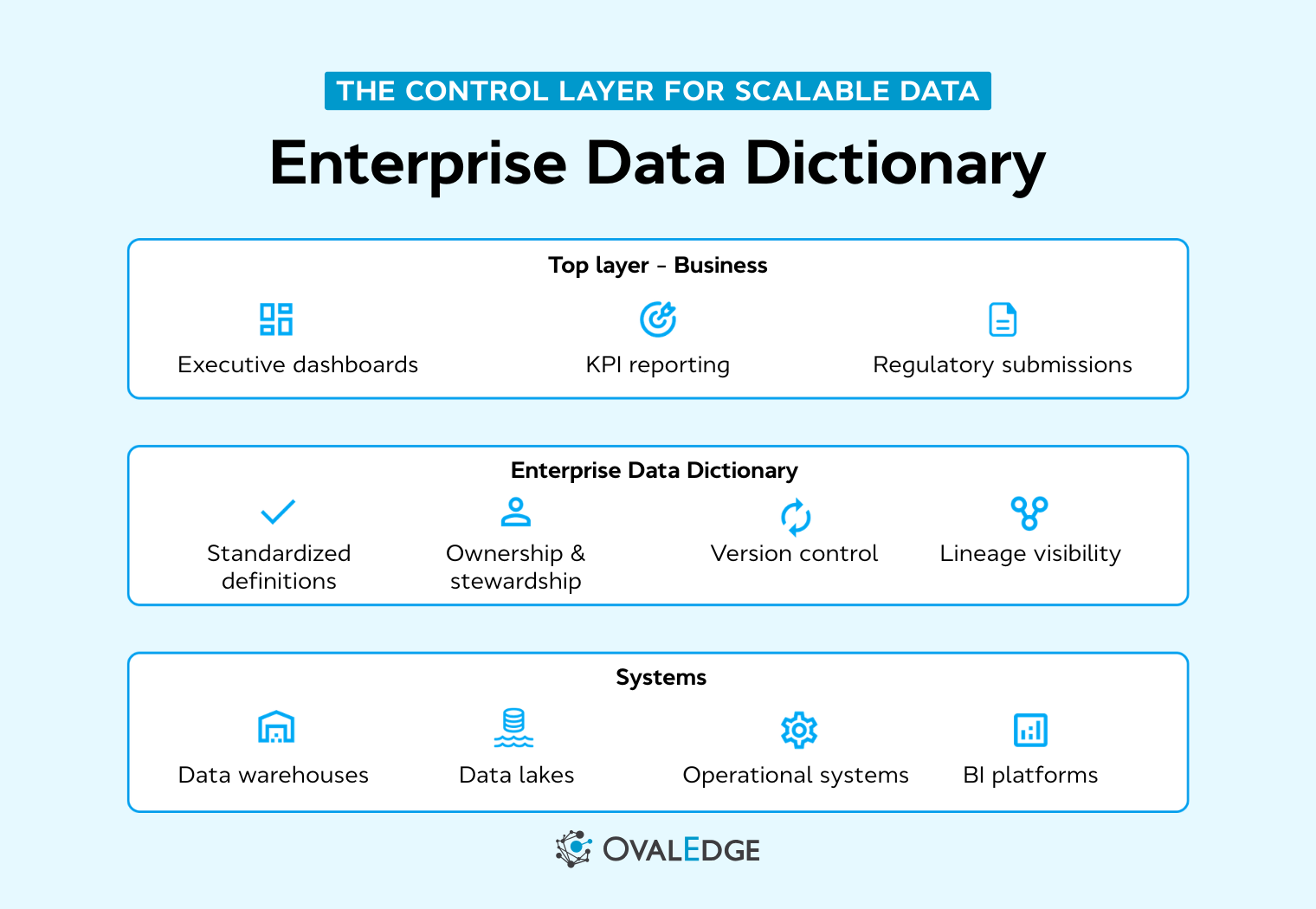
As enterprises modernize their data platforms, complexity grows faster than control. New cloud warehouses are introduced, legacy systems remain in place, analytics teams expand, and business users create more dashboards than ever before. Over time, no one has a clear view of what data exists, where it comes from, or how it should be interpreted.
This lack of clarity creates real risk. Reports rely on undocumented fields. Analysts inherit pipelines without context. Compliance teams struggle to trace how regulated data moves across systems. During audits or migrations, teams realize critical definitions were never formally agreed upon.
An enterprise data dictionary brings structure to this complexity. It creates a governed, organization-wide reference for how data elements are defined, mapped, owned, and used. Instead of scattered spreadsheets and siloed documentation, enterprises gain a controlled layer that connects business meaning with technical metadata across platforms.
As data ecosystems scale, this foundation becomes essential for consistency, accountability, and long-term governance maturity.
What is an enterprise data dictionary?
An enterprise data dictionary is a centralized, governed repository that defines and standardizes data elements across an organization’s systems, departments, and data platforms. It connects business definitions with technical metadata, ownership details, and usage context to ensure consistent understanding and trusted data at scale.
Scope typically includes:
-
Enterprise-wide data elements, metrics, attributes, and KPIs
-
Structured, semi-structured, and analytical data across warehouses, lakes, and operational systems
Primary users:
-
Data governance teams
-
Business stakeholders and domain owners
-
Data engineers, analysts, and architects
For foundational context, this builds on the broader concept explained in a “what is a data dictionary” guide, but extends it with governance, automation, and enterprise-wide scale.
How an enterprise data dictionary differs from a traditional data dictionary
A traditional data dictionary typically documents fields within a single system or project. An enterprise data dictionary operates across the entire organization, aligning business meaning, governance, and technical metadata at scale. The difference is not just scope. It is maturity, ownership, and automation.
|
Feature |
Traditional Data Dictionary |
Enterprise Data Dictionary |
|
Scope |
Single system or project |
Organization-wide across domains |
|
Data coverage |
Primarily structured database fields |
Structured, semi-structured, analytical, and cross-platform data |
|
Business alignment |
Limited business context |
Integrated business and technical definitions |
|
Governance model |
Informal, manual updates |
Formal ownership, stewardship, and approval workflows |
|
Automation |
Spreadsheet or static documentation |
Automated metadata ingestion and lineage tracking |
|
Scalability |
Suitable for small systems |
Designed for enterprise-scale environments |
At enterprise scale, the difference is not just size. It is governance maturity, cross-functional alignment, and the ability to sustain consistency across evolving data ecosystems.
Why enterprises need a data dictionary at scale
At enterprise scale, informal documentation is not enough. An enterprise data dictionary introduces governance and standardization, ensuring data elements are clearly defined, mapped, and consistently maintained across domains.
Reducing data ambiguity across teams
Large organizations often face metric misalignment. Marketing, finance, and product may calculate the same KPI differently. This creates friction. Leadership debates numbers instead of strategy. Analysts spend time reconciling data rather than generating insights.
An enterprise data dictionary enforces shared, approved definitions mapped to underlying data assets. It aligns terminology across departments and systems.
This improves:
-
KPI consistency across dashboards
-
Cross-functional reporting alignment
-
Trust in enterprise metrics
Supporting data-driven decision making
Data-driven enterprises rely on trusted metrics when definitions are unclear, and confidence in reporting declines.
A governed data dictionary documents business logic and calculation standards, linking business meaning with technical metadata.
This enables:
-
Consistent KPI interpretation across regions
-
Transparent calculation logic
-
Reduced rework from conflicting reports
Enabling regulatory compliance and audit readiness
Regulated industries face increasing pressure to demonstrate control over data definitions and reporting processes. Auditors often require traceability from reported figures back to source systems.
Without a governed reference layer, compliance teams struggle to answer basic questions: Who owns this metric? How is it calculated? Has it changed over time?
An enterprise data dictionary supports audit readiness by maintaining:
-
Documented ownership and stewardship
-
Version history of definition changes
-
Traceable lineage from source to report
This reduces compliance risk and improves accountability.
When does your organization need an enterprise data dictionary?
Not every company needs an enterprise data dictionary from day one. If your organization recognizes several of the scenarios below, it may be time to formalize and govern your data definitions at scale.
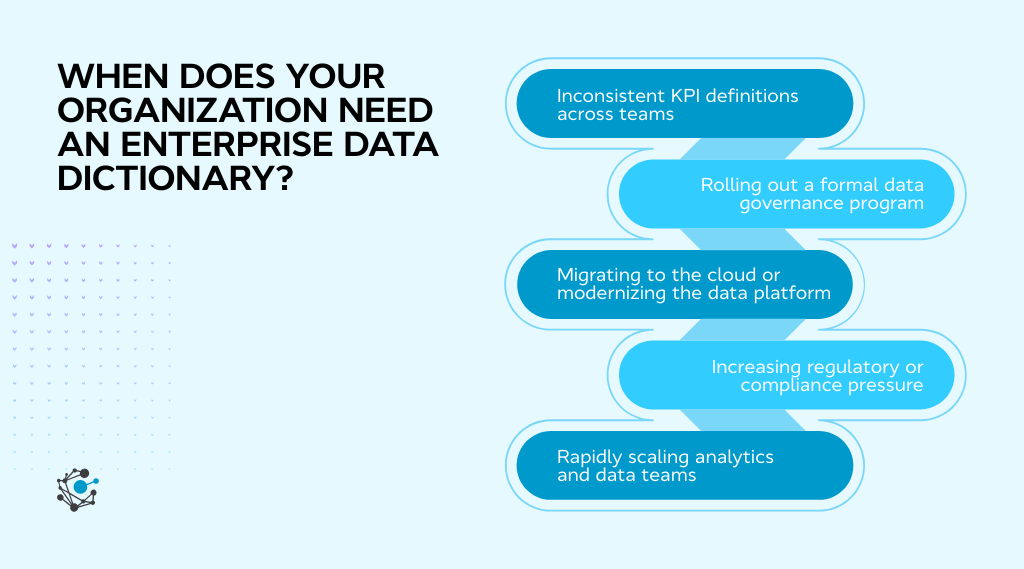
1. Inconsistent KPI definitions across teams
One of the clearest signals is metric misalignment. Marketing, finance, product, and operations report on the same KPIs, but the numbers do not match. “Revenue,” “Active User,” or “Customer” may be calculated differently across dashboards.
Executive meetings start with reconciliation exercises instead of forward-looking decisions. Teams debate logic rather than outcomes. Over time, trust in reporting erodes.
This signals the need for a centralized, governed enterprise data dictionary that:
-
Standardizes definitions across departments
-
Maps approved terms to specific tables, fields, and calculations
-
Prevents unauthorized changes to core metrics
Without this layer, metric drift becomes inevitable.
2. Rolling out a formal data governance program
If your organization is appointing data owners, defining steward roles, or creating governance councils, you are entering a more mature data phase. Governance frameworks require structured, versioned metadata that can be reviewed and approved.
An enterprise data dictionary becomes the operational backbone of governance. It provides a controlled environment where:
-
Definitions are proposed, reviewed, and approved
-
Ownership is documented by the domain
-
Changes are tracked through version history
Without a governed dictionary, governance policies remain theoretical rather than enforceable.
3. Migrating to the cloud or modernizing the data platform
Cloud migration and platform modernization often expose undocumented fields and inconsistent definitions that have accumulated over the years. When moving from legacy systems to cloud warehouses or lakehouse architectures, organizations frequently discover that business logic was never formally documented.
This creates risk during transformation. Metrics may shift unintentionally. Reports may break. Historical comparability can be lost.
An enterprise data dictionary ensures continuity by:
-
Capturing and standardizing definitions before migration
-
Mapping business terms to new data models
-
Preserving lineage and calculation logic during transformation
It acts as a stabilizing layer during large-scale technical change.
4. Increasing regulatory or compliance pressure
Organizations subject to financial reporting audits, healthcare data regulations, privacy laws, or risk reporting requirements face higher accountability standards. Regulators often expect documented definitions, ownership clarity, and traceable lineage.
If compliance teams regularly struggle to answer questions about how metrics are calculated or who is responsible for them, governance maturity is insufficient.
A governed enterprise data dictionary supports:
-
Documented ownership and stewardship
-
Version-controlled definitions
-
Traceable mapping from source systems to reports
This significantly improves audit readiness and reduces regulatory exposure.
5. Rapidly scaling analytics and data teams
Growth introduces complexity. Hiring analysts and engineers quickly, expanding into new markets, or launching new products multiplies dashboards, pipelines, and KPIs.
Without standardized definitions and lineage, scale creates confusion rather than clarity. New teams replicate metrics with slight variations. Knowledge remains siloed within individuals.
An enterprise data dictionary provides a shared foundation that:
-
Accelerates onboarding
-
Preserves consistency as teams expand
-
Reduces duplication of logic across reports
As organizations scale, structure becomes critical. An enterprise data dictionary ensures that growth strengthens governance rather than undermines it.
Core components of an enterprise-grade data dictionary
An enterprise data dictionary is more than a list of field names and descriptions. Below are the core elements that define an enterprise-ready implementation.
1. Business definitions and terminology
At its foundation, the enterprise data dictionary must clearly define business terms in language that stakeholders can understand. Definitions should explain what a metric or attribute represents, how it is used, and any important caveats.
Strong business definition practices include:
-
Clear, non-technical explanations
-
Documented calculation logic for metrics
-
Synonyms and alternate terminology
-
Identification of deprecated or retired terms
This ensures that when teams refer to “Net Revenue” or “Active Account,” they reference the same approved definition.
2. Technical metadata
Business clarity alone is not enough. The enterprise data dictionary must connect definitions to the underlying technical structure.
Technical metadata typically includes:
-
Column names and physical field mappings
-
Data types and formats
-
Constraints and validation rules
-
Source systems and environments
This bridge between business meaning and physical implementation is what distinguishes an enterprise data dictionary from a standalone business glossary.
3. Data lineage and relationships
At enterprise scale, data flows across systems, transformations, and reporting layers. Understanding upstream and downstream dependencies is critical for impact analysis and compliance.
An enterprise-grade dictionary should document:
-
Source-to-target lineage
-
Dependencies between tables and metrics
-
Transformations applied during processing
-
Relationships across domains
Lineage provides visibility into how data moves and where changes may affect reporting.
4. Ownership, stewardship, and access rules
Governance requires accountability. Each critical data element should have clearly defined ownership and stewardship roles.
This includes:
-
Assigned data owners by domain
-
Named data stewards are responsible for definition accuracy
-
Approval workflows for changes
-
Access or policy alignment, where applicable
Ownership ensures that definitions are actively maintained rather than passively documented.
5. Usage context and data quality indicators
To support decision-making, teams need context around how data is used and whether it can be trusted.
An enterprise data dictionary should capture:
-
Where the data is used, such as dashboards or reports
-
Known limitations or assumptions
-
Freshness and update frequency
-
Data quality indicators or validation status
This context helps analysts and business users assess whether a metric is appropriate for their use case.
6. Enterprise data dictionary metadata checklist
A mature implementation typically includes the following required fields:
-
Business term name
-
Approved definition
-
Calculation logic
-
Synonyms and deprecated terms
-
Physical table and column mappings
-
Data type and format
-
Source system
-
Data owner
-
Data steward
-
Version history
-
Lineage reference
-
Usage references
-
Data quality status
When these components are integrated and governed, the enterprise data dictionary becomes more than documentation. It becomes the authoritative source for how critical data elements are defined and controlled.
How enterprise data dictionaries support metadata management and governance
An enterprise data dictionary does not operate in isolation. It functions as a governed layer within broader enterprise metadata management. While metadata management captures and organizes information about data assets, the enterprise data dictionary standardizes and formalizes how critical data elements are defined and controlled.
Together, they form the structural backbone of enterprise data governance.
Relationship between data dictionaries and metadata management
Metadata management focuses on collecting, organizing, and maintaining metadata across systems. This includes technical schema details, lineage, classifications, and usage statistics.
The enterprise data dictionary adds governance and standardization to this metadata landscape. It ensures that:
-
Business definitions are formally approved
-
Technical metadata is mapped to business terms
-
Ownership is documented and enforceable
-
Changes are version-controlled
In this way, the data dictionary acts as a governed metadata layer that sits at the intersection of business and technical domains.
Standardization across systems and platforms
Enterprises typically operate across multiple data environments, including warehouses, lakes, BI tools, and operational systems. Without a centralized standard, definitions drift across platforms.
An enterprise data dictionary enforces consistency by mapping approved business terms to:
-
Cloud data warehouses
-
Data lakes and lakehouse architectures
-
BI dashboards and reporting tools
-
Operational and transactional systems
This ensures that core metrics and attributes remain aligned regardless of where they are stored or consumed.
Governance workflows and change management
Metadata without governance quickly becomes outdated. Enterprise environments require structured workflows to manage changes to definitions and ownership.
An enterprise data dictionary supports:
-
Formal review and approval processes
-
Steward-led validation of updates
-
Version history tracking
-
Impact analysis before changes are published
These controls reduce the risk of unapproved modifications that could affect reporting or compliance.
Role in enterprise data architecture
Within enterprise data architecture, the data dictionary connects logical models, physical schemas, and business terminology. It aligns conceptual definitions with implementation details.
This alignment strengthens architectural consistency by:
-
Linking business concepts to data models
-
Supporting impact analysis during schema changes
-
Providing traceability across transformation layers
-
Enabling clearer documentation for architects and engineers
As organizations mature, governance, architecture, and metadata management become increasingly interdependent. The enterprise data dictionary provides the structured foundation that ties them together, ensuring that scale does not compromise clarity or control.
Enterprise data dictionary vs data catalog vs business glossary
As organizations mature their enterprise metadata management capabilities, three terms frequently appear together: enterprise data dictionary, data catalog, and business glossary. While they are related, they serve different purposes. Understanding the distinction is critical when evaluating tools or designing your governance architecture.
What is an enterprise data dictionary?
An enterprise data dictionary defines and standardizes data elements across systems. It connects business meaning with technical metadata and formalizes ownership, governance workflows, and version control. Its primary focus is ensuring consistent interpretation of fields, metrics, and attributes across the organization.
It typically:
-
Defines columns, metrics, and attributes
-
Includes both business and technical metadata
-
Supports governance and ownership tracking
-
Drives consistency across platforms
The enterprise data dictionary ensures that “Revenue” or “Customer ID” means the same thing everywhere it appears.
What is a data catalog?
A data catalog is a searchable inventory of data assets. It helps users discover datasets, dashboards, reports, and pipelines across the organization. Its primary focus is discovery, accessibility, and usability.
A data catalog typically:
-
Enables asset discovery and search
-
Indexes metadata and applies tagging
-
Tracks dataset usage and popularity
-
Provides lineage exploration
-
Supports access and collaboration workflows
While a catalog may contain definitions, its main goal is to help users find and access data, not govern how metrics are defined.
What is a business glossary?
A business glossary is a curated collection of approved business terms. It defines metrics, KPIs, and core concepts in clear, non-technical language. Its primary purpose is to align departments around shared terminology.
A business glossary typically:
-
Defines business terms and KPIs
-
Includes synonyms and deprecated terms
-
Is owned by business stakeholders
-
Does not store detailed technical schema mappings
It focuses on meaning, not system-level metadata.
Key differences at a glance
|
Feature |
Enterprise data dictionary |
Data catalog |
Business glossary |
|
Primary purpose |
Standardize data elements |
Discover data assets |
Align business terminology |
|
Core audience |
Business and technical users |
Analysts and data users |
Business stakeholders |
|
Metadata depth |
Technical and business metadata |
Broad metadata index |
Business definitions only |
|
Governance workflows |
Yes |
Often integrated |
Limited |
|
Lineage support |
Often included |
Core capability |
Rare |
Each serves a distinct but complementary role.
How they work together in enterprise metadata management
In a mature architecture, these components integrate rather than compete.
-
The business glossary defines terms such as Revenue, Customer, or Active User in business language.
-
The enterprise data dictionary maps those terms to physical database fields, transformation logic, and technical metadata.
-
The data catalog makes datasets, reports, and pipelines searchable and accessible across the organization.
Together, they create a layered metadata architecture that supports clarity, governance, and discoverability.
Which one does your organization actually need?
The right starting point depends on your primary pain point and organizational maturity.
-
If your problem is inconsistent metric definitions → enterprise data dictionary
-
If your problem is “I cannot find the right dataset” → data catalog
-
If your problem is business terminology confusion → business glossary
This distinction becomes especially important when evaluating tooling and planning implementation at scale.
Data dictionary tools comparison
At enterprise scale, documentation alone is not enough. Tools must support automation, governance workflows, lineage tracking, integrations across platforms, and role-based access control.
Below is a comparison of leading enterprise-ready solutions that support enterprise data dictionary capabilities.
Leading enterprise data dictionary tools
OvalEdge
Best for: Organizations seeking an integrated data governance and metadata management platform with strong workflow automation.
Core strengths:
-
Integrated business glossary, data catalog, and enterprise data dictionary
-
Built-in governance workflows and stewardship management
-
Automated metadata ingestion and lineage tracking
Enterprise capabilities:
-
Role-based access and approval workflows
-
End-to-end lineage visualization
-
Data quality integration
-
Compliance and policy management support
Considerations: Designed as a comprehensive governance platform, which may be broader than needed for smaller teams.
SAP Information Steward
Best for: Enterprises operating heavily within SAP ecosystems.
Core strengths:
-
Strong integration with SAP environments
-
Data profiling and quality monitoring
-
Metadata management for structured systems
Enterprise capabilities:
-
Governance controls aligned with SAP architecture
-
Integration with enterprise resource planning systems
-
Support for regulatory reporting environments
Considerations: May be most effective within SAP-centric infrastructures rather than heterogeneous cloud stacks.
IBM Watson Knowledge Catalog
Best for: Large enterprises seeking AI-assisted metadata management within IBM ecosystems.
Core strengths:
-
AI-driven metadata enrichment
-
Integrated data catalog and governance capabilities
-
Cloud-native deployment options
Enterprise capabilities:
-
Automated classification
-
Policy enforcement workflows
- Scalable metadata management across hybrid environments
Considerations: Implementation complexity and cost may be higher for mid-sized organizations.
Informatica Axon
Best for: Organizations with mature governance programs and strong data integration needs.
Core strengths:
-
Business glossary and data dictionary integration
-
Workflow-driven governance processes
-
Deep integration with Informatica’s data integration stack
Enterprise capabilities:
-
End-to-end metadata management
-
Impact analysis and lineage
-
Policy enforcement at scale
Considerations: Best suited for enterprises already invested in Informatica products.
Microsoft Purview
Best for: Enterprises operating within Microsoft Azure environments.
Core strengths:
-
Native integration with Azure data services
-
Automated scanning and classification
-
Built-in data catalog functionality
Enterprise capabilities:
- Cross-platform metadata ingestion
- Lineage tracking
- Policy and compliance controls
Considerations: Most seamless within Microsoft-centric cloud architectures.
Atlan
Best for: Modern data teams are seeking a collaborative, cloud-native metadata platform.
Core strengths:
-
User-friendly interface
-
Strong integration with modern data stacks
-
Embedded collaboration workflows
Enterprise capabilities:
-
Metadata ingestion across cloud platforms
-
Lineage visualization
-
Governance integrations
Considerations: May require complementary governance tooling for highly regulated industries.
How to evaluate enterprise data dictionary tools
When comparing tools, focus less on documentation features and more on governance maturity and automation depth. Key evaluation criteria include:
-
Automated metadata ingestion from multiple systems
-
Integrated business glossary and catalog capabilities
-
Approval workflows and version control
-
Lineage visualization across platforms
-
Role-based access and compliance controls
-
Scalability across hybrid and multi-cloud environments
For enterprises, the data dictionary should not be a standalone feature. It should function as a governed, automated layer within a broader metadata management ecosystem.
Common use cases across large organisations
An enterprise data dictionary delivers the most value when applied to operational challenges. In large organisations, complexity increases across departments, regions, and systems. Standardised definitions and governed metadata are essential for maintaining clarity and control.
Below are common scenarios where a governed data dictionary supports scale, consistency, and risk management.
-
Enterprise analytics and BI consistency: Large organisations run multiple dashboards across business units. A governed data dictionary ensures KPIs map to approved definitions and consistent logic, preventing conflicting numbers and improving trust across regions.
-
Data platform modernisation: Cloud migrations and upgrades often expose undocumented logic and inconsistent schemas. A data dictionary standardises definitions during migration and preserves reporting continuity.
-
Mergers and acquisitions: Combining separate data ecosystems introduces conflicting terms and metrics. A governed data dictionary harmonises legacy definitions and reduces integration ambiguity.
-
Regulatory and risk reporting: Regulated industries require traceable definitions and clear ownership. A data dictionary strengthens audit readiness through documented metrics, stewardship accountability, and consistent metadata governance.
Enterprise data dictionary implementation guide
Implementing an enterprise data dictionary requires more than documenting fields. Below is a practical, step-by-step data dictionary implementation guide for enterprise environments.
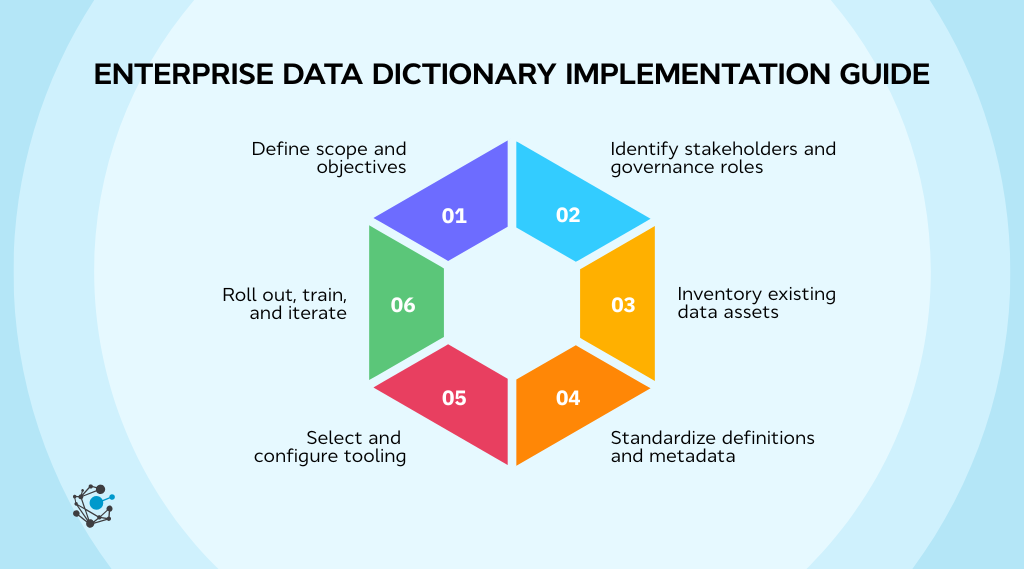
Step 1: Define scope and objectives
Start by clarifying what success looks like. Not every data domain needs to be documented on day one. Attempting full coverage immediately often leads to stalled initiatives.
Define:
-
Priority domains such as revenue, customer, regulatory, or financial reporting
-
Systems in scope include warehouses, lakes, and operational databases
- Clear business outcomes, such as KPI standardization or audit readiness
Tie the initiative to measurable governance or reporting goals to maintain executive sponsorship.
Step 2: Identify stakeholders and governance roles
An enterprise data dictionary requires shared ownership. Governance structures must be defined early to avoid stalled approvals and unclear accountability.
Identify:
-
Data owners are responsible for business definitions
-
Data stewards responsible for ongoing accuracy
-
Technical leads responsible for metadata integration
- Governance council or approval bodies
Clearly documented roles prevent the dictionary from becoming static documentation.
Step 3: Inventory existing data assets
Before standardizing definitions, you must understand your current landscape. Conduct a structured inventory of:
-
Databases and schemas
-
Data warehouses and lakes
-
Reports and dashboards
-
Data pipelines and transformation layers
Automated scanning tools significantly reduce manual effort at this stage and ensure broader coverage.
Step 4: Standardize definitions and metadata
Once assets are inventoried, begin defining and approving core business terms. Focus on high-impact metrics first.
Establish standards for:
- Naming conventions
- Business definition format
- Calculation logic documentation
- Required technical metadata fields
Consistency at this stage determines long-term sustainability.
Step 5: Select and configure tooling
Enterprise environments require automation. Manual documentation cannot keep pace with schema changes and data growth.
When selecting tooling, evaluate:
-
Automated metadata ingestion from databases and warehouses
-
Lineage tracking capabilities
-
Governance workflow automation
-
Integration with BI and analytics platforms
-
Role-based access and security controls
Configuration should align with your governance model, including approval workflows and version control.
Step 6: Roll out, train, and iterate
Adoption determines success. Even the most robust enterprise data dictionary fails if teams do not use it.
Support rollout by:
-
Embedding access within BI tools and analytics workflows
-
Conducting training sessions for analysts and business stakeholders
-
Tracking usage and adoption metrics
-
Establishing feedback loops for continuous improvement
Treat the enterprise data dictionary as a living system. Schedule periodic reviews aligned with major reporting changes or system upgrades.
A structured implementation approach ensures that your enterprise data dictionary evolves from a documentation initiative into a governed, scalable component of enterprise data operations.
Building an enterprise data dictionary is only the first step. Sustaining it requires governance discipline, automation, and continuous business engagement. Without clear operating principles, even strong initiatives lose momentum.
Best practices for building and maintaining an enterprise data dictionary
The following best practices support long-term success.
-
Start with high-impact data domains: Avoid documenting everything at once. Focus on domains tied to executive reporting, revenue, compliance, or customer analytics. Early wins build credibility and executive sponsorship.
-
Treat definitions as living assets: Business logic and regulations evolve. Establish review cycles, structured approval workflows, and version history to keep definitions accurate and trusted.
-
Balance business clarity with technical accuracy: Use clear business language, include calculation logic where needed, and map definitions to physical tables and fields to ensure cross-functional alignment.
-
Automate metadata ingestion wherever possible: Automate schema updates, lineage capture, and ownership validation to reduce manual effort and prevent metadata drift.
-
Drive adoption through workflows, not documentation: Integrate the dictionary into BI tools, reports, and certification processes so governed definitions become part of daily operations.
Common enterprise adoption challenges and how to overcome them
Even strong governance programs can struggle without clear ownership, engagement, and automation. An enterprise data dictionary must operate as a governed system, not static documentation. Below are three common challenges and how to address them.
Challenge 1: Lack of clear ownership and governance
The problem
Organizations launch initiatives without defining ownership. Business and IT work in silos, definitions remain unapproved, and multiple “official” metrics circulate. Trust gradually declines.
Why this happens
Enterprise data spans domains and systems. Without designated stewards or governance councils, accountability is unclear, and oversight weakens.
How to overcome it
Assign domain data owners, define steward responsibilities, implement structured approval workflows, and maintain version control with audit trails. Governance must be operationalized and tied to leadership accountability.
Challenge 2: Low business adoption and engagement
The problem
The data dictionary exists, but business users rely on spreadsheets or informal communication. Definitions feel technical or disconnected from daily tools.
Why this happens
Limited BI integration, unclear language, minimal training, and weak user experience reduce adoption. When not embedded in workflows, it becomes optional.
How to overcome it
Write business-friendly definitions, integrate access into BI platforms, provide onboarding, and promote certified metrics. Adoption determines sustained value.
Challenge 3: Manual processes and metadata debt
The problem
Definitions are maintained manually. Schema changes and lineage updates lag behind system changes, making documentation unreliable.
Why this happens
Legacy systems, limited automation, and rapid data growth prevent manual governance from scaling.
How to overcome it
Automate metadata ingestion, integrate with governance platforms, enable lineage tracking, and conduct periodic reviews. Automation ensures long-term sustainability.
Conclusion
An enterprise data dictionary provides the structure needed to manage data at scale. It connects business definitions with technical metadata, ownership, and lineage across systems, ensuring that teams interpret metrics and attributes consistently. As organizations expand across cloud platforms, regions, and regulatory environments, this governed layer becomes critical.
By standardizing definitions, enterprises reduce ambiguity across departments. By formalizing ownership and approval workflows, they strengthen accountability. By automating metadata ingestion and lineage tracking, they maintain accuracy as systems evolve.
The long-term value extends beyond documentation. A well-implemented enterprise data dictionary improves decision-making, accelerates onboarding, supports compliance, and reduces the risk of reporting inconsistencies. Most importantly, it transforms data governance from policy into practice.
When treated as a living, continuously governed asset, the enterprise data dictionary becomes foundational infrastructure for scalable, trustworthy data operations.
FAQs
1. What is the main purpose of an enterprise data dictionary?
The main purpose of an enterprise data dictionary is to create a shared understanding of data across the organization. It standardizes definitions, ownership, and usage so teams can interpret metrics and attributes consistently across systems, improving trust and governance at scale.
2. How is an enterprise data dictionary different from a data catalog?
An enterprise data dictionary standardizes and governs data definitions, linking business meaning with technical metadata. A data catalog focuses on discovering and accessing data assets. The dictionary ensures consistency, while the catalog improves search, visibility, and usability.
3. Who should own and maintain an enterprise data dictionary?
Ownership typically sits with data governance or data management teams, supported by business data owners and stewards. Business stakeholders define terms, while technical teams maintain metadata accuracy and integrations. Clear accountability ensures definitions remain current and governed.
4. Can an enterprise data dictionary be automated?
Yes. Modern platforms automate metadata ingestion from databases, warehouses, and BI tools. Automation keeps schemas and lineage synchronized. However, business definitions and governance approvals still require human review to maintain accuracy and control.
5. How often should an enterprise data dictionary be updated?
An enterprise data dictionary should be updated continuously as schemas and metrics evolve. Automated synchronization captures structural changes, while formal governance reviews are typically conducted quarterly or alongside major reporting or system updates.
6. Do small or mid-sized teams need an enterprise data dictionary?
Smaller teams may not require a full enterprise implementation, but standardized definitions still provide value. As data complexity, system diversity, and compliance needs increase, a governed enterprise data dictionary becomes more important for maintaining consistency and trust.
.png?width=1081&height=173&name=Forrester%201%20(1).png)
.png?width=1081&height=241&name=KC%20-%20Logo%201%20(1).png)