-Jan-20-2026-07-07-06-6655-AM.png)
Most data teams are busy shipping dashboards, pipelines, and models. On paper, it looks like progress. But in reality, very little of it gets used. Business teams still rely on spreadsheets, manual workarounds, or instinct because the data doesn’t fit how they actually make decisions.
Over time, this creates a bigger problem. Trust drops. Definitions don’t match across teams. Ownership is unclear. And instead of enabling faster decisions, data becomes another layer of confusion. Even well-built assets quietly go stale because no one is accountable for keeping them relevant.
The shift isn’t about building more data assets. It’s about treating data like a product, something designed for real users, with clear ownership, measurable outcomes, and a lifecycle that ensures it stays useful.
In this guide, we’ll break down how to make that shift practical, so your data products don’t just get delivered, they actually get used.
What is a data product strategy?
A data product strategy defines how an organization designs, delivers, governs, and retires data as reusable products that drive measurable business outcomes. It applies product thinking to data by establishing clear ownership, defined consumers, lifecycle management from discovery to deprecation, and success metrics tied to business value, not just delivery volume.
A data product is a specific asset, such as a dataset, API, dashboard, or model, designed for consumption. Data-as-a-product is the operating strategy for managing those assets with product discipline, including ownership, lifecycle management, and continuous improvement. One is the output. The other is the system for producing and sustaining that output.
Core principles of a strong data product strategy
At the heart of any successful data product strategy lies a small set of guiding principles that move teams from delivering outputs to driving adoption and measurable outcomes. These principles shape how data products are defined, built, governed, and evolved across the organization.
1. Product-market fit for data products
The concept of product-market fit, while native to traditional product management, is central to building meaningful data products. Internally, your users, whether sales leaders, analysts, operations, or customer success, represent distinct markets with specific needs, pain points, and expectations.
If a data product isn’t being used, or if it’s misunderstood or misapplied, the problem often isn’t technical. It’s a misalignment between what the product delivers and what the user needs.
A predictive model for churn may be mathematically sound, but if it doesn’t align with the cadence, metrics, or workflows of the customer success team, it fails in practice.
To evaluate product-market fit in data products, teams should monitor:
-
Adoption rates over time by user type
-
Qualitative feedback on usability and relevance
-
Business outcomes tied to product usage
-
Support requests or workarounds that indicate unmet needs
Iterating toward fit means data teams must embrace user empathy, domain context, and measurable outcomes, not just accuracy or completeness.
2. Clear value proposition and outcomes
A well-defined data product strategy doesn’t just list out deliverables. It explicitly connects each data product to a tangible decision, action, or business objective.
Data products without a clear value proposition tend to gather dust. They might be technically impressive, but if stakeholders don’t understand what to do with them or how they move the needle, they won’t be used.
An efficient data product strategy enables specific outcomes such as reducing time-to-resolution in support, increasing marketing conversion rates, or optimizing inventory levels.
This requires framing data work around outcomes like:
-
Shortening time-to-decision
-
Reducing manual intervention in business workflows
-
Driving strategic initiatives (e.g., customer retention, cost optimization)
Rather than defining success as “delivered X dashboards,” strong strategies frame success as “enabled X% reduction in onboarding time” or “identified $Y in cost leakage.”
3. Domain-driven ownership and accountability
Data product quality degrades rapidly without clear ownership. When no individual or team is accountable, issues go unnoticed, freshness declines, and user trust erodes. Ownership ensures continuous monitoring, usability, and long-term value.
Leading organizations implement domain-driven ownership models, where the teams closest to the business context take responsibility for the data products they consume or produce.
A marketing team might manage campaign performance datasets, while finance may oversee spend visibility dashboards. This principle holds true across architectures, whether data is hosted in cloud environments, hybrid platforms, or on-premise systems.
While this model aligns with modern frameworks like data mesh, it is not exclusive to them. Even in centralized or regulated environments, distributed ownership can improve responsiveness and accountability when paired with clear governance boundaries.
Federated governance enables this balance. Central teams define the shared rules, such as compliance, quality thresholds, or metadata management standards, while domain teams are free to execute, iterate, and improve data products within those boundaries. This increases agility without sacrificing oversight.
Without domain-level ownership, data remains a shared resource with unclear responsibility, leading to delays, duplicate efforts, and reduced trust. A structured, federated approach ensures every data product has both a home and an owner.
4. Lifecycle thinking over one-time delivery
One of the most common failure points in data strategy is treating delivery as the finish line. Dashboards are launched, pipelines go live, and models are deployed, but over time, usage drops, definitions drift, and trust erodes.
A data product is not complete at launch. It is an evolving asset that must be actively managed across its entire lifespan. Without a structured lifecycle, organizations accumulate unused dashboards, stale reports, and fragmented data assets that create confusion instead of value.
This is where a defined lifecycle becomes the core operating model.
The Data Product Lifecycle: Six Phases from Discovery to Retirement
This six-phase lifecycle is the foundation of a scalable data product strategy. It ensures that every data product is designed, delivered, adopted, improved, and eventually retired based on measurable value.
1. Discovery: Identify a real business need or opportunity with a named owner and a defined consumer group.
2. Design: Prototype and validate with users before building. Confirm the value proposition before committing engineering capacity.
3. Delivery: Build and launch with documented SLAs, access controls, and quality standards from day one.
4. Adoption: Drive usage actively. Monitor who is and is not using the product and why. Low adoption is feedback, not failure.
5. Improvement: Iterate based on usage data and user feedback. Update based on evolving business needs, not just technical debt.
6. Retirement: Deprecate products that no longer deliver value. Archive what is useful and sunset what is not. A product retired cleanly is a sign of maturity, not failure.
Lifecycle thinking prevents data sprawl and ensures that every data product remains accountable for delivering ongoing business value, not just initial output.
How to create a data product strategy?
Strong principles are foundational, but real progress comes from execution. The best data product strategies are operational roadmaps that guide decisions, streamline delivery, and align stakeholders across business and data teams.
Each of the following steps translates strategic intent into sustainable practice.
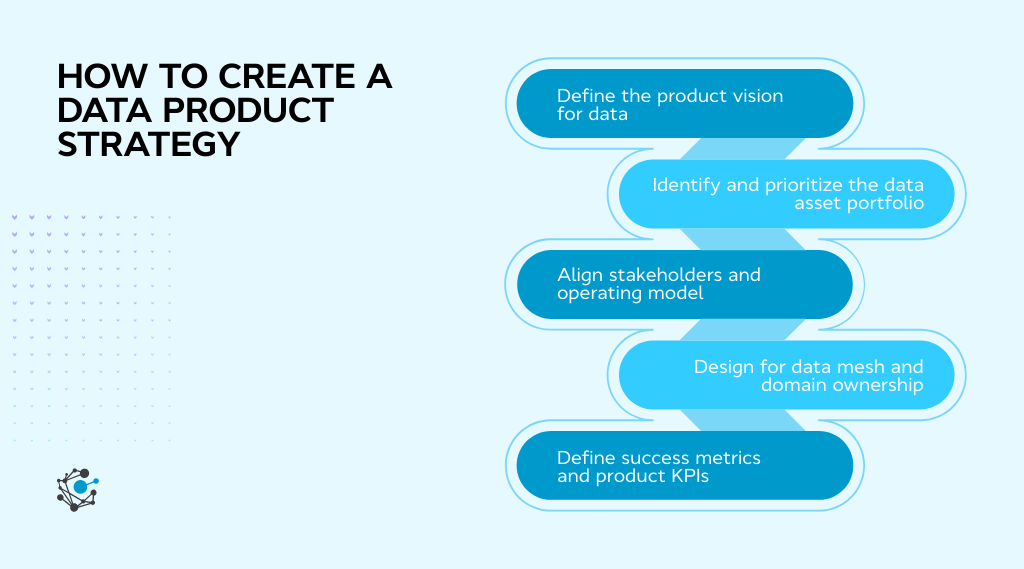
Step 1: Define the product vision for data
A meaningful data product strategy starts with a clear product vision that articulates why data products exist in the organization and what success looks like when they’re working.
This isn’t a vision for the data team. It’s a vision for how data products will help the business win.
Generic aspirations like “democratize data” or “create a single source of truth” often fall flat because they’re too abstract. A stronger vision links data outcomes directly to business priorities.
|
For example, a company aiming to reduce customer churn might craft a data product vision focused on empowering retention teams with timely, contextual, and reliable customer risk signals. |
At this stage, teams should define:
-
Who the primary consumers of data products are (e.g., sales, finance, operations)
-
What problems they’re trying to solve with data
-
What types of decisions should the data products influence
This clarity ensures that future efforts around prioritization, delivery, and iteration are grounded in business relevance rather than technical completeness.
According to Gartner’s 2024 Chief Data and Analytics Officer Agenda Survey, only 22% of organizations have defined, tracked, and communicated business impact metrics for most of their data and analytics use cases.
This gap highlights why a clear product vision must be tied to measurable business outcomes from the start.
Step 2: Identify and prioritize the data asset portfolio
Most organizations already have an ecosystem of reports, dashboards, pipelines, APIs, and datasets. However, only a few can articulate which ones are products, which ones are experiments, and which ones are simply artifacts from old initiatives.
Without visibility and prioritization, data teams get stuck maintaining everything and improving nothing.
Start by auditing the current landscape. Catalog existing data assets across domains, tools, and teams. An enterprise data catalog is the practical tool for this audit, as it surfaces what assets exist, who owns them, how they are used, and how they flow across systems. Platforms like OvalEdge automatically classify and organize these assets across domains, making it easier to move from raw inventory to structured evaluation.
With this visibility in place, classify which assets are candidates for becoming managed data products based on their usage, relevance, and strategic alignment.
From there, apply a prioritization framework. Common criteria include:
-
Usage and adoption: Are people actively using the asset? Does it show up in downstream workflows?
-
Business criticality: Does the asset support key decisions, revenue-driving processes, or regulatory reporting?
-
Data quality and freshness: Is the data accurate, up to date, and trustworthy? In practice, data quality tools automate freshness checks, flag anomalies, and provide the signals needed for reliable prioritization without manual audits.
-
Stakeholder demand: Are there champions or consistent users requesting enhancements or new features?
-
Risk and compliance: Does the product handle sensitive data or have implications for auditability?
To move from criteria to action and ensure engineering and analytics capacity is focused on high-impact work rather than maintaining legacy assets, we need to use a simple prioritization lens.
Plot your data asset candidates across two dimensions:
-
Business impact: How directly does this asset influence a key decision or process?
-
Technical readiness: How much effort is required to make this a managed data product?
Then prioritize accordingly:
-
High impact, high readiness → prioritize first. These are your quickest wins.
-
High impact, low readiness → prioritize with investment. These require effort but deliver strong value.
-
Low impact, high readiness → deprioritize. Easy to build but unlikely to drive adoption.
-
Low impact, low readiness → archive or ignore. Do not invest in these assets.
This ensures prioritization is driven by value and feasibility, not noise or demand volume.
Step 3: Align stakeholders and operating model
No data product strategy can succeed without stakeholder alignment. Yet in most enterprises, misalignment is the root cause of stalled delivery, duplicated work, and conflicting priorities.
Without clearly defined roles and shared operating norms, cross-functional collaboration breaks down. A robust strategy begins by identifying and engaging the full spectrum of stakeholders, often formalized through a data governance committee that sets enterprise-wide standards, reviews cross-domain prioritization, and resolves conflicts between domain teams and central governance.
-
Business users and domain experts who understand the problems data must solve
-
Data engineers and platform teams who build and maintain infrastructure
-
Analysts and data scientists who consume and enrich data products
-
Governance and compliance leads who manage standards, privacy, and risk
What’s often missing is role clarity, which in practice is defined throughdata stewardship roles responsible for data quality and governance within each domain. To move from reactive data delivery to product-driven execution, teams must establish decision rights and accountability across the data product lifecycle. This includes defining:
-
Who owns each data product and is responsible for its quality and adoption
-
Who has the authority to approve schema changes, feature additions, or sunsetting
-
How conflicting priorities or trade-offs are escalated and resolved
An operating model should also specify delivery workflows, collaboration patterns, and platform governance.
|
For instance, if marketing owns a campaign analytics data product, engineering should support them with standardized ingestion patterns and alerting, while governance enforces tagging and access policies. |
Misalignment often stems from implicit expectations. Making responsibilities and workflows explicit turns scattered initiatives into a coherent strategy.
Before building, teams must ask structured, role-specific questions to surface business decision gaps, data pipeline realities, and compliance expectations across stakeholders.
For business users and domain owners
-
What decision are you trying to make that data is not currently supporting?
-
How long does it take you to get an answer when you need data-driven input?
-
If this data product worked perfectly, what would you be able to do in 90 days that you cannot do today?
For data engineers and platform teams
-
What are the three data assets with the highest downstream dependencies today?
-
Where are the most common points of failure or delay in the current pipeline?
-
What governance or access policies must be enforced before this product can be used safely?
For compliance and governance leads
-
What data handling requirements apply to this asset (GDPR, HIPAA, SOX, or others)?
-
What does an acceptable audit trail look like for decisions made using this data?
-
What access controls must be in place before this data product can be released?
Defining ownership and access policies at the platform level, rather than tracking them in documents, is what makes the operating model sustainable. OvalEdge’s governance layer enforces data product ownership, access controls, and quality standards across domains without relying on manual coordination.
These questions make stakeholder alignment operational rather than theoretical.
How to evaluate if a data product is ready for use
Before moving into delivery, teams need a clear way to evaluate whether a data product meets enterprise standards.
|
Characteristic |
What it means |
|
Discoverable |
Users can find it without asking the data team |
|
Documented |
Business context, definitions, and lineage are embedded |
|
Owned |
A named person or team is accountable for quality and updates |
|
Trusted |
Quality standards and SLAs are published and monitored |
|
Accessible |
The right users can access it without unnecessary friction |
|
Measurable |
Usage, adoption, and impact are tracked |
|
Retirable |
Deprecation criteria are defined before launch |
The final characteristic, retirable, ensures lifecycle thinking is built into the product from the start, not treated as an afterthought.
Step 4: Design for data mesh and domain ownership
As data initiatives scale across departments, centralized models begin to bottleneck. Domain teams want faster delivery, clearer context, and more control, but central teams often can’t keep up, especially when every request flows through a single queue.
This is where select principles from data mesh become useful in shaping a scalable data product strategy. Data mesh promotes decentralization by giving the teams closest to the data, and the problems it’s meant to solve, ownership of their respective data products.
Decentralization refers specifically to operational responsibility, not infrastructure. What’s in scope is assigning data product ownership to domain-aligned teams, enabling self-service access and management, and enforcing shared standards for consistency, security, and governance.
What’s not in scope is rebuilding the entire platform into a fully decentralized mesh, distributing infrastructure operations across all domains, or implementing complex federated compute layers.
These principles can be applied incrementally within centralized or hybrid environments without overhauling the architectural foundation.
To implement domain ownership effectively:
-
Assign product-level responsibility to business-aligned teams (e.g., HR owns employee attrition insights, Finance owns spend visibility products), supported by data lineage that makes ownership and downstream dependencies visible at scale
-
Provide tools and workflows that allow these teams to manage ingestion, transformation, and quality with minimal dependency on central engineering.
-
Define enterprise-wide conventions for metadata, naming, documentation, access control, and certification to keep products interoperable.
Federated governance plays a vital role in balancing autonomy and alignment. Domain teams manage the evolution of their products, while central teams define policies, reusable frameworks, and lifecycle practices that promote trust and consistency at scale. OvalEdge supports this federated model by enabling domain teams to manage their own data products while enforcing enterprise-wide metadata standards, quality thresholds, and lineage tracking centrally.
When ownership is clear and standards are shared, decentralization becomes an enabler, not a risk.
Step 5: Define success metrics and product KPIs
The fifth element of any data product strategy is defining, before launch, how success will be measured.
Instead of treating delivery as the outcome, teams must establish clear metrics tied to adoption, reliability, and business impact.
The next section breaks down the KPI framework in detail, including adoption metrics, operational SLAs supported by data observability, user feedback, and decision-level outcomes.
Measuring success and iterating on data products
Without clear success metrics, teams cannot prioritize improvements or prove impact. They risk confusing output with value, building dashboards and pipelines without knowing if they improve decisions. Continuous evaluation ensures data products remain relevant, useful, and aligned with business outcomes.
1. Defining and tracking product KPIs
Many teams fall into the trap of tracking delivery metrics like the number of dashboards launched, reports shared, or tables added. These are activity indicators, not performance indicators. They show effort, not effectiveness.
A mature data product strategy tracks KPIs that reflect whether a product is:
-
Adopted by its intended users
-
Trusted and consistently used in decision workflows
-
Delivering measurable impact to business processes
Effective KPIs include:
-
Time-to-insight: How quickly can users get the answers they need after accessing the product?
-
Adoption by user role or team: Are the right people using it, or is it ignored by its target audience?
-
Decision or process impact: Has the product improved accuracy, speed, or confidence in a specific business decision?
-
Cost or efficiency gains: Has it reduced manual effort, duplication, or downstream errors?
Tracking KPIs is not a one-time setup. They should be reviewed periodically, monthly or quarterly, and aligned with evolving business priorities. OvalEdge tracks data product usage, lineage, and health in real time, giving product owners a unified view of adoption, SLA compliance, and downstream dependencies without requiring custom instrumentation.
2. Feedback loops and continuous improvement
Data products are not static deliverables. Users need to change. Business logic evolves. Even the best products eventually require rework or redesign.
This is why feedback loops are critical. They ensure that the product evolves with its users. Feedback can be gathered in several ways:
-
Embedded surveys in dashboards or data portals
-
Interviews and product review sessions with key stakeholders
-
Usage analytics that highlight drop-off points or low engagement
-
Ticketing systems that capture enhancement requests or confusion
High-performing data teams treat this feedback as input into backlog grooming and product planning. If a data product sees rising support requests, that’s an opportunity to redesign, simplify, or automate.
Some organizations establish formal product review cadences, where domain teams present product performance and upcoming roadmap items to central governance councils. This supports transparency, cross-team learning, and strategic alignment.
Iteration doesn’t mean reactive updates. It means intentional, feedback-driven enhancement that keeps products useful, usable, and used.
3. Retiring or evolving underperforming data products
Every data ecosystem accumulates clutter. Dashboards are no longer used. Tables built for one-off analyses. APIs that silently fail.
An effective data product strategy includes clear criteria for deprecation and evolution:
-
Low or no usage over a defined period
-
Overlapping functionality with a more widely adopted product
-
Stale or deprecated data sources
-
Negative feedback from end users or quality issues flagged by monitoring tools
Retirement is not a failure. It’s a sign of maturity. It helps teams maintain a focused, discoverable, and performant data portfolio. Products that are no longer delivering value are archived or sunset to reduce maintenance burden and eliminate confusion.
In some cases, decommissioned products are merged into others or replaced by a new, consolidated solution that better serves the need. In others, they are reworked into templates or starter kits for future development, preserving the useful elements and discarding the rest.
Iteration and measurement are where data product strategy becomes operational. By anchoring success in outcomes, not artifacts, and evolving products with intent, organizations can ensure that their data assets continuously earn their place.
This mindset shifts data from a cost center to a compound asset that grows in value the more it’s tested, refined, and aligned with real business needs.
Common pitfalls in building a data product strategy
Even organizations with strong platforms and skilled teams often struggle to translate good intentions into sustained value.
A data product strategy is an operating model that must balance delivery, ownership, and outcomes. When execution fails, the root cause is often one of a few recurring mistakes.
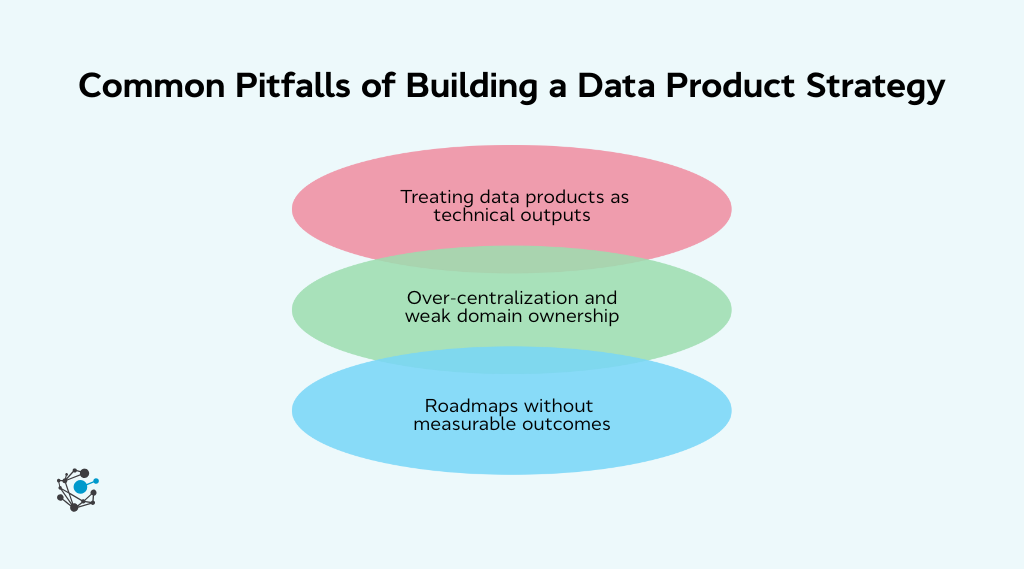
1. Treating data products as technical outputs
Many teams equate delivery with success. They build pipelines, dashboards, and models without clearly defining the business problem, user, or decision. This creates misalignment between what is built and what is used.
Low adoption follows. Users may not trust the output, understand it, or see how it fits into their workflow. The result is wasted effort and duplication.
To avoid this, shift to product thinking. Define the user, validate the use case, and design for usability alongside accuracy.
|
For example, publishing a “customer churn model” is not a product until customer success teams understand the signals, have access to the insights, and know how to act on them. Without that translation layer, the output becomes shelfware. |
2. Over-centralization and weak domain ownership
Central data teams often become bottlenecks as demand grows. Domain teams remain passive consumers, which limits scalability and slows delivery.
A scalable approach distributes ownership. Domain teams manage their data products, while central teams define standards, governance, and guardrails. This balance improves responsiveness without losing control.
3. Roadmaps without measurable outcomes
Roadmaps often list deliverables without linking them to outcomes. This creates activity without accountability.
Every data product should tie to a clear outcome, such as faster decisions or reduced manual effort. Success must be validated through adoption, feedback, or business impact.
To enforce this, every roadmap item should answer:
-
What problem does this solve?
-
Who owns it?
-
How will success be measured?
Clarity at this level ensures delivery drives real value, not just output.
Conclusion
Treating data as a product is not about packaging datasets. It is about applying product thinking to how data is designed, delivered, and maintained across the organization. The focus shifts from output to usability, ownership, and measurable outcomes.
To make this work, teams need to:
-
Design for long-term usability, not one-time delivery
-
Establish clear ownership and feedback loops
-
Operationalize SLAs, KPIs, and lifecycle management
Without this shift, data efforts remain fragmented and underused. With it, organizations build data products that are trusted, adopted, and continuously improved.
Struggling to operationalize data as a product? See how OvalEdge helps teams define ownership, govern data products, track adoption, and manage the full lifecycle from creation to retirement.

Book a demo to turn fragmented data assets into trusted, reusable data products.
FAQs
1. What’s the difference between a data product strategy and a data governance strategy?
A data product strategy focuses on building and delivering usable data products with clear outcomes. Data governance ensures quality, compliance, and control. One drives value and adoption, the other enforces standards. Both must work together.
2. What is the best way to establish data as a product across distributed teams?
Assign domain ownership and define enterprise standards for metadata, access, and quality. Use federated governance where central teams set rules and domain teams execute. Avoid centralizing execution while distributing ownership.
3. How do you build and manage a data product portfolio across multiple domains?
Audit assets, classify by usage and business value, and prioritize by impact versus effort. Track ownership, health, and lifecycle. Regularly retire unused products and invest in high-performing ones.
4. Who should own the data product strategy within an organization?
Data leadership sets the vision, while domain-aligned product owners execute. This ensures enterprise consistency and domain-level relevance across teams.
5. What is the connection between data mesh and data product strategy?
Data mesh promotes decentralized data ownership. A data product strategy provides the operating model with lifecycle, ownership, and quality standards to make it work across domains.
6. How do you measure the growth and ROI of a data product strategy?
Track adoption, operational health, user satisfaction, and business impact. ROI appears through faster decisions, reduced manual work, and fewer redundant assets, not delivery volume.
.png?width=1081&height=173&name=Forrester%201%20(1).png)
.png?width=1081&height=241&name=KC%20-%20Logo%201%20(1).png)