.png)
Many data teams begin their analytics journey with just a few pipelines and a basic scheduler. At first, the setup works well. Data flows from source systems into the warehouse, dashboards refresh overnight, and analysts can query the datasets they need.
But as organizations scale, the environment becomes far more complex. New SaaS applications are added, machine learning workflows enter the stack, and data transformations spread across tools like dbt, Spark, and notebooks. What once looked like a simple pipeline quickly turns into a network of dependencies where a single dataset may rely on dozens of upstream processes running across multiple platforms.
At this stage, pipelines start behaving less like simple workflows and more like production systems. When orchestration is weak, issues appear quickly. Jobs may run out of order, data quality checks may fail unnoticed, or delayed refresh cycles may disrupt dashboards across the organization. These challenges are rarely isolated pipeline failures. More often, they reflect coordination gaps across the entire data product lifecycle.
To manage this growing complexity, many organizations are adopting orchestration platforms that coordinate ingestion, transformation, validation, and delivery workflows. These systems form the operational backbone of modern data products and ensure that analytics pipelines remain reliable as data ecosystems expand.
What is a data product orchestration platform?
A data product orchestration platform coordinates the workflows required to build, manage, and deliver reliable data products across an enterprise data ecosystem. While traditional pipeline schedulers focus primarily on triggering tasks in sequence, orchestration platforms manage the broader operational lifecycle of data products.
Modern data products depend on several interconnected processes. These include ingestion pipelines that collect raw data, transformation workflows that prepare analytics datasets, validation checks that ensure data quality, metadata updates that maintain lineage visibility, and delivery mechanisms that publish outputs to dashboards, APIs, or machine learning systems.
Orchestration platforms coordinate these processes so that dependencies execute in the correct order and data remains reliable for downstream consumers. In many organizations, these orchestration workflows also operate alongside data governance frameworks that define ownership, policies, and accountability across the data ecosystem.
The difference between pipeline orchestration and data product orchestration becomes clearer when comparing their scope and responsibilities.
|
Aspect |
Pipeline Orchestration |
Data Product Orchestration |
|
Primary focus |
Scheduling and executing workflow tasks |
Coordinating the lifecycle of data products |
|
Scope |
Individual Pipelines |
Multiple pipelines across systems |
|
Data quality |
Limited or external checks |
Integrated validation and monitoring |
|
Governance |
Minimal visibility |
Connected to metadata, lineage, and governance |
|
Outcome |
Pipelines run successfully |
Reliable, trusted data products |
This shift reflects how organizations increasingly treat data. According to McKinsey’s 2024 research on modern data architecture, companies are moving toward managing data products as reusable, governed assets that serve multiple teams and applications.
|
Related resource:
OvalEdge explains in its whitepaper, Implementing Data Governance, how organizations establish governance frameworks that align metadata, lineage, and operational workflows across modern data platforms. |
Why data product workflows require orchestration
The need for orchestration comes from the increasing complexity of modern data environments. Analytics pipelines used to operate in relatively simple architectures. Today, they span warehouses, transformation frameworks, machine learning platforms, and streaming systems.
Without orchestration, coordinating these components becomes difficult,t and operational risk increases.
Increasing complexity of data pipelines
Data pipelines now operate across many systems simultaneously. Organizations often manage workflows across:
-
Ingestion systems and APIs
-
Data warehouses and lakehouses
-
Transformation frameworks such as dbt
-
Machine learning feature pipelines
-
Analytics and BI platforms
When these workflows are loosely connected, teams struggle to maintain reliable execution order.
|
For example, a single analytics dataset may depend on multiple upstream workflows, including CRM ingestion pipelines, payment transaction processing, revenue modeling transformations, and feature engineering pipelines used for machine learning. |
This complexity is one of the reasons DataOps practices have become more widely adopted. According to IBM’s DataOps guidance published in 2024, automation and workflow orchestration are critical to maintaining reliable data delivery in modern analytics environments.
Operational challenges without orchestration
Without a centralized orchestration layer, teams often face recurring operational issues.
Broken dependencies are one of the most common. When upstream tasks fail silently, downstream pipelines may still run, producing incomplete or inaccurate datasets.
Delayed refresh cycles are another frequent problem. A warehouse refresh may run hours late, causing dashboards to display outdated metrics.
Operational overhead also increases. Engineers spend time manually rerunning jobs, debugging failures, and investigating pipeline dependencies instead of improving data products.
These challenges reduce trust in analytics outputs and slow down decision-making.
|
Practical insight: OvalEdge explains in its guide, Building a Business Case for Data Governance, how organizations measure the value of governance initiatives and justify investments that improve analytics reliability and operational efficiency. |
The role of orchestration in DataOps
Orchestration platforms play a central role in DataOps because they automate many of the operational tasks required to maintain reliable data workflows. They enable:
-
Automated workflow execution
-
Dependency management across pipelines
-
Monitoring and alerting for failures
-
Automated retry and recovery mechanisms
These capabilities help organizations achieve key DataOps goals such as faster pipeline deployments, improved reliability, and reduced operational overhead.
10 best data product orchestration platforms
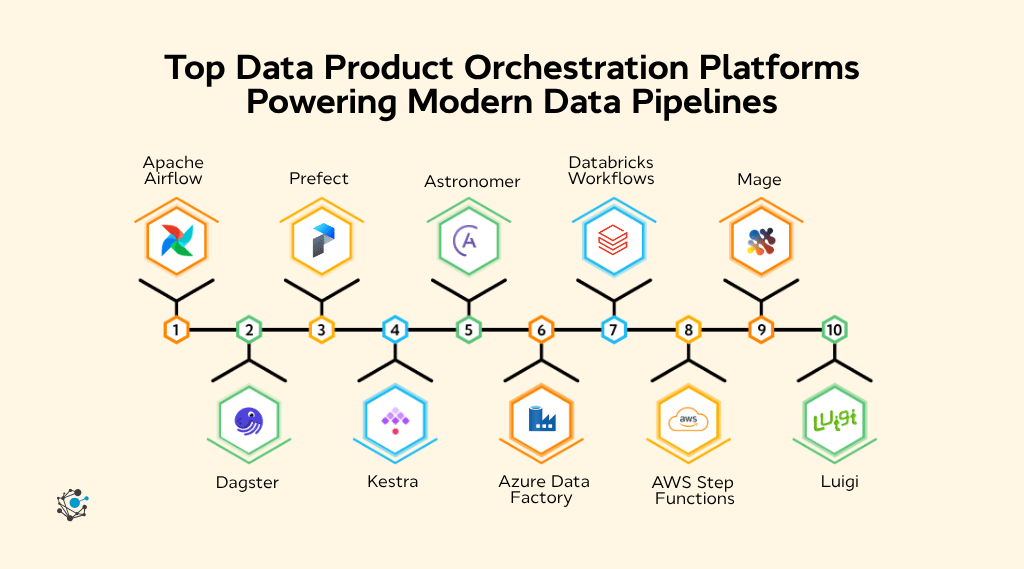
Modern data teams rely on orchestration tools to automate pipelines, coordinate dependencies, and maintain reliable data workflows. These platforms differ in architecture, deployment model, and operational focus. Some tools prioritize developer flexibility, while others focus on cloud-native orchestration or machine learning workflows.
Below are some of the most widely used data orchestration tools that organizations use to coordinate complex data pipelines and manage production-grade data products.
1. Apache Airflow
Apache Airflow is an open-source workflow orchestration platform widely used for managing data pipelines in analytics and data engineering environments. It was originally developed at Airbnb and later contributed to the Apache Software Foundation. Airflow allows teams to define workflows programmatically using Python and represent pipeline dependencies through Directed Acyclic Graphs (DAGs). Because of its flexibility and extensive integration ecosystem, it has become a common orchestration framework for coordinating ETL jobs, batch pipelines, and analytics workflows across modern data platforms.
Key features
-
Python-based workflows: Pipelines are defined in Python, allowing engineers to build flexible workflow logic.
-
DAG-based orchestration: Directed Acyclic Graphs define task dependencies and execution order across pipelines.
-
Extensive operator ecosystem: Airflow includes hundreds of operators that integrate with cloud services, databases, and processing frameworks.
-
Monitoring interface: A built-in web UI enables teams to track pipeline runs, debug failures, and monitor workflow health.
-
Scalable execution architecture: Distributed worker nodes enable Airflow to run pipelines across large data environments.
Pros
-
Highly flexible and customizable
-
Large open-source community
-
Extensive integration ecosystem
Cons
-
Complex to operate at scale
-
Requires engineering expertise
-
Infrastructure management overhead
Best for
Engineering teams running large ETL pipelines and needing a highly customizable orchestration framework.
2. Azure Data Factory

Azure Data Factory is Microsoft’s cloud-based data integration and orchestration service designed to build and manage data pipelines across hybrid and cloud environments. It enables organizations to move, transform, and coordinate data workflows between operational systems, cloud storage, and analytics platforms. The platform provides both visual pipeline design tools and code-based development options. Azure Data Factory is often used in enterprise environments that rely on Microsoft Azure infrastructure for analytics, data warehousing, and large-scale data integration.
Key features
-
Visual pipeline builder: A drag-and-drop interface allows teams to design workflows without extensive coding.
-
Hybrid data integration: Supports orchestration across both on-premise and cloud systems.
-
Event-based triggers: Pipelines can run based on schedules, events, or data availability.
-
Built-in connectors: ADF integrates with hundreds of enterprise systems and data sources.
-
Enterprise security controls: Role-based access control and Azure identity management ensure secure orchestration.
Pros
-
Strong integration with the Azure ecosystem
-
Visual development environment
-
Enterprise-grade security
Cons
-
Limited flexibility outside Azure
-
Can become expensive at scale
-
Debugging complex pipelines can be difficult
Best for
Organizations operating analytics platforms primarily within the Microsoft Azure ecosystem.
3. Databricks Workflows

Databricks Workflows is an orchestration capability built within the Databricks platform that allows teams to schedule and manage analytics and machine learning workloads. It coordinates jobs such as notebook execution, data processing tasks, and machine learning pipelines that run on Databricks clusters. The tool is closely integrated with Apache Spark and the broader Databricks ecosystem. As a result, it is commonly used by organizations running large-scale analytics and machine learning pipelines within the Databricks environment.
Key features
-
Notebook orchestration: Workflows coordinate tasks across Databricks notebooks, Spark jobs, and ML pipelines.
-
Automated compute management: Jobs can automatically scale clusters based on workload demand.
-
Pipeline monitoring: Built-in dashboards allow teams to track pipeline runs and debug issues.
-
Task dependency management: Jobs can be scheduled with dependencies and execution conditions.
-
Integration with Delta Lake: Native compatibility with Delta Lake enables reliable data processing pipelines.
Pros
-
Strong integration with the Spark ecosystem
-
Optimized for ML and analytics pipelines
-
Scalable cloud architecture
Cons
-
Primarily tied to the Databricks platform
-
Limited orchestration outside the Databricks ecosystem
-
Requires Databricks expertise
Best for
Organizations using Databricks for analytics, data engineering, and machine learning workloads.
4. Prefect

Prefect is a modern data workflow orchestration platform designed to simplify pipeline management and operational monitoring. It allows developers to define workflows using Python while incorporating operational logic such as retries, caching, logging, and alerts. Prefect provides both open-source and cloud-hosted deployment options, giving teams flexibility in how they manage orchestration infrastructure. The platform is commonly adopted by teams building dynamic data pipelines and workflows in modern cloud data environments.
Key features
-
Python workflow engine: Developers can build pipelines using standard Python code.
-
Dynamic pipeline execution: Workflows can include branching logic and conditional execution.
-
Automated retries and caching: Built-in resilience features improve pipeline reliability.
-
Cloud orchestration dashboard: Prefect Cloud provides monitoring, scheduling, and alerting capabilities.
-
Modern data stack integrations: Supports tools such as Snowflake, dbt, and Kubernetes.
Pros
-
Developer-friendly Python workflows
-
Flexible orchestration logic
-
Strong observability features
Cons
-
Smaller ecosystem than Airflow
-
Some enterprise features require paid plans
-
Learning curve for advanced workflows
Best for
Data teams building dynamic workflows and modern data pipelines.
5. Dagster

Dagster is a data orchestration platform designed around the concept of managing data assets rather than individual workflow tasks. It enables teams to define pipelines based on the datasets they produce and track dependencies between those assets. Dagster provides built-in observability, testing capabilities, and integrations with tools commonly used in modern data stacks. Its architecture supports organizations that want clearer visibility into how data assets are created, transformed, and delivered across analytics workflows.
Key features
-
Asset-based pipeline modeling: Dagster tracks datasets as first-class assets within the platform.
-
Integrated observability tools: Pipeline monitoring and asset health tracking improve reliability.
-
Built-in testing framework: Developers can validate pipelines before deployment.
-
dbt and SQL integrations: Dagster integrates directly with transformation tools used in modern data stacks.
-
Interactive UI (Dagit): The Dagit interface visualizes pipeline dependencies and execution status.
Pros
-
Strong data asset visibility
-
Built-in observability features
-
Modern developer experience
Cons
-
Smaller community compared to Airflow
-
Rapidly evolving ecosystem
-
Requires architecture planning
Best for
Organizations are building structured data platforms centered around data assets.
6. AWS Step Functions

AWS Step Functions is a serverless orchestration service provided by Amazon Web Services for coordinating workflows across distributed applications and cloud services. It allows teams to define workflows as state machines that represent the sequence and dependencies of tasks. The platform integrates directly with AWS services such as Lambda, S3, DynamoDB, and ECS. Step Functions is often used to automate event-driven workflows, data processing pipelines, and microservice-based applications within the AWS ecosystem.
Key features
-
Serverless workflow engine: Pipelines run without managing infrastructure.
-
State machine orchestration: Workflows are defined as state machines representing task execution paths.
-
Event-driven execution: Workflows trigger automatically based on AWS events.
-
AWS ecosystem integration: Supports services such as Lambda, S3, DynamoDB, and ECS.
-
Built-in retry and error handling: Automatic retries improve workflow reliability.
Pros
-
Strong AWS integration
-
Serverless architecture
-
Scales automatically
Cons
-
Limited outside the AWS ecosystem
-
Complex workflows can become expensive
-
State machine modeling requires learning
Best for
Organizations are building serverless data workflows within AWS environments.
7. Astronomer

Astronomer is a managed orchestration platform built specifically for running Apache Airflow in production environments. It simplifies the deployment, scaling, and operational management of Airflow pipelines by providing managed infrastructure and monitoring tools. Organizations can use Astronomer to run Airflow workflows without managing clusters, upgrades, or infrastructure maintenance themselves. The platform is commonly used by teams that want the flexibility of Airflow while reducing operational complexity.
Key features
-
Managed Airflow infrastructure: Removes operational overhead of managing Airflow clusters.
-
Pipeline deployment automation: CI/CD pipelines simplify workflow deployment.
-
Monitoring and alerting: Observability tools help detect pipeline failures.
-
Environment management: Centralized tools manage Airflow versions and upgrades.
-
Developer productivity tools: CLI and development environments accelerate pipeline creation.
Pros
-
Simplifies Airflow management
-
Strong operational tooling
-
Enterprise support options
Cons
-
Dependent on the Airflow ecosystem
-
Added cost compared to self-managed Airflow
-
Limited to Airflow workflows
Best for
Organizations that want managed Airflow orchestration without infrastructure complexity.
8. Flyte

Flyte is a cloud-native orchestration platform designed for machine learning workflows and large-scale data processing pipelines. It was originally developed by Lyft to support reproducible and scalable ML pipelines across distributed infrastructure. Flyte runs on Kubernetes and enables teams to define workflows that can be versioned, monitored, and executed across clusters. The platform is frequently used in environments where data pipelines and machine learning models need to operate together within scalable infrastructure.
Key features
-
ML pipeline orchestration: Supports complex machine learning workflows.
-
Kubernetes-native architecture: Designed for containerized infrastructure environments.
-
Workflow versioning: Tracks pipeline versions for reproducibility.
-
Data lineage tracking: Provides visibility into workflow dependencies.
-
Distributed execution support: Handles large-scale workloads across clusters.
Pros
-
Strong ML workflow capabilities
-
Scalable architecture
-
Supports distributed workloads
Cons
-
Requires Kubernetes expertise
-
Smaller ecosystem
-
More complex setup
Best for
Organizations orchestrating large-scale machine learning pipelines.
9. Kestra

Kestra is an event-driven orchestration platform designed to automate workflows across distributed systems and modern infrastructure environments. It uses declarative configuration files to define workflows and allows pipelines to be triggered by events rather than only by schedules. Kestra integrates with infrastructure automation tools and supports orchestration across different services and processing systems. The platform is often adopted by teams that want to manage event-driven pipelines and infrastructure workflows together.
Key features
-
Event-driven orchestration: Workflows trigger based on system events or conditions.
-
YAML pipeline configuration: Declarative configuration simplifies versioning.
-
Infrastructure-as-Code integration: Pipelines integrate with infrastructure automation workflows.
-
Distributed execution engine: Supports large-scale workflows across environments.
-
Monitoring dashboards: Observability tools track pipeline health.
Pros
-
Event-driven architecture
-
Infrastructure automation support
-
Scalable workflow engine
Cons
-
Smaller community
-
Less mature ecosystem
-
Fewer integrations than larger platforms
Best for
Teams running event-driven data workflows across distributed infrastructure.
10. Luigi

Luigi is a Python-based workflow orchestration framework developed by Spotify to manage complex batch processing pipelines. It focuses on defining tasks and dependencies so that data workflows execute in the correct order. Luigi provides a lightweight framework for coordinating long-running jobs and monitoring pipeline execution. It is commonly used in environments where organizations run large batch pipelines that depend on multiple upstream tasks and data processing steps.
Key features
-
Dependency management: Tasks automatically execute based on defined dependencies.
-
Python pipeline definitions: Developers define workflows using Python code.
-
Workflow visualization: Built-in UI shows task status and execution progress.
-
Error handling support: Retry logic helps recover from pipeline failures.
-
Hadoop and Spark integration: Works well with large-scale batch processing systems.
Pros
-
Simple workflow framework
-
Lightweight architecture
-
Reliable dependency management
Cons
-
Limited modern features
-
Smaller community today
-
Less suited for cloud-native pipelines
Best for
Organizations managing batch-oriented data pipelines.
Core capabilities of a data product orchestration platform
Although orchestration platforms vary in design, most provide a set of core capabilities that enable reliable data workflows.

1. Workflow automation and scheduling
Automation is the foundation of orchestration. Platforms allow teams to schedule workflows, trigger jobs based on events, and manage execution without manual intervention.
Automated workflows ensure pipelines run consistently and reduce operational workload for engineering teams.
2. Pipeline dependency management
Many orchestration platforms represent workflows as Directed Acyclic Graphs.
This structure allows teams to define dependencies between tasks and ensure jobs run in the correct order. If an upstream process fails, downstream tasks can be paused or retried automatically.
3. Monitoring and observability
Operational visibility is critical for maintaining reliable data pipelines.
Most orchestration platforms provide dashboards, execution logs, alerts, and workflow histories that allow teams to quickly detect failures and diagnose issues.
4. Data quality and validation workflows
Modern orchestration platforms increasingly support integrated data validation.
Quality checks can run during pipeline execution to ensure datasets meet defined standards before being delivered to analytics systems.
If validation fails, workflows can stop automatically or trigger alerts.
5. Integration with the modern data stack
A strong orchestration platform for data products integrates with the broader data ecosystem.
Typical integrations include cloud warehouses such as Snowflake and BigQuery, transformation frameworks like dbt, streaming systems such as Kafka, machine learning pipelines, and governance platforms such as data catalog solutions that track metadata and dataset ownership across the platform.
These integrations allow orchestration across the entire analytics architecture.
Key features to evaluate in a data product orchestration platform
Choosing a data product orchestration platform involves more than scheduling pipelines. The right platform should support scalable pipelines, provide visibility into workflow execution, and integrate smoothly with the broader data stack.
The following capabilities help teams evaluate whether an orchestration platform can support reliable data product operations.
1. Workflow automation flexibility
Automation sits at the core of any orchestration platform. The platform should be able to coordinate complex workflows without requiring constant manual intervention.
Modern data pipelines rarely follow a single linear path. A workflow may branch based on validation results, trigger downstream tasks only when data arrives, or retry certain steps when failures occur. Platforms that support flexible workflow logic allow teams to adapt pipelines as requirements evolve.
When evaluating automation capabilities, look for support for:
-
Scheduled workflows for recurring data processing tasks
-
Event-driven triggers that run pipelines when new data arrives
-
Conditional execution based on pipeline outcomes
-
Retry policies and error-handling logic.
These capabilities make workflows more resilient and reduce the operational overhead of managing pipelines manually.
2. Pipeline observability
Orchestration platforms should provide strong operational visibility into workflow execution. When pipelines fail, teams need to quickly understand where the failure occurred and how it affects downstream processes.
Without observability, troubleshooting data pipelines can become time-consuming and disruptive to analytics workflows.
A well-designed orchestration platform typically provides:
-
Workflow dashboards showing pipeline execution status
-
Execution logs for diagnosing failures
-
Alerts or notifications when pipelines fail
-
Historical run data for analyzing pipeline performance
These monitoring capabilities help teams detect issues early and ensure that analytics and machine learning workloads continue running reliably.
3. Scalability for large data environments
As organizations expand their analytics capabilities, the number of pipelines and dependencies increases rapidly.
An orchestration platform that works well for a handful of pipelines may struggle once workflows scale to hundreds or thousands of tasks.
Scalable orchestration platforms support:
-
Distributed task execution across multiple workers
-
Parallel pipeline execution for large workloads
-
Efficient management of large dependency graphs
Cloud-native orchestration platforms often provide auto-scaling capabilities, allowing compute resources to increase automatically when pipeline workloads grow.
For organizations running large data platforms, scalability becomes one of the most important evaluation criteria.
4. Integration with the modern data stack
Most organizations operate data platforms built from multiple specialized tools rather than a single monolithic system.
A data pipeline orchestration platform should integrate seamlessly with the technologies already used in the data stack. This allows workflows to coordinate activities across ingestion systems, transformation frameworks, analytics engines, and machine learning pipelines.
Common integrations include:
-
Cloud data warehouses such as Snowflake, BigQuery, or Redshift
-
Transformation frameworks like dbt
-
Streaming platforms such as Kafka
-
Processing engines like Spark
Strong integrations simplify pipeline orchestration and prevent the need for custom connectors or manual coordination between tools.
5. Governance and metadata visibility
As data pipelines grow more complex, visibility into data dependencies becomes increasingly important.
Some orchestration platforms integrate with metadata catalogs, lineage systems, or governance tools. These integrations help teams understand how datasets move through data lineage visibility, allowing teams to analyze how upstream changes affect downstream analytics.
Governance visibility becomes particularly valuable in regulated industries where organizations must demonstrate how data is transformed and used.
Key governance-related capabilities may include:
-
Metadata synchronization with data catalogs
-
Lineage visibility across pipeline stages
-
Policy enforcement within workflows
These capabilities help organizations maintain transparency and trust in their data products.
|
Related resource: OvalEdge explains in its whitepaper, How to Ensure Data Privacy Compliance with OvalEdge, how organizations identify sensitive data, enforce privacy policies, and maintain visibility across complex data pipelines. |
Best practices for implementing data product orchestration
Implementing data product orchestration requires more than selecting a tool. Teams must establish practices that keep workflows reliable and scalable, including clear ownership, integrated monitoring, data quality checks, and alignment with DataOps processes. These practices help teams detect failures early and maintain consistent data delivery across analytics and AI workflows.
1. Design modular data pipelines
One of the most effective ways to manage complex orchestration environments is to design modular pipelines. Instead of building large monolithic workflows, pipelines should be broken into smaller reusable components such as ingestion, transformation, validation, and delivery tasks.
This approach improves maintainability because teams can update or troubleshoot individual components without affecting the entire pipeline. Modular pipelines also support reuse across multiple data products, reducing duplicated logic and simplifying orchestration.
|
A practical insight comes from Gousto, one of the UK’s leading meal-kit companies. By implementing a centralized data catalog and automated data quality monitoring with OvalEdge, the company improved visibility into its data assets and ensured accurate product data across its supply chain and customer-facing applications. |
2. Align orchestration with DataOps workflows
Orchestration should be integrated into DataOps processes so data pipelines can be versioned, tested, and deployed using the same engineering practices applied to application development.
This typically involves connecting orchestration workflows with CI/CD pipelines, enabling automated testing and deployment of pipeline changes. When orchestration is aligned with DataOps practices, teams can release updates to data pipelines more safely while reducing the risk of production failures.
It also improves collaboration between data engineers, analytics teams, and platform engineers by standardizing how workflows are developed and maintained.
3. Integrate orchestration with monitoring tools
As orchestration environments grow, operational visibility becomes critical. Integrating orchestration platforms with monitoring tools allows teams to track pipeline performance, resource usage, execution failures, and data freshness.
These monitoring capabilities help teams detect problems early, such as delayed pipeline execution, missing upstream data, or infrastructure bottlenecks. Instead of troubleshooting issues after dashboards break, teams can proactively respond to alerts and maintain reliable data delivery across analytics and machine learning workflows.
4. Establish operational ownership
Reliable orchestration also requires clear ownership and accountability for pipelines and data products. Each workflow should have defined owners responsible for monitoring pipeline health, responding to failures, and maintaining workflow documentation.
Without ownership, pipelines often become difficult to manage as organizations scale, leading to unresolved failures or outdated workflows. Assigning data stewards or pipeline owners ensures that orchestration processes remain actively maintained and that incidents are resolved quickly.
Clear ownership also improves communication across teams by defining who is responsible for specific data assets and workflows.
|
Do you know:
OvalEdge explains in its whitepaper, Fast, Cheap, On-Demand Analytics, how metadata-driven architectures enable scalable analytics environments while maintaining governance and operational control. |
Conclusion
A data product orchestration platform is no longer just a nice addition for mature data teams. It is becoming a core operating layer for organizations that expect reliable analytics, machine learning, and operational reporting.
The big takeaway is simple: scheduling tasks is not enough anymore. Reliable data products need coordinated workflows, clear dependencies, embedded validation, operational visibility, and delivery discipline. That is why the best data orchestration tools are moving beyond simple job execution and closer to full lifecycle coordination.
As you evaluate options, ask a few practical questions. Does the platform match your cloud and engineering environment? Can it support the complexity of your dependencies? Will it help your team detect failures earlier and recover faster? Can it support the way your data products are actually delivered?
Platforms like OvalEdge support these capabilities by combining metadata management, data lineage visibility, and governance workflows in a single platform. This helps organizations maintain reliable data pipelines while ensuring that analytics outputs remain trusted and compliant.
Book a demo with OvalEdge to see how unified metadata management, lineage tracking, and governance capabilities can help your teams monitor data pipelines and deliver reliable data products across your ecosystem.
FAQs
1. What is a data orchestration platform?
A data orchestration platform automates and coordinates workflows that move and transform data across systems. It manages scheduling, dependencies, monitoring, and retries so pipelines run in the right order and deliver dependable outputs.
2. What tools are used for data orchestration?
Common tools include Apache Airflow, Dagster, Prefect, Kestra, Astronomer, Azure Data Factory, Databricks Workflows, AWS Step Functions, Mage, and Luigi. Each fits different infrastructure, workflow, and operating model needs.
3. How do orchestration platforms improve data pipeline reliability?
They improve reliability by managing dependencies, automating execution, tracking run states, and surfacing failures quickly. Some also embed validation checks, which help stop bad data before it reaches downstream consumers.
4. How do you choose the right orchestration tool?
Choose based on workflow complexity, cloud environment, developer preferences, scalability needs, and observability requirements. The best tool is usually the one that fits your operating model, not the one with the longest feature list.
5. What is the difference between data orchestration and ETL?
ETL focuses on extracting, transforming, and loading data between systems. Data orchestration coordinates the entire workflow around those processes, including scheduling pipelines, managing dependencies, monitoring execution, and integrating validation and governance checks.
6. Why is orchestration important for modern data platforms?
Modern data platforms involve multiple pipelines, tools, and processing environments. Orchestration ensures these workflows run in the correct sequence, helps detect failures early, and maintains reliable data delivery for analytics, machine learning, and operational applications.
.png?width=1081&height=173&name=Forrester%201%20(1).png)
.png?width=1081&height=241&name=KC%20-%20Logo%201%20(1).png)