-2.png)
Most businesses today say they’re “data-driven,” but very few can answer a simple question: Is your data actually trustworthy enough to drive decisions?
That’s where the confusion usually begins. Teams invest heavily in dashboards, AI tools, and BI reports, only to realise later that the underlying data is inconsistent, duplicated, or poorly managed. As a result, analytics becomes slow, manual, and often unreliable.
This is exactly where data governance and data analytics get mixed up. Both are essential, but they serve completely different purposes.
Governance creates the rules, structure, and trust around data; analytics turns that trusted data into insights and actions. When one is missing, the entire data strategy collapses.
In this blog, you’ll learn the real difference between data governance and data analytics, how they work together, and a practical framework to help you build a governance-to-analytics pipeline that actually drives business outcomes.
Let’s start by clearing the biggest confusion first.
What’s the difference between data governance and data analytics?
Data governance ensures that data is accurate, secure, and trustworthy. It establishes the policies, standards, and processes that manage data throughout its lifecycle, making sure it is compliant and of high quality.
Data analytics, on the other hand, takes that governed data and turns it into actionable insights. While governance builds trust in the data, analytics uncovers patterns and trends that help drive business decisions.
In short, data governance lays the foundation of reliable data, and data analytics leverages that trusted data to generate value through insights.
What is data governance?
Data governance is the foundation of a trustworthy, data-driven organization. It defines the rules, processes, and policies that ensure data is accurate, secure, compliant, and accessible throughout its lifecycle. Without strong governance, your data becomes unreliable, and any analytics or insights derived from it could lead to poor decisions.
The primary purpose of data governance is to establish trust in your data. It creates consistency across systems, ensures security, and reduces risks, all of which are critical for generating actionable insights through analytics. Platforms like OvalEdge automate lineage, glossary, and quality controls to accelerate analytics readiness.
Key Components of Data Governance:
-
Data Quality Management: Ensures that data is accurate, consistent, and reliable, which is essential for effective analytics.
-
Metadata and Lineage: Organizes data by tracking its origin and transformation. This provides transparency, ensuring analytics can trust the data’s journey from source to insight.
-
Data Stewardship and Ownership: Assigns responsibility for data accuracy and compliance, making sure data governance teams are actively ensuring quality before analytics teams use the data.
-
Compliance and Security: Ensures data adheres to regulatory standards (GDPR, HIPAA, etc.), which safeguards analytics outcomes from legal and security risks.
-
Access Control: Manages who can access data and how it's protected, ensuring analytics teams only work with authorized, secure data.
Who’s responsible for governance?
Effective data governance is not owned by a single team; it’s a shared responsibility across the organization:
-
Data stewards: Oversee the health, quality, and lifecycle of key datasets
-
Compliance & legal teams: Ensure regulatory adherence
-
IT & security teams: Manage infrastructure, access controls, and data protection
-
Leadership & data councils: Set governance strategy, define priorities, and align governance with business goals
Governance works best when organizations treat it as a cross-functional partnership, not an IT-only initiative.
|
Case study: Bedrock leverages OvalEdge to standardize definitions and improve data accuracy Challenge:
Solution: Bedrock implemented OvalEdge's data governance platform, including features like:
The auto lineage feature saved time by automatically mapping data flows and identifying issues at the source. Outcome:
With OvalEdge, Bedrock's lean team was able to manage data governance effectively, scaling their practices as the company grew. |
Why Governance is Essential for Analytics:
Governance doesn’t just ensure that data is trustworthy; it enables effective analytics. When data governance is in place, analytics teams can confidently use the data, knowing it’s consistent, accurate, and secure. Poor governance, on the other hand, leads to unreliable insights, which affect business decisions.
This architectural confusion often stems from the fact that governance is typically seen as an administrative function, while analytics is viewed as the high-impact, decision-making process. However, governance provides the foundation for analytics to be built on clean, reliable, and compliant data. Without proper governance, analytics teams might be analyzing flawed or incomplete data, which would ultimately undermine any insights derived from it.
What is data analytics?
Data analytics is the process of examining raw data to uncover patterns, generate insights, and support smarter business decisions. While data governance focuses on making data trustworthy, analytics focuses on using that trusted data to understand what’s happening, why it’s happening, and what actions to take next.
Definition and business value
At its core, data analytics involves applying statistical techniques, machine learning models, and visualization tools to turn data into actionable insights.
It helps businesses:
-
Understand trends and customer behavior
-
Diagnose operational bottlenecks
-
Predict future outcomes
-
Recommend optimal decisions
-
Measure performance and ROI
Analytics typically spans four levels:
-
Descriptive analytics – What happened?
-
Diagnostic analytics – Why did it happen?
-
Predictive analytics – What might happen next?
-
Prescriptive analytics
– What should we do about it?
Organizations often evolve along an analytics maturity curve—from manual reporting and spreadsheets to advanced machine learning and automated decision systems.
Core activities in data analytics
Analytics teams perform several key tasks throughout the data pipeline:
-
Data collection & preparation: Gathering data from multiple systems, cleaning it, transforming it, and ensuring it’s ready for analysis.
-
Statistical analysis & modeling: Applying statistical techniques, exploratory analysis, segmentation, forecasting, and machine learning.
-
Visualization & reporting: Communicating insights through dashboards, charts, stories, and business intelligence tools.
-
Predictive decision-making: Using models and insights to recommend actions, guide strategies, and optimize performance across sales, marketing, finance, operations, and more.
Key roles in analytics
Analytics is typically driven by a blend of technical and business-focused roles:
-
Data analysts: Explore data, create dashboards, and deliver insights
-
Data scientists: Build models, run experiments, and support predictions
-
Business intelligence (BI) teams: Manage reporting systems, data models, and visualizations
- Domain experts & product teams: Apply insights within business functions
Successful analytics requires collaboration between technical teams and business stakeholders.
Why both matter for a data-driven business
Many people assume that data governance and data analytics compete or slow each other down, but here's why that thinking is flawed.
The confusion often arises from architectural misunderstandings of how these two functions fit within the data lifecycle. Governance is concerned with the structure, quality, and security of data, while analytics leverages that structured, high-quality data to generate insights.
When businesses treat them as competing functions rather than complementary ones, they overlook the fact that governance is essential for analytics to function properly. Without governance, the analytics process would be built on unreliable data, leading to inaccurate or misleading insights.
This is where the misconception arises: while governance enables analytics, people sometimes mistakenly think they are in opposition.
Both governance and analytics are essential, but for different reasons:
-
Governance establishes trust: Without clean, well-managed data, analytics outputs become unreliable.
-
Analytics drives value: Without insights and decisions, governance becomes an administrative exercise with no measurable ROI.
-
Together, they reduce risk and maximize impact: From regulatory compliance to smarter forecasting, one supports and amplifies the other.
A truly data-driven organization treats governance and analytics as a unified strategy, not independent teams or competing priorities.
Data governance vs data analytics: in-depth comparison
Data governance and data analytics serve very different purposes, but they depend on each other to create a reliable, insight-driven data ecosystem. This section breaks down their differences across purpose, lifecycle, stakeholders, outputs, and tools, then explains how they work together in real-world environments.
|
Aspect |
Data Governance |
Data Analytics |
|
Purpose and Focus |
Ensures data accuracy, security, and compliance. Manages data quality, access, and policies. |
Focuses on insights, decision-making, and performance through data analysis. |
|
Stage in the Data Lifecycle |
Begins at data creation and spans storage, access, and management. |
Follows after data is cleaned and prepared, focusing on analysis and visualization. |
|
Data Quality Responsibility |
Ensures data consistency, accuracy, and completeness through profiling, cleansing, and validation. |
Uses clean, validated data to generate insights, forecasts, and patterns. |
|
Key Stakeholders |
Data stewards, IT teams, compliance officers, and security officers. |
Data analysts, data scientists, and BI teams who interpret data for decision-making. |
|
Outputs & Deliverables |
Produces data dictionaries, metadata catalogs, and compliance reports to ensure trustworthy data. |
Delivers dashboards, reports, and KPIs to guide business decisions. |
|
Tools & Technologies |
Tools like OvalEdge for managing data quality, compliance, and access. |
Tools like Power BI, Tableau, and Looker for analyzing and visualizing data insights. |
|
Data Security & Compliance |
Manages access controls, data privacy, and regulatory compliance (e.g., GDPR, HIPAA). |
Relies on governed data for secure analysis, ensuring compliance in insights generation. |
|
Impact on Decision-Making |
Ensures data trustworthiness, allowing reliable decision-making based on quality data. |
Provides actionable insights to drive strategic and operational decisions. |
|
Risk Management |
Mitigates risks around data breaches, inaccurate data, and compliance violations. |
Minimizes business risks through predictive analytics and insights for informed decisions. |
How data governance and data analytics work together
- Governance is a prerequisite for effective analytics
The “Garbage In, Garbage Out (GIGO)” principle applies here. Poor data quality → inaccurate insights → bad decisions → business risk.
Governance protects analytics from:
-
Inconsistent data
-
Duplicated values
-
Outdated definitions
-
Misaligned KPIs
-
Unsecure or noncompliant datasets
Data governance ensures that data is trustworthy, which makes it usable for analytics. Without governance, analytics is built on unreliable data, which compromises insights.
- Analytics creates a feedback loop for governance
Analytics teams often surface hidden issues such as:
-
Missing fields
-
Incorrect values
-
Undefined metrics
-
Broken lineage
-
Reporting conflicts
These issues help governance teams refine policies and improve data standards.
When both functions are connected
A unified governance–analytics pipeline:
-
Speeds up reporting
-
Improves accuracy
-
Reduces risk
-
Strengthens decision-making
-
Builds long-term data maturity
So, when thinking about data governance vs data analytics, remember: they are not competing functions. Governance prepares the data for analytics by ensuring consistency, accuracy, and security, while analytics uses that governed data to generate actionable insights. The confusion arises when people don’t understand that governance enables analytics, rather than hindering it.
But here’s the real problem:
Even when organizations do get governance and analytics to work together, most still fail to operationalize insights consistently. Data teams produce dashboards, reports, and models, but business teams struggle to turn them into meaningful action.
This is exactly where AskEdgi bridges the gap.
Instead of stopping at insight delivery, AskEdgi turns governed data + analytics outputs into actionable, team-specific recommendations, ensuring the last mile of the “insight-to-action loop” doesn’t break.
askEdgi in the Pipeline: The Bridge Between Governance and Analytics
Data governance and analytics are two critical functions, but the real power lies in how they work together to generate actionable insights. While governance ensures trust and security, and analytics generates insights from that trusted data, askEdgi serves as the agentic layer that operationalizes both of these ecosystems.
askEdgi automates the process of discovering, cleaning, and analyzing governed data, ensuring that every insight generated is accurate, compliant, and aligned with your business goals, without requiring any manual intervention or technical expertise. By integrating directly into the analytics workflow, askEdgi ensures that governed data is seamlessly passed into the analytics pipeline and that insights are delivered in real-time.
Building a governance-to-analytics framework in your organization
To successfully integrate data governance and analytics, organizations need a structured framework that aligns both functions to ensure data quality, security, and actionable insights. This framework should focus on collaboration, clear roles, and continuous improvement.
Here’s a step-by-step guide for building an effective governance-to-analytics pipeline.
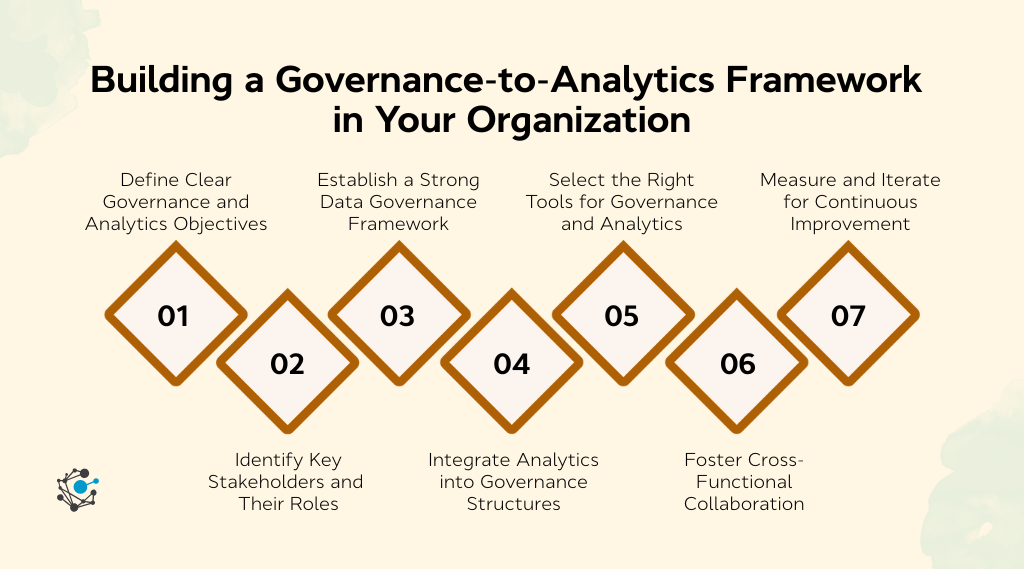
1. Define clear governance and analytics objectives
The first step is to set distinct yet aligned goals for both data governance and analytics. Governance goals should focus on maintaining data quality, security, and compliance, while analytics goals should prioritize deriving actionable insights from this governed data. Defining these objectives helps ensure that both teams are working toward the same outcomes, even if their processes differ.
Actionable steps:
-
Identify and document specific KPIs for both data governance and analytics.
-
Align analytics goals (e.g., optimizing decision-making) with governance objectives (e.g., ensuring data quality).
-
Ensure these goals are measurable and trackable to ensure progress.
2. Identify key stakeholders and their roles
Clarifying the roles and responsibilities of each team is critical to avoid confusion and ensure accountability. Data governance requires involvement from compliance officers, data stewards, and IT/security teams, while analytics involves data analysts, scientists, and business leaders. Clear ownership allows both teams to collaborate effectively and avoid bottlenecks.
Actionable steps:
-
Map out key stakeholders and define their roles in both governance and analytics.
-
Establish clear ownership of data for access, quality, and security.
-
Assign responsibilities for cross-team collaboration to bridge the gap between governance and analytics.
3. Establish a strong data governance framework
A robust data governance framework is the foundation for ensuring data integrity. It should define how data is created, stored, and managed across its lifecycle. Governance policies ensure that data remains accurate, secure, and compliant, making it reliable for analysis. This framework should cover access controls, data quality standards, and compliance with regulations.
Actionable steps:
-
Develop a data governance policy that includes standards for data quality, access, and compliance.
-
Implement data stewardship practices to ensure the ongoing management and accuracy of critical datasets.
-
Use automated tools for data quality monitoring to ensure compliance with governance standards.
4. Integrate analytics into governance structures
Data governance and analytics should be tightly integrated to ensure that the right data is used for analysis. Data governance policies should guide how data is accessed, used, and analyzed, ensuring it meets security and compliance standards. Integrating analytics into these structures allows insights to be built on clean, accurate data.
Actionable steps:
-
Ensure analytics platforms comply with governance policies by integrating data quality controls.
-
Align data access permissions with governance rules to ensure only authorized teams use data.
-
Incorporate data lineage tracking within analytics tools to ensure transparency in data usage.
5. Select the right tools for governance and analytics
Choosing the right tools ensures seamless integration between governance and analytics, enabling both functions to support each other. Governance tools ensure that data is cleaned, secured, and compliant, while analytics tools help users gain insights from that data. Both sets of tools must work together efficiently to streamline workflows and data sharing.
Actionable steps:
-
Evaluate and select governance tools (e.g., Collibra, Atlan) that can manage metadata and track data lineage.
-
Choose analytics platforms (e.g., Tableau, Power BI) that can integrate easily with governance tools.
-
Implement tools that automate data cleaning and quality monitoring to enhance the analytics process.
|
When selecting the right tools to support both governance and analytics, askEdgi plays a pivotal role. By automating the discovery, cleaning, and analysis of governed data, askEdgi eliminates manual intervention and ensures that every insight generated is accurate, compliant, and actionable. It ensures that data governance is tightly integrated with analytics, providing real-time insights from trusted data. |
6. Foster cross-functional collaboration
To maximize the effectiveness of both governance and analytics, collaboration between teams is essential. Promoting regular communication helps ensure that both teams are aligned in their approach and share the same data-driven goals. By fostering a culture of cross-functional collaboration, organizations can prevent silos and improve the data workflow.
Actionable steps:
-
Set up cross-team meetings to align on data quality goals and analytics priorities.
-
Encourage shared learning sessions to increase data literacy and governance awareness across teams.
-
Create a governance analytics task force to tackle shared challenges and ensure alignment on data management.
7. Measure and iterate for continuous improvement
Tracking the performance of both data governance and analytics efforts allows organizations to improve continuously. By defining success metrics and conducting regular reviews, teams can identify areas for enhancement and refine processes. This iterative approach ensures that the framework evolves to meet new business needs and emerging technologies.
Actionable steps:
-
Establish KPIs for both data governance (e.g., data quality scores) and analytics (e.g., time to insight).
-
Conduct regular audits to assess the effectiveness of both governance and analytics processes.
-
Use feedback to refine policies and tools, ensuring that governance evolves with the growing needs of analytics.
Common pitfalls to avoid when balancing governance and analytics
Building a unified data governance and analytics framework requires careful attention. If done incorrectly, organizations risk inefficient processes, wasted resources, or poor decision-making. Here are the most common pitfalls and how to avoid them:
1. Siloed teams and misaligned goals
When data governance and analytics teams operate in silos, they risk working toward conflicting goals, which can lead to missed opportunities for data quality improvements or inefficiencies. For example, governance teams may impose data access controls that hinder analysts’ ability to get the data they need to make decisions.
Solution:
-
Foster cross-functional collaboration. Governance and analytics teams should meet regularly to ensure they’re aligned.
-
Establish shared KPIs. Define success metrics that both governance and analytics teams work toward, such as data quality and business outcomes.
- Create a unified data strategy. Have a clear governance-to-analytics roadmap with shared ownership at the leadership level.
2. Lack of governance-driven analytics
In some cases, organizations might have strong governance in place but fail to apply it effectively within analytics workflows. Without a strong connection between governance policies and analytics processes, it can be difficult to maintain the accuracy and reliability of insights.
Solution:
-
Integrate governance directly into analytics processes. Analytics tools should automatically reference governance policies, such as data access rules, quality standards, and compliance regulations.
-
Use metadata to guide analytics. Ensure that data lineage, definitions, and quality metrics are incorporated into analytics dashboards, providing transparency and trust in the insights.
3. Limited data literacy across teams
Another common mistake is assuming that only data teams (analytics, data science, IT) need to understand governance. Lack of data literacy across the wider business can lead to poor adoption of data governance policies and prevent analytics from delivering value.
Solution:
-
Promote data literacy across the organization. Create training programs for non-technical users to help them understand data governance policies and the importance of clean data.
-
Involve all stakeholders. Make sure everyone in the organization understands the role data governance plays in ensuring quality analytics and reliable decision-making.
Future trends at the intersection of governance and analytics
As organizations increasingly rely on data to drive decision-making, the intersection between data governance and analytics is becoming more dynamic. New technologies, practices, and trends are shaping how these two functions evolve and collaborate. Here are the top trends to watch:
1. AI & ML require embedded governance
The rise of artificial intelligence (AI) and machine learning (ML) is transforming data analytics, but these technologies come with new challenges. For example, AI and ML models are often "black boxes"; it’s difficult to understand how decisions are made. Governance is needed to ensure that data used in AI models is fair, unbiased, and explainable.
What to expect:
-
Governance in model training pipelines: Data governance will become critical in training machine learning models. Organizations will need to manage data quality, remove biases, and ensure that training data is ethical and diverse.
-
Model bias management: Ensuring that AI models adhere to ethical standards will require enhanced governance frameworks, especially for industries like finance, healthcare, and hiring.
|
Key action: Implement governance policies for model explainability and bias management to ensure that your AI and ML models are ethical, transparent, and comply with emerging regulations. |
2. Rise of governance-aware analytics platforms
The growing complexity of data and the demand for speed in decision-making are leading to the development of governance-aware analytics platforms. These platforms automatically integrate governance frameworks, such as metadata tracking, data lineage, and compliance monitoring, into the analytics workflow.
What to expect:
-
Built-in cataloging and lineage tracking: Future analytics platforms will come with governance features that track data lineage (where data comes from and how it’s transformed) and metadata (context about the data).
-
Automated compliance monitoring: Analytics platforms will proactively monitor and enforce governance policies, ensuring data privacy and compliance regulations are always met without manual intervention.
|
Key action: Adopt augmented analytics tools that seamlessly blend governance with analytics, ensuring data quality and compliance are managed automatically. |
3. Emerging hybrid roles
As the data landscape becomes more complex, new roles are emerging to bridge the gap between governance and analytics. These roles combine technical expertise with business acumen, ensuring that data governance policies align with analytics objectives.
What to expect:
-
Data product managers: These professionals will be responsible for managing the lifecycle of data products (datasets, models, reports), ensuring they meet both governance standards and analytics needs.
-
Analytics translators: These individuals will act as a bridge between technical teams (IT, data scientists) and business teams (marketing, operations), ensuring that both governance policies and analytical insights are applied effectively across the organization.
-
Stewards with bi experience: As business intelligence (BI) grows, governance stewards with BI experience will be in high demand to ensure that data quality and access control are maintained while supporting self-service analytics.
|
Key action: Consider investing in cross-functional roles like data product managers or analytics translators to help facilitate collaboration and alignment between governance and analytics teams. |
Smart evaluation guide: what should you focus on first?
Integrating data governance and analytics can feel overwhelming, especially if you’re unsure where to start. This guide provides a structured approach with self-assessment questions, decision matrices, and checklists to help you evaluate your current position and prioritize your next steps.
5 self-assessment questions to ask
Before diving into the implementation process, take a moment to reflect on your organization’s current data environment. Answering these questions will help identify areas of improvement.
-
Is our data trusted by stakeholders? Are key business leaders and teams confident in the accuracy and security of the data they use for decision-making?
-
Do we have clarity on who owns each dataset? Is there a clear ownership structure for all critical data sources, including responsibility for data quality, access, and compliance?
-
Are insights often challenged for accuracy? Do your analytics teams frequently face questions about the reliability or consistency of the data they use?
-
Are we ready for AI and machine learning-driven analytics? Do we have the governance frameworks in place to support emerging AI models, including data quality checks, bias management, and compliance?
-
How well are our teams aligned on data strategy? Do the governance and analytics teams collaborate effectively, or are there silos and misalignments?
Conclusion
Data governance and data analytics are both critical to a data-driven organization. Data governance ensures that your data is accurate, secure, and compliant, while data analytics turns that reliable data into actionable insights. To truly unlock the power of your data, both must work in unison.
By integrating governance and analytics, you create a robust framework that enhances data quality, mitigates risks, and drives smarter business decisions. Neither governance nor analytics works effectively in isolation. Together, they form the foundation for sustainable growth and data maturity.
The real win is not choosing between governance and analytics, but enabling a continuous loop where governed data produces insights, and those insights instantly drive action. askEdgi operationalizes this loop, transforming reliable data into real-time decisions, automated actions, and measurable business impact.”
Ready to take your data management to the next level?

With OvalEdge, you can seamlessly integrate data governance and analytics, ensuring data quality and compliance while empowering your team to make data-driven decisions faster.

Book a demo with OvalEdge today and discover how our platform can help you create a unified, efficient, and scalable data strategy.
FAQs
1. What is the role of data governance in analytics?
Data governance ensures that data is accurate, secure, and compliant, a critical foundation for reliable analytics. Without proper governance, analytics may be based on flawed or inconsistent data, leading to inaccurate insights and poor decision-making.
2. How do data governance and data analytics impact business decisions?
Data governance ensures that the data used in decision-making is trustworthy, secure, and compliant. Data analytics, on the other hand, turns this governed data into actionable insights that guide strategy, measure performance, and optimize processes, leading to informed business decisions.
3. Can an organization have effective analytics without a data governance framework?
It’s unlikely. Without a robust data governance framework, analytics can’t rely on clean, consistent, and secure data. Governance provides the structure necessary to ensure the quality and reliability of the data used in analytics.
4. What are some tools used for data governance and analytics?
Popular data governance tools include OvalEdge, Atlan, and Informatica, which help manage data quality and compliance. For analytics, tools like Power BI, Tableau, and Looker are commonly used for data visualization and performance insights.
5. How can businesses balance data governance and data analytics?
Businesses can balance governance and analytics by creating a unified strategy that includes clear governance policies, promoting cross-functional collaboration, and selecting the right tools that support both governance and analytics objectives, ensuring data quality while enabling timely insights.
6. What are the challenges in aligning data governance and analytics teams?
The main challenges include misaligned goals, lack of communication, and differing priorities. Effective alignment requires creating shared objectives, promoting open communication, and fostering a collaborative culture between the governance and analytics teams.
.png?width=1081&height=173&name=Forrester%201%20(1).png)
.png?width=1081&height=241&name=KC%20-%20Logo%201%20(1).png)