.png)
A retail analytics team launched a new revenue forecasting dashboard to improve cross-domain reporting and decision-making. Everything appeared stable until a small schema change in the sales domain silently broke downstream pipelines.
For nearly two weeks, marketing teams relied on inaccurate revenue reports before the issue was identified. Engineers blamed decentralised ownership, while analysts pointed to weak governance controls and inconsistent coordination between domains.
Challenges like these are becoming increasingly common as enterprises adopt distributed data architectures.
According to the 2026 Data Mesh Market Report by Market Research Future, the global data mesh market is projected to grow from USD 1.78 billion in 2025 to USD 8.55 billion by 2035 at a CAGR of 17%.
Yet many organisations still struggle with schema drift, inconsistent data quality, and unclear accountability across domain teams. In this guide, the definition, architecture, implementation, and governance role of data contracts in scalable data mesh environments will be explored.
What is a data contract in data mesh?
Modern data contracts increasingly function as machine-readable governance agreements. They combine schema definitions, quality expectations, SLAs, lineage context, ownership, and policy enforcement into a single framework.
In mature data mesh environments, data contracts increasingly function as machine-readable governance artifacts attached directly to governed data products. This enables automated discoverability, version control, policy enforcement, SLA monitoring, and interoperability across decentralized domains through metadata management platforms.
Data contract definition in a data mesh context
A data contract in data mesh defines the expected behaviour of a data product across its lifecycle. It establishes how data should be structured, delivered, validated, accessed, and maintained between producing and consuming domains.
Rather than treating data as a byproduct of pipelines, data contracts formalise it as a governed product with clearly defined expectations. This helps distributed teams maintain consistency even when operating independently across multiple business domains.
A typical data contract may include:
-
Schema definitions and field structures
-
Data quality and validation requirements
-
Freshness and availability expectations
-
Access permissions and compliance rules
-
Ownership, lineage, and versioning details
-
Consumption policies, subscription workflows, and delivery access modes
These contracts can be applied across different types of data interfaces, including structured datasets, APIs, streaming events, real-time pipelines, and analytical data products.
By standardising expectations at the interface level, organisations reduce ambiguity and improve interoperability across decentralised environments.
Key components of a data contract
Every effective data contract implementation in data mesh includes several foundational components.
-
Schema definition: It establishes the structure of the data product. It defines field names, data types, formats, and required attributes. This ensures consumers understand exactly how to interpret incoming data.
-
Data quality rules: They define acceptable thresholds for completeness, accuracy, validity, and consistency.
|
For example, a customer dataset may require all email fields to follow a valid format before entering downstream systems. |
-
SLA commitments: They specify freshness, availability, and latency expectations. A financial reporting pipeline may require updates every hour with 99.9% availability.
-
Access and security policies: They define who can access data and under what conditions. This is particularly important for regulated industries handling sensitive information.
-
Metadata and lineage: They provide visibility into source systems, transformations, dependencies, and ownership responsibilities.
Together, these components create reliable interfaces that make data products predictable and reusable.
How data contracts differ from SLAs and schemas
Many organisations confuse schemas, SLAs, and data contracts because they all define expectations around data systems. However, each serves a different purpose within a data mesh architecture.
|
Component |
Primary Focus |
What It Defines |
Limitations |
|
Schema |
Data structure |
Field names, formats, data types, and required attributes |
Does not define quality, ownership, or operational guarantees |
|
SLA |
Service reliability |
Freshness, uptime, latency, and availability targets |
Does not validate structure or governance requirements |
|
Data Contract |
End-to-end data reliability |
Schema, SLAs, quality rules, governance policies, ownership, lineage |
Requires continuous enforcement and monitoring |
A schema ensures that data follows a predefined structure, while an SLA defines operational commitments such as freshness or uptime. A data contract combines both while also incorporating governance rules, ownership responsibilities, versioning controls, lineage, and data quality expectations.
This distinction matters because partial governance creates operational gaps. A technically valid schema does not guarantee trustworthy data, and meeting uptime targets does not prevent incomplete or inaccurate records from flowing into downstream systems.
Unlike static schemas or governance documentation, data contracts are most effective when integrated into validation workflows, metadata systems, and operational governance processes.
|
Pro tip: Organisations adopting data mesh contract-driven architecture increasingly rely on governance platforms such as OvalEdge to operationalise contracts across distributed domains. |
By combining metadata management, lineage visibility, data quality monitoring, stewardship workflows, and governed data product management, platforms like OvalEdge help organisations operationalise data contracts as active governance controls rather than static technical documentation.
Why data contracts are essential in a data mesh architecture
Data mesh introduces decentralised ownership, which improves scalability but also increases coordination challenges across domains. As teams independently manage data products, inconsistencies in schemas, quality standards, and governance practices can quickly create operational friction.
Role of data contracts in producer-consumer alignment
Data contracts for data products establish shared expectations between producers and consumers before implementation begins. Instead of relying on undocumented assumptions or fragmented communication across teams, contracts define how data should be structured, validated, delivered, and maintained.
This improves alignment across domains by reducing ambiguity around ownership, quality expectations, and operational guarantees. It also accelerates onboarding for downstream consumers because interfaces become predictable and standardised.
Maintaining this alignment at scale also requires continuous visibility into data quality and pipeline behaviour.
|
Practical insights: OvalEdge data observability tools help organisations detect schema drift, data quality issues, and pipeline anomalies before they impact downstream consumers, improving trust and reliability across distributed data products. |
Enabling domain ownership and federated governance
Data contracts help balance domain autonomy with organisational consistency, which is one of the hardest operational problems in data mesh architectures. Domains need the flexibility to manage their own data products independently, while governance teams require shared standards for quality, compliance, and interoperability.
By enforcing common governance rules through standardised contracts, organisations can support federated governance models without centralising ownership. This reduces governance drift while allowing distributed teams to scale data products more reliably across domains.
Enterprise data governance capabilities help operationalise federated governance through metadata management, policy enforcement, lineage visibility, and stewardship workflows.
Preventing schema drift and data pipeline failures
Schema drift is one of the most common causes of pipeline instability in distributed data environments.
A minor upstream schema modification can silently break dashboards, machine learning workflows, streaming systems, and reporting pipelines across multiple domains. These failures often surface late, making remediation expensive and time-consuming.
Data contract schema enforcement introduces automated validation, version control, and change management into the lifecycle of data products. Changes are validated and communicated before deployment, reducing the risk of downstream disruptions.
How OvalEdge improves schema visibility and impact analysisCombining data contracts with lineage visibility helps organisations identify downstream risks before changes reach production systems. OvalEdge’s automated data lineage tools help trace upstream and downstream dependencies across pipelines, dashboards, and analytical workflows. |
Supporting scalable and reliable data products
Reliable interfaces improve data product reuse across the organisation.
When consumers trust the consistency, quality, and operational guarantees of a data product, teams can integrate faster without rebuilding validation logic independently for every workflow.
Trusted data contracts improve the discoverability and reuse of governed data products because consumers can evaluate ownership, quality, lineage, SLAs, and governance maturity before using the data.
This creates several long-term operational benefits:
-
Faster analytics development
-
Reduced duplicate pipelines
-
Better data discoverability
-
Lower operational overhead
-
Improved trust in enterprise reporting
-
More reliable AI and machine learning workflows
As data products become central to enterprise analytics strategies, organisations increasingly rely on integrated metadata, lineage, and governance platforms to operationalise contract-driven architectures at scale.
Enterprise data product management software helps organisations manage governed data products with clearer ownership, lifecycle visibility, quality monitoring, and cross-domain discoverability across distributed environments.
As distributed data ecosystems grow, maintaining reliable governance and trusted data products becomes increasingly important.
Book a demo to see how OvalEdge operationalises scalable data contracts across enterprise data ecosystems.
How to implement data contracts in a data mesh architecture
Implementing data contracts in a data mesh architecture requires more than documenting schemas or publishing governance guidelines. Successful adoption depends on integrating contracts into operational workflows, validation pipelines, metadata systems, and governance processes.
Step 1: Define data products and assign domain ownership
Start by identifying domain-aligned data products and assigning clear ownership responsibilities.
Each domain team should own:
-
Schema management
-
Data quality standards
-
SLA commitments
-
Access policies
-
Consumer communication
|
For example, a customer analytics domain should own the structure, freshness, and quality expectations of customer behaviour datasets consumed by marketing and sales teams. |
Without clear accountability, contracts often become outdated and disconnected from production systems.
Step 2: Design contract-first data product interfaces
Define contracts before building pipelines or integrations.
A contract-first approach ensures teams align on schemas, validation rules, SLAs, and access policies upfront rather than resolving inconsistencies after deployment. Consumers should be able to review contract versions, policy changes, and compatibility updates before integrating with a data product
|
For instance, an event streaming pipeline can define expected message structures and latency requirements before producers publish events to downstream systems. |
This reduces implementation rework and improves cross-domain consistency.
Step 3: Implement schema enforcement and validation
Validation should occur throughout ingestion, transformation, and publishing stages.
Automated enforcement prevents malformed or incompatible data from reaching downstream consumers.
Common implementation approaches include:
-
Schema registries
-
CI/CD validation checks
-
Automated contract testing
-
Streaming validation frameworks
|
For example, a schema validation check in a CI/CD pipeline can block deployments when a breaking field modification impacts downstream dashboards. |
Step 4: Define SLAs and data quality rules
Every contract should include measurable operational and quality guarantees.
These commonly include:
-
Freshness requirements
-
Availability targets
-
Completeness thresholds
-
Latency expectations
-
Error tolerances
A financial reporting dataset may require hourly refresh intervals with 99.9% completeness thresholds to support executive reporting accuracy.
Clearly defined metrics reduce ambiguity between producers and consumers.
Some organisations also track metadata completeness and governance maturity scores to evaluate whether a data product is sufficiently curated, governed, and ready for enterprise consumption.
Step 5: Integrate contracts into pipelines and workflows
Contracts should be embedded directly into ETL and ELT workflows rather than stored in disconnected documentation repositories.
Validation checks can automatically:
-
Trigger alerts
-
Block deployments
-
Quarantine invalid records
-
Notify downstream consumers
This makes governance operational instead of reactive.
Data orchestration tools help organisations automate workflow coordination, streamline pipeline dependencies, and enforce validation rules consistently across distributed data environments.
Step 6: Manage contract versioning and change control
Data contracts evolve continuously as business requirements, regulatory policies, and downstream use cases change over time.
Effective versioning and change control processes help organisations introduce updates without disrupting downstream consumers or breaking dependent pipelines. This becomes especially important in distributed data mesh environments where multiple domains rely on shared data products.
Common backward compatibility practices include:
-
Additive schema changes
-
Deprecation windows
-
Consumer notifications
-
Parallel contract versions
Structured change management improves stability across domains by ensuring schema modifications, policy updates, and SLA changes are validated, documented, and communicated before deployment.
This reduces operational risk while allowing data products to evolve in a controlled and predictable manner.
Step 7: Monitor and enforce contracts at scale
Continuous monitoring ensures contracts remain enforceable in production environments.
Teams should track compliance through:
-
Dashboards
-
Automated alerts
-
Audit logs
-
Lineage systems
-
Quality monitoring workflows
This transforms data contracts from governance theory into operational practice.
Automated data governance capabilities help organisations scale contract monitoring, lineage visibility, and policy enforcement across distributed data ecosystems.
Operationalizing data contracts across domain teams
Defining data contracts is only the starting point. Long-term success depends on operationalising contracts across engineering workflows, governance processes, metadata systems, and cross-domain collaboration models.
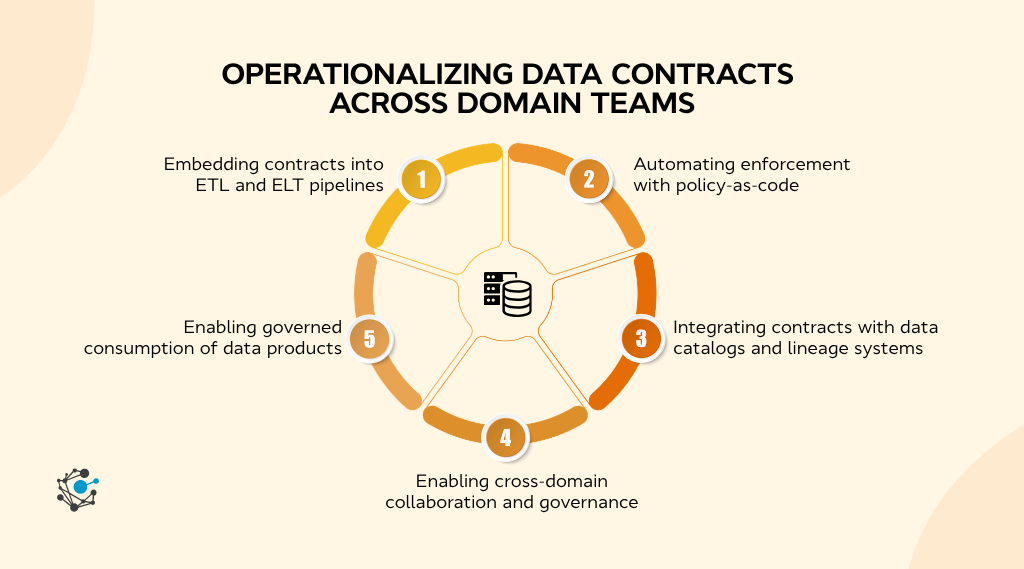
1. Embedding contracts into ETL and ELT pipelines
Contracts are most effective when validation and enforcement occur throughout the pipeline lifecycle rather than after data reaches downstream consumers.
This includes:
-
Ingestion validation for schema and format checks
-
Transformation-level quality enforcement
-
Publishing controls before data products are exposed to consumers
Embedding contracts directly into ETL and ELT workflows improves reliability while reducing manual intervention and downstream remediation efforts.
Actionable steps
-
Add schema validation checks to CI/CD workflows before deployment.
-
Enforce quality thresholds during ingestion and transformation stages.
-
Configure automated alerts for failed validations and SLA breaches
2. Automating enforcement with policy-as-code
Policy-as-code allows governance rules to be managed programmatically instead of relying entirely on manual reviews and documentation.
This approach improves consistency across distributed domains by automating enforcement for quality standards, access controls, retention policies, and compliance requirements.
As organisations scale data mesh environments, automation becomes essential for maintaining governance consistency without slowing down domain-level delivery.
Actionable steps
-
Define reusable governance policies as code templates.
-
Automate access control and compliance validations within pipelines
-
Standardise quality enforcement rules across all domain teams
3. Integrating contracts with data catalogs and lineage systems
Metadata systems play a critical role in operationalising data contracts at scale.
Data catalogs connect datasets, lineage, ownership, quality metrics, policies, and dependencies into a unified governance layer. This improves visibility into how data products evolve across domains and how downstream consumers are affected by changes.
Integrated lineage visibility also helps teams assess downstream impact before schema changes are approved, reducing operational risk across dependent pipelines, dashboards, analytical workloads, and AI workflows.
|
Implementation tip: OvalEdge enterprise data catalog helps organisations improve contract visibility, impact analysis, governance enforcement, and cross-domain discoverability across distributed data ecosystems. |
Actionable steps
-
Link contracts directly to metadata catalogs and lineage systems
-
Maintain ownership and stewardship visibility for every data product.
-
Use lineage tracking to assess downstream impact before schema changes
Unified metadata and lineage visibility help organisations manage governed data products more reliably across domains.

Book a demo to see how OvalEdge supports scalable contract-driven governance.
4. Enabling cross-domain collaboration and governance
Data contracts also improve collaboration between engineering, analytics, governance, and business teams by establishing shared operational expectations.
Instead of resolving ownership disputes during incidents or pipeline failures, responsibilities, policies, and quality expectations are clearly documented and enforceable.
This creates stronger coordination across distributed domains while reducing ambiguity around accountability and operational decision-making.
Actionable steps
-
Establish standard contract review processes across domain teams.
-
Define shared escalation workflows for contract violations.
-
Align governance, analytics, and engineering teams around common quality metrics.
5. Enabling governed consumption of data products
Operationalised data contracts also improve how consumers discover, evaluate, and subscribe to governed data products across distributed domains.
Consumers should be able to review ownership, lineage, SLAs, quality metrics, governance maturity, and version history before integrating with a data product. This improves trust while reducing the risk of consuming incomplete, low-quality, or non-compliant data assets.
Subscription workflows and governed access processes further help organisations manage how approved consumers request, access, and operationally interact with data products across enterprise environments.
Lineage visibility also allows consumers to assess upstream dependencies and downstream impact before adopting a data product for analytics, reporting, or AI workloads.
Actionable steps
-
Publish contracts, lineage, ownership, and SLA details directly within enterprise data catalogs
-
Implement governed subscription and approval workflows for data product access
-
Require consumers to review lineage dependencies, version history, and quality metrics before onboarding data products
Tools and platforms for implementing data contracts
Scaling data contracts across distributed data mesh environments requires platforms that can automate governance, lineage visibility, quality monitoring, and policy enforcement across domains.
Role of metadata management and governance platforms
Metadata and governance platforms provide the operational foundation for managing data contracts across distributed environments.
These platforms centralise:
-
Contract definitions
-
Ownership information
-
Lineage visibility
-
Governance policies
-
Quality metrics
This creates a unified governance layer where producers, consumers, and governance teams can work from a shared operational context instead of fragmented documentation.
Modern governance platforms like OvalEdge also support governed data product operations by enabling metadata curation scoring, embedded contract visibility, lifecycle governance, subscription management, and governed access workflows across distributed domains.
Integration with transformation and data quality tools
Data contracts become significantly more effective when integrated directly with transformation and data quality tooling.
Validation rules can automatically execute during ingestion, transformation, and publishing stages, reducing operational risk before data reaches downstream consumers.
This allows organisations to operationalise:
-
Schema validation
-
SLA enforcement
-
Quality monitoring
-
Policy checks
-
Change impact analysis
OvalEdge data quality solutions help organisations automate validation, monitoring, and governance enforcement across distributed pipelines.
How platforms like OvalEdge, Atlan, and Databricks support data contracts
|
Platform |
Key Capabilities for Data Contracts |
Operational Benefits |
|
Metadata management, lineage tracking, governance workflows, stewardship visibility, data quality monitoring |
Improves contract enforcement, governance consistency, and cross-domain visibility |
|
|
Active metadata management, collaboration workflows, cataloging, and lineage integration |
Enhances discoverability and collaboration across distributed teams |
|
|
Lakehouse architecture, streaming validation, unified analytics, governance integrations |
Supports scalable processing and contract-aware analytics workflows |
These capabilities help organisations operationalise data contracts more effectively across complex enterprise ecosystems.
Why data mesh fails without enforceable contracts
Many data mesh initiatives struggle because decentralised ownership often scales faster than governance maturity. Without enforceable standards, independently managed domains can introduce inconsistencies that weaken trust, reliability, and interoperability across enterprise data ecosystems.
Decentralisation without coordination creates governance drift.
Data mesh enables domains to manage data products independently, improving agility and scalability. However, without shared governance standards, teams often optimise locally rather than maintain enterprise-wide consistency.
Many organisations decentralise data ownership successfully but fail to provide shared visibility into lineage, quality, governance maturity, and contract compliance across domains.
This creates governance drift across domains, leading to inconsistent schemas, duplicated pipelines, fragmented definitions, and declining trust in analytics, AI, and enterprise reporting systems.
Why schema agreements alone are insufficient
Schemas define data structure, but they do not establish expectations around quality, ownership, freshness, lineage, or policy enforcement. As a result, documented schemas alone cannot prevent unreliable pipelines or downstream failures.
Distributed architectures require enforceable operational controls alongside structural consistency. Data access governance capabilities support operational enforcement through automated workflows, policy monitoring, audit visibility, and governed access controls.
Contracts as scalable governance primitives
Data contracts provide scalable governance controls for distributed data ecosystems by standardising how data products are defined, validated, and monitored across domains.
Unlike static documentation, enforceable contracts create reusable governance mechanisms that support decentralised ownership while maintaining consistency, reliability, and operational accountability.
Active data governance helps operationalise these controls through real-time monitoring, automated governance workflows, metadata intelligence, and continuous policy enforcement across distributed systems.
Common challenges in implementing data contracts
Implementing data contracts across distributed data mesh environments introduces operational and governance complexities that are difficult to manage without standardised enforcement mechanisms.
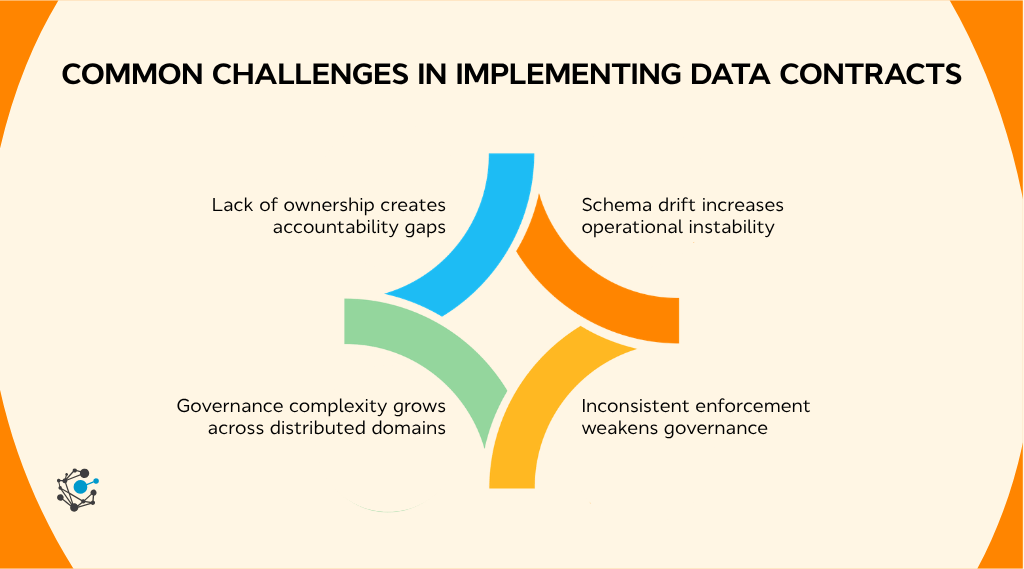
As the number of domains, pipelines, and consumers increases, maintaining consistency, accountability, and reliability becomes significantly more challenging.
-
Metadata fragmentation reduces governance visibility: When metadata, lineage, quality metrics, and contract definitions remain fragmented across disconnected tools, organisations struggle to maintain a unified view of governed data products. This limits discoverability, weakens impact analysis, and increases operational risk across distributed domains.
-
Lack of ownership creates accountability gaps: Data contracts become difficult to maintain when ownership responsibilities are unclear across domains. Successful implementations assign clear accountability for schema management, SLAs, quality standards, and consumer communication.
-
Schema drift increases operational instability: Without automated validation and version control, small schema changes can silently break downstream dashboards, pipelines, and analytics workflows. Continuous validation helps reduce these disruptions across distributed environments.
-
Inconsistent enforcement weakens governance: Governance frameworks often fail when contracts exist only as documentation. Automated validation, policy enforcement, and monitoring are essential for maintaining consistency across domains.
-
Governance complexity grows across distributed domains: As data mesh environments scale, governance complexity increases across independently managed teams and platforms. Federated governance supported by metadata visibility and policy enforcement helps maintain consistency without reducing domain autonomy.
What successful implementation looks like
Mature data contract implementations combine clear ownership, automated validation, lineage visibility, and continuous governance enforcement across all domains.
Organisations that operationalise contracts effectively create reliable, reusable, and discoverable data products that scale consistently across distributed teams.
|
How OvalEdge supports governed data mesh implementations Operational challenges: A leading sportsbook provider operating in a distributed data mesh environment struggled with fragmented governance, limited visibility into dependencies, and inconsistent ownership across data products. OvalEdge helped improve governed data mesh operations by:
|
As organisations expand AI and agentic analytics initiatives, enforceable data contracts are becoming increasingly important for ensuring trusted inputs, consistent semantics, and governed access across analytical and AI-driven workflows.
Conclusion
Data contracts provide the operational structure needed to make data mesh architectures scalable, reliable, and governable across distributed domains. They improve data quality, strengthen ownership accountability, reduce downstream failures, and create more consistent collaboration between producers and consumers.
As organisations scale distributed and AI-driven environments, contract-driven governance becomes essential for maintaining trust, interoperability, and operational consistency across data products.
OvalEdge helps organisations operationalise governed data mesh environments through metadata visibility, automated lineage, policy enforcement, and data quality monitoring.

To explore how governed data contracts can scale across enterprise ecosystems, book a demo with OvalEdge.
FAQs
1. What does a data contract specification include in a data mesh?
A data contract specification typically includes schema definitions, field-level constraints, ownership details, usage policies, and version history. It also defines how consumers should interpret data and what guarantees producers provide, ensuring consistent usage across domains without relying on informal documentation or assumptions.
2. How do data contracts handle backward compatibility in data mesh?
Data contracts manage backward compatibility through versioning strategies such as additive changes, deprecation policies, and consumer notifications. Producers maintain older contract versions temporarily, allowing consumers time to adapt, which prevents disruptions when schema or structure changes occur across distributed data products.
3. Are data contracts required for real-time and streaming data in a data mesh?
Yes, data contracts are critical for streaming data. They define message formats, event structures, and delivery expectations. Without contracts, streaming pipelines risk inconsistencies, breaking downstream consumers. Contracts ensure predictable data flow and compatibility across producers and consumers in real-time systems.
4. How do data contracts improve collaboration between domain teams?
Data contracts create a shared understanding of data expectations, reducing ambiguity between teams. They document responsibilities, structure, and usage guidelines, enabling teams to work independently while maintaining alignment. This improves communication, reduces conflicts, and supports scalable collaboration in distributed data environments.
5. What is the difference between data contracts and API contracts in data mesh?
Data contracts focus on data structure, quality, and lifecycle expectations, while API contracts define request-response behavior and service interaction. In data mesh, data contracts govern data products, whereas API contracts manage service communication. Both complement each other but serve distinct purposes.
6. How do you validate a data contract before deploying it in production?
Teams validate data contracts by testing schema rules, simulating pipeline runs, and verifying compatibility with consumer systems. They also review quality thresholds and SLA definitions. Pre-deployment validation ensures that contracts work as expected and do not introduce failures in production workflows.
.png?width=1081&height=173&name=Forrester%201%20(1).png)
.png?width=1081&height=241&name=KC%20-%20Logo%201%20(1).png)