.png)
Most customer master data management programs deliver a unified customer record that nobody trusts six months later. Sales updates it. Marketing updates it. Support updates it. Nobody reconciles the changes. The single customer view turns into a recurring cleanup exercise.
The problem is rarely the software. It is the absence of governance, lineage, and identity resolution that can hold up across multiple systems and teams. CMDM that works treats these as the foundation, not as an afterthought.
Yet only 20% of organizations have a comprehensive data strategy, according to Data Management Statistics (DataStackHub, 2025).
This gap explains why so many CMDM initiatives collapse under the weight of inconsistent updates and siloed ownership.
This guide explains what customer master data management actually is, how to build a program that stays accurate over time, and the governance practices that keep your customer data reliable as your business grows.
What is customer master data management?
Customer master data management (CMDM) is the process of consolidating customer data from systems like CRM, ERP, billing, and support into a single, trusted, and governed customer profile. It uses identity resolution, data quality rules, and governance workflows to ensure the customer record stays accurate and consistent over time.
In plain language:
-
What it is: A system for unifying customer data across the business
-
What it creates: A single customer view (also called a golden record)
-
Who uses it: Sales, marketing, support, compliance, and analytics teams
-
Why it matters: Better customer experiences, accurate reporting, and reliable compliance
CMDM stands for - CMDM stands for Customer Master Data Management.
It is sometimes referred to as Customer MDM, Customer 360, or Single Customer View, although these terms are not exactly the same.
CMDM is a subset of master data management (MDM) that focuses specifically on customer data. MDM covers all core data domains in an organization, including customers, products, suppliers, and locations.
|
Related reading: Master data is sometimes confused with metadata. They're related but not the same, and the distinction matters when scoping a CMDM program. See metadata vs master data for a full breakdown. |
How CMDM compares to CRM, CDP, and MDM
These terms are often used interchangeably, but they solve very different problems. Understanding the differences is critical because choosing the wrong system is one of the most common reasons customer data initiatives fail.
|
CRM |
CDP |
MDM |
CMDM |
|
|
Primary purpose |
Manage sales and service interactions |
Activate marketing audiences |
Govern enterprise master data |
Govern customer master data |
|
Primary users |
Sales and support teams |
Marketing teams |
IT and data teams |
Cross-functional teams |
|
Data scope |
Customer interactions and activities |
Behavioral and engagement data |
All master data domains |
Customer data only |
|
Governance level |
Low |
Low |
High |
High, customer-focused |
|
Output |
Account and contact views |
Audience segments |
Master records across domains |
Golden customer record |
|
Where it fits |
Front-office systems |
Marketing stack |
Data platform |
Data platform |
The short version
-
Use a CRM when you need to manage customer interactions and sales pipelines.
-
Use a CDP when you need to activate customer data for a marketing campaign.
-
Use MDM when you need governed master data across multiple domains.
-
Use CMDM when you need a single, trusted customer record across all systems.
In most organizations, these systems work together rather than replace each other. CMDM typically becomes the foundation. The CRM uses it for accurate account data, the CDP uses it for identity resolution, and analytics teams rely on it for consistent reporting.
For a deeper look at how governance shapes and sustains master data, explore master data management and data governance.
CMDM vs customer data management (CDM): what’s the difference?
Customer data management (CDM) is the broader practice of collecting, storing, and using customer data across the business. Customer master data management (CMDM) is a specific discipline within CDM that focuses on creating and governing a single, trusted customer record.
In simple terms:
-
CDM manages how customer data is collected, stored, and used
-
CMDM ensures that customer data is accurate, unified, and consistent across systems
Every CMDM program is part of customer data management. But not every CDM program includes CMDM. Many organizations manage customer data without ever creating a true master record, which is why duplicate profiles and inconsistent data remain common.
How to choose between CDM and CMDM
-
If your goal is to organize and use customer data more effectively, you are solving a CDM problem.
-
If your goal is to create a single, governed customer record that every system relies on, you are solving a CMDM problem
Both work together. CDM defines how customer data is handled across its lifecycle, while CMDM ensures that the core customer record stays accurate and trustworthy.
Key components of customer master data management
Strong customer master data management depends on a few essential components that keep customer records accurate, consistent, and usable across the business.
These elements work together to create a single, trusted customer view that teams can rely on for better decisions and smoother customer experiences.
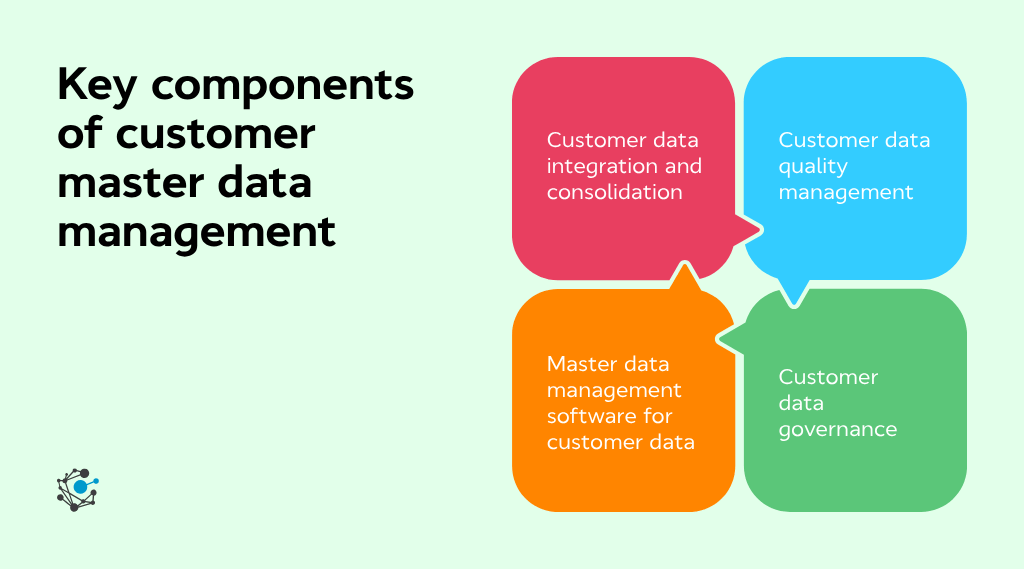
1. Customer data integration and consolidation
Customer data integration is one of the most complex parts of customer master data management because organizations store customer information across multiple systems. CRM platforms like Salesforce manage sales data, marketing tools such as HubSpot or Marketo track campaigns, ERP systems like SAP handle billing, and support tools such as Zendesk capture service interactions.
Integration brings these fragmented records into a single view using APIs, ETL pipelines, and real-time data connectors. The CMDM system then applies identity resolution and matching rules to merge duplicates and resolve conflicts.
The result is a unified, reliable customer record that supports consistent reporting, personalization, and customer experience across teams.
2. Customer data quality management
Customer data quality management ensures that customer records remain accurate, complete, and consistent over time. Many organizations deal with outdated contact details, duplicate profiles, inconsistent formats, and missing attributes, especially when data is collected across multiple systems and maintained manually.
These issues arise because systems evolve independently, data is entered inconsistently, and legacy processes accumulate errors over time.
Data quality management addresses these concerns through cleansing, standardization, validation checks, enrichment processes, and automated rules that monitor the overall health of customer data.
-
Address standardization ensures that addresses follow consistent postal formats.
-
Identity resolution identifies when multiple records refer to the same person or organization.
-
Enrichment fills in missing details from internal or third-party sources
-
Routine audits verify that quality rules continue functioning as customer data grows.
Address standardization, identity resolution, enrichment, and audit cycles all depend on the right tooling. Before selecting a CMDM platform, evaluate how modern data quality tools support data accuracy and consistency at scale.
These steps preserve the integrity of the customer master over time and support downstream initiatives such as segmentation, fraud detection, loyalty management, and customer journey analytics.
3. Customer data governance
Customer data governance provides the structure and oversight needed to manage customer master data throughout its lifecycle. It defines who owns which data elements, how they are allowed to change, and what controls must be in place to ensure responsible use.
Without governance, even the most advanced CMDM technology will gradually degrade as systems expand, teams create new data processes, and regulatory requirements evolve.
Audit trails and lineage tracking provide transparency into where data originated and how it changed as it moved through systems, making it easier to investigate errors, support compliance reviews, or update processes.
|
Pro tip: Audit trails and lineage tracking provide visibility into where customer data originates and how it changes across systems. For regulated environments and complex data flows, evaluate how automated data lineage tools support traceability and compliance at scale. |
When governance is applied consistently, organizations reduce the risks associated with incorrect reporting, unauthorized access, inconsistent updates, and customer mistrust. It also helps break down departmental silos by clarifying roles and reducing disputes over which systems hold the most accurate customer profile.
4. Master data management software for customer data
Master data management software operationalizes CMDM by providing the technical foundation required to consolidate, govern, and maintain customer records at scale.
Leading solutions such as SAP Master Data Governance, Informatica MDM, Oracle Customer Data Management, Semarchy xDM, and Tamr include capabilities for data integration, quality enforcement, governance workflows, and golden record creation.
These platforms use matching engines to identify duplicate profiles, algorithms to determine which attributes should survive during consolidation, and workflow automation to route exceptions to data stewards.
They also offer metadata management, lineage dashboards, and APIs that connect the customer master back to operational systems. This ensures that updates made in the master propagate consistently across CRM, ERP, marketing automation, and analytics tools.
Mastering these components creates a reliable foundation for analytics, personalization, and compliance. When each piece works together, customer data becomes cleaner, clearer, and far more actionable, setting the stage for stronger outcomes in every customer-facing function.
For teams evaluating how these components come together in practice, a demo with OvalEdge can provide a clearer view of how governed customer data is implemented at scale.
Customer master data management program: implementation framework
A successful customer master data management program depends on a clear, structured implementation framework. This framework guides how you define goals, align teams, map systems, and build a reliable customer master that supports accurate insights and consistent customer experiences.
Step 1: Define scope and business case
A successful CMDM program starts by clearly defining the problem it needs to solve. Organizations should identify key data issues such as inconsistent customer records, duplicate profiles, or unreliable reporting.
The scope should outline which systems, regions, or customer segments are included in the initial phase.
The business case must focus on measurable outcomes, including improved data accuracy, better customer experience, reduced manual effort, and more reliable analytics. Clear alignment on these goals helps secure stakeholder support and guide the implementation.
Step 2: Map systems and data sources
Mapping systems provide a clear view of where customer data exists and how it flows across the organization. This includes CRM, ERP, billing, marketing, support, and any legacy or regional tools.
The goal is to identify duplicate data sources, inconsistencies, and which systems hold authoritative attributes.
This step also helps uncover hidden datasets, such as spreadsheets or stand-alone tools that can introduce data quality and compliance risks.
A complete system map ensures integration is accurate and prevents conflicts during consolidation.
Step 3: Select and deploy MDM software
Selecting MDM software requires balancing technical capabilities, governance maturity, and long-term scalability.
Organizations often evaluate platforms based on whether they support multi-domain data, how well they integrate with existing systems, and the strength of their identity resolution capabilities.
This evaluation phase should also consider whether the platform includes automated workflows to support governance processes and whether it can operate in cloud, hybrid, or on-premises environments, depending on the company’s infrastructure strategy.
How to evaluate CMDM platforms
Before committing to any CMDM vendor, work through this checklist. It helps you avoid choosing a platform that looks good in a demo but fails under real-world conditions.
-
Multi-domain support: Will you eventually need to manage product, supplier, or location data, or only customer data? Single-domain tools are easier to start with but harder to scale later.
-
Identity resolution approach: Does the platform rely on rule-based, machine learning, or hybrid matching? Always ask vendors to demonstrate this using your own data, not sample datasets.
-
Governance workflows and stewardship UI: Data stewards will use this interface daily. If workflows are slow or confusing, governance will break down over time.
-
Lineage and audit trails: Essential for regulated industries and increasingly important for all organizations. You should be able to trace where data came from and how it changed.
-
Real-time vs batch synchronization: Real-time updates are critical if customer data drives personalization, risk detection, or operational decisions. Batch processing is acceptable for analytics-focused use cases.
-
Deployment options: Cloud, hybrid, or on-premises. The right choice depends on your data residency, compliance, and infrastructure requirements, not vendor preference.
-
API and integration depth: Review the API capabilities, SDKs, and webhook support. Limited integration options create long-term operational friction.
-
AI readiness: Look for capabilities like automated stewardship, policy enforcement, and metadata-aware governance. These are quickly becoming standard expectations, not optional features.
Platforms such as Informatica, SAP Master Data Governance, and Oracle Customer Data Management are often chosen for complex, multi-domain environments. To compare capabilities, trade-offs, and use cases across leading platforms, explore master data management tools.
Deployment typically starts with configuring data models, defining matching rules, and integrating priority systems, followed by iterative testing to refine accuracy.
At this stage, seeing how these capabilities work together in a real environment becomes critical for evaluation.
For organizations comparing CMDM platforms, a demo with OvalEdge can help illustrate how governance, lineage, and identity resolution operate in real-world environments.
Step 4: Establish governance, roles, and processes
Governance ensures that the customer master remains accurate and trustworthy after deployment. Without governance, data quality can deteriorate rapidly as new systems are introduced and teams develop their own data entry or update practices.
Establishing governance means assigning clear ownership for customer data domains, defining stewardship responsibilities, and creating rules that dictate how data should be captured, updated, and retired.
Governance without active stewardship breaks down over time. Assigning ownership is necessary, but it is not enough. Explore how effective stewardship models keep governance consistent in the data stewardship guide.
Governance processes should be practical and enforceable rather than theoretical documents that teams ignore.
|
For example, having stewards validate exceptions from the matching engine ensures that potentially conflicting records do not undermine the accuracy of the golden customer profile. |
Access management is another critical element because customer data has become increasingly regulated. Organizations need to ensure that only authorized teams can update sensitive attributes and that all changes are traceable.
As privacy expectations grow, governance must also incorporate consent management, retention policies, and mechanisms for honoring customer privacy requests.
Step 5: Improve data quality and harmonise records
This step focuses on transforming fragmented customer data into accurate, unified profiles. It involves identity resolution, standardization, enrichment, and conflict resolution to ensure each customer is represented consistently across systems.
Organizations often uncover duplicates, inconsistent formats, and missing data during this process. Clear rules determine how records are merged, which attributes are retained, and how conflicts are resolved.
Data quality improvement is continuous. Ongoing monitoring and refinement help maintain accuracy as new data is added and systems evolve.
Step 6: Ongoing maintenance, monitoring, and measurement
CMDM requires continuous monitoring to remain effective. Customer data changes frequently, and new systems or processes can introduce inconsistencies.
Teams track key metrics such as duplicate rates, data completeness, and integration performance to assess data health. Dashboards and alerts help identify issues early and support timely corrections.
Regular measurement ensures the program delivers value, including improved data accuracy, reduced manual effort, and more reliable reporting.
Challenges of customer master data management
Customer master data management brings major benefits, but it also comes with real challenges that can slow progress or undermine results. Understanding these obstacles early helps teams prevent data issues, set realistic expectations, and build a stronger foundation for a reliable customer master.
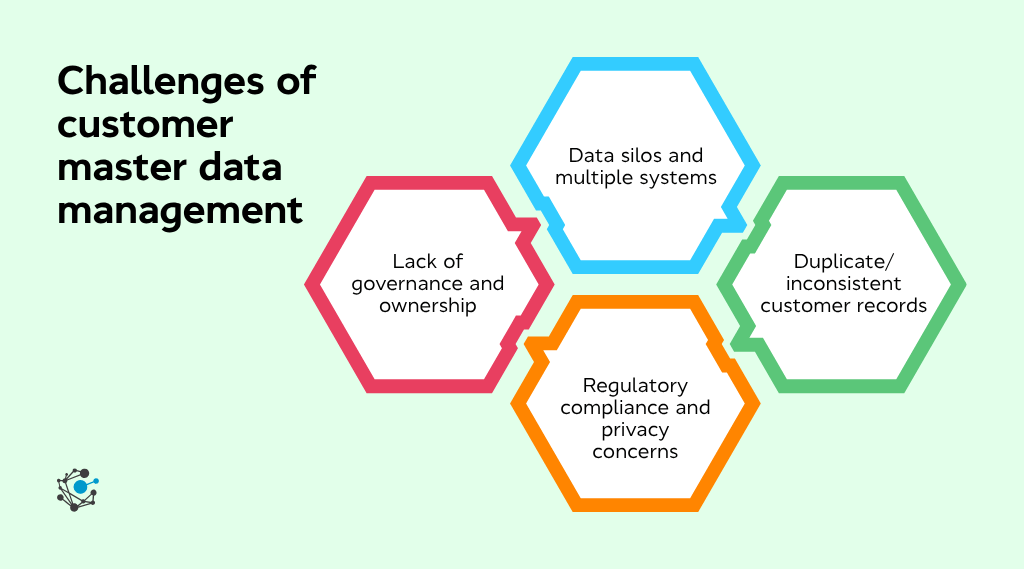
1. Data silos and multiple systems
Many organizations struggle with fragmented customer data because their technology landscapes have developed over long periods of time.
As new platforms are added and older systems remain in operation, customer information becomes dispersed across CRMs, ERPs, billing systems, support applications, marketing platforms, and regional databases.
Each system stores customer data in its own structure, using its own naming conventions, and updates records independently. As a result, organizations operate with parallel versions of the same customer, none of which are fully accurate or complete.
|
For example, industries such as banking and telecommunications face even greater complexity because their core systems were built long before modern integration standards. This creates persistent blind spots, delays in customer updates, and significant inconsistencies between front-end channels and back-office systems. |
Customer master data management addresses these issues by creating a single location where customer information is collected, standardized, and reconciled.
Instead of relying on system-specific views, organizations can reference one harmonized customer master that supports consistent interactions and analytics across channels.
2. Duplicate and inconsistent customer records
Identity resolution is the technical core of every customer master data management program. It determines whether records like “Jane Smith” in Salesforce, “J. Smith” in NetSuite, and “Jane Smithfield” in HubSpot refer to the same person or different individuals. Getting this right is what makes a single customer view reliable.
Duplicate and inconsistent records are the visible symptom. They result from manual data entry, inconsistent formatting across systems, name variations, and disconnected applications that cannot recognize when multiple records represent the same entity. The underlying issue is the absence of effective identity resolution.
Modern CMDM platforms typically approach identity resolution in three ways:
-
Rule-based matching: Uses deterministic logic such as exact email matches, standardized address comparisons, or fuzzy name matching within defined thresholds. This approach is predictable and auditable but struggles with edge cases.
-
Machine learning matching: Uses models trained on historical data t identify whether records belong to the same entity. This approach handles complex variations better but requires training data and ongoing stewardship.
-
Hybrid matching: Combines rule-based and machine learning approaches. Rules handle high-confidence matches, machine learning resolves ambiguous cases, and data stewards validate exceptions.
For organizations managing large volumes of customer data across regions and systems, hybrid matching has become the most effective and widely adopted approach.
3. Regulatory compliance and privacy concerns
Customer data is now subject to increasing scrutiny from regulators, especially as organizations expand digital engagement and data collection practices.
Regulations such as the GDPR in Europe, CCPA in California, and HIPAA in the healthcare sector impose strict requirements on how customer information is captured, stored, accessed, and updated.
These requirements include maintaining demonstrable data accuracy, honoring customer rights requests, ensuring lawful processing, and proving that adequate security measures are in place.
Regulations such as GDPR, CCPA, and HIPAA impose strict requirements on how customer data is captured, stored, and governed. To understand how to implement these controls in practice, explore data governance and compliance.
-
CMDM supports compliance by improving the structure, traceability, and reliability of customer data.
-
Clean data lineage allows organizations to track the origin and transformation of each customer attribute.
-
Access controls ensure that only authorized roles can update sensitive information.
Consent tracking becomes easier when the customer master serves as the authoritative repository for privacy preferences. Audit trails help compliance teams demonstrate that customer information was used properly and updated according to internal policy.
CMDM strengthens this confidence by making customer data transparent and consistent across applications, reducing the risk of inaccuracies that can undermine compliance efforts.
4. Lack of governance and ownership
When ownership is unclear, teams update customer data independently, leading to inconsistent records and conflicting standards across systems.
Governance brings structure by defining data ownership, stewardship responsibilities, and clear rules for how data is created, updated, and validated. Data stewards manage quality checks and exceptions, while defined processes ensure consistency across teams.
With proper governance, organizations improve data reliability, reduce errors, and build trust in the customer master. Clear ownership ensures customer data is maintained consistently rather than updated in silos.
Conclusion
Customer master data management helps organizations move beyond constant data cleanup and unreliable customer records. Instead of reacting to errors after they impact customer experience, CMDM creates a structured and scalable way to manage customer data across systems.
By unifying records, reducing duplicates, and enforcing governance, CMDM ensures that customer data stays accurate over time. It becomes the foundation for consistent customer experiences, reliable analytics, and regulatory confidence.
The real shift is operational. Teams no longer question which system is correct, and decisions are made with confidence in the data behind them.
Modern CMDM is increasingly moving toward AI-assisted stewardship and automated policy enforcement. To understand where this shift is heading, explore agentic data governance.
OvalEdge helps keep customer master accurate, governed, and ready for real-world complexity.

Book a demo and explore how it works in your environment.
FAQs
1. What is the difference between customer master data management and master data management overall?
Customer master data management focuses only on customer identities and attributes. Master data management covers all core domains, such as product, supplier, and location data, using broader models, governance, and processes to align an organization’s entire data foundation.
2. How does customer master data management differ from general data management?
General data management handles storage, access, security, and lifecycle processes for all data types. Customer master data management specifically creates a single, accurate customer record by applying matching, deduplication, governance, and integration across customer-centric systems.
3. How is customer master data management different from a customer data platform (CDP)?
A CDP collects and activates behavioral and marketing data for campaigns. Customer master data management creates a trusted, authoritative customer identity used across the entire business. MDM governs core customer attributes, while CDPs focus on real-time engagement and segmentation.
4. Does CMDM replace a CRM system?
No. CMDM enhances a CRM by supplying clean, consistent customer records. CRMs manage interactions and activities, while CMDM ensures the underlying customer identity is accurate, unified, and governed across all systems.
5. How long does a customer master data management program take to implement?
Timelines vary by complexity. Most organizations see initial value in months, especially when starting with high-priority systems. Full maturity takes longer, depending on governance readiness, data quality, and integration scope.
6. Do cloud-based CMDM solutions offer advantages over on-premises?
Cloud CMDM solutions scale more easily, support real-time integrations, and reduce infrastructure overhead. They often include faster deployment, automated updates, and stronger connectivity across modern applications.
.png?width=1081&height=173&name=Forrester%201%20(1).png)
.png?width=1081&height=241&name=KC%20-%20Logo%201%20(1).png)