-1.png)
The debate started right after a quarterly performance review. Finance reported revenue growth of 8%, while sales insisted the number was closer to 11%. Both teams were confident in their dashboards. The real issue was not the data. It was the definition of “revenue.” Each department was using the same term but interpreting it differently.
A 2024 Journal of Accountancy survey found that nearly 40% of CFOs worldwide do not fully trust the accuracy of their organization’s financial data, often because definitions, ownership, and governance processes vary across teams.
When business terms evolve without clear control, reporting conflicts and dashboard discrepancies quickly follow.
A business glossary governance model helps address this challenge. While a glossary stores definitions, governance establishes structure. It defines who owns business terms, how definitions are reviewed and approved, and how changes are controlled over time.
In this guide, we will explain what a business glossary governance model is, why organizations need it, and how to design a structured governance framework that improves reporting consistency and trust in analytics.
What is a business glossary governance model?
Many organizations assume that creating a business glossary is enough to standardize terminology across teams, but documentation alone does not ensure consistency or accountability.
A business glossary governance model provides a structured framework that governs how business terms are created, reviewed, approved, and maintained across the organization.
Definition and purpose
A business glossary governance model is the structured operating model that governs how business terms are created, reviewed, approved, updated, versioned, and retired. It not only defines the term itself. It defines the control system that manages how those definitions evolve and remain consistent across teams.
The purpose of this governance model is to create clarity and accountability in how business language is used across the organization. It standardizes terminology across domains, assigns business term stewardship, and ensures that changes move through a controlled approval process.
When governance is implemented effectively, organizations gain several benefits:
-
Consistent definitions across reports and analytics platforms
-
Reduced semantic conflicts between departments
-
Improved trust in data and business metrics
These outcomes are critical for ensuring that stakeholders interpret data in the same way, especially when multiple teams rely on shared dashboards and reporting systems.
How it differs from a basic glossary management model
Basic glossary management focuses mainly on documentation. It provides a central repository where definitions are stored and referenced by users. While useful for reference, this approach often lacks structured ownership and defined processes for updating or validating terms.
A true glossary governance framework introduces operational discipline. It includes role-based stewardship, structured approval workflows, lifecycle-driven change management, and governance controls that allow organizations to track and audit term updates.
This distinction is important. Documentation alone captures meaning at a point in time, but governance ensures that the meaning remains consistent, validated, and accountable as the business evolves.
Key components of a glossary governance framework
A well-designed glossary governance framework typically includes several core building blocks that work together to maintain definition accuracy and organizational alignment.
|
In its article “ What is a Business Glossary? ”, Ovaledge explains that a glossary becomes more valuable when it is supported by structured governance rather than treated as a static reference list. |
Stewardship roles
These roles ensure that each term has accountable stakeholders responsible for its definition and maintenance.
-
The domain owner is responsible for business domain oversight
-
Business steward responsible for managing definitions and updates
-
The governance approver is responsible for final validation and conflict resolution
Glossary ownership model
Ownership defines who controls definitions within specific business domains and who resolves disputes when multiple teams interpret terms differently.
Glossary workflow governance
Structured workflows guide how new terms are proposed, reviewed, approved, and published, ensuring updates follow a consistent and transparent process.
Lifecycle controls
Lifecycle stages such as draft, approved, deprecated, and retired ensure that outdated or conflicting definitions do not remain active in reporting environments.
Quality standards
Governance frameworks also define quality requirements for glossary entries, including metadata completeness, naming conventions, related term mapping, and duplicate detection.
Together, these components create a structured governance environment. Ownership establishes accountability, workflows enforce process discipline, and lifecycle controls maintain long-term glossary accuracy.
Why organizations need a business glossary governance model
As organizations scale their data and analytics initiatives, the number of metrics, dashboards, and business terms increases, often leading to inconsistent definitions and unclear ownership across teams.
A business glossary governance model addresses this by establishing clear ownership, stewardship roles, workflows, and lifecycle controls to keep business terminology consistent and reliable.
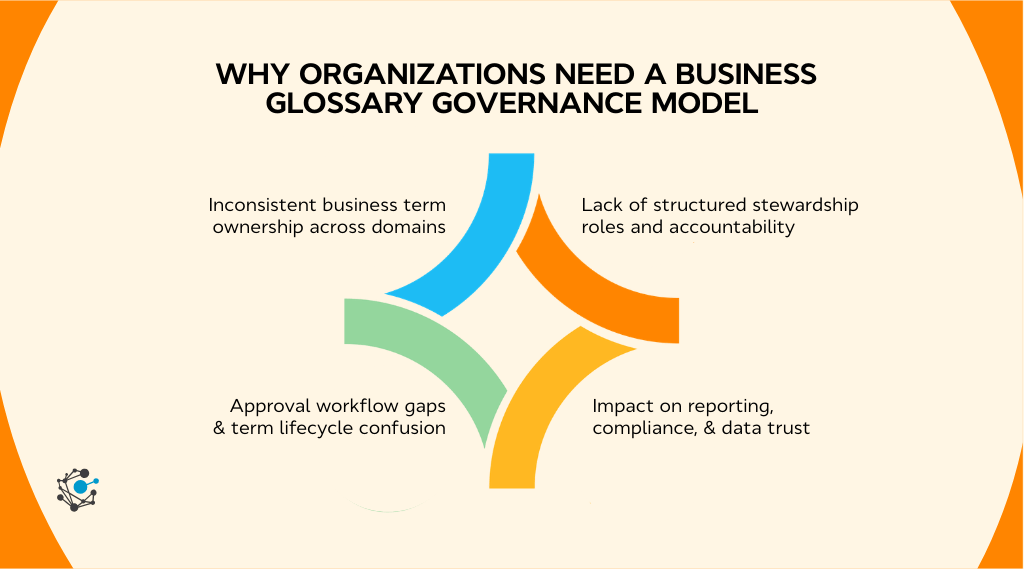
Inconsistent business term ownership across domains
This is often where the problem begins. Finance may define “gross revenue” one way, sales may interpret it differently, and product analytics may calculate it using another variation in a dashboard. Without a domain-based glossary ownership model, the same metric can carry different meanings across teams.
The result is familiar in many organizations. KPIs no longer align across reports, cross-functional teams debate which number is correct, and analysts spend time reconciling metrics rather than delivering insights. When definitions are not governed at the domain level, even small differences in interpretation can create significant reporting confusion.
Lack of structured stewardship roles and accountability
When business terms do not have clear owners, accountability becomes fragmented. One team may update a definition while another team continues using an outdated version, creating duplicate or conflicting terminology across reports.
A sustainable governance model requires clearly defined stewardship roles. Organizations typically assign a domain owner responsible for overall accountability, a business steward responsible for maintaining definitions, and a governance authority that resolves disputes and approves changes.
These roles ensure that every term has someone responsible for maintaining its accuracy and relevance.
Approval workflow gaps and term lifecycle confusion
Many glossaries struggle because there is no formal process for how new terms are introduced or existing definitions are updated. Teams often add terms informally to support immediate reporting needs, and those definitions remain unchanged even as the business evolves.
Without structured glossary workflow governance, organizations face lifecycle confusion. Outdated terms remain active, deprecated definitions continue to appear in reports, and users struggle to identify which version of a term is authoritative. A governed model introduces structured intake, review, approval, and publishing processes that keep definitions current and consistent.
Impact on reporting, compliance, and data trust
The most visible consequence of weak glossary governance is declining trust in analytics. When dashboards display conflicting metrics or definitions vary across reports, stakeholders begin questioning the reliability of the data.
This problem extends beyond reporting accuracy. Ambiguous definitions can create challenges in regulatory reporting and compliance processes, where consistent interpretation of metrics is critical.
Over time, inconsistent terminology erodes confidence in analytics outputs and slows decision-making across the organization. A strong governance model ensures that business terms remain clearly defined, consistently applied, and trusted across reporting environments.
How a glossary governance model differs from broader data governance
A data governance model establishes policies, standards, and controls for managing data across its lifecycle, while data management focuses on executing data operations such as pipelines, storage, and quality processes.
|
Related reading: The OvalEdge blog Data Governance vs Data Management explains how governance defines policies and ownership, while data management focuses on executing those policies across systems and workflows. |
A glossary governance model, however, focuses specifically on how business terms are created, defined, approved, versioned, and maintained so teams share a consistent understanding of key metrics and concepts.
The distinction becomes clearer when comparing their focus areas:
Data governance model
-
Governs policies, standards, and controls across the data lifecycle
-
Focuses on data assets, quality, security, access, and compliance
-
Roles typically include data owners, data stewards, IT teams, and governance committees
Glossary governance model
-
Governs how business terms are created, approved, versioned, and maintained
-
Focuses on business terminology, definition consistency, and ownership
-
Roles typically include business experts, glossary stewards, and domain owners
Both models are essential for effective data management.
|
Data governance ensures reliable and compliant data, while glossary governance ensures that its meaning is clearly defined and consistently understood. |
9-step business glossary governance model framework
Glossary governance models evolve from informal stewardship to formalized, metrics-driven governance structures. As organizations mature in data governance, glossary practices also shift from simple documentation to structured models with defined ownership, workflows, lifecycle controls, and measurable outcomes.
The following steps outline a practical framework for building a scalable business glossary governance model.
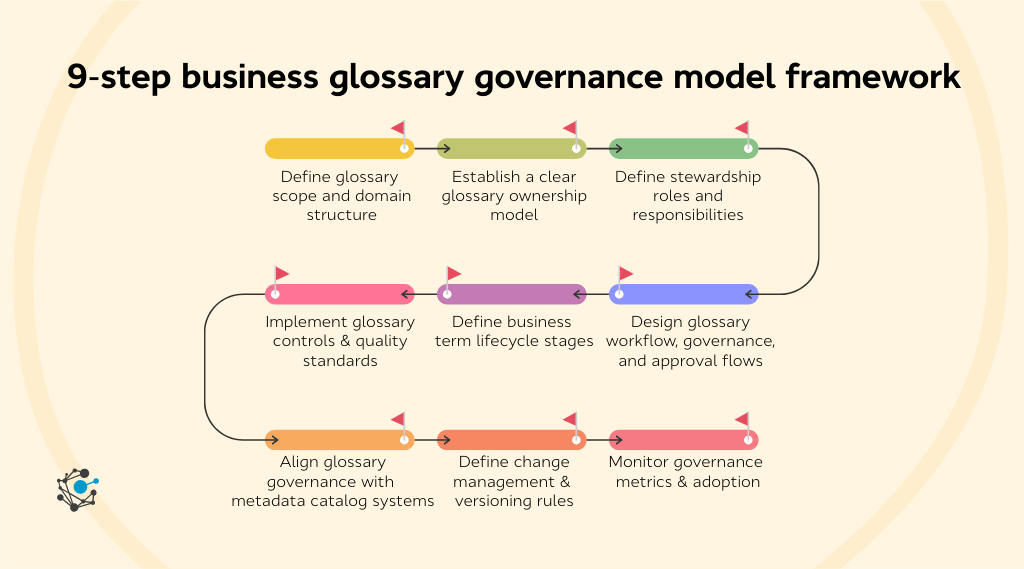
Step 1: Define glossary scope and domain structure
The first step is establishing the scope of the glossary and identifying the business domains it will support. Most organizations begin with high-impact domains such as finance, sales, operations, and marketing, where reporting conflicts are most common.
Organizations can adopt different methodologies when defining glossary scope.
|
Pro Tip: OvalEdge describes both top-down and bottom-up approaches for building a business glossary, depending on whether terms are driven by business standards or derived from existing data assets. |
Once the approach is determined, terms should be categorized by function, including KPI definitions, operational attributes, regulatory classifications, and customer or product terminology. Clearly defining domain boundaries is essential because governance ownership becomes difficult to manage when the glossary scope is vague or overlapping.
Step 2: Establish a clear glossary ownership model
Once the scope is defined, organizations need to determine who owns the glossary at both the domain and term levels. A glossary ownership model ensures that each business domain has accountable leaders responsible for maintaining definitions and resolving conflicts.
This step should also define escalation paths when disagreements arise over definitions or calculation logic. Without clear ownership boundaries, governance decisions tend to stall or become inconsistent across departments.
Step 3: Define stewardship roles and responsibilities
Effective glossary governance depends on well-defined stewardship roles. These roles ensure that definitions are created, validated, and maintained in a controlled and accountable way.
Organizations often use a RACI-style structure to clarify responsibilities. Typical roles include:
-
The domain owner is responsible for overall governance within a business domain
-
Business steward responsible for defining and maintaining business terms
-
The governance council or approver is responsible for final validation and conflict resolution
Defining these roles transforms business term stewardship from an informal responsibility into an operational governance function.
Step 4: Design glossary workflow, governance, and approval flows
Glossary governance requires a structured workflow that controls how new terms are introduced and how existing definitions are modified. Without workflow governance, updates often occur through emails or informal conversations, creating confusion and delays.
A typical workflow includes several stages:
-
The term submission stage, where new definitions are proposed
-
Domain review stage, where subject matter experts validate definitions
-
The governance approval stage, where final decisions are made
-
The publication stage, where approved terms become visible to the organization
Well-designed workflows reduce approval delays and ensure that governance processes remain consistent and transparent.
Step 5: Define business term lifecycle stages
Business terms evolve as organizations introduce new products, policies, or reporting requirements. A glossary governance model must therefore define clear lifecycle stages that control how terms progress over time.
Common lifecycle states include Draft, Under Review, Approved, Deprecated, and Retired. Governance policies should also define transition rules between these stages, along with effective dates and version history requirements. Lifecycle management prevents outdated definitions from continuing to influence reports and analytics.
Step 6: Implement glossary controls and quality standards
To maintain glossary quality, organizations should establish standardized rules for how terms are documented and structured. This includes naming conventions, definition guidelines, and required metadata attributes.
Typical glossary metadata fields include definition, owner, domain, related terms, synonyms, and associated data assets. Quality checks should also identify duplicate definitions, incomplete descriptions, and conflicting terminology. These controls ensure that glossary entries remain clear, consistent, and usable across the enterprise.
Example: Metadata fields for a glossary term
|
Field |
Example |
|
Business term |
Customer lifetime value |
|
Definition |
Total revenue expected from a customer during their relationship with the company |
|
Domain |
Marketing |
|
Owner |
Marketing analytics lead |
|
Synonyms |
CLV, customer value |
|
Related data assets |
Customer transactions table, revenue dashboard |
This type of structured metadata helps users understand the meaning of a term, identify responsible owners, and trace how the term connects to datasets and analytics assets.
Step 7: Align glossary governance with metadata catalog systems
A business glossary becomes significantly more valuable when it is connected to the organization’s metadata catalog. Linking glossary terms with datasets, tables, columns, dashboards, and reports allows users to move seamlessly from business meaning to technical implementation.
This alignment creates bidirectional traceability. Analysts can trace reports back to governed business definitions, while governance teams can identify where specific terms are used across data assets. Integrating glossary governance with metadata platforms also helps prevent definition drift between business language and reporting logic.
Step 8: Define change management and versioning rules
Glossary definitions inevitably change as organizations evolve. A strong governance model ensures these changes occur through structured change management processes rather than informal updates.
Before modifying a critical term, teams should perform impact assessments to identify affected reports, datasets, and business processes. Governance policies should also require documented justification for changes, preserved version history, and full audit visibility of who made each update and why.
Step 9: Monitor governance metrics and adoption
Governance maturity improves when organizations track measurable outcomes. Monitoring glossary performance helps governance teams identify adoption gaps and operational bottlenecks.
Common governance metrics include:
-
Term coverage ratio across domains
-
Steward response time for term requests
-
Approval turnaround time for governance workflows
-
Duplicate or conflicting definition reduction
Usage metrics such as search frequency and term references in reports also help measure glossary adoption. Regular governance reviews based on these metrics ensure the glossary continues evolving into a trusted enterprise knowledge asset.
Maturity stages of business glossary governance
Business glossary governance typically evolves in stages as organizations mature in their data governance practices. Most enterprises progress from informal documentation toward fully integrated, lifecycle-driven governance where glossary definitions are embedded across analytics and metadata platforms.
|
Do you know: This progression is also reflected in the OvalEdge Data Governance Maturity Model, which outlines how organizations evolve from basic documentation practices to structured governance frameworks with defined ownership, workflows, and automation. |
Level 1: Informal documentation
Business terms are stored in spreadsheets, shared documents, or internal wikis. Definitions are created inconsistently across teams, and there is no formal ownership, review process, or governance structure.
Level 2: Assigned ownership
Organizations begin assigning domain owners and glossary stewards responsible for maintaining definitions. Basic processes emerge for reviewing and updating terms, although workflows are still largely manual.
Level 3: Workflow-controlled governance
Structured workflows manage how new terms are submitted, reviewed, and approved. Governance councils or domain stewards oversee definition quality, and lifecycle states such as Draft, Review, and Approved are introduced.
Organizations often formalize these workflows through governance frameworks that define approval stages, ownership responsibilities, and stewardship processes.
|
Governance reference: OvalEdge’s guide on Top Data Governance Frameworks highlights that effective governance frameworks define clear roles, responsibilities, policies, and procedures to operationalize governance across the organization. |
Level 4: Metrics-driven lifecycle management
Governance becomes measurable. Organizations track glossary adoption, stewardship performance, and lifecycle health through governance metrics such as approval turnaround time, duplicate reduction, and definition completeness.
Level 5: Automated integration with metadata and analytics systems
At the most mature stage, glossary terms are integrated with data catalogs, datasets, and reporting tools. Business definitions are directly linked to data assets and dashboards, ensuring that analytics systems consistently reference governed terminology.
As organizations work toward higher governance maturity, many encounter challenges in designing and implementing an effective glossary governance structure. Understanding the common mistakes organizations make can help avoid governance gaps and improve long-term glossary adoption.
Common mistakes when designing a glossary governance framework
Many organizations struggle to operationalize glossary governance because structural mistakes are made early in the design process.
Recognizing these common pitfalls helps teams build a governance framework that remains scalable and effective.
-
Treating the glossary as a documentation repository: The first mistake is treating the glossary like a documentation repository. That creates storage, not governance. As a result, definitions quickly become outdated or duplicated, and teams continue interpreting terms differently across reports.
-
Assigning ownership without enforcement authority: The second mistake is assigning ownership without authority. A steward who cannot enforce standards is a coordinator, not an owner. This often leads to unresolved definition conflicts and inconsistent terminology across domains.
-
Designing approval workflows that slow publication: The third mistake is designing approval workflows that are too slow. Governance should reduce friction, not create new bottlenecks. When approval cycles become lengthy, teams bypass governance processes and introduce unofficial definitions.
-
Ignoring lifecycle states and versioning: The fourth mistake is ignoring lifecycle states and versioning. That is how semantic drift spreads into reports. Outdated or deprecated definitions remain active, creating confusion about which term version should be trusted.
-
Failing to measure adoption and governance health: The fifth mistake is failing to measure adoption. If you do not track usage, turnaround, and coverage, you cannot tell whether your glossary governance framework is working. Without metrics, governance teams struggle to identify gaps and improve glossary effectiveness.
To overcome these challenges, organizations need governance tools that enforce ownership, streamline workflows, and maintain lifecycle controls at scale.
How OvalEdge supports a scalable business glossary governance model
A glossary governance model becomes sustainable only when supported by tools that enforce ownership, workflows, and lifecycle controls across teams.
OvalEdge helps organizations scale glossary governance by centralizing stewardship, automating workflows, and maintaining audit visibility across business terms and data assets.
Centralized glossary ownership and stewardship tracking
OvalEdge positions its business glossary as a collaborative environment where business users, governance teams, and data teams work together to standardize terminology. The platform surfaces term definitions, classifications, ownership roles, and associated data assets within a single interface.
This centralized visibility helps organizations maintain a clear glossary ownership model. Teams can easily identify who owns a term, who approved it, and how it relates to underlying datasets, reports, and dashboards, reducing ambiguity across domains.
Configurable glossary workflow governance
OvalEdge enables configurable glossary workflow governance that automates how terms move through submission, review, approval, and publication stages. Requests are routed to the appropriate stewards and approvers, eliminating manual coordination and ensuring governance actions reach the right stakeholders quickly.
Workflow automation helps reduce approval delays by standardizing review stages and triggering notifications when actions are required. This ensures term requests are reviewed promptly instead of waiting in email threads or informal approval chains.
The platform also supports AI-assisted discovery to identify similar or duplicate terms during creation, helping prevent duplicate entries and improving definition consistency before new terms enter the governance process.
Lifecycle-based controls with audit visibility
To maintain glossary accuracy over time, OvalEdge provides lifecycle controls and version tracking for business terms, allowing teams to review who updated a definition, when the change occurred, and why. These governance capabilities are supported through the OvalEdge data catalog platform, which helps enforce governance standards across glossary terms and related data assets.
Lifecycle stages such as Draft, Under Review, Approved, and Deprecated guide how definitions progress through governance workflows. Integrations with reporting tools such as Tableau and Power BI help prevent definition drift by ensuring analytics systems reference governed terms, while data lineage provides traceability between glossary definitions and the data assets used in reports.
Conclusion
A well-designed business glossary governance model brings clarity to areas where organizations often struggle most, including ownership, approvals, updates, and trust in reporting. The real value lies not just in documenting business terms, but in ensuring those terms evolve through a transparent and controlled governance process.
If you are starting from scratch, begin with a few practical steps. Identify high-impact domains, assign clear ownership, define stewardship roles, and establish structured intake, approval, and lifecycle rules.
As adoption grows, track governance metrics and continuously refine workflows to maintain consistency across teams.
To operationalize these practices at scale, organizations turn to platforms like OvalEdge, which centralize glossary ownership, automate governance workflows, and connect business terms directly with the data assets used in analytics.

Book a demo with OvalEdge today to see how you can implement scalable glossary governance and bring consistency and trust to your organization’s data.
FAQs
1. Who should lead a business glossary governance model in an organization?
A senior data governance leader or domain-aligned business owner should lead it. They must have authority to resolve term conflicts, enforce stewardship accountability, and align glossary decisions with enterprise reporting and compliance priorities.
2. How long does it take to implement a business glossary governance model?
Most organizations establish a foundational governance structure within 4 to 8 weeks for priority domains. Enterprise-wide scaling depends on domain complexity, stewardship availability, and integration with existing governance frameworks.
3. What tools are required to manage glossary workflow governance effectively?
You need a governance-enabled glossary platform that supports role-based access, approval workflows, version tracking, metadata controls, and audit history. Manual spreadsheets cannot sustain structured stewardship at scale.
4. How do you measure the success of a glossary governance model?
Track adoption metrics, including term usage in reports, steward response time, approval turnaround, duplicate reduction, and definition completeness. Consistent improvements in these metrics indicate a maturing governance structure.
5. Can a business glossary governance model support regulatory compliance efforts?
Yes. A governed glossary standardizes definitions used in regulatory reporting, clarifies ownership, and maintains documented version history. This reduces ambiguity during audits and strengthens the defensibility of compliance submissions.
6. How often should business glossary terms be reviewed or updated?
High-impact terms should undergo review quarterly or during major business changes. Lower-impact terms can follow semi-annual reviews. Trigger-based reviews should occur when metrics, policies, or regulatory requirements change.
.png?width=1081&height=173&name=Forrester%201%20(1).png)
.png?width=1081&height=241&name=KC%20-%20Logo%201%20(1).png)