

A business glossary is the foundation for consistent reporting, stronger governance, and safer AI because it defines what key business terms mean and where they appear in data. Effective glossaries include definitions, owners, rules, relationships, status, and review cycles. The key action is to launch with priority terms, formal stewardship, platform integration, and ongoing maintenance discipline.
Walk into any 50-person company and ask three departments what a "customer" is. You will get three different answers. Each definition makes sense inside its own team, but the second a CFO asks for a single customer count, the numbers stop adding up.
This is not a small problem.
A 2024 Grammarly Business workforce productivity report put the cost of miscommunication, including unclear and contradictory terminology, at an average of $9,284 per employee per year.
For a company of 500 people, that is nearly $4.6 million leaking out of the business every year through arguments over what words mean.
In February 2024, a British Columbia tribunal ruled in Moffatt v. Air Canada that the airline had to honor a bereavement fare policy its own AI chatbot had invented. The chatbot's definition of "bereavement fare" did not match the airline's actual policy. Air Canada lost the case and set a precedent: companies are now legally liable for the definitions their AI gives out. A business glossary is what closes that gap.
This guide covers what one is, what to put in it, how to build it, and how it fits into data governance and AI readiness in 2026.
What is a Business Glossary?
A business glossary is a centralized, governed list of an organization's standard business terms and the agreed-upon definition of each one. Terms like "customer," "active user," "net revenue," or "qualified lead" mean different things to different teams. A business glossary makes the definition explicit, says who owns it, and shows where in the data each term actually lives.
A working glossary does five things:
-
Standardizes terminology across departments so that finance, sales, and product all mean the same thing by "customer."
-
Links business terms to data assets, so a definition is not just a word in a document. It points to the actual tables, columns, and reports the term shows up in
-
Assigns clear ownership to a data steward or subject matter expert so every term has a named human accountable for keeping it accurate
-
Plugs into data governance and compliance workflows so terms used in regulatory reporting are traceable and auditable
-
Powers AI and analytics with shared context so dashboards and LLM agents do not drift on what a term means
A useful glossary is a curated list of the words the business debates, plus the agreed-upon answers to those debates. The glossary captures the conversation, names the winner, assigns a steward, and prevents the same argument from being fought again every quarter.
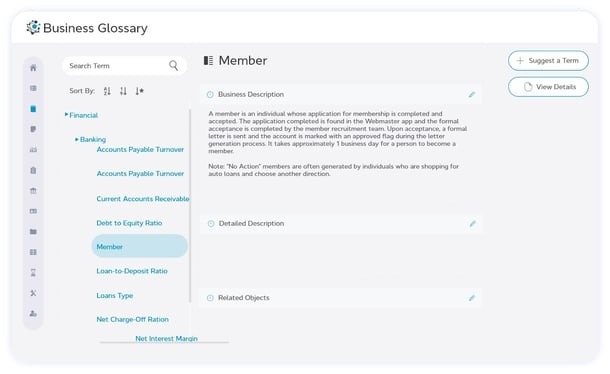 Simplified business glossary example in OvalEdge
Key components of a business glossary
Every entry in a business glossary should carry the same set of fields. That consistency is what turns the glossary from a notes file into a system the rest of the business can rely on. Below is the standard field set, with an example of what each one looks like for a single term, Customer Lifetime Value.
|
Component |
Description |
Example |
|
Term Name |
Unique identifier for the business concept |
"Customer Lifetime Value" |
|
Business Definition |
Clear explanation in plain language (40-100 words) |
"Total revenue expected from a customer over their entire relationship with the company." |
|
Owner/Steward |
Responsible person with contact information |
Sarah Chen, VP Analytics, sarah.chen@company.com |
|
Category/Domain |
Logical grouping |
Finance > Revenue Metrics |
|
Synonyms/Aliases |
Alternative terms used |
CLV, LTV, Lifetime Value |
|
Related Terms |
Connected concepts |
Customer Acquisition Cost, Retention Rate, Churn Rate |
|
Status |
Approval state |
Approved, Draft, In Review, Retired |
|
Data Sources |
Where the term is used |
CRM system, Sales reports, Marketing dashboard |
|
Business Rules |
How the term is calculated or applied |
Formula: Average Purchase Value × Purchase Frequency × Customer Lifespan |
Each field exists because something breaks without it.
-
If a term has no owner, nobody updates it.
-
If it has no status, you cannot tell whether it is the current approved version or a draft somebody abandoned.
-
If it has no data sources or business rules, two analysts can apply the same definition to two different datasets and walk out with two different answers.
For most organizations, the first 50 to 100 priority terms justify the full field set. Less critical terms can launch with the core four (Term, Definition, Owner, Status) and get the remaining fields filled in as the program matures.
Why you need a business glossary
When teams cannot agree on what a term means, the damage shows up in predictable places. A business glossary closes the gap before any of these become expensive:
-
Reports stop agreeing on the same number. Two teams use the same word to mean different things, pull from the same data, and walk into a meeting with two different totals. The argument that follows is the cost.
-
Decisions wait while definitions get litigated. Every cross-functional metric becomes a meeting before it becomes a decision. By the time the term is settled, the moment to act on it has passed.
-
Audits and regulatory filings turn into manual work. Without a single approved definition and a trail back to the data, every report has to be defended individually instead of by reference to the underlying terms.
-
The analytics team becomes a help desk. Without a glossary to point people to, the analytics function spends its time answering "what does this mean" tickets instead of building actual analysis.
-
AI agents invent their own definitions. When chatbots, copilots, or LLM agents are not grounded in approved terms, they hallucinate or pull stale definitions from training data. The Air Canada case is the public version of this. Most enterprises run the quiet version every day.
A glossary also makes the data itself more useful. People who can look up a term in twenty seconds use the data more, ask better questions, and stop pinging an analyst for every clarification. It is one of the cheapest ways to boost data literacy across the organization.
Business Glossary Examples: 4 Industries
Below are four real patterns from four industries. Each one starts with a single term being used to mean different things across teams, and ends with a glossary entry that makes the disagreement go away.
Example 1: Financial Services, Defining "Customer"
The Problem: A retail bank discovered its reports were combining personal and corporate accounts incorrectly.
Different Definitions:
-
Retail Banking used "Customer = individual account holder with Social Security Number."
-
Corporate Banking used "Customer = legal entity with 20-digit Legal Entity Identifier."
-
Wealth Management used "Customer = high-net-worth individual with $1M+ in managed assets."
Business Glossary Solution: The bank created three distinct governed terms ("Retail Customer," "Corporate Customer," "Wealth Management Client"), and cross-divisional reports started segmenting correctly.
Example 2: Healthcare, Standardizing "Patient Visit"
The Problem: Hospital executives couldn't get accurate visit counts because departments defined "patient visit" differently.
Different Definitions:
-
Emergency Department: "Patient visit = any ER entry, regardless of treatment."
-
Outpatient Services: "Patient visit = scheduled appointment only"
-
Telehealth: "Patient visit = any virtual consultation over 5 minutes."
Business Glossary Solution: The standardized definition became "any documented patient interaction requiring clinical assessment, regardless of location or modality," which enabled accurate billing, capacity planning, and regulatory compliance.
Example 3: E-commerce, Clarifying "Active Customer"
The Problem: Three departments had different definitions of "active customer," causing wildly different marketing strategies and revenue projections.
Different Definitions:
-
Marketing counted anyone who opened an email in the last 90 days.
-
Finance counted anyone who made a purchase in the last 12 months.
-
The product counted anyone who logged in within the last 30 days.
Business Glossary Solution: After cross-functional workshops, the agreed definition became "account holder with transaction or login within 180 days," which aligned campaigns, forecasts, and product priorities.
Example 4: Manufacturing, Supply Chain "Lead Time"
The Problem: Production delays occurred because purchasing and operations used different terms for the same inventory concepts.
Different Definitions:
-
Purchasing: "Lead time = days from PO to delivery at warehouse."
-
Operations: "Lead time = days from order to production line availability."
-
Difference: 2-3 days for unloading and quality checks
Business Glossary Solution: Created two distinct terms:
-
"Procurement Lead Time" (PO to warehouse)
-
"Production Lead Time" (PO to production line)
Production scheduling became more accurate, reducing costly delays.
A pattern shows up across all four. The answer is rarely to force everyone onto a single definition. Three out of four cases here were resolved by splitting the term into governed variants instead. The job of the glossary is not to flatten meaning. It is to surface the variants that already exist, name each one, and assign each one an owner.
Business Glossary vs Data Catalog vs Data Dictionary
The three terms get conflated all the time, but they solve different problems for different people. A business glossary defines what your terms mean. A data dictionary documents how your data is structured. A data catalog tells you where the data actually lives.
|
Aspect |
Business Glossary |
Data Dictionary |
Data Catalog |
|---|---|---|---|
|
Purpose |
Define business terms |
Document technical metadata |
Inventory and discover data assets |
|
Primary Audience |
Business users, analysts, executives |
Data engineers, developers, DBAs |
Both business and technical users |
|
Content Focus |
Terminology, definitions, business rules |
Tables, columns, data types |
Metadata, lineage, data quality |
|
Ownership |
Business/governance teams |
IT/engineering |
Data governance teams |
|
Example Entry |
"Customer Lifetime Value = total revenue from a customer over their relationship" |
"customer_id: INTEGER, PRIMARY KEY, NOT NULL" |
"Customer table in CRM, 2M rows, updated daily." |
|
Key Question |
"What does this term mean?" |
"How is this data structured?" |
"What data exists and where?" |
In practice, the three work together. The glossary defines "revenue." The catalog shows you which tables, dashboards, and reports contain revenue data. The data dictionary documents the technical schema underneath.
For a deeper side-by-side of glossary vs dictionary, see the dedicated business glossary vs. data dictionary post.
Business Glossary and Data Governance
A business glossary is the vocabulary layer of data governance. Every governance framework, whether DAMA-DMBOK, DCAM, or BCBS 239, assumes the organization has already agreed on what its business terms mean before it can govern who accesses them, who owns them, or how they get reported. Without that agreement, policies end up applying to terms that mean different things to different teams, and the framework falls apart on contact with reality.
The business glossary feeds three governance functions.
1. Policy and access control
Each glossary term carries a sensitivity classification (Public, Internal, Confidential, Restricted) and a regulatory tag (GDPR, HIPAA, SOX, CCPA). When governance writes a policy like "no PII in non-production environments," that policy applies automatically to every data asset linked to a term tagged as PII. Without the glossary, the policy has no target.
2. Data lineage and auditability
Glossary terms point to the columns, tables, reports, and dashboards where they live. When auditors ask "show me every system that consumes 'customer revenue'," the answer is a data lineage trace anchored to the glossary entry. This is why financial-services teams subject to BCBS 239 start their compliance program with the glossary, not the catalog.
3. Stewardship and accountability
Every governed term has a named data steward responsible for the definition's accuracy. Stewardship at scale only works if the platform lets stewards approve, retire, and update terms with version history. Without that workflow, definitions go stale, and ownership turns into "the person who used to do this."
|
Governance Question |
Without a Glossary |
With a Glossary |
|---|---|---|
|
"What does 'revenue' mean here?" |
Ask three teams, get three answers |
One approved definition, named owner |
|
"Who can access PII data?" |
Policies applied per system |
Policies applied per term, propagated everywhere |
|
"Where does 'customer count' come from?" |
Manual investigation |
Lineage trace from the glossary entry |
|
"Who owns this metric?" |
Unclear, often disputed |
Named a steward with approval workflow |
If you are setting up a data governance framework, the glossary is not just one of the deliverables. It is the foundation on which everything else stands.
5 common business glossary challenges
Most glossary programs fail in predictable ways. Five failure modes show up in almost every implementation.
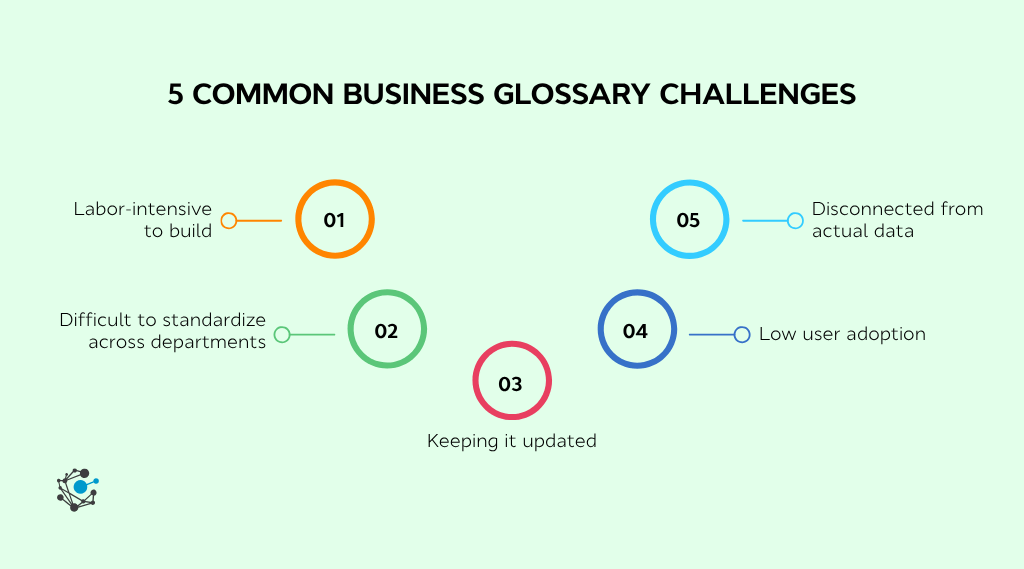
1. Labor-intensive to build
Defining 500-plus business terms by hand takes months. The fix is to start with the 50 to 100 most critical terms (regulatory, executive, cross-functional), crowdsource drafts from department heads, use data governance tools that suggest terms from existing documentation, and set realistic timelines of 2 to 6 months. Organizations using a phased approach hit 60 to 70% coverage of critical terms within 3 to 4 months.
2. Difficult to standardize across departments
Finance, Sales, and Marketing each have legitimate reasons for their own definitions of "customer." The fix is cross-functional workshops to surface the disagreements, creating governed variants when one definition will not work, and standing up a governance committee with the authority to resolve disputes. Organizations with formal governance processes hit 85% term approval rates within 6 months.
3. Keeping it updated
Glossaries go stale fast, and users stop trusting them. The fix is assigning a named data steward to every term, running quarterly review cycles, setting up automated change notifications, and using usage data to prioritize what to keep fresh. Organizations with assigned term ownership maintain 90% plus accuracy over time.
4. Low user adoption
Teams spend months building the glossary, and then nobody uses it. The fix is embedding it inside the BI tools, SQL editors, and data exploration platforms that users already open every day, making search fast (under 30 seconds to find a term), and recognizing power users. Embedded glossaries hit 70% plus adoption within 6 months. Standalone tools sit closer to 20%.
5. Disconnected from actual data
The glossary lives in one system, the catalog lives in another, and users cannot see where terms actually show up. The fix is choosing an integrated platform that links glossary terms directly to data assets, enables lineage tracing, and supports bidirectional navigation between the glossary and the data catalog. Integrated glossaries see 3 to 4 times higher usage than disconnected ones.
Who is responsible for building a business glossary?
A business glossary is not the data team's project, even though they get blamed when it fails. It is a cross-functional program that needs six distinct roles working together.
|
Role |
Primary Responsibility |
|---|---|
|
Data Governance Team |
Owns the program, sets standards, resolves conflicts, reports to executives. Operates inside the broader data governance framework |
|
Data Stewards |
Draft and maintain definitions for their domain. Review terms quarterly. |
|
Subject Matter Experts |
Provide domain expertise, validate that definitions match how the business actually operates |
|
Business Users |
Give feedback, suggest new terms, flag outdated entries |
|
IT and Data Engineering |
Implement the platform, link terms to data catalog assets, and support automation |
|
Executive Sponsors |
Provide budget, resolve high-level disputes, and champion adoption |
Pull any one of these roles out, and the glossary either does not get built or does not get used.
Business glossary template: What to Include
A working template is what separates a glossary that grows on its own from one that needs somebody policing every entry. The fields below are the same ones used by enterprise governance programs running 1,000+ terms. Use the full set for your priority terms. Lower-priority terms can launch with the core fields (Term Name, Business Definition, Owner, Status) and get the rest filled in over time.
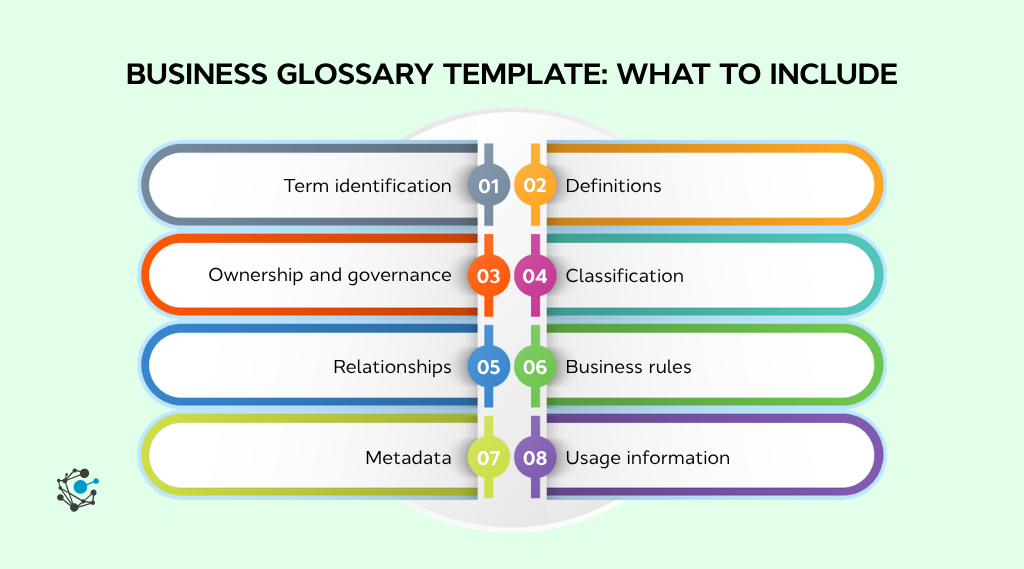
Essential Template Fields
Eight categories cover the full set.
1. Term Identification
-
Term Name: Unique identifier (e.g., "Customer Lifetime Value")
-
Abbreviations/Acronyms: Common short forms (e.g., "CLV," "LTV")
-
Synonyms: Alternative names used across the organization
-
Unique ID: System identifier for tracking and linking
2. Definitions
-
Business Definition: Plain language explanation (40-100 words) that any business user can understand
-
Technical Definition: (Optional) More precise definition for technical teams
-
Context: When and how the term is used in business processes
-
Examples: 2-3 concrete examples showing the term in action
3. Ownership and Governance
-
Owner/Steward: Primary person responsible (name, role, email)
-
Subject Matter Expert: Domain expert for questions
-
Approved By: Person or committee who approved the definition
-
Approval Date: When the term was officially approved
4. Classification
-
Category/Domain: Logical grouping (Finance, Marketing, Operations)
-
Sub-Category: More specific classification
-
Data Sensitivity: (Public, Internal, Confidential, Restricted)
-
Regulatory Impact: Regulations this term relates to (GDPR, HIPAA, SOX)
5. Relationships
-
Related Terms: Connected business concepts
-
Parent Terms: Broader categories this term belongs to
-
Child Terms: More specific terms that fall under this one
-
Data Sources: Systems where this term is used or calculated
6. Business Rules
-
Calculation Formula: How the term is computed (if applicable)
-
Business Logic: Rules governing the term's use
-
Valid Values: Acceptable values or ranges
-
Constraints: Limitations or conditions
7. Metadata
-
Status: (Draft, In Review, Approved, Published, Retired)
-
Version: Current version number
-
Created Date: When first entered
-
Last Updated: Most recent modification date
-
Last Reviewed: Most recent quality check
-
Change History: Log of modifications
8. Usage Information
-
Frequency of Use: How often the term appears in reports and queries
-
Critical Reports: Key reports using this term
-
Departments Using: Teams that rely on this term
-
Questions/Clarifications: Common questions about the term
| Need a head start? Download the free OvalEdge Business Glossary Template. It uses the same field structure as the enterprise governance programs running 1,000+ terms. |
How to build a business glossary: 9-Step implementation guide
Most glossary programs that succeed follow some version of these nine steps. The schedule below assumes a roughly 10-week build for a mid-sized organization.
Step 1: Identify Key Stakeholders (Week 1)
Form a data governance committee with executive sponsorship. Identify data stewards from Finance, Sales, Marketing, Operations, and IT. Recruit subject matter experts and assign clear roles.
Step 2: Define Scope and Domains (Weeks 1-2)
Choose 1 to 2 pilot departments. Identify the top 50 to 100 critical terms (regulatory reporting, executive dashboards, cross-functional metrics). Create an expansion roadmap.
Step 3: Audit Existing Documentation (Weeks 2-3).
Review existing data dictionaries, process documentation, reports, and dashboards. Document where the same term has multiple meanings.
Step 4: Choose Platform and Tool (Weeks 3-4)
Pick a platform that matches your size: spreadsheet for under 50 terms, collaborative platform for 50-200 terms, enterprise data governance platform for 200+ terms. Evaluate integration with your existing data catalog and BI tools.
Step 5: Collect and Define Terms (Weeks 4-8)
Run 2-hour workshops with SMEs per department. Draft definitions in plain language (40 to 100 words). Include 2 to 3 concrete examples per term. Document business rules and data sources.
Step 6: Establish Governance Process (Weeks 6-7)
Create the approval workflow (draft → review → approve → publish). Set the review cadence (quarterly for critical terms, annually for others). Assign term ownership to specific data stewards.
Step 7: Build Template and Structure (Weeks 7-8)
Configure the platform with the template fields above. Create category hierarchy (domains → sub-categories → terms). Set permissions and access controls.
Step 8: Populate and Publish (Weeks 8-10)
Enter approved terms, link them to data assets in the catalog, run training sessions, launch communication campaigns, and provide a feedback mechanism.
Step 9: Maintain and Iterate (Ongoing)
Monitor usage metrics, run quarterly term reviews, update terms when business processes change, retire outdated entries, and measure business impact (time saved, error reduction). Tools like OvalEdge surface whose terms get accessed most, so stewards know where to focus.
Business Glossary and AI Readiness
The Air Canada chatbot story from the top of this post is the cautionary tale. The chatbot invented a definition of "bereavement fare" because nothing in its system told it what the airline's actual definition was. That gap, the one between what your AI says and what your business has agreed is true, is the single most important reason to build a business glossary in 2026.
When a generative AI agent answers "what was Q3 customer churn," it needs to know what customer means and what churn means in your organization. If those definitions live in someone's head or a slide deck, the AI guesses. If they live in a governed glossary, the AI returns a precise, version-controlled answer, and so does every other downstream consumer of that number.
The glossary is the prompt grounding layer. AI assistants using Retrieval-Augmented Generation (RAG) pull context before answering. A business glossary is the natural grounding layer for that retrieval. The agent reads the approved definition, applies it consistently, and can cite the steward who owns it. Without that layer, the agent hallucinates or pulls a stale definition from training data.
Glossary-aware data agents. Agentic AI and the AI data catalog treat the glossary as a live system, not a static document. Agents read from the glossary, propose updates back to it, and flag terms that look outdated or contested. The glossary becomes operational metadata, not reference documentation.
The glossary is the AI governance perimeter. Responsible AI requires knowing what data feeds what model, and what your model is allowed to say. The glossary is where the AI governance team flags which terms map to PII, which are regulated under GDPR or HIPAA, and which are off-limits for training data. Without it, AI compliance is guesswork.
What to do with your glossary today: add a "Used by AI" flag to every term, connect the glossary to your AI catalog and RAG pipelines, and make stewards accountable for AI impact review on definition changes. A steward who quietly changes "active customer" from 30 days to 60 days can silently break every model using that feature as a training signal.
The organizations winning at AI in 2026 are not the ones with the largest models. They are the ones whose models are grounded in a trusted, governed business context. That context starts with the glossary.
Conclusion
This post has covered a lot of ground. What a business glossary is. Why definitions decide whether your reports agree. How governance, AI readiness, and audit defensibility all sit on the same definitional layer. The common ways programs fail, the steps that keep yours on the rails, and the tools that separate working glossaries from forgotten ones.
The reading is the easy part. The teams that get past planning and into a working glossary usually do it not by starting from a blank spreadsheet, but by seeing what a connected, governed system actually looks like end to end.
That is the cleanest way to tell whether OvalEdge is the right fit.
Book a 30-minute demo, and we will walk you through how a business glossary, data catalog, and data lineage work together as one system. You will see how stewards approve terms, how policies enforce against definitions, and how AI agents pull from the glossary instead of inventing answers like an airline chatbot.
Bring your hardest definitional argument. We will show you what governing it actually looks like.
FAQs
1. What is a business glossary in simple terms?
A business glossary is your organization's agreed-upon dictionary for business words. It says what "customer," "revenue," or "active user" actually means, who owns the definition, and where in the data each term lives.
2. Do I need a business glossary if I already have a data catalog?
Yes. A data catalog tells you what data assets exist and where to find them. A business glossary tells you what the words attached to that data actually mean. The catalog answers, "Where is the customer table?" The glossary answers "what counts as a customer." Most enterprise governance programs run both, because a catalog without a glossary leads to people finding the data but disagreeing on what it represents
3. How does a business glossary support AI and LLM initiatives?
AI agents using RAG pull context before they answer. If the glossary is connected to the AI catalog, the agent retrieves the approved definition of "customer churn" instead of inventing one.
4. Can I build a business glossary in Excel?
For under 50 terms and one or two contributors, yes. Excel and Google Sheets are reasonable starting points and let small teams validate which terms matter before committing to a platform. The limits show up fast: no automation, no lineage to actual data assets, no governance workflow, and no way for multiple departments to collaborate without overwriting each other. Once the program crosses 50 terms or expands beyond two teams, the cost of staying on spreadsheets becomes greater than the cost of switching
5. How often should a business glossary be updated?
Quarterly for critical terms (regulatory, executive, cross-functional) and annually for everything else. Plus an event-driven review after every product launch, regulatory change, or major reorganization. Annual-only schedules always drift.
6. What is the ROI of building a business glossary?
The return shows up in three places: reporting (less time reconciling conflicting numbers), compliance (faster audits and filings), and AI (models grounded in trusted definitions). Most programs see ROI within six to twelve months of launch.
Deep-dive whitepapers on modern data governance and agentic analytics
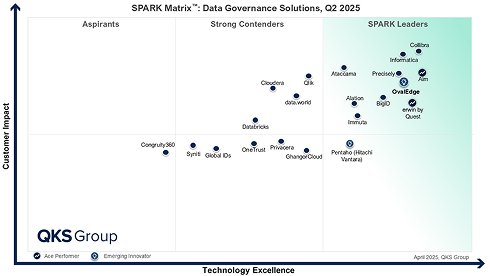
OvalEdge Recognized as a Leader in Data Governance Solutions
.png?width=1081&height=173&name=Forrester%201%20(1).png)
“Reference customers have repeatedly mentioned the great customer service they receive along with the support for their custom requirements, facilitating time to value. OvalEdge fits well with organizations prioritizing business user empowerment within their data governance strategy.”
.png?width=1081&height=241&name=KC%20-%20Logo%201%20(1).png)
“Reference customers have repeatedly mentioned the great customer service they receive along with the support for their custom requirements, facilitating time to value. OvalEdge fits well with organizations prioritizing business user empowerment within their data governance strategy.”
Gartner, Magic Quadrant for Data and Analytics Governance Platforms, January 2025
Gartner does not endorse any vendor, product or service depicted in its research publications, and does not advise technology users to select only those vendors with the highest ratings or other designation. Gartner research publications consist of the opinions of Gartner’s research organization and should not be construed as statements of fact. Gartner disclaims all warranties, expressed or implied, with respect to this research, including any warranties of merchantability or fitness for a particular purpose.
GARTNER and MAGIC QUADRANT are registered trademarks of Gartner, Inc. and/or its affiliates in the U.S. and internationally and are used herein with permission. All rights reserved.