-1.png)
Most organizations still treat data quality as a cleanup task, even as their data environments become more complex. What once relied on a single system now spans data warehouses, lakes, and multiple SaaS platforms.
As a result, the same metric often produces different values depending on the source. Teams spend time reconciling numbers instead of trusting them, and consistency becomes harder to maintain.
According to the TDWI State of Data Quality Report 2024, organizations report that data quality maturity is improving.
However, fragmentation and reliance on manual fixes remain widespread. At the same time, investment in automation and standardized processes is increasing to address ongoing trust gaps.
This highlights a broader challenge. As data ecosystems grow, maintaining accuracy, consistency, and reliability becomes more complex.
This guide outlines practical data quality best practices to help organizations build structured, scalable approaches for improving and sustaining data quality across systems.
What are data quality best practices?
Data quality best practices refer to structured approaches that ensure data remains accurate, complete, consistent, timely, and reliable across systems. These practices are essential for building trust in analytics, reporting, and AI-driven outcomes.
Maintaining data quality requires coordination across business teams, data engineers, and governance functions. Each group interacts with data differently, which makes alignment on definitions, rules, and expectations critical.
Effective data quality management best practices are typically built around four core pillars:
-
Rule definition: This ensures that quality expectations are clearly defined and aligned with business requirements
-
Monitoring: It enables early detection of anomalies, inconsistencies, or failures in data pipelines
-
Ownership: This establishes accountability for data quality at the dataset level
-
Automation: It reduces reliance on manual processes and supports scalability across growing data environments
These pillars create a structured approach where data quality is embedded into systems and workflows, rather than managed through isolated checks or manual interventions.
Data quality is not a one-time initiative. As data sources, systems, and business requirements evolve, it becomes an ongoing operational capability embedded within everyday workflows.
10 data quality best practices that support long-term success
These best practices are not standalone tactics. They work together as part of a structured data quality strategy. When implemented collectively, they shift organizations from reactive fixes to a system where data quality is embedded into everyday workflows.
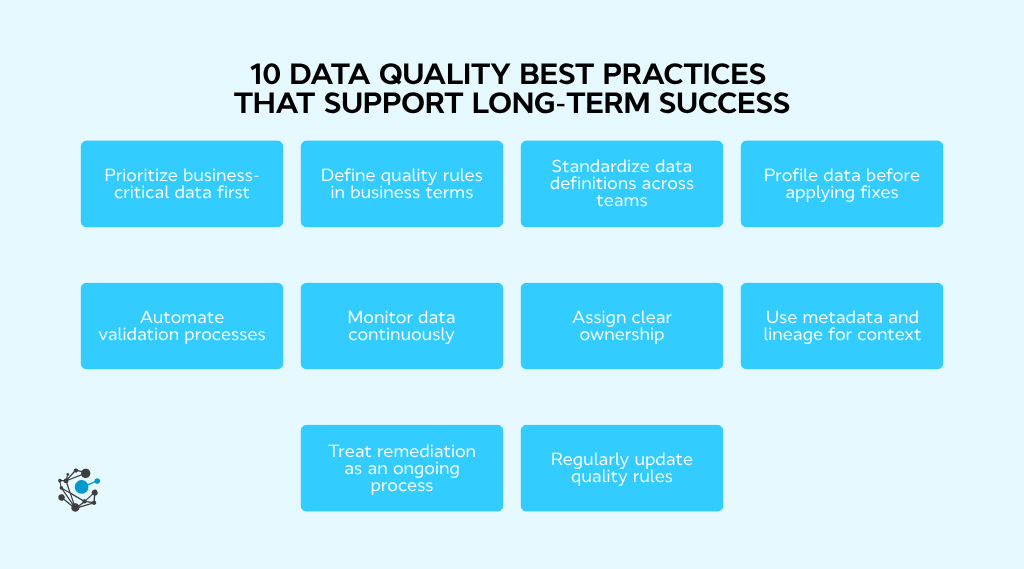
1. Prioritize business-critical data first
Trying to fix every dataset at once often leads to slow progress and unclear outcomes. Not all data carries the same weight, and treating it that way spreads efforts too thin. The focus should be on datasets that directly influence reporting, decision-making, and compliance.
Revenue data, customer records, and operational KPIs typically sit at the center of business decisions. When these datasets are unreliable, the impact shows up immediately in dashboards and forecasts.
|
What does this look like in practice? Inconsistent revenue numbers across reports can stall decision-making and reduce trust in analytics. Addressing such datasets first creates visible improvements and builds momentum for broader data quality initiatives. |
Actionable steps:
-
Identify datasets directly tied to key business metrics such as revenue, customer growth, and operational performance
-
Rank datasets based on business impact, usage frequency, and regulatory importance
-
Focus initial data quality efforts on a small set of high-priority domains
2. Define quality rules in business terms
Technical validation alone does not ensure that data is meaningful. Data may meet format requirements but still fail to support business use cases.
|
For instance, a correctly formatted email does not confirm a real or active customer. Similarly, a non-null revenue field does not guarantee accuracy if the underlying calculation is flawed. |
Quality rules need to reflect how data is used in practice. This requires translating business expectations into measurable validation criteria that systems can enforce.
Actionable steps:
-
Work with business stakeholders to define what “usable data” means for each dataset
-
Convert these expectations into clear validation rules with measurable thresholds.
-
Continuously refine rules as reporting needs and business processes evolve
3. Standardize data definitions across teams
Inconsistent definitions are a common source of confusion. Different teams often interpret the same metric in different ways, leading to conflicting reports.
|
For example, an “active user” might be defined differently by marketing, product, and finance teams. Even if the underlying data is accurate, the outputs will not align. |
Standardizing definitions through a shared business glossary ensures that all teams work with the same understanding. Aligning the glossary with a data catalog helps maintain consistency across systems and reporting layers.
Actionable steps:
-
Establish a centralized repository for business terms and metric definitions
-
Align glossary definitions with data assets in the catalog
-
Ensure dashboards and reports consistently reference standardized definitions
4. Profile data before applying fixes
Before designing rules or implementing fixes, it is important to understand the current state of data. Profiling provides insight into patterns, anomalies, and quality issues.
It reveals missing values, duplicate records, and unexpected distributions that may not be obvious at first glance. This baseline helps teams focus on the most critical issues.
|
For example, identifying a high rate of duplicate customer records early allows teams to address the root cause rather than repeatedly fixing downstream reports. |
Profiling is often supported by tools that analyze datasets and surface quality patterns automatically, making it easier to prioritize improvements.
Actionable steps:
-
Run profiling checks on key datasets to identify anomalies and patterns
-
Document baseline quality metrics such as completeness and duplication rates
-
Use profiling insights to guide rule creation and remediation efforts
5. Automate validation processes
Manual validation does not scale in modern data environments. As data volume and complexity grow, automation becomes essential for maintaining consistency.
Validation should be embedded into data pipelines at every stage, including ingestion, transformation, and output. This ensures that issues are detected early and handled consistently.
|
Practical insights:
Automated validation includes schema validation to ensure incoming data matches expected structures, anomaly detection to identify unusual patterns such as sudden spikes or drops, and rule-based checks at ingestion and transformation stages to enforce business logic before data moves downstream.
|
Automation reduces manual effort and ensures that validation processes keep pace with data growth.
Actionable steps:
-
Integrate automated validation checks into data pipelines across ingestion and transformation stages
-
Implement schema validation, anomaly detection, and rule-based checks to enforce data quality rules.
-
Ensure validation results are logged and surfaced through monitoring systems for visibility
6. Monitor data continuously
Periodic audits are no longer sufficient. Data quality issues can arise at any time, and delayed detection increases their impact.
Continuous monitoring provides real-time visibility into data quality. It allows teams to detect anomalies, track trends, and respond quickly to issues.
|
Real-world scenario:
A sudden drop in daily transaction volume may indicate a pipeline failure or upstream system issue. Monitoring systems can detect such anomalies early and trigger alerts. |
This approach aligns closely with modern data observability practices, where systems continuously track the health and reliability of data flows.
Actionable steps:
-
Define thresholds for key quality metrics such as completeness and accuracy
-
Set up automated alerts for anomalies and rule violations.
-
Track historical trends to identify recurring issues and patterns
7. Assign clear ownership
When ownership is unclear, data quality issues often remain unresolved. Clear accountability ensures that problems are addressed and prevented from recurring.
Each dataset should have defined roles. A data owner is responsible for overall accountability, while a data steward focuses on maintaining quality and managing issues.
If inconsistencies appear in a customer dataset, the assigned owner ensures that the issue is investigated and resolved instead of being overlooked.
Establishing ownership is a key part of broader data governance practices, where roles and responsibilities are clearly defined across the organization.
Actionable steps:
-
Assign a data owner and steward for each critical dataset
-
Clearly define responsibilities and expectations for each role.
-
Create escalation processes for unresolved data quality issues
8. Use metadata and lineage for context
Understanding where data comes from and how it flows through systems is essential for maintaining quality. Metadata provides context about the data, while lineage shows how it moves across systems.
This visibility allows teams to trace issues back to their origin and understand dependencies between datasets.
|
For example, if a dashboard displays incorrect values, lineage can help trace the issue back to a transformation error or an upstream data source. |
Modern data environments increasingly rely on metadata-driven approaches, where context and relationships between datasets are actively tracked and used for troubleshooting.
Actionable steps:
-
Capture and maintain metadata for key datasets
-
Enable lineage tracking from source systems to final outputs.
-
Use lineage insights to identify and resolve root causes of issues
9. Treat remediation as an ongoing process
Data quality is not a one-time effort. New data is constantly generated, and systems continue to evolve.
Treating remediation as an ongoing process ensures that issues are consistently tracked, analyzed, and resolved. It also helps prevent recurring problems.
If duplicate records appear regularly, the focus should shift to fixing the source of duplication rather than repeatedly cleaning the data downstream.
This approach aligns with broader data lifecycle management practices, where data is continuously monitored and improved throughout its lifecycle.
Actionable steps:
-
Implement workflows for tracking and managing data quality issues
-
Conduct root cause analysis for recurring problems.
-
Introduce preventive measures to avoid repeated issues
10. Regularly update quality rules
Data quality rules must evolve as business requirements and systems change. Rules that were effective in the past may become outdated over time.
Regular reviews ensure that validation processes remain aligned with current needs. This helps maintain both accuracy and relevance.
The rule validating customer status may need updates when new customer segments are introduced.
Keeping rules up to date ensures that data quality efforts remain effective and aligned with business objectives.
|
From Data Chaos to Data Trust: The whitepaper by OvalEdge highlights that achieving reliable data is an ongoing process requiring continuous monitoring, rule refinement, and alignment with evolving business needs. |
Actionable steps:
-
Schedule periodic reviews of data quality rules
-
Update rules based on changes in business logic or data systems
-
Remove outdated or redundant rules to maintain efficiency
When these best practices are applied together, they create a cohesive and scalable approach to data quality. Instead of relying on manual fixes, organizations can build systems that continuously maintain accuracy, consistency, and reliability across their data ecosystem.
Challenges of data quality frameworks
Even with the right best practices in place, maintaining data quality across systems is not straightforward. Most challenges show up when teams try to apply these practices consistently across tools, workflows, and growing data environments.
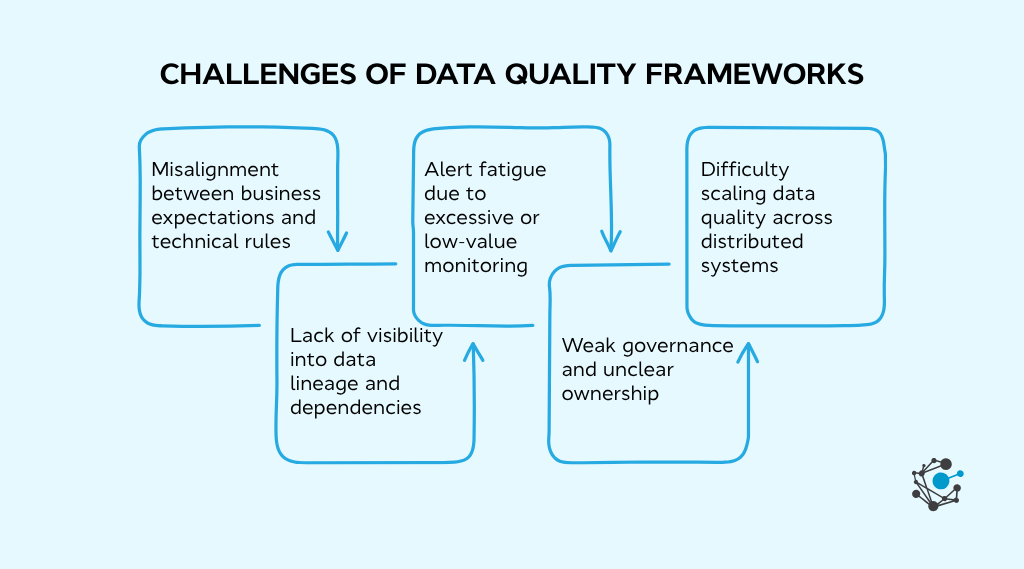
1. Misalignment between business expectations and technical rules
Business teams evaluate data based on usability, such as whether reports are accurate and actionable. Engineering teams focus on technical validation, including formats, constraints, and schema checks.
This gap creates situations where data passes all technical validations but still fails in reporting.
A typical scenario is when a dataset meets schema requirements but does not align with how a business metric is defined, leading to incorrect dashboards.
Closing this gap requires translating business expectations into validation rules that reflect real use cases, not just technical correctness.
2. Lack of visibility into data lineage and dependencies
When data issues occur, understanding where the data originated and how it moved across systems becomes critical.
Without a clear lineage, teams spend time manually tracing data across pipelines, transformations, and source systems. This slows down issue resolution and increases the chances of repeated errors.
|
For example, a reporting issue may require checking multiple upstream systems before identifying the actual source of the problem. |
Improving visibility into dependencies helps teams isolate issues faster and avoid recurring problems.
3. Alert fatigue due to excessive monitoring
Monitoring systems are designed to detect issues early, but excessive or poorly configured alerts can create noise. When teams receive too many alerts without clear prioritization, they start ignoring them. Over time, this reduces the effectiveness of monitoring systems.
A common situation is when minor threshold breaches generate frequent alerts, making it harder to identify critical failures. Effective monitoring requires prioritizing alerts based on severity and business impact, so teams focus on what truly matters.
4. Weak governance and unclear ownership
Data quality frameworks depend on clear ownership, but many organizations lack defined roles and responsibilities. When ownership is unclear, issues remain unresolved because no team is accountable for fixing them.
For instance, a data inconsistency may persist across reports simply because it is unclear which team owns the dataset. Strong governance ensures that ownership, responsibilities, and escalation paths are clearly defined, enabling faster resolution of issues.
5. Difficulty scaling data quality across distributed systems
Modern data ecosystems include multiple systems such as cloud warehouses, SaaS applications, and streaming platforms. Each system introduces its own structure and complexity.
As organizations scale, maintaining consistent data quality across these systems becomes more challenging.
|
For example, validation rules implemented in one pipeline may not be applied in another, leading to inconsistencies across outputs. |
Scaling data quality requires standardization, automation, and a unified approach that works across all systems.
Data quality management tools
Most organizations do not struggle to find tools. The real challenge is understanding when a dedicated solution becomes necessary. As data grows in volume and complexity, manual validation and fragmented processes start to break down. That is typically when investing in a data quality platform makes sense.
What to look for in a data quality management tool
A strong tool should support the full lifecycle of data quality, not just isolated validation.
Core capabilities include:
-
Data profiling and validation
-
Rule definition and automation
-
Monitoring and alerting
-
Metadata and lineage visibility
-
Governance and ownership tracking
The goal is not just validation. It is end-to-end control across the data lifecycle.
1. OvalEdge
OvalEdge manages data quality as part of a connected system where rules, monitoring, lineage, and governance work together. It helps teams detect issues, trace root causes, and resolve them within a single platform. This reduces fragmentation and improves end-to-end visibility.
Key features:
-
Centralized rule definition aligned with business context
-
Continuous monitoring with alerts and anomaly detection
-
Integrated metadata and data catalog for context
-
End-to-end lineage to trace issues across pipelines
-
Built-in governance workflows for ownership and issue tracking
Best fit: Organizations that want to manage data quality as part of a unified governance and data intelligence framework.
2. Informatica data quality
Informatica focuses on improving data quality through strong profiling, cleansing, and standardization capabilities. It helps ensure data is accurate and consistent before it is used in downstream systems. It is particularly effective for large-scale data processing environments.
Key features:
-
Advanced data profiling to assess data health
-
Data cleansing, standardization, and deduplication
-
Rule-based validation across large datasets
-
Scalable processing for enterprise workloads
-
Integration with broader enterprise data systems
Best fit: Enterprises dealing with large volumes of structured data that require strong cleansing, matching, and standardization capabilities.
3. Talend data quality
Talend embeds data quality directly into data pipelines, enabling validation during ingestion and transformation. This ensures issues are identified and corrected early in the data flow. It helps maintain consistency as data moves across systems.
Key features:
-
Data quality checks integrated into ETL/ELT pipelines
-
Real-time validation during ingestion and transformation
-
Data profiling and cleansing within workflows
-
Reusable validation components across pipelines
-
Tight integration with data integration processes
Best fit: Teams that want to enforce data quality within pipelines and ensure clean data enters downstream systems.
4. Collibra
Collibra manages data quality through governance, policy enforcement, and stewardship workflows. It ensures data issues are tracked, assigned, and resolved with clear accountability. This approach strengthens control and compliance across data pro.
Key features:
-
Policy-driven data quality rule management
-
Stewardship workflows for issue tracking and resolution
-
Integration with metadata and data catalog
-
Business glossary alignment for consistent definitions
-
Strong compliance and audit capabilities
Best fit: Organizations where governance, compliance, and stewardship are central to managing data quality.
Choosing the right tool based on your data maturity
Different tools support different stages of data quality maturity.
-
Early-stage teams: Focus on basic validation and profiling. Data quality is mostly reactive.
-
Growing teams: They need automation and monitoring to detect and manage issues proactively.
-
Enterprise environments: Require integrated platforms that combine validation, monitoring, lineage, and governance.
The right data quality tool depends on how your organization approaches data quality. If the goal is only validation, simpler tools may work. If the goal is continuous, end-to-end data quality management, a more integrated platform becomes necessary.
Conclusion
If data quality still depends on manual fixes, the system is already broken. As data ecosystems grow, maintaining accuracy, consistency, and reliability requires more than periodic checks. It demands that data quality best practices be built directly into everyday workflows.
Organizations that get this right focus on fundamentals such as prioritizing critical data, defining clear rules, establishing ownership, and automating validation and monitoring. This shifts data quality from a reactive effort to a system-level capability that scales with the business.
Persistent data issues are rarely isolated problems. They point to deeper gaps in visibility, accountability, and process design. Addressing these gaps is what separates short-term fixes from long-term reliability.
For organizations looking to operationalize data quality at scale with unified visibility and control, OvalEdge offers a comprehensive approach.

Book a demo with OvalEdge to explore how data quality can be managed more effectively across systems.
Data quality should not be something teams question. It should be something they rely on.
FAQs
1. How do you measure data quality in large-scale data systems?
Measuring data quality in large systems requires defined metrics such as accuracy, completeness, consistency, timeliness, and validity. Organizations often use scorecards and dashboards to track these metrics continuously, helping teams identify trends, prioritize fixes, and maintain visibility across distributed data environments.
2. What are the most common causes of poor data quality?
Poor data quality often stems from inconsistent data entry, a lack of standardized processes, integration issues between systems, and the absence of governance. Rapid data growth without proper controls also contributes, making it difficult to maintain reliability across multiple sources and workflows.
3. How does data quality impact business decision-making?
Data quality directly influences decision-making by affecting the reliability of reports and analytics. Inaccurate or inconsistent data can lead to flawed insights, delayed decisions, and missed opportunities, while high-quality data supports confident, timely, and strategic business actions.
4. What is the difference between data quality and data governance?
Data quality focuses on the condition of data, such as accuracy and consistency, while data governance defines the policies, roles, and processes that ensure data is managed properly. Governance provides the framework, and data quality reflects how effectively that framework is implemented.
5. When should a company invest in a data quality tool?
A company should consider investing in a data quality tool when manual processes become inefficient, data volume increases significantly, or inconsistencies begin affecting reporting and operations. Tools help automate validation, improve visibility, and maintain consistency across complex data ecosystems.
6. How can organizations improve data quality culture across teams?
Improving data quality culture requires clear ownership, training, and alignment between business and technical teams. Encouraging accountability, defining shared standards, and embedding data quality into daily workflows help teams treat data as a critical asset rather than a byproduct of operations.
.png?width=1081&height=173&name=Forrester%201%20(1).png)
.png?width=1081&height=241&name=KC%20-%20Logo%201%20(1).png)