Open source has become the default starting point for data quality work. Tools like Great Expectations and Soda Core catch bad data without buying a platform, and AI features such as anomaly detection and automated rule generation make them sharper every year.
But open source solves a narrower problem than most teams expect. These tools handle validation and profiling well alone, then stop. They were not built to carry governance, metadata context, or business alignment across a growing data estate.
The gap is not theoretical.
McKinsey found 72% of B2B companies say managing data is a top challenge, often the result of poor visibility, inconsistent definitions, and decentralized ownership.
IBM reports that 80% of organizations still rely on stale data for decision-making. Open source tools respond directly, moving well past static rule sets with none of the license cost.
This guide breaks down seven of the most capable AI-powered open source data quality tools: what each does well, where it runs out of road, and where that ceiling shows up first.
AI in data quality: What "AI-powered" really means
"AI-powered" gets used loosely, but in data quality it means something specific. It refers to systems that adapt to data trends, catch issues without predefined thresholds, recommend validation rules on their own, and enrich metadata for better traceability. Some tools now offer natural language interfaces so non-technical users can define checks without writing code.
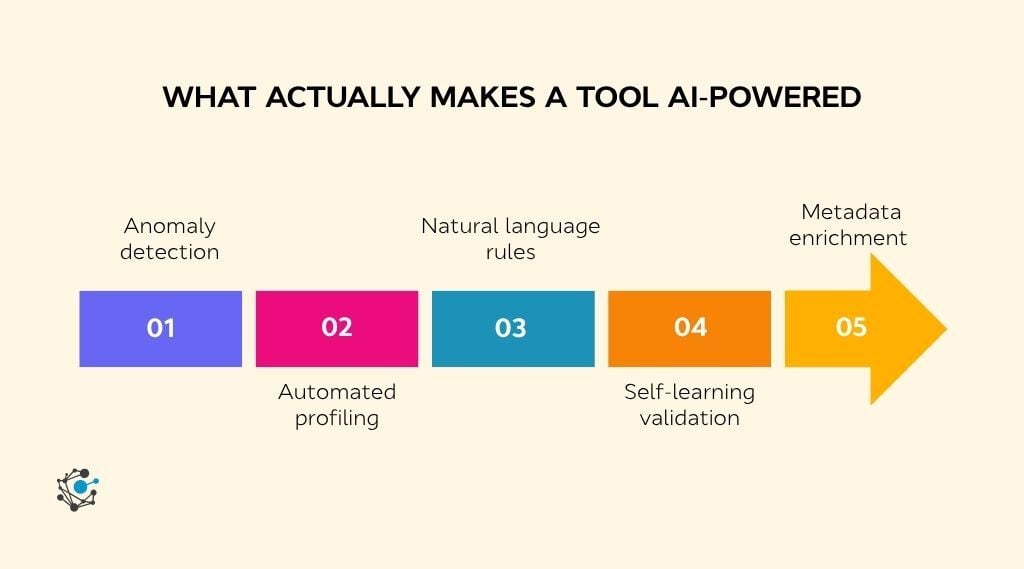
Five capabilities separate a genuinely intelligent data quality tool from one that just runs scripts on a schedule:
1. Anomaly detection: Flags outliers and shifts based on historical patterns, not fixed thresholds.
2. Automated data profiling: Uses machine learning to read data structure, patterns, and completeness without manual scripting.
3. Natural language rule creation: Turns plain-language test instructions into executable checks.
4. Self-learning validation: Improves rule recommendations as the underlying data changes.
5. Metadata enrichment: Adds context around data automatically, making it easier to discover and trace.
Most open-source tools deliver two or three of these well and leave the rest half-built. That gap barely shows at pilot scale. It becomes obvious the moment a team tries to run this across hundreds of datasets in production.
Top 7 AI-powered open source data quality tools
These seven tools span the full range of open-source data quality work, from lightweight check generation to full lifecycle platforms, each covering its strengths and limits. Here's a closer look at each one.
1. Soda Core + SodaGPT
Soda Core is a command-line tool built for engineers who want to write tests and monitor pipeline health without a heavy setup. SodaGPT adds a layer on top: describe a check in plain language, and it generates the YAML behind it, which cuts a lot of the ramp-up time for new users.
Key features
-
No-code check generation with SodaGPT: SodaGPT translates plain-language descriptions into SodaCL, the domain-specific language behind Soda's checks, so someone without an engineering background can define a data quality rule without touching code.
-
SodaCL and YAML-based checks: Every check compiles down to SodaCL and lives in a YAML file, which keeps configuration readable and easy to track through standard version control and pull request review.
-
Pipeline and orchestration integration: Soda Core connects natively with dbt, Airflow, and CI/CD tools, so checks run as part of the pipelines a team already has instead of sitting in a separate system.
-
Scan history for trend tracking: Soda Core keeps a record of past scan results, which lets a team look back at how a dataset's quality has changed over time rather than only seeing the latest pass or fail.
-
Broad connector support: Soda Core connects to most major warehouses and databases, including Snowflake, BigQuery, Redshift, and Postgres, covering the sources most engineering teams already run on.
Best for: engineering teams already living in dbt and CI/CD who want quality checks without leaving that workflow.
2. Great Expectations (GX)
Great Expectations is one of the most mature open-source data quality tools available. Teams write expectations, human-readable tests that validate data integrity at scale, and GX has added AI-assisted expectation generation to speed up test creation.
Key features
-
300+ pre-built expectations: GX ships with a large library of ready-made tests, called expectations, covering common checks like null values, value ranges, and uniqueness, so teams don't have to write validation logic from scratch for standard cases.
-
Custom expectation support: GX lets teams write their own expectations in Python when the built-in library doesn't cover a specific business rule, keeping the tool flexible for edge cases the defaults miss.
-
AI-assisted expectation generation: GX can suggest expectations based on a sample of the data itself, cutting down the time it takes a new team to go from a raw dataset to a working test suite.
-
Data docs and validation reports: GX automatically generates readable HTML reports showing which expectations passed or failed, giving engineers and non-technical stakeholders a shared view of data health.
-
Large community and documentation: GX has one of the most active open-source communities in the data quality space, which means more tutorials, faster answers to setup questions, and a steady stream of community-built integrations.
Best for: teams that value documentation and a large community over having every feature built in.
3. OpenMetadata
OpenMetadata combines discovery, lineage, data quality, and governance in one open platform, and it uses machine learning to automate rule suggestions, profiling, and anomaly detection. Of the tools on this list, it comes closest to covering the full data quality lifecycle rather than one slice of it.
Key features
-
AI-powered profiling: OpenMetadata automatically profiles tables and columns using machine learning, surfacing patterns like value distributions and completeness without a team configuring each check by hand.
-
Column-level quality checks: OpenMetadata runs tests down to the individual column, catching issues like unexpected nulls or out-of-range values before they propagate into downstream reports.
-
Automated lineage generation: OpenMetadata traces how data moves and transforms across systems automatically, rather than relying on someone to document lineage manually, which keeps the map current as pipelines change.
-
Native governance and glossary features: The platform includes a business glossary, data classification, and role-based access controls built in, so governance isn't something a team has to bolt on separately.
-
Broad connector ecosystem: OpenMetadata supports connectors across most major databases, warehouses, BI tools, and pipeline orchestrators, giving it one of the widest integration footprints among open-source options.
Best for: teams with the engineering capacity to self-host and maintain a broad platform. Teams weighing OpenMetadata against a managed alternative can see a closer breakdown of that trade-off in OvalEdge's OpenMetadata alternatives guide.
4. Amundsen (with ML extensions)
Amundsen, built by Lyft, is primarily a metadata discovery tool, with ML capabilities added through extensions such as usage-based dataset ranking. It is not a full data quality solution and works best as a discovery layer alongside other tools.
Key features
-
ML-enhanced search: Amundsen ranks search results using usage signals, like how often a dataset is queried or by whom, so the most relevant tables surface first instead of a flat alphabetical list.
-
Automated tagging and metadata capture: The tool pulls metadata from connected systems automatically and applies tags, cutting down the manual documentation work needed to keep a catalog current.
-
Lightweight deployment: Amundsen is built to be simple to stand up, making it a reasonable starting point for teams that want a discovery layer without committing to a heavier platform.
-
Popularity-based dataset ranking: Amundsen surfaces frequently used datasets and trusted owners more prominently, helping new team members find the right table faster instead of guessing between similarly named ones.
-
Open, community-driven roadmap: Amundsen's development is steered by its user community, so features tend to reflect what practitioners actually run into day-to-day, though release pace depends on contributor activity.
Best for: teams that already run quality checks elsewhere and just need a fast way for people to find and understand datasets.
5. DQOps
DQOps is an open-source data observability tool built for continuous monitoring and anomaly detection through machine learning. It focuses on automating checks for volume, freshness, completeness, and schema consistency.
Key features
-
ML-based anomaly detection: DQOps uses a machine learning algorithm to flag anomalies like unexpected volume changes or shifting value distributions, based on rolling historical patterns rather than fixed thresholds.
-
150+ built-in quality checks: The platform ships with a large library of pre-configured checks covering completeness, accuracy, timeliness, and schema consistency, so most standard validation needs are covered without custom scripting.
-
Data quality KPI scoring: DQOps calculates a KPI score based on the percentage of checks that pass, giving teams a single number to track over time and report to business stakeholders.
-
Incident management workflows: DQOps groups related quality issues into incidents automatically, with notification rules that route alerts to the right team instead of leaving everyone to sift through individual check failures.
-
JDBC-based connectivity: DQOps connects to any JDBC-compatible source, covering most major warehouses and databases, and runs scheduled scans against them without a custom connector for each one.
Best for: teams on JDBC-compatible sources who want scheduled anomaly detection without a heavy interface.
6. Datafold (open-source diff tool)
Datafold is best known for its commercial data diff and observability features. The open-source version lets engineers compare datasets across environments, which is useful during schema migrations or code changes.
Key features
-
Row and schema-level diffing: Datafold compares two versions of a dataset across environments or before and after a code change and shows exactly which rows and columns differ, catching breakage before it reaches production.
-
dbt-native workflow: The tool integrates directly with dbt, so engineers can diff the impact of a model change against production data as part of their normal development process.
-
CI/CD and pull request checks: Datafold can run automatically inside GitHub Actions and other CI/CD pipelines, flagging data regressions at the pull request stage instead of after a deployment.
-
Pre-merge regression detection: Datafold compares staging output against production before a merge, catching issues introduced by code changes, which is its main strength relative to tools built for ongoing monitoring.
-
Column-level diff breakdown: Datafold's diff results show which columns account for the differences between two dataset versions, so engineers don't have to comb through raw output row by row to find where a regression started.
Best for: teams that need reliable pre-merge data diffing during migrations, not ongoing quality monitoring.
7. Deequ
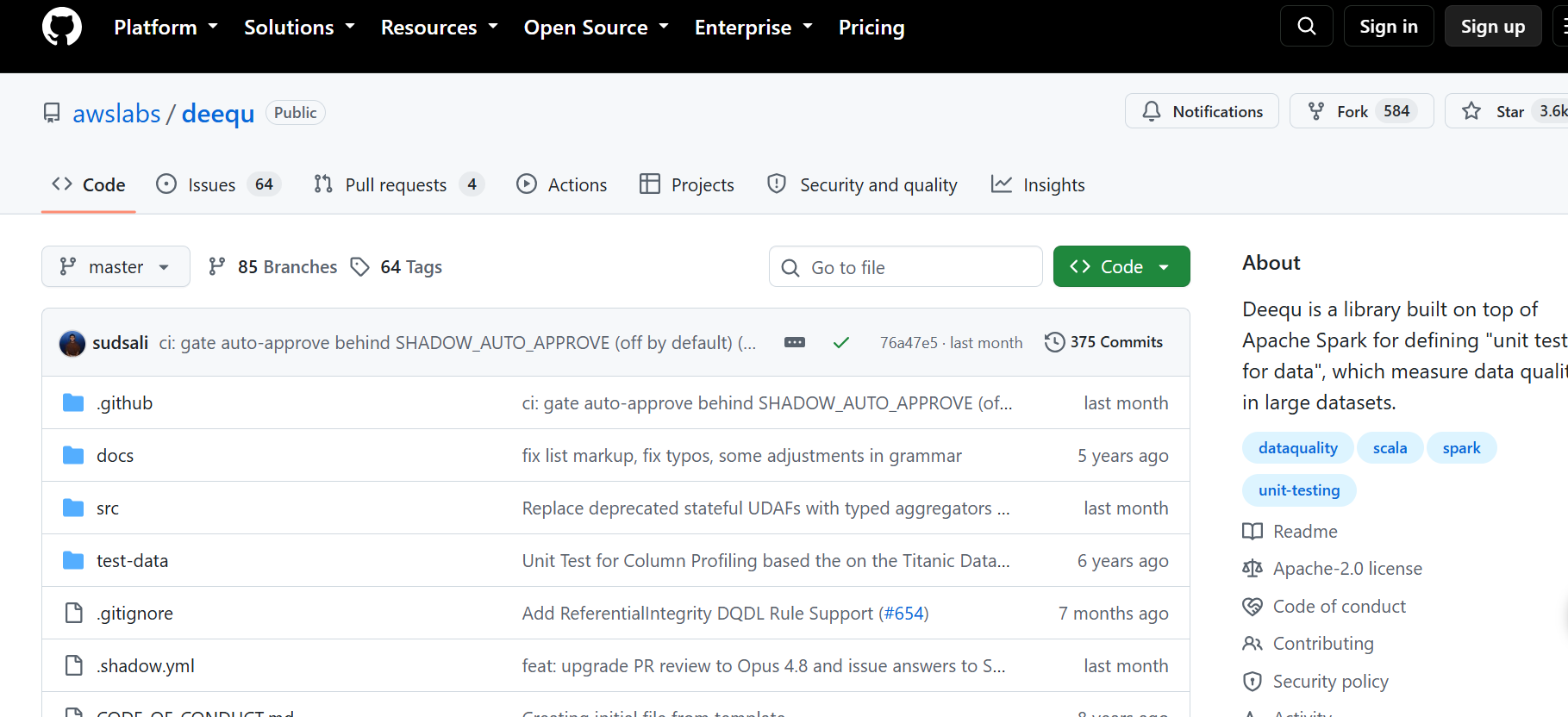
Deequ, created by Amazon AWS, is a library built on Apache Spark that lets teams define unit tests for data. It has no AI-driven features, but it remains popular for its scalability in big data environments.
Key features
-
Metric-based validation: Deequ computes data quality metrics, like completeness, uniqueness, and correlation, directly over a dataset and lets teams set constraints against those metrics rather than writing ad hoc checks.
-
Built for Apache Spark: Deequ runs natively on Spark, so it scales to the large, distributed batch workloads Spark is already handling, without adding a separate processing layer.
-
Constraint suggestion engine: Deequ can analyze a dataset and suggest a starting set of constraints based on what it finds, giving teams a baseline to refine rather than starting from a blank page.
-
Fully programmable API: Since Deequ is a library rather than a platform, engineers can write custom validation logic in Scala or Python, giving more control than tools that only work through predefined check types.
-
No AI layer, by design: Deequ doesn't include anomaly detection or natural language rule generation. It stays narrow and programmatic, which makes it predictable for teams that want direct control over validation logic rather than a model making the calls.
Best for: Spark-heavy teams that want programmatic control and don't need a UI or AI features.
Comparing open-source data quality tools
Open-source data quality tools vary widely in what they actually cover. Some lean hard into AI-driven anomaly detection, others focus on metadata and lineage, and a few stay narrowly focused on validation alone. The table below lines up all seven on the dimensions that matter most for production use.
|
Tool |
Core AI capability |
Metadata & lineage |
Governance/access control |
Best fit |
|
Soda Core + SodaGPT |
No-code check generation |
None built in |
Minimal, open-source tier |
dbt and CI/CD-native teams |
|
Great Expectations |
AI-assisted expectation suggestions |
None built in |
None built in |
Community-first teams |
|
OpenMetadata |
ML-based profiling and anomaly detection |
Full lineage and enrichment |
Built in, but complex to run |
Teams that can self-host a full platform |
|
Amundsen |
ML-ranked search and tagging |
Discovery only, no lineage |
None built in |
Teams needing a discovery layer only |
|
DQOps |
ML-based anomaly detection |
Basic profiling |
None built in |
JDBC-source teams wanting scheduled scans |
|
Datafold (open source) |
None; AI features are commercial-only |
None built in |
None built in |
Pre-merge diff checks during migrations |
|
Deequ |
None |
None built in |
None built in |
Spark-heavy batch validation |
What are the key challenges in open-source data quality tools?
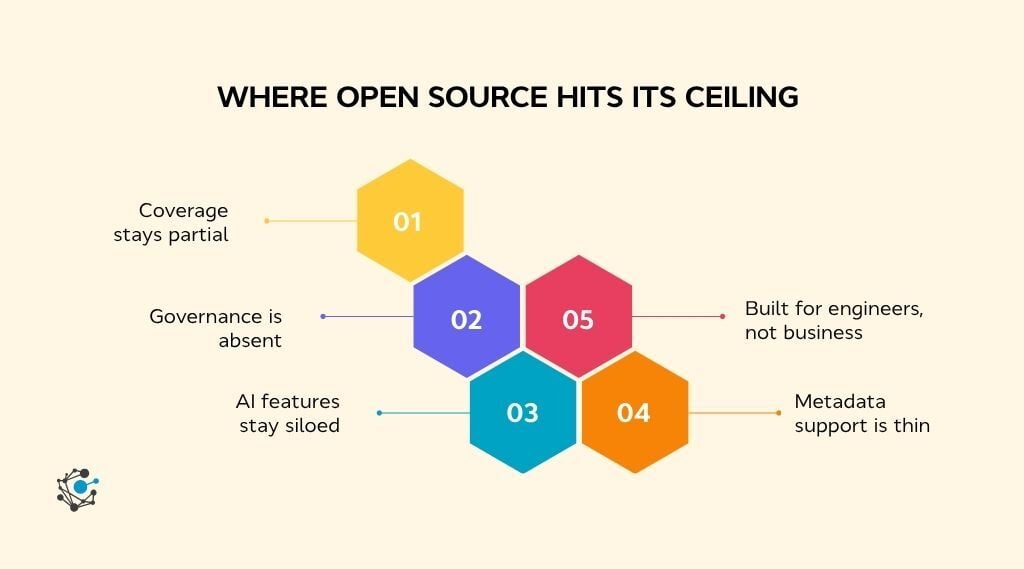
Open source tools solve real problems, but scaling past a pilot exposes gaps most teams don't expect. Five patterns show up consistently once that scaling begins, each worth planning around.
1. Coverage stays partial
Most tools handle validation, profiling, or anomaly detection well on their own, but rarely all three together. Lineage tracking and metadata enrichment are usually missing entirely, so teams end up patching together several tools for the kind of coverage a documented data quality framework is meant to provide from the start.
2. Governance is absent, not just thin
Role-based access, data classification, audit trails, and policy enforcement are either unsupported or need custom development. That makes these tools hard to run in regulated or business-facing environments.
3. AI features stay siloed
Anomaly detection and natural language checks exist, but they do not feed into rule evolution or remediation. Teams still tune rules and trace root causes by hand.
4. Metadata support is thin
Without automated capture and cross-system context, tracing an issue back to its source takes manual digging, and that slows down every fix downstream.
5. Built for engineers, not the business
CI/CD integration is strong, but low-code interfaces for compliance officers or data stewards mostly are not, so adoption stays inside engineering.
How OvalEdge bridges the gap
OvalEdge is built to pick up exactly where open-source data quality tools run out of road. Instead of stitching together separate tools for validation, lineage, and access control, OvalEdge brings quality, governance, and context into one platform. The five capabilities below carry that weight.
1. Data quality debt management
Beyond catching new issues, OvalEdge identifies and resolves the historical inconsistencies open-source validation tools were never built to touch: duplicate entities, conflicting KPIs, and reference mismatches built up over years.
2. Enterprise context graph
Every quality rule, lineage path, and ownership record connects into a single graph, so the governance work a team has already done becomes something AI agents and analysts can actually query and trust, not just a compliance record sitting in a separate tool. This is the same context engineering principle behind how OvalEdge keeps AI outputs grounded in real business meaning.
3. Source code intelligence
Lineage and business logic get pulled straight from SQL, ETL, and BI code, not inferred from query logs, which is where most open-source lineage tools fall short.
4. Fine-grained access control
Column- and row-level RBAC enforced natively across connected systems, with audit trails built in for GDPR and HIPAA, not bolted on through a third-party tool.
5. 170+ pre-built connectors
Modern cloud platforms and legacy systems alike, built and maintained by OvalEdge's own team rather than a community project.
The result is a platform where data quality is not a check that happens off to the side. It runs on the same governed context that powers lineage, access, and AI trust across the business.
Conclusion
Open source has genuinely changed what data quality work looks like for engineering teams. Great Expectations, Soda Core, OpenMetadata, and the rest on this list make validation, profiling, and anomaly detection achievable without a platform purchase, and that access matters.
What these tools were never built to do is carry that work across a growing data estate, connecting quality rules to lineage, ownership, and business context as data volume, team size, and regulatory footprint all grow at once. That is where OvalEdge picks up, turning the governance and quality checks a team has already built into an Enterprise Context Graph, context an organization can actually query, trust, and act on at scale.
Teams weighing the fuller landscape, including proprietary platforms alongside open source options, can find that comparison in OvalEdge's broader data quality tools guide.
Schedule a demo with OvalEdge to see how Data Quality Debt Management and the Enterprise Context Graph work together.
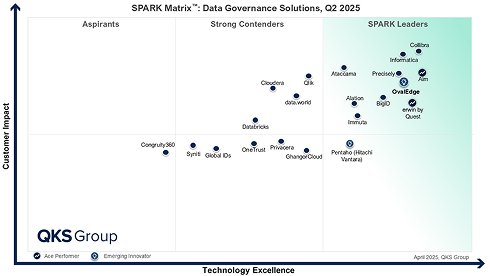
.png?width=1081&height=173&name=Forrester%201%20(1).png)
.png?width=1081&height=241&name=KC%20-%20Logo%201%20(1).png)