.png)
Silent pipeline failures, stale dashboards, schema drift, and incomplete datasets have become major operational risks in modern enterprise data environments. Modern data stacks fail faster than traditional environments, with broken transformations, freshness failures, and silent data corruption propagating across pipelines long before teams detect issues manually.
In many organizations, business users still discover data problems before engineering teams detect them, especially across cloud warehouses, AI pipelines, and self-service analytics ecosystems.
The BARC Data, BI and Analytics Trend Monitor 2025 found that data quality management remains one of the top enterprise priorities globally.
The real buying decision is no longer just about validation rules. Enterprises now evaluate which data quality monitoring tools can continuously monitor operational trust, lineage impact, governance accountability, and reliability across rapidly changing data ecosystems.
This guide evaluates the best data quality monitoring tools for 2026 based on anomaly detection, governance depth, lineage visibility, integration coverage, and operational scalability.
7 best data quality monitoring tools for 2026
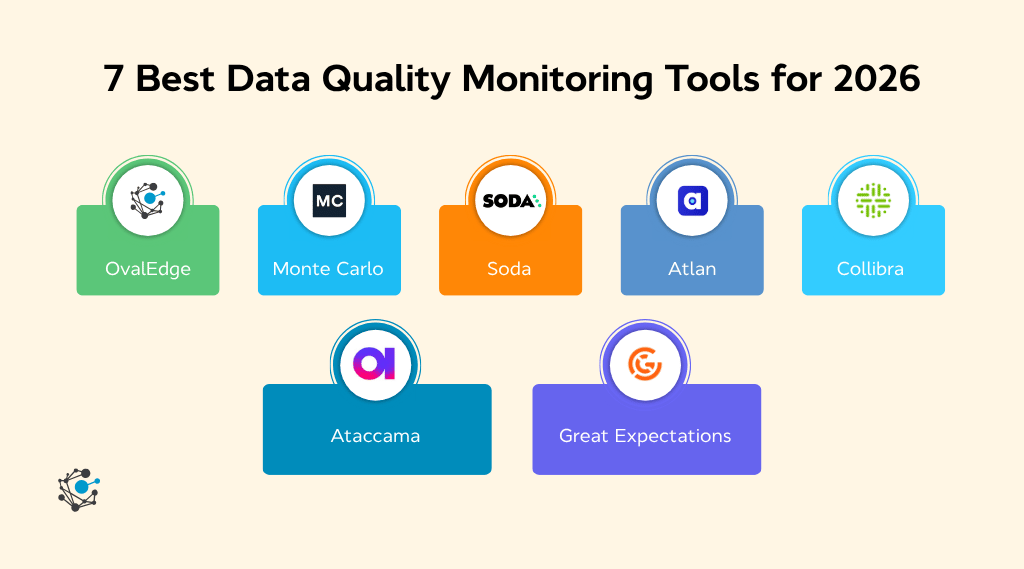
Data quality monitoring tools continuously check pipelines for anomalies, schema drift, completeness failures, and SLA breaches while alerting teams before issues impact downstream consumers.
The strongest platforms combine automated detection with lineage visibility, governance workflows, stewardship ownership, and operational alerting so organizations can resolve quality incidents faster and reduce business risk.
|
Tool |
Best For |
Core Strength |
Governance Depth |
Ideal Buyer |
|
OvalEdge |
Governance-integrated monitoring |
Unified catalog + DQ + stewardship |
High |
CDOs, data stewards |
|
Monte Carlo |
Data observability at scale |
ML-driven anomaly detection |
Medium |
Data engineers |
|
Soda |
Developer-first monitoring |
SQL-native quality checks |
Low–Medium |
Data engineers |
|
Atlan |
Context-aware monitoring |
Lineage + catalog integration |
Medium–High |
Governance leaders |
|
Collibra |
Enterprise policy enforcement |
Policy-driven quality rules |
High |
Enterprise CDOs |
|
Ataccama |
Regulated industry quality |
Hybrid DQ + governance |
High |
Compliance teams |
|
Great Expectations |
Pipeline-native checks |
Open-source flexibility |
Low |
Engineering-heavy teams |
Each platform approaches monitoring differently. Some prioritize observability speed and anomaly detection, while others emphasize governance enforcement, data stewardship workflows, or developer-controlled validations.
1. OvalEdge
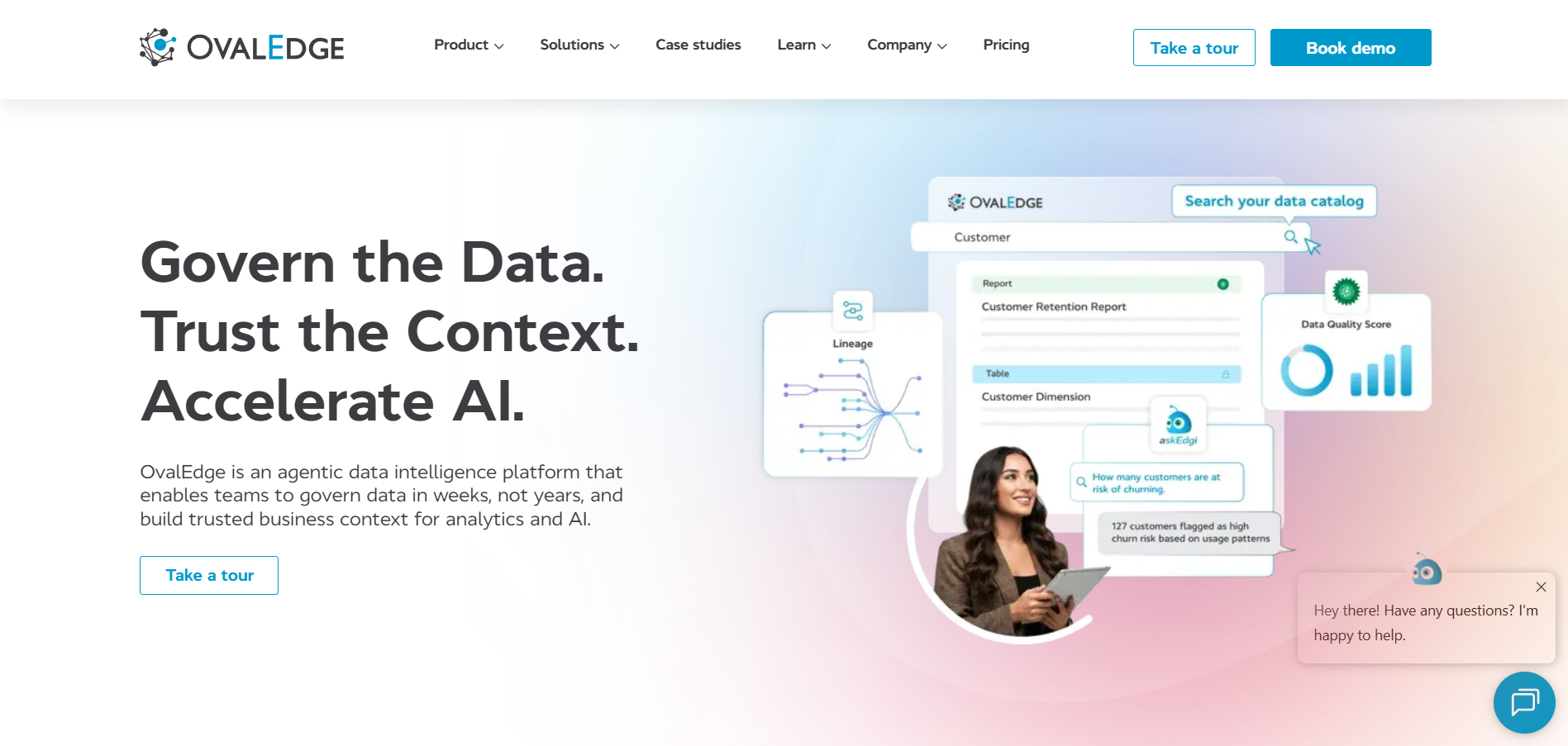
OvalEdge combines data cataloging, governance, lineage, stewardship, and data quality monitoring within a unified platform. Instead of treating monitoring as an isolated observability function, the platform embeds data quality operations directly into governed metadata and stewardship workflows.
This unified approach helps organizations improve operational trust, strengthen compliance oversight, and accelerate issue resolution across modern analytics and AI environments.
Key monitoring capabilities
-
Automated profiling and quality scoring: OvalEdge continuously profiles datasets to identify anomalies, completeness issues, null spikes, and distribution inconsistencies while generating data quality scorecards across governed assets.
-
Freshness and SLA monitoring: The platform tracks data freshness, delayed pipeline execution, and SLA breaches to help teams identify operational issues before downstream consumers are impacted.
-
Schema drift detection: Monitoring workflows detect unexpected schema modifications, structural changes, and transformation inconsistencies across pipelines and warehouse environments.
-
Stewardship-driven issue escalation: Quality incidents can be assigned directly to data owners and stewards through governance workflows, improving accountability and resolution management.
-
Lineage-aware impact analysis: OvalEdge connects monitoring events with lineage graphs, enabling teams to understand downstream business impact and accelerate root-cause analysis.
-
Governance-integrated monitoring: Monitoring workflows align with policy enforcement, metadata governance, and compliance management, making the platform particularly valuable for regulated enterprise environments.
Best fit
OvalEdge is best suited for organizations that want monitoring, governance, lineage, and stewardship integrated within a single operational layer rather than managed through disconnected point solutions.
The platform is especially valuable for enterprises with formal governance programs, compliance requirements, and large-scale self-service analytics or AI initiatives.
|
How OvalEdge supported enterprise-scale governance and monitoring According to the global consulting firm case study, the organization struggled with disconnected governance workflows across Snowflake, Kafka, APIs, and cloud analytics systems. Manual approval processes and limited operational visibility made it difficult to manage downstream reporting dependencies efficiently. To address these challenges, the organization implemented OvalEdge as a centralized governance and monitoring platform. Key operational improvements included:
This helped the organization improve operational coordination and strengthen trust across enterprise analytics operations. |
Book a demo to see how OvalEdge helps enterprises unify data quality monitoring, lineage, stewardship, and governance within a centralized operational environment.
2. Monte Carlo
Monte Carlo is a data observability platform focused on automated anomaly detection across modern cloud data pipelines. The platform uses ML-driven monitoring to identify freshness issues, schema drift, volume anomalies, and pipeline failures before they affect downstream analytics.
Key monitoring capabilities
-
ML-based anomaly detection: Automatically identifies unusual patterns in freshness, volume, distribution, and schema behavior without requiring extensive manual rule configuration.
-
Freshness and pipeline monitoring: Continuously monitors delayed jobs, stale tables, and failed transformations across warehouse and orchestration environments.
-
Schema drift detection: Monitoring workflows detect structural changes across upstream and downstream datasets that may disrupt analytics workflows or dashboards.
-
Incident alerting workflows: Automated alerts can be routed through Slack, PagerDuty, and ticketing systems for faster operational response.
-
Column-level lineage visibility: Lineage-aware monitoring helps teams trace root causes and downstream business impact more efficiently.
-
Cloud data stack integrations: The platform integrates deeply with Snowflake, Databricks, dbt, Airflow, BigQuery, and modern analytics ecosystems.
Best fit
Monte Carlo is best suited for engineering-led organizations prioritizing observability speed, and automated anomaly detection across large-scale modern data stacks.
3. Soda
Soda is a developer-first data quality monitoring platform designed for engineering teams that prefer SQL-native validation workflows. The platform enables quality checks to run directly inside pipelines, CI/CD processes, and transformation environments.
Key monitoring capabilities
-
SQL-native quality checks: Teams can create custom validations using SQL-based testing frameworks directly within data pipelines.
-
Pipeline-integrated monitoring: Monitoring workflows can be embedded into orchestration and transformation pipelines for continuous validation.
-
Freshness and schema validation: The platform tracks stale datasets, schema changes, and row-level inconsistencies across cloud warehouse environments.
-
dbt-native integrations: Strong dbt integration supports engineering-centric DataOps workflows and transformation testing.
-
Custom alerting workflows: Monitoring incidents can be escalated through Slack notifications, CI/CD pipelines, and operational alerting systems.
-
Flexible deployment model: Lightweight deployment options help teams operationalize monitoring quickly without extensive governance overhead.
Best fit
Soda is best suited for developer-focused organizations that want lightweight, SQL-driven monitoring embedded directly into modern data engineering workflows.
4. Atlan
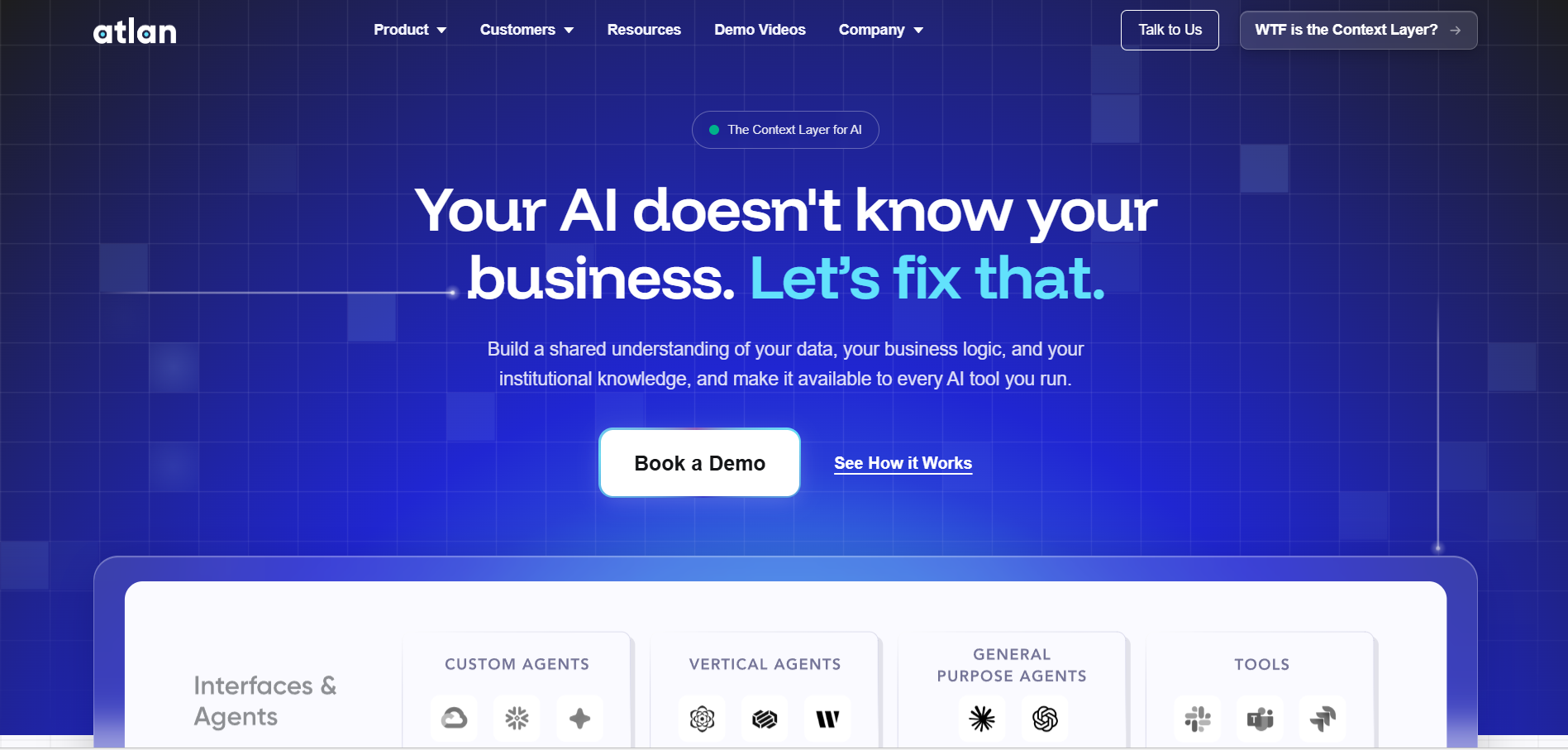
Atlan combines data cataloging, lineage, collaboration, and metadata management with context-aware monitoring capabilities. The platform helps teams investigate data quality issues through lineage-connected metadata and collaborative governance workflows.
Key monitoring capabilities
-
Metadata-aware monitoring: Monitoring insights connect directly to cataloged datasets, glossary terms, and business metadata context.
-
Lineage-linked root-cause analysis: Integrated lineage visibility helps teams trace upstream dependencies and downstream business impact.
-
Freshness and impact monitoring: Monitoring workflows track delayed updates and identify downstream analytics assets affected by quality failures.
-
Collaboration-driven workflows: Cross-functional issue resolution workflows support coordination between engineering, analytics, and governance teams.
-
Catalog-integrated visibility: Monitoring context is embedded within searchable metadata and data discovery experiences.
-
Modern analytics integrations: The platform integrates with Snowflake, Databricks, dbt, Tableau, Power BI, and orchestration ecosystems.
Best fit
Atlan is best suited for organizations that want monitoring tightly connected with metadata collaboration, lineage visibility, and modern governance operations.
5. Collibra
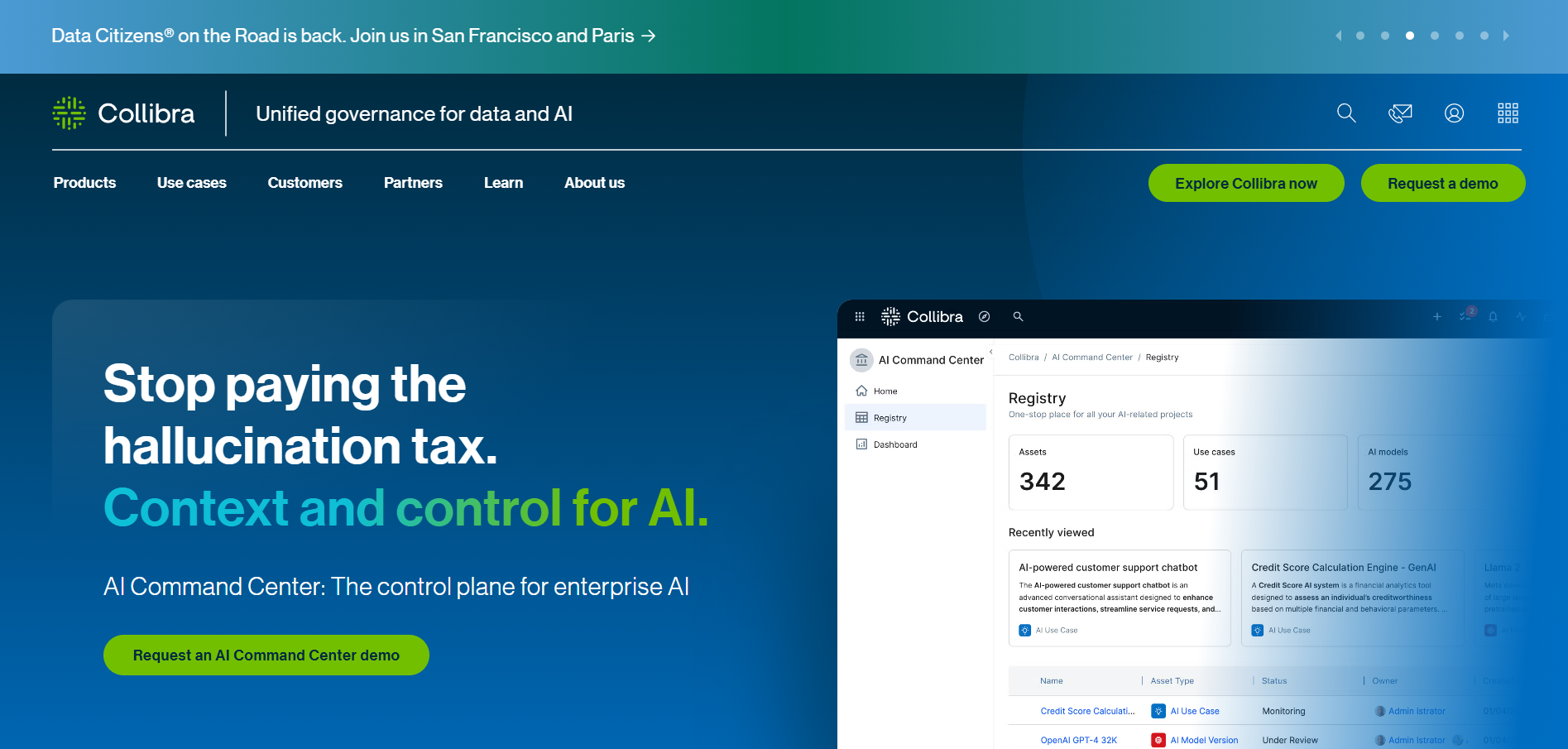
Collibra is an enterprise governance platform that integrates policy-driven data quality management with stewardship workflows and compliance operations. The platform emphasizes governance standardization and regulatory accountability across large enterprise environments.
Key monitoring capabilities
-
Policy-driven quality enforcement: Monitoring rules connect directly to governance policies, business definitions, and compliance controls.
-
Stewardship and ownership workflows: Governance workflows assign accountability for issue resolution across stewardship teams.
-
Compliance-oriented monitoring: Monitoring supports GDPR, HIPAA, financial governance, and enterprise audit requirements.
-
Lineage-aware governance visibility: Lineage-connected monitoring helps organizations understand downstream reporting and operational impact.
-
Business glossary integration: Monitoring workflows align directly with governed business terminology and metadata definitions.
-
Enterprise ecosystem integrations: The platform integrates with warehouses, governance systems, BI tools, and enterprise metadata environments.
Best fit
Collibra is best suited for large enterprises that prioritize policy enforcement, stewardship accountability, and formal governance standardization.
6. Ataccama
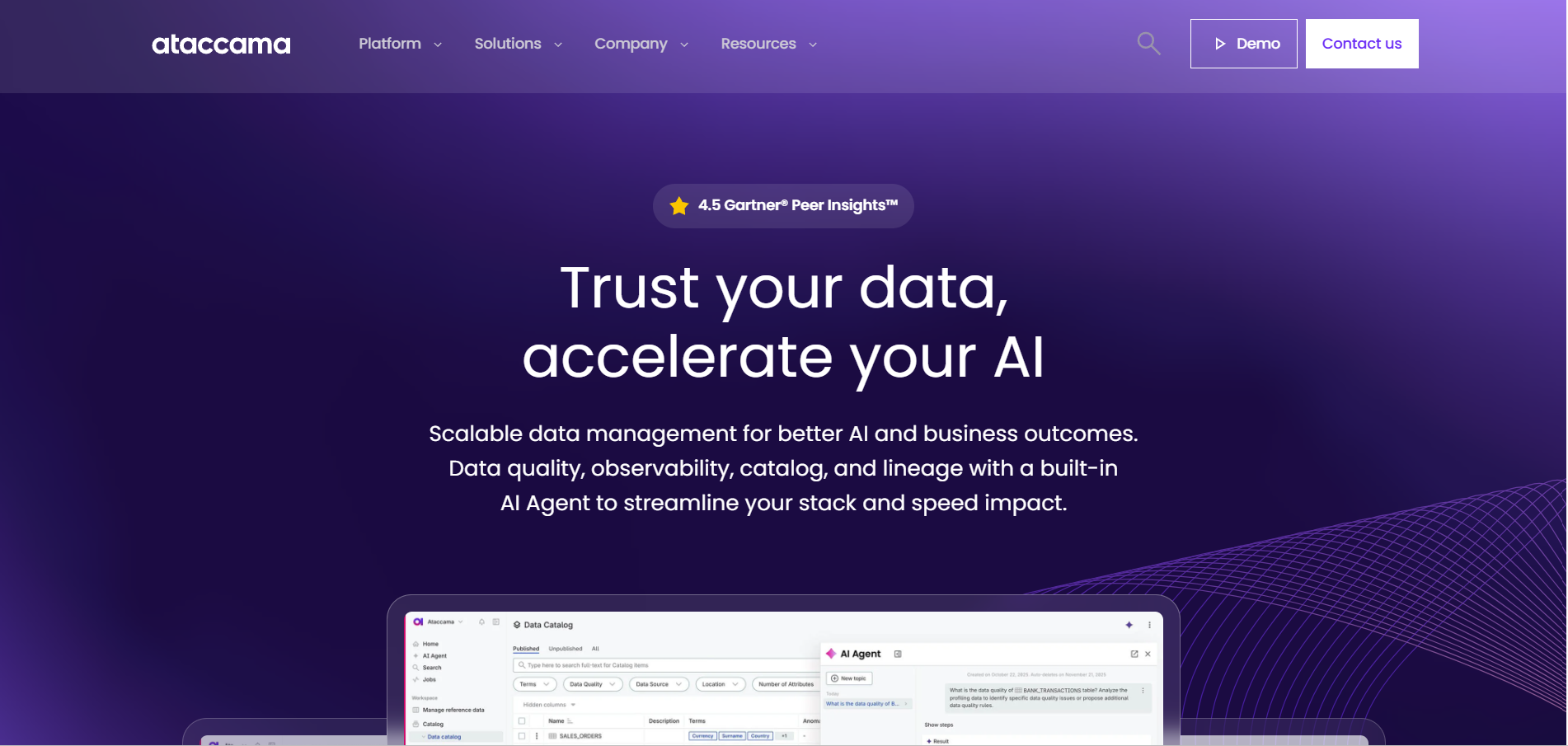
Ataccama combines data quality monitoring, governance, master data management, and compliance workflows within a unified enterprise platform. The solution is widely adopted in regulated industries requiring strong auditability and policy enforcement.
Key monitoring capabilities
-
Hybrid anomaly detection: The platform combines rule-based validations with ML-assisted monitoring to identify both expected and unknown anomalies.
-
Automated data profiling: Continuous profiling workflows analyze datasets for completeness, consistency, duplication, and structural issues.
-
Compliance-focused monitoring: Monitoring workflows support governance requirements aligned with HIPAA, GDPR, and regulated financial environments.
-
Master data quality controls: Monitoring helps maintain consistency and reliability across enterprise master data domains.
-
Remediation and escalation workflows: Automated governance escalation workflows improve issue management and operational accountability.
-
Enterprise integration support: The platform integrates with enterprise warehouses, ERP systems, cloud platforms, and governance ecosystems.
Best fit
Ataccama is best suited for highly regulated enterprises that need monitoring, governance, and compliance enforcement integrated within a centralized operational framework.
7. Great Expectations
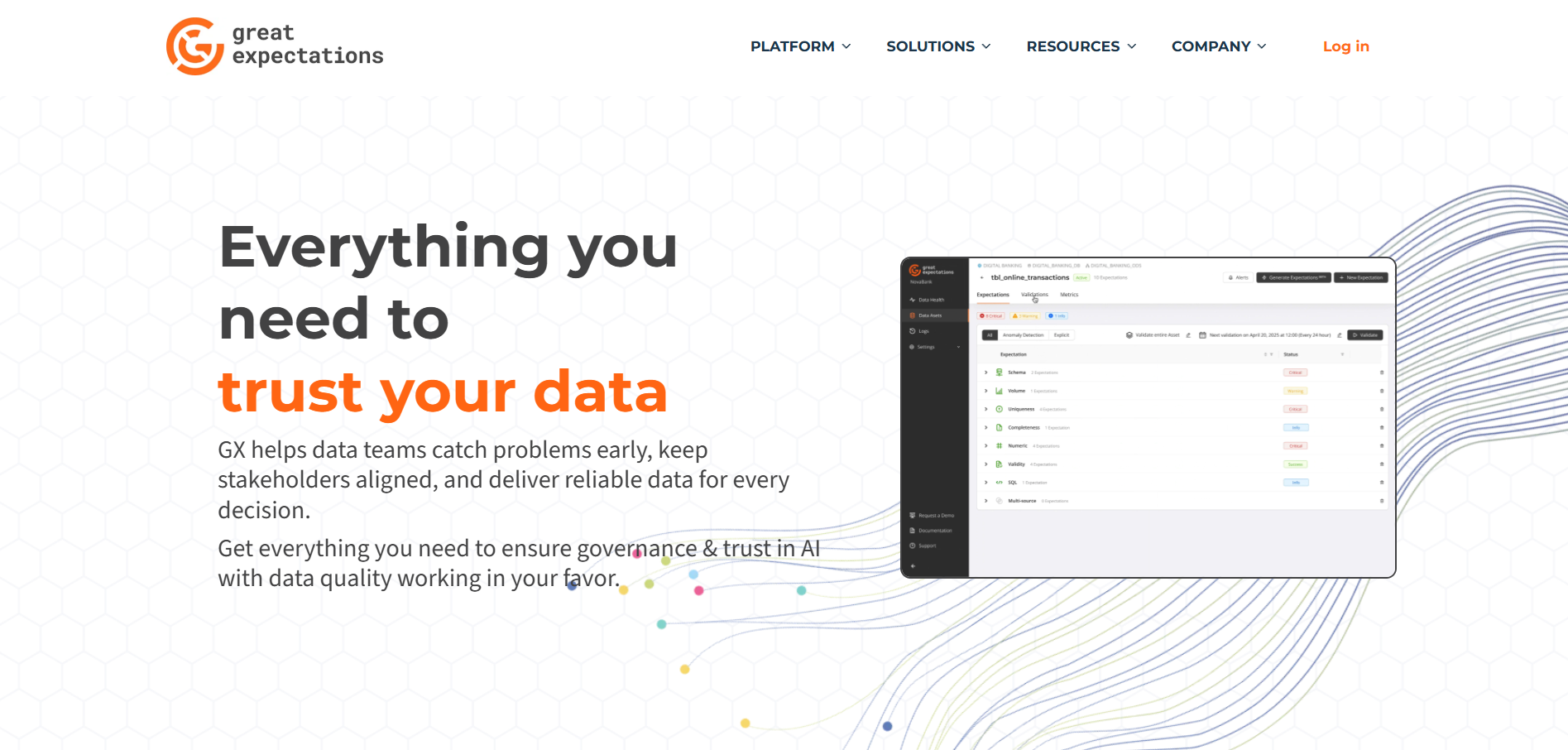
Great Expectations is an open-source data quality framework that enables engineering teams to build highly customizable validation workflows directly into pipelines. The platform emphasizes flexibility, developer control, and code-first quality testing.
Key monitoring capabilities
-
Custom validation frameworks: Teams can define tailored expectations and assertions across datasets and transformation pipelines.
-
Pipeline-native testing: Monitoring checks can be embedded directly into orchestration and transformation workflows.
-
Schema and transformation validation: Validation workflows detect structural inconsistencies, failed transformations, and data integrity issues.
-
Version-controlled monitoring logic: Git-based workflows support centralized management of validation rules and testing configurations.
-
Open-source extensibility: Engineering teams can customize monitoring frameworks for highly specialized operational environments.
-
Modern engineering integrations: The platform integrates with Airflow, Spark, dbt, Snowflake, Databricks, and Python ecosystems.
Best fit
Great Expectations is best suited for engineering-heavy teams that want highly customizable, code-first monitoring frameworks with full developer control.
What to look for in data quality monitoring tools
Many organizations already detect data issues. The harder challenge is understanding downstream impact, ownership accountability, and operational risk quickly enough to prevent disruptions across analytics, reporting, and AI systems.
1. Breadth of automated coverage vs. depth of targeted checks
Most monitoring platforms can detect failed jobs, stale datasets, or schema changes. The real differentiator is how effectively they validate business-critical data across transformations, analytics pipelines, and downstream reporting environments, something that requires a clear understanding of data quality dimensions like completeness, consistency, and timeliness.
Strong platforms combine large-scale automated monitoring with targeted validations such as distribution analysis, business-rule enforcement, and column-level anomaly detection.
Organizations should also evaluate how easily teams can operationalize real-time data quality monitoring through no-code configurations, reusable templates, and scalable deployment models.
2. Lineage-aware root-cause analysis
Detecting an issue is only part of the problem. Teams also need to identify where the issue originated, which downstream assets are affected, and how quickly business operations could be impacted.
Monitoring platforms with integrated lineage visibility help organizations trace failures across transformations, dashboards, reports, and AI workflows without relying on manual investigation.
OvalEdge's data lineage maps column-level dependencies across BI, SQL, and streaming systems, connecting monitoring events directly to downstream impact. This reduces troubleshooting delays and improves operational response across distributed analytics ecosystems.
According to the Accenture Technology Vision 2024 report, enterprises are increasingly investing in connected operational visibility frameworks to improve resilience across modern data and AI environments.
3. Governance and stewardship integration
Data quality problems are often coordination failures across teams, pipelines, ownership boundaries, and undocumented transformations, not just isolated validation problems. Many monitoring tools can generate alerts, but they lack the workflows needed to assign ownership, manage escalation, and track remediation across enterprise environments.
Governance-integrated monitoring platforms connect quality incidents with stewardship ownership, policy enforcement, and operational accountability. This helps engineering, analytics, governance, and compliance teams respond faster while reducing unresolved issues across reporting, analytics, and AI systems.
These capabilities become especially important in regulated environments where auditability, accountability, and operational trust directly influence enterprise decision-making.
4. Stack fit and integration depth
Monitoring effectiveness depends heavily on how deeply the platform integrates with the broader enterprise data ecosystem. Weak integrations often create blind spots across orchestration layers, transformations, and downstream analytics environments.
Organizations should prioritize platforms with native integrations across warehouses, orchestration systems, BI tools, streaming platforms, and operational workflows. Strong integration coverage helps teams monitor data movement, transformation health, reporting dependencies, and operational incidents more consistently across distributed cloud environments.
Modern monitoring platforms should ideally support integrations across:
-
Snowflake
-
Databricks
-
BigQuery
-
dbt
-
Airflow
-
Kafka
-
Tableau
-
Power BI
-
Slack and ticketing systems
Platforms that integrate directly into orchestration workflows, metadata environments, lineage systems, and warehouse operations provide stronger operational visibility across the analytics lifecycle.
How to choose the right data quality monitoring tool for your use case
The best data quality monitoring tool depends less on feature volume and more on how your organization manages governance, engineering operations, compliance requirements, and analytics ownership. Some platforms are optimized for observability speed, while others prioritize governance enforcement, stewardship workflows, or developer-controlled validations.
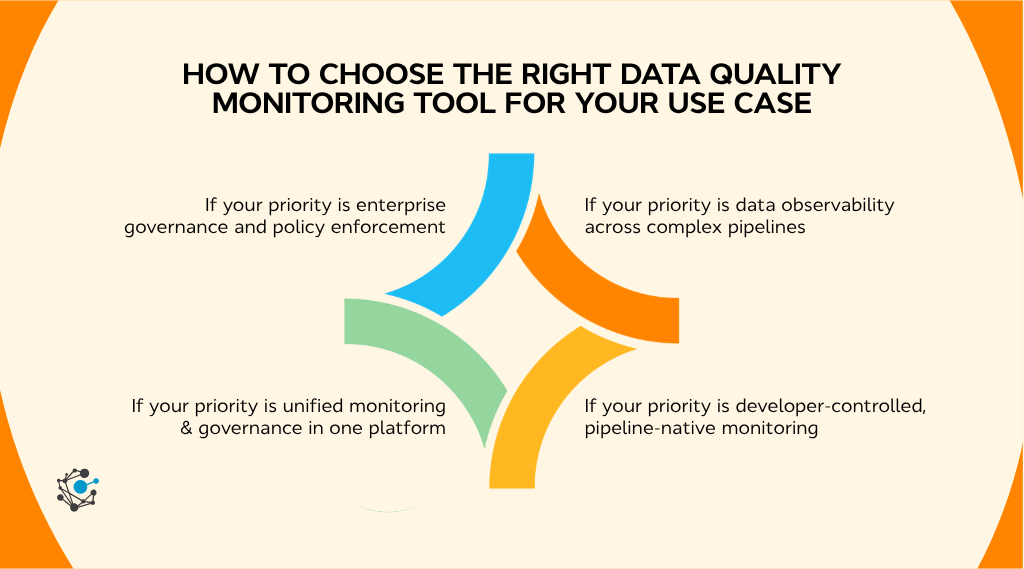
1. If your priority is enterprise governance and policy enforcement
Organizations with mature governance programs often need monitoring tightly connected with stewardship ownership, compliance workflows, and policy enforcement, rather than standalone anomaly detection.
Platforms such as OvalEdge, Collibra, and Ataccama are better suited for environments where governance accountability, auditability, and operational oversight are business-critical.
These platforms are particularly effective when organizations need:
-
Formal stewardship ownership
-
Governance-driven remediation workflows
-
GDPR or HIPAA compliance alignment
-
Centralized policy enforcement
-
Cross-functional operational accountability
This approach is commonly adopted in highly regulated industries such as healthcare, banking, insurance, and enterprise consulting environments.
2. If your priority is data observability across complex pipelines
Engineering-led organizations often prioritize rapid anomaly detection, pipeline visibility, and operational troubleshooting across large-scale cloud data environments.
Platforms such as Monte Carlo and Soda focus heavily on observability workflows, automated monitoring, and engineering-centric operations.
These platforms work particularly well when:
-
The stack is built on Snowflake, Databricks, or BigQuery
-
DataOps practices are already operationalized.
-
Engineering teams own monitoring workflows.
-
Fast incident detection is prioritized over governance depth
Their strengths lie in observability, speed, and operational visibility across distributed transformation pipelines.
3. If your priority is developer-controlled, pipeline-native monitoring
Some organizations prefer monitoring frameworks that operate directly inside engineering pipelines with fully customizable validation logic.
Great Expectations and Soda are strong options for teams that want code-first monitoring integrated into CI/CD and transformation workflows.
These platforms are well-suited for environments where:
-
Engineering teams manage validations directly
-
Monitoring logic is version-controlled through Git workflows.
-
Custom assertions and transformation testing are required.
-
Teams prefer SQL- or Python-driven quality frameworks
This approach provides flexibility but may require additional governance tooling as organizations scale operational complexity.
4. If your priority is unified monitoring and governance in one platform
Many enterprises are moving away from fragmented point solutions that separate cataloging, lineage, governance, and monitoring into disconnected operational layers. The shift toward data quality management for AI is accelerating this consolidation, as AI pipelines demand tighter integration between quality, lineage, and governance.
Platforms such as OvalEdge and Atlan help organizations unify metadata visibility, stewardship workflows, lineage analysis, and monitoring operations within a centralized environment.
This model is increasingly valuable when organizations need:
-
Shared operational visibility across teams
-
Faster root-cause analysis
-
Centralized metadata management
-
Governance-integrated monitoring workflows
-
Better coordination across analytics and AI initiatives
As enterprise analytics ecosystems continue to grow, unified governance and monitoring models are becoming increasingly important for reducing operational fragmentation and improving trust in business data.
Conclusion
The best data quality monitoring tools help organizations move beyond reactive issue detection toward scalable operational trust across analytics and AI environments. As enterprise data ecosystems grow more distributed, monitoring platforms must support anomaly detection, lineage visibility, governance accountability, and faster issue resolution across pipelines, dashboards, and business-critical reporting systems.
Organizations focused on observability speed may prioritize ML-driven monitoring platforms, while governance-mature enterprises often require stewardship workflows, policy enforcement, and centralized operational oversight. Increasingly, many teams are also consolidating fragmented tooling by adopting platforms that unify cataloging, lineage, governance, and monitoring within a single operational layer.
OvalEdge helps enterprises monitor data quality within governed data environments by combining stewardship, lineage visibility, metadata management, and governance-driven monitoring workflows.

Book a demo to see how OvalEdge improves operational visibility, accountability, and trust across enterprise analytics ecosystems.
FAQs
1. Which data quality monitoring tools support real-time anomaly detection?
Platforms such as Monte Carlo, Ataccama, and OvalEdge support real-time or near-real-time anomaly detection across freshness, schema drift, distribution changes, and operational pipeline failures.
2. What is the difference between data quality monitoring and data observability?
Data quality monitoring focuses on validating accuracy, completeness, freshness, and consistency, while data observability provides broader operational visibility into pipeline health, lineage, transformations, and downstream business impact.
3. How do data quality monitoring tools integrate with Snowflake and Databricks?
Most enterprise platforms integrate through native warehouse connectors, orchestration workflows, metadata APIs, and lineage systems to monitor transformations, schema changes, and downstream analytics dependencies.
4. What should enterprises prioritize when evaluating data quality monitoring tools?
Organizations should evaluate anomaly detection capabilities, lineage visibility, governance integration, stewardship workflows, scalability, and compatibility with modern cloud data ecosystems.
5. Can open-source data quality monitoring tools scale for enterprise use?
Open-source frameworks such as Great Expectations can scale effectively with strong engineering ownership, but enterprise deployments often require additional governance, orchestration, and operational management layers.
6. Why is lineage important in data quality monitoring?
Lineage visibility helps organizations trace upstream failures, identify affected downstream assets, accelerate root-cause analysis, and reduce operational downtime across analytics and AI environments.
.png?width=1081&height=173&name=Forrester%201%20(1).png)
.png?width=1081&height=241&name=KC%20-%20Logo%201%20(1).png)