-May-28-2026-10-08-07-9679-AM.png)
Many governance programs fail not because organizations lack a governance strategy, but because implementation becomes too slow, fragmented, and operationally disconnected from how modern data teams actually work.
According to the 2026 Data Governance Statistics Report by ZipDo, 65% of organizations had implemented governance programs by 2023, yet only 3% met basic governance standards.
The gap between launching governance initiatives and operationalizing measurable governance outcomes continues to challenge enterprises.
At the same time, AI adoption, self-service analytics, compliance requirements, and cloud data growth are accelerating governance expectations across organizations. This is driving growing interest in the data governance acceleration framework approach.
In this blog, a practical six-phase framework, a rapid implementation roadmap, and the operational strategies enterprises are using to accelerate governance adoption without compromising control, quality, or accountability are explored.
What is a data governance acceleration framework?
A data governance acceleration framework is not simply about faster governance implementation. Its primary focus is on reducing the gap between governance intent and measurable governance adoption across enterprise data environments.
Instead of emphasizing policy documentation alone, acceleration frameworks prioritize accountability, adoption, and faster governance outcomes.
How it differs from traditional governance programs
Traditional governance models and acceleration frameworks differ significantly in both execution philosophy and delivery approach.
|
Traditional governance programs |
Data governance acceleration framework |
|
Enterprise-wide governance scope from the beginning |
Domain-prioritized governance rollout |
|
Sequential, documentation-heavy implementation |
Outcome-driven governance delivery |
|
Manual metadata collection and cataloging |
Automated metadata ingestion and visibility |
|
Governance policies are managed separately from workflows |
Governance integrated into day-to-day data processes |
|
Stewardship often remains informal or inconsistent |
Workflow-driven stewardship with accountability |
|
Governance maturity is emphasized before operational value |
Early measurable business outcomes prioritized |
|
Multiple disconnected governance tools |
Integrated governance tooling from day one |
|
Long implementation timelines before ROI visibility |
Faster operational governance adoption |
This approach aligns more closely with modern cloud, AI, and analytics ecosystems, where governance must continuously evolve alongside rapidly changing data environments.
Why enterprises are shifting to fast-track governance models
The push toward rapid data governance implementation is being shaped by growing pressure to operationalize trusted data foundations for AI, analytics, compliance, and self-service environments without launching another long, adoption-heavy governance program.
AI and analytics initiatives depend on governed, traceable, and business-aligned data. Poor metadata visibility and inconsistent definitions often reduce trust in reports, dashboards, and AI outputs.
At the same time, governance leaders are increasingly measured on business outcomes rather than governance maturity alone. Many organizations now expect faster time-to-value tied to analytics enablement, compliance responsiveness, and reporting efficiency.
Regulatory requirements are also compressing governance timelines. Data residency mandates, GDPR obligations, and AI governance expectations are pushing enterprises to operationalize governance controls earlier in transformation programs.
|
Practical insight: Growing demand for faster governance outcomes is also driving greater adoption of data governance tools such as OvalEdge.
|
Why enterprise governance programs stall before they scale
Most governance failures are not caused by a lack of tooling. They happen when governance programs become overly broad, process-heavy, and disconnected from day-to-day data operations before measurable value is established.
1. Trying to govern everything at once
One of the most common governance mistakes is attempting to govern the entire enterprise data landscape simultaneously.
Many organizations begin governance initiatives across multiple business units, platforms, and datasets at the same time. While the goal is broad governance coverage, execution often slows because priorities are not clearly sequenced.
|
For example, an enterprise may try to govern customer, finance, HR, and supply chain data together during the initial rollout. Governance teams quickly become overloaded with ownership alignment, policy reviews, and onboarding activities before any domain demonstrates measurable business value. |
As the scope expands too early:
-
Ownership becomes unclear
-
Decision-making slows down
-
Timelines stretch significantly
-
Business engagement declines
The result is governance activity without visible operational progress.
2. Manual metadata and fragmented governance processes
Manual metadata management remains a major governance bottleneck for many enterprises.
When metadata collection depends on spreadsheets, interviews, or disconnected repositories, governance operations become difficult to scale. Metadata often becomes outdated quickly, limiting visibility into data usage, trust, and accountability.
|
How does this look in practice? Lineage records may exist in one system while glossary definitions and quality information exist elsewhere. During reporting investigations or audits, teams spend excessive time reconciling information manually instead of resolving issues quickly. This fragmented approach commonly leads to:
|
Modern governance acceleration strategies increasingly prioritize automation,metadata management tools, and connected governance coordination to reduce these operational delays.
3. Weak business ownership and documentation-heavy governance
Governance adoption often slows when governance remains primarily IT-led without strong business accountability.
Business teams typically own reporting definitions, operational metrics, compliance interpretation, and data usage context. Without business participation, governance standards often fail to influence operational decisions consistently.
For example, finance and sales teams may calculate revenue differently across dashboards because governance definitions exist only in policy documents rather than within reporting workflows and governed data assets.
Documentation-heavy governance models create additional friction. Policies that exist only as static documents rarely influence day-to-day governance execution, resulting in inconsistent adoption across teams and reporting processes.
A well-structured data governance policy framework, embedded in operations rather than stored in a document library, makes a measurable difference here.
The data governance acceleration framework: A six-phase model
A successful enterprise data governance acceleration initiative depends on sequencing governance activities correctly. The objective is not to reduce governance rigor, but to operationalize governance in the right order.
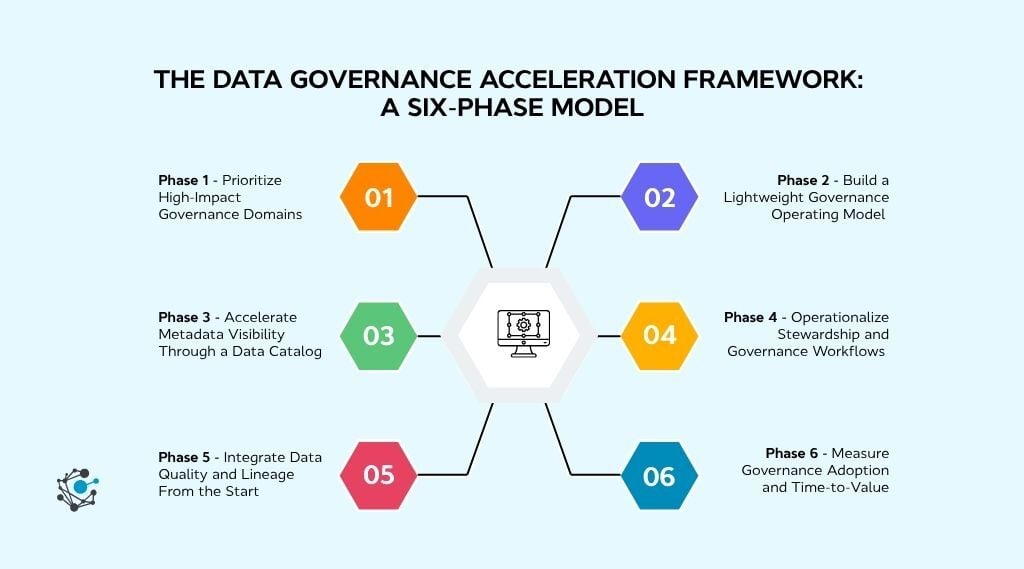
Phase 1: Prioritize high-impact governance domains
The fastest governance programs do not begin with the full enterprise landscape. They begin with a small set of high-impact domains.
Typical starting domains include:
-
Customer data
-
Financial reporting data
-
Regulatory reporting data
-
Product master data
-
Clinical or healthcare data
-
Supply chain data
Applying a data governance risk management lens here helps organizations prioritize governance investment based on operational importance, compliance exposure, and analytics dependency. A domain risk-value matrix is one practical way to score and sequence those priorities.
The primary deliverable in this phase is a governance priority map with named business owners assigned to each critical domain.
Phase 2: Build a lightweight governance operating model
Many governance initiatives become overly bureaucratic before operational momentum develops. Instead of creating large governance councils early, acceleration frameworks focus on building a lean and execution-oriented operating model.
The goal is to establish only the core governance roles required to support decision-making, accountability, and governance execution across priority domains.
A data governance team structured around these principles: lean, outcome-focused, with clear escalation paths, is what makes the difference between governance that moves and governance that stalls.
Minimum viable governance structure
-
Executive sponsor
-
Data owners
-
Data stewards
-
Governance lead
-
Escalation workflows
Key governance responsibilities to define early
|
Governance area |
Purpose |
|
Decision authority |
Clarifies who owns governance decisions |
|
Stewardship accountability |
Defines operational ownership for governed data |
|
Governance cadence |
Establishes review and decision timelines |
|
Issue escalation processes |
Defines how governance issues are resolved |
|
Policy approval ownership |
Identifies who approves governance standards |
The objective is operational clarity rather than committee expansion. Governance teams should focus on enabling faster execution, reducing approval bottlenecks, and improving accountability across governance activities.
Typical deliverables at this stage include a domain-scoped governance charter, role definitions, and a RACI model aligned to priority governance domains.
Phase 3: Accelerate metadata visibility through a data catalog
This phase is where governance becomes operationally visible.
Automated metadata ingestion significantly reduces the backlog associated with manual cataloging. Modern data catalogs ingest metadata directly from databases, BI tools, cloud platforms, pipelines, and analytics systems.
The catalog should be positioned as an operational governance layer rather than just a metadata repository. Modern enterprises increasingly rely on catalogs to connect governance activities, business context, and connected governance context across the data ecosystem.
The catalog becomes the operational governance hub, connecting metadata discovery, business glossary alignment, lineage visibility, stewardship accountability, asset certification, and governance context in one place.
OvalEdge's Data Catalog is purpose-built for this role, supporting automated metadata ingestion, business glossary management, and governance traceability across modern data environments.
The key deliverable at this stage is a cataloged priority domain with approved glossary terms, visible ownership structures, and governance traceability across critical data assets.
Phase 4: Operationalize stewardship and governance workflows
Governance only scales when stewardship becomes workflow-driven.
Governance programs become sustainable when governance workflows operate inside the flow of work rather than as separate compliance exercises managed through spreadsheets, tickets, and disconnected approval chains.
This phase operationalizes governance through
-
Issue management workflows
-
Stewardship assignments
-
SLA-based escalation paths
-
Certification approvals
-
Governance task automation
The goal is to integrate governance into day-to-day data activities instead of maintaining governance as a parallel administrative function.
As governance workflows become operationalized, stewardship activities become measurable, trackable, and easier to scale across business domains.
Typical deliverables at this stage include active stewardship workflows, issue resolution tracking, escalation management processes, and governance activity metrics.
Phase 5: Integrate data quality and lineage from the start
Many governance programs delay quality monitoring until later implementation phases. That delay often weakens governance credibility because organizations struggle to demonstrate measurable outcomes early.
Governance acceleration frameworks integrate automated data lineage tools and quality monitoring from the start, rather than treating them as later-phase additions.
Lineage visibility supports impact analysis, regulatory traceability, root-cause analysis, AI explainability, and pipeline transparency.
Quality monitoring creates visible proof that governance improves operational reliability.
Typical deliverables include:
-
Quality rules for priority domains
-
Lineage maps
-
Data quality scorecards
-
Issue remediation tracking
Phase 6: Measure governance adoption and time-to-value
Governance programs should define measurable KPIs before launch rather than after implementation. Clear governance metrics help organizations track operational adoption, demonstrate business impact, and identify areas requiring process improvement.
Governance adoption metrics typically include stewardship participation rate, glossary coverage, certified asset counts, metadata completeness, issue resolution time, and data quality improvement rates.
These operational metrics become more valuable when they are tied directly to measurable business outcomes, such as:
-
Faster reporting cycles
-
Reduced data reconciliation effort
-
Improved audit responsiveness
-
Reduced operational rework
This phase typically produces a governance scorecard reviewed on a recurring operational cadence to track adoption progress, governance effectiveness, and time-to-value across priority domains.
|
Additional resource for governance implementation planning Organizations looking for a more detailed implementation roadmap can also explore Ovaledge’s whitepaper on Implementing Data Governance: Framework & Best Practices. |
Rapid implementation roadmap: Data governance acceleration
Many organizations understand the strategic importance of governance but struggle with execution sequencing, ownership alignment, and time-to-value expectations.
A phased implementation roadmap helps governance teams operationalize governance incrementally, demonstrate measurable progress early, and scale governance adoption without overwhelming business and data teams.
Days 1–30: Assess, prioritize, and stand up governance foundations
The first month focuses on alignment and prioritization.
Core activities include:
-
Governance maturity assessment
-
Identification of executive sponsors
-
Appointment of domain owners
-
Initial stewardship assignments
-
Tool selection and configuration
-
Governance charter creation
The goal is not enterprise-wide coverage. The goal is operational readiness for the first governance domains.
Outputs should include:
-
Governance charter
-
Priority domain map
-
Initial stewardship structure
Days 31–90: Activate stewardship and drive early wins
This phase shifts governance from planning into execution.
Organizations typically begin:
-
Metadata ingestion
-
Catalog deployment
-
Glossary publication
-
Stewardship activation
-
Initial quality profiling
-
Lineage onboarding
Visible operational wins matter heavily during this stage because they reinforce executive confidence.
Deliverables often include the first actively governed business domain with measurable stewardship participation and quality indicators.
Days 91–180: Scale, measure, and demonstrate ROI
Once the initial governance pattern stabilizes, organizations expand governance to adjacent domains.
Key activities include:
-
KPI reporting formalization
-
Stewardship process refinement
-
Additional domain onboarding
-
Workflow optimization
-
Governance retrospectives
This phase also helps governance teams identify remaining friction points and operational bottlenecks.
Outputs include a governance scorecard and an expansion roadmap.
Beyond 180 days: Enterprise-wide governance operationalization
At this stage, governance begins transitioning toward broader operational maturity.
Organizations often evolve toward federated data governance structures where business units retain stewardship ownership while central governance teams maintain standards and coordination.
Governance also becomes increasingly embedded in:
-
Data product lifecycle management
-
AI pipeline governance
-
Analytics enablement
-
Access governance
-
Regulatory reporting operations
The result is a scalable governance operating model capable of supporting enterprise-wide data initiatives.
How AI and modern data platforms are reshaping governance speed
Governance acceleration is increasingly being shaped by AI-enabled metadata operations and modern governance platforms.
AI-assisted governance is valuable primarily because it reduces operational governance overhead across discovery, classification, lineage, stewardship, and policy management, helping lean governance teams scale governance coverage without proportional headcount growth.
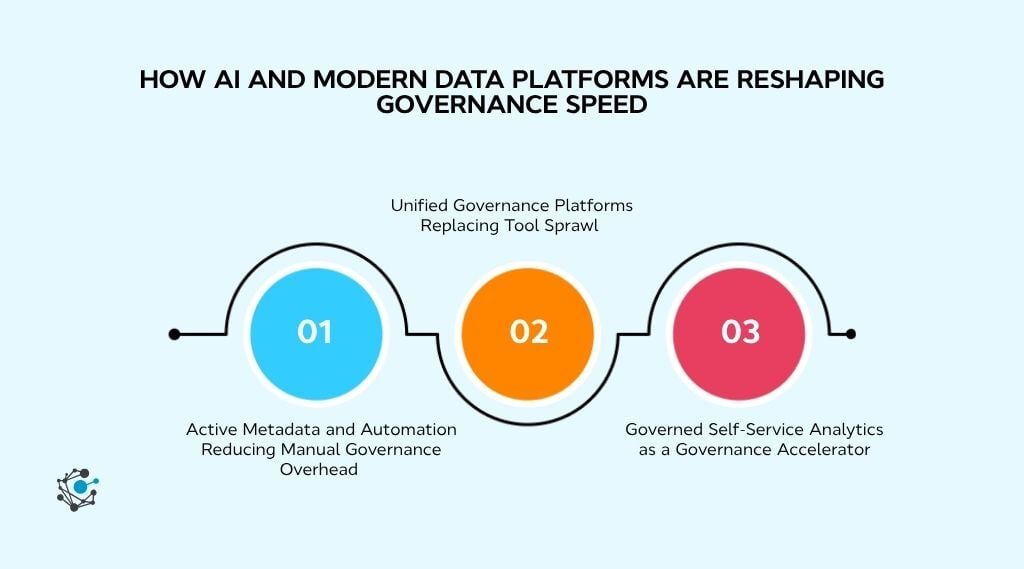
1. Active metadata and automation reducing manual governance overhead
AI-assisted governance operations are helping enterprises reduce the manual effort associated with governance administration and oversight.
Modern governance platforms increasingly support capabilities such as automated classification, metadata tagging, anomaly detection, relationship discovery, policy recommendations, and sensitive data identification.
These capabilities help governance teams reduce repetitive manual tasks while improving governance responsiveness across rapidly changing data environments.
This shift toward active metadata allows governance activities to operate more continuously rather than relying heavily on periodic documentation updates and manual governance reviews.
|
Do you know? Platforms such as askEdgi by OvalEdge are increasingly supporting governance acceleration through AI-assisted governance agents and reusable governance automation workflows embedded across crawl, curate, and consume lifecycle stages. Schedule a demo to explore how AI-assisted governance workflows can help reduce manual governance overhead across modern enterprise data environments. |
As governance environments become more dynamic, automation is increasingly becoming essential for scaling governance coverage efficiently across large enterprise data ecosystems.
2. Unified governance platforms replacing tool sprawl
Tool fragmentation remains a major governance bottleneck for many enterprises.
As governance environments grow, teams often spend significant time coordinating approvals, reconciling governance context, and managing governance activities across disconnected operational processes. This increases governance overhead and slows execution across analytics, compliance, and stewardship operations.
The difference between fragmented governance environments and connected governance operating layers becomes more visible as governance complexity increases across enterprise data ecosystems.
|
Fragmented governance environment |
Unified governance operating layer |
|
Governance context spread across disconnected systems |
Shared governance context across governance operations |
|
Teams manually reconcile metadata, lineage, and policy information |
Governance visibility is coordinated within a connected environment |
|
Governance approvals move through isolated tickets and spreadsheets |
Governance workflows operate through centralized operational processes |
|
Limited end-to-end governance traceability |
Continuous governance visibility across the data lifecycle |
|
Higher operational overhead for governance teams |
Reduced coordination effort and faster governance execution |
|
Governance accountability becomes inconsistent across environments |
Governance, ownership, and policies remain aligned across domains |
Unified governance platforms are increasingly being adopted to reduce governance fragmentation and operational overhead across modern enterprise data ecosystems.
3. Governed self-service analytics as a governance accelerator
Self-service analytics often exposes governance weaknesses quickly.
Without governance:
-
KPI definitions diverge
-
Reports conflict
-
Trust declines
-
Data duplication increases
With governance embedded directly into analytics environments, organizations can scale self-service analytics adoption more safely. Certified assets, glossary-aligned metrics, policy-enforced access controls, and lineage visibility help analytics teams move faster without sacrificing governance integrity.
In this model, governance becomes an operational enabler rather than a reporting bottleneck.
How to measure whether governance acceleration is working
Governance acceleration only matters if organizations can demonstrate measurable operational outcomes. Effective measurement frameworks should track both governance adoption and business impact over time.
-
Leading indicators of governance momentum: Stewardship participation rate, glossary coverage percentage, certified asset count, metadata completeness, and workflow closure rates help measure whether governance activities are gaining operational adoption across enterprise workflows.
-
Lagging indicators tied to business outcomes: Reduced reporting rework, faster audit response times, lower data validation effort, fewer governance escalations, and faster analytics delivery cycles help demonstrate measurable operational impact.
-
Governance maturity progression as a strategic signal: Most organizations evolve through governance stages such as Initial, Managed, Defined, and Optimized. Quarterly maturity reviews help leadership track governance progression over time, but maturity scoring becomes meaningful only when connected to measurable business outcomes.
Together, these indicators help organizations evaluate whether governance acceleration is producing measurable adoption, operational efficiency, and long-term governance scalability across enterprise data environments.
Conclusion
Governance acceleration is not about cutting governance corners. It is about sequencing governance correctly so organizations can operationalize trust, quality, accountability, and stewardship faster across modern data environments.
The most effective governance programs prioritize high-impact domains, automate metadata visibility early, and measure governance outcomes from the start to scale governance more sustainably.
Governance acceleration is not about governing more data faster. It is about building a governance operating model that can adapt to increasingly distributed, AI-driven, and complex enterprise ecosystems.
Organizations looking to accelerate governance execution can explore platforms such as OvalEdge to improve metadata visibility, lineage traceability, stewardship coordination, and governance scalability.

Schedule a demo to evaluate how governance workflows can be operationalized more efficiently across modern enterprise data environments.
The future of governance will belong to organizations that can operationalize trust as fast as they operationalize data.
FAQs
1. What is a data governance acceleration framework?
A data governance acceleration framework is a structured approach designed to operationalize governance faster across enterprise data environments. Instead of focusing only on policy creation, it prioritizes governance execution through metadata visibility, stewardship workflows, lineage, data quality, and measurable governance outcomes.
2. How do you accelerate enterprise data governance implementation?
-
Prioritize high-impact business domains instead of governing the entire data landscape at once
-
Establish lightweight governance roles and decision-making structures early.
-
Automate metadata ingestion, lineage visibility, and governance workflows
-
Measure governance adoption and business outcomes continuously from the beginning
3. What are the core components of a modern data governance acceleration strategy?
Core components typically include metadata management, business glossary alignment, data cataloging, lineage visibility, stewardship workflows, data quality monitoring, governance KPIs, certification processes, and governance operating models designed for scalable execution.
4. Does a governance acceleration framework work for both centralized and federated governance models?
Yes. The framework itself remains consistent, but the operating model influences how governance is scaled. Many organizations begin with centralized governance for initial domains and gradually transition toward federated governance as stewardship responsibilities expand across business units.
5. What is the difference between a governance acceleration framework and a governance maturity model?
A governance maturity model is diagnostic because it measures the current state of governance capabilities. A governance acceleration framework is prescriptive because it defines how organizations can operationalize governance and progress through maturity stages faster. The two approaches are complementary.
6. How does a data governance acceleration framework support AI readiness?
AI initiatives depend heavily on trusted, governed, and traceable data. A governance acceleration framework helps establish the foundational conditions required for responsible AI adoption through cataloged assets, lineage traceability, data quality controls, stewardship accountability, and governed access management.
.png?width=1081&height=173&name=Forrester%201%20(1).png)
.png?width=1081&height=241&name=KC%20-%20Logo%201%20(1).png)