Compare Best Decube alternatives for trusted data governance
See how Decube alternatives compare when your team needs trusted data, clearer ownership, automated lineage, quality workflows, and policy-backed access.
In this article
What are the best Decube alternatives?
The best Decube alternatives include OvalEdge, Collibra, Atlan, Alation, Monte Carlo, and Acceldata. Each platform fits a different buyer need, from governance execution to active metadata, data discovery, and observability.
-
OvalEdge: Best for unified data governance, cataloging, lineage, quality, access, and AI-driven stewardship.
-
Collibra: Best for large enterprises with mature governance, policy, and compliance programs.
-
Atlan: Best for active metadata, modern collaboration, and data team workflows.
-
Alation: Best for catalog adoption, data search, business glossary, and self-service discovery.
-
Monte Carlo: Best for data observability, incident detection, and data reliability.
-
Acceldata: Best for pipeline observability, data reliability, and platform-level monitoring.
The right choice depends on whether you need stronger governance execution, faster discovery, deeper observability, or broader business adoption.
Let’s compare these Decube competitors side by side.
Decube alternatives compared
Many organizations evaluate Decube to improve visibility into data trust issues through lineage, quality monitoring, metadata context, and observability. As governance maturity grows, teams often look for stronger ownership workflows, stewardship coordination, policy execution, and governed decision-making across business and technical users.
Here is a quick comparison of the top Decube alternatives:
|
Tool |
Deployment model |
Best for |
Core strength |
AI capability |
Limitation |
|
OvalEdge |
SaaS, private cloud, on-prem |
Governance-first teams |
Catalog + governance execution |
Agentic governance workflows |
Needs governance alignment |
|
Collibra |
Cloud |
Large enterprises |
Policy-led data governance |
Data and AI governance |
Heavier rollout |
|
Atlan |
Cloud |
Modern data teams |
Active metadata collaboration |
AI-powered discovery |
Less governance-operating depth |
|
Alation |
Cloud |
Catalog adoption |
Search and data discovery |
Agentic data intelligence |
Broader setup effort |
|
Monte Carlo |
Cloud, agent-based options |
Data reliability teams |
Data + AI observability |
Anomaly and root-cause automation |
Not governance-first |
|
Acceldata |
Cloud, hybrid, on-prem |
Data platform teams |
Pipeline and data observability |
Agentic data management |
Technical-team focus |
Each tool solves a different part of the data trust problem. The best fit depends on whether your team needs governance execution or operational reliability first.
What users say about Decube
Decube is commonly used by data teams that want cataloging, observability, lineage, quality monitoring, and governance in one platform. It is positioned around data trust for AI-era data teams, with catalog, lineage, quality, and observability working together.
Decube works well for teams that want clearer data health signals, tighter reliability workflows, and observability built for modern data operations. Despite this, users on review pages like G2 and Capterra mention that it may not fit every governance program, especially when teams need deeper operating workflows across business users, stewards, policy owners, and compliance teams.
Strengths users mention
-
Unified data visibility: Users value having cataloging, lineage, quality, and observability connected in one environment.
-
Reliability workflows: Decube is seen as useful for detecting data issues, monitoring pipelines, and supporting operational follow-through.
-
Operational trust visibility: Its metadata, lineage, and observability capabilities help technical teams understand where trust issues appear.
-
Modern observability positioning: Decube fits teams that want a newer data trust platform built around reliability, monitoring, and AI-era data readiness.
Limitations users mention
-
Governance can feel observability-led: Decube supports governance, but its strongest positioning centers on reliability, monitoring, and operational trust.
-
Less suited for broad governance programs: Teams may need deeper stewardship workflows, certification processes, and governance accountability.
-
Technical-team orientation: The platform appears more aligned with data engineering, analytics engineering, and platform teams.
-
Enterprise participation may need evaluation: Broad governance adoption often involves stewards, domain owners, compliance teams, and business users.
-
AI is focused on trust and operations: Buyers looking for AI-led governance execution may need a platform built around agentic stewardship.
That is why the next section groups Decube alternatives by use case, so buyers can compare tools based on what they need most.
Best Decube alternatives by platform type
Decube brings data observability, lineage, quality, and metadata visibility into a modern data trust platform. But not every buyer looking for a Decube alternative has the same priority. Some teams need governance execution, some need faster discovery, and others need deeper reliability monitoring.
The following alternatives are grouped by the type of problem they solve best.
Tools for governance-first data management
This group is best for organizations that need governance to work across people, policies, data assets, and business teams. It fits buyers who want to move beyond trust signals and build a repeatable governance operating model.
1. OvalEdge
OvalEdge is a unified data governance platform that brings data cataloging, business glossary, automated lineage, data quality, privacy, access control, and AI-driven stewardship workflows into one place. It is designed for enterprises that want governed data to become easier to find, understand, approve, and use across teams.
What is it used for
OvalEdge is used to operationalize data governance across complex data environments. Teams use it to catalog assets, assign ownership, manage glossary terms, trace lineage, monitor quality, classify sensitive data, enforce access policies, and give business users trusted answers through askEdgi.
When buyers choose it over Decube
Buyers usually evaluate OvalEdge over Decube:
1. When data trust needs clear ownership
Decube is a strong fit when data teams want observability, quality checks, metadata visibility, lineage, and reliability signals in one platform. That makes sense for teams trying to reduce data incidents and improve trust in operational pipelines.
OvalEdge becomes the stronger fit when the question changes from “Can we trust this data?” to “How do we govern this data every day?” That means assigning owners, routing approvals, certifying assets, managing policies, and tracking stewardship activity across teams.
2. When business users need to participate
Decube’s strongest positioning is technical and operational. Its messaging focuses on monitors, incidents, anomalies, data contracts, lineage, and AI readiness. That is valuable for data engineering and platform teams.
OvalEdge extends trusted data use into business-facing workflows. Business glossary, stewardship, data literacy, governed access, data products, and askEdgi help non-technical users work with trusted data without depending on data teams for every question.
3. When AI needs governed context
Decube supports AI readiness through trusted metadata, lineage, quality, and observability. OvalEdge adds an operating layer for trusted AI use.
Its agentic model uses AI agents to discover assets, enrich metadata, classify sensitive data, infer lineage, detect quality debt, route decisions, and support human review. This helps governed operations keep moving while stewards stay in control.
What changes after adoption
After OvalEdge adoption, teams get a repeatable operating process for trusted data. Teams get one place to manage data assets, ownership, glossary terms, lineage, quality rules, classifications, policies, and access requests. That changes how ownership, policy administration, and stewardship coordination move across the organization.
Key changes include:
-
Clearer ownership: Data owners and stewards can be assigned directly to assets.
-
Faster impact analysis: Auto lineage helps teams understand downstream impact before changes are made.
-
Stronger policy execution: Governance rules can connect to workflows and access decisions.
-
Better business adoption: Glossary terms, trusted assets, and governed answers help business users use data with more confidence.
Bayview’s case shows this shift clearly. After adopting OvalEdge with Matillion during its Snowflake migration, Bayview improved data quality monitoring, identified errors in minutes, reduced hands-on data management work, and made its governance environment easier for business users to work with.
AI governance and automation capabilities
OvalEdge uses AI to reduce the manual work that usually slows governance workflows. Its agentic model helps teams discover data, enrich metadata, classify sensitive information, infer lineage, and route tasks for human review.
Core AI capabilities include:
-
AI-curated catalog: Keeps metadata organized and easier to maintain.
-
AI-assisted lineage: Infers lineage and flags lower-confidence paths for manual review.
-
Data quality automation: Detects quality debt and helps suggest governance rules.
-
Sensitive data classification: Supports privacy and access workflows.
-
askEdgi: Gives users governed answers based on approved metadata and business definitions.
This makes OvalEdge useful when teams need automation, but still want humans to review important decisions.
Things to consider
OvalEdge is a strong fit when your organization wants governance to become part of daily data work. It works best when you already have clear goals around ownership, stewardship, privacy, access, or AI readiness.
Consider OvalEdge if:
-
You need ownership workflows, not just metadata visibility.
-
Business users need trusted data access.
-
Stewards need help with reviews and approvals.
-
Your team wants lineage, quality, and policy context together.
If your immediate priority is only pipeline monitoring, a dedicated observability tool may feel more focused.
Ratings, reviews, and analyst validation
OvalEdge has strong validation across review and analyst sources.
- G2 lists OvalEdge at 5.0 out of 5, with users mentioning reduced data search time and better end-to-end data management.
- Gartner Peer Insights lists OvalEdge at 4.7 out of 5, and users highlight the data catalog, business glossary, support quality, customization, and AI-enabled term association.
- TrustRadius shows OvalEdge with a 10.0 out of 10 score, with users highlighting auto lineage, impact analysis, metadata propagation, API support, and customer support.
The platform is also recognized in the 2025 Gartner Magic Quadrant and SPARK Matrix for its data management and governance capabilities.
Forrester TEI impact:A useful proof point for buyers evaluating governance ROI: a Forrester Total Economic Impact study reported 337% ROI and payback in under 6 months for organizations adopting OvalEdge. The study also found lower cataloging effort, better analyst productivity, faster sensitive data discovery, and reduced compliance risk. For buyers, the value is clear: less manual effort, faster access to trusted data, and measurable impact after rollout. |
See how OvalEdge compares in your environment
If you are evaluating Decube alternatives, OvalEdge is worth a closer look. Explore how OvalEdge fits your architecture, governance needs, and rollout plan.
2. Collibra
Collibra is a data and AI governance platform for enterprises that need cataloging, policy management, data quality, lineage, privacy, and governance workflows in one environment. It is often evaluated by teams with formal governance programs.
What is it used for
Collibra is used to centralize data governance work across business and technical teams. Organizations use it to manage catalogs, business glossaries, stewardship processes, data quality rules, privacy controls, AI governance, and trusted data access across connected systems.
When buyers choose it over Decube
Buyers usually evaluate Collibra over Decube when governance needs to be formalized across a large enterprise.
It fits teams that need:
-
Policy-led governance: Collibra centralizes policies, workflows, and governance rules for regulated data programs.
-
Enterprise operating models: Teams can define domains, roles, responsibilities, and stewardship processes.
-
Data and AI control: Collibra’s AI Command Center focuses on visibility, trust signals, traceability, and AI oversight.
What changes after adoption
After adoption, Collibra gives teams a more structured way to manage governance activities. Instead of treating cataloging, policy work, quality checks, and stewardship as separate efforts, teams can connect them through shared workflows.
Common changes include:
-
Clearer governance ownership: Teams can assign roles and responsibilities across domains.
-
Standardized definitions: Glossary and catalog features help reduce inconsistent data interpretation.
-
Better policy control: Governance teams can document policies and connect them with governed data assets.
AI and automation capabilities
Collibra’s AI capabilities focus on governing AI systems and making enterprise data usable for AI programs. Its AI Command Center supports real-time visibility, trust signals, automated traceability, and risk oversight for AI use cases.
Its automation capabilities include:
-
Workflow automation: Teams can automate governance approvals and stewardship tasks.
-
Quality automation: Adaptive rules support data quality monitoring.
-
Traceability: AI and data flows can be documented for oversight.
Things to consider
Collibra may require more planning than teams expect, especially when governance ownership is still unclear. The platform fits large programs better when processes, roles, and data domains are already defined.
Key considerations:
-
Implementation effort: Setup can take time across domains, workflows, and integrations.
-
Learning curve: Users may need training to understand the model and terminology.
-
Adoption risk: Governance work can sit outside daily data workflows if teams do not actively embed it.
Ratings and reviews
Collibra has a 4.2 out of 5 rating on G2 and an 8.1 out of 10 score on TrustRadius. Users mention governance coverage, centralized metadata, workflow support, and business glossary management as positives. Common concerns include setup effort, a learning curve for new users, performance issues in some environments, and the amount of configuration needed before teams see value.
Users positively point to Collibra’s governance depth and enterprise fit, but also mention slow rollout, heavy administration, and lower day-to-day adoption when business users are not actively involved.
Also read → Comparing Collibra alternatives in 2026? Compare tools before you buy
|
Did you know? In 2025, 54% of governance modernization efforts focus on embedding governance into workflows and increasing automation, according to the 2025 State of Enterprise Data Governance report. That is why governance-first tools matter. They help teams move from policy documentation to daily execution. |
Tools for active metadata and data discovery
This group fits teams that want a better way to find, understand, and use data across a modern stack. These platforms are usually evaluated when buyers need stronger discovery, richer metadata context, and smoother collaboration between data producers and consumers.
3. Atlan
Atlan is an active metadata platform that helps data teams connect cataloging, lineage, collaboration, and governance context. It is positioned as a context layer for enterprise AI and trusted data use.
What is it used for
Atlan is used to help teams discover data, understand lineage, document assets, manage business context, and collaborate inside existing data workflows. It also supports AI use cases by connecting data assets with definitions, policies, lineage, and certified context.
When buyers choose it over Decube
Buyers usually evaluate Atlan over Decube when metadata collaboration and discovery matter more than reliability monitoring alone.
It fits teams that need:
-
Active metadata workflows: Metadata can move across tools and help teams understand data in context.
-
Collaboration inside daily tools: Data users can document, discuss, and find assets without relying only on a central catalog.
-
AI context layer: Atlan connects business definitions, lineage, and access policies to support trusted AI outputs.
What changes after adoption
After adoption, Atlan can make catalog usage more natural for data teams that already work across modern cloud tools. The main shift is better metadata visibility in the places where users work.
Common changes include:
-
Faster discovery: Users can find assets with richer technical and business context.
-
Clearer lineage: Teams can trace data movement and understand downstream impact.
-
More collaborative documentation: Ownership, notes, and context can be maintained closer to daily workflows.
AI and automation capabilities
Atlan’s AI features focus on documentation, discovery, and contextual answers for data teams. Its public materials describe Atlan AI as a copilot that can document tables, support natural-language exploration, and answer questions about the data stack.
Automation is mainly used for:
-
Metadata enrichment: Tags and context can be propagated through hierarchy and lineage.
-
Workflow support: Teams can automate parts of documentation and governance routines.
-
AI-ready context: Business definitions and policies help reduce unsupported AI responses.
Things to consider
Atlan works best when teams are ready to maintain metadata as part of their daily data work. Without clear ownership, catalog content can become stale even if the interface is easy to use.
Key considerations:
-
Governance depth: Teams with complex policy execution needs may need to assess workflow depth carefully.
-
Data quality coverage: Atlan notes that PII detection and data issue detection often require connected tools.
-
Sales-to-delivery fit: Buyers should validate implementation scope, support expectations, and promised outcomes before rollout.
Ratings and reviews
Atlan has a 4.5 out of 5 rating on G2 and 4.6 average rating on Gartner reviews. Users mention ease of use, intuitive search, collaboration, lineage, and integration experience as positives. Common concerns include a learning curve for new users, support expectations, and the need to configure metadata routines well before the catalog becomes useful.
Users on Reddit call out concerns around sales expectations, slower support response times, and whether the platform delivers enough value for the cost. Positive comments are more limited, but some users still acknowledge Atlan’s catalog and collaboration fit for metadata-heavy teams.
Also read → Looking for Atlan alternatives in 2026? Start comparing platforms here | Compare OvalEdge vs Alation vs Collibra vs Informatica side-by-side
4. Alation
Alation is an agentic data intelligence platform focused on data discovery, cataloging, governance, lineage, and quality. It helps teams create a shared knowledge layer for trusted analytics and AI use.
What is it used for?
Alation is used to help users find data, understand business context, view lineage, and collaborate around trusted assets. Its catalog brings metadata, business definitions, lineage, and governance context into one searchable environment.
When buyers choose it over Decube
Buyers usually evaluate Alation over Decube when catalog adoption and data discovery are the main priorities. It fits teams that want a searchable catalog experience with business context.
Key reasons include:
-
Search-led discovery: Users can find relevant data with metadata, definitions, usage context, and popularity signals.
-
Business-user adoption: Alation’s catalog helps business and technical users work from shared data context.
-
Governance context: Policies, glossary terms, and lineage can support trusted data use.
What changes after adoption
After adoption, Alation gives teams a more organized way to discover and interpret data. The main shift is from scattered knowledge to a catalog-led experience.
Common changes include:
-
Better data discovery: Users can search assets with technical and business context in one place.
-
More consistent definitions: Glossary and catalog content help reduce conflicting interpretations.
-
Improved collaboration: Data owners and consumers can add context around trusted assets.
AI and automation capabilities
Alation’s AI and automation capabilities focus on discovery, documentation, governance support, and trusted data use. Its platform messaging highlights agentic workflows that help automate documentation, policy enforcement, and data product delivery.
Useful capabilities include:
-
Behavioral intelligence: Usage patterns can help users identify relevant assets.
-
AI-assisted discovery: Natural-language support helps users explore catalog content.
-
Governance automation: Workflows can support policies, stewardship, and data quality routines.
Things to consider
Alation works best when catalog adoption is the main goal. Teams with heavier governance execution needs should assess workflow depth, quality coverage, and implementation effort carefully.
Key considerations:
-
Lineage expectations: Some users note that lineage can need improvement around integration and performance.
-
Governance depth: Buyers should validate how far policy execution and stewardship workflows go.
-
Adoption dependency: The catalog needs ongoing ownership to stay useful.
Ratings and reviews
Alation has a 4.6 out of 5 rating on Gartner Peer Insights and G2 users commonly mention its user-friendly interface, search experience, catalog structure, and collaboration benefits. Review summaries also note concerns around lineage depth, integration behavior, and performance in some use cases.
On Reddit, users describe Alation as easier to understand than more formal governance tools. They also point to trade-offs around feature depth, automation maturity, and lineage experience, especially for teams expecting deeper governance execution.
Also read → Looking for Alation alternatives? Compare top tools in 2026 | Compare OvalEdge vs Alation vs Collibra vs Informatica side-by-side
Evaluate Decube alternatives with agentic analytics and governance frameworks
Understand how agentic analytics accelerates data governance through AI-driven workflows, real-time insights, and governed self-service. This whitepaper shows how teams operationalize governance for analytics and AI readiness.
Tools for data observability and reliability
This group fits teams that care most about data downtime, freshness issues, pipeline failures, and incident response. These platforms are usually evaluated by data engineering, analytics engineering, and platform teams that need deeper monitoring before they expand into broader governance workflows.
5. Monte Carlo
Monte Carlo is a data and AI observability platform that helps teams detect, triage, and resolve data reliability issues across warehouses, lakes, ETL, BI, and AI systems.
What is it used for
Monte Carlo is used to monitor data health across modern data stacks. Teams use it to detect freshness, volume, schema, quality, and lineage issues before they affect dashboards, downstream workflows, or AI applications.
When buyers choose it over Decube
Buyers usually evaluate Monte Carlo over Decube when observability depth is the primary requirement. It fits teams that want dedicated monitoring for data and AI reliability.
Key reasons include:
-
Incident detection: Monte Carlo focuses on finding data issues before users report them.
-
Root-cause analysis: Lineage and monitoring context help teams understand where issues started.
-
AI observability: The platform extends monitoring into AI systems, including inputs, outputs, drift, and reliability.
What changes after adoption
After adoption, teams get a clearer operating process for data incidents. Instead of waiting for broken dashboards or failed reports, they can monitor data health continuously.
Common changes include:
-
Earlier alerts: Teams can detect freshness, volume, and schema issues sooner.
-
Clearer impact context: Lineage helps show which assets may be affected.
-
Faster triage: Monitoring signals help teams prioritize issues that matter most to users.
AI and automation capabilities
Monte Carlo uses machine learning and AI agents to support data quality operations. Its documentation says AI Agents help teams identify issues faster, understand root causes, and improve monitoring coverage.
Automation is mainly used for:
-
Monitor coverage: The platform can learn data patterns and surface unusual changes.
-
Incident triage: AI agents help explain problems and guide investigation.
-
AI reliability: Data and AI observability helps teams monitor model inputs, outputs, and performance risk.
Things to consider
Monte Carlo is a better fit for observability than full governance execution. Teams should evaluate whether they need monitoring alone or a broader system for stewardship, ownership, approvals, access, and policy workflows.
Key considerations:
-
Governance coverage: It is not designed as a governance-first platform.
-
Cost fit: Buyers should validate pricing against data volume and monitoring scope.
-
Team fit: It works best when data engineering teams own incident response.
Ratings and reviews
Monte Carlo has a 4.6 average rating on Gartner Peer Insights. Users mention alerting, visibility into data incidents, ease of deployment, service, and support as positives. Review feedback also points to concerns around pricing, alert noise, and the need to tune monitors so teams do not chase low-impact issues.
On Reddit, users describe Monte Carlo as useful for enterprise-scale observability when budget is available. Concerns center on cost, fit for smaller teams, and whether its managed experience is worth the trade-off against lighter tools.
6. Acceldata
Acceldata is an agentic data management platform for data observability, governance, runtime control, and secure access across cloud, hybrid, and on-premise data environments.
What is it used for
Acceldata is used to monitor data pipelines, infrastructure, data quality, usage, and reliability across complex data environments. Teams use it to detect anomalies, troubleshoot jobs, control compute costs, and improve trust in data operations.
When buyers choose it over Decube
Buyers usually evaluate Acceldata over Decube when reliability needs extend beyond data quality and catalog visibility into platform-level monitoring.
It fits teams that need:
-
Hybrid data visibility: Acceldata supports observability across cloud, hybrid, and on-premise environments.
-
Pipeline and infrastructure context: Teams can monitor jobs, data movement, and compute behavior in one place.
-
Operational control: The platform also supports workflow routing, scheduling, retries, and runtime management.
What changes after adoption
After adoption, teams gain more visibility into how data systems behave across pipelines, workloads, and infrastructure. This helps technical teams connect reliability issues with operational causes.
Common changes include:
-
Earlier anomaly detection: Teams can identify unusual changes before downstream users are affected.
-
Better workload visibility: Pipeline and job-level context helps explain failures faster.
-
Cost awareness: Usage and compute insights can support better resource planning.
AI and automation capabilities
Acceldata positions its platform around autonomous data and agentic AI. Its ADM platform includes xReasoning for continuous understanding of the data estate, xObserve for observability, xGovern for cataloging, and xRoute for workflow automation.
Automation is used for:
-
Anomaly detection: AI helps identify unusual data and pipeline behavior.
-
Root-cause analysis: Teams can trace issues to pipeline, system, or workload changes.
-
Workflow automation: Scheduling, dependencies, and retries support operational recovery.
Things to consider
Acceldata is more technical-team oriented than business-governance oriented. It fits data platform teams that need reliability, infrastructure visibility, and operational control.
Key considerations:
-
Governance depth: Buyers should validate stewardship, policy, and business glossary requirements.
-
User fit: Non-technical stakeholders may face a learning curve.
-
Scope control: Broad platform monitoring can require clear ownership to avoid alert overload.
Ratings and reviews
Acceldata has a 4.4 out of 5 rating on G2. Users mention real-time insights, data operations visibility, support quality, and observability coverage as positives. Review feedback also points to a learning curve for non-technical users, scope complexity, reporting improvements, and user interface refinements as areas to evaluate.
Acceldata is discussed for broader data observability needs, especially where teams want visibility across pipelines and operational health. Concerns are more practical: buyers question setup effort, pricing fit, and whether the platform is necessary if the team only needs lightweight monitoring.
Not sure which Decube alternative fits your use case?
Get a tailored walkthrough based on your data stack and governance needs.
OvalEdge vs Decube: Side-by-side comparison
Decube and OvalEdge both help teams improve data trust, but they approach the problem differently. Here’s a practical comparison of the two tools side-by-side:
|
Evaluation factor |
OvalEdge |
Decube |
|
Positioning |
Governance-first data intelligence platform |
Data trust and observability platform |
|
Governance execution |
Owners, stewards, approvals, policies, and workflows |
Governance through metadata, quality, and trust signals |
|
Data catalog |
Governed catalog with glossary, ownership, and access context |
Catalog for discovery and metadata visibility |
|
Lineage |
Auto lineage for impact analysis and governance decisions |
Column-level lineage for trust and root-cause analysis |
|
Data quality |
Quality rules tied to ownership and remediation |
Quality monitoring tied to reliability signals |
|
Observability |
Supports governance context around data reliability |
Core focus on monitoring and issue detection |
|
AI capability |
Agentic governance, askEdgi, AI lineage, and policy automation |
AI for trust, monitoring, Text2SQL, and metadata context |
|
Setup effort |
Best when governance roles are defined early |
Best when data teams lead operational rollout |
|
User adoption |
Built for stewards, business users, and data teams |
More natural for engineering and platform teams |
|
Pricing fit |
Better fit for broad governance participation |
Pricing scales by users, monitors, AI queries, and sources |
|
Best use case |
Operationalizing governance across the enterprise |
Improving data reliability and operational trust |
|
Best fit |
Teams that need governance execution, not just visibility |
Teams focused on observability and data trust monitoring |
Where each fits:
Decube gives teams visibility into data trust through observability, quality monitoring, lineage, metadata context, and issue detection. That works well when the goal is to understand data health and reduce operational data incidents.
OvalEdge turns that trust layer into a governance operating model. It connects catalog, lineage, quality, privacy, access, ownership, stewardship, approvals, and AI-led governance workflows so teams can move from monitoring issues to governing action.
See what governance execution looks like with OvalEdge
If Decube helps your team understand where data trust issues exist, OvalEdge helps you turn those signals into governed action across owners, stewards, policies, quality, privacy, access, and AI workflows.
How to choose the right Decube alternative
Before you compare platforms, get clear on what you want to improve after Decube. A team trying to reduce data incidents will need a different platform than a team trying to scale governance across owners, stewards, policies, and business users.
1. Start with the main problem you need to solve
If your issue is broken pipelines, freshness gaps, or recurring data incidents, prioritize observability depth. If your issue is unclear ownership, weak stewardship, poor glossary adoption, or manual policy work, look for a governance-first platform.
2. Check how governance actually gets executed
Do not stop at whether the platform has a catalog, lineage, and policies. Look at whether it lets teams assign owners, route approvals, certify assets, manage access, track remediation, and keep governance work moving after issues are found.
3. Evaluate who the platform is built for
Some Decube alternatives are designed mainly for data engineering and platform teams. Others support business users, stewards, compliance teams, and domain owners. The right fit depends on who needs to use the platform every week.
4. Look closely at AI capabilities
AI features should do more than summarize metadata or answer catalog questions. For governance-led teams, AI should help classify data, enrich assets, surface quality debt, suggest rules, support lineage, and keep human reviewers in control.
5. Compare adoption and pricing together
A platform may look affordable for a small technical team but become harder to scale when governance needs broader participation. Review how pricing changes as you add stewards, analysts, business users, data sources, monitors, and AI usage.
A good Decube alternative should not only show you where data trust issues exist. It should help your team decide who owns the issue, what action comes next, and how governance becomes easier to repeat.
Make AI governance easier to run
Gartner found that 70% of CDAOs now own AI strategy and operating models. That puts pressure on teams to make data trusted, traceable, and ready for responsible AI use.
If AI is becoming part of your data team’s responsibility, OvalEdge helps you govern the data, ownership, access, and policies behind it.
Where OvalEdge stands out among Decube competitors
Many teams start with observability and data trust platforms to improve reliability and reduce data incidents. As their programs mature, the next question becomes how ownership, stewardship, approvals, access policies, and accountability work alongside those trust signals.
That is where OvalEdge stands out. It helps teams turn data trust into governed operations that business and technical users can act on every day.
1. It connects governance with measurable business value
OvalEdge’s strongest validation comes from the Forrester Total Economic Impact study. The study reported 337% ROI, $3.2 million in three-year benefits, $2.5 million NPV, and payback in under 6 months for a composite organization using OvalEdge.
Forrester also found up to 40% lower effort for metadata cataloging, data requests, and lineage work. That matters when teams need governance to reduce manual effort, not add more review cycles.
2. It turns governance into work people can actually complete
Decube is useful for surfacing data trust issues through observability, quality monitoring, lineage, and metadata intelligence. OvalEdge takes the next step by helping teams act on those signals through owners, stewards, policies, approvals, remediation workflows, privacy controls, and governed access.
Gartner describes OvalEdge as an AI-enhanced data catalog and end-to-end governance platform with catalog, lineage, glossary, quality rules, remediation, privacy compliance, classification, and access governance.
3. It supports business users, not only technical teams
Reviews show that users value OvalEdge for making data easier to find and trust. On G2, a user reports that time spent searching for data dropped from 70% to 5% after using OvalEdge. TrustRadius users highlight ease of use, data governance capability, and customer service, while Gartner lists OvalEdge at 4.7 stars in verified reviews.
4. It has independent analyst validation
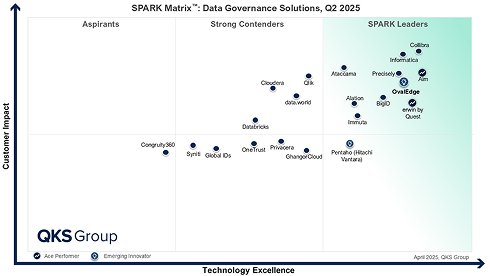
OvalEdge’s Forrester page highlights its recognition as a Leader in the SPARK Matrix for Data Governance Solutions 2025 and as a Niche Player in the 2025 Gartner Magic Quadrant for Data and Analytics Governance Platforms. The same page notes reference customer feedback around service, support for custom requirements, time to value, and business-user empowerment.
5. It brings AI into governance execution
OvalEdge’s AI story centers on reducing manual governance work. Its agents support catalog curation, lineage inference, quality-debt detection, sensitive data classification, access automation, and governed answers through askEdgi. The goal is practical: help stewards review and approve faster while keeping governance decisions anchored in trusted metadata.
Together, these proof points make OvalEdge a stronger fit for buyers who want data trust to move beyond issue detection and become repeatable governance action. Book a demo today.
Turn trusted data into governed action
OvalEdge helps teams connect owners, policies, lineage, quality, and access workflows so governance moves from manual follow-up to repeatable action.
Frequently asked questions
1. What is the best Decube alternative?
OvalEdge is one of the best Decube alternatives for teams that need governance, cataloging, lineage, quality, privacy, and access in one platform. It fits best when teams want to move from data trust visibility to governance execution.
2. Is OvalEdge a good alternative to Decube?
Yes, OvalEdge is a good Decube alternative for organizations that need more than data monitoring and metadata visibility. It helps teams connect trusted data with owners, workflows, approvals, lineage, quality checks, and access controls.
3. How does OvalEdge compare with Decube?
Decube focuses heavily on data trust, observability, lineage, data quality, and operational reliability. OvalEdge takes a governance-first approach by connecting cataloging, stewardship, ownership, privacy, access, lineage, quality, and AI-led governance workflows.
4. Which Decube alternative is best for data governance?
OvalEdge is a strong fit for governance-first teams because it connects cataloging, glossary, lineage, quality, privacy, and stewardship. Collibra is also relevant for large enterprises with formal governance programs.
5. Which Decube alternative is best for data observability?
Monte Carlo and Acceldata are more focused on data observability, incident detection, and pipeline reliability. OvalEdge is a better fit when observability needs to connect with governance workflows, ownership, access, and policy enforcement.
6. What should buyers look for in a Decube alternative?
Buyers should first decide whether they need observability depth, governance execution, or better data discovery. Then compare how each platform handles ownership, lineage, quality, access, AI support, pricing, and adoption across business and technical teams.
Choosing a Decube alternative? Start here
- Need governance action beyond data trust signals?
- Want catalog, lineage, quality, and access together?
- Do owners and stewards need clear workflows?
- Should business users find trusted data faster?
- Need AI governance your team can control?
Implement data governance faster with a proven framework
Access a practical 5-step framework used across real deployments to scope, prioritize, and implement governance without over-engineering.
Learn how to identify high-impact use cases and apply AI and automation to reduce manual effort.
Proven by customer successes across industries
.png?width=151&height=151&name=Mask%20group%20(18).png)
How Delta Community Credit Union enhanced its data governance with OvalEdge
"We have seen dramatic results across the board by implementing these programs, centralizing our metadata with the OvalEdge data catalog, and enabling self-service data education."
Dr. Su Rayburn
Vice President, Information Management & Analytics

.png?width=151&height=151&name=Mask%20group%20(19).png)
Bedrock leverages OvalEdge to standardize definitions, improve data accuracy
"OvalEdge stands out for its holistic approach, providing everything from business glossary to data lineage, all seamlessly integrated. The auto-lineage feature saves us months of work, enabling us to quickly understand data flows and address issues at the source.”
Sergei Vandalov
Senior Manager, Data Governance & Analytics

.png?width=151&height=151&name=Mask%20group%20(20).png)
Gousto’s continued data governance journey to deliver exceptional customer experience
“Incorrect pricing, nutritional or allergen information can disrupt the customer experience. With quality data at every stage, Gousto aligns its customer promise with operational excellence.”
Cathy Pendleton
Senior Manager - Data Governance
OvalEdge Recognized as a Leader in Data Governance Solutions
.png?width=1081&height=173&name=Forrester%201%20(1).png)
“Reference customers have repeatedly mentioned the great customer service they receive along with the support for their custom requirements, facilitating time to value. OvalEdge fits well with organizations prioritizing business user empowerment within their data governance strategy.”
.png?width=1081&height=241&name=KC%20-%20Logo%201%20(1).png)
“Reference customers have repeatedly mentioned the great customer service they receive along with the support for their custom requirements, facilitating time to value. OvalEdge fits well with organizations prioritizing business user empowerment within their data governance strategy.”
Gartner, Magic Quadrant for Data and Analytics Governance Platforms, January 2025
Gartner does not endorse any vendor, product or service depicted in its research publications, and does not advise technology users to select only those vendors with the highest ratings or other designation. Gartner research publications consist of the opinions of Gartner’s research organization and should not be construed as statements of fact. Gartner disclaims all warranties, expressed or implied, with respect to this research, including any warranties of merchantability or fitness for a particular purpose.
GARTNER and MAGIC QUADRANT are registered trademarks of Gartner, Inc. and/or its affiliates in the U.S. and internationally and are used herein with permission. All rights reserved.