.jpg)
What happens when a governance program that worked perfectly for one team gets handed to the rest of the enterprise?
In most cases, it breaks. A small group catalogs critical datasets, defines ownership, enforces access rules, and reports clean results to leadership. The pilot runs well. Then the organization tries to roll it out across business units and regions. Policies can't keep up. Stewardship falls to whoever has time. Enforcement lives in meetings nobody attends.
The problem isn't effort or intent. It's that pilot-stage mechanisms simply don't hold under enterprise data governance at scale, where thousands of users, petabyte-scale data, and overlapping regulations change the game entirely.
This guide covers why that breakdown happens, the four pillars that hold governance together at scale, how to choose the right operating model, and how to measure whether it's actually working.
What is enterprise data governance at scale?
Enterprise data governance at scale is the organization-wide system of policies, roles, and automated controls that keeps data accurate, secure, and compliant across every business unit, region, and data domain. It moves governance from a set of documented rules into the systems where data actually gets created, accessed, and shared.
What separates a scalable data governance program from a limited one is operational reach: hundreds of data sources, multiple regulatory jurisdictions, and enforcement that runs inside daily workflows rather than alongside them.
Enterprise governance vs. team-level governance
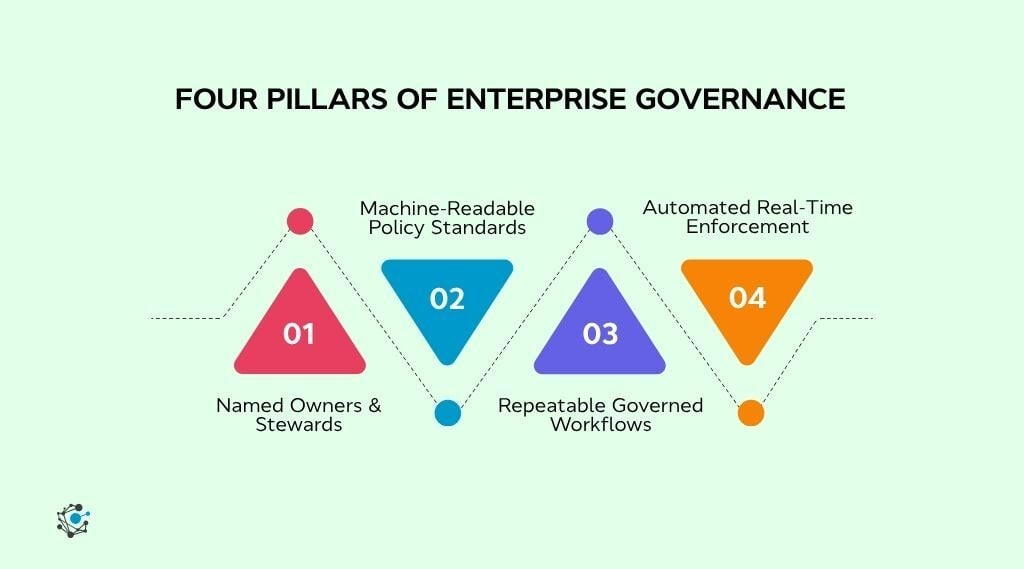
Team-level governance depends on people knowing the rules. Enterprise governance builds those rules into the infrastructure.
That shift rests on four interdependent pillars:
-
People & Accountability: named data owners, stewards, and custodians with clear decision rights across every domain
-
Policy & Standards: classification schemas, data contracts, and usage rules that are machine-readable, not just documented
-
Process & Workflow: repeatable intake, access requests, schema-change management, and escalation paths
-
Technology & Automation: catalogs, lineage, automated classification, and real-time policy enforcement
When any one of these pillars is missing or underfunded, governance programs stall, especially during the shift from pilot to enterprise-wide rollout.
Why governance breaks down beyond the pilot stage
Most organizations misdiagnose the problem. They assume governance failed because people didn't follow the rules. In practice, the rules were never built into the systems where data actually moves.
The pilot-to-enterprise gap
Pilot-stage governance works because a small team can manually enforce policies across a limited scope. The moment governance scales to multiple business units, regulatory jurisdictions, and data platforms, that manual model collapses. The gap isn't about volume alone. It's about governance living in documents and meetings instead of inside the data workflows themselves.
Five common failure points at scale
These five failure points surface when governance operates as a layer on top of data workflows rather than inside them.
|
Failure Point |
Root Cause |
Business Impact |
How to Prevent It |
|
Siloed enforcement |
No shared policy source across domains |
Conflicting rules on the same data |
Centralize policy, automate execution |
|
No downstream visibility |
Lineage not tracked |
Broken dashboards, unreliable models |
Automate lineage at ingestion |
|
Delayed auditing |
Compliance checks happen after the fact |
Violations surface too late |
Embed real-time access monitoring |
|
Governance outside the stack |
Tools disconnected from data platforms |
Low adoption, shadow workarounds |
Connect controls to catalogs and pipelines |
|
No business alignment |
Governance positioned as control, not enablement |
Executive support erodes |
Tie initiatives to business outcomes |
The business cost of inaction
When governance stays manual and disconnected, the costs stack up fast:
-
Compliance risk: every ungoverned data domain is an unmonitored regulatory surface
-
AI readiness gaps: models trained on unclassified, unlabeled data can't be trusted or audited
-
Redundant engineering: teams build duplicate pipelines because governed, discoverable data doesn't exist
-
Decision drag: analysts spend cycles verifying data integrity instead of generating insight
For a framework on quantifying these gaps at the executive level, see OvalEdge's whitepaper on building a business case for data governance.
The four pillars of a scalable enterprise governance framework
A scalable enterprise governance framework rests on four pillars: people and accountability, policy and standards, process and workflow, and technology and automation. Each pillar reinforces the others. A gap in any one creates pressure the rest can't absorb at enterprise scale.
1.People & accountability
The people pillar defines who owns, stewards, and makes decisions about data across the enterprise. Without clear accountability, governance defaults to whoever volunteers.
At enterprise scale, the most common breakdown isn't missing roles. It's competing ownership. When two business units both claim a shared customer dataset, classification decisions stall, access requests loop, and quality degrades with no single party responsible.
A RACI framework that maps ownership, approval, and execution rights at the domain level resolves this. The CDO sets direction, data owners authorize usage within their domains, stewards enforce daily standards, and a governance council arbitrates cross-domain disputes.
For stewardship structures that hold at scale, see OvalEdge's guide on data stewardship best practices.
2. Policy & standards
The policy pillar defines rules for how data is classified, labeled, accessed, and used. Policies that exist only in documents fail at scale because they depend entirely on people reading and remembering them.
The critical shift is moving classification to the schema level. When sensitivity labels, PII markers, and contractual restrictions attach directly to schemas, those labels travel with the data as it moves across pipelines, warehouses, and consumption layers. Manual labels get lost in transit.
Schema-level classification turns static rules into active triggers. Access controls, retention policies, and compliance checks activate automatically rather than waiting for manual review.
3. Process & workflow
The process pillar defines how governance actions flow: who requests access, how schema changes get approved, where escalations land, and what triggers an audit.
The test for whether governance processes work at scale is simple: if completing a governance step requires leaving the data platform, adoption drops. Governance workflows need to live inside the tools teams already use.
Standardized paths for intake, access requests, schema changes, and cross-domain escalation keep governance consistent. Automated impact analysis surfaces downstream effects before a change goes live, not after.
4. Technology & automation
The technology pillar turns the other three from manual effort into operational infrastructure. At enterprise scale, governance capabilities can't function as separate tools. They operate as connected layers: the catalog discovers and organizes assets, lineage tracks data from source to consumption, classification engines apply policy labels, and enforcement checks trigger at the point of access.
What makes this work as a system is how the layers feed each other. Classification informs lineage. Lineage informs access controls. Access controls enforce policy. Platforms like OvalEdge connect these layers into a single governance fabric so enforcement activates at the point of use, not in a quarterly review cycle.
Choosing a governance operating model
A governance operating model defines how authority distributes across the organization. The right choice depends more on governance maturity than org chart design.
Centralized governance
A centralized model concentrates all policy, enforcement, and stewardship authority in a single team, typically under the CDO.
This works best when domain-level stewardship capacity doesn't exist yet. A central team can move fast, set standards, and build foundational infrastructure without negotiating across business units. The signal that centralized governance has run its course: domain-specific needs start queuing behind a single team's capacity, and governance becomes the bottleneck it was designed to prevent.
Decentralized governance
A decentralized model gives each business unit full ownership over its own governance rules and execution.
This suits organizations where operational autonomy is already cultural, not aspirational. Each domain moves at its own pace. The tradeoff is that consistency caps out no matter how mature the individual domains get. The signal that decentralization is failing: teams discover conflicting definitions of the same entity across domains, and no authority exists to resolve the conflict.
Federated governance (Hub-and-Spoke)
A federated model keeps policy authority central while distributing execution and day-to-day stewardship to domain teams.
Most large enterprises land here eventually. Federation balances central standards with local agility. But it requires mid-to-high maturity (Level 3+) to sustain because it depends on standing infrastructure, established roles, and coordination capacity that earlier-stage programs haven't built. The signal that federation is working: domain teams enforce central policies without waiting for central approval on every action.
A quick decision framework
Before selecting a model, assess five factors:
-
How many regulatory jurisdictions does the organization operate across?
-
How many distinct data domains exist?
-
How large is the data estate?
-
How much operational autonomy do business units expect?
-
How mature is the current governance program?
Organizations with high autonomy, multiple jurisdictions, and Level 3+ maturity typically land on federated. Organizations still building governance foundations start centralized and evolve as stewardship capacity grows.
|
Model |
Best Fit |
Strength |
Key Risk |
Typical Maturity Fit |
|
Centralized |
Uniform regulation, early-stage programs |
Consistency, fast rollout |
Bottlenecks at scale |
Level 1-2 |
|
Decentralized |
Autonomous culture, domain independence |
Speed, flexibility |
Inconsistency, no interoperability |
Any (culture-dependent) |
|
Federated |
Multi-domain, multi-region enterprises |
Control with agility |
Coordination overhead, drift |
Level 3+ |
Most enterprise-scale programs converge on federated governance over time, but federation only holds when the operational details are right.
Federated governance in practice
Federated governance splits authority into two layers: the central team owns what must stay consistent, and domain teams own what requires local context. A governance council arbitrates where the boundary falls.
What stays central vs. what goes local
Central governance owns four categories of decisions: data security policies that affect all environments, privacy and consent standards tied to regulatory obligations, shared definitions and classification schemas used across domains, and ethical guidelines for AI and analytics use.
Domain teams own four categories of decisions: domain-specific data quality rules, stewardship assignments and workflows, local maturity roadmaps and improvement plans, and schema design decisions within their datasets.
The test for whether a decision stays central: if a conflict between two domains could create regulatory exposure or break a downstream system, it belongs to the central layer.
The cross-functional governance council
The governance council is the mechanism that connects central policy to domain execution. An effective council includes domain data owners, central IT and platform representatives, compliance and legal stakeholders, and standards owners responsible for shared definitions.
Councils that sustain federation operate on a fixed cadence (monthly or biweekly) with three standing agenda items: resolve cross-domain conflicts, approve policy changes, and assess domain-level maturity progress. Organizations operating across dozens of domains add sub-councils at the domain-cluster level. The central council handles only escalations that sub-councils can't resolve.
Where federated models break down
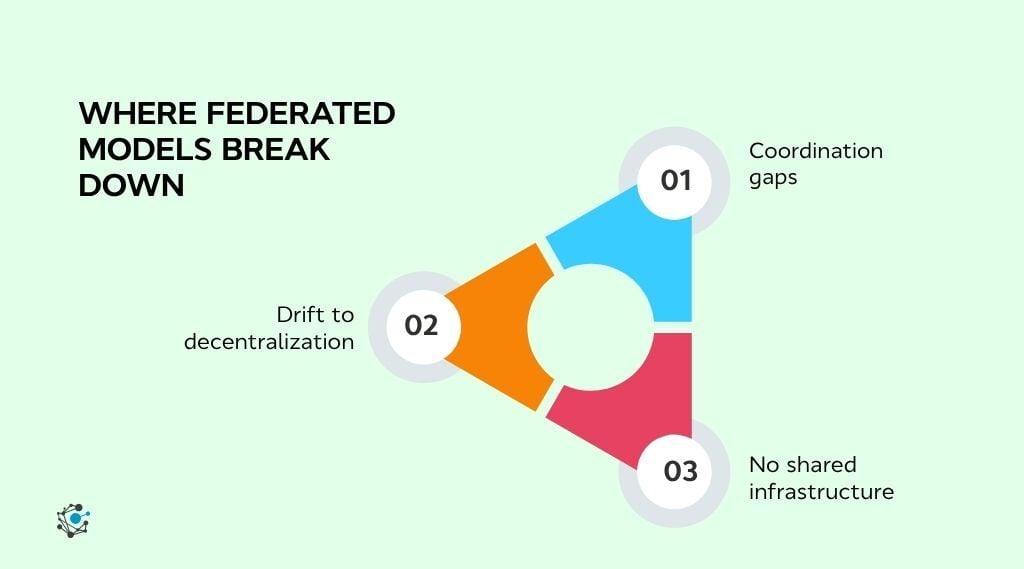
Federation fails in three predictable ways:
-
Coordination gaps: domain teams stop attending council sessions and central policies go unenforced locally
-
Drift to decentralization: without sustained investment in the central function, domains adopt local standards and the hub becomes ceremonial
-
No shared infrastructure: federation depends on a common catalog, lineage, and policy layer connecting all domains. Without it, domains operate as silos with a governance label but no actual interoperability
The third failure mode is the most common and the hardest to reverse, because by the time interoperability breaks, each domain has already built its own tooling and workflows around local standards.
For a deeper look at how federated models operate across modern data architectures, see OvalEdge's guide on federated data governance.
From policy to practice: enforcing governance at the point of action
Governance enforcement works when it activates inside the systems where data gets created, accessed, and used. Enforcement that lives in review meetings, audit cycles, or policy documents stays optional in practice, regardless of how strict it looks on paper.
Why documentation-only governance fails at scale
Policy decks fail for one structural reason: they sit outside the data stack. A data engineer building a pipeline doesn't stop to consult a governance wiki. A business analyst pulling a report doesn't cross-reference a classification spreadsheet. When the policy lives in a document, and the data lives in a platform, enforcement depends entirely on human memory. At enterprise scale, that gap becomes a guarantee of non-compliance.
Operationalizing enforcement
OvalEdge approaches enforcement as something that starts in the catalog and radiates outward through three connected layers:
-
Classification at the metadata level: every dataset, schema, and column gets labeled by sensitivity, PII status, and contractual restriction inside the catalog. These labels travel with the data wherever it moves.
-
Lineage-driven traceability: automated lineage tracks data from source to consumption, so every enforcement action can be traced back to its origin, and every downstream impact can be assessed before a change goes live.
-
Access governance at the point of use: role-based and attribute-based access controls activate at the moment data gets queried, exported, or fed into a model. Non-compliant actions get blocked automatically, not flagged after the fact.
These three layers work as a system. Classification informs what lineage needs to track. Lineage reveals who accesses what. Access controls enforce the rules classification created. Remove any layer and enforcement breaks.
Governance in action: illustrative scenarios
These scenarios show what enforcement looks like when it runs inside the governance platform, not alongside it:
Healthcare: A marketing team builds a patient outreach list. The catalog's classification labels automatically identify non-consented profiles. Access governance excludes them before the list generates. No manual review, no compliance risk.
Retail: An analytics team attempts to push restricted third-party data through an unapproved activation channel. Lineage flags the data's contractual restrictions. The policy engine blocks the export at the point of activation and logs the attempt for audit.
B2B: A junior analyst opens a customer dataset containing high-risk fields. Role-based access controls, tied to the catalog's sensitivity labels, restrict editing to authorized stewards. The analyst views aggregate data but can't modify or export individual records.
When enforcement operates inside the data stack, governance stops being something teams do separately and becomes something the infrastructure handles continuously.
Measuring governance maturity at scale
Governance maturity measurement converts "are we governing well" into something quantifiable and fundable. Without it, programs can't demonstrate progress, secure continued investment, or pinpoint which capability needs attention next.
The 5-level maturity model
Data governance maturity progresses through five levels, each defined by how deeply governance operates inside the data infrastructure:
-
Initial: No formal governance exists. Rules vary by team and live in tribal knowledge.
-
Managed: Policies documented. Enforcement manual, inconsistent, and dependent on individual effort.
-
Defined: Standardized policies across the organization. Stewardship roles active. Processes repeatable.
-
Quantitatively Managed: Governance measured through KPIs. Enforcement automated for critical domains. Outcomes tracked against targets.
-
Optimizing: Governance fully embedded in infrastructure. Enforcement continuous and self-correcting through automated monitoring.
The progression from Level 1 to Level 5 follows one trajectory: governance moves from documents and meetings into the operational data stack. Each level represents a deeper integration of governance into how data actually gets created, classified, accessed, and used.
For a detailed breakdown of each level, see OvalEdge's guide on the data governance maturity model.
KPIs mature programs track
Organizations at Level 3 and above typically measure five categories:
-
Data quality score: percentage of datasets meeting accuracy, completeness, and consistency thresholds
-
Policy compliance rate: percentage of data assets classified and labeled per organizational standards
-
Time to access: hours from access request to provisioning
-
Violations detected: policy breaches caught through automated monitoring vs. manual audit
-
Governance ROI: cost savings, risk reduction, and efficiency gains tied to governance investment
The distinction between Level 3 and Level 4 programs: Level 3 tracks these KPIs. Level 4 acts on them automatically.
Maturity scorecard: benchmark your program
Score your governance program across five dimensions. Identify your current level in each row, then find the widest gap between where you sit and where the program needs to be.
|
Dimension |
Initial |
Managed |
Defined |
Quantitatively Managed |
Optimizing |
|
People |
No assigned roles |
Roles exist, no RACI |
RACI active, stewards assigned |
Performance tracked per role |
Accountability self-sustaining |
|
Policy |
Informal, tribal |
Documented, static |
Standardized, machine-readable |
Compliance measured |
Auto-adapting to change |
|
Process |
Ad hoc |
Basic workflows exist |
Repeatable, integrated |
SLA-monitored |
Self-correcting |
|
Technology |
Spreadsheets, email |
Point tools, no integration |
Catalog and lineage in place |
Automated classification |
Fully connected governance stack |
|
Automation |
None |
Manual with scripts |
Rule-based triggers |
Real-time enforcement |
Autonomous, continuous |
The widest gap across rows reveals where governance investment delivers the highest return.
A practical roadmap to scale governance beyond the pilot
Scaling governance from pilot to enterprise is a sequencing problem. Each step builds a foundation the next step depends on. Skip a step, and the program stalls.
-
Secure executive sponsorship tied to business outcomes: Governance programs without executive mandate stall at the first cross-domain conflict. Frame governance as a business capability (compliance, AI readiness, operational efficiency), not a data team initiative.
-
Classify and label data enterprise-wide: Build the metadata foundation before automating anything. Apply sensitivity, PII, and contractual labels at the schema level across all critical domains.
-
Select an operating model and stand up a governance council: Match the model to current maturity. Start centralized if stewardship capacity doesn't exist yet. Establish the council with a fixed cadence and decision authority.
-
Automate enforcement and monitoring: Connect classification labels to access controls, lineage tracking, and policy engines. Shift enforcement from manual review to real-time checks at the point of access.
-
Measure, iterate, expand domain by domain: Track data quality, compliance rates, and time-to-access at the domain level. Prioritize the dimension with the widest maturity gap and close it before expanding to the next domain.
Classification enables automation. Automation enables measurement. Measurement reveals where to expand next.
Governance's next frontier: scaling for AI and GenAI
AI and GenAI become trustworthy at enterprise scale only when the governance foundation already exists. Organizations that treat AI governance as a standalone track build a second layer of policies, roles, and controls on top of an already fragile foundation.
Three governance capabilities determine whether AI operates reliably:
-
Governed metadata gives AI systems accurate business context: Without it, models consume raw data stripped of meaning, ownership, and usage restrictions.
-
Automated lineage makes AI decisions traceable: Every model output, agent action, and generated insight traces back to its source data, which becomes a prerequisite for trust at scale.
-
Classification and access controls determine what AI can reach: Models trained on incomplete, unlabeled, or non-compliant data don't introduce new risk. They expose and accelerate existing governance gaps faster than any human process could.
AI doesn't need a separate governance framework. It needs the existing one to actually work.
Conclusion
Every quarter governance stays manual and disconnected, the costs compound. Compliance gaps widen. AI initiatives stall on data nobody trusts. Engineering teams duplicate work because governed, discoverable data doesn't exist.
The organizations that scale governance successfully share one trait: they treat governance as operational infrastructure, not a policy exercise. They embed classification, lineage, and enforcement into the systems where data actually moves.
OvalEdge connects these capabilities into a single governance layer across the full data estate. Stewardship, classification, lineage, access governance, and maturity tracking operate inside one platform, so enforcement activates at the point of use rather than in a quarterly review.
Schedule a demo to see how OvalEdge operationalizes governance at enterprise scale.
.png?width=1081&height=173&name=Forrester%201%20(1).png)
.png?width=1081&height=241&name=KC%20-%20Logo%201%20(1).png)