.png)
AI moves fast in enterprises, but trust usually breaks before scale happens.
IBM reported in early 2024 that 42% of enterprise-scale companies had already actively deployed AI, while another 40% were still exploring or experimenting.
Yet many of these initiatives stall when teams cannot explain outcomes, assign ownership, or connect decisions to the real business context.
That is where a trusted AI governance model for enterprises becomes critical. It connects AI systems with policies, risk controls, ownership, and business context, so governance decisions reflect how models are actually used. When context is missing, governance stays generic. When it is embedded, teams can assess risk accurately and enforce the right controls.
This blog explains what a trusted AI governance model is, why enterprises need one, how it works, and how business context improves governance decisions at scale.
What is a trusted AI governance model for enterprises?
A trusted AI governance model for enterprises is an operating model that ensures AI systems are transparent, accountable, fair, and compliant across their lifecycle. It enables organizations to monitor, control, and manage AI systems to reduce risk and build trust in decisions.
Unlike an AI governance framework, which defines principles and guidelines, a governance model defines how those principles are executed. It establishes the operating structure, ownership, and lifecycle processes required to enforce governance across teams, systems, and real-world AI workflows.
A trusted AI governance model is built on a few core elements that enable consistent execution across the AI lifecycle:
-
Explainability and model transparency
-
Ownership and accountability structures
-
Bias detection and fairness controls
-
Risk classification and governance policies
-
Lifecycle monitoring and validation
-
Auditability and reporting mechanisms
A trusted AI governance model is not just a set of policies. It is an execution layer that ensures governance is enforced across the AI lifecycle, with clear ownership and continuous oversight built into how AI systems operate.
|
Related resource: OvalEdge explains in its guide Implement Data Governance Faster how enterprises can operationalize governance by embedding policies, ownership, and workflows directly into data and AI systems. |
Why enterprises need a trusted AI governance model
AI is moving from experimentation to production, but governance is not keeping pace. When governance breaks, the impact is immediate: model rollbacks, compliance exposure, delayed deployments, and loss of trust in AI-driven decisions.
1. Increasing regulatory and compliance pressure
Regulation is no longer optional guidance. The EU AI Act introduces a risk-based system with strict requirements for high-risk AI, while the NIST AI Risk Management Framework pushes organizations to operationalize transparency, accountability, and auditability.
This means enterprises must prove how AI decisions are made, who is accountable, and how risks are controlled. Governance is no longer about intent. It is about evidence.
Failure has direct consequences:
-
Regulatory fines and penalties
-
Forced withdrawal of non-compliant models
-
Restrictions on deploying AI in critical use cases
A trusted AI governance model ensures that compliance is built into workflows, not handled as a last-minute audit exercise.
2. Business risks from ungoverned AI
Ungoverned AI creates real operational failures, not just theoretical risks. Bias in decision systems, hallucinations in generative AI, and inaccurate predictions directly affect business outcomes.
McKinsey’s 2025 State of AI report found that 51% of organizations using AI have already experienced negative consequences, with inaccuracy being the most common issue. These failures are not isolated incidents. They surface in production.
In enterprise environments, this leads to:
-
Model rollbacks after deployment due to unreliable outputs
-
Customer-facing errors that damage brand trust
-
Rework across data, engineering, and compliance teams
In sectors like financial services, biased credit models can trigger regulatory scrutiny. In healthcare, incorrect recommendations can affect outcomes. Without governance, AI risk quickly becomes business risk.
|
Related resource: OvalEdge explains in its guide How to Ensure Data Privacy Compliance with OvalEdge how organizations can strengthen compliance readiness by understanding what data they hold, how it is processed, and where governance controls need to be enforced. |
3. Lack of trust is slowing down AI adoption
Even when AI systems are technically sound, a lack of trust limits their impact. Business teams hesitate to rely on outputs they cannot explain or validate.
When teams cannot trace how outputs are generated or validate decisions, they rely on manual overrides, slow down approvals, and limit AI usage to low-risk scenarios.
As a result, AI adoption stalls. Outputs are overridden, decisions are delayed, and AI investments fail to translate into measurable business value. Trust becomes the bottleneck, not technology.
4. Fragmented ownership across AI governance teams
AI governance spans multiple teams, but ownership is often unclear. Data teams manage inputs, ML teams manage models, compliance teams define policies, and business teams use outputs. Without a clear operating model, governance breaks down between these layers.
This fragmentation creates measurable friction:
-
Delays in approvals and model deployment
-
Unclear accountability during incidents or failures
-
Duplicated governance efforts across teams
-
Slower response to compliance or performance issues
|
Case study: A credit union strengthened data governance by defining clear data ownership and improving visibility into data lineage with OvalEdge. This reduced operational friction, improved compliance readiness, and enabled more consistent decision-making across teams. |
The cost is not just inefficiency. It is risk exposure and lost momentum. A trusted AI governance model establishes clear ownership, aligns responsibilities, and connects governance across the lifecycle, reducing both friction and failure.
These challenges highlight why governance must move beyond principles into structured execution.
Core principles and components of a trusted AI governance model
A trusted AI governance model combines clear principles with execution mechanisms to ensure AI systems are governed consistently across the enterprise. It connects ethics, risk controls, and operational workflows so governance decisions are applied continuously, not just during reviews.
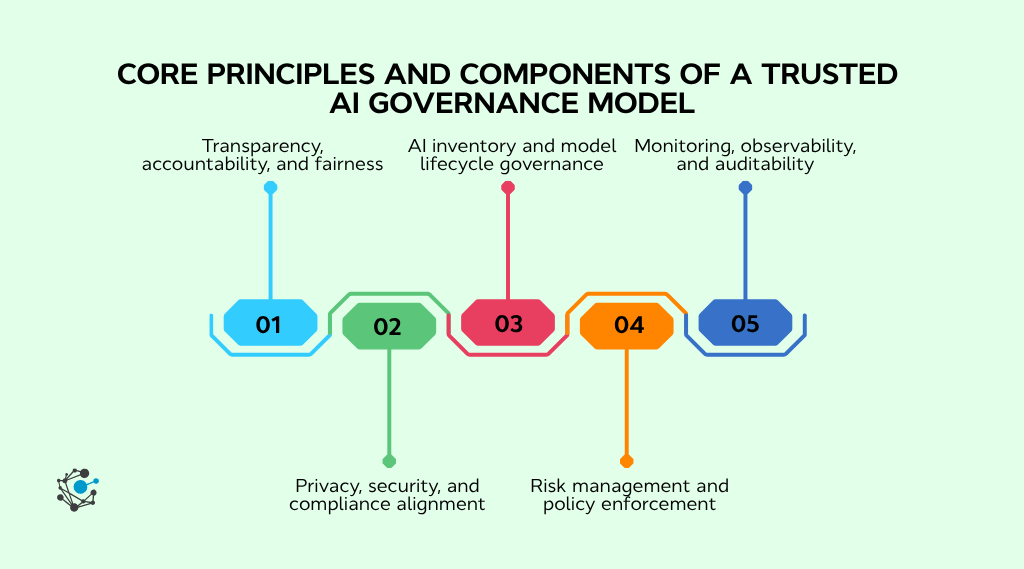
1. Transparency, accountability, and fairness
Transparency starts with making AI decisions understandable. This includes explainable models, clear documentation, and traceability of how outputs are generated. Without this, teams cannot validate or trust decisions.
Accountability ensures that every model has defined ownership across its lifecycle, from development to deployment. Fairness controls, including bias detection and mitigation, reduce the risk of unintended outcomes.
These elements directly influence adoption. Explainability and transparency are essential for building trust in AI systems, especially in high-stakes decision environments where outcomes must be justified. When decision-makers can interpret outputs, AI moves from experimentation to reliable usage.
2. Privacy, security, and compliance alignment
AI systems rely on sensitive data, which makes privacy and security foundational to governance. This includes enforcing data protection policies, applying role-based access controls, and aligning with regulatory requirements.
The EU AI Act and global privacy regulations reinforce that AI governance must demonstrate control over how data is used and protected. Without this alignment, organizations face compliance risks that can limit AI deployment.
A strong governance model ensures that data usage, access, and model behavior remain compliant across regions and use cases, reducing exposure while enabling safe scaling.
3. AI inventory and model lifecycle governance
Enterprises cannot govern what they cannot see. A centralized AI inventory creates visibility into all models, including their purpose, ownership, versions, and usage across systems.
This prevents the growth of “shadow AI,” where models are developed and deployed outside governance processes. PwC’s 2025 Responsible AI findings emphasize that organizations with structured AI inventories and governance processes are better positioned to scale AI while managing risk effectively.
|
Related resource: OvalEdge explains in its guide, Data Lineage: Benefits and Techniques, how end-to-end lineage improves transparency, supports impact analysis, and strengthens governance across complex data and AI environments. |
Lifecycle governance ensures that models are tracked from development to retirement, with clear accountability at each stage.
4. Risk management and policy enforcement
Governance applies different controls based on risk level, ensuring high-impact models undergo stricter validation, monitoring, and audit requirements. A trusted governance model classifies AI systems based on impact, sensitivity, and regulatory exposure, then applies appropriate controls.
This includes:
-
Stricter validation for high-risk models
-
Automated policy checks during deployment
-
Continuous enforcement of governance rules in production
Risk-based governance ensures that controls are proportional and actionable. It moves governance from static policies to enforced decisions embedded in workflows.
5. Monitoring, observability, and auditability
AI systems change over time. Data shifts, model performance degrades, and bias can emerge after deployment. Continuous monitoring is essential to detect these changes early.
This includes tracking model drift, performance variations, and fairness metrics, along with maintaining audit logs of decisions and changes. In 2023, NIST emphasizes continuous monitoring as a core requirement for managing AI risk across the lifecycle.
From an enterprise perspective, this enables audit readiness, supports compliance reporting, and ensures that governance adapts as models evolve.
These components only create value when applied consistently across the AI lifecycle.
How a trusted AI governance model works across the AI lifecycle
A trusted AI governance model operates as a continuous loop where AI systems are discovered, evaluated, monitored, and refined over time.
Consider a credit risk scoring model in a bank. Governance does not stop after deployment. As data changes, regulations evolve, and usage expands, the model moves through a continuous cycle of validation, monitoring, and improvement.
1. AI discovery and inventory creation
The first step is visibility. All AI systems across business units are identified and registered in a centralized inventory.
In this case, the credit scoring model is logged with clear ownership by the risk team, its purpose in loan approval decisions, and its data sources and dependencies. This creates a foundation for governance by ensuring no model operates outside oversight.
|
Case study: A healthcare organization improved data literacy and governance using OvalEdge by creating a centralized view of data assets and lineage. This helped teams understand data dependencies, improve compliance, and make more reliable decisions across systems. |
2. Risk classification and governance tiering
Once identified, the model is classified based on its risk level. Not all AI systems require the same level of control.
The credit model is categorized as high-risk due to its financial impact, regulatory sensitivity, and potential bias implications. This classification determines the level of governance controls applied, ensuring oversight is proportional and targeted.
3. Policy implementation and enforcement
Governance policies are then enforced within workflows, not applied as external checks.
For the credit model, this includes mandatory explainability for decisions, bias testing across demographic groups, and compliance with financial regulations. These controls are embedded into development and deployment processes, ensuring governance is active during execution.
4. Continuous monitoring and validation
After deployment, the model is continuously monitored for performance, drift, and emerging risks.
The credit model is tracked for accuracy changes, shifts in approval patterns, and potential bias introduced by new data. This ongoing validation ensures that the model remains reliable as conditions evolve.
5. Audit, reporting, and feedback loops
Governance insights are captured through audits and reporting, then fed back into the system.
If audit reports detect bias increases in certain segments, this triggers model retraining, updates to risk classification, and stricter monitoring thresholds. Each outcome informs the next cycle of governance.
Governance does not end with monitoring or audits. Each insight feeds back into the system, ensuring that AI models are continuously reclassified, refined, and governed as conditions change.
To operationalize this lifecycle effectively, enterprises need a clear organizational structure.
How to structure and implement AI governance in enterprises
Governance only works when responsibilities are clearly defined and embedded into how teams build and use AI. Without a structured operating model, governance remains fragmented, slowing decisions and increasing risk across the lifecycle.
Centralized vs federated governance structures
Enterprises typically choose between centralized and federated governance, but neither works well in isolation.
A centralized model offers strong control and consistency, but struggles to scale across business units. A federated model enables domain-level ownership and faster execution, but often leads to inconsistent standards.
Most enterprises adopt a hybrid approach, where central teams define policies, standards, and risk frameworks, while domain teams execute governance within their workflows. This balances control with scalability and aligns governance with how AI is actually used.
Roles and responsibilities across AI governance teams
AI governance spans multiple functions, and governance breaks down when responsibilities are not clearly assigned across teams.
A structured model defines clear responsibilities:
-
Data governance teams manage data policies, quality, and access
-
ML teams own model development, validation, and performance
-
Risk and compliance teams handle regulatory alignment and oversight
-
Business teams own usage, outcomes, and accountability
| According to Deloitte’s 2024 Generative AI report, organizations with clearly defined AI governance roles are significantly more likely to scale AI initiatives successfully, highlighting the direct link between ownership clarity and operational outcomes. |
Embedding governance into AI development workflows
Governance is most effective when it is built into how AI systems are designed, tested, and deployed.
This means integrating governance controls directly into:
-
Model design, through explainability and fairness requirements
-
Testing, through validation and bias checks
-
Deployment, through approval workflows and policy enforcement
When governance is embedded early, teams avoid rework, reduce approval delays, and ensure models meet requirements before production.
Scaling governance with automation
Manual governance does not scale with enterprise AI adoption. As the number of models and use cases grows, monitoring, policy enforcement, and reporting must be automated.
Automation enables:
-
Continuous monitoring of model performance and risk
-
Real-time enforcement of governance policies
-
Audit-ready reporting without manual effort
This shifts governance from periodic reviews to continuous control, making it possible to scale AI safely across business units without slowing down innovation.
How to evaluate your AI governance model maturity
Implementing governance is only the starting point. Enterprises need a clear way to assess how mature their AI governance model is across lifecycle execution, risk control, and team alignment. A maturity view helps identify gaps between defined policies and actual execution.
Level 1: Ad hoc governance (initial stage)
At this stage, governance is informal and inconsistent. Visibility into AI systems is limited, and policies exist but are rarely enforced in practice.
There is no centralized model inventory, documentation is manual, and ownership is unclear. This leads to reactive governance, high risk exposure, and low trust in AI outputs.
Level 2: Structured governance (developing stage)
Governance processes are defined and partially implemented, with some visibility into AI systems.
Organizations may have a centralized inventory and apply risk classification to critical use cases. However, enforcement remains inconsistent and dependent on manual effort. Governance varies across teams, which creates uneven control and reliability.
Level 3: Operationalized governance (advanced stage)
Governance is embedded across the AI lifecycle, with consistent enforcement of policies.
Ownership is clearly defined, monitoring and policy checks are automated, and governance is integrated into development workflows. This reduces risk exposure, improves trust in AI systems, and enables faster, more reliable adoption.
Level 4: Scalable and adaptive governance (leading stage)
Governance operates as a continuous, adaptive system that evolves with changing data, models, and regulations.
Organizations at this stage use real-time monitoring, dynamic risk classification, and integrated governance across data, AI, and observability systems. Governance scales across business units while maintaining strong alignment with regulatory and business requirements.
Key indicators to assess your current maturity level
A quick self-assessment can help identify where governance gaps exist:
-
Is there a centralized inventory of all AI models?
-
Are AI systems classified based on risk level?
-
Are governance policies enforced automatically or manually?
-
Is monitoring continuous or periodic?
-
Are ownership and accountability clearly defined?
-
Can audit-ready reports be generated on demand?
Most enterprises operate between Level 1 and Level 2, where governance is defined but not fully operationalized. This gap often leads directly to the challenges seen in real-world AI adoption.
Common challenges in implementing AI governance
Implementing AI governance at enterprise scale introduces both operational and organizational complexity. The challenge is not defining policies, but ensuring they are consistently applied across systems, teams, and evolving AI use cases without slowing down innovation.
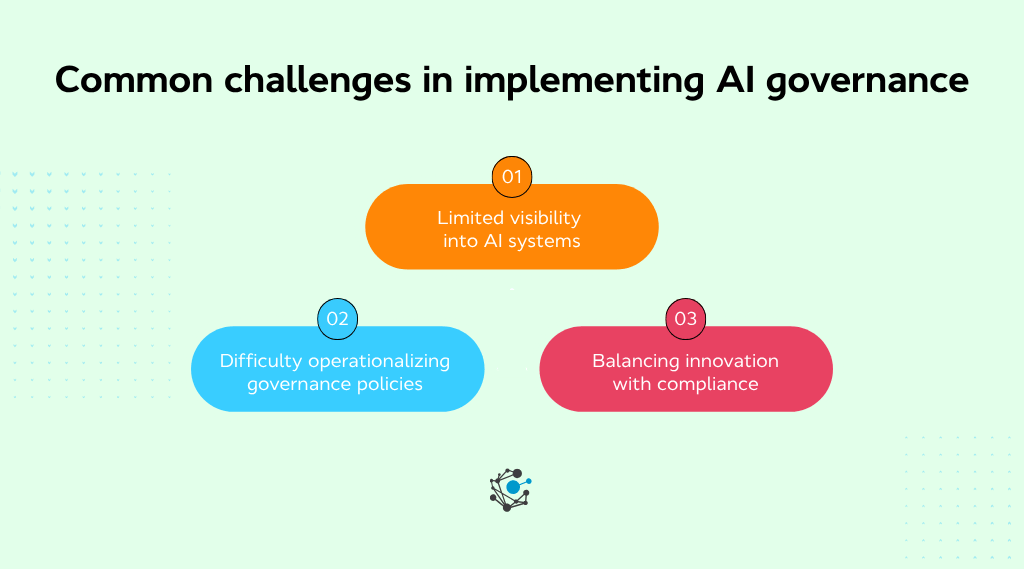
Limited visibility into AI systems
Many enterprises lack a centralized view of all AI models in use. Teams often build or adopt models independently, leading to “shadow AI” that operates outside governance processes.
This creates blind spots where risks go unmonitored, ownership is unclear, and compliance gaps emerge. Without visibility, governance cannot be enforced effectively.
Difficulty operationalizing governance policies
Policies are often well-defined but poorly executed. Governance remains confined to documentation, with limited integration into real workflows.
A key issue is the lack of automation. Manual checks cannot keep up with the scale and speed of AI deployments.
According to a 2024 Boston Consulting Group (BCG) report, only 26% of companies have developed the capabilities needed to move beyond AI pilots and generate real value, reinforcing that many organizations struggle to operationalize AI beyond pilots.
As a result, governance becomes theoretical rather than actionable.
Balancing innovation with compliance
Enterprises often face a trade-off between speed and control. Strict governance can slow experimentation, while weak governance increases risk.
In practice, teams may bypass controls to meet delivery timelines, especially when governance processes are seen as blockers. This creates inconsistent enforcement and higher exposure to failures.
The goal is not to choose between innovation and compliance, but to design governance that enables both through risk-based controls, embedded workflows, and automation.
Conclusion
Trusted AI governance is not just about compliance. It is what allows enterprises to scale AI with confidence, ensuring that decisions are reliable, explainable, and aligned with business and regulatory expectations.
To make governance work in practice, a few fundamentals matter:
-
Governance must span the entire AI lifecycle, not just pre-deployment checks
-
Governance must be embedded into workflows, not treated as a separate control layer
-
Clear ownership and operating models are essential to avoid gaps
-
Automation is required to scale monitoring, enforcement, and reporting
Enterprises that operationalize these elements move faster with fewer failures. They reduce risk, improve trust in AI outputs, and create a foundation for long-term adoption.
Platforms like OvalEdge support this shift by connecting metadata, lineage, governance policies, and AI workflows into a unified layer. This helps teams enforce governance consistently, maintain visibility across AI systems, and align decisions with business context.
To see how this works in practice, book a demo with OvalEdge and explore how to operationalize trusted AI governance across your organization.
FAQs
1. What is the difference between AI governance and AI risk management?
AI governance is the broader operating model for how AI is controlled, monitored, and held accountable. AI risk management is one part of that model, focused on identifying, assessing, and mitigating specific risks.
2. How does a trusted AI governance model improve business outcomes?
It improves reliability, reduces regulatory and operational risk, and increases confidence in AI outputs. Responsible AI programs also show measurable business upside in efficiency, ROI, innovation, and customer experience.
3. What are the key components of enterprise AI governance?
The core components include model inventory, risk classification, policy enforcement, monitoring, auditability, transparency, fairness controls, and clearly assigned ownership.
4. How do enterprises ensure AI compliance with regulations?
They align governance processes with regulatory frameworks such as the EU AI Act and NIST AI RMF, document decisions, apply risk-based controls, and maintain audit-ready evidence across the lifecycle.
5. What role do AI governance teams play in enterprises?
AI governance teams define and enforce policies, monitor model performance, manage risks, and ensure regulatory compliance. They coordinate across data, ML, and business teams to maintain consistent governance and accountability throughout the AI lifecycle.
6. How can AI governance scale across multiple business units?
AI governance scales through a federated model with centralized standards and distributed execution. Standardized policies combined with automated monitoring, enforcement, and reporting ensure consistent governance across business units without slowing down innovation or creating operational bottlenecks.
.png?width=1081&height=173&name=Forrester%201%20(1).png)
.png?width=1081&height=241&name=KC%20-%20Logo%201%20(1).png)