AI systems scale faster than governance, leaving teams with limited visibility, weak accountability, and growing compliance pressure.
In fact, 93% of organizations now use AI for governance functions, but only 8% have fully embedded governance frameworks, creating a significant risk gap.
This is where an AI governance risk management platform becomes essential. It provides a centralized layer to track models, manage risk, enforce policies, and ensure transparency across the AI lifecycle.
With regulations like the EU AI Act and frameworks such as NIST AI RMF gaining traction, AI risk is now a board-level concern. Enterprises need structured oversight to deploy AI responsibly.
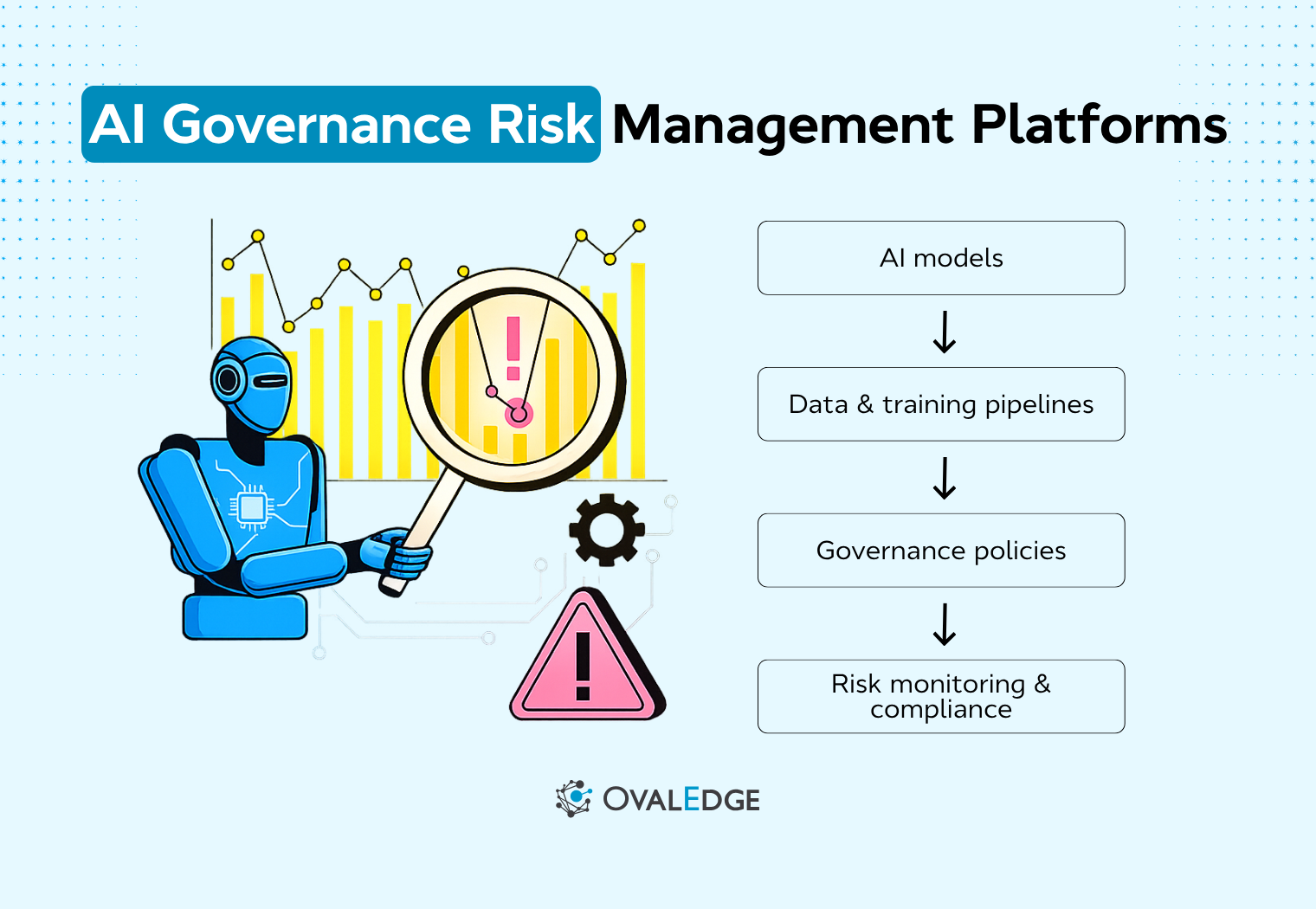
Data flows through a structured system where governance acts as the control layer. At a high level, the flow looks like this:
Data → Models → Governance platform → Monitoring → Compliance
This structure ensures that as AI systems are built and deployed, they remain visible, controlled, and aligned with regulatory and business expectations.
In this guide, we'll walk through the core capabilities of these platforms, the types of AI governance tools available, the leading solutions in the market, and how to evaluate the right platform for your organization.
AI governance risk management platform: Core capabilities
An AI governance risk management platform manages AI model risk, enforces policies, and ensures compliance across the AI lifecycle. It monitors model performance, detects bias and drift, and supports explainability and auditability.
The platform automates risk scoring, reporting, and governance workflows. It integrates with data and ML systems to provide centralized oversight. Enterprises use it to reduce risk, improve transparency, and align with regulations like the EU AI Act, NIST AI RMF, and ISO 42001.
At a practical level, these platforms bring together governance, risk, and compliance functions that are often scattered across teams. Instead of relying on disconnected tools or manual processes, organizations get a structured system to manage AI models from development through deployment and beyond.
|
Here’s a fact: This shift is happening quickly. According to Global Market Insights, the AI governance market is projected to grow at over 49% CAGR by 2034, driven by rising regulatory pressure and enterprise adoption. |
These platforms typically provide a set of core capabilities that enable responsible AI adoption at scale:
-
AI model inventory and lifecycle tracking: The platform maintains a centralized catalog of AI models, including metadata, ownership, deployment status, and lifecycle stages.
-
AI risk identification and scoring: Platforms assess risks such as bias, fairness issues, security vulnerabilities, and operational failure using structured risk scoring frameworks.
-
Compliance monitoring and regulatory alignment: Governance tools map AI systems to frameworks like the EU AI Act, NIST AI RMF, and ISO standards to ensure compliance readiness.
-
Model explainability and transparency controls: Organizations gain visibility into how models generate outputs, which supports trust and regulatory requirements.
-
Governance workflows and approval processes: Platforms enable structured approvals, documentation reviews, and governance checkpoints before and after deployment.
-
Audit trails and accountability documentation: Systems maintain logs and records that demonstrate governance practices during audits or regulatory reviews.
As AI adoption expands, these capabilities shift from optional to essential. The way organizations prioritize them often depends on whether they are solving for governance, monitoring, or compliance first.
Regulatory drivers behind AI governance platforms
AI governance is increasingly shaped by external pressure from regulators, industry standards, and executive oversight. Organizations are now expected to prove that their AI systems are safe, explainable, and accountable, not just functional.
|
Stat: According to recent studies, AI governance frameworks are now being implemented across more than 40 countries, signaling rapid regulatory standardization and reflecting a global shift. |
These expectations are formalized through frameworks and regulations that require structured governance, documentation, and continuous monitoring across the AI lifecycle.
1. EU AI Act
The EU AI Act introduces a risk-based classification for AI systems, which fundamentally changes how organizations approach governance.
High-risk AI systems must meet strict requirements around documentation, monitoring, and control. This includes maintaining detailed records, ensuring transparency in decision-making, and implementing continuous oversight mechanisms.
For enterprises operating in regulated environments, this means AI governance can no longer be reactive. It must be designed into the system from the start, with clear traceability and accountability.
2. NIST AI Risk Management Framework
The NIST AI Risk Management Framework provides a structured approach to identifying and managing AI risks across the lifecycle.
It emphasizes four key areas: risk identification, governance processes, monitoring, and accountability. This framework helps organizations move from ad hoc risk management to a more standardized and repeatable governance model.
Many enterprises use NIST AI RMF as a practical starting point to build internal AI governance programs, especially when aligning cross-functional teams around risk and compliance.
3. ISO/IEC 42001 AI governance standard
ISO/IEC 42001 introduces a formal management system for AI governance, similar to how ISO standards structure quality or security programs.
It focuses on defining governance processes, conducting risk assessments, and maintaining consistent documentation. This standard helps organizations create a structured and auditable approach to AI governance.
For enterprises operating across regions, ISO standards provide a common baseline that aligns governance practices globally.
4. Increasing board-level AI risk oversight
AI risk is now part of executive and boardroom discussions. Leaders recognize that AI-driven decisions can introduce legal, financial, and reputational risks if left unmanaged.
As a result, organizations are under pressure to demonstrate responsible AI use, with clear accountability, visibility, and control across all deployed systems.
|
Expert insight: According to BCG, 69% of executives say emerging AI systems like agentic AI require entirely new risk management approaches, reinforcing the need for structured governance. |
Governance platforms play a key role here by providing centralized visibility into AI models, risks, and decisions, making it easier for leadership to understand and act on potential issues.
As these regulatory and organizational pressures continue to grow, governance is becoming a structured discipline rather than a reactive effort. The way organizations respond often depends on whether they prioritize enterprise governance, technical monitoring, or compliance readiness.
Types of AI governance risk management platforms
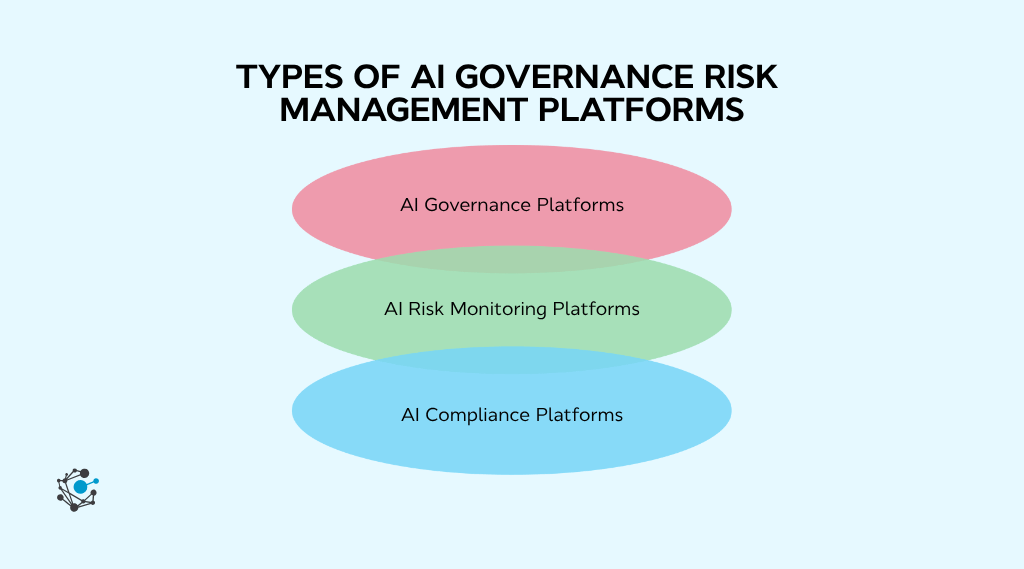
AI governance platforms did not emerge as a single category. They evolved from data governance tools, risk management systems, MLOps monitoring platforms, and compliance software. As a result, most vendors today focus on a specific slice of the problem, while some combine multiple capabilities into a unified solution.
You will rarely find a one-size-fits-all platform. The right choice depends on whether your priority is governance, technical monitoring, or regulatory compliance.
AI governance platforms
These platforms focus on building enterprise-wide governance structures and giving teams centralized oversight of AI systems.
They typically manage AI inventories, enforce governance policies, and enable workflows for approvals and reviews. Many also integrate with data governance systems, which helps connect AI models to underlying data assets and improve traceability.
Governance teams, data leaders, compliance officers, and risk functions rely on these platforms to standardize how AI systems are managed across the organization.
AI risk monitoring platforms
Some platforms go deeper into the technical side of AI and focus on how models behave in production.
They provide capabilities such as model explainability, bias detection, performance tracking, and drift monitoring. These tools help teams understand whether models are reliable, fair, and stable over time.
Machine learning teams and model risk specialists use these platforms to continuously monitor models and respond to issues before they impact business outcomes.
AI compliance platforms
Other platforms focus on helping organizations stay aligned with regulatory requirements and audit expectations.
They support documentation, risk assessments, governance policies, and compliance reporting. This makes it easier for organizations to demonstrate accountability during audits or regulatory reviews.
Compliance teams, legal functions, and regulatory risk teams depend on these platforms to manage governance in highly regulated environments.
Most enterprises end up evaluating a mix of these capabilities rather than a single category. The real challenge is understanding how different platforms position themselves across governance, monitoring, and compliance.
Quick comparison: Top AI governance risk management platforms
Several vendors now provide platforms designed to support enterprise AI governance and risk management. Most AI governance platforms span multiple capabilities across governance, monitoring, and compliance. The categorization here reflects each platform’s primary focus, but in practice, many tools overlap and support multiple aspects of AI governance.
|
Platform |
Primary Focus |
Key Capabilities |
Best Suited For |
|
OvalEdge |
Enterprise AI governance and data governance integration |
AI model inventory, metadata-driven governance, data lineage visibility, governance workflows |
Enterprises needing unified data and AI governance |
|
IBM watsonx.governance |
AI lifecycle governance and model oversight |
Model monitoring, explainability, bias detection, risk dashboards |
Organizations deploying large-scale AI models |
|
Credo AI |
Responsible AI governance and policy management |
Risk assessment, governance documentation, compliance frameworks |
Enterprises building responsible AI programs |
|
Holistic AI |
AI risk auditing and regulatory compliance |
Bias testing, risk evaluation, compliance readiness, and audits |
Organizations preparing for regulatory reviews |
|
OneTrust AI Governance |
Compliance and governance workflow management |
AI inventory, risk assessments, policy enforcement, reporting |
Compliance teams managing AI governance |
|
Fiddler AI |
AI model monitoring and explainability |
Model monitoring, explainability, bias detection, performance tracking |
ML teams need real-time model oversight and explainability |
Different AI governance risk management platforms address different aspects of AI oversight. Some platforms focus on enterprise governance and policy enforcement, while others emphasize model monitoring, explainability, or regulatory compliance.
The following sections group these tools by their primary governance use cases to help organizations evaluate which platform best fits their needs.
AI governance platforms for enterprise governance and compliance teams
These platforms focus on creating a centralized governance layer for AI systems across the enterprise. They help organizations standardize how models are tracked, approved, and monitored, while ensuring alignment with data governance and compliance processes.
1. OvalEdge
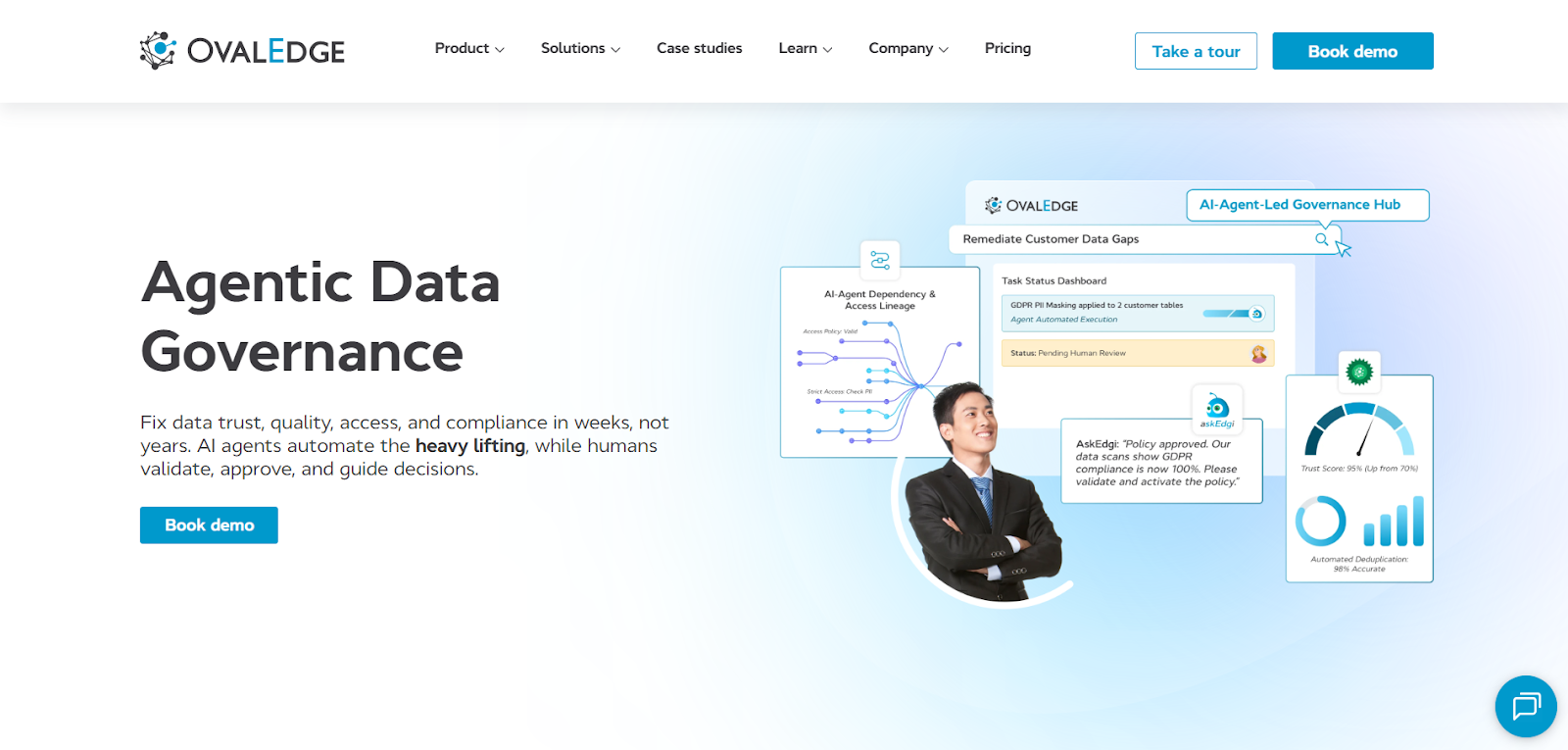
OvalEdge brings together data governance and AI governance into a unified, metadata-driven platform designed for enterprise-scale oversight. It connects AI models with underlying data assets, giving teams clear visibility into lineage, ownership, and usage.
By combining governance workflows, policy enforcement, and model traceability, OvalEdge helps organizations move from fragmented AI oversight to a structured governance system that supports compliance, accountability, and responsible AI adoption across complex data ecosystems.
Key features:
-
Centralized model inventory: OvalEdge maintains a unified catalog of AI models with metadata, ownership, and lifecycle tracking
-
End-to-end data lineage: It connects AI models to upstream and downstream data assets for full traceability.
-
Metadata-driven governance: It uses metadata relationships to enforce governance policies across data and AI systems.
-
Governance workflows: The platform enables structured approvals, reviews, and policy enforcement across the AI lifecycle.
-
Model traceability: OvalEdge tracks how models are built, trained, and deployed to improve accountability.
-
Policy enforcement: It applies governance rules consistently across models, datasets, and pipelines.
-
Integration with data systems: The platform connects with enterprise data platforms to unify governance across ecosystems.
-
Audit readiness support: It also maintains documentation and logs required for compliance and regulatory audits.
Best for: Enterprises looking to unify data governance and AI governance within a single, metadata-driven platform.
If your challenge is fragmented visibility across models and data, OvalEdge helps you bring governance, lineage, and accountability into one place. You can explore how this works in your environment by booking a demo with OvalEdge.
2. OneTrust AI Governance
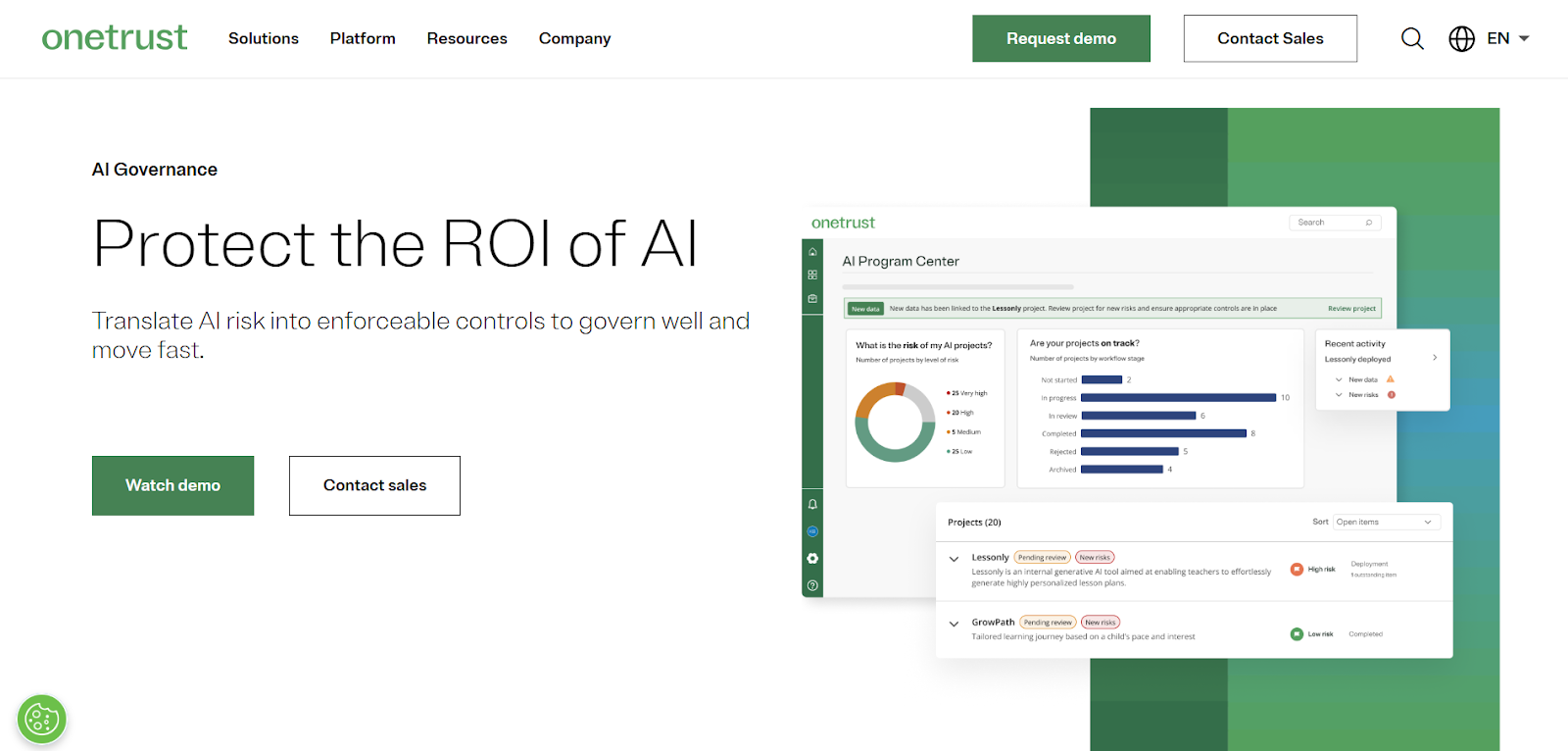
OneTrust AI Governance focuses on operationalizing governance workflows and compliance processes for AI systems. It extends existing privacy and compliance programs into AI governance, making it easier for organizations to manage risk, documentation, and reporting in one place. The platform is often used by teams already managing regulatory and privacy obligations.
Key features:
-
It manages AI inventories and risk assessments within a centralized governance framework
-
The platform enables policy enforcement and structured governance workflows
-
It supports documentation for regulatory compliance and audit readiness
-
OneTrust AI integrates AI governance with broader privacy and compliance programs
-
It also provides reporting tools for regulatory and internal stakeholders
Best for: Compliance and governance teams managing AI risk alongside privacy and regulatory programs.
AI risk monitoring platforms for model oversight and explainability
These platforms focus more on how models behave in production rather than how they are governed at an enterprise level. They help teams monitor performance, detect bias, and understand model decisions in real time.
3. IBM watsonx.governance
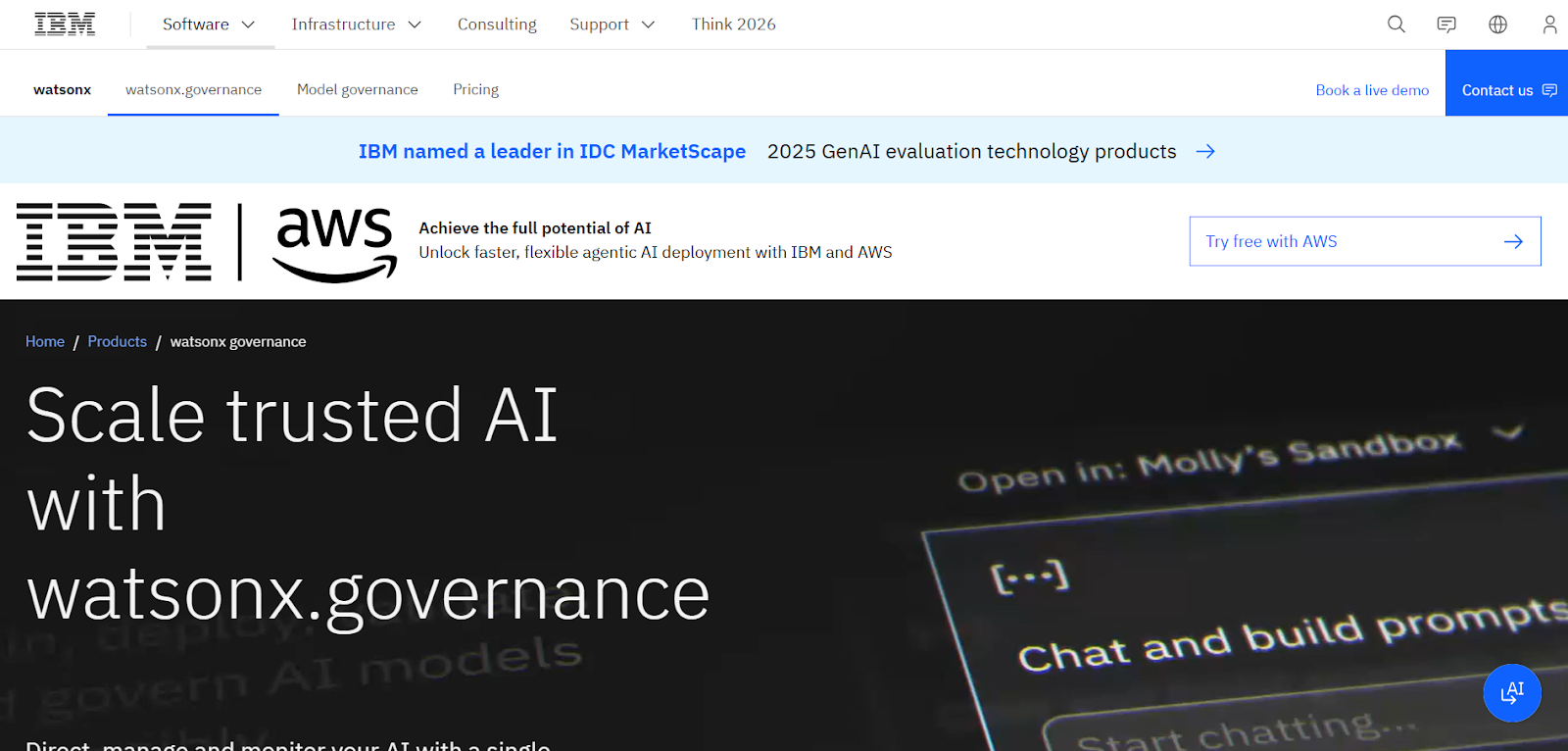
IBM watsonx.governance centers on managing AI models throughout their lifecycle, with a strong focus on monitoring, explainability, and risk visibility. It integrates closely with IBM’s AI ecosystem, allowing organizations to track model behavior, assess risk, and ensure transparency across deployments. The platform is designed for enterprises running large-scale AI initiatives.
Key features:
-
IBM monitors model performance, drift, and risk across the AI lifecycle
-
It provides explainability tools to understand model decisions and outputs
-
The platform detects bias and fairness issues in production models
-
It offers dashboards for tracking governance metrics and risk indicators
-
It also integrates with IBM’s broader AI and data platforms
Best for: Organizations deploying AI at scale that need strong lifecycle monitoring and model oversight.
4. Fiddler AI

Fiddler AI focuses on model monitoring, explainability, and trust in production AI systems. It helps teams track model performance, detect bias, and understand how models behave in real-world scenarios. The platform is designed to give machine learning teams continuous visibility into model health, which becomes critical as AI systems scale across business functions.
Key features:
-
The platform tracks model accuracy, drift, and stability in production environments
-
It provides visibility into how models generate predictions and decisions
-
Fiddler AI identifies fairness issues across different data segments and use cases
-
It flags anomalies and performance degradation proactively
-
It also helps teams diagnose issues and improve model behavior
Best for: Machine learning teams that need continuous monitoring, explainability, and real-time visibility into model performance.
AI compliance platforms for regulatory risk management
These platforms are designed to help organizations meet regulatory requirements and prepare for audits. They focus on documentation, risk assessments, and compliance workflows.
5. Credo AI
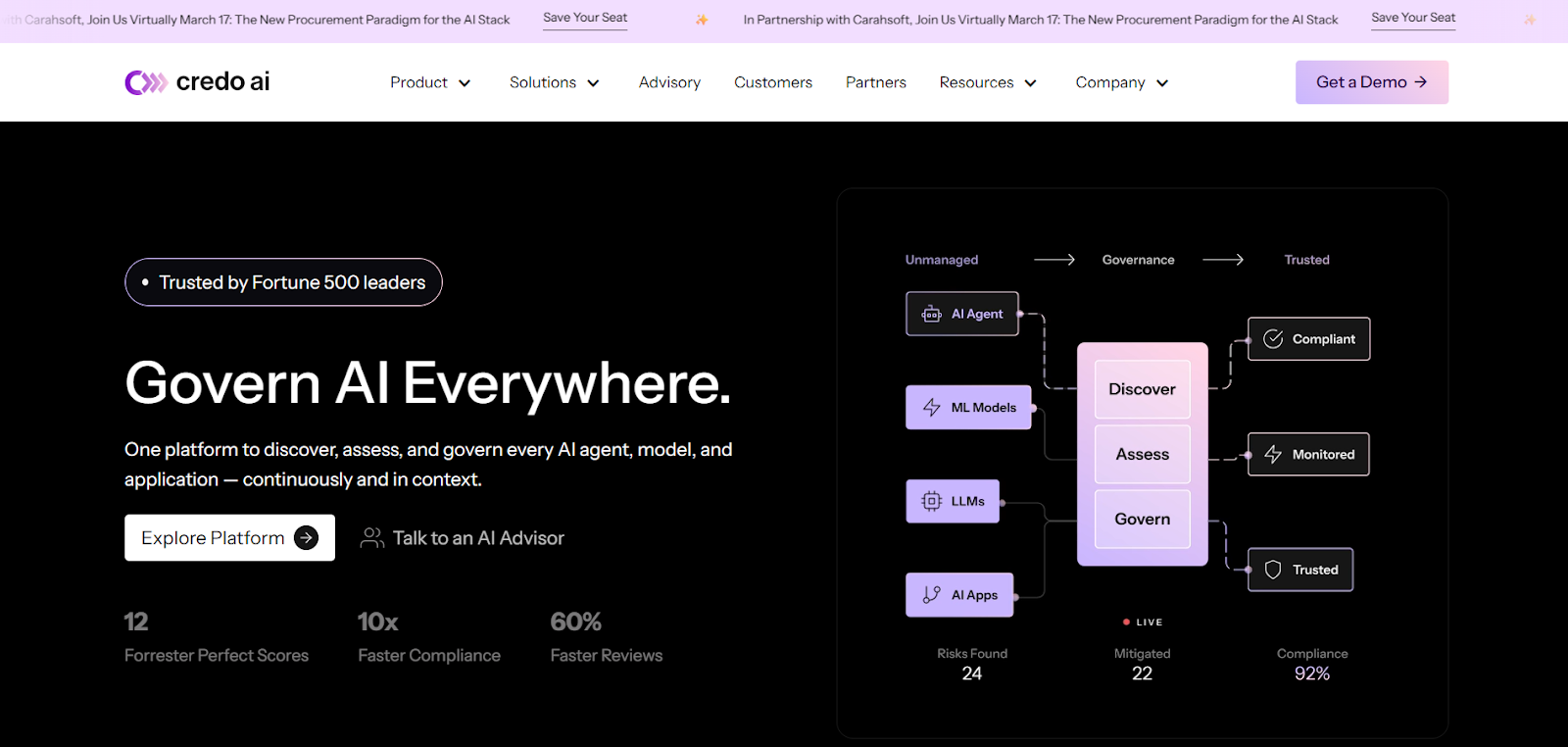
Credo AI focuses on responsible AI governance by combining risk assessment, policy management, and compliance frameworks into a structured platform. It helps organizations operationalize responsible AI programs by aligning governance practices with regulatory expectations. The platform is often used by enterprises building formal AI governance strategies.
Key features:
-
Credo AI conducts structured AI risk assessments across models and use cases
-
It manages governance policies and compliance frameworks
-
It supports documentation and reporting for regulatory requirements
-
The platform enables workflows for governance approvals and oversight
-
It also aligns AI governance practices with responsible AI principles
Best for: Enterprises implementing responsible AI programs with a focus on governance and compliance alignment.
6. Holistic AI
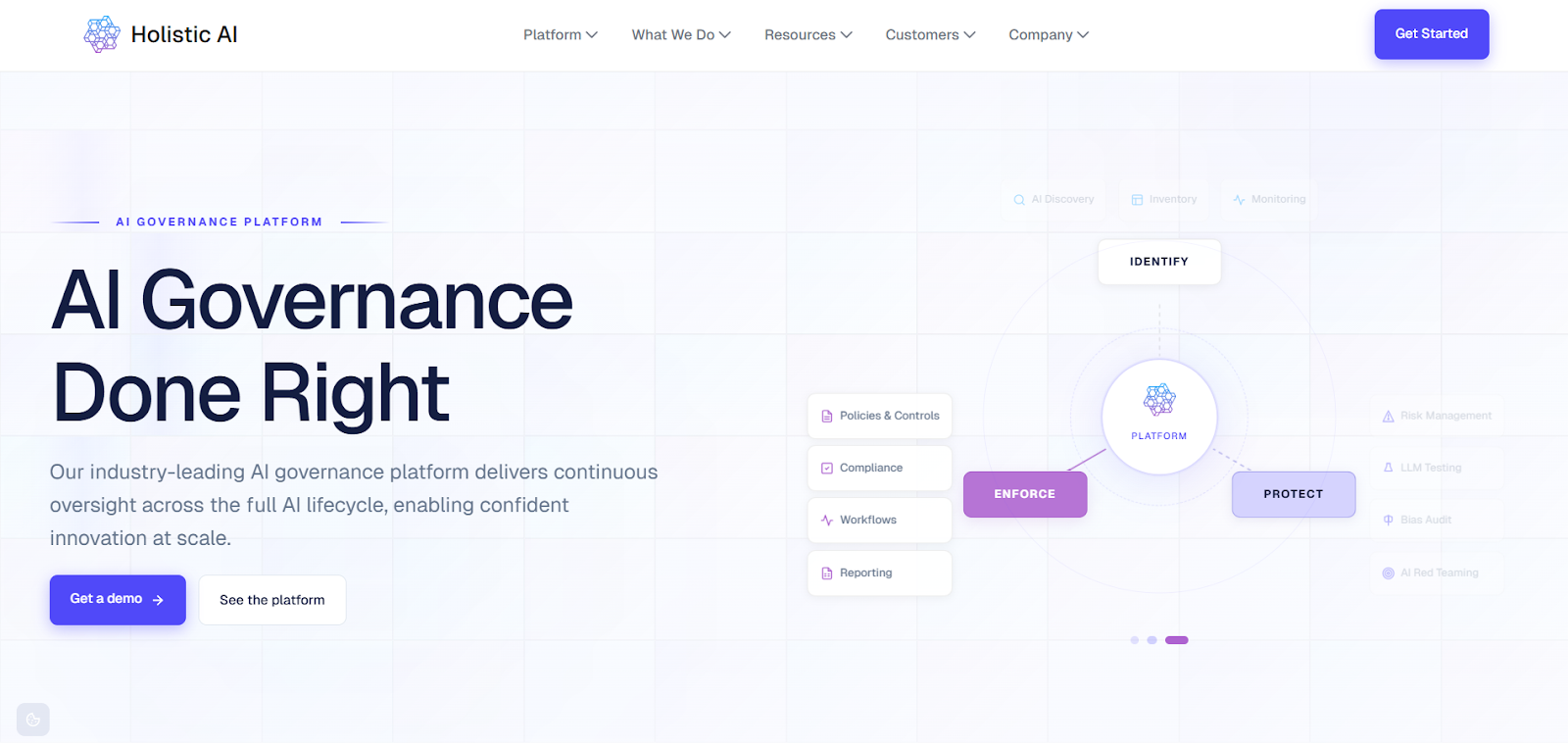
Holistic AI focuses on helping organizations assess, audit, and manage AI risks from a regulatory perspective. It provides tools for bias testing, compliance readiness, and model auditing, which are essential for organizations operating in regulated industries. The platform is often used to prepare for external audits and regulatory reviews.
Key features:
-
The platform performs bias testing and risk evaluation across AI models
-
Holistic AI supports compliance readiness for emerging AI regulations
-
It provides tools for AI auditing and governance validation
-
The platform helps document governance practices for regulatory reviews
-
It also enables organizations to assess risk across AI use cases
Best for: Organizations preparing for regulatory audits and needing structured AI risk and compliance assessments.
How to evaluate an AI governance risk management platform
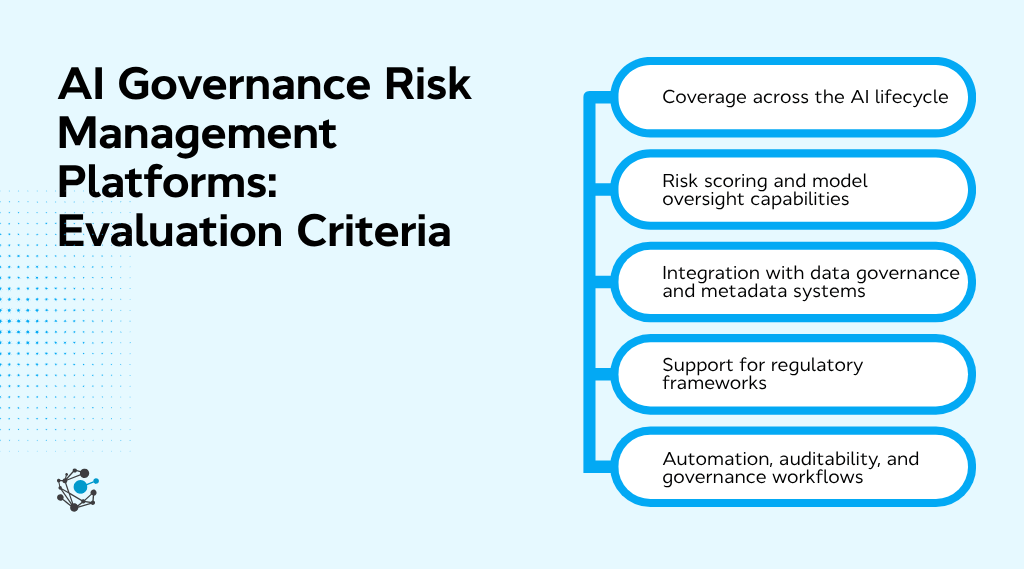
Choosing the right AI governance risk management platform is about how well the platform fits your governance model, risk priorities, and compliance requirements. Most enterprises struggle because AI risk spans both technical monitoring and organizational control, so the evaluation needs to reflect both sides.
|
Did you know? This complexity is one reason why 74% of companies still struggle to achieve and scale AI value, despite widespread adoption. |
Not every capability needs to be prioritized at the same time. What matters most depends on your AI maturity and where your biggest risks lie. At a practical level, organizations tend to prioritize differently based on their stage:
-
Early-stage adoption (limited AI in production): Focus on model inventory, basic governance workflows, and documentation. At this stage, visibility and control matter more than advanced monitoring.
-
Scaling AI across teams and use cases: Prioritize lifecycle coverage, risk scoring, and model monitoring. As more models move into production, continuous oversight and risk management become critical.
-
Regulated or high-risk environments: Emphasize compliance alignment, auditability, and governance workflows. The focus shifts to proving accountability, meeting regulatory requirements, and maintaining audit readiness.
-
Advanced, AI-driven enterprises: Look for full integration across governance, monitoring, and compliance, with automation and real-time insights. The goal is to operationalize governance as a continuous system rather than a checkpoint.
This maturity-based approach helps avoid over-engineering early on while ensuring that governance scales with AI adoption.
Coverage across the AI lifecycle
A strong platform should support governance across the entire AI lifecycle, not just isolated stages. Gaps between development and production often create the biggest risks.
Look for coverage across:
-
Model development, including documentation and approvals
-
Deployment, with governance checkpoints before release
-
Continuous monitoring for drift, bias, and performance issues
-
Retirement and decommissioning processes
End-to-end lifecycle support ensures that governance remains consistent as models evolve.
Risk scoring and model oversight capabilities
Risk visibility is where many platforms fall short. You need more than static reports; you need continuous insight into model behavior.
Key capabilities to prioritize:
-
Automated risk scoring based on defined criteria
-
Bias detection and fairness monitoring across datasets
-
Real-time alerts for performance degradation or anomalies
-
Dashboards that provide clear visibility into model health
These features help teams move from reactive fixes to proactive risk management.
Integration with data governance and metadata systems
AI models do not operate in isolation. They depend on data, and without visibility into that data, governance breaks down quickly.
Platforms that integrate with metadata and lineage systems provide:
-
Model-to-data traceability for better accountability
-
Visibility into how data changes impact model outputs
-
Stronger governance workflows across data and AI
This is where platforms like OvalEdge stand out. By connecting AI models with data lineage and metadata, they help organizations understand not just what a model does, but how it is influenced by underlying data.
Support for regulatory frameworks
Regulatory alignment is no longer optional. Platforms should make it easier to map governance processes to emerging frameworks. Look for support across:
-
EU AI Act requirements for high-risk systems
-
NIST AI Risk Management Framework for lifecycle governance
-
ISO standards for structured governance and documentation
This reduces the burden on teams and ensures readiness for audits or regulatory reviews.
Automation, auditability, and governance workflows
Manual governance does not scale with AI adoption. Automation and auditability are critical for maintaining control without slowing down innovation. Focus on platforms that provide:
-
Policy enforcement across models and workflows
-
Approval processes for model validation and deployment
-
Audit trails that capture decisions, changes, and ownership
-
Compliance reporting for internal and external stakeholders
These capabilities ensure that governance is not just defined, but consistently applied and easy to demonstrate. When you step back, the right platform is the one that brings governance, monitoring, and compliance into a single, connected system.
Conclusion
AI is already shaping critical decisions across your business.
The next step is building a connected governance layer that brings together model oversight, data lineage, risk scoring, and compliance workflows into one system.
This is where OvalEdge comes in. When you engage with our team, the process typically starts with understanding how your current AI and data ecosystem is structured.
From there, we map your models to data assets, identify governance gaps, and show how a metadata-driven approach can bring visibility, accountability, and control across the AI lifecycle.
If you are evaluating how to operationalize AI governance in your organization, it is worth seeing how this works in practice. Schedule a call with OvalEdge to explore how you can bring governance, risk, and compliance into a single, unified platform.
FAQs
1. What risks do AI governance platforms help organizations manage?
AI governance platforms help organizations manage risks such as algorithmic bias, regulatory violations, model misuse, security vulnerabilities, and a lack of decision transparency. They provide structured oversight to ensure AI systems operate responsibly, safely, and in compliance with organizational policies.
2. Who is responsible for AI governance in large enterprises?
AI governance responsibilities are typically shared across multiple teams, including data governance leaders, risk management teams, compliance officers, AI engineers, and legal departments. Many organizations also establish responsible AI committees to oversee model accountability and policy enforcement.
3. Can AI governance platforms monitor third-party AI models?
Yes. Many platforms provide mechanisms to track and assess third-party AI systems integrated through APIs, SaaS platforms, or external vendors. This helps organizations evaluate vendor risk, enforce governance policies, and ensure external models meet internal compliance standards.
4. How do AI governance platforms support responsible AI initiatives?
AI governance platforms support responsible AI by enabling organizations to document model objectives, assess risks, monitor fairness, and maintain transparency. They also help enforce internal policies and ethical guidelines throughout the lifecycle of AI development and deployment.
5. What is the difference between AI governance and model risk management?
AI governance focuses on organizational oversight of AI systems, including policies, accountability, and compliance. Model risk management primarily evaluates technical risks related to model performance, bias, and reliability within machine learning and statistical modeling environments.
6. How do organizations prepare for AI regulations using governance platforms?
Organizations prepare for AI regulations by documenting AI systems, conducting risk assessments, maintaining audit trails, and aligning governance policies with regulatory frameworks. Governance platforms centralize these processes, making it easier to demonstrate compliance during regulatory reviews or audits.
.png?width=1081&height=173&name=Forrester%201%20(1).png)
.png?width=1081&height=241&name=KC%20-%20Logo%201%20(1).png)