-1.png)
Three teams pull the same revenue number from the same data lake. They get three different answers. All three are technically correct. That's the storage-vs-meaning problem a semantic data lake is built to solve.
Data lakes store everything but define nothing. Every BI tool, ML pipeline, and AI agent pointed at raw tables has to infer what the data means independently, and they all infer differently. That gap is what quietly stalls analytics and AI initiatives long after the lake is technically working.
A semantic data lake adds a semantic layer, including metadata, ontologies, and knowledge graphs, on top of raw storage, connecting fields to shared business definitions instead of leaving interpretation to each consumer. This guide covers why traditional data lake architecture falls short, how the core components work together, and when it makes sense to build one.
What is a semantic data lake?
A semantic data lake is a data lake architecture that adds a semantic layer on top of raw stored data, connecting data attributes to business meaning and relationships instead of just file locations. It gives people, BI tools, and AI systems one shared way to query the lake using consistent business concepts rather than raw table and column names.
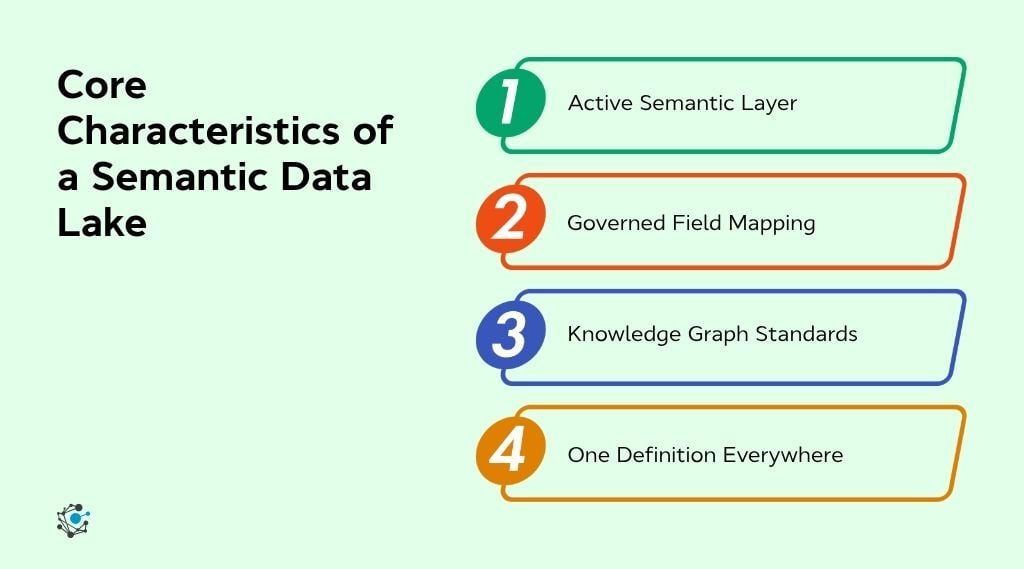
Core characteristics:
-
Combines traditional data lake storage with an active semantic layer that translates technical schemas into business terms
-
Maps raw fields to governed concepts (e.g., net_rev_q becomes "Net Revenue: gross revenue minus refunds, scoped to fiscal quarter")
-
Built on knowledge graph and ontology standards (RDF, OWL, SPARQL) that make entity relationships machine-readable
-
Serves one consistent definition set to every consumer: BI dashboards, data science notebooks, and AI/RAG pipelines alike
That distinction between storage and meaning is exactly what breaks down when organizations rely on a traditional data lake alone.
Why don't data lakes create business meaning on their own?
Data lakes were built to store raw data cheaply at scale, not to define what that data means. They provide no built-in mechanism for attaching business definitions, relationships, or rules to the data they hold. Every downstream consumer fills that gap independently, which produces three recurring problems:
|
Symptom |
Root Cause |
Business Impact |
|
Same metric, different numbers across teams |
No central logic layer to resolve definitions |
Decisions depend on which dashboard is opened first |
|
Every new tool rebuilds core metrics from scratch |
Business logic lives inside tools, not above the lake |
Engineering costs scale with each new consumer |
|
AI returns plausible but wrong answers |
Raw schemas carry no business context |
AI pilots stall before reaching production |
Inconsistent definitions and metric drift
When a data lake consolidates raw data from CRM, ERP, and finance systems, it inherits every system's local naming conventions. Sales defines "active customer" by login frequency. Finance defines it by contract status. Support defines it by open ticket history. All three pull from the same tables and produce different totals.
The root cause isn't broken pipelines. It's semantic fragmentation: no shared logic layer sits above the lake to arbitrate which interpretation holds. Each department fills that gap with its own rules, and the numbers drift further apart over time.
Every consuming tool duplicates the same business logic
Without a centralized meaning layer, every BI dashboard, dbt model, and ML feature store hardcodes its own version of core metrics. Revenue gets calculated in three different ways. "Active user" gets four different definitions. Each version is technically defensible, which makes reconciliation harder, not easier.
Data teams absorb the cost of aligning these definitions manually across departments, and that cost compounds every time the organization adds a new consuming tool.
Raw data lakes can't ground AI and LLMs
LLMs, RAG pipelines, and autonomous agents pointed at raw tables have no governed context to work with. They read column names like "cust_stat_cd," infer meaning from patterns, and produce answers that sound right but trace back to no approved definition.
It's a data architecture gap.
A 2025 Gartner survey of data management leaders found that 63% of organizations either lack or are unsure they have the right data management practices to support AI.
That gap between storing data and making it AI-ready is why "metadata-driven data lake" and "AI-ready data lake" have shifted from aspirational labels to hard architecture requirements.
Limitations of traditional data lake architecture
Traditional data lake architecture has two core limitations: it provides no mechanism for defining business meaning above the storage tier, and it pushes the full cost of interpreting data onto every downstream consumer.
1. Storage architecture does not mean architecture
Schema-on-read was a deliberate trade-off. It lets data engineers ingest anything from any source without modeling it first, which dropped storage costs and removed ingestion bottlenecks. The cost of that flexibility landed somewhere else: every team, tool, and pipeline that reads the data now has to figure out what each field means on its own.
For years, experienced analysts absorbed that cost silently. They carried business definitions in their heads, knew which columns to trust, and manually reconciled conflicting reports when needed. The architecture looked fine because the humans compensating for it were good at their jobs.
That compensation doesn't scale. When an organization adds its tenth BI dashboard, its third ML pipeline, or its first AI agent, each new consumer repeats the same interpretive work from scratch.
The result is predictable:
According to research compiled by DataStackHub (2025), roughly 55% of enterprise data goes completely unanalyzed despite years of cloud investment. The data landed safely.
No semantic data model existed above it to make interpretation repeatable.
2. AI exposes the design gap immediately
AI accelerated this breakdown. A human analyst who encounters an ambiguous column like "cust_stat_cd" will ask a colleague or check the documentation. An LLM will guess, and it will guess confidently.
In a paired benchmark by Own Your AI, frontier models given only raw schemas correctly answered roughly half of the first-shot analytical questions.
When the same models received a basic semantic-layer context document, accuracy improved by 17 to 23 percentage points. The model choice made almost no difference. The context did.
That's the core finding: data readiness for AI is a semantic challenge, not an algorithmic one. If the storage tier can't provide that semantic foundation, something has to sit above it.
Semantic data lake architecture: core components and how it works
A semantic data lake architecture is a five-layer system where each layer depends on the one below it and enables the one above it. Remove any single layer, and the architecture breaks.
The core components
A semantic data lake architecture consists of five interdependent layers: storage, metadata and knowledge graph, ontology, semantic layer, and governance.
-
Storage layer: Object storage and open table formats (Iceberg, Delta Lake, Hudi) hold raw structured, semi-structured, and unstructured data. This layer gives the architecture its scale and cost advantages, but it carries zero business meaning on its own.
-
Metadata and knowledge graph layer: Scans storage and expresses what it finds as connected entities: tables, columns, schemas, data flows. This layer provides the raw material that the ontology formalizes into business concepts. Platforms like OvalEdge build this foundation through their Enterprise Context Graph, connecting metadata, lineage, and relationships into a single queryable structure.
-
Ontology and business glossary: Takes the entities surfaced by the knowledge graph and assigns formal business definitions. "net_rev_q" becomes "Net Revenue: gross revenue minus refunds, scoped to fiscal quarter." "cust_stat_cd" becomes "Customer Status: active, churned, or suspended." This is where raw labels turn into governed meaning.
-
Semantic layer and query virtualization: Exposes the ontology's definitions to BI tools, notebooks, and AI agents through a single query interface. Analysts query in business terms. AI agents read governed definitions instead of guessing from column headers. Every consumer follows the same logic.
-
Governance and access control: Enforces policy on top of the same concepts the ontology defines. If "Employee Salary" is classified as sensitive, that classification travels with the concept across every dashboard, export, and AI pipeline. Define once, enforce everywhere.
The dependency chain runs in one direction: raw metadata without an ontology is just labels, an ontology without a semantic layer is unreachable by tools, and a semantic layer without governance exposes ungoverned data at scale.
How it works in practice
A retailer asks, "Which top accounts had a service issue tied to a discontinued product line?"
Without a semantic data lake, an analyst manually pulls data from CRM, support ticketing, and product lifecycle systems, reconciles field names across all three, and builds a one-off query. That process typically takes weeks.
With a semantic data lake, Customer, Service Incident, and Product are already modeled as connected entities with pre-mapped relationships and governed definitions. The same question routes through the semantic layer and resolves in hours. No manual reconciliation. No custom pipeline.
That's the practical difference between storing data and giving it shared meaning.
Benefits of a semantic (AI-ready) data lake
%20data%20lake.jpg?width=1024&height=569&name=Benefits%20of%20a%20semantic%20(AI-ready)%20data%20lake.jpg)
An AI-ready data lake built on semantic architecture delivers four outcomes a raw data lake cannot.
AI gets reliable, governed context
This is the primary reason enterprises invest in semantic data lake architecture today. Three capabilities improve when a governed context layer sits between raw storage and AI consumers:
-
RAG grounding: Retrieval-augmented generation pipelines pull from governed definitions and contextual data through a semantic layer architecture instead of raw tables. A revenue question returns one governed calculation, not whichever table the retriever surfaced first.
-
Agent reliability: Autonomous agents need to know which definitions are current, which fields are sensitive, and which policies apply. A semantic layer provides that context at query time so agents act on governed rules, not guesses.
-
Reduced hallucination: A governed definition turns an inference into a lookup. Lookups are verifiable. Inferences are not. That shift moves AI outputs from "plausible" to "traceable."
Faster cross-domain answers
Questions spanning CRM, support, and finance previously required weeks of manual reconciliation across systems. Pre-mapped relationships in the knowledge graph let analysts and AI agents traverse those connections directly. Weeks compress to hours.
Governable self-service
Without a semantic layer, business users query raw tables and invent local metric definitions that drift from corporate standards. An intelligent data lake gives them governed business terms to query against. Same independence, no conflicting KPIs.
Reusable business logic
Model "Customer" or "Net Revenue" once in the ontology, and every future dashboard, report, or AI agent reuses that definition. Each new use case stacks on existing meaning instead of starting from scratch. The marginal cost of each deployment drops as the semantic model grows.
Where does a semantic data lake fit, and what doesn't it replace?
A semantic data lake adds a meaning layer above existing infrastructure. It doesn't replace any of the systems below.
|
Concept |
What it actually is |
Relationship to a semantic data lake |
When to use it |
|
Semantic layer |
Definitions, metrics, and business rules in one logic tier |
Core component inside it, not a separate architecture |
Standardizing BI metrics without full knowledge-graph modeling |
|
Data lakehouse |
Storage architecture (Iceberg, Delta, Hudi) with warehouse capabilities |
Provides the storage substrate it sits on top of |
Fixing transactional gaps: ACID compliance, schema evolution |
|
Data fabric/data mesh |
Operating model for decentralized data ownership |
Complementary: semantic layer lets independent domains interoperate |
Solving ownership (who owns data), not definitions (what data means) |
|
Metadata inventory: lineage, ownership, asset location |
Catalog shows where data lives; semantic layer shows what it means |
Discoverability and lineage without resolving conflicting definitions |
Semantic data lake vs. semantic layer
The table covers the structural relationship. The practical question most teams ask is: can a semantic layer work on its own? Yes. Many BI teams run a standalone semantic layer (dbt metrics, LookML, Cube) without a full semantic data lake. It works well for standardizing metrics across dashboards.
It starts breaking when AI agents, RAG pipelines, or cross-domain questions need the deeper entity modeling and governance that a full semantic data lake provides.
Semantic data lake vs. data lakehouse
The most common misconception is that these compete. They don't. A lakehouse upgrades how data is stored and transacted. A semantic data lake upgrades what that data means. Most enterprises that invest in a lakehouse (Databricks, Snowflake) find that metric drift and definition conflicts persist because the lakehouse was never designed to resolve them. Layering semantics on top of an existing lakehouse is the standard path.
Semantic data lake vs. data fabric and data mesh
Neither mesh nor fabric automatically aligns business definitions across domains. A mesh architecture decentralizes ownership, which is valuable, but three product teams defining "Active User" independently will still produce three different numbers.
The semantic layer is what keeps decentralized domains speaking the same language. Most mature mesh implementations add one eventually.
Semantic data lake vs. data catalog
These solve different problems, and nearly every mature architecture runs both. The catalog indexes what exists and tracks how it moves. The semantic layer defines what it means and how concepts relate to each other. A common mistake is purchasing a catalog expecting it to resolve definition conflicts. Catalogs track definitions. Semantic layers enforce them.
That said, not all catalogs are equal starting points for a semantic data lake. The most effective foundation is a catalog that already governs what it indexes: business glossary terms mapped to assets, lineage tracked end-to-end, data quality measured, and access policies enforced in one workflow.
Platforms like OvalEdge connect these capabilities in a single data governance layer, so the semantic tier above it starts with trusted, governed definitions rather than an ungoverned metadata inventory.
When should you build a semantic data lake, and when should you wait?
A semantic data lake is a long-term architecture investment, not a quick fix. The organizations that succeed with it share three conditions, and the ones that stall usually skip the same foundational step.
Signals you're ready
Three patterns consistently indicate that an organization has outgrown raw data lake architecture and needs a semantic layer above it.
-
Cross-system questions routinely need custom engineering: High-value business questions pull data from three or more source systems, and answering them requires analysts to build one-off pipelines or manually reconcile exports every time.
-
Core metrics conflict across teams: "Revenue," "Active Customer," or "Churn" mean materially different things depending on which dashboard or department generated the number. Teams spend more time debating whose number is right than acting on insights.
-
AI initiatives stall on accuracy: RAG, agentic, or analytics AI pilots can't clear production accuracy thresholds because the underlying data carries no governed business context for models to ground against.
If all three are present, the cost of NOT building a semantic data lake is already compounding.
Signals you can wait
Not every data estate needs a semantic data lake today. Three conditions suggest the investment is premature.
-
The data estate is single-domain: If the organization's data sits within one operational department and a small technical team runs analytics on it, a well-modeled warehouse or a standalone semantic layer will cover the need.
-
Governance maturity is too low: A semantic layer amplifies existing governance. It doesn't create it. If no clear ownership exists for data quality, business definitions, or access policies, those foundations need to come first. Layering semantics on top of ungoverned data just exposes ungoverned data faster.
-
Nobody owns core business concepts: If the organization hasn't assigned ownership for terms like "Customer" or "Revenue," adding a semantic layer won't resolve the conflict. It will surface it more visibly without anyone being empowered to fix it.
The common thread across all three: governance comes before semantics, not after.
A simple way to start
The fastest path to value is narrow and iterative, not broad and simultaneous.
-
Pick one contested concept: Choose a single high-friction business term where teams actively disagree on the definition (e.g., "Active Customer").
-
Model it and map it: Define the term formally, map it to the specific lake tables it draws from, and connect exactly one downstream consumer (a BI dashboard or an AI agent).
-
Stabilize before expanding: Run it in production. Let teams use it. Fix edge cases. Don't add a second concept until the first one is trusted and adopted.
-
Scale through repetition: Each additional concept follows the same pattern. The cost of adding the second is lower than the first, and the tenth is lower than the second.
Start with one concept, prove it works, then repeat. That's how semantic data lake implementations scale without stalling.
What are the common challenges and pitfalls?
The most common challenges with semantic data lake implementations are poor source data quality, over-scoped first rollouts, vendor lock-in from proprietary tooling, confusion between semantic layers and data catalogs, and treating the implementation as a one-time project instead of an ongoing governance discipline.
-
Source data quality still matters: A semantic layer standardizes how data gets interpreted, not whether the underlying data is accurate. If ingestion pipelines land dirty or incomplete records, governed definitions will just make bad data consistently wrong instead of inconsistently wrong. Organizations need end-to-end data lineage to trace quality issues back to their source before layering semantics on top.
-
Over-scoping the first rollout kills adoption: Modeling dozens of business concepts simultaneously before proving any single one in production stalls the entire program. The organizations that succeed start with one contested term, stabilize it, and expand from there. The ones that stall try to model the whole enterprise at once.
-
Proprietary tooling recreates the lock-in the lake was built to avoid: If the semantic layer runs on closed, vendor-specific standards, the organization trades one dependency for another. Open standards (RDF, OWL, SPARQL) keep the meaning layer portable and interoperable across platforms.
-
A semantic layer is not a data catalog: A catalog indexes what data exists and where it lives. A semantic layer defines what that data means. Conflating the two leads to redundant purchases where each product does half the job the organization expected.
-
One-time project thinking causes definitions to drift: A semantic data lake requires ongoing governance: regular definition reviews, ownership updates, and policy enforcement. Organizations that treat the rollout as a project with a finish line find their definitions drifting back within months.
Most of these pitfalls stem from the same root cause: treating the semantic layer as a technology purchase rather than an operational discipline that needs sustained ownership and investment.
Building a semantic data lake starts with governed meaning
Every additional AI agent, dashboard, or analytics pipeline pointed at an ungoverned data lake multiplies the cost of missing business definitions. The problem doesn't plateau. It compounds.
The organizations that avoid this share one trait: they treat business meaning as infrastructure, not as a cleanup project they'll get to later. They define core concepts once, govern them actively, and let every consumer read from the same source of truth.
A semantic data lake works best when the layer above it is actively governed: glossary terms defined, classifications enforced, ownership assigned. Platforms like OvalEdge help enterprises build and maintain that governed foundation, so the semantic layer above it starts with trusted, governed definitions from day one.
Book a demo to see how OvalEdge connects business glossary, lineage, data quality, and access governance into one platform, giving a semantic data lake initiative the governed starting point it needs.
.png?width=1081&height=173&name=Forrester%201%20(1).png)
.png?width=1081&height=241&name=KC%20-%20Logo%201%20(1).png)