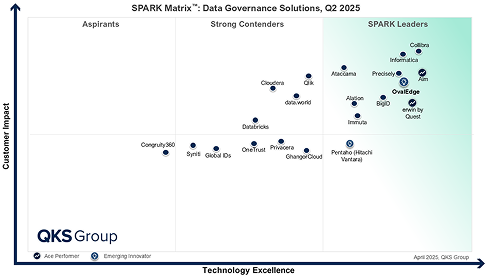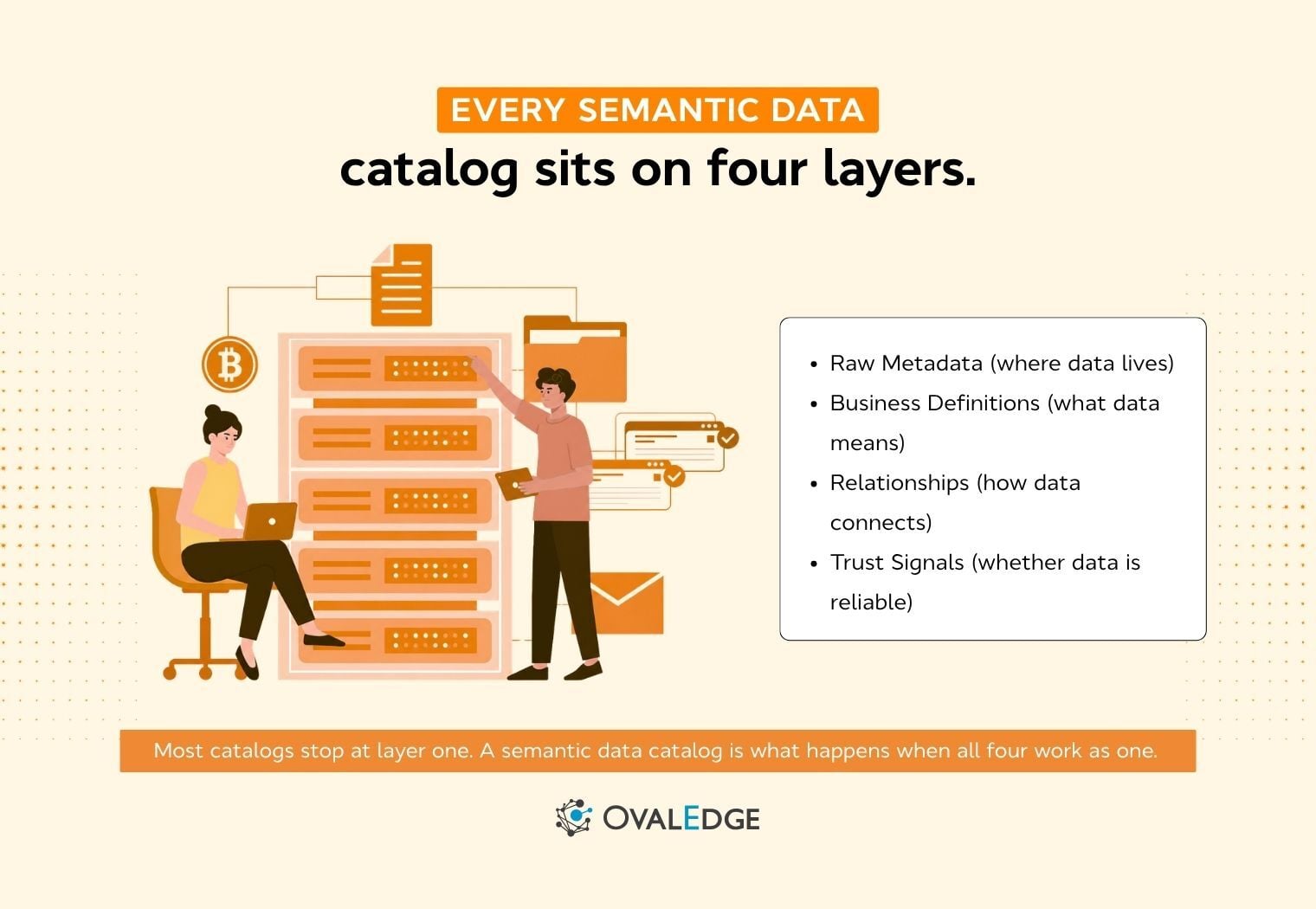
A semantic data catalog is a metadata catalog that adds business meaning, relationships, and natural-language search on top of an organization's data assets. It lets people find and understand data by concept rather than by structure, without needing to know the exact table or column where something lives.
For years, enterprises have poured effort into automating technical metadata collection: column types, table names, ownership tags, all captured with less and less manual work. But the bottleneck has moved. It is no longer about gathering metadata.
It is about meaning, and whether people, and increasingly AI systems, can trust what data represents and how it relates to everything else. That is exactly what the catalog solves.
What is a semantic data catalog?
A semantic data catalog is a system that describes not just where your data lives, but what it means. It sits on top of your existing metadata and adds business definitions, the relationships between data assets, and search that understands plain language. The result is a catalog people can query by concept, like "monthly recurring revenue," instead of hunting through schemas for the right table.
Semantic data catalog vs. Traditional metadata catalog
A traditional metadata catalog indexes technical facts: table names, column types, ownership tags, maybe usage stats. It can tell you a column called cust_ltv exists in a table called fact_sales.
A semantic catalog adds the layer that helps: it knows cust_ltv means customer lifetime value, that finance owns it, and that it draws from billing and subscription data. You search by the question you're answering, not the naming convention someone chose years ago.
Semantic data catalog vs. Semantic layer
A semantic layer defines the metrics and logic for querying: revenue equals this formula, filtered these ways, so every query returns the same number. The catalog defines meaning and discoverability across your whole data estate: what exists, what it represents, and where to find it. One governs how you calculate; the other governs how you find and understand.
Meaning only matters if people, and increasingly AI agents, can actually find the data it describes. That is where the catalog’s real work begins.
Why semantic data catalogs matter now
Semantic data catalogs aren't a new idea, but the pressure behind them is. Three forces have converged to move them from nice-to-have to necessary: AI systems that need trustworthy context, a discovery problem that keeps getting worse, and years of metadata work that stopped short of meaning.
1. AI agents and RAG need a trusted context layer
AI agents, copilots, and RAG pipelines are only as reliable as the context they're grounded in. Feed a model a warehouse full of columns with no shared meaning, and it will guess. Ask the same question two ways, and you can get two different answers, or one that's confidently wrong. The model isn't broken. It just has no way to know that "revenue" in one table follows a different definition than "revenue" in another.
This is why semantic data catalogs are getting real attention right now. As companies wire AI directly into enterprise data, ungoverned access stops being a theoretical concern and becomes an operational risk.
A Gartner 2025 study on AI-ready data makes the point in blunter terms: what stalls AI projects isn't model quality; it's the absence of governed meaning and relationships underneath the data feeding them.
A semantic catalog is the layer that closes that gap, giving agents a governed structure of business context to reason against instead of raw tables.
OvalEdge Expert insight: The stalled AI project isn't a model problem. It's a meaning problem. Teams that get their catalog right before scaling agents see fewer hallucinations, faster time to trusted answers, and far less rework than teams that treat governance as a phase-two problem.
2. The discovery problem compounds the risk
The same confusion that trips up an AI agent already slows down people. Data sprawls across warehouses, lakes, and BI tools. Naming is inconsistent. Data mesh spreads ownership across domains that each label things their own way.
If two analysts can't agree on what a field means, the agent querying it has no chance. Human discovery problems and AI grounding problems are the same problem in different clothes.
3. From metadata catalogs to semantic catalogs: a brief evolution
Catalogs got here in stages. First came manual inventories, someone's spreadsheet of what lived where. Then automated tools that collected technical metadata at scale. Then business glossaries that added meaning but stayed walled off from search, so you still couldn't find data by what it meant. The semantic data catalog is the step that folds meaning, relationships, and discovery into one layer.
None of this works as an idea alone. It depends on specific building blocks operating together, starting with what "semantic metadata" actually means.
Core components of a semantic data catalog
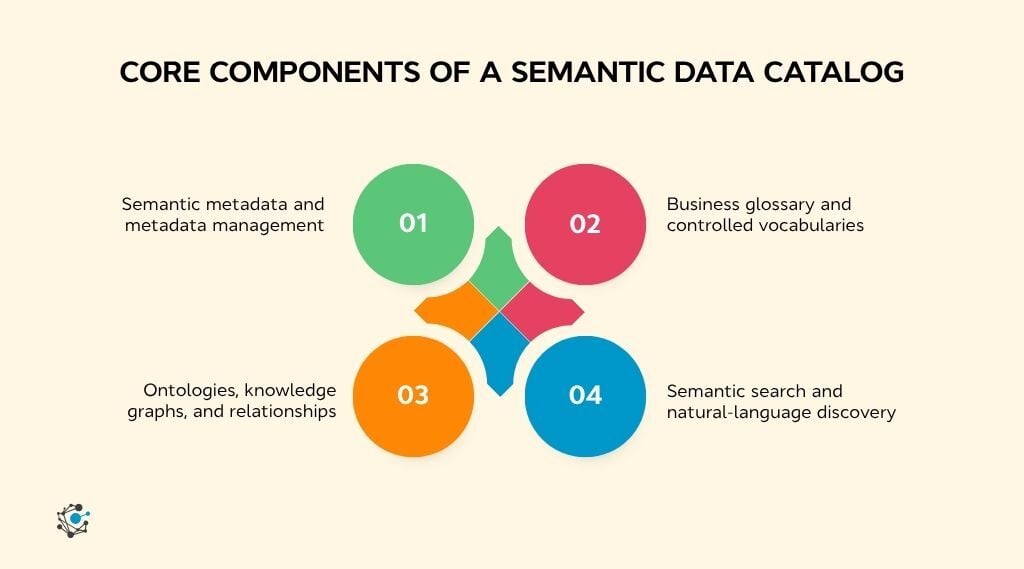
A semantic data catalog isn't one feature. It's a handful of parts working together, each adding a different layer of meaning on top of raw metadata. Understanding them individually makes it clear why the catalog can do things a plain metadata index can't, and why they only pay off when connected.
1. Semantic metadata and metadata management
Technical metadata tells you a column's name, type, and location. Semantic metadata tells you what it means: the business definition, the concept it maps to, who owns it, and how trustworthy it is.
Managing both together through metadata management is what lets a catalog answer "what is this and can I rely on it," not just "does it exist."
At OvalEdge, the lineage module ties technical assets back to the business definitions managed in the governance layer, keeping trust signals visible next to the data.
2. Business glossary and controlled vocabularies
A business glossary is your organization's shared dictionary. It fixes definitions for terms like "active customer" or "net revenue" so every team means the same thing. Controlled vocabularies go further. It limits terms to an approved set that stops five departments from inventing five names for one idea.
3. Ontologies, knowledge graphs, and relationships
A flat catalog lists assets. A knowledge catalog connects them. Ontologies define how concepts relate (a customer places an order, an order contains products), and a knowledge graph stores those links so the catalog understands context, not just contents.
That’s what lets a search for “customer churn” surface the tables feeding it, even when none of them contain the word “churn.”
4. Semantic search and natural-language discovery
Traditional catalog search matches keywords against names and tags, so you have to guess how something was labeled. Semantic search turns catalog entries into vector embeddings, numerical representations of meaning, and matches your query to the closest concepts rather than the closest strings.
Ask for "customers who cancelled last quarter" in plain language, and it returns the right assets, even if the underlying columns are named things like churn flag and subscription end date.
How these components work together as a single context layer
Most tools get this wrong: these aren’t features you adopt one at a time. They only pay off connected. A glossary term is trustworthy only if it's tied to lineage. Lineage is useful only if it's mapped to business meaning. Governance holds only if it's enforced consistently across all of it. Pull one piece out and the rest weakens.
A platform like OvalEdge runs this as one governed layer, where meaning, lineage, ownership, and access control operate together instead of as separate modules you stitch together yourself. Governance plus context held in a single connected layer is what makes the catalog usable by both analysts and AI agents.
How a semantic data catalog works
Under the hood, a semantic data catalog runs a repeatable pipeline:
-
Ingest and profile metadata. Connect to source systems (warehouses, lakes, BI tools) and pull in technical metadata automatically, profiling each asset for structure, quality, and usage.
-
Enrich with business context. Layer on glossary terms, definitions, and ownership so every asset carries meaning, not just a schema.
-
Map relationships. Link technical assets to business concepts and to each other, building the graph that ties a concept like "churn" to the tables behind it.
-
Index for semantic search. Generate embeddings so natural-language queries return relevant assets by meaning rather than exact keyword.
-
Sync continuously. Refresh metadata as source systems change, so definitions and lineage don't go stale.
Take a "customer churn" query. The catalog resolves it across a CRM table of cancellations, a product table of usage drop-off, and a billing table of failed payments, even though none of them is literally named "churn." The analyst gets the right assets in seconds instead of pinging three teams and hoping someone remembers.
OvalEdge Expert insight: Step 5 is where most catalogs quietly fail. One that’s accurate at launch but stale three months later loses trust fast. Continuous sync, not one-time documentation, is what keeps it usable.
Snowflake has started building this kind of framework natively. It’s worth parsing on what it does, and doesn’t, cover.
Semantic data catalogs and Snowflake: native capabilities vs. broader needs
Snowflake has moved semantic modeling into the warehouse itself with Semantic Views and Cortex Analyst, which raises a fair question: if your data already lives there, do you still need a separate catalog?
Native tooling is the right call when your world fits inside the warehouse. Single platform, AI use cases scoped to Snowflake data, a manageable set of hand-authored models. If that's you, stop here.
The picture changes once data lives in more than one place. Snowflake's native semantics are warehouse-bounded by design. They see only Snowflake data, not the 15 to 30 other systems in a typical stack, and hand-authoring stops scaling once definitions multiply. That is when the catalog earns its cost.
|
Snowflake Semantic Views are enough |
You need a semantic data catalog |
|
Data lives mostly in one Snowflake warehouse |
Data spans multiple warehouses, lakes, and SaaS tools |
|
AI use cases scoped to Snowflake data |
Agents must reason across systems Snowflake can't see |
|
One team authoring a manageable set of models |
Semantic models multiplying into a maintenance bottleneck |
|
Governance needed inside a single platform |
Shared glossary and governance required across many systems |
One thing is worth noting. Snowflake, dbt Labs, and Salesforce co-founded the Open Semantic Interchange initiative to make semantic definitions portable across tools. That's a quiet admission from the warehouse vendors that native semantics have a portability problem.
Data fabric architectures face the same constraint. They automate integration and delivery, but without a governed semantic layer underneath, the automation moves data without preserving what it means.
Key benefits of a semantic data catalog
Not every benefit here is brand new. Snowflake's native tools already deliver some of them inside the warehouse. What a semantic data catalog changes is scope: the same wins now apply across every system you run, not just the one you've invested the most in.
-
Faster, more accurate data discovery: search by business concept instead of table name.
-
Less dependence on tribal knowledge: fewer bottlenecks waiting on a data engineer to explain a field.
-
Consistent definitions across teams: one glossary, not five conflicting spreadsheets.
-
More accurate AI and LLM outputs: agents query against governed, approved definitions.
-
Stronger governance and auditability: every asset traceable to an owner and a definition.
-
Reusable data products across teams: supports data mesh and domain ownership models.
Semantic vs. Enterprise vs. AI vs. knowledge data catalog
These four terms get used interchangeably, but they describe different emphases, not the same thing under four names. Here's how they actually differ and who each one fits best.
|
Term |
Primary focus |
Best for |
|
Semantic data catalog |
Business meaning, relationships, and natural-language discovery |
Teams that need everyone to agree on what data means |
|
Enterprise data catalog |
Scale, governance, and broad connectors across the whole stack |
Large, regulated, multi-system organizations |
|
AI data catalog |
ML-driven classification, automated enrichment, and semantic search |
Reducing manual curation as data volume grows |
|
Knowledge catalog |
Broader knowledge assets beyond structured data alone |
Org-wide knowledge management, not just data |
In practice, most modern platforms blend all four rather than fitting neatly in one box. A strong enterprise catalog usually carries semantic and AI capabilities inside it, and a knowledge catalog leans on the same metadata backbone. Use the table to decide which capabilities you actually need, then evaluate tools on whether they deliver those across your full data estate.
Semantic data catalog use cases across the enterprise
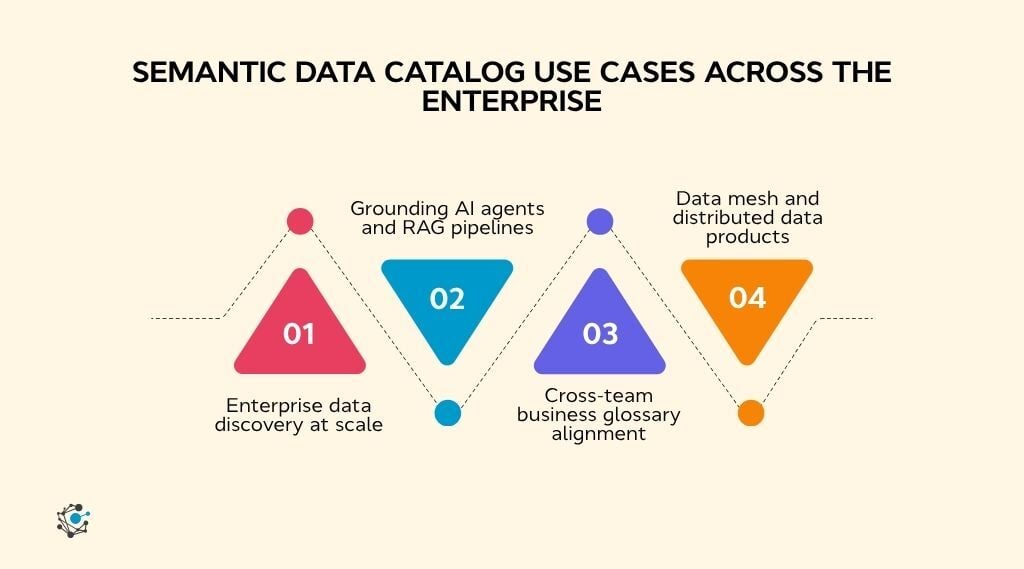
The value gets concrete once you see it in motion. Here are four places a semantic data catalog earns its keep, each with the kind of scenario that plays out daily inside data teams.
1. Enterprise data discovery at scale
A marketing analyst needs campaign attribution data. Instead of Slacking three teams and waiting a day, they search "campaign conversions by channel," land on the right table through a glossary term, and confirm ownership and freshness in the same view. What used to take hours of tribal knowledge takes seconds.
2. Grounding AI agents and RAG pipelines
The catalog acts as the context layer that keeps LLM-generated SQL honest. When an agent like OvalEdge's AskEdgi answers 'what's our churn rate,' it resolves the question against the catalog’s governed definitions and lineage rather than guessing from column names.
At OvalEdge, the catalog uses natural-language search so business users get results on their first query without memorizing schema names or learning query syntax.
Cortex Analyst does the same job inside Snowflake; a semantic catalog extends it across every system the agent needs to reach
3. Cross-team business glossary alignment
Finance counts an "active customer" one way, marketing another, product a third. A shared glossary forces one definition everyone builds on, so the number in a board deck matches the number in a dashboard. That alignment is quietly one of the highest-leverage things a catalog does.
Example: A hospital network discovered that “readmitted patient” used a 30-day window in CMS reporting, a 15-day window in internal quality dashboards, and no fixed window in finance. Governing the term through a shared glossary gave clinical, compliance, and finance teams one approved, source-tied definition, so every report used the same number.
4. Data mesh and distributed data products
When domains own their own data products, discovery fragments fast, and every domain ends up naming similar concepts differently. The semantic catalog becomes the shared vocabulary and searchable index over that decentralized setup, so a marketing team’s “customer” and a finance team’s “customer” resolve to the same governed definition, and a domain-owned product stays findable and trustworthy without recentralizing the data itself.
Evaluation comes down to six capabilities that separate a tool governing meaning inside one warehouse from one that governs it everywhere.
What to look for in a semantic data catalog
These criteria matter for one specific reason: the gap covered earlier: they separate a tool that governs meaning inside one warehouse from one that governs it everywhere your data lives. Use this as your evaluation shortlist.
Key evaluation criteria
- Breadth of native connectors across warehouses, lakes, BI tools, and SaaS, not just your primary platform.
- Depth of the glossary and ontology layer, so you get real business meaning and relationships, not just tags.
- Quality of semantic and natural-language search, measured by how well plain-language queries return the right assets.
- AI-readiness, meaning it can ground your RAG pipelines and enterprise agents against governed definitions, so answers stay consistent with the meaning your catalog enforces.
- Data governance, lineage, and access controls built in, so discovery never outruns security.
- Adoption curve for business users, because a catalog only the data team touches has already failed.
Build vs. buy
Native warehouse tools like Snowflake Semantic Views are a strong starting point if you're a single-platform team, and building on them can be enough for a while. A standalone catalog earns its cost once your data spans multiple systems or business-wide adoption becomes the actual goal.
The honest test: if your meaning problem stops at the warehouse edge, build; if it crosses that edge, buy.
Common challenges (and how to overcome them)
A semantic data catalog is only as good as the habits around it. Three problems trip up most rollouts, and each has a practical fix rather than a heroic one.
1. Metadata quality and freshness
Stale metadata quietly kills trust. The moment a definition, lineage path, or relationship is wrong, people stop believing the catalog and go back to asking around.
The fix isn't more documentation; it's less manual work: continuous sync that refreshes metadata, glossary terms, and the underlying relationship graph as source systems change, so the catalog stays current without someone babysitting it.
2. Adoption across business and technical users
A catalog only the data team uses hasn't solved the problem; it's just relocated it. Adoption comes from two things: clear glossary ownership, so every term has a named steward who keeps it accurate, and search that's genuinely intuitive, so a business user can find what they need without learning query syntax.
3. Governance at scale
Open discovery and tight access control pull against each other, and the tension grows with the catalog. This is exactly where extending Snowflake's governed-metric model enterprise-wide gets hard. The access rules and definitions that hold cleanly inside one warehouse are much harder to keep consistent across many systems. A clear data governance strategy defines how those rules scale beyond a single platform.
The answer is governance built into the catalog layer itself, applied uniformly, rather than reimplemented per system.
OvalEdge Expert insight: If your access rules and definitions live in the same layer as your metadata, they travel together. If they don't, every new source becomes a governance rebuild. That single architectural choice decides whether the catalog scales or slowly turns into another silo.
Conclusion
A semantic data catalog adds business meaning, relationships, and natural-language discovery on top of raw metadata, so people can find and understand data by concept instead of by structure.
Get it right, and the catalog becomes a natural entry point into the Enterprise Context Graph, where meaning, lineage, and governance stay connected across the full stack, so analysts and AI agents draw on the same trusted definitions.
Where you start depends on where your actual gap is. If your data and AI use cases live inside one warehouse, Snowflake-native tools may already cover you. If the gap runs past the warehouse edge, you need something broader.
OvalEdge is built for this broader case. It grounds enterprise-wide data discovery in a governed catalog (glossary, lineage, ownership, and AI-governance readiness), so every team and every agent can trust the data they’re using.
Book a demo with OvalEdge to see the Enterprise Context Graph in action, holding meaning, lineage, and governance together across every system your data lives in.