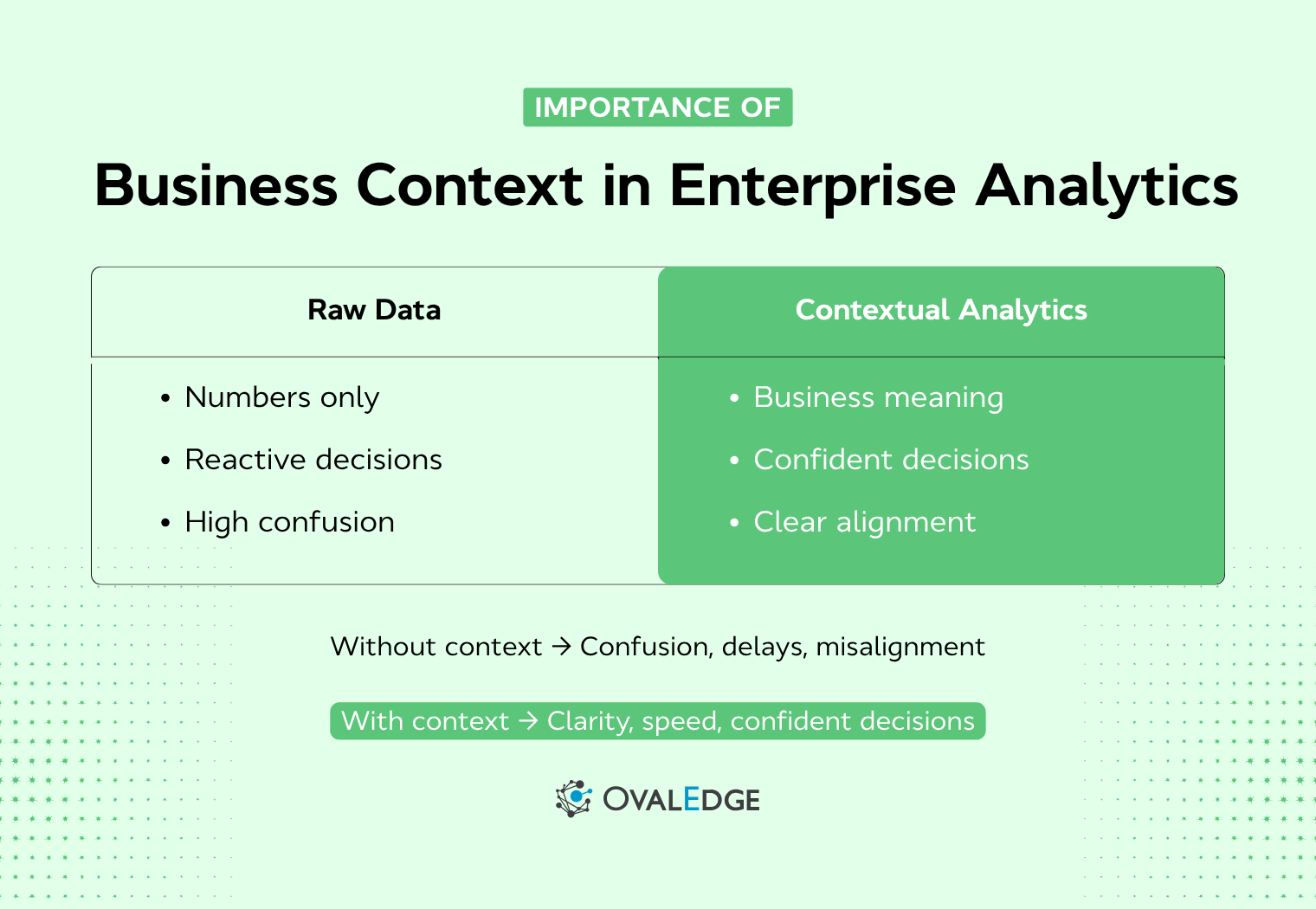
Enterprise analytics has become widespread, but using analytics does not guarantee reliable decisions.
The Worldmetrics Business Analytics Industry Statistics report 2026 found that 82% of organizations use business analytics to inform strategic decisions, while only 20% have achieved mature analytics capabilities.
The underlying figures are attributed to McKinsey and Gartner research from 2023. That maturity gap becomes critical when teams use different definitions, calculation rules, or assumptions for the same business metric.
A technically correct revenue figure can still mislead when its ownership, lineage, operating conditions, or intended use are unclear. Business context closes these gaps by connecting enterprise data with shared meaning and governance.
This guide explains how business context strengthens enterprise analytics and provides a six-part framework for building consistent, governed, and AI-ready contextual analytics across teams and systems.
What is business context in enterprise analytics?
Business context in enterprise analytics is the meaning, rules, ownership, lineage, and operating conditions surrounding data that help users understand what it represents, how it was calculated, and when it should be used. It turns raw data into information that can be interpreted consistently across business decisions, reporting, and AI-driven analytics.
For example, technical metadata may identify a column called net_revenue, its data type, and its source table. Business context explains whether that figure includes discounts, refunds, taxes, currency conversions, or specific revenue-recognition rules. It also identifies who owns the definition, which reports rely on it, and where the metric is approved for use.
|
Context element |
Question it answers |
Enterprise example |
|
Business definition |
What does this measure mean? |
What qualifies as an active customer? |
|
Calculation logic |
How is it produced? |
Which transactions, filters, and exclusions create net revenue? |
|
Ownership |
Who can approve or change it? |
Finance owns the official gross-margin definition. |
|
Lineage and provenance |
Where did it come from? |
A dashboard KPI traces through transformations to source systems. |
|
Operational context |
What conditions affect interpretation? |
A conversion decline follows a pricing or channel change. |
|
Governance context |
Where can it be used? |
A dataset carries certification, privacy, quality, and access requirements. |
These elements solve different problems. Definitions establish meaning. Lineage establishes traceability. Ownership creates accountability. Operational signals explain circumstances. Governance controls establish appropriate use.
A mature context model connects them rather than storing each one in isolation. That principle also underpins business context in data governance frameworks, where definitions, metadata, lineage, ownership, and governance workflows need to work as one system.
Business context vs data context vs semantic context
Several terms around context are used interchangeably even though they describe different layers of enterprise analytics.
|
Concept |
Primary purpose |
Example |
|
Data context |
Describes technical characteristics surrounding data |
Schema, source, timestamp, format, refresh frequency |
|
Business context |
Explains organizational meaning and intended use |
KPI definition, owner, business process, policy |
|
Semantic context |
Defines relationships among business concepts |
Customer, account, order, region, and product relationships |
|
Contextual analytics |
Applies relevant context while analyzing a question |
Interpreting a revenue decline using definitions, lineage, seasonality, and operational events |
A semantic layer is one important mechanism for making business meaning reusable. It can convert technical structures into consistent metrics, dimensions, entities, relationships, and calculation rules that BI tools and AI systems understand.
A semantic layer alone does not account for every form of context. Operational events, stewardship decisions, quality status, policy restrictions, and source provenance can sit outside the metric model. Enterprise contextual analytics therefore requires a broader view of context than standardized calculations alone.
OvalEdge expert insight: A semantic layer can standardize business meaning, but reliable interpretation also depends on ownership, provenance, quality, and approval context. The strongest analytics foundation governs meaning as actively as it governs the underlying data.
What is contextual analytics?
Contextual analytics is the practice of combining data with relevant business, semantic, technical, operational, and governance context at the time of analysis to produce more accurate and actionable insights.
How contextual analytics works
Contextual analytics can be implemented through five stages.
1. Identify the business question
Start with the decision the analysis needs to support. “Why did revenue fall?” requires different context from “Which revenue figure belongs in the regulatory report?”
Actionable steps:
-
Define the decision or business outcome the analysis will support.
-
Identify the metrics, entities, time periods, and business processes involved.
-
Specify the context needed to interpret the result correctly.
2. Locate trusted data and metadata
Find the assets that can answer the question across databases, warehouses, pipelines, and BI environments. A governed data catalog can connect technical and business metadata so analysts can distinguish trusted assets from outdated or departmental alternatives.
Actionable steps:
-
Identify candidate datasets and analytical assets.
-
Check ownership, freshness, certification, and quality status.
-
Prioritize approved sources over duplicate or unverified datasets.
3. Resolve business meaning
Confirm what important terms and metrics mean before applying them. A governed business glossary can connect approved definitions with owners, classifications, and related data assets.
Actionable steps:
-
Match metrics and terms to approved business definitions.
-
Identify legitimate variants across departments or use cases.
-
Confirm which definition applies to the current decision.
4. Trace data and calculation logic
Verify how the metric was produced and where its underlying data originated. Data lineage connects downstream analytics with upstream sources and transformations.
Actionable steps:
-
Trace the metric from the analytical output to its source systems.
-
Review transformations, filters, exclusions, and calculation logic.
-
Check whether recent pipeline, schema, or logic changes affected the result.
5. Apply situational and governance signals
Add conditions that influence interpretation or determine appropriate use. These can include pricing changes, seasonal demand, acquisitions, quality warnings, certification status, privacy requirements, and access policies.
Actionable steps:
-
Identify business events that coincide with the analytical result.
-
Apply relevant quality, certification, privacy, and access signals.
-
Interpret the finding using both the data and the conditions surrounding it.
The result is an analysis that explains not only what happened, but also which meaning, source, conditions, and rules should shape the decision that follows.
Why enterprise analytics loses context
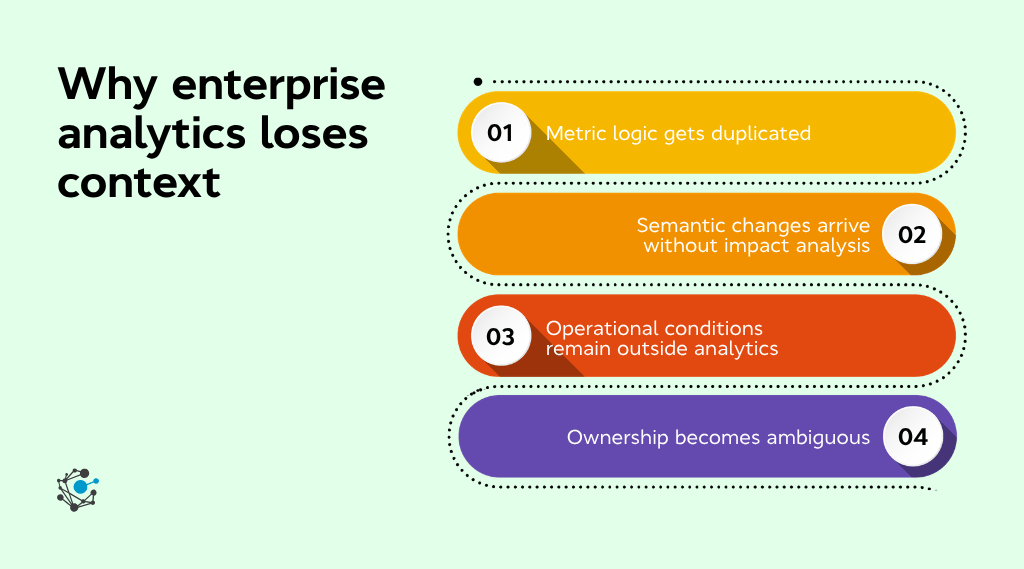
Business context usually breaks through accumulation rather than a single failure. Organizations add systems, teams, dashboards, models, and definitions faster than they connect their meaning.
1. Metric logic gets duplicated
A metric often begins with one agreed calculation. Over time, analysts copy the logic into BI workbooks, semantic models, spreadsheets, transformation code, and departmental reports.
Each copy becomes another place where a filter, time window, or exclusion can change.
The problem resembles the distinction between business glossaries and data dictionaries. Technical documentation can explain fields and structures, while business definitions establish what an organization means by a term. Both are useful, but neither can substitute for the other.
2. Semantic changes arrive without impact analysis
A definition can change even when the physical data does not.
Suppose an organization changes its definition of an active customer from “placed an order within 12 months” to “placed an order within six months.” The database may continue operating normally, but dashboards, forecasts, customer segments, and AI queries that depend on the old definition can immediately diverge.
This is why semantic layer architecture needs governance around metric ownership and change management, not only a technical modeling layer.
3. Operational conditions remain outside analytics
Many important business events never enter the analytics model.
A manufacturer may know that a plant was partially offline for maintenance. A retailer may know that a promotion ended three days early. A healthcare organization may know that a coding process changed. Those facts can materially change interpretation without appearing in the measures themselves.
Contextual analytics requires a mechanism for associating such conditions with relevant assets, metrics, periods, and decisions.
4. Ownership becomes ambiguous
Definitions remain stable only when someone has authority to approve them.
A glossary entry without an accountable owner can become stale. A dashboard without an identified business owner may continue using an obsolete metric. A semantic model managed entirely by technical teams can encode logic that no longer represents business policy.
Context therefore needs ownership at the same level as the metric, dataset, and reporting process.
How to keep analytics context consistent across teams
Enterprise consistency does not require every department to use identical measures. It requires differences to be explicit, governed, and traceable.
1. Establish canonical definitions for decision-critical metrics
Organizations rarely need to standardize every field at once. Priority should go to metrics that influence executive reporting, financial planning, customer decisions, regulatory obligations, or automated actions.
Each critical metric should have a defined meaning, formula, owner, approved use, and relationship to its underlying data.
Aligning a business glossary with a data catalog helps connect the business term with the technical assets that implement it. This closes the common gap between documentation and actual analytics usage.
2. Preserve legitimate variants
A global organization may need different definitions for local reporting, statutory accounting, product operations, and corporate planning.
Forcing those definitions into one universal metric can remove necessary context.
A better model distinguishes the variants, explains why they exist, assigns ownership, and identifies the reports or decisions each version supports. Consistency then means that users select intentionally rather than discovering differences during a meeting.
3. Connect context through relationships
A list of definitions is useful. A connected model is more powerful.
An enterprise context model should be able to relate a business term to its metrics, owners, source fields, transformations, dashboards, policies, quality status, and dependent business processes.
Book an Enterprise Context Graph demo to see how this context can be operationalized across analytics and AI.
4. Govern changes to meaning
Context changes need a lifecycle.
A proposed metric change should identify the owner, reason, impacted reports, effective date, dependent assets, and approval status. Critical downstream users need enough visibility to understand whether they are still looking at the same business concept after the change.
The principle is similar to data lineage best practices: traceability becomes most useful when it supports impact analysis before changes reach downstream consumers.
A six-part framework for context-aware analytics
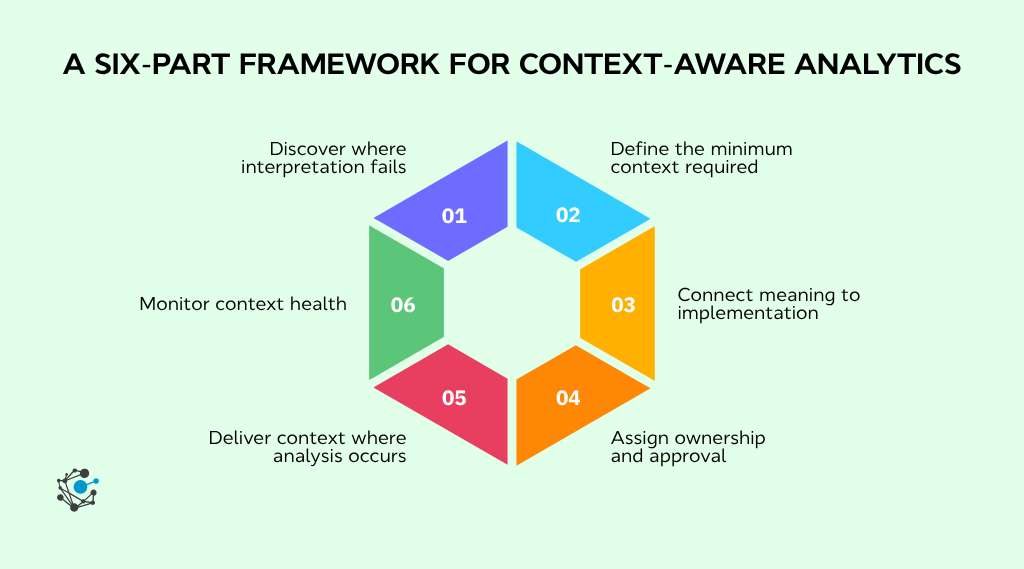
Organizations can build context-aware analytics incrementally by starting with high-value decisions and connecting the context required to interpret them correctly.
1. Discover where interpretation fails
Start with recurring points of analytics friction. Look for executive meetings spent reconciling numbers and metrics with competing formulas, dashboards with unclear source logic, repeated requests for definitions, and reports that change unexpectedly after upstream updates.
Prioritize problems where inconsistent interpretation affects decisions, increases manual work, or creates measurable business risk.
Example: Finance and sales report different quarterly revenue because their dashboards apply different exclusion rules to the same underlying transactions.
2. Define the minimum context required
Determine which context is necessary to interpret each priority metric or decision correctly. This may include its definition, formula, owner, lineage, reporting period, certification status, business conditions, and applicable policies.
Avoid documenting every possible metadata attribute. Capture the context required for the specific decision first, then expand as adoption grows.
Example: Finance determines that net revenue requires an approved formula, accounting owner, reporting calendar, source lineage, adjustment policy, and certification status.
3. Connect meaning to implementation
Link approved business definitions to the technical assets that implement them, including datasets, columns, transformations, semantic models, dashboards, and applications.
Automated lineage becomes important when calculation logic spans warehouses, ETL processes, BI tools, and other analytical environments. These connections make it possible to see where a definition is implemented and what could be affected when it changes.
Example: The approved net revenue definition is connected to its warehouse columns, transformation logic, semantic model, and executive revenue dashboard.
4. Assign ownership and approval
Give every decision-critical definition an accountable business owner. Technical owners can maintain its implementation, while data stewards coordinate documentation, approvals, review cycles, and consistency across domains.
Ownership should also define who can approve changes and when definitions need to be reviewed.
Example: Finance owns the net revenue definition, a data steward manages its review and approval workflow, and data engineering maintains the underlying calculation.
5. Deliver context where analysis occurs
Make definitions, lineage, certification, quality signals, and usage guidance accessible within the workflows where people consume data. Requiring analysts to search separate documentation makes context easier to overlook.
For questions spanning multiple systems, a Pop-Up Analytics Engine can retrieve the required data and apply on-demand compute without requiring teams to build a permanent pipeline for every analytical question.
Example: An analyst investigating declining revenue can access the metric definition, source lineage, certification status, and relevant business conditions alongside the analysis.
6. Monitor context health
Treat context as an asset that needs continuous maintenance. Track whether critical KPIs have approved owners, definitions are reviewed on schedule, dashboards use certified metrics, lineage remains available, and semantic changes receive impact analysis.
Data quality should be monitored alongside context because an approved definition provides little value when the underlying data is unreliable.
Example: A governance team tracks the percentage of critical KPIs with current definitions, approved owners, certified sources, usable lineage, and completed review cycles.
How business context changes real enterprise decisions
Business context helps teams move from seeing an analytical signal to understanding what caused it and deciding how to respond.
|
Industry |
Analytical signal |
Business context reveals |
Decision changes to |
|
Financial services |
Fee revenue falls below plan |
A policy change affected eligibility for one account type |
Analyze policy and segment impact before changing pricing |
|
Retail |
Digital conversion declines |
Traffic mix, mobile usage, and fulfillment conditions changed |
Separate marketing, experience, and operational causes |
|
Healthcare |
Service utilization shifts |
Coding practices changed during the reporting period |
Validate reporting effects before assuming patient behavior changed |
|
Manufacturing |
On-time delivery falls |
Planned maintenance affected specific production lines and orders |
Prioritize capacity recovery and affected orders |
Business context for BI, conversational analytics, and AI
As analytics moves beyond predefined dashboards, business context needs to become machine-readable and available at the point of consumption.
Business intelligence
Traditional BI embeds much of its context in dashboards, semantic models, and analyst workflows. Metric definitions and calculation logic can be predefined, but users may still need external documentation to understand ownership, lineage, quality, or appropriate use.
Conversational analytics
Natural-language analytics introduces more ambiguity because users can ask questions that were never modeled as predefined reports. A question such as “Which customers are becoming less profitable?” requires an approved customer definition, profitability logic, time period, cost allocation rules, source relationships, and appropriate access.
AskEdgi applies governed enterprise context to these cross-system questions, helping users analyze distributed data through natural language while grounding responses in business definitions, metadata, lineage, and governance signals.
AI agents
AI agents raise the requirement further because they may use analytical results to recommend or initiate actions. Retrieval alone cannot determine which definition is approved, whether a dataset is current, or whether the agent is authorized to use it.
Business context provides these distinctions, giving BI users, conversational analytics systems, and AI agents a consistent foundation for interpreting enterprise data.
What enterprises should evaluate in contextual analytics
Contextual analytics should be evaluated as an operating capability rather than a single software feature.
Several questions reveal whether the foundation is strong enough:
-
Can critical terms be traced to approved definitions and owners?
-
Can a metric be followed from a dashboard through transformation logic to its source?
-
Can business and technical metadata be searched together?
-
Can legitimate definition variants be distinguished by domain and use case?
-
Can teams see the downstream impact of a semantic or source change?
-
Can quality, certification, policy, and access context travel with the asset?
-
Can context reach BI tools, analytics workflows, and AI interfaces?
-
Can cross-system questions be analyzed without permanently rebuilding the architecture for each request?
-
Can owners measure whether important context is current, reviewed, and actually used?
Those questions shift evaluation away from the quantity of metadata captured and toward whether context changes the quality of enterprise decisions.
The underlying architecture does not have to reside in one physical system. Many organizations will continue using warehouses, semantic layers, BI platforms, governance systems, and operational applications together.
The important design principle is that business meaning should remain connected as information moves among them.
Conclusion
Reliable enterprise analytics depends on more than accurate data. Definitions, lineage, ownership, quality, policies, and operating conditions need to remain connected as data moves across BI, conversational analytics, and AI workflows.
Treating business context as shared infrastructure gives teams a consistent way to interpret metrics, trace their origins, understand changes, and determine how data should be used. As AI takes on more analytical work, that governed context becomes even more important for keeping decisions grounded in approved enterprise meaning.
OvalEdge connects business definitions, metadata, lineage, quality, ownership, and governance relationships to help organizations operationalize context across their data environment.
Book an Enterprise Context Graph demo to see how OvalEdge connects governed business context across analytics, BI, and AI workflows.
.png?width=1081&height=173&name=Forrester%201%20(1).png)
.png?width=1081&height=241&name=KC%20-%20Logo%201%20(1).png)