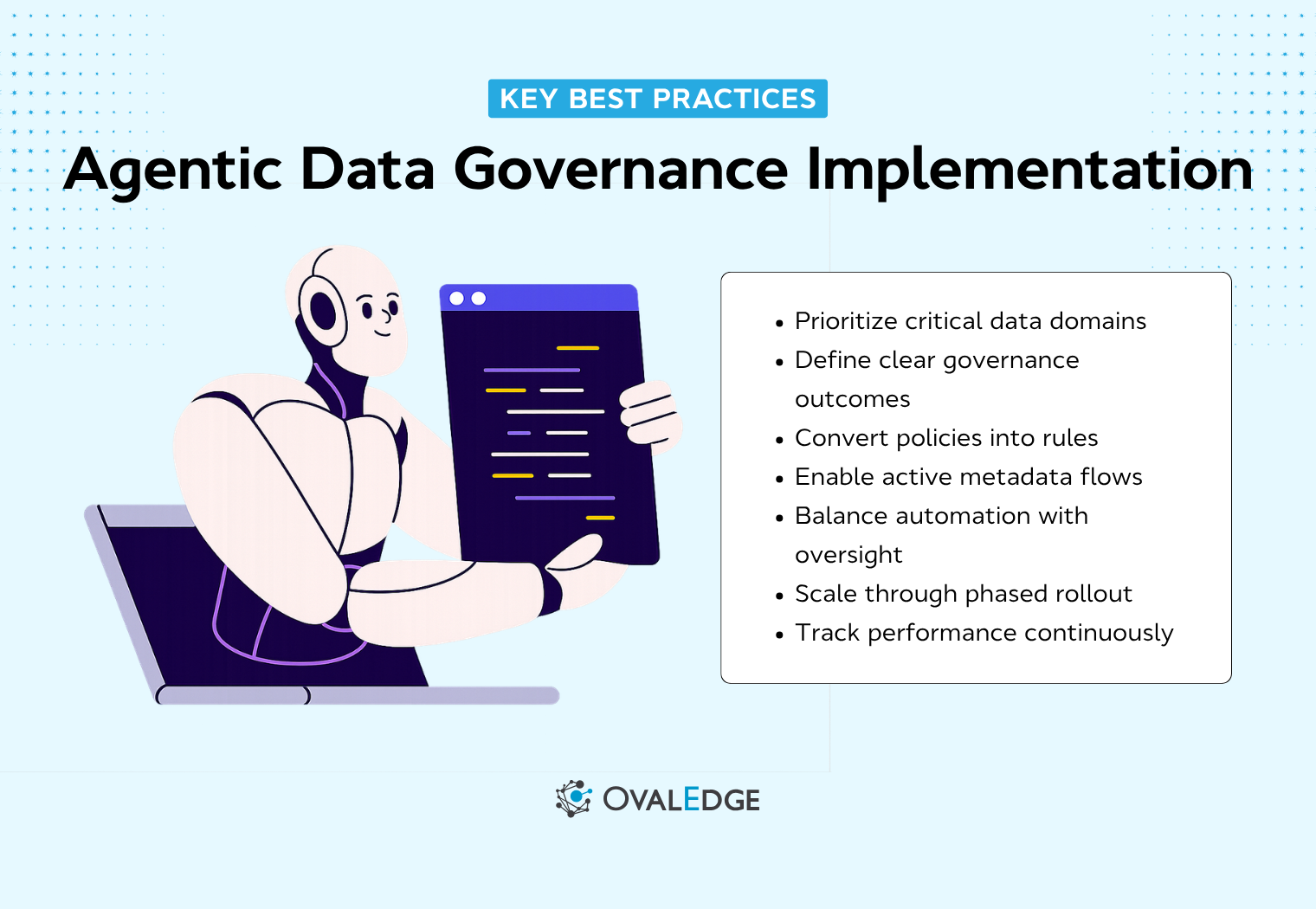
Despite years of investment, many organizations still struggle with governance that actually works in practice. Policies exist, but they are rarely enforced consistently. Data quality rules are defined, yet violations often slip through unnoticed until they disrupt reporting, analytics, or compliance efforts.
The root problem is straightforward. Traditional governance models depend heavily on manual workflows and periodic checks. These approaches simply cannot keep pace with the speed, scale, and complexity of modern data environments.
The impact is not just operational; it is financial.
According to Forrester’s 2023 Data Culture and Literacy Survey insights, more than 25% of organizations estimate losing over $5 million annually due to poor data quality, with some reporting losses exceeding $25 million.
Agentic data governance addresses this challenge by shifting from passive oversight to active execution. Instead of documenting policies, organizations deploy systems that continuously monitor, enforce, and adapt governance rules across the data lifecycle.
By the end of this guide, you will clearly understand when agentic governance becomes necessary, how to implement it step by step, what pitfalls to avoid during execution, and how to scale it effectively across your organization.
When to implement agentic data governance
What once worked with structured processes and periodic reviews starts breaking under continuous data movement and real-time demands. Agentic data governance becomes essential at this inflection point.
Signs that traditional governance models are breaking down
Early signals usually appear in daily operations. Data quality issues persist despite defined rules, and teams begin working with inconsistent definitions, leading to misaligned decisions. Governance processes also start slowing down analytics and AI initiatives instead of enabling them.
Common operational symptoms include:
-
Recurring data quality issues
-
Conflicting metric definitions
-
Slower analytics and AI workflows
These issues are often reinforced by organizational friction. Manual approvals create delays, governance teams become bottlenecks, and ownership across data domains becomes unclear.
Typical organizational challenges include:
-
Heavy reliance on manual approvals
-
Overloaded governance teams
-
Lack of clear data ownership
On the technical side, limitations become more visible. Metadata remains outdated, lineage is incomplete, and impact analysis becomes reactive rather than proactive.
Key technical gaps include:
-
Static or outdated metadata
-
Limited lineage visibility
-
Weak impact analysis capabilities
At this stage, governance exists but does not scale. This is where agentic governance becomes necessary to enable real-time, automated enforcement.
Business scenarios where agentic governance delivers immediate value
Agentic governance delivers the most value in high-risk, high-frequency scenarios where manual processes struggle to keep up.
Common high-impact use cases include:
-
Regulatory compliance monitoring
-
Data quality enforcement in critical pipelines
-
Sensitive data access control and auditing
These scenarios benefit from automation because they involve frequent events, high consequences for failure, and clearly defined rules.
The urgency for improving governance in these areas is clear.
According to a 2023 report by Experian, 91% of organizations say poor data quality negatively impacts their business performance, affecting everything from operational efficiency to customer experience.
This reinforces why organizations are shifting toward automated and agent-driven approaches to ensure continuous data reliability.
|
How this works in practice In a financial services organization, regulatory reporting depends on accurate and timely data from multiple systems. If a data quality issue enters a critical pipeline, it can lead to incorrect reports and potential compliance violations.
|
Defining implementation scope and success criteria
Trying to automate everything at once often introduces more complexity than value. Agentic governance works best when it starts with a clearly defined scope and expands based on proven outcomes. If the scope is too broad or unclear, automation can amplify weak rules and inconsistencies, reducing trust instead of improving control.
Identifying priority domains, datasets, and workflows
Effective implementation begins with narrowing the focus to business-critical areas. Not all data needs the same level of governance, and prioritization plays a key role in early success. The most suitable starting points are datasets that are frequently used, highly sensitive, or directly tied to revenue and compliance outcomes.
|
For example, customer data in financial services or patient data in healthcare naturally demands stronger governance due to regulatory exposure and business impact. Starting with such domains ensures that improvements are both visible and measurable. |
Once priority datasets are defined, the focus should shift to associated workflows. Processes like access requests, data quality checks, and policy enforcement cycles are strong candidates for automation because they are repetitive and time-sensitive.
Organizations that prioritize high-risk domains early tend to see faster returns and smoother adoption. Keeping the scope limited to a well-defined pilot domain helps validate the approach before expanding governance efforts across the enterprise.
Setting measurable governance KPIs and outcomes
Clarity in measurement is essential for scaling governance effectively. Without defined success criteria, automation efforts become difficult to evaluate and justify.
Quantitative KPIs typically focus on improvements in data quality, reduction in policy violations, and faster turnaround times for processes such as access approvals. These metrics provide a clear view of how governance performance evolves over time.
Qualitative outcomes also play an important role. Increased trust in data and improved collaboration across teams indicate that governance is becoming part of daily operations rather than remaining a separate control layer.
Aligning these KPIs with business outcomes strengthens their impact. Improvements should connect to areas such as revenue protection, risk reduction, and operational efficiency. Establishing a baseline at the start is critical to track progress consistently.
|
Implementation tip: Platforms such as OvalEdge provide built-in capabilities for data quality scoring, policy tracking, and workflow monitoring, enabling organizations to measure both operational performance and governance effectiveness in a unified way. |
Prerequisites for execution readiness
Automation amplifies whatever exists beneath it. If metadata is incomplete or policies are unclear, agent-driven systems will scale those gaps instead of solving them.
Agentic governance depends on a strong, well-structured foundation across metadata, policies, and organizational alignment.
Minimum metadata, lineage, and catalog readiness
Agents rely entirely on metadata to make decisions. Without accurate and connected metadata, governance actions quickly become unreliable and inconsistent.
A strong foundation starts with a centralized data catalog, clear end-to-end lineage, and metadata that is continuously updated. Together, these elements provide the context needed to monitor data flows, detect issues, and enforce policies in real time.
When metadata is fragmented or outdated, automation loses effectiveness and trust. Disconnected tools, incomplete lineage, and inconsistent standards are common gaps that limit the ability to scale governance. These issues need to be addressed before introducing agent-driven workflows.
Building this foundation requires moving beyond static metadata practices toward approaches that emphasize real-time visibility and context across systems, ensuring governance decisions are based on current and complete information.
Standardizing governance policies for automation
Policies are often well-documented but not designed for execution. For agentic governance to work, policies must be structured in a way that systems can interpret and act on them.
This requires clarity and consistency. Policies should define conditions, thresholds, and actions in a format that can be translated into rules.
|
For example, access policies need clearly defined roles and permissions, while data quality rules must specify measurable thresholds and expected outcomes. |
When policies remain ambiguous, automation introduces risk rather than control. Standardization ensures that governance decisions can be applied consistently across systems and workflows.
This shift from documentation to execution is a key step toward automated governance, where policies actively guide data behavior rather than remain passive guidelines.
Aligning stakeholders across data, governance, and AI teams
Even with the right technology and policies, governance will not scale without alignment across teams. Data stewards, engineers, and governance leaders must operate with shared ownership and clear responsibilities.
Challenges often arise from ownership conflicts and misaligned priorities, especially in distributed data environments. Without coordination, governance efforts become fragmented and inconsistent.
A defined operating model helps address this. Centralized governance provides control and standardization, while federated models allow flexibility within domains. The right balance depends on organizational structure and data maturity.
Establishing clear roles and accountability ensures that agentic governance operates effectively, with both automation and oversight working together.
Step-by-step implementation of agentic data governance
This process is iterative in practice, with teams often revisiting steps as they scale. Most organizations do not fail at governance because they lack intent. They struggle because execution becomes fragmented across tools, teams, and workflows. Agentic data governance introduces structured, repeatable execution through controlled steps rather than a one-time transformation.
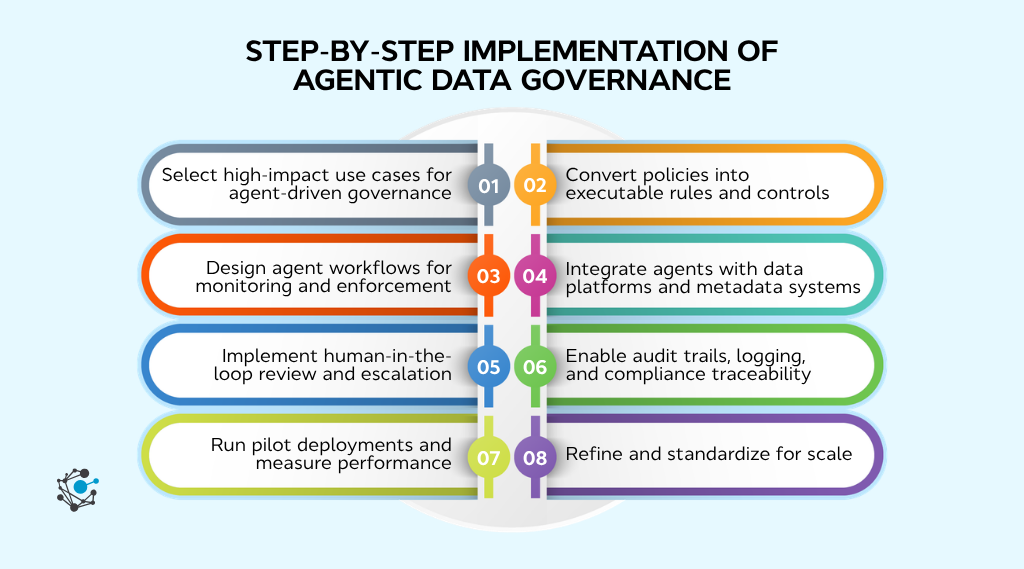
Step 1: Select high-impact use cases for agent-driven governance
Implementation should begin with use cases that are easy to validate and deliver visible outcomes. The focus should be on workflows that are repeatable, measurable, and directly tied to business impact. This ensures that early efforts demonstrate value without introducing unnecessary complexity.
Data quality enforcement in critical pipelines or automated access approvals is a strong starting point. These areas generate frequent events and have clear success criteria, making them ideal for agent-driven execution.
Step 2: Convert policies into executable rules and controls
Policies must evolve from static definitions into enforceable logic. This requires translating governance intent into rules that systems can interpret and act upon consistently.
The process typically involves linking policies to metadata, defining conditions, and specifying actions.
|
For example, a data quality rule can automatically flag anomalies or prevent downstream usage when thresholds are not met, ensuring consistent enforcement without manual intervention. |
Step 3: Design agent workflows for monitoring and enforcement
Agent workflows should be designed with clear responsibilities and decision boundaries. Monitoring agents focus on detecting deviations, while enforcement agents handle corrective actions based on predefined rules.
These workflows need to be mapped across the data lifecycle, from ingestion to consumption. This ensures that governance is applied continuously rather than at isolated checkpoints.
Step 4: Integrate agents with data platforms and metadata systems
Integration is often the most critical and complex step. Agents must operate within the existing data ecosystem, interacting seamlessly with platforms such as data warehouses, ETL pipelines, and catalog systems.
The goal is to embed governance directly into data workflows rather than treating it as a separate layer. Strong integration enables real-time monitoring and enforcement without disrupting existing processes.
|
For example, in a modern data stack, an agent integrated with an ETL pipeline can automatically halt data ingestion when schema changes are detected, preventing downstream failures in analytics dashboards. |
Step 5: Implement human-in-the-loop review and escalation
Automation should not eliminate oversight. Instead, it should reduce manual effort while preserving control for high-risk decisions.
Defining approval layers and escalation paths ensures that sensitive actions, such as access approvals or policy overrides, are reviewed appropriately. This balance helps maintain trust while scaling automation.
Step 6: Enable audit trails, logging, and compliance traceability
Traceability is essential for governance credibility. Every action taken by agents must be recorded, making it possible to review decisions and demonstrate compliance when required.
Detailed logs and audit trails provide visibility into how policies are enforced and how data flows are managed. This is particularly important in regulated environments where accountability is critical.
|
For example, in a healthcare setting, an agent logs every access to patient records, including who accessed the data and why, enabling audit teams to verify compliance with data privacy regulations. |
Step 7: Run pilot deployments and measure performance
Before scaling, it is important to validate the approach in a controlled environment. Pilot deployments help test assumptions, identify gaps, and refine workflows without exposing the entire organization to risk.
Performance should be measured against predefined KPIs, allowing teams to assess effectiveness and make necessary adjustments before broader rollout.
Step 8: Refine and standardize for scale
Once the pilot demonstrates consistent results, the focus shifts to standardization. Successful workflows should be documented and optimized to ensure repeatability across domains.
Scaling agentic governance requires consistency in how rules, workflows, and integrations are applied. Refinement at this stage ensures that expansion does not introduce variability or inefficiencies.
Phased rollout strategy for enterprise agentic governance
Scaling agentic governance is less about speed and more about control. Expanding too quickly often leads to fragmented adoption and inconsistent enforcement. A phased approach allows organizations to build on proven outcomes while aligning with broader enterprise data governance strategies.
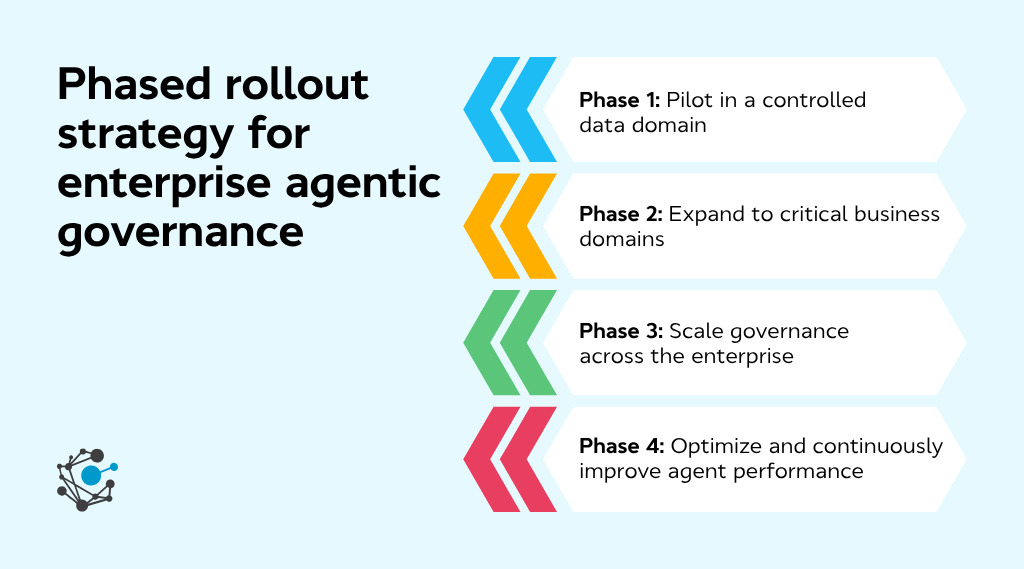
Phase 1: Pilot in a controlled data domain
The first phase focuses on depth rather than breadth. A single domain or use case is selected to validate how agentic governance performs under real conditions. The goal is to observe behavior, identify gaps, and ensure that governance actions align with business expectations.
This phase helps establish confidence by validating assumptions around performance, usability, and system compatibility. It also creates a reference model that can be reused in later stages.
Phase 2: Expand to critical business domains
Once the pilot demonstrates consistent results, the scope can expand to other high-impact areas. This phase introduces governance across additional datasets and domains that carry significant operational or regulatory importance.
The focus shifts toward consistency. Processes, rules, and workflows are applied more broadly, ensuring that governance practices remain uniform as adoption increases.
Phase 3: Scale governance across the enterprise
At this stage, governance evolves into an embedded capability across systems and teams. Agent-driven workflows are extended across platforms, ensuring policies are enforced consistently regardless of where data resides.
This shift aligns with the principles of active data governance, where governance operates continuously within data workflows rather than as a separate control layer.
Phase 4: Optimize and continuously improve agent performance
Agentic governance is not static. As data environments evolve, governance rules and workflows must adapt to new requirements and patterns.
This phase focuses on continuous improvement by monitoring agent performance, refining rules, and enhancing workflows. Over time, this ensures that governance remains aligned with business needs while improving efficiency and accuracy.
Common implementation challenges and how to resolve them
Even well-planned agentic governance initiatives face practical challenges during execution. Most issues arise from gaps in data foundations, team readiness, and system integration rather than strategy itself. Addressing these early ensures that automation delivers consistent and reliable outcomes.
Poor metadata quality
Metadata gaps can lead to unreliable decisions and inconsistent enforcement. When lineage is incomplete or metadata is outdated, agents lack the context needed to act accurately.
For example, a data quality issue in one pipeline may go undetected in downstream reports due to missing lineage visibility.
The solution is to strengthen metadata foundations early by improving completeness, standardization, and continuous updates.
Resistance to automation
Teams often hesitate to trust automated governance, especially for critical decisions. This is usually driven by concerns around control and accountability.
A gradual rollout helps overcome this. Starting with low-risk use cases, demonstrating value, and keeping human oversight for sensitive actions builds confidence over time.
Integration complexity
Fragmented data environments make integration challenging. Without consistent connectivity across systems, governance enforcement becomes uneven.
For instance, agents may not function effectively if they cannot access unified metadata across pipelines and platforms.
Focusing on interoperability and adopting platform-driven integration ensures that governance workflows operate consistently across the ecosystem.
How to evaluate and select the right platform for agentic governance
Choosing the right platform is about finding what fits your needs, not what has the most features. The focus should be on how well the platform supports real-time, automated governance within your existing data environment.
-
Start with your business goals: Begin by identifying what you want governance to achieve. This could be improving compliance, enabling AI initiatives, or making data more accessible across teams. Clear goals help narrow down options and avoid unnecessary complexity.
-
Focus on what really matters: Instead of evaluating everything, prioritize a few key capabilities such as reliable metadata, policy enforcement, real-time monitoring, and seamless integration with your data stack. These determine whether governance becomes operational or remains passive.
-
Understand the platform maturity: Different platforms offer different levels of capability. Legacy tools focus on documentation, modern platforms add automation, and newer platforms enable continuous, agent-driven governance. The right choice depends on your current maturity and long-term goals.
-
Validate before you commit: Rather than relying only on feature comparisons, test the platform with real use cases. A focused proof of concept helps evaluate performance, usability, and measurable impact in your environment.
Platforms like OvalEdge bring together metadata, lineage, data quality, and automation in a unified environment, helping organizations operationalize and scale agentic governance effectively.
Conclusion
Governance is no longer about control on paper. It is about control in motion. As data ecosystems expand and AI-driven decisions accelerate, the gap between defined policies and real execution becomes harder to ignore.
Agentic data governance closes that gap by turning governance into a continuous, active system that monitors, enforces, and adapts in real time.
The next step is not a large transformation, but a focused start. Identify one high-impact workflow, strengthen the foundation, and build from there. Momentum matters more than scale in the beginning.
Platforms like OvalEdge make this shift practical by bringing together metadata, lineage, data quality, and automation in one place. With askEdgi, teams can interact with governed data more intuitively while maintaining control and compliance.
Exploring how this approach fits your environment through a tailored walkthrough. Book a demo to help translate these concepts into actionable outcomes.
The organizations that move first will not just manage data better, they will make faster, more confident decisions with it.
FAQs
1. How is agentic data governance different from AI-driven data governance?
Agentic data governance focuses on autonomous execution of policies through agents that can act, adapt, and enforce decisions continuously. AI-driven governance typically assists with insights and recommendations, while agentic systems actively intervene in workflows to maintain compliance and data quality without constant human input.
2. What level of automation is safe to implement in governance workflows?
The safe level of automation depends on risk sensitivity and regulatory impact. Low-risk processes like metadata updates can be fully automated, while high-risk decisions such as access approvals require human validation. A balanced approach combines automation with controlled oversight to prevent unintended consequences.
3. Can agentic governance work in multi-cloud or hybrid data environments?
Yes, agentic governance can operate across multi-cloud and hybrid environments if supported by unified metadata and integration layers. The key requirement is consistent visibility across systems, enabling agents to enforce policies and monitor data flows regardless of where the data resides.
4. How do you measure the long-term success of agentic governance initiatives?
Long-term success is measured through sustained improvements in data reliability, reduced manual intervention, and faster decision-making cycles. Organizations also track reduced operational costs, improved compliance posture, and the ability to scale governance practices without increasing team size.
5. What skills are required to manage and maintain agentic governance systems?
Teams need a combination of data governance expertise, metadata management knowledge, and familiarity with automation frameworks. Understanding policy design, data architecture, and workflow orchestration is essential, along with the ability to monitor agent performance and refine rules over time.
6. How does agentic governance support AI and analytics initiatives?
Agentic governance ensures that AI and analytics systems operate on trusted, well-governed data by continuously enforcing quality, access, and compliance rules. This reduces the risk of biased or incorrect outputs and enables faster deployment of data-driven use cases with greater confidence.
.png?width=1081&height=173&name=Forrester%201%20(1).png)
.png?width=1081&height=241&name=KC%20-%20Logo%201%20(1).png)