-1.jpg)
A data pipeline can run on time, an LLM trace can look clean, and the AI agent can still give your finance team a revenue figure built on a metric definition that changed last quarter. Traditional monitoring watches whether data arrives and whether the model responds faithfully. Neither one checks whether the context itself was current, certified, traceable, and permitted for that agent.
Governed context observability closes that gap by checking the context AI agents use against the definitions, quality standards, lineage, freshness rules, and access policies your organization has already approved. In this article, we break it into five measurable dimensions and walk through how to implement it.
What is governed context observability?
Governed context observability is the practice of continuously monitoring the context AI agents use against the governance rules an organization has approved. It checks whether that context was fresh, certified, traceable, correctly defined, and permitted at the moment the agent used it.
"Context" here means everything an AI agent draws on before it responds: dataset metadata, business definitions, relationships between assets, and the policies that govern their use.
Governed context observability asks a question those layers skip: was the input fit to use at the moment the agent used it?
What "governed" adds to context observability
The "governed" modifier gives observability a baseline to measure against. Without it, a monitor can report that context changed. With governance baselines in place, it can report whether that change breaks a rule.
Governance supplies the reference points:
-
Approved business definitions for every metric and term
-
Certification and quality thresholds for each data asset
-
Named owners who can investigate and resolve issues
-
Classification and access policies that determine permitted use
-
Freshness expectations set per asset by the data owner
Governance defines what acceptable context looks like. Observability determines whether the context an agent received met those expectations.
At OvalEdge, we believe observability shows you that context changed. Governance tells you whether that change is acceptable. AI teams need both answers before they can trust what an agent says.
Why AI agents fail silently when context goes wrong
AI agents rarely throw errors when context is wrong. They return confident, well-formed answers built on stale, conflicting, or out-of-scope inputs. The failure only surfaces when someone acts on the answer, and the numbers don't add up.
Most silent failures fall into four patterns:
-
Stale context: an insurance company's pricing model keeps using a mortality-rating factor the actuarial team retired two months ago. The dataset refreshed on schedule, so no pipeline alert fired. The factor just no longer applies.
-
Conflicting context: "policyholder age" means age at policy inception in the underwriting system and current age in the claims system. The agent pulls whichever source it retrieves first, and both look valid.
-
Untraceable context: a risk agent delivers a credit exposure number, but nobody can show which tables, joins, or transformations produced it. Without a source-to-answer path, the number is unverifiable.
-
Out-of-scope context: a customer-facing agent retrieves an internal pricing tier it was never meant to surface. Classification tags exist in the catalog, but nothing enforced them at the point of delivery.
Silent failures compound through what's called context drift: the gradual gap between the context an agent relies on and the current approved state of the business. Drift builds quietly through definition and schema changes, none of which trigger pipeline errors.
Did you know? According to a Gartner press release in 2025, organizations will abandon 60% of AI projects unsupported by AI-ready data through 2026. Context failures are a data readiness problem that model tuning cannot fix.
Context observability vs data observability vs LLM observability
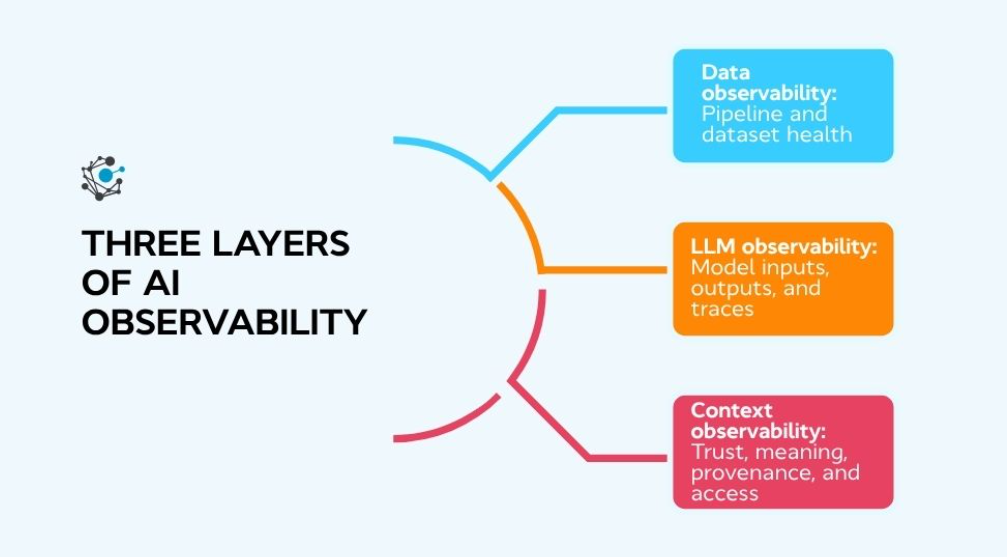
Data observability checks whether pipelines and datasets are healthy. LLM observability checks whether the model behaves as expected. Context observability checks whether the input an agent used was fit for that task. Each layer watches something the other two assume is fine.
|
Data Observability |
LLM Observability |
Context Observability |
|
|
What it watches |
Pipelines and datasets |
Model inputs, outputs, and execution traces |
The context an AI agent retrieves and uses |
|
Key signals |
Freshness, volume, schema, failed jobs |
Latency, cost, groundedness, output quality, hallucination rate |
Currency, certification, provenance, definition consistency, access scope |
|
Main question |
Did the data arrive intact and on time? |
Did the model produce a reliable response? |
Was the context trustworthy, current, and permitted? |
|
What it misses |
Whether a correct table contains a retired definition |
Whether the retrieved information itself was authoritative |
Model reasoning and response quality |
|
Typical owner |
Data engineering |
AI/ML engineering |
Data governance with AI teams |
A single incident can pass data and LLM checks and still fail context checks. A procurement agent surfaces a vendor risk score built on a compliance dataset that was valid last quarter but has since been reclassified. The pipeline delivered on time, and the model produced a well-formed answer. The compliance status behind it was outdated.
Mature AI teams run all three layers. Data observability tools catch pipeline and quality failures. LLM observability catches model-level issues like hallucination and latency spikes. Context observability fills the gap between them.
OvalEdge expert insight: Data and LLM dashboards can both show green while an agent answers with outdated compliance data. Context observability catches what each layer assumes the other one checked.
Five dimensions of governed context observability
Governed context observability measures five dimensions: freshness, quality and certification, lineage and provenance, definition consistency, and access and scope. Each one maps to a governance baseline the organization already maintains, and each one catches a failure the other four miss.
1. Context freshness
Context freshness monitoring confirms that the data and documents an agent uses reflect the latest approved state. A stale input does not trigger a schema error or a failed job. It just produces an answer built on numbers the business has already moved past.
Signals to monitor:
-
Last refresh timestamp against the freshness SLA set by the data owner
-
Pipeline delays between source update and context delivery
-
Schema drift at the source that has not propagated downstream
The governance baseline here is the freshness threshold each data owner sets per asset. Without that threshold, a monitor can report when something last refreshed but cannot tell you whether that timing is acceptable. A data catalog with operational quality monitoring can automate these checks, tracking freshness against owner-set SLAs and flagging schema drift before it reaches an agent.
2. Context quality and certification
Context quality monitoring checks that the assets feeding an agent meet agreed quality rules and carry a current certification. An uncertified dataset may contain valid rows, but nobody has confirmed it meets the standard the business signed off on.
Signals to monitor:
-
Quality rule failures, null rates, and duplicate entities
-
Changes in certification status
-
Open data quality issues flagged by stewards
The governance baseline is the set of quality rules and certification criteria approved by data stewards. When an asset loses its certification, it should either drop out of agent context automatically or raise a flag before delivery.
3. Context lineage and provenance
Context lineage shows how data moved and changed from source to answer. Context provenance records where it originated and who owns it. Together they turn "the agent said so" into a verifiable path.
Signals to monitor:
-
Lineage breaks where a transformation is undocumented
-
Assets with no recorded source or owner
-
Gaps between column-level lineage and what agents actually retrieve
The governance baseline is complete lineage for every asset an agent can reach. Without it, an audit question about any AI-generated answer hits a dead end.
4. Definition consistency
Definition consistency checks that a business term or metric carries the same approved meaning across every source an agent can use.
Unlike a schema break or a failed quality rule, a definition change produces no technical signal at all. It is the dimension teams skip most often, and the one that causes the most confident wrong answers.
In banking, "high-risk counterparty" can carry different thresholds across credit, compliance, and trading desks. In retail, "active member" can mean app login in one system, in-store purchase in another, and web session in a third. An agent pulling from any two of these sources will blend definitions without flagging a conflict.
Signals to monitor:
-
Conflicting glossary definitions across business units
-
Metric definition changes that have not been reconciled
-
Terms with no approved definition in the business glossary
The governance baseline is one certified definition per term. Every synonym, variant, and department-level override should resolve to a single approved meaning.
5. Access and scope
Access and scope monitoring confirms an agent only uses context its user, role, and task are permitted to see. Classification tags and access policies may exist in the catalog, but they only protect AI outputs when they are enforced at the point of delivery.
Signals to monitor:
-
Sensitive data classification on retrieved assets
-
Access policy violations logged at delivery
-
Agents reaching data outside their assigned domain
The governance baseline is a set of classification tags and fine-grained access policies that apply to AI agents the same way they apply to people. A customer-facing agent and an internal risk agent should never draw from the same unfiltered context.
How to implement governed context observability
Start by mapping the context your agents use, set a governance baseline for each dimension, then monitor at the source and at the point of delivery, with named owners handling every alert.
-
Map the context your agents use: List the datasets, documents, glossary terms, and policies each agent can reach. You cannot observe context you have not inventoried.
-
Set a governance baseline for each dimension: Agree on freshness SLAs, quality and certification rules, approved definitions in your business glossary, and access policies before you turn on monitoring. Alerts without baselines produce noise.
-
Connect lineage from source to agent: Make sure every asset carries its lineage and owner, so any answer can be traced back to its origin.
-
Monitor at the source: Run freshness, quality, schema-drift, and definition-conflict checks where the context is created, before it reaches the agent.
-
Log what reaches each agent: Record which assets and definitions were delivered to which agent, for example, through MCP server for enterprise data access logs, and link those records to agent traces from your LLM observability tool.
-
Assign owners and act on alerts: Route each alert to the steward who owns the asset, and retire stale or uncertified context on a regular cadence.
Two common pitfalls slow teams down here. Switching on alerts before agreeing on baselines floods stewards with false positives. Treating observability as an engineering-only initiative leaves definition and ownership problems unresolved, because the people who can fix those sit in the business.
Pro tip: Start small. Pick the ten datasets and glossary terms your agents query most, set baselines for those, and expand coverage once alerts reach the right owners and get resolved.
Why governed context observability starts with data governance
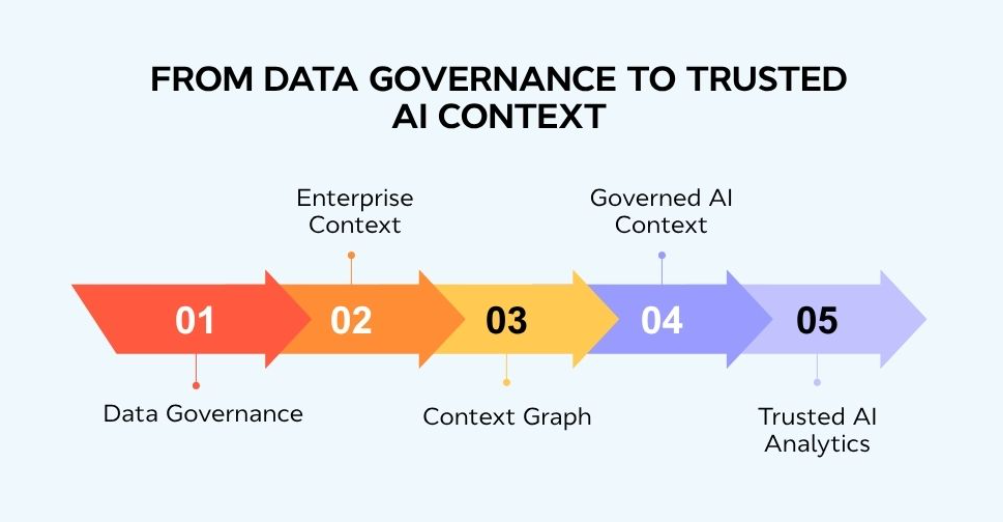
Most enterprises already maintain the governance artifacts that context observability depends on. The gap is rarely that these artifacts don't exist. It's that they aren't connected to the systems delivering context to AI agents.
How governed metadata becomes observable enterprise context
When governance artifacts live in separate tools, each one works in isolation. A glossary holds definitions, a catalog holds lineage, and a classification system holds access policies, but no single layer links them so an agent can be checked against all five dimensions at once.
Connecting that metadata into enterprise context changes the picture. Instead of checking one dimension at a time across separate tools, teams can evaluate an asset's full governance profile in one place: who owns it, what it means, how it got here, whether it passed quality checks, and who is allowed to use it.
A context layer for AI agents delivers those connected signals wherever agents request them. Observability becomes a natural extension of governance rather than a separate initiative.
From an enterprise context graph to trusted AI analytics
An Enterprise Context Graph makes that connection permanent. It gives observability checks a single, consistent source of truth instead of scattered governance artifacts across multiple tools.
A context layer then delivers governed context to AI agents through governed MCP access. The outcome shows up in analytical AI use cases where trust matters most:
-
Sales forecasting models draw on metrics with one certified definition instead of blending conflicting ones
-
Risk scoring uses data with documented lineage, so auditors can trace every input
-
Financial modeling runs on context that meets freshness SLAs, not last quarter's snapshot
When the graph is built from the governance foundation an enterprise already maintains, governance signals stay visible and enforceable wherever AI agents draw context.
How OvalEdge can help
An Enterprise Context Graph only works if something connects the governance artifacts an enterprise already maintains into one queryable layer. OvalEdge does that. Its Enterprise Context Graph brings catalog metadata, business definitions, lineage, quality rules, ownership, and access policies into one governed source against which AI context can be evaluated.
OvalEdge's business glossary helps surface definition conflicts across business units, while operational data quality monitoring tracks freshness and schema drift at the source. Combined with lineage, certification, ownership, and governed access, this gives AI teams context that agents can query and teams can trace back to its governed source.
Bring your governance foundation to AI with OvalEdge
Governed context observability depends on governance baselines that most enterprises already maintain: approved definitions, lineage, certification, ownership, quality rules, and access policies. The challenge is connecting them to the AI systems that depend on them. Without that connection, definition conflicts slip into production unnoticed, context goes stale between refreshes, and teams can't trace an AI output back to the governed source it should have used.
OvalEdge's Enterprise Context Graph closes that gap. One governed layer that AI agents draw from, teams observe end to end, and every answer traces back to an approved, certified source.
Schedule a demo to see how OvalEdge supports governed context for analytical AI.
.png?width=1081&height=173&name=Forrester%201%20(1).png)
.png?width=1081&height=241&name=KC%20-%20Logo%201%20(1).png)