-Apr-01-2026-12-34-08-9061-PM.png)
Enterprises are shifting from managing datasets to managing data products.
But while the idea sounds simple, execution is where things break down. Teams still work with disconnected data, unclear ownership, and metrics that don’t align across the business. In many cases, the same metric shows different values and conflicting KPIs across dashboards, creating confusion and slowing down decisions.
This is where enterprise data product management software comes in. It helps organizations treat data as products with defined ownership, governance, and lifecycle control, so data becomes reliable, usable, and aligned with business outcomes.
In this guide, we'll walk you through how these platforms work, what capabilities actually matter, and compare leading tools to help you choose the right solution for your enterprise.
Enterprise data product management platforms: Core capabilities
Enterprise data product management software is a platform that helps organizations build, manage, govern, and scale data products across systems. It combines metadata, ownership, lifecycle management, and governance into a unified layer.
Teams define data products, track lineage, enforce policies, and monitor quality in one place. The platform connects pipelines, catalogs, and analytics tools through integration and automation. It enables domain ownership, improves data reliability, and supports scalable, self-service access to trusted data assets.
Most platforms claim similar capabilities, but the real difference shows up in how deeply they execute them. Here’s how to separate surface-level features from enterprise-ready execution:
Data product lifecycle management
-
Good: Clear lifecycle from creation to monitoring with defined owners, SLAs, and measurable outcomes
-
Bad: Static datasets with no ownership, no lifecycle visibility, and no performance tracking
Metadata and catalog integration
-
Good: Unified business + technical metadata with strong search, context, and usability
-
Bad: Siloed metadata where users can find data, but cannot understand or trust it
|
Practical insight: This gap shows up clearly in practice. According to a 2024 Capgemini study, while 60% of organizations have automated data collection, only 45% say they have full visibility into their data inventory. |
Governance and policy enforcement
-
Good: Automated access controls, embedded policies, and audit-ready workflows
-
Bad: Manual governance with inconsistent enforcement and dependency on teams
Ownership and accountability
-
Good: Clearly assigned owners, stewards, and domain responsibilities
-
Bad: Shared or unclear ownership leading to gaps in accountability
What separates leading platforms further is how they handle advanced capabilities at scale:
Lineage tracking
-
Good: Column-level, end-to-end lineage with impact analysis across systems
-
Bad: Table-level or partial lineage with limited traceability
Data quality and observability
-
Good: Automated quality checks, anomaly detection, and proactive alerts
-
Bad: Reactive validation after issues impacts decisions
|
Here's a fact: This becomes a major bottleneck as organizations scale. In fact, a 2026 Deloitte Chief Data and Analytics Officer survey found that 61% of data leaders say improving data quality and access is critical for AI success. |
Business glossary integration
-
Good: Strong mapping between business terms and data assets
-
Bad: Glossary exists but is disconnected from actual datasets
Collaboration workflows
-
Good: Built-in workflows for approvals, issue resolution, and cross-team coordination
-
Bad: Reliance on email or chat tools to manage governance processes
Usage tracking and adoption analytics
-
Good: Visibility into how data products are used and by whom
-
Bad: No insight into adoption or business impact
Most tools check the must-have boxes. The real evaluation comes down to how well they deliver these capabilities in a unified, scalable way.
Once you understand what “good” actually looks like, the next step is to see how these capabilities come together in practice across the lifecycle of a data product.
How enterprise data product management software works in practice
To really understand the value of these platforms, it helps to look beyond features and see how they operate in day-to-day workflows. What makes enterprise data product management software effective is not just what it offers, but how it connects each stage of the data product lifecycle into a continuous, usable system.
Step 1: Data product creation and definition
It always starts with a business need, not a dataset. Teams define what problem the data product solves, who it serves, and how success will be measured.
At this stage, ownership becomes critical. Clear owners and stakeholders are assigned, expectations are set, and KPIs are tied directly to business outcomes. This is where the shift happens as data stops being something managed by engineering alone and becomes something owned by the business.
What typically breaks: Ownership stays informal, leading to unclear accountability and metrics that are defined differently across teams.
|
Did you know? 84% of organizations report that their data products have created measurable competitive advantages, according to IBM’s 2025 CDO Study. |
Step 2: Metadata enrichment and cataloging
Once the data product is defined, context gets layered in. Teams enrich it with both technical metadata and business meaning so it can be understood beyond the team that created it.
It gets connected to business glossary terms, categorized properly, and made discoverable through the data catalog. This is what turns data from something hidden in pipelines into something teams across the organization can actually find and use with confidence.
What typically breaks: Metadata remains incomplete or inconsistent, so users can find data, but still don’t trust or fully understand it.
Step 3: Governance and policy application
Governance works best when it is built into the workflow rather than added on later. At this stage, access controls, permissions, and compliance policies are applied directly to the data product.
Instead of relying on manual approvals or external processes, workflows are automated. This keeps governance consistent without slowing teams down, which is often where traditional approaches fail.
What typically breaks: Governance relies on manual approvals or tickets, creating delays and inconsistent policy enforcement.
Step 4: Monitoring, usage tracking, and optimization
Once the data product is in use, the focus shifts to reliability and improvement. Teams monitor data quality, track freshness, and detect anomalies before they impact decisions.
At the same time, usage patterns start to reveal what is actually driving value. Which teams rely on the data? Where are gaps emerging? This feedback loop allows teams to refine and improve data products continuously, rather than treating them as finished outputs.
What typically breaks: Monitoring is reactive, so issues are discovered only after they impact dashboards or decisions.
When all of these steps come together, data products become easier to trust, easier to use, and easier to scale across the organization. And that’s where the real difference between platforms starts to show, especially when you compare how each one approaches lifecycle, governance, and usability.
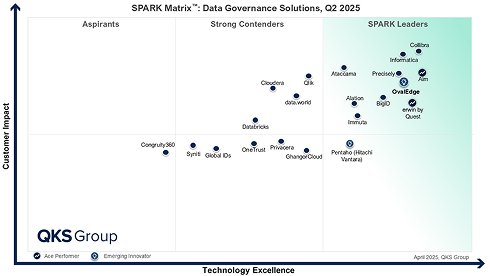
Leading enterprise data product management software: Quick comparison
Not all platforms approach data product management the same way. In fact, Gartner found that 61% of organizations are actively evolving their data and analytics operating models, with many rethinking how they manage and govern data assets.
The comparison below highlights differences in lifecycle management, governance depth, and enterprise readiness.
|
Platform |
Core Strength |
Governance Depth |
Lifecycle Coverage |
Best For |
|
OvalEdge |
Unified governance + lifecycle platform |
Strong |
End-to-end (creation → monitoring) |
Enterprises needing a single platform for governance, catalog, and data products |
|
Collibra |
Governance-first architecture |
Very strong |
Moderate (workflow-driven) |
Highly regulated industries prioritizing compliance |
|
Atlan |
Collaboration + modern data stack |
Moderate |
Strong (data mesh aligned) |
Data teams focused on usability and fast adoption |
|
Alation |
Data discovery and catalog |
Moderate |
Limited (catalog-centric) |
Organizations improving data discovery and analytics adoption |
Clearly, not all platforms approach data product management the same way. Let’s take a closer look at how each tool reveals where they truly stand out, and where they may fall short depending on your needs.
1. OvalEdge
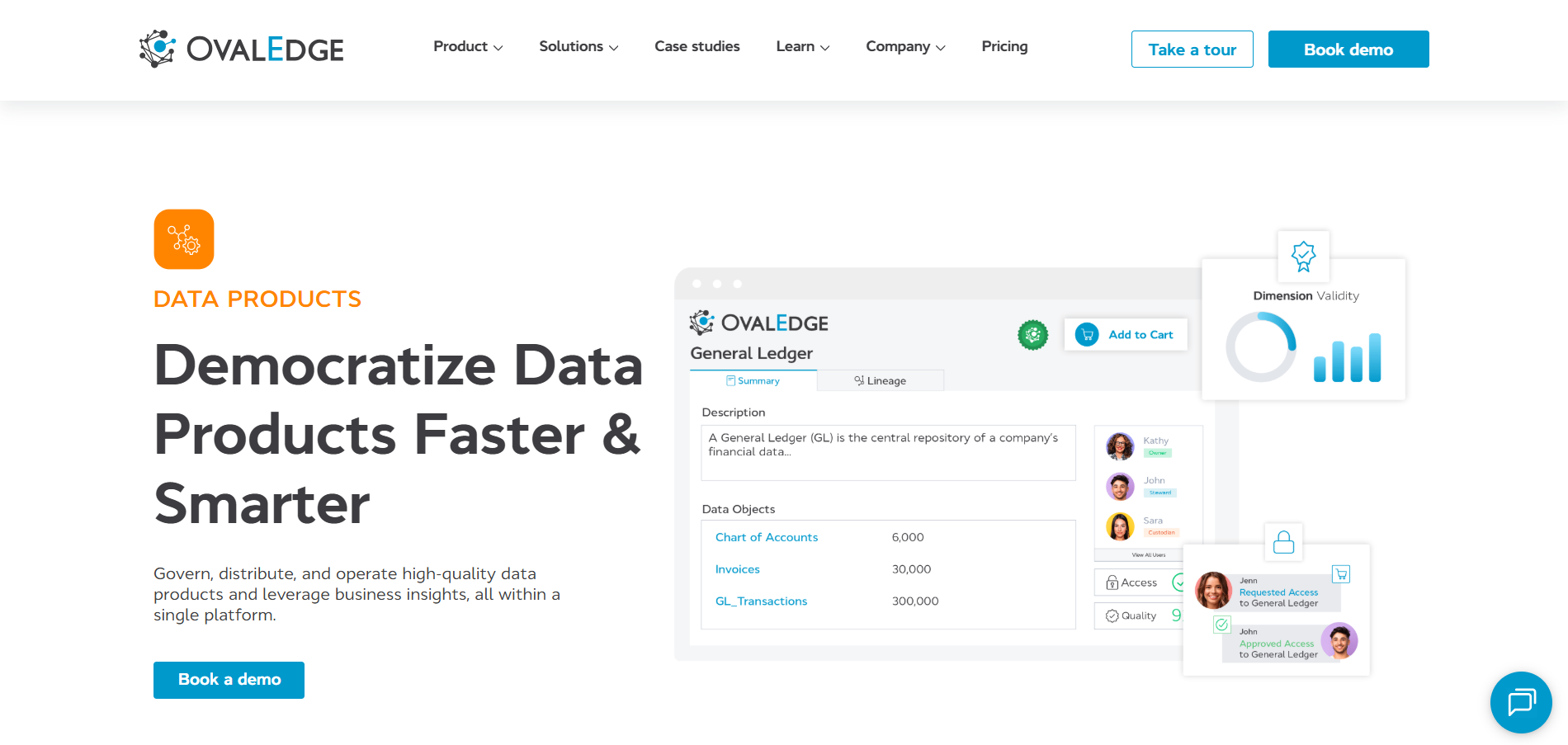
OvalEdge brings together data catalog, governance, lineage, and data quality into a unified platform with a strong focus on managing the full lifecycle of data products. Instead of treating these capabilities as separate layers, it connects them directly to how data is created, governed, and used across the enterprise.
This approach helps organizations move from fragmented data environments to a more structured, accountable, and scalable data product model.
Key strengths:
- Unified platform: OvalEdge integrates governance, catalog, and lifecycle management into a single, cohesive system.
- End-to-end lineage: The platform provides detailed lineage with impact analysis across systems.
- Built-in data quality: It includes native monitoring to track reliability, freshness, and anomalies.
- Ownership and accountability: It enables clear ownership and stewardship for every data product.
- Automated governance: The platform supports policy enforcement with audit-ready workflows.
- Business context integration: It connects business glossary terms directly with data assets for better understanding.
- Usage and adoption insights: OvalEdge offers visibility into how data products are used and their business impact.
Keep in mind: While OvalEdge delivers strong end-to-end capabilities, teams looking for highly specialized point solutions may find it more comprehensive than needed.
Best suited for: Enterprises that want a unified, governance-driven platform to manage and scale data products across domains.
If you’re looking to reduce inconsistencies in reporting, improve data trust, and bring governance and lifecycle management into one system, OvalEdge can help you move faster with fewer gaps. You can explore how it fits your environment by booking a demo and seeing how it works with your existing data stack.
2. Collibra
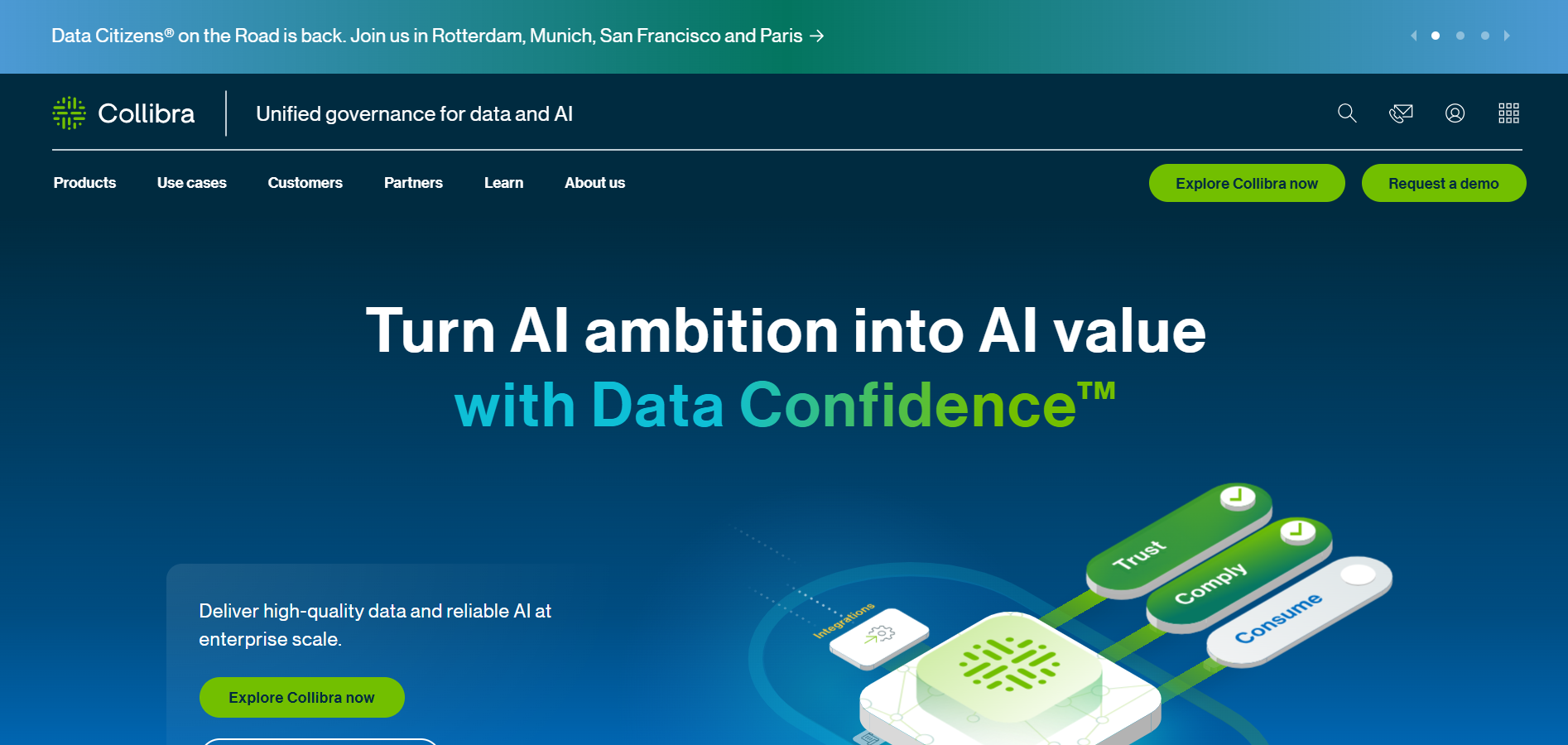
Collibra is a governance-first platform designed to help enterprises manage policies, stewardship, and compliance at scale. It focuses on building structured governance workflows and ensuring regulatory alignment across data assets, making it a strong choice for organizations that need consistent control, auditability, and clearly defined ownership across complex data environments.
Key strengths:
- Collibra delivers robust governance workflows with strong policy enforcement.
- The platform provides detailed stewardship and role-based accountability features.
- It supports regulatory compliance through structured governance frameworks.
- Collibra enables workflow-driven governance across distributed teams.
- The platform integrates well with enterprise data ecosystems.
Keep in mind: While Collibra excels in governance and compliance, it may require additional tools or effort to fully support data quality and lifecycle management.
Best suited for: Organizations operating in highly regulated environments where governance and compliance are the primary focus.
3. Atlan
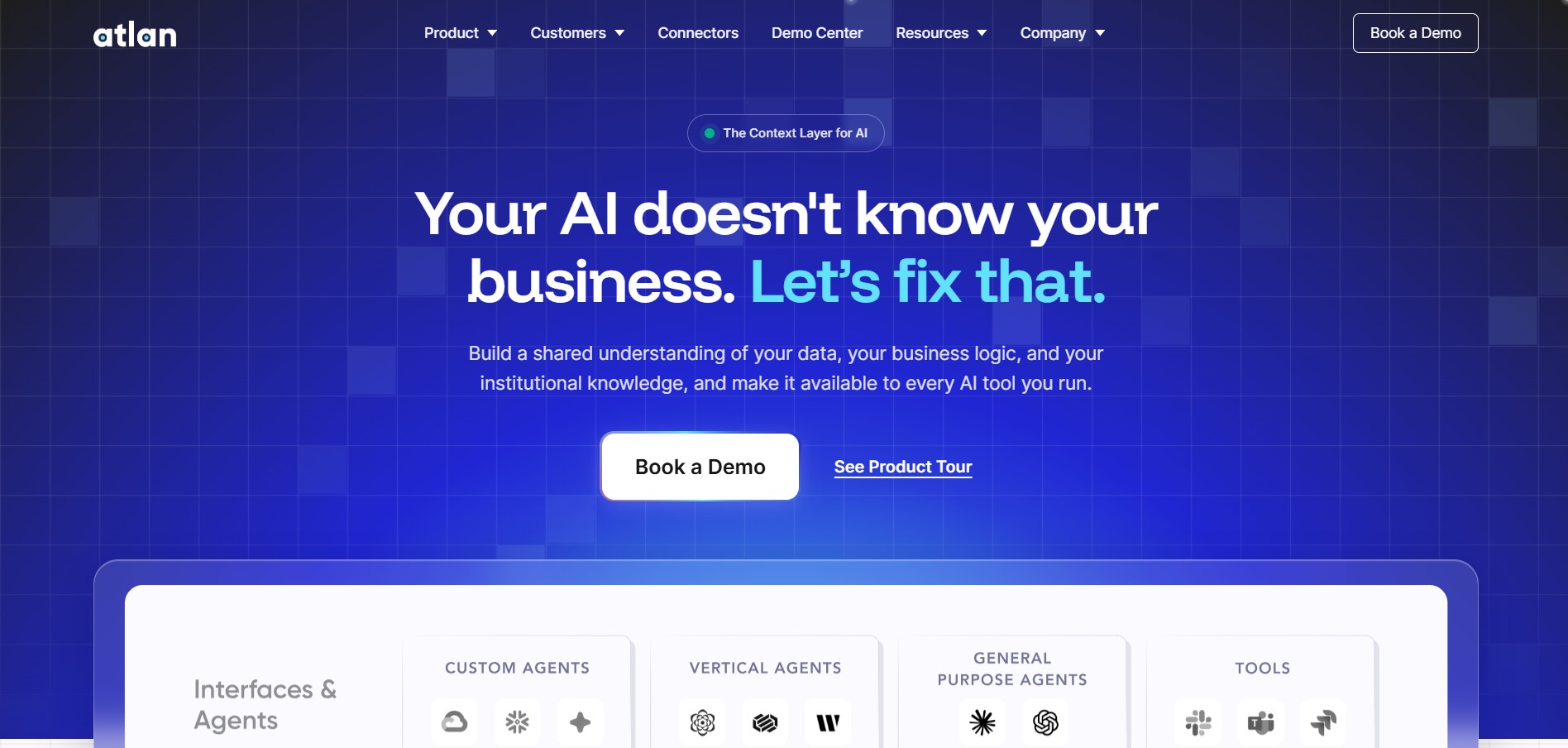
Atlan is a modern data workspace built for collaboration and ease of use, especially in teams adopting data mesh principles. It emphasizes quick onboarding, strong integrations with modern data stacks, and a user-friendly experience that encourages teams to discover, understand, and work with data more effectively across distributed environments.
Key strengths:
- Atlan offers a collaboration-first interface that encourages cross-team usage.
- The platform integrates well with modern tools like Snowflake and dbt.
- It supports intuitive data discovery through a user-friendly catalog.
- Atlan enables fast adoption with simple and accessible workflows.
- The platform aligns well with decentralized data ownership models.
Keep in mind: While Atlan is strong in usability and collaboration, enterprises with complex governance requirements may find its governance depth less comprehensive.
Best suited for: Data teams looking for a modern, collaborative platform that supports fast adoption and data mesh environments.
4. Alation
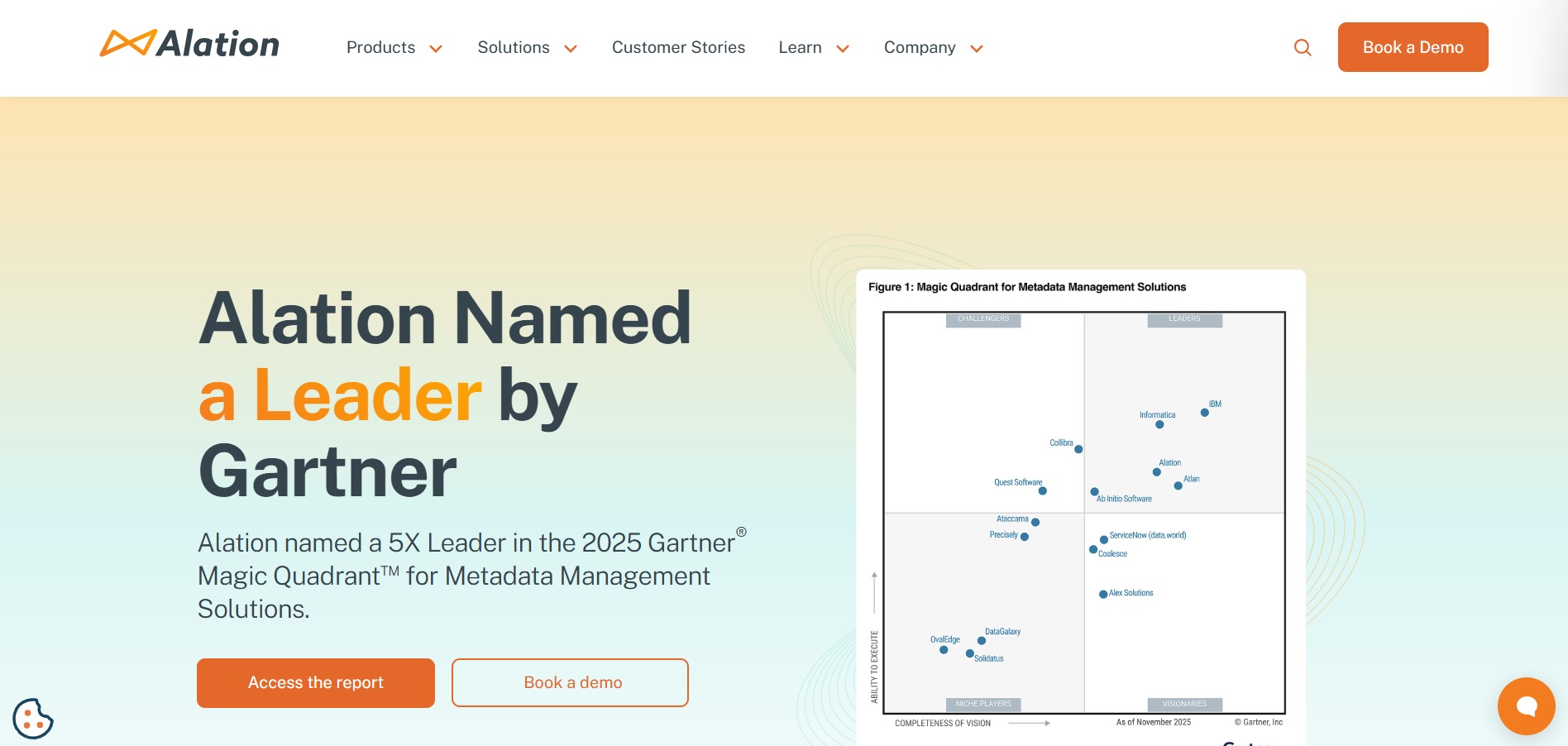
Alation is a data catalog platform focused on improving data discovery and adoption across organizations. It helps teams find, understand, and use data through strong search capabilities and behavioral insights, making it easier for users to navigate data assets and build trust in analytics without deeply managing the full data product lifecycle.
Key strengths:
- Alation provides powerful search and discovery capabilities for data assets.
- The platform uses behavioral analytics to surface relevant data.
- It supports user adoption through intuitive catalog features.
- Alation enables collaboration through shared insights and annotations.
- The platform integrates with a wide range of enterprise data tools.
Keep in mind: While Alation performs well in cataloging and discovery, it offers limited support for managing the full lifecycle of data products.
Best suited for: Organizations focused on improving data discovery and driving analytics adoption across teams.
How to choose the right data product management software?
Choosing the right platform is less about picking the “best” tool and more about finding the right fit for how your organization actually works. What works well for a highly regulated enterprise may not suit a fast-moving data team adopting a data mesh approach.
|
Stat: This is also reflected in investment trends. Forrester claims 69% of data leaders say they are increasing budgets for data management and analytics, signaling continued demand for platforms that improve trust and reuse. |
A good starting point is understanding how the platform aligns with your existing setup:
- Data architecture alignment: Some organizations operate in centralized environments, while others are moving toward domain-driven models. The platform you choose should support your current architecture and not force a complete redesign unless you are ready for it.
- Lifecycle vs governance focus: Not all tools are built the same way. Some are governance-first, with strong policy and compliance features. Others are lifecycle-first, focusing on how data products are created, managed, and improved over time. The right choice depends on where your biggest gaps are today.
- Integration with your data stack: A platform is only as useful as its ability to connect with the tools you already use. Look closely at how well it integrates with your warehouse, pipelines, and BI tools, whether that is Snowflake, Databricks, or your existing ETL setup.
- Scalability and enterprise readiness: As your data ecosystem grows, the platform should be able to support multiple domains, role-based workflows, and increasing complexity without slowing teams down. What works for a small team may not hold up at enterprise scale.
- Ease of adoption across teams: This is often underestimated. Even the most powerful platform creates no value if teams find it difficult to use. Look for intuitive workflows, collaboration features, and a user experience that encourages adoption beyond just the data team.
The goal is not just to manage data better, but to make it easier for teams to trust, use, and build on it consistently. When the platform fits both your technical environment and your team’s way of working, the impact becomes visible quickly.
Once you have a clear sense of what matters most, the focus shifts from features to outcomes. And that’s where the long-term value of your decision really starts to show.
Best practices for successful implementation
Even the best data product management platform will fall short if the implementation approach is rushed or overly broad. What separates successful initiatives from stalled ones is how deliberately teams roll out and operationalize data products across the organization.
- Start with high-impact data products: Focus on a few critical use cases first so teams can see value quickly instead of spreading efforts too thin.
- Build a strong metadata foundation early: Ensure business and technical context are well-defined from the start to avoid confusion later.
- Align governance with business context: Tie policies to how data is actually used, not just technical rules that teams struggle to follow.
- Assign clear ownership: Define owners and stewards for every data product so accountability is never ambiguous.
- Monitor usage and refine continuously: Track adoption and performance, then improve workflows based on real usage patterns.
These best practices are not just about getting the platform up and running, but about ensuring it delivers meaningful outcomes across teams. When done right, implementation becomes the foundation for a more reliable, scalable, and trusted data ecosystem.
Conclusion
Most teams don’t realize their data problem until a critical decision slows down because no one fully trusts the numbers.
That hesitation usually comes from unclear ownership, disconnected context, and systems that were never designed to manage data as products. You can fix this by creating a structure where data is owned, governed, and continuously improved.
A platform like OvalEdge helps you move in that direction by connecting metadata, lineage, governance, and data quality into a single layer. It brings ownership, policy enforcement, and lifecycle management into everyday workflows, so teams are not chasing data issues but working with trusted, ready-to-use data products.
If you want to see what that looks like in your environment, schedule a call with OvalEdge and explore how it can fit into your existing data stack and help your teams move faster with confidence.
FAQs
1. What is the difference between a data product and a dataset?
A dataset is a collection of raw or processed data, while a data product is curated, governed, and packaged for a specific business use case, with defined ownership, quality standards, and measurable outcomes tied to its usage.
2. Do enterprises need separate tools for data product management and data governance?
Not always. Many modern platforms combine data governance, cataloging, and lifecycle management into a single system, reducing tool sprawl and improving consistency. However, some organizations still use specialized tools depending on their architecture and maturity.
3. How does data product management support data mesh architecture?
Data product management enables domain teams to own, publish, and maintain data products independently. It provides the structure for ownership, discoverability, and governance, which are essential for scaling decentralized data mesh environments effectively.
4. What role does metadata play in data product management platforms?
Metadata provides the context needed to understand, trust, and use data products. It connects technical data with business meaning, enabling search, lineage tracking, governance enforcement, and better decision-making across teams.
5. How long does it take to implement enterprise data product management software?
Implementation timelines vary based on data complexity, integration needs, and organizational readiness. Most enterprises start seeing value within a few months by focusing on high-priority data products and gradually expanding adoption across domains.
6. What are the key evaluation criteria for enterprise data product platforms?
Beyond features, enterprises should assess scalability, integration flexibility, governance capabilities, user adoption, and vendor support. The ability to align with business workflows and support cross-functional collaboration is equally critical for long-term success.
.png?width=1081&height=173&name=Forrester%201%20(1).png)
.png?width=1081&height=241&name=KC%20-%20Logo%201%20(1).png)