Most teams don’t realize they have a data product problem until something breaks.
A dashboard misses its SLA before a leadership review. A data pipeline changes upstream, but no one knows who owns the downstream impact. A domain publishes a dataset, but there’s no clear contract, no usage visibility, and no accountability when things fail.
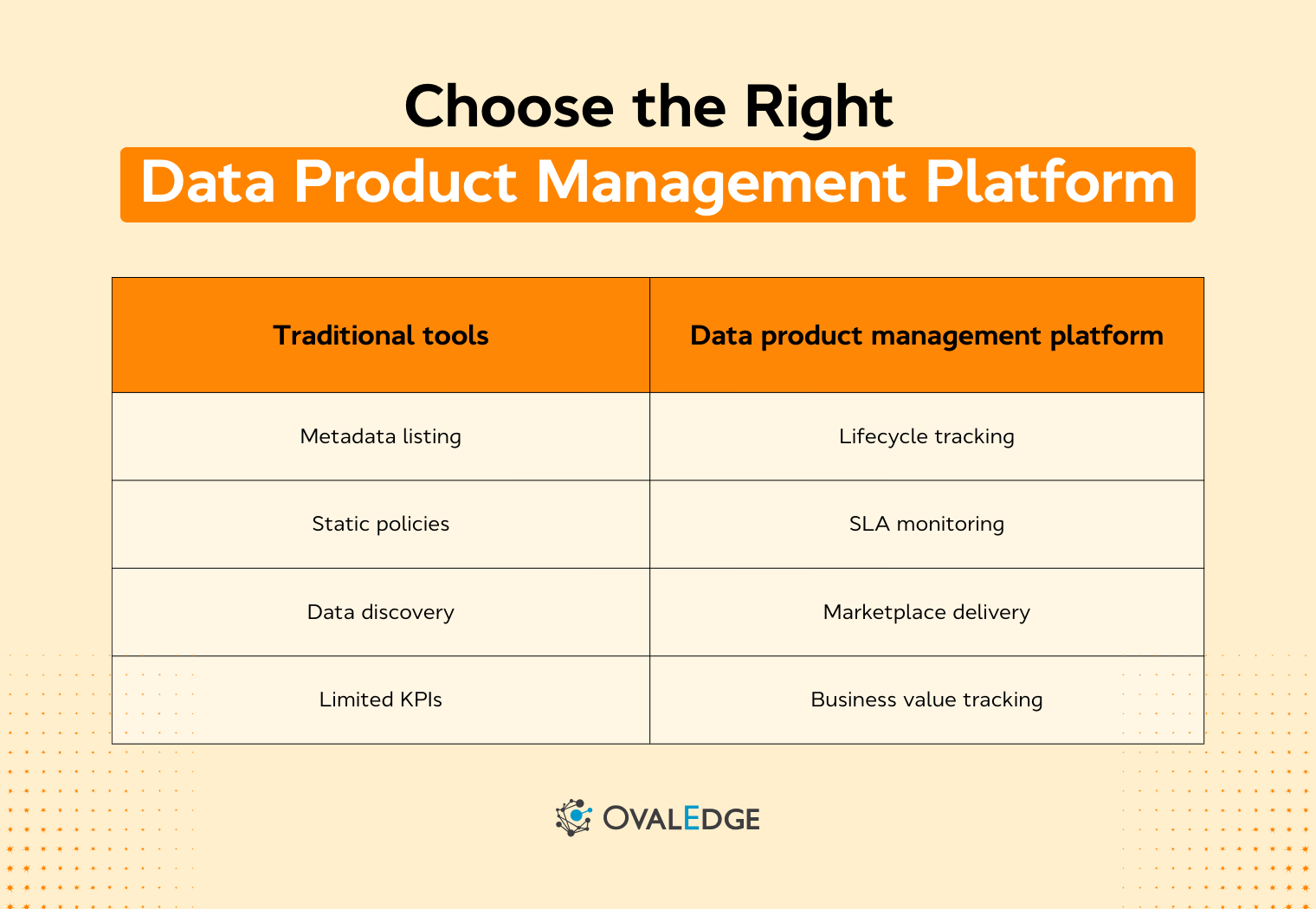
At that point, catalogs and governance tools are not enough. You can see the data, and you can define policies, but you still cannot manage it like a product with owners, SLAs, lifecycle control, and measurable business impact.
This is where a data product management platform comes in. It sits between governance, engineering, and business teams to operationalize data as accountable, consumption-ready products, not just assets.
In this guide, we break down how these platforms work, where they are used in practice, how they differ across vendors, and how to choose the right one based on your operating model.
What is a data product management platform?
A data product management platform is a system that helps teams manage data as an operational product by combining ownership, SLA enforcement, governance workflows, and usage tracking into a single, accountable lifecycle. It solves the gap between data visibility and data reliability.
Most organizations already have catalogs, pipelines, and governance tools. But when data becomes operational, domain-owned, or tied to business outcomes, a different set of problems starts to show up.
For example:
-
A domain publishes a dataset, but no one owns its reliability
-
SLAs are defined, but not monitored or enforced
-
Data is discoverable, but not consumption-ready
-
Multiple teams use the same data, but changes break downstream use cases
At this point, the issue is no longer visibility or policy, but a lack of product-level accountability.
This is where a data product management platform fits. It connects:
-
Ownership and accountability
-
Lifecycle management from definition to retirement
-
SLA monitoring and reliability tracking
-
Lineage and impact visibility
-
Marketplace-style discovery and access
-
Business value measurement
into one coordinated system.
Instead of managing datasets as isolated assets, teams can assign clear owners, define contracts and SLAs, track usage and adoption, monitor performance and incidents, and improve or retire products based on value.
How it differs from catalogs and governance tools
-
Data catalogs help you discover what exists.
-
Governance tools help you enforce policies.
-
Data product management platforms help you operate data as accountable, measurable products.
That distinction becomes critical in environments like data mesh, internal data marketplaces, or AI-driven workflows, where ownership, reliability, and usage tracking need to work together, not in silos.
Where do teams actually use a data product management platform?
A data product management platform becomes necessary when data moves from passive analysis to operational dependency. That shift introduces ownership, reliability, and coordination challenges that traditional tools cannot handle alone.
Here are 3 real scenarios where teams typically adopt these platforms.
1. When governance needs to move from policy to accountability
In regulated environments, governance often exists on paper but breaks down in execution. For example, a financial reporting dataset is used across multiple dashboards. Policies are defined, but when data quality drops or freshness SLAs are missed, no single owner is accountable, and resolution is slow.
What changes with a data product management platform:
-
Ownership is explicitly assigned to a product owner.
-
SLAs are defined and continuously monitored.
-
Governance workflows are tied to lifecycle stages.
-
Incidents are visible and traceable to the responsible teams.
Instead of governance being a checklist, it becomes operational and enforceable.
2. When internal data marketplaces fail to drive adoption
Many organizations launch internal data marketplaces expecting self-service adoption. What they get instead is low usage and duplicate data products.
A dataset may be discoverable, but:
-
It lacks clear documentation or a business context.
-
Access approvals are slow or unclear.
-
No one tracks whether it is actually used.
What changes with a data product management platform:
-
Data products are packaged with clear ownership, context, and usage guidelines.
-
Access is managed through structured approval workflows.
-
Adoption and usage are tracked at the product level.
-
Teams can measure which data products deliver value.
This shifts the marketplace from visibility to actual consumption and reuse.
|
Practical insight: This shift is also reflected in how the market is investing in data platforms. PitchBook reported that the data analytics vertical raised $20.7 billion in VC funding in H1 2024, signaling strong demand for systems that turn data into reusable, operational products. |
3. When data mesh introduces ownership without control
In a data mesh setup, domains are responsible for their own data products. But without coordination, this creates fragmentation. For example:
-
Each domain defines its own standards.
-
SLAs are inconsistent or missing.
-
Downstream teams cannot trust cross-domain data.
-
Lineage is unclear across systems.
What changes with a data product management platform:
-
Domains retain ownership, but operate within shared governance frameworks.
-
SLAs and data contracts are standardized and monitored.
-
Lineage provides cross-domain impact visibility.
-
Stakeholders can collaborate across domains with clear accountability.
This enables federated ownership without losing trust or consistency.
|
Stat: In fact, this challenge is widely recognized. Gartner reports that 63% of organizations either lack or are unsure they have the right data management practices for AI, which is why federated governance, lineage, and SLA enforcement are becoming essential in data mesh environments. |
Across all three scenarios, the pattern is the same. Once data becomes shared, operational, or business-critical, managing it informally stops working. A data product management platform introduces the structure needed to maintain ownership, reliability, and measurable value at scale.
How a data product management platform supports the data product lifecycle
A data product lifecycle is where most teams lose control. On paper, the lifecycle looks straightforward: define, build, publish, and monitor. In practice, ownership gaps, missing SLAs, and disconnected workflows break the process at multiple points.
A data product management platform matters because it keeps the lifecycle connected, accountable, and measurable. Here’s where things typically break, and how the platform intervenes.
1. Define: Where ownership and SLAs are unclear
At the definition stage, teams outline what the data product should deliver. But in many organizations:
-
Ownership is loosely assigned.
-
SLAs are documented but not enforced.
-
Success metrics are unclear.
This creates problems later when reliability or usage is questioned.
With a data product management platform:
-
Ownership is formally assigned to accountable stakeholders.
-
SLAs and data contracts are defined as enforceable commitments.
-
KPIs and business outcomes are tied to the product from the start.
This ensures the product is built with clear accountability, not assumptions.
2. Publish: Where discoverability exists but usability does not
Publishing often means making a dataset visible in a catalog or marketplace. But visibility does not guarantee adoption. Common issues include:
-
Poor documentation or missing business context.
-
Unclear access workflows.
-
No indication of trustworthiness or readiness.
As a result, users either avoid the product or misuse it.
With a data product management platform:
-
Products are packaged with metadata, context, and usage guidelines.
-
Access is governed through structured approval workflows.
-
Certification, ownership, and SLAs signal trust to consumers.
This shifts publishing from listing data to delivering usable products.
3. Monitor and iterate: Where SLAs and reliability break down
Once data products are in use, reliability becomes critical. But monitoring is often fragmented. Typical gaps include:
-
SLA breaches are detected late or not at all.
-
No clear visibility into incidents or root causes.
-
Teams cannot trace the downstream impact of changes.
This leads to broken dashboards, delayed decisions, and loss of trust.
With a data product management platform:
-
SLAs for freshness, availability, and quality are continuously tracked
-
Incidents are visible with clear ownership and accountability
-
Lineage enables impact analysis across upstream and downstream systems
This turns monitoring into proactive reliability management, not reactive firefighting.
Without a unified platform, each lifecycle stage operates in isolation, and accountability breaks between handoffs. A data product management platform connects these stages into a single system where ownership, SLAs, and performance are visible and enforceable end-to-end.
Best data product management platforms compared by use case
The right platform depends less on feature lists and more on how your organization operates. Governance-heavy enterprises, marketplace-driven teams, and data mesh architectures each require different strengths.
Here is a practical comparison based on where each platform performs best and where it falls short.
|
Platform |
Primary Strength |
Governance Depth |
Lifecycle Support |
Best Fit |
Trade-offs to Consider |
|
OvalEdge |
Governance-led lifecycle management |
High |
Full |
Regulated enterprises |
Requires structured adoption; less lightweight for small teams |
|
Atlan |
Collaborative data marketplace |
Moderate |
Moderate |
Modern, fast-moving data teams |
Governance depth may be limited for highly regulated use cases |
|
Alation |
Data intelligence and catalog foundation |
Moderate |
Moderate |
BI-driven organizations |
Marketplace and lifecycle features are less tightly integrated |
|
Informatica |
Enterprise governance + MDM integration |
High |
Strong |
Compliance-heavy enterprises |
Complex implementation and higher operational overhead |
|
DataHub |
Open-source, extensible metadata platform |
Moderate |
Moderate |
Engineering-led data mesh environments |
Requires significant engineering investment to operationalize |
|
Collibra |
Workflow-driven governance framework |
High |
Moderate |
Large enterprises with formal governance |
Slower to implement and less flexible for rapid iteration |
The real decision shows up when you map each platform to your top use case and the workflows you need to run consistently, not just the features you want to demo.
For enterprise data governance and lifecycle management
In regulated environments, the platform usually succeeds or fails on operational accountability. You want governance that stays connected to the product lifecycle, so ownership, approvals, and reliability standards do not live in separate systems.
1. OvalEdge
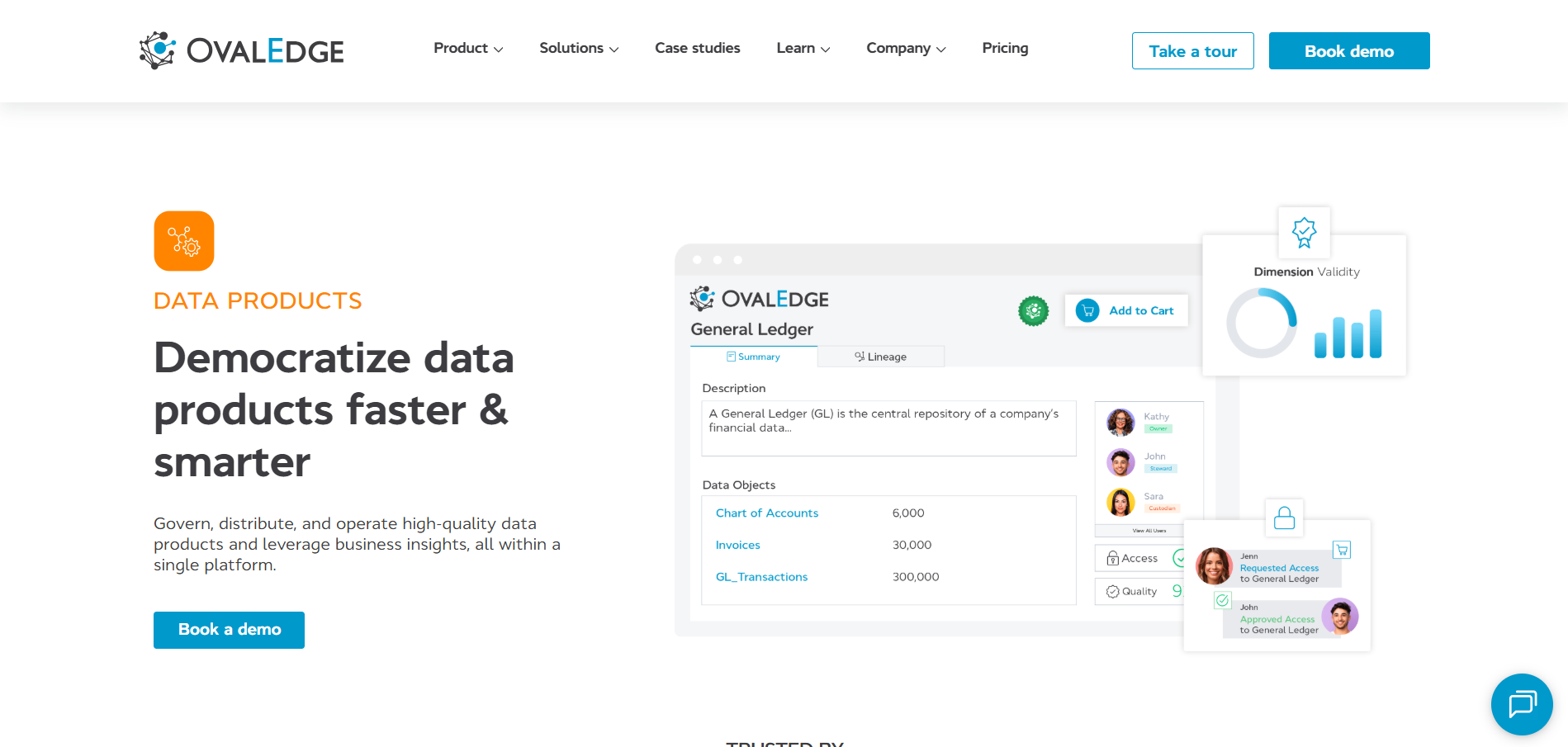
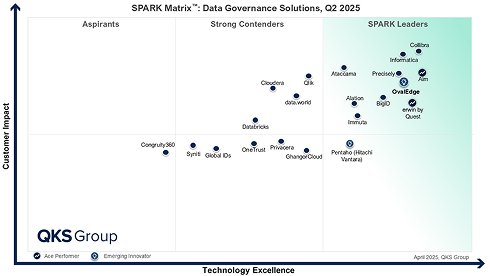
OvalEdge is a governance-led data product management platform designed to help enterprises operationalize data as accountable, consumption-ready products. It unifies data cataloging, governance workflows, lifecycle tracking, SLA monitoring, lineage visibility, and marketplace publishing in a single system.
By connecting ownership, compliance controls, and business value tracking, OvalEdge enables organizations to move beyond passive discovery toward measurable, reliable data product delivery.
Key strengths:
-
Strong lifecycle governance with embedded approval workflows
-
Built-in SLA monitoring and reliability tracking
-
End-to-end lineage with impact analysis
-
Marketplace-style publishing with usage visibility
Trade-offs to consider:
-
Works best in organizations ready for structured governance models
-
May require alignment across teams to fully adopt lifecycle workflows
Best for: Enterprises that need governance-driven lifecycle management with strong accountability and compliance alignment.
Why does this matter? IDC highlighted a commercial bank case where automation enabled 70% faster credit approval and 70% faster data access for analysts and data scientists, which is the kind of measurable outcome enterprises target when they operationalize trusted, governed data products.
|
For organizations ready to operationalize data as a product rather than manage it as infrastructure, OvalEdge brings governance, lifecycle coordination, and measurable value into one unified platform. If your teams are struggling with ownership clarity, SLA accountability, or marketplace adoption, this is the stage where booking a structured demo can help you see how those gaps close in practice. |
2. Collibra
Collibra is widely adopted for enterprise governance programs that rely on workflow, operating models, and policy enforcement at scale. For data products specifically, Collibra supports structured governance workflows and automated lineage, which helps large organizations standardize how data products are requested, approved, and maintained across domains and stakeholders.
Key strengths:
-
Strong governance workflows and policy enforcement
-
Enterprise-grade compliance and audit capabilities
-
Scalable operating model across domains
-
Well-defined stewardship and approval processes
Trade-offs to consider:
-
Implementation can be time-intensive
-
Less flexible for fast-moving, product-style iteration
Best for: Large enterprises with mature governance requirements and formal operating models.
For data marketplace enablement and monetization
Marketplace adoption is less about whether you can publish something and more about whether people actually use it. Platforms that win here tend to reduce friction in discovery, access, and collaboration, while keeping governance embedded so trust does not collapse as usage scales.
3. Atlan
Atlan emphasizes a modern, collaboration-first experience that helps data teams drive adoption across analysts, engineers, and business stakeholders. Its marketplace-oriented positioning focuses on helping teams package governed assets for reuse, while keeping discovery and day-to-day governance accessible enough to become a habit, not a quarterly project.
Key strengths:
-
Strong marketplace and discovery experience
-
High usability across technical and business users
-
Collaboration-driven workflows
-
Faster time-to-adoption
Trade-offs to consider:
-
Governance depth may not meet highly regulated enterprise requirements
-
SLA enforcement and lifecycle control are less central
Best for: Teams prioritizing adoption, collaboration, and ease of use over heavy governance.
4. Alation
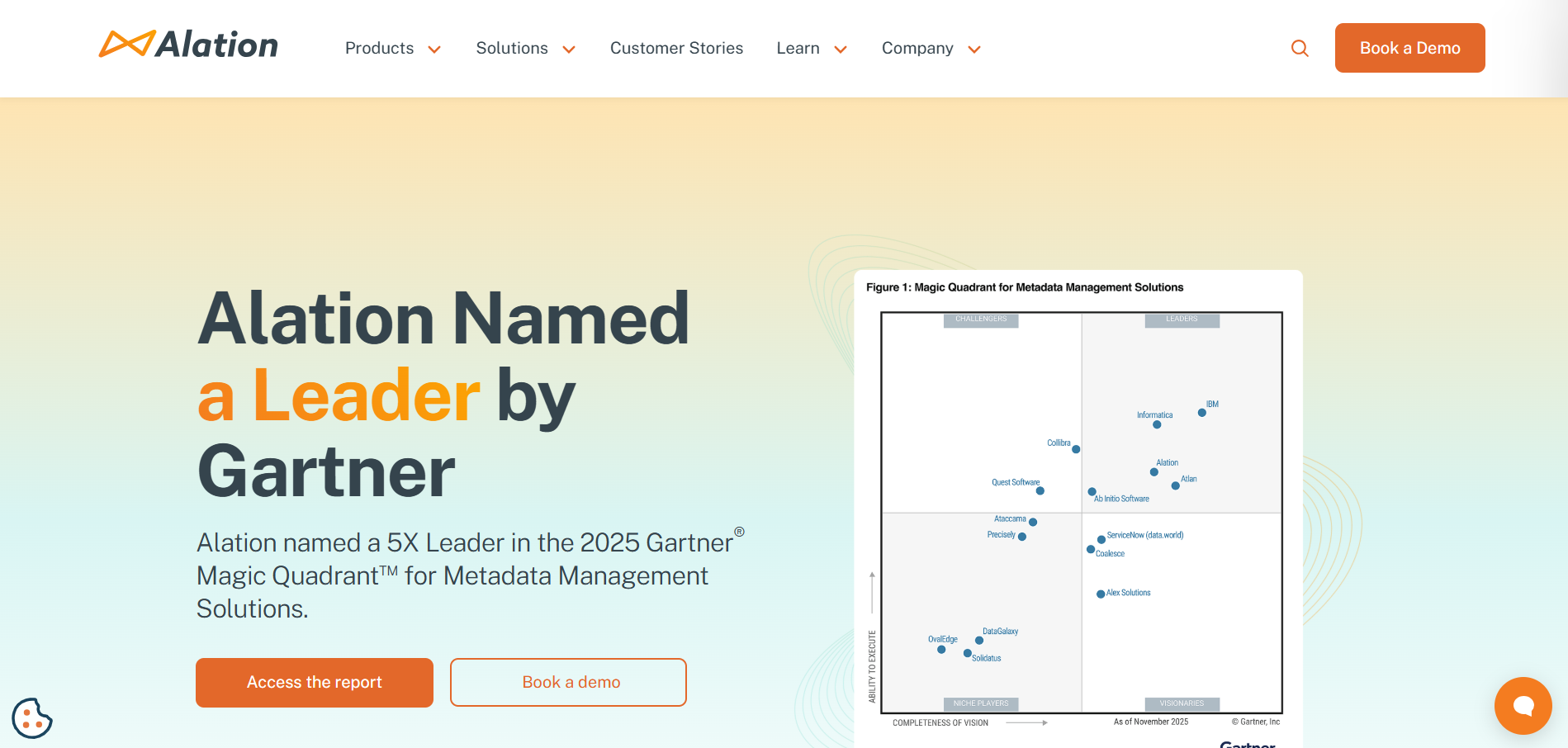
Alation approaches productization from a catalog and data intelligence foundation, then extends into a data products marketplace model. Its positioning leans toward helping teams turn trusted assets into reusable, governed “products” that are easier to consume, with standards around ownership and compliance before publishing to a marketplace experience.
Key strengths:
-
Strong data catalog and discovery foundation
-
Focus on trusted, certified data products
-
Governance embedded in publishing workflows
-
Business-friendly interface for data discovery and context
Trade-offs to consider:
-
Lifecycle management is less comprehensive
-
Marketplace capabilities depend on catalog maturity
Best for: Organizations transitioning from catalog-driven discovery to structured data product reuse.
For data mesh and domain-driven ownership
When data products are owned by domains, the hard part is keeping things consistent without centralizing everything. Platforms that fit here tend to provide flexible metadata modeling, strong lineage, and mechanisms like data contracts or assertions that let domains declare what “good” looks like.
5. DataHub
DataHub is an extensible metadata platform and modern catalog that is often used by engineering-led teams building federated governance patterns. It supports discovery and lineage, and it also offers data contracts built on verifiable assertions, which is useful when domains need to publish products with clear expectations around schema, freshness, and quality.
Key strengths:
-
Flexible, extensible metadata model
-
Strong lineage and impact analysis
-
Supports data contracts and assertions
-
Developer-friendly integration with modern data stacks
Trade-offs to consider:
-
Requires engineering effort to implement and maintain
-
Governance and lifecycle workflows need a custom setup
Best for: Tech-first organizations building custom data mesh solutions.
6. Informatica
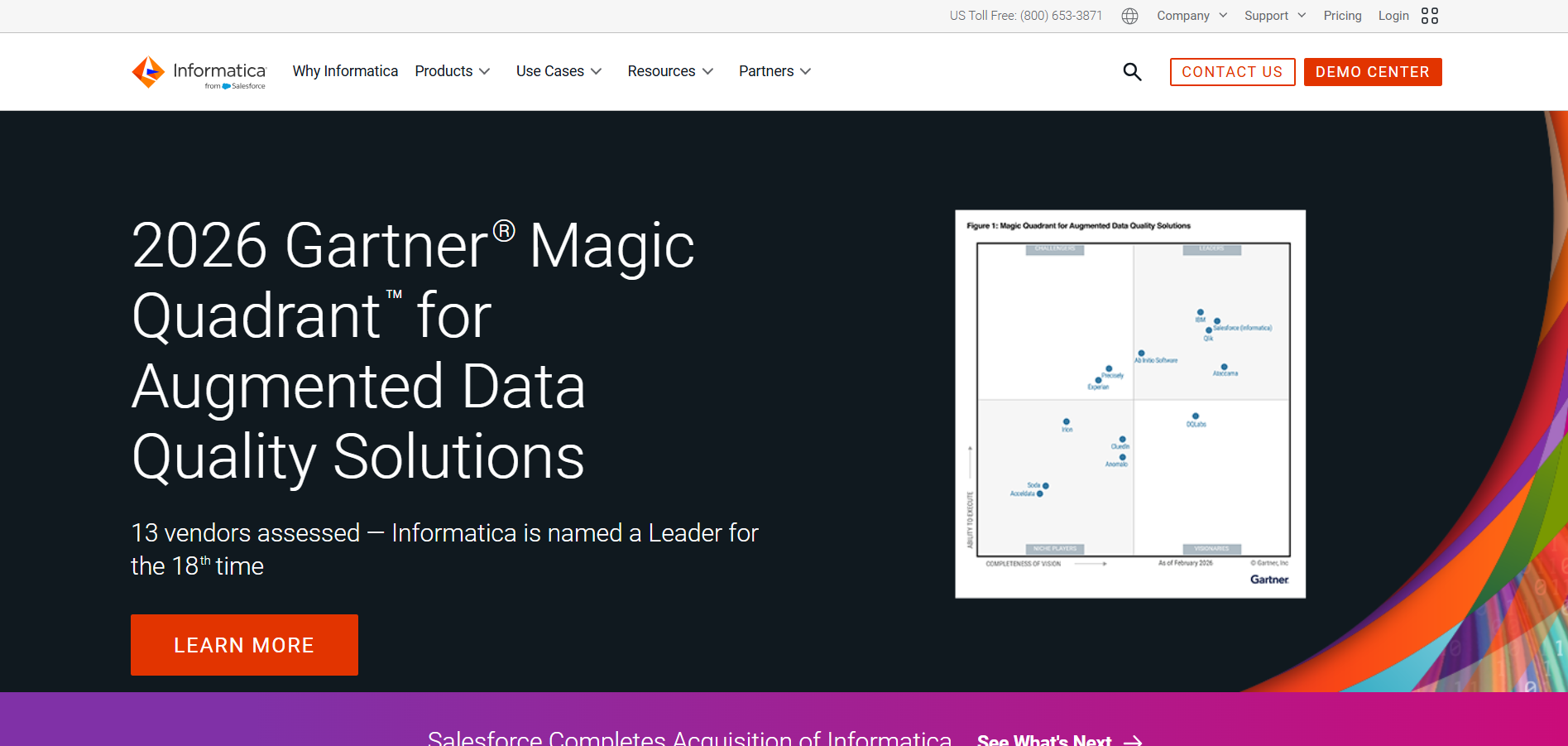
Informatica’s governance stack is often chosen when organizations want governance, cataloging, and lineage tied closely to enterprise data management, including MDM-oriented programs. With Axon for governance collaboration and Cloud Data Governance and Catalog for discovery and lineage, it supports standardized controls that can extend across domains while maintaining centralized compliance oversight.
Key strengths:
-
Deep governance and compliance capabilities
-
Strong integration across enterprise data management tools
-
Mature lineage and metadata capabilities
-
Integrated support for MDM and enterprise data controls
Trade-offs to consider:
-
Higher cost and implementation complexity
-
Can be heavy for teams seeking faster iteration
Best for: Compliance-heavy enterprises with complex data ecosystems.
What capabilities actually matter in a data product management platform?
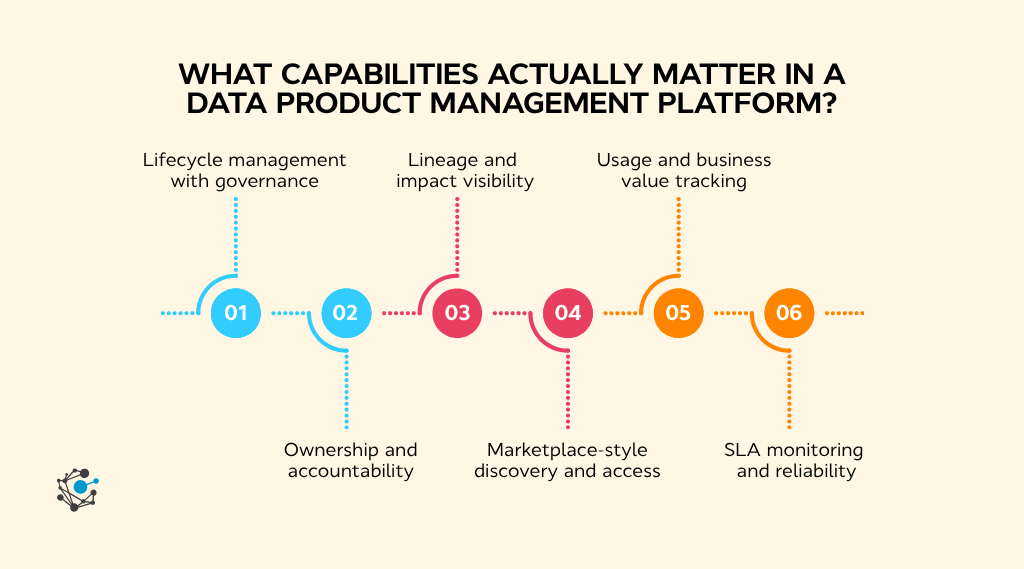
Most platforms list similar features, but the real difference shows up in how those capabilities work together to support ownership, reliability, and adoption at scale. When evaluating a data product management platform, focus on these core areas:
-
Lifecycle management with embedded governance: A strong platform does not just track lifecycle stages; it ensures governance is applied at every step. Look for structured workflows where approvals, versioning, and compliance checks are built directly into how data products are defined, released, and retired.
-
Ownership and accountability across domains: Every data product should have clearly assigned owners and stewards. The platform should make ownership visible, enforce responsibilities, and support domain-level accountability, especially in data mesh environments.
-
Lineage and impact visibility: End-to-end lineage helps teams understand how data flows across systems. Look for platforms that provide impact analysis so teams can assess upstream and downstream dependencies before making changes.
-
Marketplace-style discovery with controlled access: Discoverability should translate into usability. The platform should support marketplace-style publishing, structured access workflows, and clear context so users can trust and use data products effectively.
-
Usage and business value tracking: Data products should be measurable in terms of adoption and impact. Platforms should provide visibility into usage patterns, consumer engagement, and business outcomes to help teams prioritize and improve what they deliver.
-
SLA monitoring and reliability tracking: Reliability must be measurable. The platform should allow teams to define SLAs for freshness, availability, and quality, and continuously monitor them with clear visibility into incidents and ownership.
|
Market insight: This shift toward reliability is also reflected in market investment. Grand View Research estimates the DataOps platform market will reach $17.17 billion by 2030, growing at a 22.5% CAGR, reinforcing how SLA monitoring and operational visibility are becoming standard requirements. |
Individually, these capabilities exist in many tools. The real value of a data product management platform comes from how they operate together as a single system that connects ownership, governance, reliability, and measurable business outcomes.
What does this look like in practice? A data product workflow with OvalEdge
Understanding features in isolation is useful. But the real value of a data product management platform shows up when you see how ownership, governance, SLAs, and delivery work together in a single workflow. Here’s what that looks like in practice.
A typical scenario
A domain team is responsible for a customer analytics data product used by marketing, finance, and leadership dashboards. Before a structured platform:
-
Ownership is unclear across teams
-
SLA expectations exist, but are not enforced
-
Changes in upstream pipelines break downstream dashboards
-
Data is discoverable, but not consistently trusted or reused
This creates friction across teams and delays decision-making.
How does this workflow change with OvalEdge
.png?width=1024&height=569&name=Info%202%20(3).png)
With OvalEdge, the same data product is managed as a structured, accountable system.
-
Ownership is defined upfront: A product owner and stewards are assigned, with clear responsibility for quality, access, and lifecycle decisions.
-
Lifecycle and governance are connected: As the product evolves, approvals, documentation, and compliance checks are embedded into each stage instead of being handled separately.
-
SLAs are monitored continuously: Freshness, availability, and reliability are tracked against defined SLAs, with visibility into incidents and accountability for resolution.
-
Lineage provides full impact visibility: Teams can see how upstream changes affect downstream use cases, reducing the risk of breaking critical dashboards.
-
Marketplace delivery improves adoption: The data product is published with clear context, ownership, and access workflows, making it easier for other teams to discover, trust, and use it.
-
Usage and value are measurable: Adoption and usage patterns are tracked, helping teams understand which data products are delivering business impact.
What changes at an organizational level?
Instead of managing data as disconnected assets:
-
Teams operate with clear ownership and accountability.
-
Governance becomes part of execution, not a separate process.
-
Reliability is monitored, not assumed.
-
Data products are measured based on usage and impact.
This is what allows organizations to move from managing data to operating data as a product.
If your teams are struggling with ownership clarity, SLA enforcement, or marketplace adoption, this is where evaluating a structured platform like OvalEdge can help you understand what changes in practice.
How to choose the right data product management platform?
Choosing a data product management platform is less about feature comparison and more about how well the platform fits your operating model. Before evaluating vendors, clarify where your organization sits across governance, ownership, and scale.
.png?width=1024&height=569&name=How%20to%20choose%20the%20right%20data%20product%20management%20platform%20(2).png)
Use this checklist to guide your decision:
-
Governance depth: Can the platform enforce policies, approvals, and compliance requirements within day-to-day workflows, or does governance remain a separate layer? If you operate in a regulated environment, this becomes a primary filter.
-
Lifecycle management maturity: Does the platform support end-to-end lifecycle coordination with versioning, approvals, and retirement workflows, or is lifecycle tracking fragmented across tools? This matters when multiple teams depend on the same data products.
-
SLA monitoring and reliability: Are SLAs measurable, monitored, and enforceable, or are they documented but not actively tracked? This is critical for operational dashboards, AI systems, and executive reporting.
-
Ownership and domain alignment: Can you assign clear ownership at the data product level and align it with domain teams? It is essential for data mesh or federated operating models.
-
Marketplace readiness and adoption tracking: Does the platform support structured publishing, access workflows, and usage visibility? This is important if your goal is self-service adoption, not just discoverability.
-
Lineage and impact analysis: Can teams understand upstream and downstream dependencies before making changes? Without this, reliability and trust degrade quickly at scale.
-
Ecosystem integration: Does the platform integrate with your existing stack, including Snowflake, Databricks, BigQuery, BI tools, and orchestration systems? Integration depth often determines long-term usability.
-
Total cost of ownership: Beyond licensing, consider implementation effort, operational overhead, and scaling complexity. Some platforms require significant engineering investment to operationalize.
The right platform is not the one with the most features. It is the one that aligns with how your organization manages ownership, enforces reliability, and scales data products across teams.
When do organizations need a data product management platform?
Not every organization needs a data product management platform from day one. The need becomes clear when data stops being an internal resource and starts becoming an operational dependency across teams.
Most organizations reach this point through a few common triggers:
-
Scaling data mesh or domain ownership: As domains take ownership of data products, coordination becomes harder. Without structured lifecycle visibility and governance, consistency and trust break across domains.
|
Did you know? This shift is already underway. Gartner found that 61% of organizations are evolving or rethinking their data and analytics operating model due to AI technologies, with data products emerging as one of the most practical ways to operationalize that change. |
-
Building an internal data marketplace: Publishing data products without structured ownership, access workflows, and usage tracking often leads to low adoption and duplication.
-
Managing SLA-driven data products: When dashboards, operational systems, or AI models depend on defined SLAs, informal monitoring introduces risk. Reliability must be measurable and enforceable.
-
Monetizing data or tracking business impact: When data products are tied to revenue, cost savings, or decision-making outcomes, teams need visibility into adoption, usage, and value.
If your organization is facing even one of these challenges, it is a strong signal that managing data as an asset is no longer enough. At that point, a structured data product management platform becomes necessary to maintain ownership, reliability, and measurable value at scale.
Conclusion
The real question is not whether you have data products; it is whether they are actually managed.
If ownership is unclear, SLAs are not enforced, and marketplace adoption is inconsistent, then data may be visible, but it is not operational. That gap is where reliability breaks and value leaks.
A data product management platform closes that gap by connecting ownership, lifecycle, governance, and usage into a single system. The shift is simple but critical: from documenting data to running it as a product.
If your organization is reaching that point, the next step is to evaluate how a platform like OvalEdge can bring structure, accountability, and measurable outcomes into your data workflows.

If you are ready to treat data as a measurable business product rather than a managed asset, schedule a call with OvalEdge and explore what structured lifecycle management looks like in practice.
FAQs
1. What features should a data product management platform have for data mesh with SLA enforcement?
A strong platform should combine domain ownership, SLA monitoring, lineage visibility, and governance workflows. It must allow domains to operate independently while enforcing shared standards for reliability, access, and accountability across data products.
2. How do data product management platforms enforce SLAs and ownership?
They define SLAs at the product level and continuously monitor freshness, availability, and quality. Ownership is assigned to specific stakeholders, making SLA breaches visible, traceable, and accountable for resolution.
3. How is a data product management platform different from a data catalog or governance tool?
A data catalog helps discover assets, and governance tools enforce policies. A data product management platform connects lifecycle, ownership, SLAs, and usage tracking to manage data as an accountable, measurable product.
4. Can these platforms support internal data marketplaces with approvals and usage tracking?
Yes. They enable marketplace-style publishing, structured access approval workflows, and usage tracking. This ensures data products are not just discoverable but also trusted, governed, and actively used.
5. How do teams evaluate data product management platforms?
Teams should evaluate based on governance depth, lifecycle support, SLA enforcement, ownership models, lineage visibility, and marketplace capabilities. The right choice depends on whether the focus is compliance, adoption, or data mesh scalability.
6. Do you need a data product management platform to implement data mesh?
Not strictly, but it significantly reduces complexity. It provides structure for domain ownership, SLA enforcement, and cross-domain visibility, which are difficult to manage manually at scale.
.png?width=1081&height=173&name=Forrester%201%20(1).png)
.png?width=1081&height=241&name=KC%20-%20Logo%201%20(1).png)