.png)
Every growing data team eventually hits the same wall. The catalog has hundreds of datasets, but nobody knows which ones are still accurate. Three teams built their own version of a customer churn model because they couldn't find or trust the one that already existed. A pipeline that served finance reporting for two years quietly broke, and nobody noticed until the CFO flagged numbers that didn't add up.
The problem isn't a lack of data or infrastructure. It's the absence of lifecycle discipline.
KPMG's 2024 Data Products Survey confirms the pattern: 92% of executives consider data products critical, but only 35% have achieved real value from them.
A data product lifecycle framework closes that gap. This guide covers what it looks like in practice, why it matters at every stage, and what to look for in a platform that supports the full process.
What is a data product lifecycle framework?
A data product lifecycle framework is a structured process for managing data products across every stage, from planning and development through deployment, monitoring, and retirement.
It connects governance, quality controls, ownership, metadata, and consumption workflows into a single repeatable model so that every data product has a defined purpose, a responsible owner, target consumers, quality standards, and measurable business outcomes.
Most organizations don't struggle with building data products. They struggle with maintaining them. Datasets lose accuracy over time. Ownership changes hands without documentation. Quality degrades after deployment because nobody is actively monitoring it. A lifecycle framework makes ongoing management part of the process, not an afterthought.
How a data product lifecycle framework differs from traditional data management
Traditional data management answers one question: can the data move from source to destination? It covers storage, ETL jobs, pipelines, and delivery.
A data product lifecycle framework shifts that focus from delivery to value: who is this data product for, what business problem does it solve, who's accountable for quality, and how will the organization know when it's no longer relevant?
|
Aspect |
Traditional Data Management |
Data Product Lifecycle Framework |
|
Primary focus |
Storage, pipelines, delivery |
Business-ready, governed data products |
|
Ownership model |
Centralized IT |
Domain-driven with dedicated product owners |
|
Governance approach |
Reactive, applied at deployment |
Continuous, embedded across all stages |
|
Usage visibility |
Limited or no tracking |
Full lifecycle observability and adoption metrics |
|
Reusability |
Hard to discover, often duplicated |
Designed for discoverability and cross-team reuse |
|
Retirement |
Assets accumulate indefinitely |
Governed decommission when the value declines |
Core components of a governed data product lifecycle
A governed lifecycle framework is built from five interconnected components. Each one addresses a specific failure mode that shows up when organizations try to scale data products without structure.
Ownership and accountability. Every data product gets a dedicated owner and defined stewardship responsibilities, including approval workflows, escalation paths, and accountability tracking across domains.
Metadata and lineage. Business definitions, sensitivity classifications, upstream and downstream dependencies, and transformation logic are captured and maintained continuously. This is what makes impact analysis, audit readiness, and discoverability possible.
Data quality management. Quality rules and SLAs are defined during planning, not bolted on after deployment. Continuous monitoring checks for completeness, freshness, and anomalies, with automated alerts that catch problems before downstream consumers do.
Access and privacy controls. Role-based access, data masking, classification controls, and compliance enforcement for regulations like GDPR and CCPA are built into the framework from day one.
Usage monitoring and feedback loops. Adoption tracking and duplicate detection feed directly into lifecycle decisions. Low-usage products get flagged for improvement or retirement. High-usage products get prioritized for investment.
|
What does this look like in practice? Platforms like OvalEdge bring these components together through connected cataloging, automated lineage, quality monitoring, and governance workflows. |
Why data product lifecycle management matters for modern enterprises
Data product lifecycle management gives enterprises a repeatable way to create, govern, publish, monitor, and improve data products over time. Without it, data products become static assets that degrade in quality, lose relevance, and create more confusion than clarity as the organization scales.
How lifecycle management improves data trust and reuse
Trust in a data product comes from three things: knowing who owns it, understanding where the data comes from, and being able to verify its quality. Lifecycle management makes all three visible by default.
When every data product has a named owner, documented lineage, quality scores, and usage history, consumers can evaluate fitness for their use case without chasing down the team that built it. That visibility is what turns a dataset sitting in a warehouse into a reusable enterprise asset.
Reuse follows directly. When governed data products are searchable through a catalog and documented with business context, teams stop rebuilding what already exists. The downstream effects are practical:
-
Fewer duplicate datasets competing for trust across departments
-
Consistent numbers in reporting because teams reference the same governed source
-
Faster onboarding for AI and analytics initiatives that need vetted, production-ready data
Why governance must exist in every lifecycle stage
Governance applied only at deployment creates two problems: bottlenecks before launch, and blind spots after it. This is how organizations end up with data products that passed every compliance check at go-live but haven't been monitored, updated, or reviewed in 18 months.
A data product lifecycle framework distributes governance across all stages instead of concentrating it at one gate:
-
Planning: Classify sensitive data, assign ownership, and define quality expectations before engineering begins
-
Active use: Enforce access controls, monitor compliance, maintain audit trails, track adoption
-
Retirement: Archive assets properly, enforce retention policies, and remove duplicates that clutter the catalog
When governance runs continuously, it stops being the thing that slows teams down and becomes the operating model that keeps data products reliable.
How lifecycle frameworks support AI, analytics, and self-service consumption
AI models, analytics dashboards, and self-service tools all depend on the same foundation: trusted data with clear lineage, consistent definitions, and governed access. A data product lifecycle framework is how organizations build and sustain that foundation at scale.
|
Area |
What lifecycle management provides |
Enterprise impact |
|
AI readiness |
Governed datasets with lineage, quality controls, and semantic context |
More reliable models, reduced hallucination risk |
|
Analytics consistency |
Standardized metrics and definitions across domains |
Trusted reporting, fewer conflicting numbers |
|
Self-service adoption |
Searchable, documented, access-controlled data products |
Faster insights, less engineering dependency |
|
Compliance |
Automated policy enforcement across the full lifecycle |
Audit readiness, reduced regulatory risk |
A 2026 Gartner press release predicts that organizations prioritizing semantics in AI-ready data could improve GenAI model accuracy by up to 80% and reduce costs by up to 60% by 2027. That kind of semantic readiness doesn't happen without structured lifecycle processes behind the data feeding those models.
How the data product lifecycle framework works end-to-end
A data product lifecycle framework organizes the data product development process into six stages: define, build, validate, deploy, monitor, and retire. Each stage has a clear objective and specific governance controls. Together, they form a data product roadmap that takes a data product from an initial business need through active use and eventual decommission.
Stage 1: Define and plan the data product
This is where product thinking enters the data product development process. Instead of starting with available datasets, teams start with the business problem and work backward.
-
Identify the business use case and target consumers
-
Define quality expectations and freshness SLAs
-
Assign a data product owner with clear stewardship responsibilities
-
Classify data sensitivity and set access approval policies
Governance starts here, not at deployment. Ownership, compliance requirements, and access policies established in this stage become the foundation that every other stage builds on. When this stage is rushed, data products launch without clear accountability, and governance becomes a retrofit.
Stage 2: Engineer and build data pipelines
This stage translates the plan into working infrastructure. What makes this different from standard data engineering is that every pipeline decision is tied back to the lifecycle requirements defined in Stage 1.
-
Integrate source systems and build transformation workflows
-
Standardize schema naming conventions and versioning rules
-
Build pipeline monitoring that maps to the quality SLAs defined in planning
-
Implement PII masking, access restrictions, and classification controls specified during planning
The distinction matters. A pipeline built without a lifecycle context moves data. A pipeline built within a lifecycle framework moves governed, quality-controlled data to known consumers for a defined purpose.
Stage 3: Validate and test data quality
This is the quality gate. Before a data product reaches consumers, it needs to pass validation for accuracy, completeness, freshness, lineage integrity, and governance compliance.
-
Validate against the quality rules and SLAs defined in Stage 1
-
Verify lineage from source through every transformation step
-
Test freshness thresholds under real-world conditions
-
Run certification workflows to formally approve the product for consumption
Every data product should meet a minimum quality bar before it's published. Rushing past this stage is one of the most common and expensive mistakes. Teams push products into production because the business is waiting, then spend months rebuilding trust after downstream reports turn out to be wrong.
Stage 4: Deploy and distribute data products
This is where data products become available to consumers across the enterprise.
-
Publish through a data catalog with full metadata, business terms, and lineage.
-
Configure role-based access permissions and usage approvals
-
Implement data product versioning to manage changes without breaking downstream consumers
Versioning deserves special attention. Without it, a schema change in one data product can silently break pipelines, dashboards, and models across the organization. Data product versioning should include backward compatibility rules, consumer notification workflows, and a transition period before older versions are deprecated.
Platforms like OvalEdge support this stage through connected cataloging, metadata registration, and policy-driven access controls that make governed data products discoverable at scale.
Stage 5: Monitor and evolve the data product
Deployment isn't the finish line. A data product that was accurate and well-governed at launch can degrade within months if nobody is watching.
- Track usage patterns and adoption rates to understand who's consuming what
- Detect anomalies, pipeline failures, and schema drift before consumers do
- Measure freshness against SLAs and flag products that fall below thresholds
- Feed monitoring data back into improvement decisions
This feedback loop is what separates lifecycle management from a one-time launch process. Without it, data products become stale assets that consumers quietly stop trusting.
Stage 6: Retire and decommission data assets
When usage declines, business priorities shift, or newer products replace older ones, governed retirement prevents stale assets from cluttering the catalog and wasting infrastructure.
-
Evaluate usage trends to identify retirement candidates
-
Notify downstream consumers and map dependencies before removal
-
Archive with full documentation for compliance and audit purposes
-
Remove duplicates and consolidate overlapping products
Retirement without governance creates risk. Removing a dataset that's still feeding a compliance report or an AI model downstream isn't cleanup. It's an incident.
What capabilities should a modern data product lifecycle platform provide?
A modern data product lifecycle platform should support the full journey from design to retirement in one connected environment. That means metadata, lineage, policies, access controls, monitoring, and collaboration workflows working together rather than spread across disconnected tools.
Three capabilities separate platforms that can actually support lifecycle management from those that only cover parts of it.
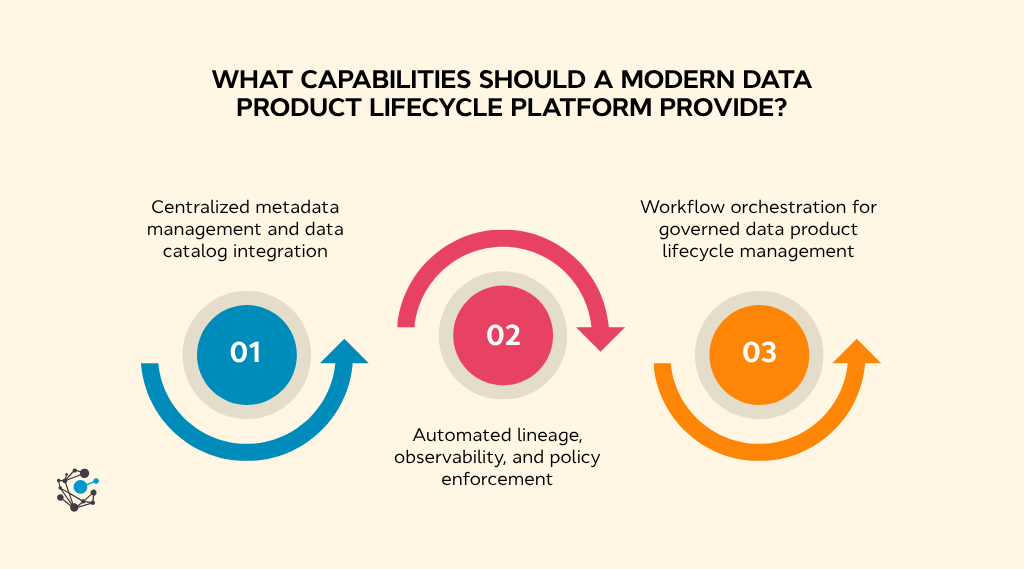
Centralized metadata management and data catalog integration
Every data product needs a clear identity: its definition, owner, source systems, business terms, sensitivity level, quality rules, and approved use cases. Centralized metadata management captures all of this in one place, so teams don't have to piece together context from five different tools.
Data catalog integration makes these products findable. When metadata is connected to a governed catalog, consumers can search for approved data products, compare available assets, review usage context, and assess fitness for their specific analytics, AI, or operational use case. Without catalog integration, organizations end up with governed data products that nobody can discover.
Automated lineage, observability, and policy enforcement
Automated lineage shows how data flows from source systems through transformations, pipelines, data products, reports, dashboards, and AI models. This visibility is essential for impact analysis. When something changes upstream, teams need to know what breaks downstream before it happens, not after a stakeholder flags a broken report.
Observability goes further. A lifecycle platform should continuously monitor freshness, schema changes, anomalies, quality failures, and usage patterns. And policy enforcement should be automated, covering access controls, privacy rules, and compliance requirements, rather than depending on manual reviews that don't scale.
Workflow orchestration for governed data product lifecycle management
Lifecycle management involves constant handoffs: data product requests, ownership assignments, access approvals, quality validations, and retirement decisions. Without structured orchestration, these handoffs become ad-hoc email threads and Slack messages that nobody tracks, and nothing enforces.
A lifecycle platform should connect data producers, data stewards, engineers, compliance teams, and business consumers through governed workflows. This makes it easier to track responsibilities, resolve issues, manage change requests, and keep data products maintained as priorities evolve. The alternative is governance that exists in documentation but not in practice.
|
Where do these capabilities come together? OvalEdge brings metadata management, automated lineage, quality monitoring, access controls, and workflow orchestration together in a single platform.
|
Common challenges in managing data products
Even with a lifecycle framework in place, data product management across teams and distributed systems isn't straightforward. These are the challenges that come up most often.
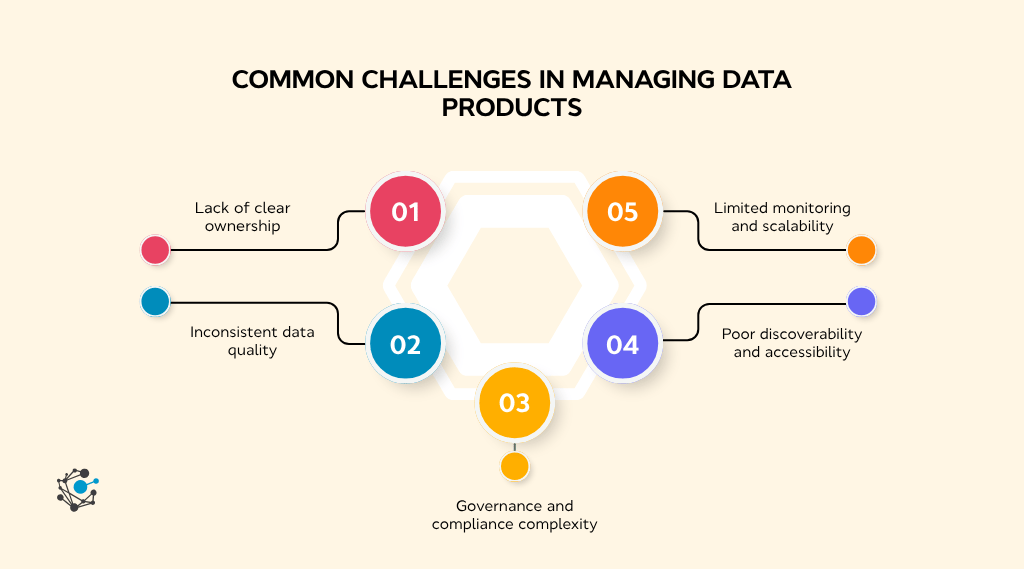
-
No clear ownership: Data products built by someone who's since changed roles sit without an accountable owner. Quality degrades, metadata goes outdated, and nobody knows who to contact when something breaks.
-
Inconsistent data quality: Duplicate datasets across departments, missed freshness SLAs, and unmonitored pipelines lead to reports and models running on data that nobody has validated in months.
-
Fragmented governance: GDPR, CCPA, and industry-specific regulations demand consistent access controls, audit trails, and retention policies. When enforcement is split across disconnected tools, compliance becomes a liability rather than a process.
-
Poor discoverability: When finding a trusted data product takes longer than building a new one, teams default to duplication. Missing business context and weak catalog adoption make the problem worse.
-
No observability at scale: Without automated monitoring, problems surface only after consumers report broken outputs. That approach doesn't survive past a few dozen data products.
Most of these challenges share a root cause: data products being treated as one-time deliverables rather than managed assets with a lifecycle. A structured framework doesn't eliminate every problem, but it gives teams the operating model to catch and resolve them before they compound.
Conclusion
A data product lifecycle framework isn't a documentation exercise. It's an operating model. The organizations that get this right are the ones that stop treating data products as project deliverables and start managing them the way they manage any business-critical asset.
The next step for data leaders isn't building more data products. It's building the discipline to govern, monitor, and improve what's already in production. That requires a platform built for full lifecycle management, not a patchwork of disconnected tools covering parts of it.
OvalEdge helps enterprises manage data products from planning through retirement in a single governed platform. Book a demo to see what lifecycle management looks like when it actually works end-to-end.
FAQs
1. What is the role of a data product owner in a lifecycle framework?
A data product owner is accountable for the product's quality, governance, relevance, and evolution across all lifecycle stages. They define requirements, approve access, coordinate with stewards and engineers, and make decisions about improvements or retirement.
2. How do data contracts fit into a data product lifecycle?
Data contracts define the agreed schema, quality standards, freshness SLAs, and access terms between producers and consumers. They formalize expectations at the planning stage and serve as the enforceable baseline for validation, monitoring, and versioning throughout the lifecycle.
3. What metrics should teams track for data product performance?
Key metrics include adoption rate, active consumers, query frequency, quality score trends, SLA compliance, freshness, lineage completeness, and duplicate rate. These feed lifecycle decisions around investment, improvement, or retirement.
4. How does a data product lifecycle framework differ from data mesh?
Data mesh is an organizational model that decentralizes data ownership to domains. A lifecycle framework is the operational process each domain follows to plan, build, govern, publish, monitor, and retire its data products. They're complementary, not interchangeable.
5. How long does it typically take to implement a data product lifecycle framework?
Most organizations start with a pilot domain and expand over 3 to 6 months. Full enterprise rollout typically takes 9 to 18 months, depending on organizational complexity, tooling maturity, and the number of domains being onboarded.
6. Can a data product lifecycle framework work without a data catalog?
Technically, yes, but it's significantly harder. A catalog provides the discoverability, metadata visibility, and governance context that lifecycle management depends on. Without one, teams can't find, evaluate, or reuse data products efficiently.
.png?width=1081&height=173&name=Forrester%201%20(1).png)
.png?width=1081&height=241&name=KC%20-%20Logo%201%20(1).png)