.jpg)
The finance team says revenue grew 12% last quarter. Marketing says it was 9%. Both pulled the number from what they believe is the right source, and neither is wrong in the way they calculated it. But the executive team now trusts neither.
This is what happens when data gets created, copied, and consumed across systems without consistent ownership, shared definitions, or any real control over what changes and when.
Data product governance addresses this by treating data as a managed product with clear owners, quality standards, access rules, and lifecycle controls across every domain.
In this guide, we'll cover what data product governance actually means, how to measure success, and where governance is headed as enterprises scale data products across teams.
What is data product governance?
Data product governance is a framework of policies, ownership structures, quality standards, and control mechanisms used to manage data products across their entire lifecycle. It treats data as a managed product rather than a system output, with clearly defined accountability, documentation, access rules, and versioning at every stage.
In practice, this means governance moves closer to where data is actually created and consumed. Instead of a central team trying to enforce rules across every system, domain teams take responsibility for the data products they own, while operating within enterprise-wide standards that keep quality, access, and compliance consistent across the organization.
This is a meaningful shift from how most enterprises have traditionally governed data, and it's where older models start to break down.
Why traditional governance models fail modern data teams
Traditional data governance was designed for centralized, slow-moving environments where a small team controlled access, enforced rules, and documented everything from one place. That model worked when data lived in a few systems and changed infrequently.
Modern data ecosystems look nothing like that. Data gets produced continuously across dozens of platforms and consumed by teams who never interact with each other. Pipelines run faster than any approval workflow can keep up with. When governance sits outside this flow, it either becomes a bottleneck that teams route around or a compliance checkbox that nobody trusts to reflect what's actually happening.
|
Did you know? 2024 Gartner press release predicted that at least 30% of generative AI projects would be abandoned after proof of concept by the end of 2025, with poor data quality cited as a key factor. When governance can't keep pace with how data products are built and consumed, downstream failures like this become inevitable. |
The table below breaks down where the gap shows up in practice:
|
Dimension |
Traditional governance |
Data product governance |
|
Ownership |
Centralized, often unclear across domains |
Assigned to domain teams closest to the data |
|
Quality management |
Reactive, audit-driven checks |
Continuous monitoring with defined SLAs |
|
Scalability |
Struggles with cloud, streaming, and multi-platform setups |
Built for distributed, evolving architectures |
|
Metadata and definitions |
Inconsistent, siloed documentation |
Standardized glossary and lineage across products |
|
Access control |
Broad, role-based at the infrastructure level |
Granular, context-aware at the product level |
|
Speed of delivery |
Slowed by approval-driven workflows |
Embedded controls that move with the data |
|
Change management |
Manual reviews with limited impact visibility |
Version-controlled with downstream impact tracking |
The issue isn't that traditional governance was wrong. It was built for a different era. As data products become the primary unit of data delivery across enterprises, governance needs to operate at the same level, embedded within products, owned by domains, and enforced continuously rather than after the fact.
4 core components of a data product governance framework
A data product governance framework connects four areas into a single operating model: ownership, quality, metadata, and stewardship. Each one plays a different role, but they only work when they're connected. Gaps between any of them are usually where trust breaks down, and teams start building workarounds.
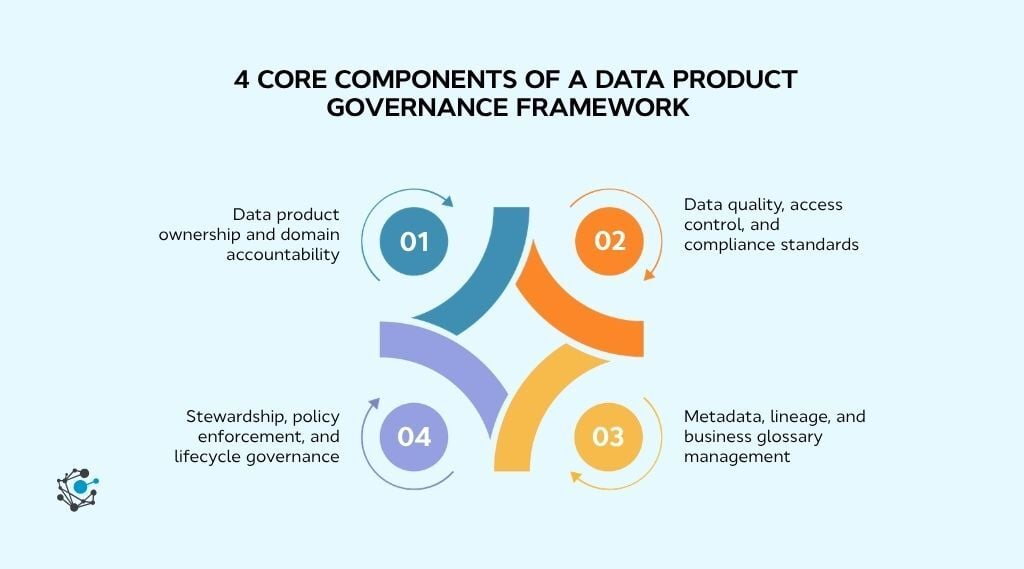
1. Data product ownership and domain accountability
Data product ownership means more than assigning a name to a RACI chart. The owner is accountable for the product's definition, its quality commitments, change approvals, and how consumers are notified when something evolves.
This sits with the domain team that creates and understands the data, not a central governance office reviewing requests from a distance. That proximity to context is what makes decisions faster and issue resolution more practical compared to traditional models, where accountability is spread thin across teams.
2. Data product quality gates and compliance standards
Quality in a data product governance model isn't a periodic audit. It's a set of gates built directly into the product lifecycle, with defined thresholds for accuracy, completeness, freshness, and consistency that are validated as data flows through pipelines.
When a freshness threshold is breached or completeness drops below an agreed level, the issue surfaces during ingestion or transformation rather than showing up as a broken report days later. For regulated industries, these same gates double as compliance controls, creating an auditable trail of what was checked, when, and what the outcome was.
3. Metadata, lineage, and business glossary management
This is where most data product governance efforts either succeed or collapse. Without shared metadata, teams can't agree on what a product contains, where it came from, or what its fields actually mean in business terms.
Metadata captures the structure and technical attributes of each product. Lineage maps how data moves from source through every transformation to its final destination, making it possible to trace any value back to its origin.
A business glossary standardizes definitions so that a term like "active customer" resolves to the same logic whether it appears in a finance dashboard or a marketing report. When these three layers are connected, every control built on top of them, from access rules to impact analysis, works as intended.
| For a deeper look at how these layers connect operationally, this guide onintegrating data lineage with business glossary covers the practical steps. |
4. Data product stewardship and lifecycle governance
Data stewards are the operational layer that keeps governance running between policy updates. In a data product model, stewardship workflows include validating new product registrations, reviewing proposed changes before they reach consumers, managing issue resolution when quality gates fail, and coordinating retirement when a product reaches the end of life.
Lifecycle governance gives each stage, from creation through updates to deprecation, a defined set of rules: who approves a new version, how consumers are migrated off retiring products, and what certification criteria must be met before a product is marked as trusted. Without this structure, even well-governed products degrade over time as modifications accumulate without oversight.
For organizations building or refining their approach,
OvalEdge's  Implementing Data Governance whitepaper provides a step-by-step model that connects these components into an operational program.
Why lifecycle governance matters for data products
Lifecycle governance matters because data products change continuously, and without controls around those changes, even small modifications can break consuming workflows, distort analytics, and erode trust across teams. It ensures that every stage from creation through updates to retirement has defined rules, accountability, and visibility.
-
Structural schema evolution: When fields are renamed, types change, or new columns are introduced, consuming systems need time to adapt. Lifecycle governance enforces compatibility rules so that upstream changes don't silently break what's running downstream. A single unmanaged schema update can cascade into failed dashboards, stale models, and hours of debugging with no warning.
-
Downstream impact visibility: Lifecycle governance maps dependencies between data products, reports, and applications so that before any change goes live, teams can see exactly what will be affected. This turns change management from a reactive scramble into a deliberate, informed decision.
-
Structured product deprecation: Retiring a data product without a defined process creates orphaned dependencies and confusion. Lifecycle governance sets clear end-of-life paths that include consumer notification timelines, migration guidance to replacement products, and a documented cutoff after which the product is no longer maintained.
-
Continuous contract governance: Transformation logic and calculation methods evolve over time. Data contracts track what changed, when, and why, maintaining a historical record that supports both operational debugging and regulatory audits where teams need to explain how a specific output was produced at a specific point in time.
Once lifecycle governance is in place, the next question becomes how to know whether it's actually working. That's where measurement comes in.
Measuring success: Key metrics for data product governance
The success of data product governance shows up in whether data products are trusted, reliable, and consistently maintained across the organization. Measuring this requires metrics that go beyond data quality alone and cover reliability, accountability, adoption, security, and change safety.
|
Dimension |
Metric |
What does it tell you |
|
Quality |
Data quality score per product |
Whether individual products meet the accuracy, completeness, and consistency standards they've committed to |
|
Reliability |
Freshness SLA compliance rate |
Whether products deliver data within agreed timelines, and how often they fall behind |
|
Accountability |
Ownership coverage across products |
What percentage of active data products have a clearly assigned and active owner |
|
Governance adoption |
Data contract coverage |
How many products operate under formal contracts with defined rules, thresholds, and responsibilities |
|
Security |
Sensitive data protection coverage |
Whether classification and access controls are applied consistently across products containing sensitive information |
|
Change safety |
Impact detection rate before deployment |
How often does dependency mapping catch potentially breaking changes before they reach consumers |
|
Product adoption |
Consumer reuse rate across teams |
Whether data products are actually being used and trusted by their intended audience, or sitting idle after creation |
These metrics work best when tracked continuously rather than reviewed quarterly. Of these, ownership coverage and data contract coverage tend to be the earliest indicators of whether a governance program is gaining real traction or just producing documentation. When either stalls, it usually signals that domain teams aren't yet bought into the operating model, which is worth addressing before scaling further.
|
Go deeper: For a structured approach to evaluating governance maturity across these dimensions, OvalEdge's Data Governance Maturity Model explains how to benchmark current capabilities and identify where to focus next. |
The future of data governance in product-driven enterprises
The way organizations govern data products is changing. Governance is moving from a separate function that reviews and approves to an operational capability that runs inside the data platform itself. Three developments are driving this shift, and each one changes how governance teams will need to operate going forward.
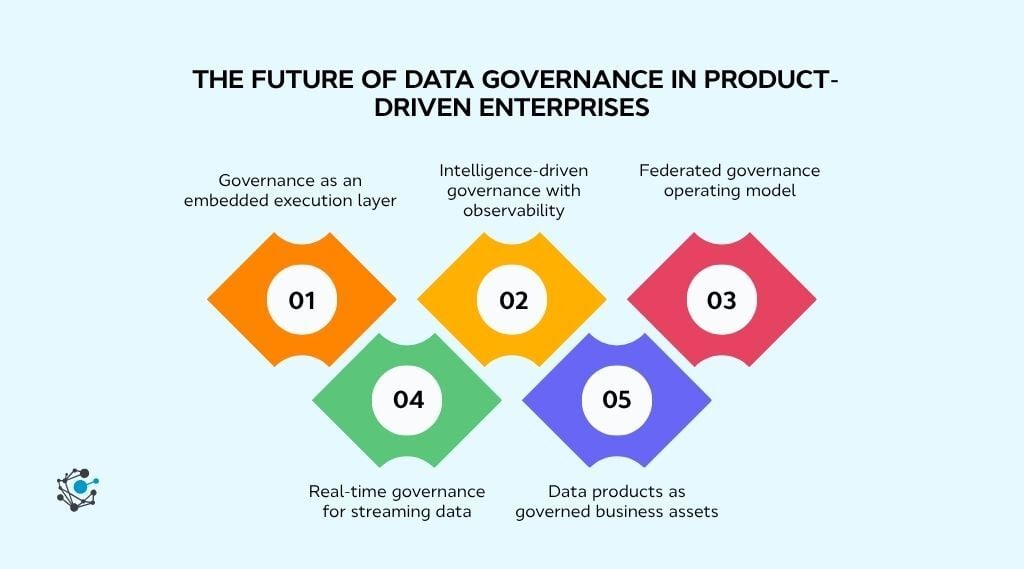
Governance as an embedded execution layer
Governance is becoming executable code rather than something written in a policy doc nobody opens. The checks live inside the pipeline and run while data moves, not as a separate review step somebody does afterward.
-
Policy gets written as code that runs inside ETL, ELT, and streaming pipelines, so a rule applies as data moves instead of sitting in a document that depends on someone remembering to enforce it
-
Access control happens at runtime through RBAC and ABAC, which means permissions are decided when a query actually runs, rather than being set broadly at the infrastructure level and left alone
-
Data contracts define the schema and structure each product commits to, so a change that would break that contract gets stopped at the product boundary rather than slipping through unnoticed
Intelligence-driven governance with observability
Governance is gaining an observability layer that connects metadata, lineage, and pipeline logs into one view rather than leaving them spread across separate tools. That single view is what makes the embedded checks above worth acting on.
-
Freshness, quality signals, and schema changes get watched as they happen, so issues show up while they're still small instead of when a consumer notices a broken report
-
Lineage shows where a problem started and which downstream products, dashboards, and models it touches, not just that something failed
-
For governance teams, this turns debugging from guesswork into following a known path, which shortens the time between a problem appearing and someone resolving it
Federated governance operating model
The split between central standards and domain execution is becoming more formalized, but organizations are still figuring out where to draw the line. According to the 2025 State of Enterprise Data Governance Report, data leaders are evenly split between centralized (36%), federated (36%), and hybrid (29%) models, which shows there's no settled consensus yet.
-
Central teams work best when they narrow their scope to security policies, classification taxonomies, and interoperability standards
-
Domain teams handle quality, access, and lifecycle decisions with explicit decision rights and clear accountability
-
Organizations that get this boundary wrong tend to either slow down domains with unnecessary approvals or lose consistency when domains operate without guardrails
Real-time governance for streaming data
More data now flows through streaming and event-driven systems, and governance has to operate at that speed. Checking data in scheduled batches falls apart when teams are making decisions off events the moment they land.
-
Rules run at the point of ingestion, so each event gets validated as it enters the pipeline instead of hours later in a batch job
-
Sensitive fields are masked or access-restricted before the data is ever written to storage, not cleaned up after the fact
-
Continuous runtime validation replaces scheduled checks, which means a bad record gets caught at entry rather than surfacing in a dashboard the next morning
Data products are governed as business assets
Not every data product needs the same level of governance attention. Organizations are starting to identify which products drive the most downstream decisions and are concentrating resources accordingly.
-
High-impact products are being treated like critical software services, with SLA commitments and consumption analytics tied to governance investment
-
Lower-impact products follow lighter governance paths, keeping the overall program sustainable without spreading effort thin
-
This prioritization makes it possible to scale governance across growing product portfolios without proportionally increasing overhead
These shifts all point in the same direction: governance that works as part of how data products are built and delivered, not as a separate layer that slows them down.
Platforms like OvalEdge are already moving toward this model by connecting catalog, lineage, quality, and access controls into a single environment where governance runs within the data workflow rather than alongside it.
Conclusion
The cost of ungoverned data products shows up everywhere: conflicting metrics in leadership meetings, pipeline changes that break things nobody expected, and AI initiatives that stall because nobody trusts the underlying data.
The organizations that avoid this aren't the ones with the most policies. They're the ones that embed governance into how data products are built, owned, and consumed, so that trust scales alongside adoption.
OvalEdge makes this operational by connecting catalog, lineage, quality monitoring, stewardship, and access controls into a single governed environment where domain teams move fast and governance leaders maintain full visibility.
If building a data product governance framework that holds up across domains and teams is a priority, schedule a demo with OvalEdge to see how it works in practice.
FAQs
1. How is data product governance different from traditional data governance?
Traditional data governance controls data at the infrastructure level through centralized policies. Data product governance operates at the product level, assigning ownership, quality standards, and lifecycle rules directly to individual data products managed by domain teams.
2. Who is responsible for data product governance in an organization?
Responsibility is shared. Domain teams own individual data products and their quality. A central governance team sets enterprise-wide standards for security, compliance, and interoperability. Data stewards coordinate between both layers to ensure policies are followed consistently.
3. How does data product governance relate to data mesh?
Data mesh treats data as a product owned by domain teams. Data product governance provides the framework that makes this work, defining ownership models, quality contracts, access rules, and lifecycle controls that keep domain-owned products trustworthy and interoperable across the organization.
4. Can data product governance work without a data catalog?
Technically, yes, but not at scale. A data catalog provides the metadata, lineage, and discoverability layer that governance depends on. Without it, teams lose visibility into what data products exist, who owns them, and how they connect to downstream systems.
5. How long does it take to implement a data product governance framework?
Most organizations see initial structure within 8 to 12 weeks, starting with ownership assignments and quality standards for high-impact products. Full maturity across domains, lifecycle controls, and automated enforcement typically takes 6 to 12 months.
6. Does data product governance replace existing data governance programs?
No. It extends them. Existing policies for security, compliance, and access control remain in place. Data product governance adds product-level ownership, quality gates, lifecycle management, and domain accountability that traditional programs typically don't address.
.png?width=1081&height=173&name=Forrester%201%20(1).png)
.png?width=1081&height=241&name=KC%20-%20Logo%201%20(1).png)