.jpg)
Enterprises today manage sensitive data across cloud platforms, SaaS applications, analytics environments, AI systems, and third-party ecosystems where governance gaps create growing compliance and operational risks.
Many organizations already have privacy policies and security controls in place, yet they still struggle to maintain visibility into how personal data is collected, shared, retained, and monitored across distributed environments.
A 2024 Express Computer article, citing the “CII Digital & Protiviti State of Data Privacy Survey in India,” found that 82% of organizations face challenges in maintaining transparency around privacy practices.
As digital ecosystems expand, data privacy governance has evolved beyond compliance documentation and periodic audits.
This guide explores governance frameworks, regulatory requirements, operational challenges, and how metadata, lineage, and automation help enterprises operationalize privacy governance at scale.
What is data privacy governance?
Data privacy governance establishes the policies, operational controls, accountability structures, and monitoring processes organizations use to manage personal and regulated data responsibly across the enterprise.
What does data privacy governance mean for modern enterprises?
Modern enterprises process enormous amounts of personal and regulated information across cloud warehouses, SaaS platforms, customer analytics systems, AI tools, and third-party applications. Privacy governance helps organizations maintain consistent oversight over how data is collected, classified, accessed, shared, retained, and deleted across distributed environments.
Unlike traditional compliance programs that rely heavily on documentation and periodic reviews, modern privacy governance requires continuous oversight across enterprise data operations.
Organizations must understand where personally identifiable information (PII) resides, how it flows across applications, who can access it, and whether governance policies align with regulatory obligations. This is why PII data discovery has become a foundational governance capability rather than a one-time audit exercise.
Effective data privacy governance frameworks typically focus on:
-
Protecting PII and regulated information
-
Enforcing lawful processing requirements
-
Managing retention and deletion obligations
-
Supporting consent governance
-
Maintaining audit readiness
-
Monitoring third-party data usage
-
Governing AI-training datasets
Enterprises increasingly view privacy governance as a continuous operational discipline that supports compliance, trust, and risk reduction across evolving digital ecosystems.
How data privacy governance differs from data security and data governance
Many organizations use the terms data governance, data security, and data privacy governance interchangeably, but each serves a different operational purpose.
|
Area |
Primary Focus |
Core Objective |
|
Data governance |
Data quality, ownership, usability |
Improve trust and consistency |
|
Data security |
Access protection and threat prevention |
Prevent unauthorized access |
|
Data privacy governance |
Lawful and ethical data usage |
Ensure compliant processing |
Data governance defines how organizations manage data ownership, quality, consistency, and usability across the enterprise. Data security focuses on protecting systems and information through access controls, encryption, monitoring, and threat prevention.
Privacy governance focuses specifically on how organizations collect, process, retain, share, and monitor regulated and personal data. It governs consent management, lawful processing, retention policies, data subject rights, and regulatory accountability.
Although these disciplines have distinct responsibilities, they work closely together operationally. Strong privacy governance depends on centralized governance visibility, reliable metadata, and effective security controls across enterprise systems.
Why enterprises need a formal privacy governance program
Ad hoc privacy management fails quickly at enterprise scale. Distributed cloud environments, self-service analytics adoption, unmanaged SaaS applications, and growing AI experimentation create governance fragmentation that spreadsheets and manual audits cannot manage effectively.
A 2025 Economic Times report on Cisco’s Data Privacy Benchmark Study found that 86% of organizations support privacy legislation, while 96% reported that privacy investments deliver returns exceeding costs.
The findings reflect how enterprises increasingly view privacy governance as both a compliance necessity and a business resilience initiative.
Modern regulatory requirements continue expanding. GDPR, CPRA, CCPA, and the EU AI Act introduce operational obligations that require continuous monitoring rather than periodic compliance exercises.
Organizations without formal privacy governance programs often struggle with:
-
Inconsistent policy enforcement
-
Limited visibility into PII movement
-
Weak audit preparedness
-
Poor retention management
-
Incomplete consent tracking
-
Cross-border governance gaps
Centralized privacy governance programs improve accountability, traceability, compliance reporting, and enterprise-wide policy consistency.
Building a data privacy governance framework
Building a scalable data privacy governance framework requires enterprises to establish ownership structures, identify regulated data, operationalize privacy controls, and continuously monitor compliance across evolving data ecosystems.
Step 1: Define governance roles and accountability models
Governance ownership is the foundation of effective privacy governance. Many organizations struggle because responsibilities are spread across legal, security, analytics, governance, and business teams without clear accountability.
A strong governance framework typically defines responsibilities for:
-
Data owners
-
Data stewards
-
Privacy officers
-
Compliance teams
-
Security teams
-
Analytics leaders
-
AI governance stakeholders
Governance councils often help coordinate policy decisions, escalation workflows, and cross-functional accountability. Many enterprises also use RACI frameworks to clarify who is responsible for approving, reviewing, monitoring, and enforcing governance decisions.
|
For example, when a customer requests data deletion under GDPR or CPRA, clearly defined ownership helps legal, governance, and technical teams coordinate retention validation, deletion workflows, and audit documentation efficiently. |
Step 2: Identify and classify sensitive and regulated data
Organizations cannot govern data they cannot locate. Sensitive data visibility remains one of the biggest operational challenges in enterprise privacy governance.
Modern privacy governance frameworks rely on automated data discovery, metadata scanning, centralized data inventories, business glossary mapping, and dedicatedsensitive data discovery tools that can scan across cloud warehouses, SaaS apps, and analytics environments.
Enterprises typically classify:
-
Personally identifiable information (PII)
-
Financial data
-
Healthcare information
-
Employee records
-
AI-training datasets
-
Customer behavioral data
Governance blind spots often emerge from unmanaged SaaS applications, spreadsheets, and AI experimentation environments where regulated data exists outside formal governance processes.
|
For example, a marketing team may export customer records into a third-party analytics platform without governance approval, creating compliance risks around consent tracking and retention enforcement. |
Step 3: Establish consent, retention, and lawful-processing controls
Privacy governance must operationalize how organizations collect, process, retain, share, and delete regulated information.
Core governance controls typically include:
-
Consent management
-
Purpose limitation enforcement
-
Retention-policy governance
-
Deletion workflows
-
Lawful-processing documentation
-
Third-party data-sharing controls
Operational complexity increases when customer data moves across disconnected systems and vendors. Many organizations struggle to synchronize consent preferences consistently across marketing tools, customer platforms, analytics systems, and AI applications.
Retention governance creates additional operational challenges. Enterprises must ensure regulated data is deleted according to legal requirements while maintaining traceability and auditability.
|
For example, if a customer withdraws consent for marketing communications, governance teams must ensure that preference updates propagate consistently across CRM systems, campaign platforms, analytics environments, and third-party vendors. |
Step 4: Implement lineage tracking and privacy risk assessments
Data lineage has become essential for modern privacy governance. Organizations need visibility into how sensitive data moves across systems, pipelines, transformations, and downstream analytics environments.
Lineage improves:
-
Audit readiness
-
Breach investigations
-
Regulatory reporting
-
Data subject request handling
-
Impact analysis
-
AI governance traceability
Privacy impact assessments and DPIAs help organizations evaluate governance risks before launching initiatives involving regulated information.
AI-driven environments introduce additional governance complexity because organizations must track how regulated data is used within models, analytics workflows, and automated decision-making systems.
Governance teams increasingly require stronger controls around data origins, model dependencies, retention policies, and downstream AI usage.
For example, if an AI recommendation engine uses customer behavioral data, governance teams must understand where training data originated, how it was transformed, and whether usage aligns with consent and retention policies.
|
Operational insight: OvalEdge Data Lineage helps enterprises improve traceability and analyze downstream privacy impacts across complex data ecosystems. |
Step 5: Operationalize continuous privacy governance monitoring
Privacy governance is not a one-time initiative. Enterprises require ongoing oversight across access management, retention enforcement, consent governance, third-party sharing, and regulatory compliance.
Continuous governance monitoring typically includes:
-
Access reviews
-
Compliance monitoring
-
Policy enforcement validation
-
Breach-response readiness
-
Exception monitoring
-
Stewardship workflows
Manual governance approaches struggle to keep pace with rapidly evolving enterprise ecosystems. New cloud platforms, SaaS applications, AI tools, and integrations continuously introduce privacy and compliance risks.
|
For example, a newly deployed AI assistant connected to internal knowledge repositories may unintentionally expose sensitive employee or customer information if access permissions and governance controls are not regularly monitored. |
To improve operational scalability, many enterprises adopt governance platforms that automate workflows, centralize governance visibility, and strengthen continuous policy monitoring across distributed data environments.
Book a demo with OvalEdge to explore how centralized metadata visibility, lineage tracking, and governance automation can help operationalize enterprise privacy governance at scale.
Regulatory requirements shaping data privacy governance
Modern privacy governance frameworks must operationalize evolving regulatory requirements across global jurisdictions while maintaining consistent governance controls across distributed enterprise environments.
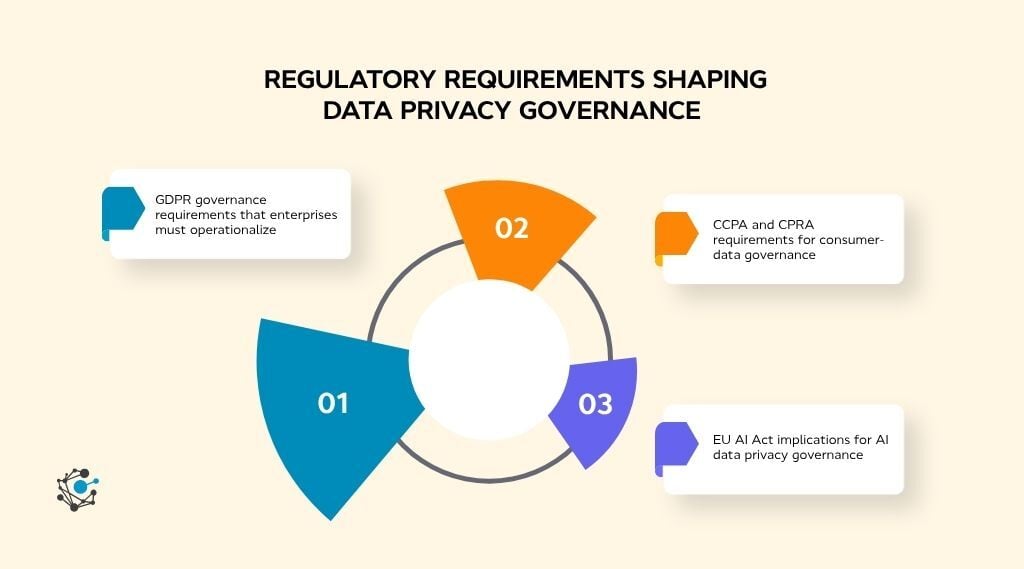
GDPR governance requirements that enterprises must operationalize
GDPR established one of the most influential modern privacy governance frameworks because it requires organizations to demonstrate continuous accountability across data-processing activities, not just implement security controls.
|
GDPR governance area |
Operational requirement |
|
Lawful processing |
Ensure data is collected and used for approved purposes |
|
Data minimization |
Limit unnecessary collection and storage of personal data |
|
Purpose limitation |
Prevent data usage beyond approved business purposes |
|
Data subject rights |
Support access, correction, portability, and deletion requests |
|
Breach notification |
Maintain incident response and reporting workflows |
|
Accountability |
Document governance policies, controls, and audit evidence |
Operationalizing GDPR requires enterprises to coordinate consent governance, retention enforcement, DPIAs, audit documentation, and cross-border transfer oversight across multiple systems.
For example, when a customer submits a deletion request, organizations must identify where personal data exists across CRM systems, cloud warehouses, analytics platforms, and third-party applications while maintaining evidence of regulatory compliance throughout the process.
This is where GDPR data discovery becomes the operational bottleneck. Most teams can write the policy, but few can locate every instance of personal data fast enough to meet GDPR's 30-day response window.
CCPA and CPRA requirements for consumer-data governance
CCPA and CPRA expanded privacy governance obligations for organizations handling consumer data in the United States. These regulations introduced operational requirements around consumer transparency, opt-out management, deletion rights, and restrictions on sensitive-data usage.
Governance implications are especially significant for customer-data platforms, marketing ecosystems, advertising technologies, and third-party data-sharing arrangements where consumer information moves across multiple environments.
Organizations operating across different states often struggle to maintain consistent governance controls while adapting to evolving regional privacy requirements. For example, a retailer sharing customer behavioral data with advertising partners must ensure opt-out preferences are enforced consistently across downstream platforms and analytics systems.
These regulations are increasing pressure on enterprises to centralize governance visibility, strengthen consent governance, and improve traceability into downstream data usage.
EU AI Act implications for AI data privacy governance
The EU AI Act is accelerating convergence between AI governance and privacy governance by introducing stronger oversight requirements for AI systems that process regulated or sensitive information.
|
AI governance requirement |
Governance implication |
|
AI-training data transparency |
Track the origin and usage of training datasets |
|
Risk categorization |
Identify high-risk AI systems and governance controls |
|
Human oversight |
Ensure human review for automated decision-making |
|
Data quality obligations |
Validate the accuracy and reliability of training data |
|
Explainability |
Improve transparency into AI outputs and logic |
These requirements affect generative AI systems, recommendation engines, AI-powered analytics platforms, and automated customer decisioning workflows.
Most teams will need dedicated AI governance tools to track training-data origins, monitor model dependencies, and document oversight decisions in a way that holds up to regulator scrutiny.
For example, if an AI-driven hiring platform uses historical employee data for model training, organizations must ensure the data is governed properly, retention policies are enforced, and biased or unauthorized data usage can be identified through lineage and metadata visibility.
Common challenges in data privacy governance
Many privacy governance initiatives struggle because enterprises cannot maintain consistent visibility, policy enforcement, and accountability across increasingly distributed and AI-driven data ecosystems.
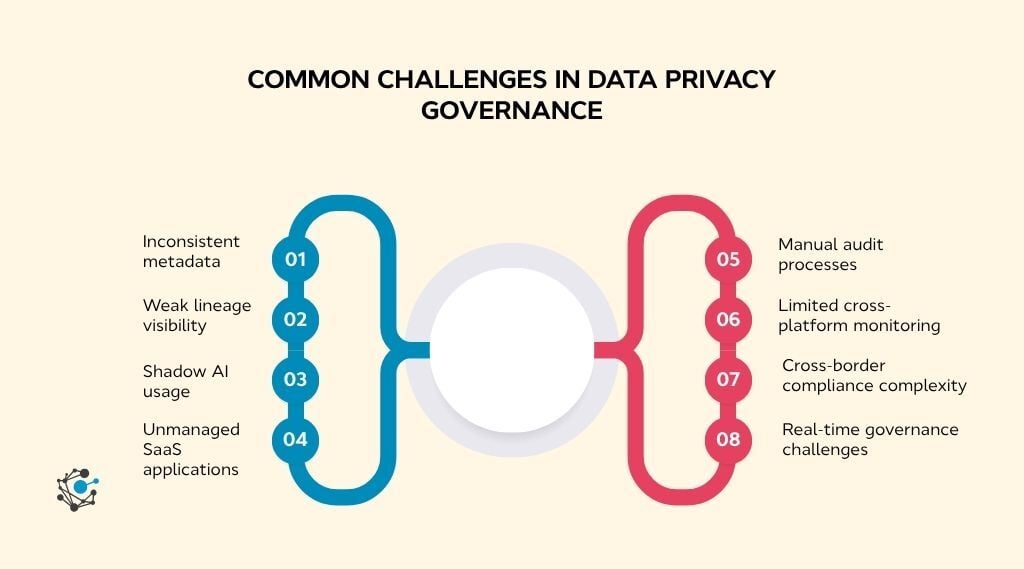
-
Inconsistent metadata: Organizations often lack standardized metadata across cloud platforms, analytics tools, and SaaS applications, making it difficult to identify sensitive data, track ownership, and enforce governance policies consistently.
-
Weak lineage visibility: Many enterprises cannot trace how regulated data moves across pipelines, reports, AI systems, and downstream applications, creating operational gaps during audits, investigations, and compliance reporting.
-
Shadow AI usage: Business teams increasingly adopt unmanaged AI tools and external generative AI platforms without governance oversight, increasing the risk of unauthorized data exposure and uncontrolled data usage.
-
Unmanaged SaaS applications: Sensitive information frequently spreads across disconnected SaaS environments outside centralized governance processes, limiting visibility into access controls, retention enforcement, and third-party data sharing.
-
Manual audit processes: Enterprises still relying on spreadsheets, emails, and manual documentation often struggle to maintain accurate compliance records across rapidly growing data ecosystems.
-
Limited cross-platform monitoring: Multi-cloud environments, AI systems, analytics platforms, and external vendors create governance silos that make continuous monitoring and policy enforcement difficult at scale.
-
Cross-border compliance complexity: Global organizations must manage varying retention requirements, transfer restrictions, and regional privacy obligations while maintaining consistent governance controls across jurisdictions.
-
Real-time governance challenges: Enterprise ecosystems evolve continuously as new applications, integrations, and AI services are introduced, making periodic audits insufficient for modern privacy governance needs.
As enterprise ecosystems continue expanding across cloud, SaaS, analytics, and AI platforms, organizations increasingly require governance models that can adapt quickly to evolving compliance obligations, operational risks, and cross-platform data dependencies.
How governance tools operationalize data privacy at scale
Governance tools help enterprises scale privacy operations by improving data traceability, automating governance workflows, supporting policy enforcement, and strengthening oversight across modern enterprise environments.
1. Using metadata and data catalogs for sensitive-data visibility
Metadata helps organizations understand where sensitive data exists, who owns it, and how it is used across business systems. As enterprises expand across cloud platforms, analytics environments, SaaS applications, and AI systems, centralized metadata becomes essential for maintaining consistent governance controls.
Modern data catalogs support automated discovery, sensitive-data classification, business glossary mapping, and stewardship management. This helps governance teams identify regulated information faster and reduce governance blind spots across distributed environments.
|
For example, a financial-services organization managing customer data across multiple reporting systems can use centralized metadata to identify datasets containing regulated information and assign accountability more efficiently. |
2. Using data lineage for compliance audits and regulatory investigations
Data lineage helps organizations trace how sensitive information moves across pipelines, reports, dashboards, and downstream applications. This visibility becomes critical during audits, breach investigations, regulatory reporting, and data subject request handling.
Lineage also helps governance teams understand downstream dependencies, identify affected systems faster, and improve accountability across complex enterprise environments.
|
How OvalEdge supported Bedrock’s governance transformation Bedrock’s governance transformation with OvalEdge highlights how centralized metadata management and governance traceability improved operations across distributed data environments. As Bedrock expanded its digital initiatives, the organization faced challenges with fragmented reporting workflows, inconsistent business definitions, and limited visibility into data movement across systems. OvalEdge helped support governance improvements through:
These capabilities helped Bedrock improve traceability, strengthen governance accountability, and support more efficient reporting and compliance operations across the enterprise. |
3. Automating policy enforcement and privacy compliance workflows
Manual governance workflows become difficult to manage as enterprise ecosystems grow. Governance automation helps organizations enforce policies more consistently while reducing operational overhead.
Automation commonly supports access approvals, stewardship assignments, retention enforcement, compliance validations, and sensitive-data alerts. This improves governance responsiveness while reducing dependency on spreadsheets and disconnected approval processes.
|
For example, when regulated customer data enters a cloud warehouse, automated workflows can classify the dataset, assign ownership, and trigger governance reviews automatically. |
Automation also improves scalability because governance teams can manage larger environments without relying heavily on manual coordination.
4. Monitoring access, retention, and consent governance continuously
Modern privacy governance requires ongoing oversight across access permissions, retention enforcement, consent management, and third-party data sharing. Enterprises must identify governance gaps early before they create compliance exposure or operational risk.
Monitoring capabilities typically include:
-
Access-certification workflows
-
Consent tracking
-
Retention-policy monitoring
-
Exception reporting
-
Governance observability
Observability improves proactive compliance management by helping organizations identify unusual access patterns, retention violations, or governance gaps early.
Organizations evaluating governance platforms increasingly prioritize integrated monitoring, lineage visibility, metadata intelligence, and workflow automation capabilities.
Conclusion
Data privacy governance has become a core operational requirement for enterprises managing sensitive information across cloud platforms, analytics systems, AI environments, and third-party ecosystems. As regulatory expectations continue expanding, organizations can no longer rely on reactive audits and disconnected governance processes.
Enterprises that establish scalable governance frameworks improve accountability, strengthen compliance readiness, and reduce operational risk through better metadata management, policy enforcement, and governance coordination.
Solutions such as OvalEdge help organizations operationalize privacy governance across complex enterprise environments while improving governance efficiency and regulatory preparedness.

Book a demo with OvalEdge to explore how modern governance capabilities can support enterprise-scale privacy and compliance initiatives.
FAQs
1. What are the biggest risks of poor data privacy governance?
Weak privacy governance increases the risk of regulatory penalties, unauthorized data exposure, inaccurate consent handling, and poor audit readiness. It also creates operational inefficiencies when enterprises cannot trace sensitive data usage across cloud, SaaS, analytics, and AI environments.
2. Which teams should participate in a privacy governance program?
Privacy governance requires collaboration across legal, compliance, security, data governance, analytics, and business teams. Shared accountability helps organizations enforce policies consistently, manage regulated data responsibly, and reduce operational gaps between governance strategy and day-to-day data usage.
3. What is the role of metadata in privacy governance?
Metadata helps organizations identify sensitive data, understand data relationships, track ownership, and improve governance visibility across distributed systems. It also supports policy enforcement, audit preparation, and regulatory reporting by creating a centralized view of enterprise data assets and governance context.
4. Why do enterprises struggle with privacy governance in multi-cloud environments?
Multi-cloud environments create governance challenges because sensitive data moves across disconnected systems, platforms, and vendors. Inconsistent metadata standards, fragmented access controls, and limited lineage visibility make it difficult to maintain unified privacy policies and demonstrate compliance consistently.
5. How does privacy governance support AI governance initiatives?
Privacy governance helps organizations control how AI systems access, process, retain, and use personal data. Governance controls improve transparency around AI training datasets, support regulatory compliance, and reduce risks associated with biased models, excessive retention, and unauthorized data usage.
6. What should enterprises evaluate when selecting a privacy governance tool?
Organizations should evaluate metadata management, lineage visibility, automation capabilities, policy enforcement workflows, regulatory reporting support, and integration coverage. Scalable governance platforms should also support cloud environments, AI governance requirements, sensitive-data discovery, and cross-functional collaboration across enterprise teams.
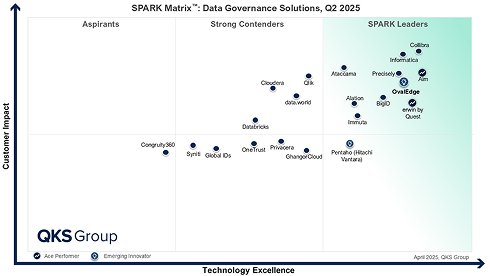
.png?width=1081&height=173&name=Forrester%201%20(1).png)
.png?width=1081&height=241&name=KC%20-%20Logo%201%20(1).png)